Multicomponent Lifestyle Interventions During Colorectal Cancer Surveillance: A Systematic Review

 , , , , and
Simple Summary
Abstract
1. Introduction
2. Methods
2.1. Eligibility Criteria
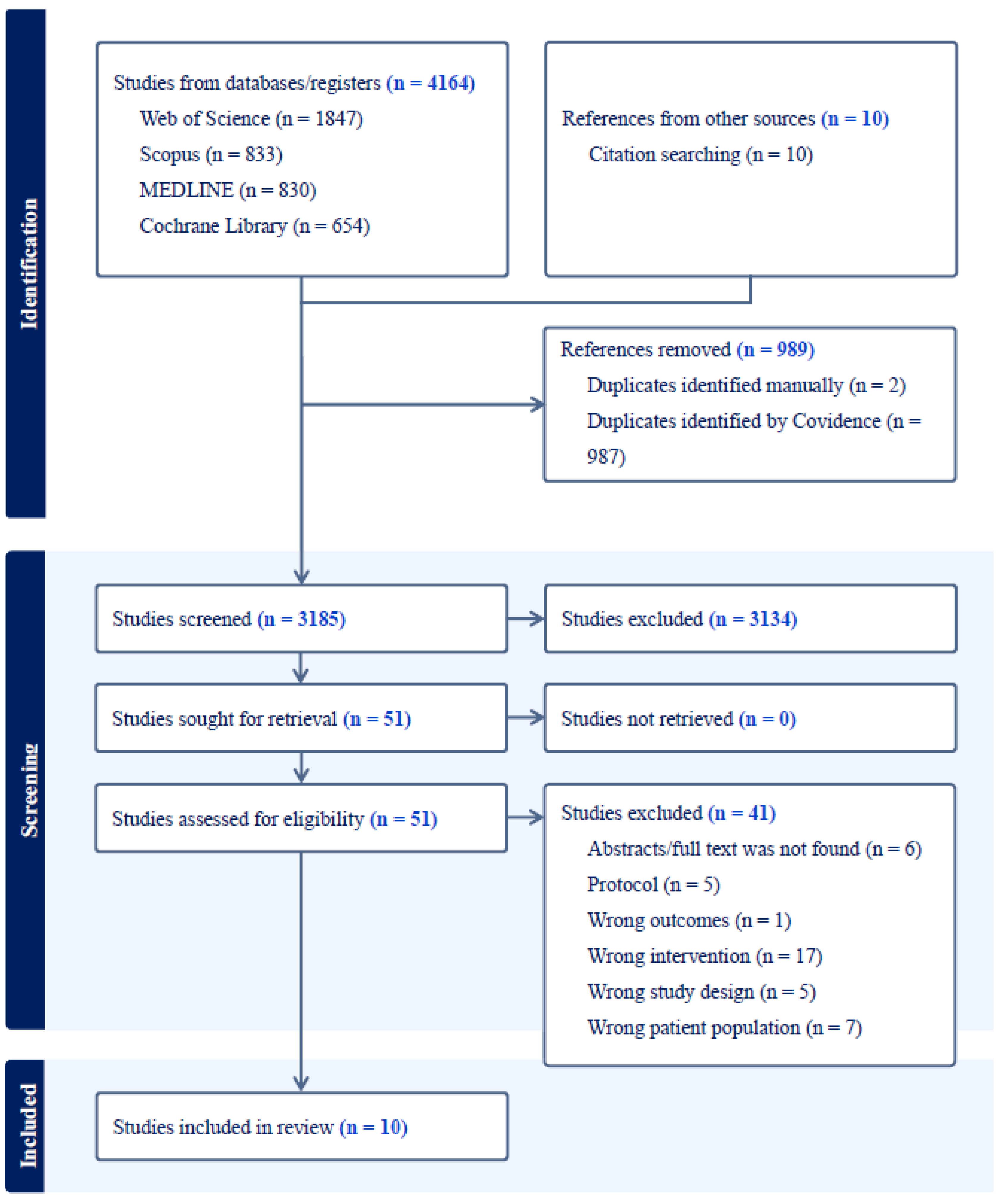
2.2. Search Strategy and Selection
2.3. Data Extraction
2.4. Risk of Bias
2.5. Data Synthesis
2.6. Amendment from the Published Protocol
2.7. Patient and Public Involvement
2.8. Ethics Approval
3. Results
3.1. Descriptive Characteristics of the Study
3.2. Types of Multicomponent Interventions and Study Outcomes
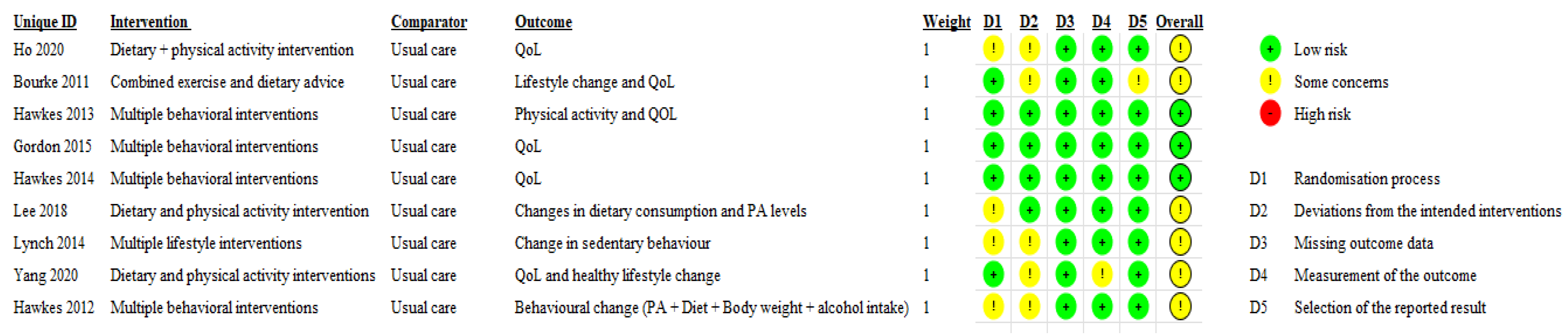
3.3. Risk of Bias Assessment of the Studies
3.4. Effect of Multicomponent Lifestyle Interventions on Incidence, Recurrence, or Mortality of Colorectal Neoplasia
3.5. Effect of Multicomponent Lifestyle Interventions on Behavioural Change
3.5.1. Change in Body Weight
3.5.2. Change in Dietary Intake
3.5.3. Change in Physical Activity and Sedentary Behaviours
3.5.4. Effect of Multicomponent Lifestyle Intervention on the Quality of Life
Physical Domain
Psychological/Emotional Well-Being Domain
Social Domain
4. Discussion
5. Conclusions
5.1. Clinical Practice Implications
5.2. Public Health Recommendations
5.3. Future Research Directions
Supplementary Materials
Author Contributions
Funding
Institutional Review Board Statement
Informed Consent Statement
Data Availability Statement
Conflicts of Interest
References
- Sung, H.; Ferlay, J.; Siegel, R.L.; Laversanne, M.; Soerjomataram, I.; Jemal, A.; Bray, F. Global cancer statistics 2020: GLOBOCAN estimates of incidence and mortality worldwide for 36 cancers in 185 countries. CA Cancer J. Clin. 2021, 71, 209–249. [Google Scholar] [CrossRef]
- Morgan, E.; Arnold, M.; Gini, A.; Lorenzoni, V.; Cabasag, C.; Laversanne, M.; Vignat, J.; Ferlay, J.; Murphy, N.; Bray, F. Global burden of colorectal cancer in 2020 and 2040: Incidence and mortality estimates from GLOBOCAN. Gut 2023, 72, 338–344. [Google Scholar] [CrossRef] [PubMed]
- Levine, J.S.; Ahnen, D.J. Adenomatous polyps of the colon. N. Engl. J. Med. 2006, 355, 2551–2557. [Google Scholar] [CrossRef]
- Sweetser, S.; Smyrk, T.C.; Sinicrope, F.A. Serrated colon polyps as precursors to colorectal cancer. Clin. Gastroenterol. Hepatol. 2013, 11, 760–767. [Google Scholar] [CrossRef] [PubMed]
- Larsen, P.T.; Jørgensen, S.F.; Rasmussen, M.; Andersen, B.; Njor, S.H. Screening outcomes at second FIT screening in individuals with a first time negative FIT-result or low-risk adenomas: Results from a nationwide FIT screening program. Int. J. Cancer 2025, 157, 698–708. [Google Scholar] [CrossRef]
- Cancer Council Australia. Surveillance Colonoscopy Guidelines Working Party. Clinical Practice Guidelines for Surveillance Colonoscopy; Cancer Council Australia: Sydney, Australia, 2018. [Google Scholar]
- Zheng, S.; Schrijvers, J.J.; Greuter, M.J.; Kats-Ugurlu, G.; Lu, W.; de Bock, G.H. Effectiveness of colorectal cancer (CRC) screening on all-cause and CRC-specific mortality reduction: A systematic review and meta-analysis. Cancers 2023, 15, 1948. [Google Scholar] [CrossRef]
- Shaukat, A.; Levin, T.R. Current and future colorectal cancer screening strategies. Nat. Rev. Gastroenterol. Hepatol. 2022, 19, 521–531. [Google Scholar] [CrossRef]
- Model, S.E. Colorectal Cancer Control Program (CRCCP); Centers for Disease Control and Prevention: Atlanta, GA, USA, 2012.
- Sharma, K.P.; DeGroff, A.; Maxwell, A.E.; Cole, A.M.; Escoffery, N.C.; Hannon, P.A. Evidence-based interventions and colorectal cancer screening rates: The colorectal cancer screening program, 2015–2017. Am. J. Prev. Med. 2021, 61, 402–409. [Google Scholar] [CrossRef]
- Fearon, E.R.; Vogelstein, B. A genetic model for colorectal tumorigenesis. Cell 1990, 61, 759–767. [Google Scholar] [CrossRef] [PubMed]
- Carr, P.R.; Weigl, K.; Jansen, L.; Walter, V.; Erben, V.; Chang-Claude, J.; Brenner, H.; Hoffmeister, M. Healthy lifestyle factors associated with lower risk of colorectal cancer irrespective of genetic risk. Gastroenterology 2018, 155, 1805–1815. [Google Scholar] [CrossRef]
- Soriano, L.C.; Soriano-Gabarró, M.; García Rodríguez, L.A. Trends in the contemporary incidence of colorectal cancer and patient characteristics in the United Kingdom: A population-based cohort study using The Health Improvement Network. BMC Cancer 2018, 18, 402. [Google Scholar] [CrossRef]
- Force, L.M.; Kocarnik, J.M.; May, M.L.; Bhangdia, K.; Crist, A.; Penberthy, L.; Pritchett, N.; Acheson, A.; Deitesfeld, L.; Aalruz, H. The global, regional, and national burden of cancer, 1990–2023, with forecasts to 2050: A systematic analysis for the Global Burden of Disease Study 2023. Lancet 2025, 406, 1565–1586. [Google Scholar] [CrossRef]
- Lee, D.J.; Parikh, A.; Sirohi, B.; Cao, Y.; Chan, A.T. Emerging trends in the global burden of colorectal cancer. Nat. Rev. Clin. Oncol. 2026. ahead of print. [Google Scholar] [CrossRef] [PubMed]
- Wang, X.; O’Connell, K.; Jeon, J.; Song, M.; Hunter, D.; Hoffmeister, M.; Lin, Y.; Berndt, S.; Brenner, H.; Chan, A.T. Combined effect of modifiable and non-modifiable risk factors for colorectal cancer risk in a pooled analysis of 11 population-based studies. BMJ Open Gastroenterol. 2019, 6, e000339. [Google Scholar] [CrossRef]
- Eyl-Armbruster, R.E.; Thong, M.S.; Carr, P.R.; Jansen, L.; Chang-Claude, J.; Hoffmeister, M.; Brenner, H.; Arndt, V. Change toward healthier lifestyles is associated with better health-related quality of life in long-term colorectal cancer survivors. J. Natl. Compr. Cancer Netw. 2022, 20, 1233–1243. [Google Scholar] [CrossRef]
- Yu, J.; Feng, Q.; Kim, J.H.; Zhu, Y. Combined effect of healthy lifestyle factors and risks of colorectal adenoma, colorectal cancer, and colorectal cancer mortality: Systematic review and meta-analysis. Front. Oncol. 2022, 12, 827019. [Google Scholar] [CrossRef]
- Zhu, Y.; Wu, H.; Wang, P.P.; Savas, S.; Woodrow, J.; Wish, T.; Jin, R.; Green, R.; Woods, M.; Roebothan, B. Dietary patterns and colorectal cancer recurrence and survival: A cohort study. BMJ Open 2013, 3, e002270. [Google Scholar] [CrossRef] [PubMed]
- Alwers, E.; Carr, P.R.; Banbury, B.; Walter, V.; Chang-Claude, J.; Jansen, L.; Drew, D.A.; Giovannucci, E.; Nan, H.; Berndt, S.I. Smoking behavior and prognosis after colorectal cancer diagnosis: A pooled analysis of 11 studies. JNCI Cancer Spectr. 2021, 5, pkab077. [Google Scholar] [CrossRef] [PubMed]
- Schmid, D.; Leitzmann, M. Association between physical activity and mortality among breast cancer and colorectal cancer survivors: A systematic review and meta-analysis. Ann. Oncol. 2014, 25, 1293–1311. [Google Scholar] [CrossRef]
- Jaspan, V.; Lin, K.; Popov, V. The impact of anthropometric parameters on colorectal cancer prognosis: A systematic review and meta-analysis. Crit. Rev. Oncol. Hematol. 2021, 159, 103232. [Google Scholar] [CrossRef]
- Richardson, L.C.; Wingo, P.A.; Zack, M.M.; Zahran, H.S.; King, J.B. Health-related quality of life in cancer survivors between ages 20 and 64 years: Population-based estimates from the Behavioral Risk Factor Surveillance System. Cancer Interdiscip. Int. J. Am. Cancer Soc. 2008, 112, 1380–1389. [Google Scholar] [CrossRef]
- Sánchez-Jiménez, A.; Cantarero-Villanueva, I.; Delgado-García, G.; Molina-Barea, R.; Fernández-Lao, C.; Galiano-Castillo, N.; Arroyo-Morales, M. Physical impairments and quality of life of colorectal cancer survivors: A case–control study. Eur. J. Cancer Care 2015, 24, 642–649. [Google Scholar] [CrossRef]
- Aune, D.; Lau, R.; Chan, D.S.; Vieira, R.; Greenwood, D.C.; Kampman, E.; Norat, T. Nonlinear reduction in risk for colorectal cancer by fruit and vegetable intake based on meta-analysis of prospective studies. Gastroenterology 2011, 141, 106–118. [Google Scholar] [CrossRef]
- Boyle, T.; Keegel, T.; Bull, F.; Heyworth, J.; Fritschi, L. Physical activity and risks of proximal and distal colon cancers: A systematic review and meta-analysis. J. Natl. Cancer Inst. 2012, 104, 1548–1561. [Google Scholar] [CrossRef] [PubMed]
- Ma, Y.; Yang, Y.; Wang, F.; Zhang, P.; Shi, C.; Zou, Y.; Qin, H. Obesity and risk of colorectal cancer: A systematic review of prospective studies. PLoS ONE 2013, 8, e53916. [Google Scholar] [CrossRef] [PubMed]
- Zhang, Y.-B.; Pan, X.-F.; Chen, J.; Cao, A.; Zhang, Y.-G.; Xia, L.; Wang, J.; Li, H.; Liu, G.; Pan, A. Combined lifestyle factors, incident cancer, and cancer mortality: A systematic review and meta-analysis of prospective cohort studies. Br. J. Cancer 2020, 122, 1085–1093. [Google Scholar] [CrossRef]
- Gielen, A.H.; Thomassen, B.J.; Bult, T.J.; Melenhorst, J.; Kimman, M.L.; Breukink, S.O. The Effect of Post-Treatment Combined Lifestyle Interventions on Quality of Life in Colorectal Cancer Patients–A Systematic Review. Lifestyle Med. 2024, 5, e109. [Google Scholar] [CrossRef]
- Wang, X.; Sun, J.; Yin, X.; Zou, C.; Li, H. Effects of behavioral change techniques on diet and physical activity in colorectal cancer patients: A systematic review and meta-analysis. Support. Care Cancer 2023, 31, 29. [Google Scholar] [CrossRef]
- Moug, S.J.; Bryce, A.; Mutrie, N.; Anderson, A.S. Lifestyle interventions are feasible in patients with colorectal cancer with potential short-term health benefits: A systematic review. Int. J. Color. Dis. 2017, 32, 765–775. [Google Scholar] [CrossRef]
- Molla, M.D.; Symonds, E.L.; Winter, J.M.; Bulamu, N.B.; Azanaw, M.M.; Wassie, M.M. Effect of a combined lifestyle intervention on behavioural and clinical outcomes in people at above-average risk of colorectal cancer: A systematic review and meta-analysis protocol. Consid. Med. 2026, 4, e000033. [Google Scholar] [CrossRef]
- Chandler, J.; Cumpston, M.; Li, T.; Page, M.J.; Welch, V. Cochrane Handbook for Systematic Reviews of Interventions; Wiley: Hoboken, NJ, USA, 2019; p. 4. [Google Scholar]
- Moher, D.; Shamseer, L.; Clarke, M.; Ghersi, D.; Liberati, A.; Petticrew, M.; Shekelle, P.; Stewart, L.A. Preferred reporting items for systematic review and meta-analysis protocols (PRISMA-P) 2015 statement. Syst. Rev. 2015, 4, 1. [Google Scholar] [CrossRef]
- Sterne, J.A.; Savović, J.; Page, M.J.; Elbers, R.G.; Blencowe, N.S.; Boutron, I.; Cates, C.J.; Cheng, H.-Y.; Corbett, M.S.; Eldridge, S.M. RoB 2: A revised tool for assessing risk of bias in randomised trials. BMJ 2019, 366, 4898. [Google Scholar] [CrossRef] [PubMed]
- Sterne, J.A.; Hernán, M.A.; Reeves, B.C.; Savović, J.; Berkman, N.D.; Viswanathan, M.; Henry, D.; Altman, D.G.; Ansari, M.T.; Boutron, I. ROBINS-I: A tool for assessing risk of bias in non-randomised studies of interventions. BMJ 2016, 355, 4919. [Google Scholar] [CrossRef] [PubMed]
- Gordon, L.; Patrao, T.; Kularatna, S.; Hawkes, A. A telephone-delivered multiple health behaviour change intervention for colorectal cancer survivors: Making the case for cost-effective healthcare. Eur. J. Cancer Care 2015, 24, 854–861. [Google Scholar] [CrossRef] [PubMed]
- Hawkes, A.L.; Chambers, S.K.; Pakenham, K.I.; Patrao, T.A.; Baade, P.D.; Lynch, B.M.; Aitken, J.F.; Meng, X.; Courneya, K.S. Effects of a telephone-delivered multiple health behavior change intervention (CanChange) on health and behavioral outcomes in survivors of colorectal cancer: A randomized controlled trial. J. Clin. Oncol. 2013, 31, 2313–2321. [Google Scholar] [CrossRef]
- Hawkes, A.L.; Pakenham, K.I.; Chambers, S.K.; Patrao, T.A.; Courneya, K.S. Effects of a multiple health behavior change intervention for colorectal cancer survivors on psychosocial outcomes and quality of life: A randomized controlled trial. Ann. Behav. Med. 2014, 48, 359–370. [Google Scholar] [CrossRef] [PubMed]
- Hawkes, A.L.; Patrao, T.A.; Green, A.; Aitken, J.F. CanPrevent: A telephone-delivered intervention to reduce multiple behavioural risk factors for colorectal cancer. BMC Cancer 2012, 12, 560. [Google Scholar] [CrossRef]
- Lynch, B.M.; Courneya, K.S.; Sethi, P.; Patrao, T.A.; Hawkes, A.L. A randomized controlled trial of a multiple health behavior change intervention delivered to colorectal cancer survivors: Effects on sedentary behavior. Cancer 2014, 120, 2665–2672. [Google Scholar] [CrossRef]
- Ho, M.; Ho, J.W.; Fong, D.Y.; Lee, C.; Macfarlane, D.J.; Cerin, E.; Lee, A.M.; Leung, S.; Chan, W.Y.; Leung, I.P. Effects of dietary and physical activity interventions on generic and cancer-specific health-related quality of life, anxiety, and depression in colorectal cancer survivors: A randomized controlled trial. J. Cancer Surviv. 2020, 14, 424–433. [Google Scholar] [CrossRef]
- Lee, C.; Ho, J.W.; Fong, D.Y.; Macfarlane, D.J.; Cerin, E.; Lee, A.M.; Leung, S.; Chan, W.Y.; Leung, I.P.; Lam, S.H. Dietary and physical activity interventions for colorectal cancer survivors: A randomized controlled trial. Sci. Rep. 2018, 8, 5731. [Google Scholar] [CrossRef]
- Bourke, L.; Thompson, G.; Gibson, D.J.; Daley, A.; Crank, H.; Adam, I.; Shorthouse, A.; Saxton, J. Pragmatic lifestyle intervention in patients recovering from colon cancer: A randomized controlled pilot study. Arch. Phys. Med. Rehabil. 2011, 92, 749–755. [Google Scholar] [CrossRef] [PubMed]
- Macleod, M.; Steele, R.J.; O’Carroll, R.E.; Wells, M.; Campbell, A.; Sugden, J.A.; Rodger, J.; Stead, M.; McKell, J.; Anderson, A.S. Feasibility study to assess the delivery of a lifestyle intervention (TreatWELL) for patients with colorectal cancer undergoing potentially curative treatment. BMJ Open 2018, 8, e021117. [Google Scholar] [CrossRef] [PubMed]
- Yang, S.-Y.; Wang, J.-D.; Chang, J.-H. Occupational therapy to improve quality of life for colorectal cancer survivors: A randomized clinical trial. Support. Care Cancer 2020, 28, 1503–1511. [Google Scholar] [CrossRef]
- Khattab, R. Weight loss programs: Why do they fail? A multidimensional approach for obesity management. Curr. Nutr. Rep. 2024, 13, 478–499. [Google Scholar] [CrossRef]
- Dabas, J.; Shunmukha Priya, S.; Alawani, A.; Budhrani, P. What could be the reasons for not losing weight even after following a weight loss program? J. Health Popul. Nutr. 2024, 43, 37. [Google Scholar] [CrossRef]
- Dixon, L.B.; Subar, A.F.; Peters, U.; Weissfeld, J.L.; Bresalier, R.S.; Risch, A.; Schatzkin, A.; Hayes, R.B. Adherence to the USDA Food Guide, DASH Eating Plan, and Mediterranean dietary pattern reduces risk of colorectal adenoma. J. Nutr. 2007, 137, 2443–2450. [Google Scholar] [CrossRef]
- Bauman, A.E.; Reis, R.S.; Sallis, J.F.; Wells, J.C.; Loos, R.J.; Martin, B.W. Correlates of physical activity: Why are some people physically active and others not? Lancet 2012, 380, 258–271. [Google Scholar] [CrossRef]
- Gasana, J.; O’Keeffe, T.; Withers, T.; Greaves, C. A systematic review and meta-analysis of the long-term effects of physical activity interventions on objectively measured outcomes. BMC Public Health 2023, 23, 1697. [Google Scholar] [CrossRef]
- Burse, N.R.; Weng, X.; Wang, L.; Cuffee, Y.L.; Veldheer, S. Influence of social and behavioral determinants on health-related quality of life among cancer survivors in the USA. Support. Care Cancer 2023, 31, 67. [Google Scholar] [CrossRef]
- Heywood, S.E.; Connaughton, J.; Kinsella, R.; Black, S.; Bicchi, N.; Setchell, J. Physical therapy and mental health: A scoping review. Phys. Ther. 2022, 102, pzac102. [Google Scholar] [CrossRef] [PubMed]
- Lundqvist, L.-O.; Rytterström, P.; Rask, M.; Brunt, D.; Sellin, T.; Grim, K.; Rystedt, I.; Schröder, A. Influence of mental health service provision on the perceived quality of life among psychiatric outpatients: Associations and mediating factors. Front. Psychiatry 2024, 14, 1282466. [Google Scholar] [CrossRef] [PubMed]


| Study | Country | Study Design | Study Setting | Participant Characteristics | Total Sample Size | Intervention | Control |
|---|---|---|---|---|---|---|---|
| Bourke 2011 [44] | United Kingdom | Pilot RCT | Sheffield Hallam University rehabilitation facility/Northern General Hospital, Sheffield, United Kingdom | Colon cancer survivors | 18 | 9 | 9 |
| Gordon 2015 [37] | Australia | RCT | Recruited from Queensland Cancer Registry | CRC survivors | 410 | 205 | 205 |
| Hawkes 2013 [38] | Australia | RCT | Recruited from Queensland Cancer Registry | CRC survivors | 410 | 205 | 205 |
| Hawkes 2014 [39] | Australia | RCT | Recruited from Queensland Cancer Registry | CRC survivors | 410 | 205 | 205 |
| Hawkes 2012 [40] | Australia | Pilot RCT | Adults in Queensland, Australia—community setting | First-degree relatives of CRC survivors | 22 | 22 | NA |
| Ho 2020 [42] | China | RCT | Surgical and oncological departments of four public hospitals in Hong Kong | CRC survivors | 224 | Group A (Dietary + physical activity) (n = 55), Group B (Dietary only) (n = 56) and Group C (physical activity only) (n = 56) | Group D (Usual care control) (n = 56) |
| Lee 2018 [43] | Hong Kong, China | RCT | Surgical and oncological departments of four public hospitals in Hong Kong | CRC survivors | 224 | Group A (Dietary + physical activity) (n = 55), Group B (Dietary only) (n = 56) and Group C (physical activity only) (n = 56) | Group D (Usual care control) (n = 56) |
| Lynch 2014 [41] | Australia | RCT | Recruited from Queensland Cancer Registry | CRC survivors | 410 | 205 | 205 |
| Macleod 2018 [45] | United Kingdom | Non-randomised feasibility trial | National Health Service (NHS) Tayside | CRC survivors | 22 | 15 | NA |
| Yang 2020 [46] | Taiwan | RCT | National Cheng Kung University Hospital | CRC survivors | 68 | 34 | 34 |
| Study | Follow-Up Time | Duration of Intervention Details | Lifestyle Interventions | Description of Intervention | Control Groups/Comparator | Specific Measurement of Outcomes |
|---|---|---|---|---|---|---|
| Bourke 2011 [44] | 6–24 months | 12-week multicomponent lifestyle intervention, in the first 6 weeks participants attended 2 supervised exercise sessions a week, made up of 30 min of aerobic exercise. In the final 6 weeks of intervention, participants attended the university facility weekly and were advised to do home-based exercise twice a week. | Multicomponent exercise and dietary advice. | A 12-week lifestyle intervention on supervised and home-based exercise sessions and dietary advice. | A standard care (a holistic nurse-led CRC follow-up service). | Change in diet, physical activity, body weight and perception in QoL. |
| Gordon 2015 [37] | 12 months | Health coaching was delivered over a six-month period, consisting of weekly sessions for the first five months, followed by a final telephone session conducted four weeks later. | A telephone-delivered multiple health behaviour change intervention. | Telephone-delivered sessions that addressed a specific acceptance and commitment to therapy processes about lifestyle behaviours (values, mindfulness, diffusion, acceptance and committed action, and strategies) to enhance improvement in health behaviours consistent with the Australian recommendations. | Usual care (participants were provided with four publicly available educational brochures developed by Cancer Council Australia covering CRC awareness, cancer risk reduction, nutrition, and physical activity). | Change in QoL. |
| Hawkes 2013 [38] | 12 months | Health coaching was delivered over a six-month period, consisting of weekly sessions for the first five months, followed by a final telephone session conducted four weeks later. | A telephone-delivered multiple health behaviour change intervention. | Telephone-delivered sessions that addressed a specific acceptance and commitment to therapy processes about lifestyle behaviours (values, mindfulness, diffusion, acceptance and committed action, and strategies) to enhance improvement in health behaviours consistent with the Australian recommendations. | Usual care (participants were provided with four publicly available educational brochures developed by Cancer Council Australia covering CRC awareness, cancer risk reduction, nutrition, and physical activity). | Change in BMI, physical activity, diet, health-related quality of life (HRQOL). |
| Hawkes 2014 [39] | 12 months | Health coaching was delivered over a six-month period, consisting of weekly sessions for the first five months, followed by a final telephone session conducted four weeks later. | A telephone-delivered multiple health behaviour change intervention. | Telephone-delivered sessions that addressed a specific acceptance and commitment to therapy processes about lifestyle behaviours (values, mindfulness, diffusion, acceptance and committed action, and strategies) to enhance improvement in health behaviours consistent with the Australian recommendations. | Usual care (participants were provided with four publicly available educational brochures developed by Cancer Council Australia covering CRC awareness, cancer risk reduction, nutrition, and physical activity). | Change in psychosocial outcomes and QoL. |
| Hawkes 2012 [40] | 6 weeks | Health coaching for six weeks for one hour each (an introductory session followed by four weekly and one fortnightly session). | Multiple health behaviour changes interventions. | Health coaching training on moderate−vigorous physical activity, television viewing, diet, alcohol intake, BMI, and waist circumference. | Baseline measurements. | Change in health behaviours (physical activity, television viewing, diet, alcohol, and body weight). |
| Ho 2020 [42] | 24 months | 12-month interventions: individual face-to-face motivational interviewing (two sessions for Groups A and B; one session for Group C), in combination with fortnightly motivational telephone contacts, monthly mailed educational pamphlets tailored to their stage of change, quarterly newsletters, and quarterly group-based sessions. | Dietary and physical activity intervention. | Dietary, physical activity, or multicomponent intervention (received 5 general leaflets on healthy lifestyle plus the “Moving Bright, Eating Smart intervention programme”). | Usual care (received five pamphlets containing general healthy lifestyle advice, such as healthy eating, increased physical activity, weight management, smoking cessation, and limiting alcohol use, which were emailed to participants at two-month intervals over the initial 12 months). Unlike the intervention groups, the control group did not receive personalised dietary or physical activity interventions. | Change in generic and cancer-specific QoL. |
| Lee 2018 [43] | 24 months | 12-month interventions: individual face-to-face motivational interviewing (two sessions for Groups A and B; one session for Group C), in combination with fortnightly motivational telephone contacts, monthly mailed educational pamphlets tailored to their stage of change, quarterly newsletters, and quarterly group-based sessions. | Dietary and physical activity intervention. | Dietary, physical activity, or multicomponent intervention (received 5 general leaflets on healthy lifestyle plus “Moving Bright, Eating Smart intervention programme”). | Usual care (received five pamphlets containing general healthy lifestyle advice, such as healthy eating, increased physical activity, weight management, smoking cessation, and limiting alcohol use, which were emailed to participants at two-month intervals over the initial 12 months). Unlike the intervention groups, the control group did not receive personalised dietary or physical activity interventions. | Change in diet or physical activity. |
| Lynch 2014 [41] | 12 months | Health coaching was delivered over a six-month period, consisting of weekly sessions for the first five months, followed by a final telephone session conducted four weeks later. | A telephone-delivered multiple health behaviour change intervention. | Telephone-delivered sessions that addressed a specific acceptance and commitment to therapy processes about lifestyle behaviours (values, mindfulness, diffusion, acceptance and committed action, and strategies) to enhance improvement in health behaviours consistent with the Australian recommendations. | Usual care (participants were provided with four publicly available educational brochures developed by Cancer Council Australia covering CRC awareness, cancer risk reduction, nutrition, and physical activity). | Sedentary behaviour change. |
| Macleod 2018 [45] | 7 months | 31-week interventions delivered across three phases (pre-surgery, surgical recovery, and post-treatment recovery), consisting of three face-to-face counselling sessions supplemented by nine telephone calls, all facilitated by trained lifestyle coaches. | Multiple health behaviour interventions. | Three face-to-face counselling sessions plus nine phone calls by lifestyle coaches over three phases: pre-surgery, surgical recovery and post-treatment recovery. The training programme covered smoking cessation, increasing moderate physical activity, brief interventions on alcohol and weight management. | Baseline measurements. | Changes in body weight, walking and self-reported physical activity, diet, smoking, alcohol intake, bowel function and QoL. |
| Yang 2020 [46] | 3 months | Motivational interviewing or consultation at discharge for 30 min and at a 1-month and 3-month clinic follow-up for 15–20 min. | Multiple lifestyle interventions. | Provided with a CRC education handbook and healthy lifestyle education by an occupational therapist. | Usual care (provided with a CRC education handbook during discharge preparation but did not receive any further occupational therapy consultations. | Change in QoL and lifestyle behaviour. |
| Study | Outcome | Endpoint Timeframe | Intervention Group | Control Group | p-Value | ||||
|---|---|---|---|---|---|---|---|---|---|
| Baseline: Mean ± SD | Endpoint: Mean ± SD | Mean difference (MD) (95% CI) | Baseline: Mean ± SD | Endpoint: Mean ± SD | Mean difference (MD) (95% CI) | ||||
| Bourke 2011 [44] | BMI | 12 weeks | 26.9 ± 3.8 | 26.5 ± 3.3 | −0.4 (−0.8 to 0.1) | 27 ± 3.5 | 26.8 ± 3.6 | −0.2 (−0.7 to 0.4) | 0.429 |
| Waist-to-hip ratio | 12 weeks | 0.9 ± 0.1 | 0.8 ± 0.1 | −0.05 (−0.1 to −0.01) * | 0.9 ± 0.1 | 0.94 ± 0.07 | 0.01 (−0.06 to 0.07) | 0.002 | |
| Macleod 2018 [45] | BMI (kg/m2): median (lower quartile, upper quartile) | 7 months | 28.3 (25.5, 33.5) | 28.6 (26.1, 33.6) | NA | NA | NA | NA | NA |
| Lynch 2014 [41] | Obese (30 kg/m2) | 6 months | NA | NA | −0.5 (−1.36 to 0.36) | NA | NA | −0.27 (−1.15 to 0.61) | NA |
| 12 months | NA | NA | −0.39 (−1.26 to 0.48) | NA | NA | −1.29 (−2.17 to −0.41) | NA | ||
| Nonobese (<30 kg/m2) | 6 months | NA | NA | −0.69 (−1.28 to −0.1) * | NA | NA | −0.47 (−1.05 to 0.1) | NA | |
| 12 months | NA | NA | −1.42 (−2.03 to −0.81) * | NA | NA | −0.32 (−0.92 to 0.28) | NA | ||
| Hawkes 2012 [40] | Body mass index, kg/m2 | 6 weeks | 30.4 ± 7.4 | 29 ± 6.1 | −1.4 (−2.3 to −0.5) * | NA | NA | NA | <0.01 |
| Waist circumference, cm | 6 weeks | 97.5 ± 18.4 | 92.4 ± 15.7 | −5.1 (−8.3 to −2) * | NA | NA | NA | <0.01 | |
| Hawkes 2013 [38] | BMI, kg/m2 | 6 months | 24.5 ± 4.8 | 0.1 ± 0.2 # | Adjusted between-group difference in mean change | 26.4 ± 4.7 | 0.7 ± 0.2 # | −0.5 (−1.0 to 0.0) * | 0.035 |
| 12 months | 24.5 ± 4.8 | 0.4 ± 0.2 # | 26.4 ± 4.7 | 1.3 ± 0.2 # | −0.9 (−1.4 to 0.4) * | 0.001 | |||
| Study | Outcome | Endpoint Timeframe | Intervention Group | Control Group | p-Value | ||||
|---|---|---|---|---|---|---|---|---|---|
| Baseline: Mean ± SD | Endpoint: Mean ± SD | Mean difference (MD) (95%CI) | Baseline: Mean ± SD | Endpoint: Mean ± SD | Mean difference (MD) (95% CI) | ||||
| Bourke 2011 [44] | Energy (kcal) | 12 weeks | 2012 ± 488 | 1755 ± 395 | −257 (19 to 495) | 2027 ± 348 | 1802 ± 361 | −270 (−6–544) | 0.932 |
| Total fat (g) | 72 ± 28 | 60 ± 15 | −12 (−35 to 11) | 86 ± 17 | 79 ± 23 | −7 (−23 to 9) | 0.117 | ||
| Carbohydrate (g) | 263 ± 66 | 227 ± 74 | −36 (−64 to 7) | 244 ± 55 | 209 ± 53 | −35 (−71 to 2) | 0.898 | ||
| Starch (g) | 145 ± 56 | 123 ± 52 | −22 (−41 to −4) * | 135 ± 45 | 112 ± 35 | −23 (−40 to −5) | 0.814 | ||
| Fibre (g) | 18 ± 7 | 19 ± 7 | 1 (−2 to 4) | 16 ± 2 | 13 ± 4 | −3 (−8 to 1) | 0.044 | ||
| Saturated fat (g) | 27 ± 11 | 23 ± 7 | −4 (−12 to 5) | 33 ± 9 | 31 ± 10 | −2 (−8 to 5) | 0.153 | ||
| Monounsaturated fat (g) | 23 ± 9 | 23 ± 6 | −3 (−9 to 3) | 27 ± 7 | 25 ± 7 | −2 (−11 to 6) | 0.293 | ||
| Cholesterol (mg) | 142 ± 65 | 260 ± 137 | 18 (−104 to 140) | 291 ± 101 | 301 ± 94 | 10 (−71 to 92) | 0.597 | ||
| Alcohol (g): median (range) | 7 (0–28) | 3 (0–22) | −4 | 1 (0–15) | 0 (0–24) | −1 | 0.297 | ||
| Polyunsaturated fat (g): median (range) | 12 (7–20) | 10 (7–23) | −2 | 11 (4–34) | 9 (5–15) | −2 | 0.310 | ||
| Sugars (g): median (range) | 102 (82–163) | 101 (44–135) | −1 | 110 (67–198 | 100 (37–177) | −10 | 0.987 | ||
| Lee 2018 [43] | Red and processed meat intake (servings/week) | 6 months | 8.7 ± 5.8 | 4.3 ± 4 | −2.8 (−4.0 to −1.6) * | 8.2 ± 5.9 | 7.3 ± 5.8 | NA | <0.001 |
| 12 months | 8.7 ± 5.8 | 3.8 ± 3.8 | −3.5 (−4.6 to −2.3) * | 8.2 ± 5.9 | 7 ± 4.7 | NA | <0.001 | ||
| 18 months | 8.7 ± 5.8 | 4.5 ± 4.4 | −2.5 (−3.7 to −1.3) * | 8.2 ± 5.9 | 7.7 ± 5.7 | NA | <0.001 | ||
| 24 months | 8.7 ± 5.8 | 4.6 ± 3.6 | −2.9 (−3.9 to −2.0) | 8.2 ± 5.9 | 7 ± 4.5 | NA | <0.001 | ||
| Refined grain intake (servings/day) | 6 months | 2.8 ± 1 | 1.9 ± 0.8 | −0.50 (−0.72 to −0.27) * | 2.7 ± 0.9 | 2.5 ± 1.1 | NA | <0.001 | |
| 12 months | 2.8 ± 1 | 2 ± 0.9 | −0.31 (−0.52 to −0.09) * | 2.7 ± 0.9 | 2.4 ± 1 | NA | 0.005 | ||
| 18 months | 2.8 ± 1 | 2.1 ± 0.8 | −0.38 (−0.60 to −0.17) * | 2.7 ± 0.9 | 2.3 ± 0.9 | NA | <0.001 | ||
| 24 months | 2.8 ± 1 | 2 ± 0.7 | −0.45 (−0.62 to −0.29) * | 2.7 ± 0.9 | 2.4 ± 0.8 | NA | <0.001 | ||
| Hawkes 2012 [40] | Red meat (serves/week) | 6 weeks | 2.8 ± 1.5 | 2.8 ± 1.5 | 0.02 (−0.6 to 0.6) | NA | NA | NA | 0.93 |
| Processed meat (serves/week) | 6 weeks | 2 ± 1.8 | 0.9 ± 1.2 | −1.2 (−1.8 to −0.5) * | NA | NA | NA | <0.01 | |
| Fruit (serves/day) | 6 weeks | 1.8 ± 0.9 | 2.2 ± 1.2 | 0.3 (−0.3 to 0.9) | NA | NA | NA | 0.27 | |
| Vegetables (serves/day) | 6 weeks | 2.5 ± 1.3 | 3.5 ± 1.1 | 1 (0.4 to 1.6) | NA | NA | NA | <0.01 | |
| Hawkes 2013 [38] | Total fat, % of kJ intake | 6 months | 64.2 ± 29.9 | −2.1 ± 1.8 # | −8.5 (−13.4 to 3.6) | 64.7 ± 29.6 | 6.5 ± 1.7 # | Adjusted between-group difference in mean change | 0.001 |
| 12 months | 64.2 ± 29.9 | −0.6 ± 1.8 # | −7.0 (−12.0 to 2.0) | 64.7 ± 29.6 | 6.4 ± 1.8 # | 0.006 | |||
| Saturated fat, % of kJ intake | 6 months | 25.9 ± 13.7 | −1.7 ± 0.8 # | −3.5 (−5.7 to 1.2) | 26.4 ± 13.8 | 1.8 ± 0.8 # | 0.002 | ||
| 12 months | 25.9 ± 13.7 | −0.8 ± 0.8 # | −2.8 (−5.1 to 0.5 | 26.4 ± 13.8 | 2.0 ± 0.8 # | 0.016 | |||
| Fibre, g per day | 6 months | 20.7 ± 8.3 | 0.3 ± 0.6 # | −0.7 (−2.2 to 0.8) | 20.4 ± 7.9 | 1.0 ± 0.5 # | 0.383 | ||
| 12 months | 20.7 ± 8.3 | −0.2 ± 0.6 # | −1.0 (−2.5 to 0.6) | 20.4 ± 7.9 | 0.7 ± 0.6 # | 0.223 | |||
| Fruit, servings per day | 6 months | 1.8 ± 1.1 | 0.4 ± 0.1 # | −0.2 (−0.0 to 0.4) | 1.8 ± 1.2 | 0.2 ± 0.1 # | 0.119 | ||
| 12 months | 1.8 ± 1.1 | 0.2 ± 0.1 # | 0.0 (−0.2 to 0.3) | 1.8 ± 1.2 | 0.2 ± 0.1 # | 0.751 | |||
| Vegetables, servings per day | 6 months | 3.6 ± 1.2 | 0.3 ± 0.1 # | −0.4 (−0.2 to 0.7) | 3.6 ± 1.3 | −0.1 ± 0.1 # | 0.001 | ||
| 12 months | 3.6 ± 1.2 | 0.2 ± 0.1 # | 0.2 (0.1 to 0.5) | 3.6 ± 1.3 | 0.0 ± 0.1 # | 0.139 | |||
| Alcohol, g per day | 6 months | 4.6 ± 10.6 | 3.6 ± 0.9 # | −1.4 (−3.7 to 1.0) | 6.2 ± 13.8 | 4.9 ± 0.8 # | 0.259 | ||
| 12 months | 4.6 ± 10.6 | 4.4 ± 0.9 # | −0.6 (−3.0 to 1.8) | 6.2 ± 13.8 | 5.1 ± 0.9 # | 0.607 | |||
| Study | Outcome | Endpoint Timeframe | Intervention Group | Control Group | p-Value | ||||
|---|---|---|---|---|---|---|---|---|---|
| Baseline: Mean (SD) | Endpoint: Mean (SD) | Mean difference (MD); 95%CI | Baseline: Mean (SD) | Endpoint: Mean (SD) | Mean difference (MD); 95%CI | ||||
| Bourke 2011 [44] | Maximum voluntary torque (Nm) | 12 weeks | 187.9 ± 27.1 | 189.2 ± 27.7 | 1.3 (−5 to 7.7) | 153.1 ± 37.5 | 169 ± 45.6 | 15.9 (−1.7 to 33.4) | 0.127 |
| Exercise tolerance (s) | 12 weeks | 404.2 ± 113.1 | 528.2 ± 114.5 | 199.9 (75.4 to 164.4) * | 328.3 ± 120 | 376.7 ± 125.7 | 48.4 (18.4 to 81.3) | 0.01 | |
| Hawkes 2013 [38] | Moderate | 6 months | 37.3 ± 88.4 | 59.2 ± 128 | 16.5 (−7.4 to 40.5) | 42.2 ± 96.2 | 47.2 ± 100.5 | Adjusted between-group difference in mean change | 0.176 |
| 12 months | 37.3 ± 88.4 | 59.1 ± 142.4 | 28.5 (3.9 to 53.1) * | 42.2 ± 96.2 | 34.8 ± 80.8 | 0.023 | |||
| Vigorous | 6 months | 10.8 ± 45.7 | 13 ± 74.3 | −2.7 (3.9 to 53.1) | 4.9 ± 29.4 | 9.9 ± 49.2 | 0.023 | ||
| 12 months | 10.8 ± 45.7 | 13 ± 49.5 | −2.5 (−14.4 to 9.3) | 4.9 ± 29.4 | 9.7 ± 45.4 | 0.676 | |||
| Moderate-to-vigorous physical activity | 6 months | 58.9 ± 132.9 | 85.1 ± 197.9 | 11.5 (−18.8 to 41.9) | 52 ± 112.5 | 66.7 ± 139.2 | 0.457 | ||
| 12 months | 58.9 ± 132.9 | 85.2 ± 181 | 23.7 (−7.4 to 54.8) | 52 ± 112.5 | 54.3 ± 120 | 0.136 | |||
| Lee 2018 [43] | Physical activity: level (accumulated minutes/week of moderate-to-vigorous intensity physical activity) | 6 months | 498.2 ± 289.8 | 660.6 ± 317.5 | 21.6 (−61 to 104.3) | 485.1 ± 290.7 | 612.4 ± 325.8 | NA | 0.607 |
| 12 months | 498.2 ± 289.8 | 594.7 ± 238.3 | 10.1 (−78.2 to 98.3) | 485.1 ± 290.7 | 578.4 ± 291.4 | NA | 0.823 | ||
| 18 months | 498.2 ± 289.8 | 681.8 ± 309.7 | 3.3 (−81.7 to 88.3) | 485.1 ± 290.7 | 643.8 ± 291.4 | NA | 0.939 | ||
| 24 months | 498.2 ± 289.8 | 705 ± 324 | 73.1 (−12.5 to 158.8) | 485.1 ± 290.7 | 613.3 ± 321.4 | NA | 0.094 | ||
| Lynch 2015 [41] | Sufficient activity (150 min/wk.) | 6 months | NA | NA | −0.94 (−2.03 to 0.15) | NA | NA | 0.77 (−0.37–1.92) | NA |
| 12 months | NA | NA | −0.99 (−2.12 to 0.15) | NA | NA | −0.15 (−1.43 to 1.14) | NA | ||
| Insufficient activity (<150 min/wk). | 6 months | NA | NA | −0.63 (−1.19 to −0.07) * | NA | NA | −0.62 (−1.17 to −0.08) | NA | |
| 12 months | NA | NA | −21.25 (−21.82 to −20.67) * | NA | NA | −20.62 (−21.18 to −20.07) | NA | ||
| Watching television/videos (h/d) | 6 months | NA | NA | −0.36 (−0.59 to −0.15) * | NA | NA | −0.22 (−0.43 to 0) | NA | |
| 12 months | NA | NA | −0.49 (−0.71 to −0.26) * | NA | NA | −0.29 (−0.52 to −0.07) | NA | ||
| Screen time (h/d) | 6 months | NA | NA | −0.41 (−0.67 to −0.16) * | NA | NA | −0.17 (−0.43 to 0.07) | NA | |
| 12 months | NA | NA | −0.56 (−0.83 to −0.3) * | NA | NA | −0.24 (−0.5 to 0.02) | NA | ||
| Total sedentary time (h/d) | 6 months | NA | NA | −0.65 (−1.14 to −0.15) * | NA | NA | −0.44 (−0.93 to 0.05) | NA | |
| 12 months | NA | NA | −1.21 (−1.71 to −0.7) * | NA | NA | −0.55 (−1.06 to −0.05) | NA | ||
| Hawkes 2012 [40] | Mean change in moderate-to-vigorous physical activity | 6 weeks | 66.6 ± 21.1 | 217.3 ± 34.7 | 150.7 (22.7 to 110.5) * | NA | NA | NA | <0.01 |
| TV viewing, h/week | 6 weeks | 12.9 ± 1.7 | 11.5 ± 1.6 | −1.4 (−4 to 1.2) | NA | NA | NA | 0.28 | |
| Study | Outcome/Validated Tool Used to Measure QoL | Endpoint Timeframe | Intervention Group | Control Group | |||||
|---|---|---|---|---|---|---|---|---|---|
| Baseline: Mean (SD) | Endpoint: Mean (SD) | Mean difference (MD); 95%CI | Baseline: Mean (SD) | Endpoint: Mean (SD) | Mean difference (MD); 95%CI | ||||
| Bourke 2011 [44] | FACT-C (functional assessment of cancer therapy—colorectal) | 12 weeks | 120 ± 10 | 120 ± 11 | 0 (−3 to 3) | 102 ± 15 | 106 ± 13 | 4 (−5 to 12) | 0.795 |
| FACT-F (functional assessment of cancer therapy—fatigue) | 12 weeks | 43 ± 7 | 48 ± 4 | 5 (1 to 8) * | 42 ± 9 | 43 ± 6 | 1 (−1 to 4) | 0.005 | |
| Ho 2020 [42] | QoL: SF-6D utility index (0–1) | 6 months | 0.8 ± 0.2 | 0.9 ± 0.1 | NA | 0.8 ± 0.2 | 0.9 ± 0.2 | Mean difference was presented for only the diet or physical activity intervention, but not for the multicomponent one | NA |
| 12 months | 0.8 ± 0.2 | 0.9 ± 0.1 | NA | 0.8 ± 0.2 | 0.9 ± 0.2 | NA | |||
| 18 months | 0.8 ± 0.16 | 0.9 ± 0.1 | NA | 0.8 ± 0.2 | 0.9 ± 0.1 | NA | |||
| 24 months | 0.8 ± 0.2 | 0.9 ± 0.1 | NA | 0.8 ± 0.2 | 0.9 ± 0.1 | NA | |||
| QoL: SF-12 PCS (0–100) | 6 months | 46.7 ± 7.1 | 50.7 ± 5.4 | NA | 46.4 ± 6.7 | 47.8 ± 7.2 | NA | ||
| 12 months | 46.7 ± 7.1 | 50.1 ± 5.1 | NA | 46.4 ± 6.7 | 47.8 ± 6.8 | NA | |||
| 18 months | 46.7 ± 7.1 | 50.1 ± 6.2 | NA | 46.4 ± 6.7 | 48 ± 7.8 | NA | |||
| 24 months | 46.7 ± 7.1 | 51.5 ± 5.1 | NA | 46.4 ± 6.7 | 48.4 ± 7.5 | NA | |||
| QoL: SF-12 MCS (0–100) | 6 months | 53.2 ± 8.5 | 57.8 ± 6.4 | NA | 50.2 ± 10.6 | 56 ± 8.8 | NA | ||
| 12 months | 53.2 ± 8.5 | 59.5 ± 4.5 | NA | 50.2 ± 10.6 | 58 ± 7.3 | NA | |||
| 18 months | 53.2 ± 8.5 | 58.6 ± 6.7 | NA | 50.2 ± 10.6 | 57.1 ± 8.6 | NA | |||
| 24 months | 53.2 ± 8.5 | 59.9 ± 4.3 | NA | 50.2 ± 10.6 | 60.1 ± 5.5 | NA | |||
| QoL: FACT-C total score (0–132) | 6 months | 110.4 ± 18.2 | 122.7 ± 14.2 | NA | 106.9 ± 16.6 | 120.6 ± 16.8 | NA | ||
| 12 months | 110.4 ± 18.2 | 126.6 ± 9.6 | NA | 106.9 ± 16.6 | 120.3 ± 15.5 | NA | |||
| 18 months | 110.4 ± 18.2 | 123.7 ± 13.5 | NA | 106.9 ± 16.6 | 121.3 ± 17.3 | NA | |||
| 24 months | 110.4 ± 18.2 | 127.9 ± 11 | NA | 106.9 ± 16.6 | 125.1 ± 14.6 | NA | |||
| QoL: FACT-G total score (0–104) | 6 months | 82.8 ± 13.5 | 91.7 ± 11 | NA | 79.1 ± 13.8 | 90 ± 13.3 | NA | ||
| 12 months | 82.8 ± 13.5 | 95.8 ± 7.6 | NA | 79.1 ± 13.8 | 90.2 ± 12.3 | NA | |||
| 18 months | 82.8 ± 13.5 | 92.5 ± 10.5 | NA | 79.1 ± 13.8 | 90.9 ± 13.8 | NA | |||
| 24 months | 82.8 ± 13.5 | 96.4 ± 8.3 | NA | 79.1 ± 13.8 | 93.9 ± 11.7 | NA | |||
| HADS—anxiety (0–21) | 6 months | 10.6 ± 4 | 8.9 ± 2.4 | NA | 10.7 ± 3.8 | 9 ± 3.2 | NA | ||
| 12 months | 10.6 ± 4 | 8.4 ± 1.6 | NA | 10.7 ± 3.8 | 9.1 ± 3.1 | NA | |||
| 18 months | 10.6 ± 4 | 8.6 ± 2.2 | NA | 10.7 ± 3.8 | 9 ± 3.3 | NA | |||
| 24 months | 10.6 ± 4 | 8 ± 1.7 | NA | 10.7 ± 3.8 | 8.4 ± 2.7 | NA | |||
| HADS—depression (0–21) | 6 months | 11.9 ± 3.7 | 10.8 ± 3.4 | NA | 11.8 ± 3.4 | 11.3 ± 3.2 | NA | ||
| 12 months | 11.9 ± 3.7 | 9.3 ± 2.2 | NA | 11.8 ± 3.4 | 10.7 ± 2.8 | NA | |||
| 18 months | 11.9 ± 3.7 | 9.6 ± 2.6 | NA | 11.8 ± 3.4 | 10.7 ± 3.6 | NA | |||
| 24 months | 11.9 ± 3.7 | 8.5 ± 1.8 | NA | 11.8 ± 3.4 | 10.1 ± 3 | NA | |||
| Hawkes 2013 [38] | SF-36 HRQoL (0–100), physical component summary | 6 months | 44.6 ± 10.7 | 3.4 ± 0.6 # | −0.0 (−1.8 to 1.8) | 45.5 ± 9.1 | 3.4 ± 0.6 # | Adjusted between-group difference in mean change | 0.991 |
| 12 months | 44.6 ± 10.7 | 4.8 ± 0.7 # | 1.7 (−0.2 to 3.5) | 45.5 ± 9.1 | 3.2 ± 0.7 # | 0.072 | |||
| SF-36 HRQoL (0–100), mental component summary | 6 months | 50.2 ± 10.1 | 1.9 ± 0.6 # | 0.7 (−1.1 to 2.5) | 50.9 ± 9.5 | 1.2 ± 0.6 # | 0.455 | ||
| 12 months | 50.2 ± 10.1 | 0.3 ± 0.7 # | −0.7 (−2.5 to 1.2) | 50.9 ± 9.5 | 1 ± 0.7 # | 0.472 | |||
| Gordon 2015 [37] | SF-6D | 6 months | 0.7 ± 0.1 | 0.7 ± 0.1 | 0.002 (−0.020 to 0.024) | 0.7 ± 0.1 | 0.8 ± 0.1 | Which mean difference is not explained and probably may be adjusted between-group difference in mean change | NA |
| 12 months | 0.7 ± 0.1 | 0.75 ± 0.1 | 0.004 (−0.019 to 0.028) | 0.7 ± 0.1 | 0.8 ± 0.1 | NA | |||
| SF-36 physical component | 6 months | 44.6 ± 10.7 | 48.5 ± 10.4 | −0.0 (−1.8 to 1.8) | 45.5 ± 9.2 | 49.2 ± 9.2 | NA | ||
| 12 months | 44.6 ± 10.7 | 50.1 ± 9.5 | 1.7 (−0.2 to 3.5) | 45.5 ± 9.2 | 49.3 ± 8.9 | NA | |||
| SF-36 mental component | 6 months | 50.2 ± 10.1 | 52.3 ± 8.5 | 0.7 (−1.1 to 2.5) | 50.9 ± 9.5 | 52.7 ± 8 | NA | ||
| 12 months | 50.2 ± 10.1 | 50.7 ± 9.1 | −0.7 (−2.5 to 1.2) | 50.9 ± 9.5 | 52.4 ± 8.1 | NA | |||
| Hawkes 2014 [39] | FACT-C version 4 cancer-specific quality of life (range 0–132) | 6 months | 109.8 ± 16.5 | 5.4 ± 0.9 # | 1.9 (−0.6 to 4.3) | 112.7 ± 112.7 | 3.6 ± 0.9 # | Adjusted between-group difference in mean change | NA |
| 12 months | 109.8 ± 16.5 | 6 ± 0.9 # | 1.8 (−0.7 to 4.3) | 112.7 ± 112.7 | 4.2 ± 0.9 # | NA | |||
| Cancer-specific quality of life—physical well-being (0–28) | 6 months | 22.9 ± 5.2 | 1.8 ± 0.3 # | 0.8 (0 to 1.6) | 24.1 ± 24.1 | 1 ± 0.3 # | NA | ||
| 12 months | 22.9 ± 5.2 | 2.2 ± 0.3 # | 0.9 (0.1 to 1.7) | 24.1 ± 24.1 | 1.3 ± 0.3 # | NA | |||
| Cancer-specific quality of life—social well-being (0–28) | 6 months | 22.6 ± 4.8 | 0.9 ± 0.3 # | 0.1 (−0.7 to 0.9) | 22.9 ± 5.2 | 0.7 ± 0.3 # | NA | ||
| 12 months | 22.6 ± 4.8 | 0.3 ± 0.3 # | −0.3 (−1.1 to 0.6) | 22.9 ± 5.2 | 0.5 ± 0.3 # | NA | |||
| Cancer-specific quality of life—emotional well-being (0–24) | 6 months | 20.9 ± 3 | 0.5 ± 0.2 # | 0.3 (−0.3 to 0.8) | 21.2 ± 3 | 0.5 ± 0.2 # | NA | ||
| 12 months | 20.9 ± 3 | 0.4 ± 0.2 # | 0.3 (−0.2 to 0.8) | 21.2 ± 3 | 0.4 ± 0.2 # | NA | |||
| Cancer-specific quality of life—functional well-being (0–28) | 6 months | 21.4 ± 5.2 | 0.8 ± 0.3 # | 0.4 (−0.4 to 1.3) | 22.4 ± 4.6 | 0.8 ± 0.3 # | NA | ||
| 12 months | 21.4 ± 5.2 | 1.1 ± 0.3 # | 0.5 (−0.4 to 1.3) | 22.4 ± 4.6 | 1.1 ± 0.3 # | NA | |||
| Cancer-specific quality of life—additional well-being (0–36) | 6 months | 22.1 ± 3.9 | 0.7 ± 0.3 # | 0.2 (−0.6 to 0.9) | 22 ± 4.1 | 0.7 ± 0.3 # | NA | ||
| 12 months | 22.1 ± 3.9 | 1.0 ± 0.3 # | 0.3 (−0.4 to 1.1) | 22 ± 4.1 | 1 ± 0.3 # | NA | |||
| Cancer-specific quality of life—trial outcome index | 6 months | 66.3 ± 11.9 | 2.4 ± 0.7 # | 1.4 (−0.5 to 3.4) | 68.5 ± 10.8 | 2.4 ± 0.7 # | NA | ||
| 12 months | 66.3 ± 11.9 | 3.3 ± 0.7 # | 1.7 (−0.2 to 3.7) | 68.5 ± 10.8 | 3.3 ± 0.7 # | NA | |||
| Hawkes 2012 [40] | SF-36 Health-related quality of life (HRQoL) | ||||||||
| Physical functioning | 6 weeks | 50.6 ± 6.5 | 52.8 ± 4.4 | 2.2 (0.9 to 3.5) | NA | NA | NA | <0.01 | |
| Role physical | 6 weeks | 47.2 ± 8.5 | 50.2 ± 7.7 | 3.1 (−0.9 to 7) | NA | NA | NA | 0.12 | |
| Bodily pain | 6 weeks | 45 ± 11.4 | 50.7 ± 9.7 | 5.8 (1.4 to 10.1) * | NA | NA | NA | 0.01 | |
| General health | 6 weeks | 48.4 ± 29.6 | 52.1 ± 8.6 | 3.7 (0.3 to 7.1) | NA | NA | NA | 0.03 | |
| Vitality | 6 weeks | 47.3 ± 42.7 | 52 ± 49.3 | 4.8 (1.4 to 8.2) * | NA | NA | NA | 0.01 | |
| Social functioning | 6 weeks | 48 ± 43.2 | 52.3 ± 49.8 | 4.3 (−0.4 to 9) | NA | NA | NA | 0.07 | |
| Role emotional | 6 weeks | 47 ± 14.2 | 50.7 ± 6.5 | 3.7 (−2 to 9.4) | NA | NA | NA | 0.19 | |
| Mental health | 6 weeks | 45.8 ± 13.7 | 50.6 ± 6.8 | 4.8 (−0.7 to 10.3) | NA | NA | NA | 0.08 | |
| Physical HRQoL | 6 weeks | 48.6 ± 1.6 | 51.9 ± 6.6 | 3.3 (0.3 to 6.3) | NA | NA | NA | 0.03 | |
| Mental HRQoL | 6 weeks | 46.4 ± 14.9 | 50.8 ± 6.9 | 4.4 (−1.9 to 10.7) | NA | NA | NA | 0.16 | |
| Yang 2020 [46] | Taiwan version of the WHOOQOL-BREF physical health | 1 month | 12 ± 1.7 | 14.5 ± 1.9 | NA | 12.3 ± 1.9 | 14.1 ± 1.9 | NA | NA |
| 3 months | 12 ± 1.7 | 15.3 ± 1.7 | NA | 12.3 ± 1.9 | 14.6 ± 1.7 | NA | NA | ||
| Psychological health | 1 month | 12.8 ± 2.4 | 13.7 ± 2.5 | NA | 12.2 ± 1.9 | 13.2 ± 2 | NA | NA | |
| 3 months | 12.8 ± 2.4 | 14.2 ± 2.2 | NA | 12.2 ± 1.9 | 13.6 ± 1.8 | NA | NA | ||
| Social relationships | 1 month | 13.8 ± 2.1 | 13.7 ± 1.9 | NA | 13.2 ± 1.7 | 13.6 ± 1.7 | NA | NA | |
| 3 months | 13.8 ± 2.1 | 14.5 ± 2.1 | NA | 13.2 ± 1.7 | 13.7 ± 1.6 | NA | NA | ||
| Environment | 1 month | 13.7 ± 2.1 | 14.3 ± 2.1 | NA | 13.4 ± 1.6 | 14.3 ± 1.9 | NA | NA | |
| 3 months | 13.7 ± 2.1 | 14.5 ± 2 | NA | 13.4 ± 1.6 | 14.4 ± 1.6 | NA | NA | ||
| Barthel index | 1 month | 80.9 ± 14.7 | 96 ± 11.7 | NA | 77.2 ± 17.3 | 97.2 ± 6.3 | NA | NA | |
| 3 months | 80.9 ± 14.7 | 99 ± 3.3 | NA | 77.2 ± 17.3 | 98.3 ± 5.6 | NA | NA | ||
| Handbook self-checklist score | 1 month | 80.9 ± 14.7 | 53.5 ± 8.7 | NA | 77.2 ± 17.3 | 51.9 ± 7.1 | NA | NA | |
| 3 months | 80.9 ± 14.7 | 58.1 ± 10.5 | NA | 77.2 ± 17.3 | 53.2 ± 5.5 | NA | NA | ||
| Brief Symptom Rating Scale (BSRS-5) | 1 month | 5.3 ± 3.1 | 3 ± 2.8 | NA | 5.2 ± 3.1 | 2.7 ± 2.1 | NA | NA | |
| 3 months | 5.3 ± 3.1 | 1.8 ± 2.3 | NA | 5.2 ± 3.1 | 1.9 ± 2.5 | NA | NA |
Disclaimer/Publisher’s Note: The statements, opinions and data contained in all publications are solely those of the individual author(s) and contributor(s) and not of MDPI and/or the editor(s). MDPI and/or the editor(s) disclaim responsibility for any injury to people or property resulting from any ideas, methods, instructions or products referred to in the content. |
© 2026 by the authors. Licensee MDPI, Basel, Switzerland. This article is an open access article distributed under the terms and conditions of the Creative Commons Attribution (CC BY) license.
Share and Cite
Molla, M.D.; Symonds, E.L.; Winter, J.M.; Bulamu, N.B.; Azanaw, M.M.; Wassie, M.M. Multicomponent Lifestyle Interventions During Colorectal Cancer Surveillance: A Systematic Review. Cancers 2026, 18, 1906. https://doi.org/10.3390/cancers18121906
Molla MD, Symonds EL, Winter JM, Bulamu NB, Azanaw MM, Wassie MM. Multicomponent Lifestyle Interventions During Colorectal Cancer Surveillance: A Systematic Review. Cancers. 2026; 18(12):1906. https://doi.org/10.3390/cancers18121906
Chicago/Turabian StyleMolla, Meseret Derbew, Erin L. Symonds, Jean M. Winter, Norma B. Bulamu, Melkalem Mamuye Azanaw, and Molla M. Wassie. 2026. "Multicomponent Lifestyle Interventions During Colorectal Cancer Surveillance: A Systematic Review" Cancers 18, no. 12: 1906. https://doi.org/10.3390/cancers18121906
APA StyleMolla, M. D., Symonds, E. L., Winter, J. M., Bulamu, N. B., Azanaw, M. M., & Wassie, M. M. (2026). Multicomponent Lifestyle Interventions During Colorectal Cancer Surveillance: A Systematic Review. Cancers, 18(12), 1906. https://doi.org/10.3390/cancers18121906