Article

Clinical Outcome in Elderly Patients (Aged ≥ 65 Years) Treated with Chemotherapy for Advanced Soft Tissue Sarcomas: A Tokai Musculoskeletal Oncology Consortium Study


1
Department of Orthopaedic Surgery, Mie University Graduate School of Medicine, Tsu 514-8507, Japan
2
Department of Orthopaedic Surgery, Aichi Cancer Center Hospital, Nagoya 464-8681, Japan
3
Department of Orthopaedic Surgery, Gifu University Graduate School of Medicine, Gifu 501-1194, Japan
4
Department of Orthopaedic Surgery, Nagoya University Graduate School of Medicine, Nagoya 466-8560, Japan
5
Department of Orthopaedic Surgery, Nagoya City University Graduate School of Medicine, Nagoya 467-8602, Japan
6
Division of Orthopaedic Oncology, Shizuoka Cancer Center Hospital, Shizuoka 411-8777, Japan
7
Department of Orthopedic Oncology, Okazaki City Hospital, Okazaki 444-8553, Japan
8
Department of Orthopaedic Surgery, Hamamatsu University School of Medicine, Hamamatsu 431-3192, Japan
9
Department of Orthopaedics and Rehabilitation Medicine, Faculty of Medical Sciences, University of Fukui, Fukui 910-1193, Japan
10
Department of Orthopaedic Surgery, Fujita Health University, Toyoake 470-1192, Japan
11
Department of Orthopaedic Surgery, Aichi Medical University School of Medicine, Nagakute 480-1195, Japan
12
Department of Orthopaedic Surgery, Nagoya Memorial Hospital, Nagoya 468-8520, Japan
13
Department of Rehabilitation, Nagoya University Hospital, Nagoya 466-8560, Japan
*
Author to whom correspondence should be addressed.
Cancers 2026, 18(11), 1849; https://doi.org/10.3390/cancers18111849 (registering DOI)
Submission received: 23 April 2026 / Revised: 13 May 2026 / Accepted: 28 May 2026 / Published: 4 June 2026
(This article belongs to the Special Issue Recent Updates and Future Perspectives on Anti-Cancer Agents)

Simple Summary

This multicenter study aimed to examine the outcomes of elderly patients treated with chemotherapy for advanced soft tissue sarcoma. The study cohort included 131 patients with a mean age of 73 years. Patients with performance status (PS) 2 or 3 had poorer survival than those with PS 0 or 1 in multivariate analysis. Among 131 patients, no fatal adverse events occurred, although chemotherapy was discontinued due to adverse events in 28 patients. Chemotherapy for advanced STS in elderly patients may be effective in those with good PS, although it should be considered to evaluate the benefits and risks of cytotoxic chemotherapy.

Abstract

Background/Objectives: Chemotherapy is recommended for patients with advanced soft tissue sarcoma (STS). However, chemotherapy is less aggressive in elderly patients than in younger patients owing to comorbidities and other health problems. This multicenter study aimed to examine the outcomes of elderly patients treated with chemotherapy for advanced STS. Methods: The study cohort included 60 men and 71 women with a mean age of 73 years. The mean follow-up duration was 22.9 months. Results: As first-line treatment, the doxorubicin-containing regimen was the most frequently used. Dose reduction was more frequent in patients aged ≥ 75 years than in those aged ≤ 74 years. Complete response occurred in two patients and partial response in eight patients. The objective response rate was 8.2%. The 1- and 2-year survival rates after first-line chemotherapy were 61.8% and 40.2%, respectively. The median survival time was 19 months. In multivariate analysis, patients with performance status (PS) 2 or 3 had poorer survival than those with PS 0 or 1. The median survival times for patients with PS 0 or 1 and PS 2 or 3 were 22.1 and 4.3 months, respectively. Among 131 patients, no fatal adverse events occurred, although chemotherapy was discontinued due to adverse events in 28 patients. Conclusions: Chemotherapy for advanced STS in elderly patients may be effective in those with good PS, although it should be considered to evaluate the benefits and risks of cytotoxic chemotherapy.

1. Introduction

Globally, the number of elderly individuals is rapidly increasing. In 2026, 36.5%, 32.3%, 26.1%, and 24.9% of Japanese, German, UK, and US citizens, respectively, will be aged > 60 y, according to a World Health Organization report [1]. An aging population may increase demand for healthcare and long-term care services. Elderly people often face multiple health issues that may affect cancer treatment strategies. According to the Bone and Soft Tissue Tumor Registry in Japan, the incidence of soft tissue sarcoma (STS) is highest between the ages of 60 and 80 [2]. Of all patients diagnosed with STS, 20–50% present with clinically detectable metastases [3,4,5]. Chemotherapy is recommended for patients with advanced STS [6]. However, chemotherapy is less aggressive in elderly patients than in younger patients owing to comorbidities and other health problems [7,8]. In some cases, elderly patients or their relatives refuse chemotherapy. In other cases, the physician’s decision was based on the patient’s activities of daily living, performance status (PS), and comorbidities. These decisions may reflect evidence that these therapeutic options do not substantially improve prognosis. However, prolonged patient survival may be expected in the era of newer agents, such as pazopanib, trabectedin, and eribulin. This multicenter study aimed to examine the outcomes of elderly patients treated with chemotherapy for advanced STS in Japan since 2012, following the introduction of these agents.

2. Materials and Methods

Based on the findings of clinical trials in Japan, pazopanib (since 2012), trabectedin (since 2015), and eribulin (since 2016) can be administered regardless of prior doxorubicin-based chemotherapy or histological subtype. Therefore, we included Japanese patients from 12 hospitals who initiated chemotherapy for advanced STS between November 2012 and December 2023. Advanced STS was defined as unresectable local recurrence and distant metastasis.
The study cohort included 60 men and 71 women with a mean age of 73 y (range, 65–90 y) at the time of receiving first-line chemotherapy for advanced STS. The mean follow-up duration was 22.9 months (range, 1.1–103.3 months). Doxorubicin alone or doxorubicin and ifosfamide (AI) was administered to 28 patients as neoadjuvant and adjuvant chemotherapy.
The standard chemotherapy doses were as follows: Doxorubicin alone 60 mg/m2 or 75 mg/m2 (the 75 mg/m2 dose required institutional review board approval); doxorubicin (60 mg/m2) and ifosfamide (10 g/m2), eribulin (1.4 mg/m2), gemcitabine (900 mg/m2) and docetaxel (70 mg/m2) (GD), pazopanib (800 mg/day), trabectedin (1.2 mg/m2), paclitaxel (100 mg/m2).
The primary purpose of this study was to examine the prognostic factors associated with post-metastatic overall survival (OS) in elderly patients with STS who underwent chemotherapy for advanced STS. The secondary purpose was to determine whether treatment strategy and response to chemotherapy differed according to histological diagnosis.

Statistical Analysis

Clinicopathological factors were evaluated using the Mann–Whitney U test (quantitative data) and the chi-square test (qualitative data). Tumor response to chemotherapy was evaluated according to the new response evaluation criteria in solid tumors (RECIST version 1.1). OS was defined as the period from the initial administration of first-line chemotherapy for advanced STS to death or the last follow-up. Survival curves were constructed using the Kaplan–Meier method. Univariate and multivariate analyses were conducted using the log-rank test and Cox proportional hazards model, respectively. Variables with p < 0.05 in univariate analysis were included in the multivariate model. All statistical analyses were performed using the EZR graphical user interface (Saitama Medical Center, Jichi Medical University, Saitama, Japan) for R Ver 1.70 (R Foundation for Statistical Computing, Vienna, Austria), a modified version of R Commander with functions commonly used in biostatistics. p values < 0.05 were considered statistically significant.

3. Results

3.1. Patient’s Characteristics

In total, 131 patients were included in this study (Table 1). The PS scores were 0 in 63 patients, 1 in 53, 2 in 12, and 3 in 3. Patients aged ≥ 75 y had higher PS than those aged ≤ 74 y (p = 0.0145, Mann–Whitney U test). As few patients had a PS of 3 (n = 3), PS 2 and 3 were combined into a single category (PS 2+). Primary tumor sites included the retroperitoneum (n = 37), thighs (n = 30), legs (n = 9), buttocks (n = 9), chest wall (n = 8), legs (n = 8), knees (n = 7), upper arm (n = 6), back (n = 6), and other sites (n = 11). STS histological subtypes were 33 dedifferentiated liposarcomas (DDLPS), 24 undifferentiated pleomorphic sarcomas (UPS), 20 leiomyosarcomas (LMS), 13 myxofibrosarcomas (MFS), 8 myxoid liposarcomas (MLPS), 6 malignant peripheral nerve sheath tumors (MPNST), and 27 tumors of other types.
Overall, 64 patients had unresectable local STS, 84 had lung metastases, 11 had liver metastases, 9 had bone metastases, and 18 had metastases to other sites. Specifically, 24 had unresectable STS alone, 69 had distant metastasis alone, and 38 had both unresectable STS and metastasis.

3.2. Tumor Response

As first-line treatment, the doxorubicin-containing regimen (n = 61) was the most frequently used, followed by eribulin (n = 33), pazopanib (n = 17), trabectedin (n = 7), and GD (n = 5) (Table 1). Initial dose reduction was performed in 69 patients (52.7%). Dose reduction was more frequent in patients aged ≥ 75 y (28/41, 68.3%) than in those aged ≤ 74 y (41/90, 45.6%) (p = 0.023, chi-square test). Among 131 patients, 122 had an evaluable tumor response. According to RECIST criteria, Complete response (CR) occurred in 2 patients (1.6%) with LMS and angiosarcoma, partial response (PR) in 8 patients (6.6%). The objective response rate was 8.2% (10/122). Age (65–74 vs. ≥75) was not associated with tumor response.
Table 2 shows the relationship between major chemotherapy agents and tumor response. CR occurred in one patient with LMS who received doxorubicin alone. PR occurred in three patients who received doxorubicin alone and five patients who received eribulin. CR occurred in another patient with angiosarcoma who received paclitaxel.
Table 3 shows the relationship between the regimen and histological diagnosis. Eribulin was frequently used in patients with DDLPS, whereas doxorubicin alone or AI was commonly administered to patients with other STS types as first-line treatment.
Three patients continued first-line chemotherapy at the final follow-up visit. Among those who discontinued first-line treatment, 86 patients (65.6%) received second-line therapy. As second-line treatment, eribulin (n = 27) was most frequently used, followed by pazopanib (n = 25), GD (n = 13), trabectedin (n = 9), doxorubicin (n = 8), and other drugs (n = 4). Of the 86 patients, 41 received third-line treatment. Eribulin (n = 15) was most frequently prescribed, followed by trabectedin (n = 12), pazopanib (n = 6), GD (n = 5), and other drugs (n = 3). Of the 41 patients, 17 received fourth-line treatment. Eribulin (n = 6) was the most frequently prescribed, followed by pazopanib (n = 4), trabectedin (n = 3), GD (n = 3), and other drugs (n = 1).

3.3. Survival

At final follow-up, 26 patients were alive with disease, and 105 had died. The 1- and 2-year survival rates after first-line chemotherapy were 61.8% and 40.2%, respectively. The median survival time was 19 months. Table 3 shows the median survival time according to major histological diagnosis. Patients with LMS and MLPS had longer median survival times, whereas those with UPS, MFS, and MPNST had median survival of <10 months (Table 4).
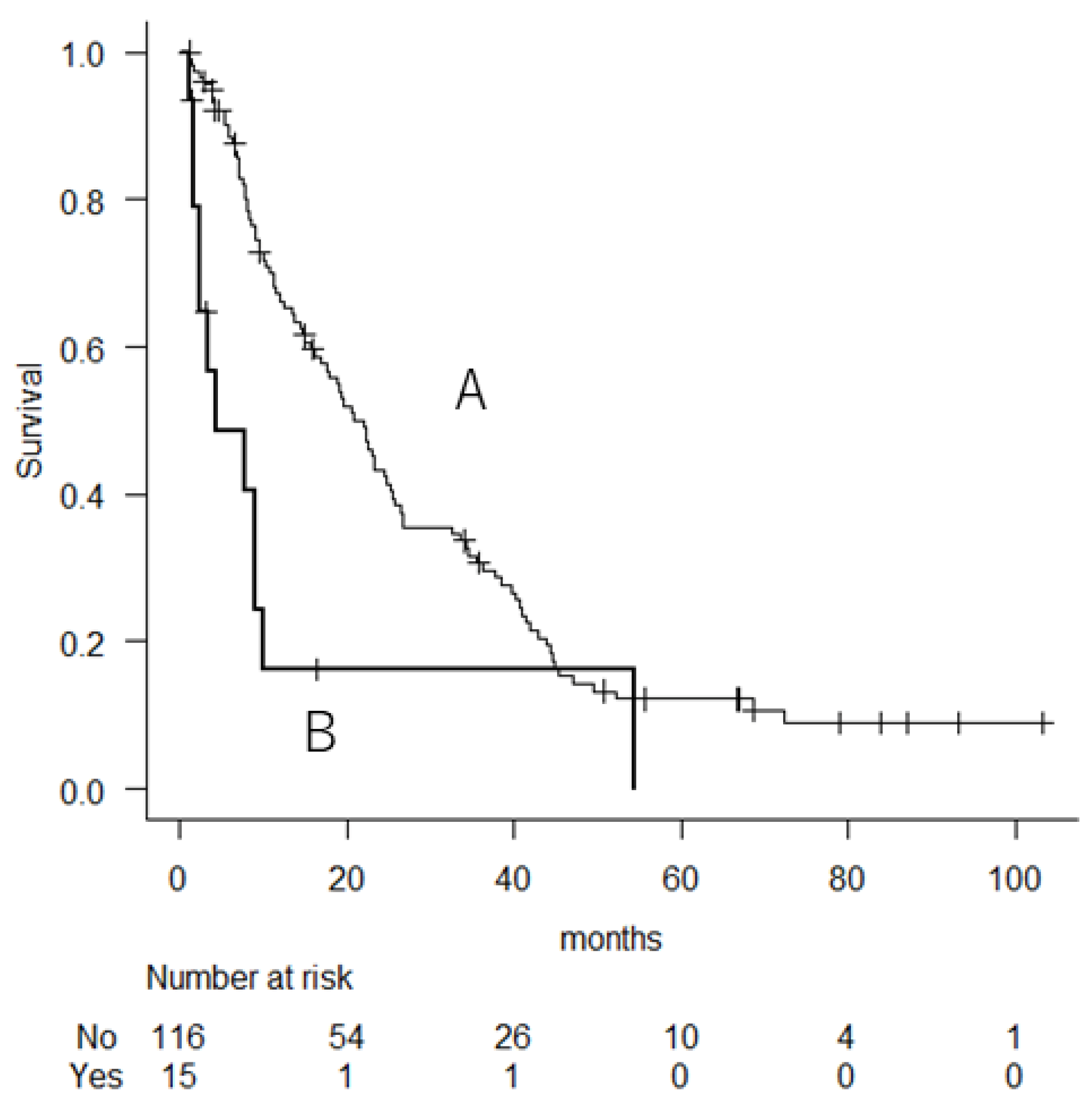
In all 131 patients, PS, tumor response to first-line therapy, and chemotherapy target were related to prognosis in the univariate Cox hazard proportional model analysis (Table 5). In multivariate analysis, patients with PS 2+ had poorer OS than those with PS 0 or 1 (HR 2.243, 95% Confidence Interval (CI) 1.109–4.539, p = 0.02467). The median survival times for patients with PS 0 or 1 and PS 2+ were 22.1 and 4.3 months, respectively (p < 0.0001, log-rank test) (Figure 1). There was no significant difference in survival between patients aged ≥ 75 y and those aged ≤ 74 y. Median survival was 22.5 months in 90 patients aged ≤ 74 y and 12 months in 41 patients aged ≥ 75 (p = 0.242, log-rank test). Similarly, survival did not differ between patients who received doxorubicin as first-line treatment and the other patients. Median survival time was 16.9 months in 70 patients treated with doxorubicin alone or AI and 22.3 months in 61 patients treated with other agents (p = 0.457, log-rank test). First-line chemotherapy agents and histological diagnosis were not associated with predicting survival.

3.4. Safety

Among 131 patients, no fatal adverse events occurred. Chemotherapy was discontinued due to adverse events in 28 patients (21.4%). Discontinuation rates due to adverse events were as follows: pazopanib (6/17; 35.3%), trabectedin (2/7; 28.6%), eribulin (8/33; 24.2%), AI (1/6; 16.7%), and doxorubicin (7/52; 13.5%). Reasons for discontinuation included pneumonia (n = 5), pneumothorax (n = 3), general fatigue (n = 3), liver disorders (n = 3), sepsis (n = 2), heart failure (n = 2), febrile neutropenia (n = 2), and other causes (n = 8).

4. Discussion

Among 131 elderly patients with advanced STS at 12 hospitals, the 1- and 2-year survival rates after first-line chemotherapy for advanced STS were 61.8% and 40.2%, respectively. The median survival time was 19 months. PS was a prognostic variable for predicting OS in multivariate analysis. A good PS is widely recognized as an independent predictor of survival in several varieties of cancer and sarcoma [9,10,11,12,13,14]. A doxorubicin-containing regimen (46.6%) was the most frequently used first-line therapy. Eribulin was frequently administered to patients with DDLPS. CR and PR were achieved in 10 of 122 patients (8.2%). Age (65–74 vs. ≥75) was not associated with OS or tumor response. Chemotherapy was discontinued due to adverse events in 28 patients (21.4%).
These patients were highly selected elderly individuals. Savina et al. reported that age ≥ 75 y was significantly associated with a lower probability of receiving systemic treatment [8]. In their analysis of 2165 patients with metastatic STS, 1429 of 1886 patients aged ≤ 74 y (75.8%) received chemotherapy, compared with 146 of 279 patients aged ≥ 75 y (52.3%). Overall, age was identified as a prognostic variable for advanced STS [15,16]. Karavasillis et al. reported a relative risk of death was 1.46 (95% CI: 1.10–1.92) in patients aged > 60 y compared with that in patients aged < 40 y [16]. However, we also emphasize that it is important not to deny life-prolonging treatment for elderly patients based exclusively on their chronological age.
Doxorubicin is the standard first-line chemotherapy for advanced STS [6,17], although Pautier et al. recently reported that induction therapy with doxorubicin and trabectedin, followed by trabectedin maintenance, was associated with improved overall and progression-free survival compared with doxorubicin alone in metastatic or unresectable uterine or soft-tissue LMS [18]. In this study, the median survival time after the administration of first-line chemotherapy was 19 months. Younger reported the outcomes of 348 elderly patients with advanced STS treated with first-line chemotherapy [17]. The median overall survival among those treated with doxorubicin was 9.8 months, and outcomes in elderly patients were only slightly worse than in younger patients. Nakamura et al. reported that the median post-metastatic survival of the 32 patients with musculoskeletal sarcoma who received no treatment for their metastasis was 7.2 months [19]. Therefore, chemotherapy for advanced STS may be considered in elderly patients, although we did not perform a comparison of OS between patients who received chemotherapy and those who did not receive it for advanced STS directly in this study.
In this study, eribulin was frequently administered to patients with DDLPS, possibly reflecting favorable outcomes in advanced liposarcoma treated with eribulin as first- or second-line chemotherapy [20,21,22,23,24]. Schöffski P et al. reported that patients with LMS and liposarcoma (LPS) in the eribulin group had significantly longer overall survival than those treated with dacarbazine (HR 0.77; 95% CI 0.62–0.95; p = 0.0169) in a phase 3 study [14]. Furthermore, Demetri et al. demonstrated improved progression-free survival with eribulin versus dacarbazine in a subgroup analysis of patients with liposarcoma (2.9 vs. 1.7 months) [25]. Nakamura et al. also reported a significant difference in progression-free survival (PFS) between patients with and without L-sarcoma treated with eribulin [22]. These findings support the hypothesis that eribulin is effective in L-sarcoma, particularly liposarcoma.
Savina suggested that the best supportive care should be considered after failure of second-line therapy [8]. However, their study included patients treated between 1990 and 2013. In this study, 41 patients (31.3%) received third-line treatment. In the era of newer agents such as pazopanib, trabectedin, and eribulin, further-line therapy may be considered if PS is maintained. Interestingly, Ikeda et al. reported the usefulness of chemotherapy for patients with poor PS non-small cell lung cancer by the inverse probability weighting (IPW) method, although commonly, patients with not only elderly but also poor PS are often considered to be particularly fragile and unfit for cytotoxic chemotherapy [23]. They compared the overall survival of the chemotherapy and best supportive care (BSC). In both PS2 and PS3 cohorts, IPW-adjusted overall survival was significantly longer in the chemotherapy group than in the BSC group (HR 0.42; 95% CI 0.32–0.55; p < 0.001 and HR 0.56; 95% CI 0.41–0.75; p < 0.003, respectively). They emphasized cancer cachexia, which was defined as weight loss > 5% over the past 6 months, was related to shorter overall survival, which was consistent with previous studies [23,24,25,26].
The American Society of Clinical Oncology recommends the use of geriatric assessment (GA) to evaluate the benefits and risks of cytotoxic chemotherapy in elderly patients [27]. GA-based tools, such as the Geriatric-8 or Vulnerable Elders Survey-13, are useful for estimating the risk of chemotherapy toxicity [27,28,29,30,31,32]. Chen et al. performed a meta-analysis including 42 studies with 9053 patients, and they reported the results from subgroup analyses, which showed that high G-8 scores were associated with increased OS (HR 1.97; 95% CI; 1.59–2.44; p < 0.001) and PFS (HR 1.73; 95% CI 1.43–2.10; p < 0.001) in patients treated with chemotherapy [28]. Lee et al. reported the association of the G-8 with treatment intensity and prognosis in 451 elderly patients with diffuse large B-cell lymphoma. They showed that the factors associated with the administration of the standard regimens, the G-8, remained as a significant factor in the multivariate logistic regression analyses, although standard therapy significantly contributed to a decreased mortality risk for patients with all G-8 scores [31]. Therefore, future clinical trials are needed for elderly patients with advanced STS incorporating GA, given the global aging population, for the association of the G-8 with treatment intensity and prognosis. In this study, chemotherapy was discontinued due to adverse events in 28 patients (21.4%), although most had a PS of 0 or 1 and more than half underwent dose reduction at initial administration. The pre-treatment assessment using the GA-based tool should be administered.
This study was retrospective, and comparison with previous phase 3 trials may be limited due to differences in tumor subtypes, eligibility, and follow-up procedures. The elderly patients were highly selected. We also should understand the survival results in this study with explicit caution due to the histological subtypes with small sizes.

5. Conclusions

Chemotherapy for advanced STS in elderly patients may be effective in those with good PS, although it should be considered to evaluate the benefits and risks of cytotoxic chemotherapy.

Author Contributions

Conceptualization, T.N. and Y.N.; methodology, all authors; software, T.N.; validation, T.N.; formal analysis, T.N.; investigation, T.N.; resources, all authors; data curation, T.N. and M.H.; writing—original draft preparation, T.N.; writing—review and editing, all authors; visualization, T.N.; supervision, M.H. and Y.N.; project administration, T.N.; funding acquisition, M.H. All authors have read and agreed to the published version of the manuscript.

Funding

This research received no external funding.

Institutional Review Board Statement

This study was approved by the Clinical Research Ethics Review Committee of Mie University Hospital (H2025-111) on 26 July 2025, and conducted in accordance with the Declaration of Helsinki.

Informed Consent Statement

The need for informed consent was waived due to the retrospective study design; instead, patients were allowed to opt out.

Data Availability Statement

The datasets generated during and/or analyzed during the current study are available from the corresponding author upon reasonable request.

Conflicts of Interest

The authors declare no conflicts of interest.

References

  1. World Health Organization. Percentage of Total Population Aged 60 Years or Over. Available online: https://www.who.int/data/gho/indicator-metadata-registry/imr-details/percentage-of-total-population-aged-60-years-or-over (accessed on 29 March 2026).
  2. Japanese Orthopaedic Association Musculoskeletal Tumor Committee. Soft Tissue Tumor Registry in Japan 2021; National Cancer Centre: Tokyo, Japan, 2021.
  3. Nevala, R.; Jäämaa, S.; Tukiainen, E.; Tarkkanen, M.; Räsänen, J.; Blomqvist, C.; Sampo, M. Long-term results of surgical resection of lung metastases from soft tissue sarcoma: A single center experience. J. Surg. Oncol. 2019, 120, 168–175. [Google Scholar] [CrossRef]
  4. Kawamoto, T.; Hara, H.; Morishita, M.; Fukase, N.; Kawakami, Y.; Takemori, T.; Fujiwara, S.; Kitayama, K.; Yahiro, S.; Miyamoto, T.; et al. Prognostic influence of the treatment approach for pulmonary metastasis in patients with soft tissue sarcoma. Clin. Exp. Metastasis 2020, 37, 509–517. [Google Scholar] [CrossRef]
  5. Gusho, C.A.; Seder, C.W.; Lopez-Hisijos, N.; Blank, A.T.; Batus, M. Pulmonary metastasectomy in bone and soft tissue sarcoma with metastasis to the lung. Interact. Cardiovasc. Thorac. Surg. 2021, 33, 879–884. [Google Scholar] [CrossRef]
  6. Gronchi, A.; Miah, A.B.; Dei Tos, A.P.; Abecassis, N.; Bajpai, J.; Bauer, S.; Biagini, R.; Bielack, S.; Blay, J.Y.; Bolle, S.; et al. Soft tissue and visceral sarcomas. ESMO-EURACAN-GENTURIS clinical practice guidelines for diagnosis, treatment and follow-up. Ann. Oncol. 2021, 32, 1348–1365. [Google Scholar] [CrossRef]
  7. Tsuda, Y.; Ogura, K.; Kobayashi, E.; Hiruma, T.; Iwata, S.; Asano, N.; Kawai, A.; Chuman, H.; Ishii, T.; Morioka, H.; et al. Impact of geriatric factors on surgical and prognostic outcomes in elderly patients with soft-tissue sarcoma. Jpn. J. Clin. Oncol. 2017, 47, 422–429. [Google Scholar] [CrossRef]
  8. Savina, M.; Le Cesne, A.; Blay, J.Y.; Ray-Coquard, I.; Mir, O.; Toulmonde, M.; Cousin, S.; Terrier, P.; Ranchere-Vince, D.; Meeus, P.; et al. Patterns of care and outcomes of patients with METAstatic soft tissue SARComa in a real-life setting: The METASARC observational study. BMC Med. 2017, 15, 78. [Google Scholar] [CrossRef]
  9. Van Glabbeke, M.; van Oosterom, A.T.; Oosterhuis, J.W.; Mouridsen, H.; Crowther, D.; Somers, R.; Verweij, J.; Santoro, A.; Buesa, J.; Tursz, T. Prognostic factors for the outcome of chemotherapy in advanced soft tissue sarcoma: An analysis of 2185 patients treated with anthracycline-containing first-line regimens—A European Organization for Research and Treatment of Cancer Soft Tissue and Bone Sarcoma Group Study. J. Clin. Oncol. 1999, 17, 150–157. [Google Scholar]
  10. Colloca, G.A.; Venturino, A. Prognostic Effect of Performance Status on Outcomes of Patients with Colorectal Cancer Receiving First-Line Chemotherapy: A Meta-analysis. J. Gastrointest. Cancer 2024, 55, 418–426. [Google Scholar] [CrossRef]
  11. Mellgard, G.; Saffran, N.; Chakrani, Z.; McCroskery, S.; Taylor, N.; Patel, M.; Liaw, B.; Galsky, M.; Oh, W.; Tsao, C.K.; et al. Performance status and end-of-life outcomes in patients with metastatic castration-resistant prostate cancer treated with androgen receptor targeted therapy. Am. J. Clin. Oncol. 2024, 47, 459–464. [Google Scholar] [CrossRef]
  12. Westgaard, A.; Pirnat, A.; Hjermstad, M.J.; Aass, N.; Kaasa, S.; Dajani, O.F. Prognostic value of performance status, albumin, and CRP in last-line chemotherapy for pancreatic vs. other gastrointestinal cancers-simple tools matter. Curr. Oncol. 2024, 31, 5462–5471. [Google Scholar] [CrossRef]
  13. Hsu, C.C.; Hung, Y.S.; Yu, S.M.; Hsueh, S.W.; Chou, W.C. Integrating frailty assessment to enhance care in cancer patients with borderline Eastern Cooperative Oncology Group Performance Status. Am. J. Hosp. Palliat. Med. 2024, 41, 1272–1279. [Google Scholar] [CrossRef]
  14. Tamiya, H.; Imura, Y.; Wakamatsu, T.; Takenaka, S. Comorbidity, body mass index, and performance status as prognostic factors in older patients with soft-tissue sarcoma. J. Geriatr. Oncol. 2022, 13, 673–681. [Google Scholar] [CrossRef]
  15. Younger, E.; Litière, S.; Le Cesne, A.; Mir, O.; Gelderblom, H.; Italiano, A.; Marreaud, S.; Jones, R.L.; Gronchi, A.; van der Graaf, W.T.A. Outcomes of elderly patients with advanced soft tissue sarcoma treated with first-line chemotherapy: A pooled analysis of 12 EORTC soft tissue and bone sarcoma group trials. Oncologist 2018, 23, 1250–1259. [Google Scholar] [CrossRef]
  16. Karavasilis, V.; Seddon, B.M.; Ashley, S.; Al-Muderis, O.; Fisher, C.; Judson, I. Significant clinical benefit of first-line palliative chemotherapy in advanced soft tissue sarcoma: Retrospective analysis and identification of prognostic factors in 488 patients. Cancer 2008, 112, 1585–1591. [Google Scholar] [CrossRef]
  17. Seddon, B.; Strauss, S.J.; Whelan, J.; Leahy, M.; Woll, P.J.; Cowie, F.; Rothermundt, C.; Wood, Z.; Benson, C.; Ali, N.; et al. Gemcitabine and docetaxel versus doxorubicin as first-line treatment in previously untreated advanced unresectable or metastatic soft-tissue sarcomas (GeDDiS): A randomised controlled phase 3 trial. Lancet Oncol. 2017, 18, 1397–1410. [Google Scholar] [CrossRef]
  18. Pautier, P.; Italiano, A.; Piperno-Neumann, S.; Chevreau, C.; Penel, N.; Firmin, N.; Boudou-Rouquette, P.; Bertucci, F.; Lebrun-Ly, V.; Ray-Coquard, I.; et al. Doxorubicin-trabectedin with trabectedin maintenance in leiomyosarcoma. N. Engl. J. Med. 2024, 391, 789–799. [Google Scholar] [CrossRef]
  19. Nakamura, T.; Matsumine, A.; Matsubara, T.; Asanuma, K.; Niimi, R.; Uchida, A.; Sudo, A. Retrospective analysis of metastatic sarcoma patients. Oncol. Lett. 2011, 2, 315–318. [Google Scholar] [CrossRef]
  20. Schöffski, P.; Chawla, S.; Maki, R.G.; Italiano, A.; Gelderblom, H.; Choy, E.; Grignani, G.; Camargo, V.; Bauer, S.; Rha, S.Y.; et al. Eribulin versus dacarbazine in previously treated patients with advanced liposarcoma or leiomyosarcoma: A randomised, open-label, multicentre, phase 3 trial. Lancet 2016, 387, 1629–1637. [Google Scholar] [CrossRef]
  21. Demetri, G.D.; Schöffski, P.; Grignani, G.; Blay, J.Y.; Maki, R.G.; Van Tine, B.A.; Alcindor, T.; Jones, R.L.; D’Adamo, D.R.; Guo, M.; et al. Activity of eribulin in patients with advanced liposarcoma demonstrated in a subgroup analysis from a randomized Phase III study of eribulin versus dacarbazine. J. Clin. Oncol. 2017, 35, 3433–3439. [Google Scholar] [CrossRef]
  22. Nakamura, T.; Tsukushi, S.; Asanuma, K.; Katagiri, H.; Ikuta, K.; Nagano, A.; Kozawa, E.; Yamada, S.; Shido, Y.; Yamada, K.; et al. The clinical outcome of eribulin treatment in Japanese patients with advanced soft tissue sarcoma: A Tokai Musculoskeletal Oncology Consortium study. Clin. Exp. Metastasis 2019, 36, 343–350. [Google Scholar] [CrossRef]
  23. Ikeda, S.; Ogura, T.; Miyaoka, E.; Sekine, I.; Shukuya, T.; Takayama, K.; Inoue, A.; Okamoto, I.; Seike, M.; Takahashi, K.; et al. Survival benefit and potential markers of chemotherapy for elderly and poor performance status patients with advanced non-small cell lung cancer: Results from the Japanese Joint Committee of lung cancer registry database. Lung Cancer 2025, 200, 108102. [Google Scholar] [CrossRef]
  24. Antoun, S.; Morel, H.; Souquet, P.J.; Surmont, V.; Planchard, D.; Bonnetain, F.; Foucher, P.; Egenod, T.; Krakowski, I.; Gaudin, H.; et al. Staging of nutrition disorders in non-small-cell lung cancer patients: Utility of skeletal muscle mass assessment. J. Cachexia Sarcopenia Muscle 2019, 10, 782–793. [Google Scholar] [CrossRef]
  25. Naito, T.; Okayama, T.; Aoyama, T.; Ohashi, T.; Masuda, Y.; Kimura, M.; Shiozaki, H.; Murakami, H.; Kenmotsu, H.; Taira, T.; et al. Skeletal muscle depletion during chemotherapy has a large impact on physical function in elderly Japanese patients with advanced non-small-cell lung cancer. BMC Cancer 2017, 17, 571. [Google Scholar] [CrossRef]
  26. Hentschel, L.; Richter, S.; Kopp, H.G.; Kasper, B.; Kunitz, A.; Grünwald, V.; Kessler, T.; Chemnitz, J.M.; Pelzer, U.; Schuler, U.; et al. Quality of life and added value of a tailored palliative care intervention in patients with soft tissue sarcoma undergoing treatment with trabectedin: A multicentre, cluster-randomised trial within the German Interdisciplinary Sarcoma Group (GISG). BMJ Open 2020, 10, e035546. [Google Scholar] [CrossRef]
  27. Mohile, S.G.; Dale, W.; Somerfield, M.R.; Schonberg, M.A.; Boyd, C.M.; Burhenn, P.S.; Canin, B.; Cohen, H.J.; Holmes, H.M.; Hopkins, J.O.; et al. Practical assessment and management of vulnerabilities in older patients receiving chemotherapy: ASCO guideline for geriatric oncology. J. Clin. Oncol. 2018, 36, 2326–2347. [Google Scholar] [CrossRef]
  28. Rowbottom, L.; Loucks, A.; Jin, R.; Breunis, H.; Syed, A.T.; Watt, S.; Timilshina, N.; Puts, M.; Yokom, D.; Berger, A.; et al. Performance of the Vulnerable Elders survey 13 screening tool in identifying cancer treatment modification after geriatric assessment in pre-treatment patients: A retrospective analysis. J. Geriatr. Oncol. 2019, 10, 229–234. [Google Scholar] [CrossRef]
  29. Chen, R.; Yang, D.; Tian, M.; Xu, H.; Jin, X. The prognostic role of Geriatric 8 in patients with cancer: A meta-analysis and systematic review. Oncologist 2025, 30, oyaf118. [Google Scholar] [CrossRef]
  30. Seaman, A.T.; Rowland, J.H.; Werts, S.J.; Tam, R.M.; Torres, T.K.; Hucek, F.A.; Wickersham, K.E.; Fairman, C.M.; Patel, H.D.; Thomson, C.A.; et al. Examining provider perceptions and practices for comprehensive geriatric assessment among cancer survivors: A qualitative study with an implementation science focus. Front. Aging 2023, 4, 1305922. [Google Scholar] [CrossRef]
  31. Javier-González, M.; Galli, R.; Amorós Rivera, C.; Rosenberg, R.; Vetter, M. Impact of age and comorbidities on therapeutic decision-making among older patients with gastrointestinal cancer. J. Gastrointest. Cancer 2025, 56, 209. [Google Scholar] [CrossRef]
  32. Lee, S.; Fujita, K.; Morishita, T.; Oiwa, K.; Tsukasaki, H.; Negoro, E.; Hara, T.; Tsurumi, H.; Ueda, T.; Yamauchi, T. Association of the geriatric 8 with treatment intensity and prognosis in older patients with diffuse large b-cell lymphoma. Br. J. Haematol. 2021, 194, 325–335. [Google Scholar] [CrossRef]
Figure 1. Kaplan-Meier curve shows disease-specific survival after first-line chemotherapy depending on performance status (A: PS 0 or 1, B: PS 2 or 3).
Cancers 18 01849 g001
Table 1. Patient’s background.
Patient Characteristicsn
Age
65–7490
≥7541
Sex
Men60
Women71
Performance status
063
153
2+15
Treatment
Doxorubicin55
Doxorubicin and ifosfamide6
Eribulin33
Pazopanib17
Trabectedin7
Gemcitabine and docetaxel5
Paclitaxel4
Others4
Full dose intensity of initial administration
Yes62
No69
Histological cell type
Dedifferentiated liposarcoma33
Undifferentiated pleomorphic sarcoma24
Leiomyosarcoma20
Myxofibrosarcoma13
Myxoid liposarcoma8
Malignant peripheral nerve sheath tumor6
Fibrosarcoma4
Angiosarcoma4
Synovial sarcoma4
Others15
Neoadjuvant chemotherapy at primary STS
Yes32
No99
Site of disease involvement
primary site involved64
lung metastasis84
liver metastasis11
bone metastasis9
other metastases18
STS: soft tissue sarcoma, PS2+: PS2 and 3.
Table 2. The relationship between major agents and tumor response.
AgentTumor Response
CRPRSDPDNE
A or AI (n = 61)1330261
Eriburin (n = 33)051765
Pazopanib (n = 17)00962
Trabectedin (n = 7)00430
A: Doxorubicin, AI: Doxorubicin-ifosfamide, CR: Complete response, PR: Partial response, SD: Stable disease, PD: Progressive disease, NE: not evaluated.
Table 3. The relationship between histological diagnosis and regimen.
HistologynMedian Survival Time (95% CI)
DDLPS3316 months (8.5–22.3)
UPS249 months (5.8–17.8)
LMS2034.2 months (15.7–42)
MFS139.5 months (5.9–23.3)
MPLS834.2 months (5.3–NA)
MPNST68.9 months (2.4–NA)
Others2725.2 months (9.5–33.5)
DDLPS: De-differentiated liposarcoma, UPS: Undifferentiated pleomorphic sarcoma, LMS: Leiomyosarcoma, MFS: Myxofibrosarcoma, MLPS: Myxoid liposarcoma, MPNST: Malignant peripheral nerve sheath tumor, ( ): complete response or partial response, 95% CI: 95% confidence interval.
Table 4. Median overall survival according to histological diagnosis.
HistologynMedian Survival Time (95% CI)
DDLPS3316 months (8.5–22.3)
UPS249 months (5.8–17.8)
LMS2034.2 months (15.7–42)
MFS139.5 months (5.9–23.3)
MPLS834.2 months (5.3–NA)
MPNST68.9 months (2.4–NA)
Others2725.2 months (9.5–33.5)
DDLPS: De-differentiated liposarcoma, UPS: Undifferentiated pleomorphic sarcoma, LMS: Leiomyosarcoma, MFS: Myxofibrosarcoma, MLPS: Myxoid liposarcoma, MPNST: Malignant peripheral nerve sheath tumor, ( ): complete response or partial response, 95% CI: 95% confidence interval.
Table 5. Cox proportional analysis for predicting survival.
Univariate AnalysisMultivariate Analysis
VariablesHR95% CIp ValueHR95% CIp Value
AgeYears1.0170.979–1.0560.397
Age65–741
≥751.2880.842–1.9720.244
SexWomen1 1
Men1.4090.961–2.0680.07951.0830.687–1.7080.732
PS0–11 1
2–32.8041.522–5.165<0.0012.2431.109–4.5390.0247
Full dose intensityNo1
of chemotherapyYes0.9240.627–1.3620.69
Histological diagnosisDDLPS1
UPS1.4810.411–1.4950.459
MFS1.690.841–3.3950.141
LMS0.7830.411–1.4950.459
MLPS0.660.269–1.6170.363
MPNST1.2370.47–3.2540.363
Others1.1530.651–2.0430.626
First-line agentA or AI1
Eribulin1.1990.737–1.9490.465
GD0.890.321–2.4720.824
Pazopanib1.2950.716–2.3430.392
Trabectedin1.3840.627–3.0560.422
Retroperitoneal STSNo1
Yes0.6770.434–1.0550.0849
Best overall responseSD or PD1 1
CR or PR0.4310.198–0.9390.03410.5370.242–1.1930.127
Target lesionBoth1 11.522–5.165<0.001
Local 0.4550.248–0.8350.0110.5820.296–1.1420.116
Metastasis0.8870.575–1.3710.5890.8480.518–1.3870.511
HR: Hazard ratio, 95% CI: 95% confidence interval, PS: Performance status, SD: Stable disease, PD: Progressive disease, CR: Complete response, PR: Partial response, STS: Soft tissue sarcoma. DDLPS: De-differentiated liposarcoma, UPS: Undifferentiated pleomorphic sarcoma, LMS: Leiomyosarcoma, MFS: Myxofibrosarcoma, MLPS: Myxoid liposarcoma, MPNST: Malignant peripheral nerve sheath tumor. A: Doxorubicin, AI: Doxorubicin-ifosfamide, GD: Gemcitabine-docetaxel.
Disclaimer/Publisher’s Note: The statements, opinions and data contained in all publications are solely those of the individual author(s) and contributor(s) and not of MDPI and/or the editor(s). MDPI and/or the editor(s) disclaim responsibility for any injury to people or property resulting from any ideas, methods, instructions or products referred to in the content.