


Immunotherapy and Stereotactic Body Radiation Treatment—An Overview of the Current Landscape of the Strategic Combination of Two Treatment Modalities to Achieve Better Therapeutic Outcomes
Simple Summary
Abstract
1. Introduction
2. Methods
3. Cancer Immunology and Immunotherapy
4. Radiation and Its Immune Effects
5. Stereotactic Radiation and Its Immune Effects
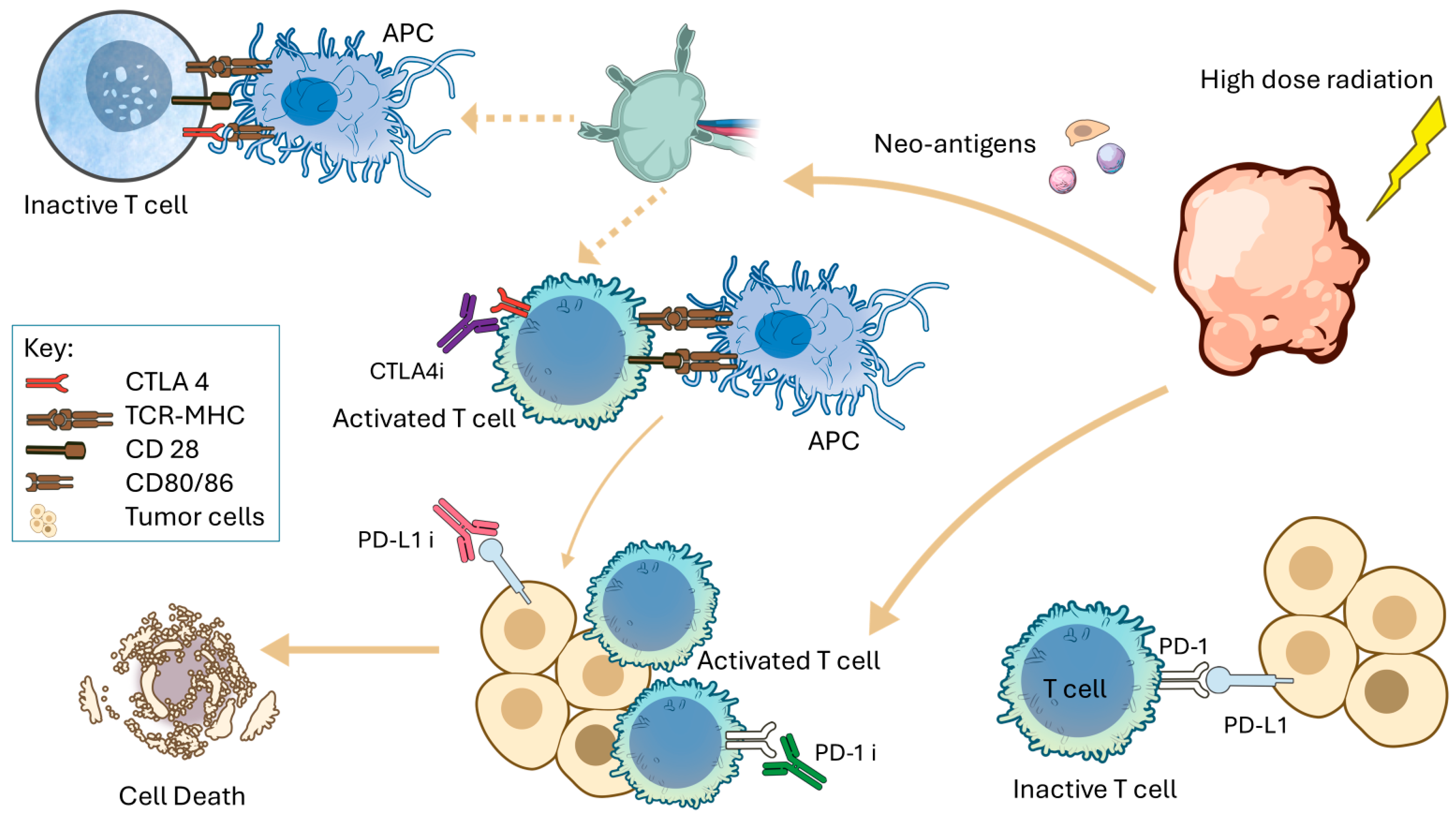
6. Rationale for Combining Stereotactic Radiation and Immunotherapy
7. Hyperthermia—A Novel Therapeutic Approach to Improve Effectiveness of the Combination of SBRT and Immunotherapy
8. Lung Cancer
8.1. Extracranial Lung Cancer Oligo-Metastases
8.2. Lung Cancer Brain Metastases
8.3. Early-Stage/Non-Metastatic Lung Cancer
9. Melanoma
10. Genito-Urinary Malignancies
10.1. Renal Cell Carcinoma
10.2. Prostate Cancer and Urinary Bladder Cancer
11. Gastro-Intestinal Malignancies
11.1. Liver-Hepatocellular Carcinoma
11.2. Pancreatic Cancer
11.3. Colorectal and Other Gastro-Intestinal Cancers
12. Breast Cancer
13. Toxicity of Combined Treatment
14. Looking Forward
15. Conclusions
Author Contributions
Funding
Data Availability Statement
Conflicts of Interest
References
- Norvell, A. Chapter 2—Components of the Immune System. In Cancer Immunotherapy, 2nd ed.; Prendergast, G., Jaffee, E.M., Eds.; Academic Press: New York, NY, USA, 2013; pp. 11–24. [Google Scholar]
- Baumeister, S.H.; Freeman, G.J.; Dranoff, G.; Sharpe, A.H. Coinhibitory Pathways in Immunotherapy for Cancer. Annu. Rev. Immunol. 2016, 34, 539–573. [Google Scholar] [CrossRef]
- Walker, L.S.; Sansom, D.M. The emerging role of CTLA4 as a cell-extrinsic regulator of T cell responses. Nat. Rev. Immunol. 2011, 11, 852–863. [Google Scholar] [CrossRef] [PubMed]
- Leach, D.R.; Krummel, M.F.; Allison, J.P. Enhancement of antitumor immunity by CTLA-4 blockade. Science 1996, 271, 1734–1736. [Google Scholar] [CrossRef]
- Klocke, K.; Sakaguchi, S.; Holmdahl, R.; Wing, K. Induction of autoimmune disease by deletion of CTLA-4 in mice in adulthood. Proc. Natl. Acad. Sci. USA 2016, 113, E2383–E2392. [Google Scholar] [CrossRef]
- Kinter, A.L.; Godbout, E.J.; McNally, J.P.; Sereti, I.; Roby, G.A.; O’Shea, M.A.; Fauci, A.S. The common gamma-chain cytokines IL-2, IL-7, IL-15, and IL-21 induce the expression of programmed death-1 and its ligands. J. Immunol. 2008, 181, 6738–6746. [Google Scholar] [CrossRef]
- Francisco, L.M.; Salinas, V.H.; Brown, K.E.; Vanguri, V.K.; Freeman, G.J.; Kuchroo, V.K.; Sharpe, A.H. PD-L1 regulates the development, maintenance, and function of induced regulatory T cells. J. Exp. Med. 2009, 206, 3015–3029. [Google Scholar] [CrossRef] [PubMed]
- Yi, M.; Niu, M.; Xu, L.; Luo, S.; Wu, K. Regulation of PD-L1 expression in the tumor microenvironment. J. Hematol. Oncol. 2021, 14, 10. [Google Scholar] [CrossRef] [PubMed]
- Chocarro, L.; Blanco, E.; Arasanz, H.; Fernandez-Rubio, L.; Bocanegra, A.; Echaide, M.; Garnica, M.; Ramos, P.; Fernandez-Hinojal, G.; Vera, R.; et al. Clinical landscape of LAG-3-targeted therapy. Immuno-Oncol. Technol. 2022, 14, 100079. [Google Scholar] [CrossRef]
- Anderson, A.C.; Joller, N.; Kuchroo, V.K. Lag-3, Tim-3, and TIGIT: Co-inhibitory Receptors with Specialized Functions in Immune Regulation. Immunity 2016, 44, 989–1004. [Google Scholar] [CrossRef]
- Yang, L.; Shi, P.; Zhao, G.; Xu, J.; Peng, W.; Zhang, J.; Zhang, G.; Wang, X.; Dong, Z.; Chen, F.; et al. Targeting cancer stem cell pathways for cancer therapy. Signal Transduct. Target. Ther. 2020, 5, 8. [Google Scholar] [CrossRef]
- Alexandrov, L.B.; Nik-Zainal, S.; Wedge, D.C.; Aparicio, S.A.; Behjati, S.; Biankin, A.V.; Bignell, G.R.; Bolli, N.; Borg, A.; Borresen-Dale, A.L.; et al. Signatures of mutational processes in human cancer. Nature 2013, 500, 415–421. [Google Scholar] [CrossRef]
- Lawrence, M.S.; Stojanov, P.; Polak, P.; Kryukov, G.V.; Cibulskis, K.; Sivachenko, A.; Carter, S.L.; Stewart, C.; Mermel, C.H.; Roberts, S.A.; et al. Mutational heterogeneity in cancer and the search for new cancer-associated genes. Nature 2013, 499, 214–218. [Google Scholar] [CrossRef] [PubMed]
- Schreiber, R.D.; Old, L.J.; Smyth, M.J. Cancer immunoediting: Integrating immunity’s roles in cancer suppression and promotion. Science 2011, 331, 1565–1570. [Google Scholar] [CrossRef]
- Iwai, Y.; Ishida, M.; Tanaka, Y.; Okazaki, T.; Honjo, T.; Minato, N. Involvement of PD-L1 on tumor cells in the escape from host immune system and tumor immunotherapy by PD-L1 blockade. Proc. Natl. Acad. Sci. USA 2002, 99, 12293–12297. [Google Scholar] [CrossRef]
- Peggs, K.S.; Quezada, S.A.; Korman, A.J.; Allison, J.P. Principles and use of anti-CTLA4 antibody in human cancer immunotherapy. Curr. Opin. Immunol. 2006, 18, 206–213. [Google Scholar] [CrossRef] [PubMed]
- Iwai, Y.; Hamanishi, J.; Chamoto, K.; Honjo, T. Cancer immunotherapies targeting the PD-1 signaling pathway. J. Biomed. Sci. 2017, 24, 26. [Google Scholar] [CrossRef]
- Cushman, T.R.; Caetano, M.S.; Welsh, J.W.; Verma, V. Overview of ongoing clinical trials investigating combined radiotherapy and immunotherapy. Immunotherapy 2018, 10, 851-00. [Google Scholar] [CrossRef] [PubMed]
- Liu, Y.; Dong, Y.; Kong, L.; Shi, F.; Zhu, H.; Yu, J. Abscopal effect of radiotherapy combined with immune checkpoint inhibitors. J. Hematol. Oncol. 2018, 11, 104. [Google Scholar] [CrossRef]
- Demaria, S.; Golden, E.B.; Formenti, S.C. Role of Local Radiation Therapy in Cancer Immunotherapy. JAMA Oncol. 2015, 1, 1325–1332. [Google Scholar] [CrossRef]
- Galluzzi, L.; Kepp, O.; Kroemer, G. Immunogenic cell death in radiation therapy. Oncoimmunology 2013, 2, e26536. [Google Scholar] [CrossRef]
- Stone, H.B.; Coleman, C.N.; Anscher, M.S.; McBride, W.H. Effects of radiation on normal tissue: Consequences and mechanisms. Lancet Oncol. 2003, 4, 529–536. [Google Scholar] [CrossRef]
- Kim, J.Y.; Son, Y.O.; Park, S.W.; Bae, J.H.; Chung, J.S.; Kim, H.H.; Chung, B.S.; Kim, S.H.; Kang, C.D. Increase of NKG2D ligands and sensitivity to NK cell-mediated cytotoxicity of tumor cells by heat shock and ionizing radiation. Exp. Mol. Med. 2006, 38, 474–484. [Google Scholar] [CrossRef]
- Park, B.; Yee, C.; Lee, K.M. The effect of radiation on the immune response to cancers. Int. J. Mol. Sci. 2014, 15, 927–943. [Google Scholar] [CrossRef]
- Reits, E.A.; Hodge, J.W.; Herberts, C.A.; Groothuis, T.A.; Chakraborty, M.; Wansley, E.K.; Camphausen, K.; Luiten, R.M.; de Ru, A.H.; Neijssen, J.; et al. Radiation modulates the peptide repertoire, enhances MHC class I expression, and induces successful antitumor immunotherapy. J. Exp. Med. 2006, 203, 1259–1271. [Google Scholar] [CrossRef] [PubMed]
- Lugade, A.A.; Moran, J.P.; Gerber, S.A.; Rose, R.C.; Frelinger, J.G.; Lord, E.M. Local radiation therapy of B16 melanoma tumors increases the generation of tumor antigen-specific effector cells that traffic to the tumor. J. Immunol. 2005, 174, 7516–7523. [Google Scholar] [CrossRef] [PubMed]
- Grossman, S.A.; Ellsworth, S.; Campian, J.; Wild, A.T.; Herman, J.M.; Laheru, D.; Brock, M.; Balmanoukian, A.; Ye, X. Survival in Patients With Severe Lymphopenia Following Treatment With Radiation and Chemotherapy for Newly Diagnosed Solid Tumors. J. Natl. Compr. Cancer Netw. 2015, 13, 1225–1231. [Google Scholar] [CrossRef]
- Tang, C.; Liao, Z.; Gomez, D.; Levy, L.; Zhuang, Y.; Gebremichael, R.A.; Hong, D.S.; Komaki, R.; Welsh, J.W. Lymphopenia association with gross tumor volume and lung V5 and its effects on non-small cell lung cancer patient outcomes. Int. J. Radiat. Oncol. Biol. Phys. 2014, 89, 1084–1091. [Google Scholar] [CrossRef]
- Nakamura, N.; Kusunoki, Y.; Akiyama, M. Radiosensitivity of CD4 or CD8 positive human T-lymphocytes by an in vitro colony formation assay. Radiat. Res. 1990, 123, 224–227. [Google Scholar] [CrossRef] [PubMed]
- Venkatesulu, B.P.; Mallick, S.; Lin, S.H.; Krishnan, S. A systematic review of the influence of radiation-induced lymphopenia on survival outcomes in solid tumors. Crit. Rev. Oncol. Hematol. 2018, 123, 42–51. [Google Scholar] [CrossRef]
- Lee, Y.; Auh, S.L.; Wang, Y.; Burnette, B.; Wang, Y.; Meng, Y.; Beckett, M.; Sharma, R.; Chin, R.; Tu, T.; et al. Therapeutic effects of ablative radiation on local tumor require CD8+ T cells: Changing strategies for cancer treatment. Blood 2009, 114, 589–595. [Google Scholar] [CrossRef]
- Wild, A.T.; Ye, X.; Ellsworth, S.G.; Smith, J.A.; Narang, A.K.; Garg, T.; Campian, J.; Laheru, D.A.; Zheng, L.; Wolfgang, C.L.; et al. The Association Between Chemoradiation-related Lymphopenia and Clinical Outcomes in Patients With Locally Advanced Pancreatic Adenocarcinoma. Am. J. Clin. Oncol. 2015, 38, 259–265. [Google Scholar] [CrossRef] [PubMed]
- Contreras, J.A.; Lin, A.J.; Weiner, A.; Speirs, C.; Samson, P.; Mullen, D.; Campian, J.; Bradley, J.; Roach, M.; Robinson, C. Cardiac dose is associated with immunosuppression and poor survival in locally advanced non-small cell lung cancer. Radiother. Oncol. 2018, 128, 498–504. [Google Scholar] [CrossRef]
- Crocenzi, T.; Cottam, B.; Newell, P.; Wolf, R.F.; Hansen, P.D.; Hammill, C.; Solhjem, M.C.; To, Y.Y.; Greathouse, A.; Tormoen, G.; et al. A hypofractionated radiation regimen avoids the lymphopenia associated with neoadjuvant chemoradiation therapy of borderline resectable and locally advanced pancreatic adenocarcinoma. J. Immunother. Cancer 2016, 4, 45. [Google Scholar] [CrossRef]
- Yovino, S.; Kleinberg, L.; Grossman, S.A.; Narayanan, M.; Ford, E. The etiology of treatment-related lymphopenia in patients with malignant gliomas: Modeling radiation dose to circulating lymphocytes explains clinical observations and suggests methods of modifying the impact of radiation on immune cells. Cancer Investig. 2013, 31, 140–144. [Google Scholar] [CrossRef]
- Park, H.J.; Griffin, R.J.; Hui, S.; Levitt, S.H.; Song, C.W. Radiation-induced vascular damage in tumors: Implications of vascular damage in ablative hypofractionated radiotherapy (SBRT and SRS). Radiat. Res. 2012, 177, 311–327. [Google Scholar] [CrossRef] [PubMed]
- Brooks, E.D.; Schoenhals, J.E.; Tang, C.; Micevic, G.; Gomez, D.R.; Chang, J.Y.; Welsh, J.W. Stereotactic Ablative Radiation Therapy Combined With Immunotherapy for Solid Tumors. Cancer J. 2016, 22, 257–266. [Google Scholar] [CrossRef]
- Wherry, E.J. T cell exhaustion. Nat. Immunol. 2011, 12, 492–499. [Google Scholar] [CrossRef]
- Vanpouille-Box, C.; Alard, A.; Aryankalayil, M.J.; Sarfraz, Y.; Diamond, J.M.; Schneider, R.J.; Inghirami, G.; Coleman, C.N.; Formenti, S.C.; Demaria, S. DNA exonuclease Trex1 regulates radiotherapy-induced tumour immunogenicity. Nat. Commun. 2017, 8, 15618. [Google Scholar] [CrossRef] [PubMed]
- Siva, S.; Bressel, M.; Mai, T.; Le, H.; Vinod, S.; de Silva, H.; Macdonald, S.; Skala, M.; Hardcastle, N.; Rezo, A.; et al. Single-Fraction vs Multifraction Stereotactic Ablative Body Radiotherapy for Pulmonary Oligometastases (SAFRON II): The Trans Tasman Radiation Oncology Group 13.01 Phase 2 Randomized Clinical Trial. JAMA Oncol. 2021, 7, 1476–1485. [Google Scholar] [CrossRef]
- Moding, E.J.; Castle, K.D.; Perez, B.A.; Oh, P.; Min, H.D.; Norris, H.; Ma, Y.; Cardona, D.M.; Lee, C.L.; Kirsch, D.G. Tumor cells, but not endothelial cells, mediate eradication of primary sarcomas by stereotactic body radiation therapy. Sci. Transl. Med. 2015, 7, 278ra234. [Google Scholar] [CrossRef]
- Moding, E.J.; Mowery, Y.M.; Kirsch, D.G. Opportunities for Radiosensitization in the Stereotactic Body Radiation Therapy (SBRT) Era. Cancer J. 2016, 22, 267–273. [Google Scholar] [CrossRef] [PubMed][Green Version]
- Dewan, M.Z.; Galloway, A.E.; Kawashima, N.; Dewyngaert, J.K.; Babb, J.S.; Formenti, S.C.; Demaria, S. Fractionated but not single-dose radiotherapy induces an immune-mediated abscopal effect when combined with anti-CTLA-4 antibody. Clin. Cancer Res. Off. J. Am. Assoc. Cancer Res. 2009, 15, 5379–5388. [Google Scholar] [CrossRef]
- Videtic, G.M.; Hu, C.; Singh, A.K.; Chang, J.Y.; Parker, W.; Olivier, K.R.; Schild, S.E.; Komaki, R.; Urbanic, J.J.; Timmerman, R.D.; et al. A Randomized Phase 2 Study Comparing 2 Stereotactic Body Radiation Therapy Schedules for Medically Inoperable Patients With Stage I Peripheral Non-Small Cell Lung Cancer: NRG Oncology RTOG 0915 (NCCTG N0927). Int. J. Radiat. Oncol. Biol. Phys. 2015, 93, 757–764. [Google Scholar] [CrossRef]
- Golden, E.B.; Chhabra, A.; Chachoua, A.; Adams, S.; Donach, M.; Fenton-Kerimian, M.; Friedman, K.; Ponzo, F.; Babb, J.S.; Goldberg, J.; et al. Local radiotherapy and granulocyte-macrophage colony-stimulating factor to generate abscopal responses in patients with metastatic solid tumours: A proof-of-principle trial. Lancet Oncol. 2015, 16, 795–803. [Google Scholar] [CrossRef] [PubMed]
- Siva, S.; MacManus, M.P.; Martin, R.F.; Martin, O.A. Abscopal effects of radiation therapy: A clinical review for the radiobiologist. Cancer Lett. 2015, 356, 82–90. [Google Scholar] [CrossRef]
- Twyman-Saint Victor, C.; Rech, A.J.; Maity, A.; Rengan, R.; Pauken, K.E.; Stelekati, E.; Benci, J.L.; Xu, B.; Dada, H.; Odorizzi, P.M.; et al. Radiation and dual checkpoint blockade activate non-redundant immune mechanisms in cancer. Nature 2015, 520, 373–377. [Google Scholar] [CrossRef]
- Ko, E.C.; Formenti, S.C. Radiotherapy and checkpoint inhibitors: A winning new combination? Ther. Adv. Med. Oncol. 2018, 10, 1758835918768240. [Google Scholar] [CrossRef]
- Gameiro, S.R.; Jammeh, M.L.; Wattenberg, M.M.; Tsang, K.Y.; Ferrone, S.; Hodge, J.W. Radiation-induced immunogenic modulation of tumor enhances antigen processing and calreticulin exposure, resulting in enhanced T-cell killing. Oncotarget 2014, 5, 403–416. [Google Scholar] [CrossRef]
- Deng, L.; Liang, H.; Burnette, B.; Beckett, M.; Darga, T.; Weichselbaum, R.R.; Fu, Y.X. Irradiation and anti-PD-L1 treatment synergistically promote antitumor immunity in mice. J. Clin. Investig. 2014, 124, 687–695. [Google Scholar] [CrossRef]
- Luke, J.J.; Lemons, J.M.; Karrison, T.G.; Pitroda, S.P.; Melotek, J.M.; Zha, Y.; Al-Hallaq, H.A.; Arina, A.; Khodarev, N.N.; Janisch, L.; et al. Safety and Clinical Activity of Pembrolizumab and Multisite Stereotactic Body Radiotherapy in Patients With Advanced Solid Tumors. J. Clin. Oncol. 2018, 36, 1611–1618. [Google Scholar] [CrossRef]
- Brooks, E.D.; Chang, J.Y. Time to abandon single-site irradiation for inducing abscopal effects. Nat. Rev. Clin. Oncol. 2019, 16, 123–135. [Google Scholar] [CrossRef]
- Spaas, M.; Sundahl, N.; Kruse, V.; Rottey, S.; De Maeseneer, D.; Duprez, F.; Lievens, Y.; Surmont, V.; Brochez, L.; Reynders, D.; et al. Checkpoint Inhibitors in Combination With Stereotactic Body Radiotherapy in Patients With Advanced Solid Tumors: The CHEERS Phase 2 Randomized Clinical Trial. JAMA Oncol. 2023, 9, 1205–1213. [Google Scholar] [CrossRef]
- Chang, J.Y.; Verma, V.; Weichselbaum, R.R. Reconciling the discrepancies in randomized data of combining immunotherapy and radiation therapy: Not all radiotherapy is created equal. Eur. J. Cancer 2024, 201, 113972. [Google Scholar] [CrossRef]
- Bauml, J.M.; Mick, R.; Ciunci, C.; Aggarwal, C.; Davis, C.; Evans, T.; Deshpande, C.; Miller, L.; Patel, P.; Alley, E.; et al. Pembrolizumab After Completion of Locally Ablative Therapy for Oligometastatic Non-Small Cell Lung Cancer: A Phase 2 Trial. JAMA Oncol. 2019, 5, 1283–1290. [Google Scholar] [CrossRef] [PubMed]
- Theelen, W.; Peulen, H.M.U.; Lalezari, F.; van der Noort, V.; de Vries, J.F.; Aerts, J.; Dumoulin, D.W.; Bahce, I.; Niemeijer, A.N.; de Langen, A.J.; et al. Effect of Pembrolizumab After Stereotactic Body Radiotherapy vs Pembrolizumab Alone on Tumor Response in Patients With Advanced Non-Small Cell Lung Cancer: Results of the PEMBRO-RT Phase 2 Randomized Clinical Trial. JAMA Oncol. 2019, 5, 1276–1282. [Google Scholar] [CrossRef]
- Tang, C.; Welsh, J.W.; de Groot, P.; Massarelli, E.; Chang, J.Y.; Hess, K.R.; Basu, S.; Curran, M.A.; Cabanillas, M.E.; Subbiah, V.; et al. Ipilimumab with Stereotactic Ablative Radiation Therapy: Phase I Results and Immunologic Correlates from Peripheral T Cells. Clin. Cancer Res. Off. J. Am. Assoc. Cancer Res. 2017, 23, 1388–1396. [Google Scholar] [CrossRef] [PubMed]
- Welsh, J.W.; Tang, C.; de Groot, P.; Naing, A.; Hess, K.R.; Heymach, J.V.; Papadimitrakopoulou, V.A.; Cushman, T.R.; Subbiah, V.; Chang, J.Y.; et al. Phase II Trial of Ipilimumab with Stereotactic Radiation Therapy for Metastatic Disease: Outcomes, Toxicities, and Low-Dose Radiation-Related Abscopal Responses. Cancer Immunol. Res. 2019, 7, 1903–1909. [Google Scholar] [CrossRef]
- Pircher, A.; Sótér, S.; Eaton, M.; Galffy, G.; Kowalski, D.; Hata, A.; Bustamante, A.A.V.; Frost, N.; Levchenko, E.; Monteiro, M.; et al. 117O Stereotactic body radiotherapy (SBRT) with pembrolizumab (pembro) for unresected stage I/II non-small cell lung cancer (NSCLC): The randomized, double-blind, phase III KEYNOTE-867 study. Immuno-Oncol. Technol. 2024, 24, 100746. [Google Scholar] [CrossRef]
- Chang, J.Y.; Lin, S.H.; Dong, W.; Liao, Z.; Gandhi, S.J.; Gay, C.M.; Zhang, J.; Chun, S.G.; Elamin, Y.Y.; Fossella, F.V.; et al. Stereotactic ablative radiotherapy with or without immunotherapy for early-stage or isolated lung parenchymal recurrent node-negative non-small-cell lung cancer: An open-label, randomised, phase 2 trial. Lancet 2023, 402, 871–881. [Google Scholar] [CrossRef] [PubMed]
- Hallqvist, A.; Koyi, H.; de Petris, L.; Lindberg, K.; Farooqi, S.; Helland, Å.; Wikström, A.; Johansson, M.; Planck, M.; Lindberg, L.; et al. 63MO Safety analysis of durvalumab following stereotactic body radiotherapy (SBRT) in early-stage non-small cell lung cancer (NSCLC) patients: A first report of a randomized phase II trial (ASTEROID). J. Thorac. Oncol. 2021, 16, S729–S730. [Google Scholar] [CrossRef]
- De Wolf, K.; Kruse, V.; Sundahl, N.; van Gele, M.; Chevolet, I.; Speeckaert, R.; Brochez, L.; Ost, P. A phase II trial of stereotactic body radiotherapy with concurrent anti-PD1 treatment in metastatic melanoma: Evaluation of clinical and immunologic response. J. Transl. Med. 2017, 15, 21. [Google Scholar] [CrossRef]
- Boutros, C.; Chaput-Gras, N.; Lanoy, E.; Larive, A.; Mateus, C.; Routier, E.; Sun, R.; Tao, Y.G.; Massard, C.; Bahleda, R.; et al. Dose escalation phase 1 study of radiotherapy in combination with anti-cytotoxic-T-lymphocyte-associated antigen 4 monoclonal antibody ipilimumab in patients with metastatic melanoma. J. Immunother. Cancer 2020, 8, e000627. [Google Scholar] [CrossRef]
- Masini, C.; Iotti, C.; De Giorgi, U.; Bellia, R.S.; Buti, S.; Salaroli, F.; Zampiva, I.; Mazzarotto, R.; Mucciarini, C.; Vitale, M.G.; et al. Nivolumab in Combination with Stereotactic Body Radiotherapy in Pretreated Patients with Metastatic Renal Cell Carcinoma. Results of the Phase II NIVES Study. Eur. Urol. 2022, 81, 274–282. [Google Scholar] [CrossRef] [PubMed]
- Hammers, H.J.; Vonmerveldt, D.; Ahn, C.; Nadal, R.M.; Drake, C.G.; Folkert, M.R.; Laine, A.M.; Courtney, K.D.; Brugarolas, J.; Song, D.Y.; et al. Combination of dual immune checkpoint inhibition (ICI) with stereotactic radiation (SBRT) in metastatic renal cell carcinoma (mRCC) (RADVAX RCC). J. Clin. Oncol. 2020, 38, 614. [Google Scholar] [CrossRef]
- Siva, S.; Bressel, M.; Wood, S.T.; Shaw, M.G.; Loi, S.; Sandhu, S.K.; Tran, B.; Azad, A.A.; Lewin, J.H.; Cuff, K.E.; et al. Stereotactic Radiotherapy and Short-course Pembrolizumab for Oligometastatic Renal Cell Carcinoma-The RAPPORT Trial. Eur. Urol. 2022, 81, 364–372. [Google Scholar] [CrossRef]
- Kwon, E.D.; Drake, C.G.; Scher, H.I.; Fizazi, K.; Bossi, A.; van den Eertwegh, A.J.; Krainer, M.; Houede, N.; Santos, R.; Mahammedi, H.; et al. Ipilimumab versus placebo after radiotherapy in patients with metastatic castration-resistant prostate cancer that had progressed after docetaxel chemotherapy (CA184-043): A multicentre, randomised, double-blind, phase 3 trial. Lancet Oncol. 2014, 15, 700–712. [Google Scholar] [CrossRef]
- Fizazi, K.; Drake, C.G.; Beer, T.M.; Kwon, E.D.; Scher, H.I.; Gerritsen, W.R.; Bossi, A.; den Eertwegh, A.; Krainer, M.; Houede, N.; et al. Final Analysis of the Ipilimumab Versus Placebo Following Radiotherapy Phase III Trial in Postdocetaxel Metastatic Castration-resistant Prostate Cancer Identifies an Excess of Long-term Survivors. Eur. Urol. 2020, 78, 822–830. [Google Scholar] [CrossRef] [PubMed]
- O’Kane, G.M.; Mesci, A.; Jang, R.W.; Barry, A.; Bocaya, C.M.; Boukhaled, G.M.; Acton, H.; Doddington, D.; Rodrigo, R.; Chan, L.M.L.; et al. Pembrolizumab and stereotactic body radiotherapy combined in advanced hepatocellular carcinoma post sorafenib—A phase II trial (PEMRAD). JHEP Rep. 2026, 8, 101658. [Google Scholar] [CrossRef] [PubMed]
- Juloori, A.; Katipally, R.R.; Lemons, J.M.; Singh, A.K.; Iyer, R.; Robbins, J.R.; George, B.; Hall, W.A.; Pitroda, S.P.; Arif, F.; et al. Phase 1 Randomized Trial of Stereotactic Body Radiation Therapy Followed by Nivolumab plus Ipilimumab or Nivolumab Alone in Advanced/Unresectable Hepatocellular Carcinoma. Int. J. Radiat. Oncol. Biol. Phys. 2023, 115, 202–213. [Google Scholar] [CrossRef]
- Chiang, C.L.; Chiu, K.W.H.; Chan, K.S.K.; Lee, F.A.S.; Li, J.C.B.; Wan, C.W.S.; Dai, W.C.; Lam, T.C.; Chen, W.; Wong, N.S.M.; et al. Sequential transarterial chemoembolisation and stereotactic body radiotherapy followed by immunotherapy as conversion therapy for patients with locally advanced, unresectable hepatocellular carcinoma (START-FIT): A single-arm, phase 2 trial. Lancet Gastroenterol. Hepatol. 2023, 8, 169–178. [Google Scholar] [CrossRef]
- Liu, Q.; Chen, J.; Lin, Y.; Ye, J.; Shen, W.; Luo, H.; Li, B.; Huang, W.; Wei, S.; Song, J.; et al. Systemic therapy with or without local intervention for oligometastatic oesophageal squamous cell carcinoma (ESO-Shanghai 13): An open-label, randomised, phase 2 trial. Lancet Gastroenterol. Hepatol. 2024, 9, 45–55. [Google Scholar] [CrossRef] [PubMed]
- Voorwerk, L.; Slagter, M.; Horlings, H.M.; Sikorska, K.; van de Vijver, K.K.; de Maaker, M.; Nederlof, I.; Kluin, R.J.C.; Warren, S.; Ong, S.; et al. Immune induction strategies in metastatic triple-negative breast cancer to enhance the sensitivity to PD-1 blockade: The TONIC trial. Nat. Med. 2019, 25, 920–928. [Google Scholar] [CrossRef]
- Ho, A.Y.; Barker, C.A.; Arnold, B.B.; Powell, S.N.; Hu, Z.I.; Gucalp, A.; Lebron-Zapata, L.; Wen, H.Y.; Kallman, C.; D’Agnolo, A.; et al. A phase 2 clinical trialassessing theefficacy and safety of pembrolizumab and radiotherapy in patients with metastatic triple-negative breast cancer. Cancer 2020, 126, 850–860. [Google Scholar] [CrossRef]
- Barroso-Sousa, R.; Krop, I.E.; Trippa, L.; Tan-Wasielewski, Z.; Li, T.; Osmani, W.; Andrews, C.; Dillon, D.; Richardson, E.T., 3rd; Pastorello, R.G.; et al. A Phase II Study of Pembrolizumab in Combination With Palliative Radiotherapy for Hormone Receptor-positive Metastatic Breast Cancer. Clin. Breast Cancer 2020, 20, 238–245. [Google Scholar] [CrossRef]
- De Guillebon, E.; Dardenne, A.; Saldmann, A.; Seguier, S.; Tran, T.; Paolini, L.; Lebbe, C.; Tartour, E. Beyond the concept of cold and hot tumors for the development of novel predictive biomarkers and the rational design of immunotherapy combination. Int. J. Cancer 2020, 147, 1509–1518. [Google Scholar] [CrossRef]
- Su, X.; Li, J.; Xu, X.; Ye, Y.; Wang, C.; Pang, G.; Liu, W.; Liu, A.; Zhao, C.; Hao, X. Strategies to enhance the therapeutic efficacy of anti-PD-1 antibody, anti-PD-L1 antibody and anti-CTLA-4 antibody in cancer therapy. J. Transl. Med. 2024, 22, 751. [Google Scholar] [CrossRef]
- Abreu, M.M.; Chocron, A.F.; Smadja, D.M. From cold to hot: Mechanisms of hyperthermia in modulating tumor immunology for enhanced immunotherapy. Front. Immunol. 2025, 16, 1487296. [Google Scholar] [CrossRef]
- Van Dieren, L.; Quisenaerts, T.; Licata, M.; Beddok, A.; Lellouch, A.G.; Ysebaert, D.; Saldien, V.; Peeters, M.; Gorbaslieva, I. Combined Radiotherapy and Hyperthermia: A Systematic Review of Immunological Synergies for Amplifying Radiation-Induced Abscopal Effects. Cancers 2024, 16, 3656. [Google Scholar] [CrossRef]
- Smyth, M.J. Multiple approaches to immunotherapy—The new pillar of cancer treatment. Immunol. Cell Biol. 2017, 95, 323–324. [Google Scholar] [CrossRef] [PubMed]
- Carbone, D.P.; Reck, M.; Paz-Ares, L.; Creelan, B.; Horn, L.; Steins, M.; Felip, E.; van den Heuvel, M.M.; Ciuleanu, T.E.; Badin, F.; et al. First-Line Nivolumab in Stage IV or Recurrent Non-Small-Cell Lung Cancer. N. Engl. J. Med. 2017, 376, 2415–2426. [Google Scholar] [CrossRef] [PubMed]
- Govindan, R.; Szczesna, A.; Ahn, M.J.; Schneider, C.P.; Gonzalez Mella, P.F.; Barlesi, F.; Han, B.; Ganea, D.E.; Von Pawel, J.; Vladimirov, V.; et al. Phase III Trial of Ipilimumab Combined With Paclitaxel and Carboplatin in Advanced Squamous Non-Small-Cell Lung Cancer. J. Clin. Oncol. 2017, 35, 3449–3457. [Google Scholar] [CrossRef]
- Reck, M.; Rodriguez-Abreu, D.; Robinson, A.G.; Hui, R.; Csoszi, T.; Fulop, A.; Gottfried, M.; Peled, N.; Tafreshi, A.; Cuffe, S.; et al. Five-Year Outcomes With Pembrolizumab Versus Chemotherapy for Metastatic Non-Small-Cell Lung Cancer With PD-L1 Tumor Proportion Score >/= 50. J. Clin. Oncol. 2021, 39, 2339–2349. [Google Scholar] [CrossRef]
- Reck, M.; Rodriguez-Abreu, D.; Robinson, A.G.; Hui, R.; Csoszi, T.; Fulop, A.; Gottfried, M.; Peled, N.; Tafreshi, A.; Cuffe, S.; et al. Pembrolizumab versus Chemotherapy for PD-L1-Positive Non-Small-Cell Lung Cancer. N. Engl. J. Med. 2016, 375, 1823–1833. [Google Scholar] [CrossRef]
- Reck, M.; Rodriguez-Abreu, D.; Robinson, A.G.; Hui, R.; Csoszi, T.; Fulop, A.; Gottfried, M.; Peled, N.; Tafreshi, A.; Cuffe, S.; et al. Updated Analysis of KEYNOTE-024: Pembrolizumab Versus Platinum-Based Chemotherapy for Advanced Non-Small-Cell Lung Cancer With PD-L1 Tumor Proportion Score of 50% or Greater. J. Clin. Oncol. 2019, 37, 537–546. [Google Scholar] [CrossRef] [PubMed]
- Antonia, S.J.; Villegas, A.; Daniel, D.; Vicente, D.; Murakami, S.; Hui, R.; Yokoi, T.; Chiappori, A.; Lee, K.H.; de Wit, M.; et al. Durvalumab after Chemoradiotherapy in Stage III Non-Small-Cell Lung Cancer. N. Engl. J. Med. 2017, 377, 1919–1929. [Google Scholar] [CrossRef]
- Rittmeyer, A.; Barlesi, F.; Waterkamp, D.; Park, K.; Ciardiello, F.; von Pawel, J.; Gadgeel, S.M.; Hida, T.; Kowalski, D.M.; Dols, M.C.; et al. Atezolizumab versus docetaxel in patients with previously treated non-small-cell lung cancer (OAK): A phase 3, open-label, multicentre randomised controlled trial. Lancet 2017, 389, 255–265. [Google Scholar] [CrossRef]
- Gandhi, L.; Rodriguez-Abreu, D.; Gadgeel, S.; Esteban, E.; Felip, E.; De Angelis, F.; Domine, M.; Clingan, P.; Hochmair, M.J.; Powell, S.F.; et al. Pembrolizumab plus Chemotherapy in Metastatic Non-Small-Cell Lung Cancer. N. Engl. J. Med. 2018, 378, 2078–2092. [Google Scholar] [CrossRef] [PubMed]
- Shaverdian, N.; Lisberg, A.E.; Bornazyan, K.; Veruttipong, D.; Goldman, J.W.; Formenti, S.C.; Garon, E.B.; Lee, P. Previous radiotherapy and the clinical activity and toxicity of pembrolizumab in the treatment of non-small-cell lung cancer: A secondary analysis of the KEYNOTE-001 phase 1 trial. Lancet Oncol. 2017, 18, 895–903. [Google Scholar] [CrossRef]
- Rudin, C.M.; Awad, M.M.; Navarro, A.; Gottfried, M.; Peters, S.; Csoszi, T.; Cheema, P.K.; Rodriguez-Abreu, D.; Wollner, M.; Yang, J.C.; et al. Pembrolizumab or Placebo Plus Etoposide and Platinum as First-Line Therapy for Extensive-Stage Small-Cell Lung Cancer: Randomized, Double-Blind, Phase III KEYNOTE-604 Study. J. Clin. Oncol. 2020, 38, 2369–2379. [Google Scholar] [CrossRef] [PubMed]
- Horn, L.; Mansfield, A.S.; Szczesna, A.; Havel, L.; Krzakowski, M.; Hochmair, M.J.; Huemer, F.; Losonczy, G.; Johnson, M.L.; Nishio, M.; et al. First-Line Atezolizumab plus Chemotherapy in Extensive-Stage Small-Cell Lung Cancer. N. Engl. J. Med. 2018, 379, 2220–2229. [Google Scholar] [CrossRef]
- Pakkala, S.; Higgins, K.; Chen, Z.; Sica, G.; Steuer, C.; Zhang, C.; Zhang, G.; Wang, S.; Hossain, M.S.; Nazha, B.; et al. Durvalumab and tremelimumab with or without stereotactic body radiation therapy in relapsed small cell lung cancer: A randomized phase II study. J. Immunother. Cancer 2020, 8, e001302. [Google Scholar] [CrossRef] [PubMed]
- Bestvina, C.M.; Hara, J.H.L.; Karrison, T.; Bowar, B.; Chin, J.; Garassino, M.C.; Pitroda, S.P.; Thawani, R.; Vokes, E.E.; Gan, G.; et al. DARES: A Phase II Trial of Durvalumab and Ablative Radiation in Extensive-Stage Small Cell Lung Cancer. Clin. Lung Cancer 2024, 25, e448–e452. [Google Scholar] [CrossRef]
- Sperduto, P.W.; Mesko, S.; Li, J.; Cagney, D.; Aizer, A.; Lin, N.U.; Nesbit, E.; Kruser, T.J.; Chan, J.; Braunstein, S.; et al. Survival in Patients With Brain Metastases: Summary Report on the Updated Diagnosis-Specific Graded Prognostic Assessment and Definition of the Eligibility Quotient. J. Clin. Oncol. 2020, 38, 3773–3784. [Google Scholar] [CrossRef]
- Cao, Y.; Tsien, C.I.; Shen, Z.; Tatro, D.S.; Ten Haken, R.; Kessler, M.L.; Chenevert, T.L.; Lawrence, T.S. Use of magnetic resonance imaging to assess blood-brain/blood-glioma barrier opening during conformal radiotherapy. J. Clin. Oncol. 2005, 23, 4127–4136. [Google Scholar] [CrossRef]
- Lugade, A.A.; Sorensen, E.W.; Gerber, S.A.; Moran, J.P.; Frelinger, J.G.; Lord, E.M. Radiation-induced IFN-gamma production within the tumor microenvironment influences antitumor immunity. J. Immunol. 2008, 180, 3132–3139. [Google Scholar] [CrossRef]
- Enright, T.L.; Witt, J.S.; Burr, A.R.; Yadav, P.; Leal, T.; Baschnagel, A.M. Combined Immunotherapy and Stereotactic Radiotherapy Improves Neurologic Outcomes in Patients with Non-small-cell Lung Cancer Brain Metastases. Clin. Lung Cancer 2021, 22, 110–119. [Google Scholar] [CrossRef]
- Shepard, M.J.; Xu, Z.; Donahue, J.; Eluvathingal Muttikkal, T.J.; Cordeiro, D.; Hansen, L.; Mohammed, N.; Gentzler, R.D.; Larner, J.; Fadul, C.E.; et al. Stereotactic radiosurgery with and without checkpoint inhibition for patients with metastatic non-small cell lung cancer to the brain: A matched cohort study. J. Neurosurg. 2019, 133, 685–692. [Google Scholar] [CrossRef]
- Yang, Y.; Deng, L.; Yang, Y.; Zhang, T.; Wu, Y.; Wang, L.; Bi, N. Efficacy and Safety of Combined Brain Radiotherapy and Immunotherapy in Non-Small-Cell Lung Cancer With Brain Metastases: A Systematic Review and Meta-Analysis. Clin. Lung Cancer 2022, 23, 95–107. [Google Scholar] [CrossRef] [PubMed]
- Timmerman, R.D.; Hu, C.; Michalski, J.M.; Bradley, J.C.; Galvin, J.; Johnstone, D.W.; Choy, H. Long-term Results of Stereotactic Body Radiation Therapy in Medically Inoperable Stage I Non-Small Cell Lung Cancer. JAMA Oncol. 2018, 4, 1287–1288. [Google Scholar] [CrossRef]
- Chi, A.; Liao, Z.; Nguyen, N.P.; Xu, J.; Stea, B.; Komaki, R. Systemic review of the patterns of failure following stereotactic body radiation therapy in early-stage non-small-cell lung cancer: Clinical implications. Radiother. Oncol. 2010, 94, 1–11. [Google Scholar] [CrossRef] [PubMed]
- Theurich, S.; Rothschild, S.I.; Hoffmann, M.; Fabri, M.; Sommer, A.; Garcia-Marquez, M.; Thelen, M.; Schill, C.; Merki, R.; Schmid, T.; et al. Local Tumor Treatment in Combination with Systemic Ipilimumab Immunotherapy Prolongs Overall Survival in Patients with Advanced Malignant Melanoma. Cancer Immunol. Res. 2016, 4, 744–754. [Google Scholar] [CrossRef]
- Rodriguez Pla, M.; Dualde Beltran, D.; Ferrer Albiach, E. Immune Checkpoints Inhibitors and SRS/SBRT Synergy in Metastatic Non-Small-Cell Lung Cancer and Melanoma: A Systematic Review. Int. J. Mol. Sci. 2021, 22, 11621. [Google Scholar] [CrossRef]
- Gabani, P.; Robinson, C.G.; Ansstas, G.; Johanns, T.M.; Huang, J.Y. Use of extracranial radiation therapy in metastatic melanoma patients receiving immunotherapy. Radiother. Oncol. 2018, 127, 310–317. [Google Scholar] [CrossRef] [PubMed]
- Barker, C.A.; Postow, M.A.; Khan, S.A.; Beal, K.; Parhar, P.K.; Yamada, Y.; Lee, N.Y.; Wolchok, J.D. Concurrent Radiotherapy and Ipilimumab Immunotherapy for Patients with Melanoma. Cancer Immunol. Res. 2013, 1, 92–98. [Google Scholar] [CrossRef]
- Chicas-Sett, R.; Morales-Orue, I.; Rodriguez-Abreu, D.; Lara-Jimenez, P. Combining radiotherapy and ipilimumab induces clinically relevant radiation-induced abscopal effects in metastatic melanoma patients: A systematic review. Clin. Transl. Radiat. Oncol. 2018, 9, 5–11. [Google Scholar] [CrossRef]
- Hannan, R.; Ishihara, D.; Louder, K.; Ahn, C.; Margulis, V.; Arriaga, Y.E.; Courtney, K.D.; Timmerman, R.D.; Brugarolas, J. Phase II trial of high-dose interleukin-2 (IL-2) and stereotactic radiation therapy (SABR) for metastatic clear cell renal cell carcinoma (ccRCC): Interim analysis. J. Clin. Oncol. 2016, 34, 532. [Google Scholar] [CrossRef]
- Hannan, R.; Mohamad, O.; de Leon, A.D.; Manna, S.; Pop, L.M.; Zhang, Z.; Mannala, S.; Christie, A.; Christley, S.; Monson, N.; et al. Outcome and Immune Correlates of a Phase II Trial of High-Dose Interleukin-2 and Stereotactic Ablative Radiotherapy for Metastatic Renal Cell Carcinoma. Clin. Cancer Res. 2021, 27, 6716–6725. [Google Scholar] [CrossRef]
- Palma, D.A.; Olson, R.; Harrow, S.; Gaede, S.; Louie, A.V.; Haasbeek, C.; Mulroy, L.; Lock, M.; Rodrigues, G.B.; Yaremko, B.P.; et al. Stereotactic ablative radiotherapy versus standard of care palliative treatment in patients with oligometastatic cancers (SABR-COMET): A randomised, phase 2, open-label trial. Lancet 2019, 393, 2051–2058. [Google Scholar] [CrossRef]
- Phillips, R.; Shi, W.Y.; Deek, M.; Radwan, N.; Lim, S.J.; Antonarakis, E.S.; Rowe, S.P.; Ross, A.E.; Gorin, M.A.; Deville, C.; et al. Outcomes of Observation vs Stereotactic Ablative Radiation for Oligometastatic Prostate Cancer: The ORIOLE Phase 2 Randomized Clinical Trial. JAMA Oncol. 2020, 6, 650–659. [Google Scholar] [CrossRef] [PubMed]
- Kantoff, P.W.; Higano, C.S.; Shore, N.D.; Berger, E.R.; Small, E.J.; Penson, D.F.; Redfern, C.H.; Ferrari, A.C.; Dreicer, R.; Sims, R.B.; et al. Sipuleucel-T immunotherapy for castration-resistant prostate cancer. N. Engl. J. Med. 2010, 363, 411–422. [Google Scholar] [CrossRef]
- Slovin, S.F.; Higano, C.S.; Hamid, O.; Tejwani, S.; Harzstark, A.; Alumkal, J.J.; Scher, H.I.; Chin, K.; Gagnier, P.; McHenry, M.B.; et al. Ipilimumab alone or in combination with radiotherapy in metastatic castration-resistant prostate cancer: Results from an open-label, multicenter phase I/II study. Ann. Oncol. Off. J. Eur. Soc. Med. Oncol./ESMO 2013, 24, 1813–1821. [Google Scholar] [CrossRef] [PubMed]
- Friedman, D.; Baird, J.R.; Young, K.H.; Cottam, B.; Crittenden, M.R.; Friedman, S.; Gough, M.J.; Newell, P. Programmed cell death-1 blockade enhances response to stereotactic radiation in an orthotopic murine model of hepatocellular carcinoma. Hepatol. Res. 2017, 47, 702–714. [Google Scholar] [CrossRef] [PubMed]
- Choi, C.; Yoo, G.S.; Cho, W.K.; Park, H.C. Optimizing radiotherapy with immune checkpoint blockade in hepatocellular carcinoma. World J. Gastroenterol. 2019, 25, 2416–2429. [Google Scholar] [CrossRef]
- El-Khoueiry, A.B.; Sangro, B.; Yau, T.; Crocenzi, T.S.; Kudo, M.; Hsu, C.; Kim, T.Y.; Choo, S.P.; Trojan, J.; Welling, T.H.R.; et al. Nivolumab in patients with advanced hepatocellular carcinoma (CheckMate 040): An open-label, non-comparative, phase 1/2 dose escalation and expansion trial. Lancet 2017, 389, 2492–2502. [Google Scholar] [CrossRef]
- Zhu, A.X.; Finn, R.S.; Edeline, J.; Cattan, S.; Ogasawara, S.; Palmer, D.; Verslype, C.; Zagonel, V.; Fartoux, L.; Vogel, A.; et al. Pembrolizumab in patients with advanced hepatocellular carcinoma previously treated with sorafenib (KEYNOTE-224): A non-randomised, open-label phase 2 trial. Lancet Oncol. 2018, 19, 940–952. [Google Scholar] [CrossRef]
- Yau, T.; Park, J.W.; Finn, R.S.; Cheng, A.L.; Mathurin, P.; Edeline, J.; Kudo, M.; Harding, J.J.; Merle, P.; Rosmorduc, O.; et al. Nivolumab versus sorafenib in advanced hepatocellular carcinoma (CheckMate 459): A randomised, multicentre, open-label, phase 3 trial. Lancet Oncol. 2022, 23, 77–90. [Google Scholar] [CrossRef]
- Finn, R.S.; Ryoo, B.Y.; Merle, P.; Kudo, M.; Bouattour, M.; Lim, H.Y.; Breder, V.; Edeline, J.; Chao, Y.; Ogasawara, S.; et al. Pembrolizumab As Second-Line Therapy in Patients With Advanced Hepatocellular Carcinoma in KEYNOTE-240: A Randomized, Double-Blind, Phase III Trial. J. Clin. Oncol. 2020, 38, 193–202. [Google Scholar] [CrossRef]
- Lee, Y.H.; Tai, D.; Yip, C.; Choo, S.P.; Chew, V. Combinational Immunotherapy for Hepatocellular Carcinoma: Radiotherapy, Immune Checkpoint Blockade and Beyond. Front. Immunol. 2020, 11, 568759. [Google Scholar] [CrossRef]
- Zhu, M.; Liu, Z.; Chen, S.; Luo, Z.; Tu, J.; Qiao, L.; Wu, J.; Fan, W.; Peng, Z. Sintilimab plus bevacizumab combined with radiotherapy as first-line treatment for hepatocellular carcinoma with portal vein tumor thrombus: A multicenter, single-arm, phase 2 study. Hepatology 2024, 80, 807–815. [Google Scholar] [CrossRef]
- Li, J.X.; Su, T.S.; Gong, W.F.; Zhong, J.H.; Yan, L.Y.; Zhang, J.; Li, L.Q.; He, M.L.; Zhang, R.J.; Du, Y.Q.; et al. Combining stereotactic body radiotherapy with camrelizumab for unresectable hepatocellular carcinoma: A single-arm trial. Hepatol. Int. 2022, 16, 1179–1187. [Google Scholar] [CrossRef] [PubMed]
- Chiang, C.L.; Lee, F.A.S.; Chan, K.S.K.; Lee, V.W.Y.; Chiu, K.W.H.; Ho, R.L.M.; Fong, J.K.S.; Wong, N.S.M.; Yip, W.W.L.; Yeung, C.S.Y.; et al. Survival Outcome Analysis of Stereotactic Body Radiotherapy and Immunotherapy (SBRT-IO) versus SBRT-Alone in Unresectable Hepatocellular Carcinoma. Liver Cancer 2024, 13, 265–276. [Google Scholar] [CrossRef] [PubMed]
- Chiang, C.L.; Chan, K.S.K.; Chiu, K.W.H.; Lee, F.A.S.; Chen, W.; Wong, N.S.M.; Ho, R.L.M.; Lee, V.W.Y.; Man, K.; Kong, F.M.S.; et al. Complete Response to Locoregional Therapy Plus Immunotherapy for Hepatocellular Carcinoma. JAMA Oncol. 2024, 10, 1548–1553. [Google Scholar] [CrossRef] [PubMed]
- Zhu, X.; Cao, Y.; Liu, W.; Ju, X.; Zhao, X.; Jiang, L.; Ye, Y.; Jin, G.; Zhang, H. Stereotactic body radiotherapy plus pembrolizumab and trametinib versus stereotactic body radiotherapy plus gemcitabine for locally recurrent pancreatic cancer after surgical resection: An open-label, randomised, controlled, phase 2 trial. Lancet Oncol. 2022, 23, e105–e115, Erratum in Lancet Oncol. 2022, 23, p330. [Google Scholar] [CrossRef]
- Christenson, E.; Lim, S.J.; Wang, H.; Ferguson, A.; Parkinson, R.; Cetasaan, Y.; Rodriguez, C.; Burkhart, R.; Jesus-Acosta, A.D.; He, J.; et al. Nivolumab and a CCR2/CCR5 dual antagonist (BMS-813160) with or without GVAX for locally advanced pancreatic ductal adenocarcinomas: Results of phase I study. J. Clin. Oncol. 2023, 41, 730. [Google Scholar] [CrossRef]
- Chen, I.M.; Theile, S.; Madsen, K.; Johansen, J.S.; Lorentzen, T.; Toxvaerd, A.; Hogdall, E.; Svane, I.M.; Nielsen, D. A phase II study of nivolumab, ipilimumab, and radiation in combination with influenza vaccine in patients with pancreatic cancer (INFLUENCE). Immunooncol. Technol. 2025, 26, 101054. [Google Scholar] [CrossRef]
- Levy, A.; Sun, R.; Texier, M.; Rodriguez, M.; Morel, D.; Racadot, S.; Supiot, S.; Magne, N.; Cyrille, S.; Louvel, G.; et al. 2257P Stereotactic body radiation therapy and atezolizumab combination: Results of the international multi-centre SABR-PDL1 phase II trial colorectal cohort. Ann. Oncol. 2023, 34, S1161. [Google Scholar] [CrossRef]
- Levy, A.; Morel, D.; Texier, M.; Sun, R.; Durand-Labrunie, J.; Rodriguez-Ruiz, M.E.; Racadot, S.; Supiot, S.; Magné, N.; Cyrille, S.; et al. An international phase II trial and immune profiling of SBRT and atezolizumab in advanced pretreated colorectal cancer. Mol. Cancer 2024, 23, 61. [Google Scholar] [CrossRef]
- Levy, A.; Morel, D.; Texier, M.; Rodriguez-Ruiz, M.E.; Bouarroudj, L.; Bouquet, F.; Bustillos, A.; Quevrin, C.; Clémenson, C.; Mondini, M.; et al. Monocyte-lineage tumor infiltration predicts immunoradiotherapy response in advanced pretreated soft-tissue sarcoma: Phase 2 trial results. Signal Transduct. Target. Ther. 2025, 10, 103. [Google Scholar] [CrossRef] [PubMed]
- Seligmann, J.; Koessler, T.; Mauer, M.; Evrard, S.; Freedman, J.; Gootjes, E.C.; Guckenberger, M.; Govaerts, A.S.; Giraut, A.; Ricke, J.; et al. Durvalumab and tremelimumab plus local partial tumour ablation (radiofrequency ablation or stereotactic radiotherapy) in patients with unresectable liver metastases from metastatic colorectal cancer: Results of the EORTC-1560-GITCG multicentre, single-arm phase II study (ILOC). ESMO Open 2025, 10, 105508. [Google Scholar] [CrossRef] [PubMed]
- Kojima, T.; Shah, M.A.; Muro, K.; Francois, E.; Adenis, A.; Hsu, C.H.; Doi, T.; Moriwaki, T.; Kim, S.B.; Lee, S.H.; et al. Randomized Phase III KEYNOTE-181 Study of Pembrolizumab Versus Chemotherapy in Advanced Esophageal Cancer. J. Clin. Oncol. 2020, 38, 4138–4148. [Google Scholar] [CrossRef]
- Schmid, P.; Adams, S.; Rugo, H.S.; Schneeweiss, A.; Barrios, C.H.; Iwata, H.; Dieras, V.; Hegg, R.; Im, S.A.; Shaw Wright, G.; et al. Atezolizumab and Nab-Paclitaxel in Advanced Triple-Negative Breast Cancer. N. Engl. J. Med. 2018, 379, 2108–2121. [Google Scholar] [CrossRef]
- Cortes, J.; Cescon, D.W.; Rugo, H.S.; Nowecki, Z.; Im, S.A.; Yusof, M.M.; Gallardo, C.; Lipatov, O.; Barrios, C.H.; Holgado, E.; et al. Pembrolizumab plus chemotherapy versus placebo plus chemotherapy for previously untreated locally recurrent inoperable or metastatic triple-negative breast cancer (KEYNOTE-355): A randomised, placebo-controlled, double-blind, phase 3 clinical trial. Lancet 2020, 396, 1817–1828. [Google Scholar] [CrossRef]
- Schmid, P.; Cortes, J.; Pusztai, L.; McArthur, H.; Kummel, S.; Bergh, J.; Denkert, C.; Park, Y.H.; Hui, R.; Harbeck, N.; et al. Pembrolizumab for Early Triple-Negative Breast Cancer. N. Engl. J. Med. 2020, 382, 810–821. [Google Scholar] [CrossRef]
- Nanda, R.; Liu, M.C.; Yau, C.; Shatsky, R.; Pusztai, L.; Wallace, A.; Chien, A.J.; Forero-Torres, A.; Ellis, E.; Han, H.; et al. Effect of Pembrolizumab Plus Neoadjuvant Chemotherapy on Pathologic Complete Response in Women With Early-Stage Breast Cancer: An Analysis of the Ongoing Phase 2 Adaptively Randomized I-SPY2 Trial. JAMA Oncol. 2020, 6, 676–684. [Google Scholar] [CrossRef] [PubMed]
- Fang, P.; Jiang, W.; Allen, P.; Glitza, I.; Guha, N.; Hwu, P.; Ghia, A.; Phan, J.; Mahajan, A.; Tawbi, H.; et al. Radiation necrosis with stereotactic radiosurgery combined with CTLA-4 blockade and PD-1 inhibition for treatment of intracranial disease in metastatic melanoma. J. Neuro-Oncol. 2017, 133, 595–602. [Google Scholar] [CrossRef] [PubMed]
- Tree, A.C.; Jones, K.; Hafeez, S.; Sharabiani, M.T.A.; Harrington, K.J.; Lalondrelle, S.; Ahmed, M.; Huddart, R.A. Dose-limiting Urinary Toxicity With Pembrolizumab Combined With Weekly Hypofractionated Radiation Therapy in Bladder Cancer. Int. J. Radiat. Oncol. Biol. Phys. 2018, 101, 1168–1171. [Google Scholar] [CrossRef] [PubMed]
- Goodman, A.M.; Kato, S.; Bazhenova, L.; Patel, S.P.; Frampton, G.M.; Miller, V.; Stephens, P.J.; Daniels, G.A.; Kurzrock, R. Tumor Mutational Burden as an Independent Predictor of Response to Immunotherapy in Diverse Cancers. Mol. Cancer Ther. 2017, 16, 2598–2608. [Google Scholar] [CrossRef]

| Cancer Type | Study Title/ID | Study Details | n | RT Dose | Outcomes | Toxicity-≥gr3 | ||
|---|---|---|---|---|---|---|---|---|
| mOS | mPFS/EFS | ORR | ||||||
| Lung | NCT02316002 [55] | Phase II Study of Pembrolizumab After Curative Intent Treatment for Oligometastatic Non-Small Cell Lung Cancer | 45 (30 had SBRT) | 41.6 mo (27–56.2 mo) | 19.1 mo (9.4–28.7 mo) | |||
| PEMBRO-RT (NCT02492568) [56] | Randomized Phase II, 2-arm Study of Pembrolizumab After High-Dose Radiation (SBRT) Versus Pembrolizumab Alone in Patients With Advanced Non-small Cell Lung Cancer | 76 | 24 Gy in 3 fractions | 15.9 mo vs. 7.6 mo (HR 0.66; CI = 0.37–1.18; p = 0.16) | 6.6 mo vs. 1.9 mo (HR 0.71, CI = 0.42–1.18; p = 0.19) | 36% vs. 18% (p = 0.07) | ||
| NCT02239900 [57,58] | Phase I/II Trial of Ipilimumab (Immunotherapy) and Hypofractionated Stereotactic Radiation Therapy in Patients With Advanced Solid Malignancies | 35 and 106 | 50 Gy in 4 fractions or 60 Gy in 10 fractions concurrently or sequentially with systemic treatment | 2.9 mo | 36% | |||
| KEYNOTE-867 (NCT03924869) [59] | Phase 3, Randomized, Placebo-Controlled Clinical Study to Evaluate the Safety and Efficacy of Stereotactic Body Radiotherapy (SBRT) With or Without Pembrolizumab (MK-3475) in Participants With Unresected Stages I or II Non-Small Cell Lung Cancer (NSCLC) (KEYNOTE-867) | 448 | 45–70 Gy in 3–8 fractions | EFS of 31.2 mo vs. 28.3 mo (HR 0.92, CI = 0.69–1.24, p = 0.29) | 20.4% | |||
| I-SABR (NCT03110978) [60] | Phase II Randomized Clinical Trials Comparing Immunotherapy Plus Stereotactic Ablative Radiotherapy (I-SABR) Versus SABR Alone for Stage I, Selected Stage IIa, or Isolated Lung Parenchymal Recurrent Non-Small Cell Lung Cancer: I-SABR | 141 | 50–70 Gy in 4 to 10 fractions | 77 vs. 56% EFS at 4 years (HR 0.38, CI = 0.19–0.75; p = 0.0056) | 15% | |||
| ASTEROID (NCT03446547) [61] | Randomized Phase II Trial With Durvalumab Following SBRT in Patients With Stage I Non-Small Cell Lung Cancer (NSCLC) | 104 | No survival difference at 33 months | Numerically fewer progression events (p = 0.054) | ||||
| Melanoma | NCT02821182 [62] | Phase II Trial of Stereotactic Body Radiotherapy With Concurrent Anti-PD1 Treatment in Metastatic Melanoma. | 20 | 24 Gy in 3 fractions | 45% | |||
| NCT01557114 [63] | Phase I trial to determine the side effects and best dose of radiation therapy administered in combination with ipilimumab. | 19 | 9, 15, 18 and 24 Gy | 0.9 mo (0.5–2.0 mo) | 0.4 mo (0.2–1.4 mo) | 31% | MTD 9 Gy | |
| Renal cell carcinoma | NIVES (NCT03469713) [64] | Nivolumab and SBRT in II and III Line of Patients With Metastatic Renal Cell Carcinoma (mRCC) | 69 | 10 Gy in 3 fractions | 20 mo | 5.6 mo (2.9–7.1 mo) | ORR 17% and DCR 55% | |
| RADVAX RCC (NCT03065179) [65] | Phase II Trial of Stereotactic Body Radiation Therapy in Combination With Nivolumab Plus Ipilimumab in Patients With Metastatic Renal Cell Cancer | 29 | 50 Gy in 5 fractions | 56% | ||||
| RAPPORT (NCT02855203) [66] | Single arm phase I/II trial of Stereotactic Radiotherapy and Pembrolizumab for Oligometastatic Renal Tumors | 30 | 20 Gy in 1 fraction or 30 Gy in 10 fractions | 74% (53–87%) OS at 2 years | 45% (27–62%) PFS at 2 years | FFLP at 2 yr was 92% (80–90%). ORR was 63% (44–80%) and DCR was 83% (65–94%). | 13% | |
| Prostate | CA184-043 (NCT00861614) [67,68] | A Randomized, Double-Blind, Phase 3 Trial Comparing Ipilimumab vs. Placebo Following Radiotherapy in Subjects With Castration Resistant Prostate Cancer That Have Received Prior Treatment With Docetaxel | 799 | 8 Gy in 1 fraction | 2 yr (25.2% vs. 16.6%), 3 yr (15.3% vs. 7.9%), 4 yr (10.1% vs. 3.3%), and 5 yr (7.9% vs. 2.7%) | 4 vs. 3.1 mo (HR 0.70, CI = 0.61–0.82, p < 0.0001) | 26% vs. 3% | |
| Liver | PEMRAD (NCT03316872) [69] | Pembrolizumab and Stereotactic Radiotherapy Combined in Subjects With Advanced Hepatocellular Carcinoma-A Phase II Study | 18 | 25–50 Gy in 5 fractions | 12.6 mo (5.7–25.8 mo) | 5.4 mo (2.8–9.9 mo) | 41% (18–67%) | |
| NCT03203304 [70] | Phase I Study of Stereotactic Body Radiotherapy (SBRT) Followed by Nivolumab or Ipilimumab With Nivolumab in Unresectable Hepatocellular Carcinoma | 7 vs. 6 | 40 Gy in 5 fractions | 41.6 (4.5 − x) vs. 4.7 mo (2.0–16.2 mo) | 11.6(4.5 − x) vs. 2.7 mo (1.3–4.7 mo) | 57% (23–87%) vs. 0% (0–39%) | ||
| START-FIT (NCT03817736) [71] | Sequential Trans Arterial Chemoembolization and SBRT Followed by Immunotherapy for downstaging hepatocellular carcinoma for Hepatectomy (START-FIT) | 33 | 27.5–40 Gy in 5 fractions for the SBRT group | 42% radiologic CR | 33% | |||
| Esophagus | ESO-Shanghai 13 (NCT03904927) [72] | Randomized phase II trial evaluating role of Local Therapy for Patients with Oligorecurrent and Oligometastatic Esophageal Squamous Cell Carcinoma After Radical Treatment | 104 | 30–50 Gy in 3–10 fractions depending of site of treatment | 15.3 mo vs. 6.4 mo (HR 0.26, CI 0.16–0.42, p < 0.0001) | 43% vs. 41% (p = 0.538) | ||
| Breast | TONIC (NCT02499367) [73] | Adaptive Phase II Randomized Non-comparative Trial of Nivolumab After Induction Treatment in Triple-negative Breast Cancer (TNBC) Patients | 70 | 24 Gy in 3 fractions | 1.9 mo (1.8–2.0) | 20% (11–31%) in Pd-1 blockage arm | 3% | |
| NCT02730130 [74] | Single Arm Phase II Study to Assess the Efficacy of Pembrolizumab Plus Radiotherapy in Metastatic Triple Negative Breast Cancer Patients | 17 | 30 Gy in 5 fractions | 17.6% (4.7–44.2%) | 17.6% | |||
| NCT03366844 [75] | Preoperative Combination of Pembrolizumab and Radiation Therapy in Patients With Operable Breast Cancer | 8 | 20 Gy in 5 fractions | 2.9 mo (0.9–3.6%) | 1.4 mo (0.4–2.1 mo) | 0% | ||
| Tumor Site | Study Title/ID | Study Details | Primary Endpoint | Status and Results |
|---|---|---|---|---|
| Lung | NRG-LU002 (NCT03137771) | Phase II/III trial evaluating maintenance chemotherapy with or without local consolidation therapy in stage IV NSCLC | Phase II: PFS Phase III: Overall survival | Active, not recruiting |
| LONESTAR (NCT03391869) | Phase III trial with nivolumab and ipilimumab with or without local consolidation therapy in patients with stage IV NSCLC | Overall Survival | Active, not recruiting | |
| STICk-IM-NSCLC (NCT04650490) | Randomized, 2-arm, phase II study to determine the effect, of the timing of stereotactic radiosurgery (SRS) relative to immune checkpoint inhibitor (IO) therapy | Intracranial PFS | Withdrawn due to inadequate enrollment | |
| STRAITLUC (NCT04787185) | Observational trial evaluating patients with brain metastases from NSCLC who are candidates for radiosurgery or fractionated stereotactic radiation in course of immunotherapy | Evaluation of toxicity related to the combination of radiotherapy and immunotherapy | ||
| MIGRAINE (NCT04427228) | Randomized trIal of Single Versus Multifraction Radiosurgery on Immunotherapy | To determine if Multi-Fraction SRS will decrease the rate of radionecrosis when compared to single-fraction SRS for patients with small metastases and are on immunotherapy. | Withdrawn due to inadequate enrollment | |
| PACIFIC-4 (NCT03833154) | Efficacy and safety of durvalumab combined with SBRT in patients with stage I/II unresectable NSCLC | Progression-Free Survival | Active and ongoing | |
| KEYNOTE-867 (NCT03924869) | Phase 3, randomized, placebo-controlled study of stereotactic body radiotherapy (SBRT) with or without pembrolizumab in patients with unresected stage I or II non–small cell lung cancer (NSCLC) | Event-Free Survival | Discontinued in 2024 after interim analysis showed lack of a statistically significant event-free survival advantage on the experimental arm | |
| I-SABR (NCT03110978) | Randomized phase 2 trial of SABR alone compared with SABR with immunotherapy (I-SABR) for people with early-stage NSCLC. | Event-Free Survival | Compared with SABR alone, I-SABR significantly improved event-free survival at 4 years in people with early-stage treatment-naive or lung parenchymal recurrent node-negative NSCLC | |
| ASTEROID (NCT03446547) | Randomized multicenter open-label phase 2 study comparing SBRT alone versus SBRT followed by adjuvant treatment with durvalumab. | Time to progression (TTP). | Ongoing | |
| BR-38 (NCT06686771) | Randomized trial evaluating the consolidative Use of Radiotherapy to Block Oligoprogression In Patients With Metastatic Non-Small-Cell Lung Cancer | PFS and OS at 5.5 years | Ongoing | |
| Melanoma | ABC-X (NCT03340129) | Phase II, open label, randomized trial of ipilimumab and nivolumab with concurrent intracranial stereotactic radiotherapy versus ipilimumab and nivolumab alone in patients with asymptomatic, untreated melanoma brain metastases | Neurologic specific survival (NSS) at 12 months | Ongoing |
| HAMMER (NCT05169957) | Phase 1 trial of feasibility of liver stereotactic body radiation therapy (SBRT) given in combination with systemic therapy (ipilimumab and nivolumab) in adults with metastatic melanoma with liver metastases who are at significant risk of not benefiting from systemic therapy alone | Percentage of patients who receive all planned radiotherapy. | Completed-results awaited | |
| Renal Cell Carcinoma | NCT02781506 | Phase 2 trial with SBRT to multiple metastatic sites concurrently administered with Nivolumab for patients with metastatic clear cell renal cell cancer who have failed at least one anti-angiogenic therapy. | RR (response rate) of treatment with Nivolumab by the concurrent administration of SBRT | Terminated-due to change in practice landscape. Data from treated patients awaited. |
| NCT02855203 | Phase 1/2 trial evaluating safety, efficacy and biological effects of combining pembrolizumab (MK-3475) an antibody targeted against anti-programmed cell death 1 (PD-1), with stereotactic ablative body radiotherapy (SABR) for oligometastatic renal cell carcinoma (RCC) | Grade 3 Treatment Related Adverse Events as determined using CTCAE. | Completed | |
| NCT02599779 | A phase II proof of concept, multi-center, safety and efficacy study to investigate if a treatment strategy where SBRT given with pembrolizumab is sufficiently active to warrant further investigation in randomized phase II or III studies | Progression-Free Survival | Completed-results awaited. | |
| Prostate and bladder | POSTCARD (NCT03795207) | A Randomized Phase II Trial of Stereotactic Body Radiation Therapy (SBRT) With or Without Durvalumab (MEDI4736) in Oligometastatic Recurrent Hormone Sensitive Prostate Cancer Patients | Two-year progression-free survival | Active, but not recruiting |
| ASTRA (NCT07413523) | Randomized trial of standard of care with or without metastases-directed SBRT in patients affected by oligometastatic urothelial carcinoma: ASTRA Trial | Local control | Active-not yet recruiting | |
| Liver | NCT03482102 | Phase II Trial of Durvalumab (MEDI4736) and Tremelimumab and Radiation Therapy in Hepatocellular Carcinoma and Biliary Tract Cancer | Best overall response rate | Active and recruiting |
| NCT03203304 | Phase I Study of Stereotactic Body Radiotherapy (SBRT) Followed by Nivolumab or Ipilimumab With Nivolumab in Unresectable Hepatocellular Carcinoma | Number of participants with adverse events | Study stopped due to poor accrual | |
| NCT03316872 | Phase 2 study to assess the systemic efficacy of combined SBRT and pembrolizumab in subjects with advanced HCC who have experienced disease progression after previous therapy | Overall response rate | Study stopped due to change in practice. Study results show a high overall response rate (41%), especially in patients with macrovascular invasion (45%) | |
| NRG GI 012/HELIO-RT (NCT07166406) | Phase III trial comparing the effect of immunotherapy with stereotactic body radiation therapy (SBRT) to immunotherapy alone in treating patients with advanced hepatocellular cancer with macrovascular invasion | Overall survival | Active and recruiting | |
| Pancreas | NCT03767582 | Phase I/II Trial of Combination Immunotherapy With Nivolumab and a CCR2/CCR5 Dual Antagonist (BMS-813160) With or Without GVAX Following Chemotherapy and Radiotherapy for Locally Advanced Pancreatic Ductal Adenocarcinomas (PDACs) | 1. Number of Participants experiencing study drug-related toxicities. 2. Percentage of participants treated with immunotherapy who achieve an immune response | Phase 1 study results show that the combination is safe and does not delay surgery. Phase 2 results awaited. |
| NCT05088889 | Single arm study, which aims to evaluate the efficacy and safety of combination therapy with SBRT, nivolumab and ipilimumab as a maintenance regimen following first line induction chemotherapy in patients with metastatic pancreatic cancer. | Objective tumor response rate | Pilot study completed. Disease control rates of 90% | |
| INFLUENCE (NCT05116917) | Nivolumab, Ipilimumab and Radiation in Combination With Influenza Vaccine in Patients With Pancreatic Cancer | Objective response rate | Study terminated based on the prespecified interim analysis that showed the predictive probability was below 10% for the prespecified endpoint. | |
| EMPIRE (NCT06843551) | Phase 2 Single Arm Trial of Stereotactic Body Radiation Therapy Followed by Dual Immune Checkpoint Inhibition for Patients With Metastatic Pancreatic Ductal Adenocarcinoma | Clinical benefit Rate | Ongoing | |
| PREOPANC-5 (NCT06384560) | Neoadjuvant Triple Treatment With mFOLFIRINOX, Pembrolizumab and SBRT in Patients With (Borderline) Resectable Pancreatic Cancer | Progression-Free Survival | Ongoing | |
| Colorectal and other GI cancers | SABR-PDL1 (NCT02992912) | Phase II Study to Assess the Efficacy of the Anti-PD-L1 Antibody Atezolizumab Administered With SBRT in Patients With Metastatic Tumors | Progression-Free Survival | Active, not recruiting. No PFS benefit seen, but improved immune response noted |
| ILOC (NCT03101475) | Phase II of Immunotherapy Plus Local Tumor Ablation (RFA or Stereotactic Radiotherapy) in Patients With Colorectal Cancer Liver Metastases | Best overall immune response rate (iBOR) of lesions not treated by ablation/radiotherapy including the extrahepatic lesions according to iRECIST | Completed-No response in untreated areas. | |
| NCT07330583 | Phase II Single Arm Study to Evaluate Stereotactic Body Radiation Therapy (SBRT) and Immunotherapy for Management of Patients With Oligometastatic Esophageal Cancer | PFS | Not yet recruiting | |
| ABIMMUNE (NCT03212469) | Phase I/II Study Evaluating the Safety and Clinical Activity of Anti-PDL1 (Durvalumab [MEDI4736]) + Anti CTLA-4 (Tremelimumab) Antibodies Administrated in Combination With Stereotactic Body Radiotherapy (SBRT) in Patients With Metastatic Squamous Cell Carcinoma of Head and Neck, Lung, Oesophageus, Cervix, Vagina, Vulva or Anus | Dose limiting toxicity | Completed-data awaited | |
| NCT05732662 | SBRT Combined With PD-1/CTLA-4 Dual Antibody to Overcome Anti-PD-1 Resistant in Relapsed or Metastatic Esophageal Squamous Cell Carcinoma | Objective response rate | Not yet recruiting | |
| NCT05760391 (ESO-Shanghai19) | Single arm study evaluating the combination and timing of Immunotherapy With Radiotherapy in Patients With Advanced Esophageal Squamous Cell Carcinoma. | OS from start of 1st line treatment in metastatic ESCC | Recruiting | |
| NCT06190782 (ESO-Shanghai20) | Phase III Randomized-controlled Study of PD-1 Inhibitor Combined With Local Therapy in Patients With Oligometastatic Esophageal Squamous Cell Carcinoma | PFS difference in PD-1 inhibitor + radiotherapy and PD-1 inhibitor alone | Recruiting | |
| NCT05626569 | Phase 2 Study of Anti-PD-1 Immunotherapy Combined With Stereotactic Body Radiation Therapy for Patients With Oligometastatic Esophageal Squamous Cell Carcinoma | PFS at 1 year | Ongoing | |
| Breast | TROG 17.05 AZTEC (NCT03464942) | Randomized Phase II Trial Comparing the Efficacy of Single-fraction (20 Gy in 1 fraction) or Multi-fraction SBRT (24 Gy in 3 fractions) With Atezolizumab in patients with advanced triple negative breast cancer | Progression-Free Survival | Study completed. The median PFS for the 20 Gy arm was 2.5 (90% CI: 1.7–4.5) months, 3.1 (90% CI: 1.8–3.9) months for the 24 Gy arm. OS data awaited. |
| AGADIR (NCT03915678) | Basket trial concept to independently and simultaneously assess the effects of the association of atezolizumab + BDB001 + radiotherapy in multiple solid tumors. | Antitumor activity assessed in terms of disease control rate within 24 weeks of treatment onset and defined as the proportion of patients with complete response (CR), partial response (PR) or stable disease (SD) observed within 24 weeks of treatment onset (while treated with the investigational product), based on RECIST 1.1 criteria. | Recruiting | |
| NCT04683679 | Phase II Study of Pembrolizumab and Ablative Radiotherapy With or Without Olaparib in Metastatic Triple-Negative or Hormone-Receptor Positive/Her2 Negative Breast Cancers: Initial Test Cohorts of a Platform Trial to Sequentially Investigate Immunotherapy Combinations for the Augmentation of Immune Responses | Overall response rate | Recruiting | |
| NCT06238921 | Phase I/II Study of Stereotactic Radiation and Sacituzumab Govitecan With Zimberelimab in the Management of Metastatic Triple Negative Breast Cancer With Brain Metastases (TARGET-TNBC) | Phase 1: Neurotoxicity Phase 2: PFS | Recruiting | |
| NCT06165900 | A Multicenter, Randomized Trial of Stereotactic Radiotherapy Combined With Adebrelimab and TCb (Nab-paclitaxel + Carboplatin) Versus Adebrelimab Combined With TCb (Nab-paclitaxel + Carboplatin) in Neoadjuvant Treatment of Triple-negative Breast Cancer | Pathologic complete response | Recruiting | |
| NCT02499367 | Adaptive Phase II Randomized Non-comparative Trial of Nivolumab After Induction Treatment in Triple-negative Breast Cancer (TNBC) Patients: TONIC-trial. Radiation therapy and immunotherapy to be compared against chemotherapy and immunotherapy in metastatic TNBC | PFS | Stage 1 component of trial reported feasibility of approach. | |
| NCT06401005 | A Single-arm, Open, Phase II Clinical Study of SBRT, Chemotherapy, and Cadonilimab (AK104) Neoadjuvant Therapy for Triple-negative Breast Cancer (TNBC) | Pathologic complete response | Recruiting |
| Determinant | Parameter | Detail |
|---|---|---|
| Radiation dose and fractionation | Ablative dose | Ablative doses required to trigger cell death and release of tumor associated antigens |
| Pathway activation | Cross presentation of antigens and activation of cytotoxic T-cells. | |
| Immune sparing | Minimizing damage and preservation of immune cells | |
| Timing and sequencing of treatments | Timing of immunotherapy before, during or after SBRT | Studies suggest that starting immunotherapy after SBRT yields the best systemic outcomes. |
| Immune system priming | Optimal sequencing leads to radiation-induced antigen release and immune priming | |
| Microenvironment and host immunity | Immunological state of tumor | “Hot” tumors with existing T cell infiltration show good response. “Cold” tumors show poor response to immunotherapy, which can be abrogated by SBRT |
| Host immune system | Robust and active immune system is essential for achieving a good outcome | |
| Immunosuppressive cells | Presence of immunosuppressive cells like T-regs and tumor associated macrophages can blunt effect of immunotherapy. High-dose SBRT can potentially deplete the immunosuppressive cells and re-engage the immunotherapy related response. | |
| Abscopal effect | Tumor type | Highly dependent on tumor type and variable |
| Tumor burden and heterogeneity | Abscopal response is often limited by a high degree of intra-tumoral heterogeneity and massive overall tumor burden |
Disclaimer/Publisher’s Note: The statements, opinions and data contained in all publications are solely those of the individual author(s) and contributor(s) and not of MDPI and/or the editor(s). MDPI and/or the editor(s) disclaim responsibility for any injury to people or property resulting from any ideas, methods, instructions or products referred to in the content. |
© 2026 by the authors. Licensee MDPI, Basel, Switzerland. This article is an open access article distributed under the terms and conditions of the Creative Commons Attribution (CC BY) license.
Share and Cite
Abraham, A.; Menon, A.; Joseph, K.; Roa, W.; Kunheri, B. Immunotherapy and Stereotactic Body Radiation Treatment—An Overview of the Current Landscape of the Strategic Combination of Two Treatment Modalities to Achieve Better Therapeutic Outcomes. Cancers 2026, 18, 1682. https://doi.org/10.3390/cancers18111682
Abraham A, Menon A, Joseph K, Roa W, Kunheri B. Immunotherapy and Stereotactic Body Radiation Treatment—An Overview of the Current Landscape of the Strategic Combination of Two Treatment Modalities to Achieve Better Therapeutic Outcomes. Cancers. 2026; 18(11):1682. https://doi.org/10.3390/cancers18111682
Chicago/Turabian StyleAbraham, Aswin, Anjali Menon, Kurian Joseph, Wilson Roa, and Beena Kunheri. 2026. "Immunotherapy and Stereotactic Body Radiation Treatment—An Overview of the Current Landscape of the Strategic Combination of Two Treatment Modalities to Achieve Better Therapeutic Outcomes" Cancers 18, no. 11: 1682. https://doi.org/10.3390/cancers18111682
APA StyleAbraham, A., Menon, A., Joseph, K., Roa, W., & Kunheri, B. (2026). Immunotherapy and Stereotactic Body Radiation Treatment—An Overview of the Current Landscape of the Strategic Combination of Two Treatment Modalities to Achieve Better Therapeutic Outcomes. Cancers, 18(11), 1682. https://doi.org/10.3390/cancers18111682

