Functional Impact of Sublobar Resection for Early Stage Lung Cancers



Simple Summary
Abstract
1. Introduction
2. Search Strategy
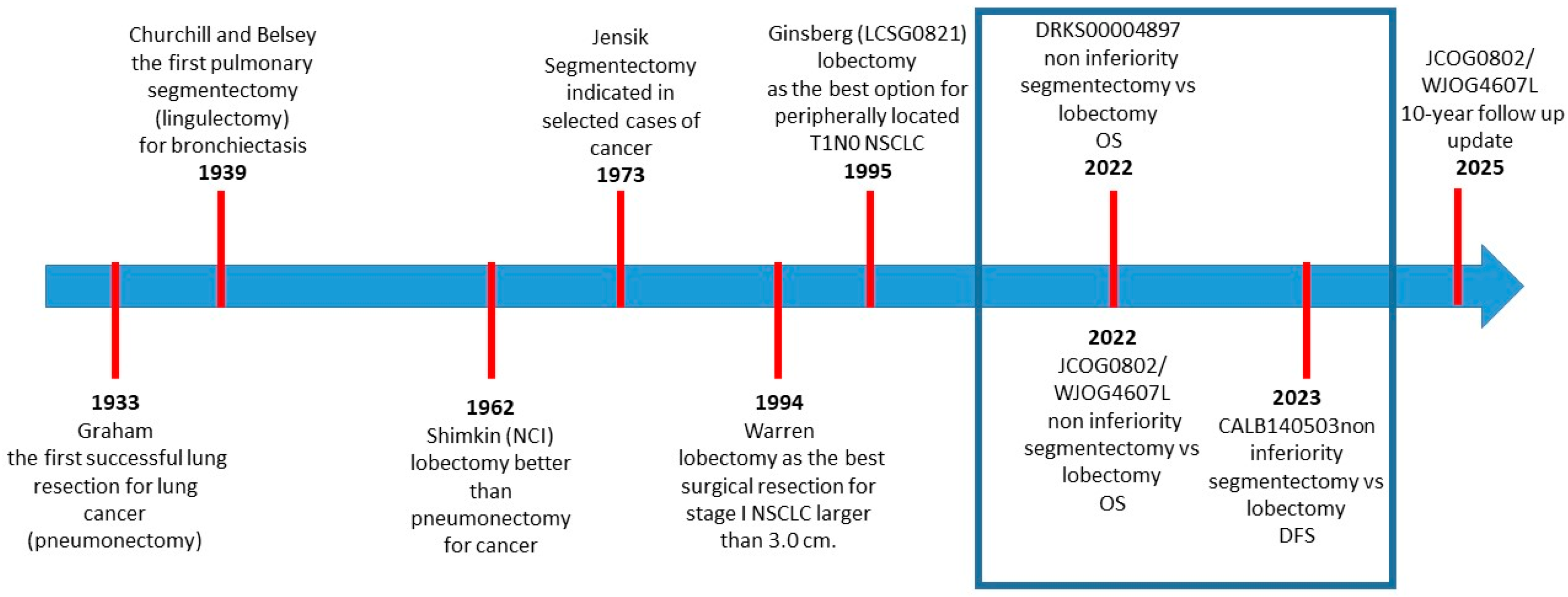
3. Historical Background
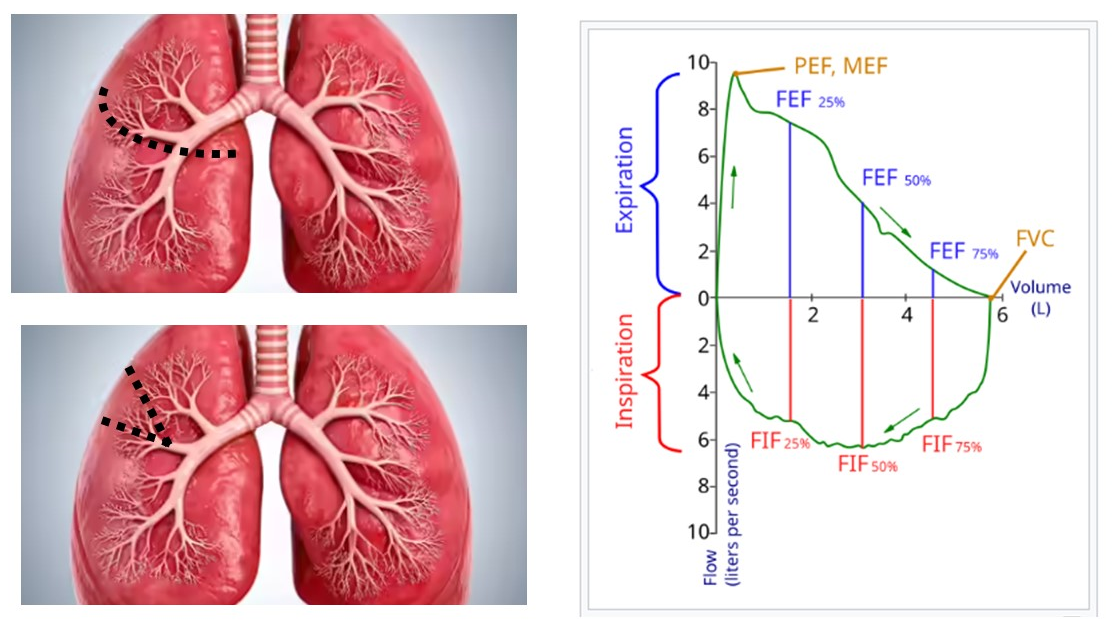
4. Pathophysiology of Pulmonary Function Changes After Lung Resection
4.1. Functional Changes in Randomized Trials
- Segmentectomy group
- o
- 6 months: median FEV1 reduction 10.4% (IQR 4.7–16.6);
- o
- 12 months: median reduction 8.5% (IQR 3.5–14.8).
- Lobectomy group
- o
- 6 months: median FEV1 reduction 13.1% (IQR 7.0–20.5);
- o
- 12 months: median reduction 12.0% (IQR 5.6–18.8).
- 6 months: 2.7% in favor of segmentectomy;
- 12 months: 3.5% in favor of segmentectomy (p < 0.0001).
4.2. CALGB 140503 Trial
- FEV1 (% predicted): median reduction from baseline was −4.0 (95% CI, −5.0 to −2.0) after sublobar resection versus −6.0 (95% CI, −8.0 to −5.0) after lobar resection, corresponding to a 2-percentage-point difference favoring sublobar resection.
- FVC (% predicted): median reduction was −3.0 (95% CI, −4.0 to −1.0) after sublobar resection versus −5.0 (95% CI, −7.0 to −3.0) after lobar resection, again a 2-percentage-point difference favoring sublobar resection [6].
- (a)
- Compromised patients: The functional advantage of sublobar resection may be more clinically relevant in patients with pre-existing airflow limitation (e.g., COPD) or reduced pulmonary reserve, where even small absolute differences in FEV1 may translate into meaningful symptomatic or functional effects.
- (b)
- Lower-lobe disease: Lobectomy for lower-lobe tumors may be associated with greater impairment of pulmonary function due to the larger volume of resected parenchyma and the disproportionate contribution of lower lobes to ventilation.
- (c)
- Single time-point measurement: A single spirometric assessment at 6 months may not fully capture the trajectory of pulmonary function recovery, which may continue to evolve over 12–18 months.
- (d)
- Limitations of spirometry: Spirometry alone may underestimate the true functional impact of resection. The investigators suggested that measures such as the 6-min walk test or cardiopulmonary exercise testing (CPET) may better capture functional preservation.
- FEV1 (L): 2.29 (0.98–3.70) in the segmentectomy group vs. 2.25 (1.2–3.8) in the lobectomy group.
- FEV1 (% predicted): 82.1 (36.5–118.9) vs. 82.8 (32.7–132.0).
- DLCO (mL/mmHg/min): 66.55 (29.6–112.6) vs. 70.36 (34.6–104).
- Vital capacity (L): 3.30 (2.08–4.69) vs. 3.16 (2.41–4.69).
5. Discussion
6. Limitations of Randomized Trials in Assessing Functional Outcomes
- (1)
- Reliance on FEV1 alone, without systematic inclusion of DLCO, cardiopulmonary exercise testing, or patient-reported outcomes as formal endpoints;
- (2)
- Assessment at only one or two postoperative time points, which may not capture the full long-term trajectory of functional recovery;
- (3)
- Inclusion of predominantly physiologically fit patients, limiting generalizability to individuals with impaired baseline pulmonary function who may derive the greatest benefit from parenchyma-sparing strategies;
- (4)
- Insufficient accounting for heterogeneity among segmentectomy techniques and lobe-specific differences in functional recovery;
- (5)
- In CALGB 140503, pooling of wedge resection and segmentectomy may obscure procedure-specific differences in functional preservation.
7. Conclusions
Author Contributions
Funding
Institutional Review Board Statement
Informed Consent Statement
Data Availability Statement
Conflicts of Interest
Abbreviations
| COPD | Chronic obstructive pulmonary disease |
| FEV1 | Forced Expiratory Volume in the 1st second |
| ERS | European Respiratory Society |
| ESTS | European Society of Thoracic Surgeons |
| RCT | Randomized Controlled Trial |
| NSCLC | Non-small-cell lung cancer |
| ACCP | American College of Chest Physicians |
| NCCN | National Comprehensive Cancer Network |
| OS | Overall Survival |
| DLCO | Diffusing Capacity of the Lung for Carbon Monoxide |
| FVC | Forced Vital Capacity |
| PPO | Predicted post-operative |
| FACT L score | Functional Assessment of Cancer Therapy—Lung |
References
- Ginsberg, R.J.; Rubinstein, L.V. Randomized trial of lobectomy versus limited resection for T1 N0 non-small cell lung cancer. Ann. Thorac. Surg. 1995, 60, 615–623. [Google Scholar] [CrossRef] [PubMed]
- Kidane, B.; Bott, M.; Spicer, J.; Backhus, L.; Chaft, J.; Chudgar, N.; Colson, Y.; D’AMico, T.A.; David, E.; Lee, J.; et al. The American Association for Thoracic Surgery (AATS) 2023 Expert Consensus Document: Staging and multidisciplinary management of patients with early-stage non-small cell lung cancer. J. Thorac. Cardiovasc. Surg. 2023, 166, 637–654. [Google Scholar] [CrossRef] [PubMed]
- Saji, H.; Okada, M.; Tsuboi, M.; Nakajima, R.; Suzuki, K.; Aokage, K.; Aoki, T.; Okami, J.; Yoshino, I.; Ito, H.; et al. Segmentectomy versus lobectomy in small-sized peripheral non-small-cell lung cancer (JCOG0802/WJOG4607L): A multicentre, open-label, phase 3, randomised, controlled, non-inferiority trial. Lancet 2022, 399, 1607–1617. [Google Scholar] [CrossRef]
- Nakajima, R.; Saji, H.; Tsuboi, M.; Aokage, K.; Suzuki, K.; Wakabayashi, M.; Nakamura, K.; Fukuda, H.; Takeda, K.; Mitsudomi, T.; et al. LB9. Long-Term Outcomes of Segmentectomy Versus Lobectomy in Small-Sized Peripheral Non-Small Cell Lung Cancer: A 10-Year Follow-Up Analysis of the Phase 3 Randomized Trial (JCOG0802/WJOG4607L); American Association for Thoracic Surgery: Seattle, WA, USA, 2025; Available online: https://www.aats.org/resources/long-term-outcomes-of-segmente-10304 (accessed on 13 April 2026).
- Lim, E. JCOG0802 and CALGB140503: The gap between trial design and clinical application. Lancet Respir. Med. 2026, 14, e22. [Google Scholar] [CrossRef]
- Altorki, N.; Wang, X.; Kozono, D.; Watt, C.; Landrenau, R.; Wigle, D.; Port, J.; Jones, D.R.; Conti, M.; Ashrafi, A.S.; et al. Lobar or sublobar resection for peripheral stage IA non-small-cell lung cancer. N. Engl. J. Med. 2023, 388, 489–498. [Google Scholar] [CrossRef]
- Stamatis, G.; Leschber, G.; Schwarz, B.; Brintrup, D.L.; Flossdorf, S.; Passlick, B.; Hecker, E.; Kugler, C.; Eichhorn, M.; Krbek, T.; et al. Survival outcomes in a prospective randomized multicenter phase III trial comparing anatomical segmentectomy versus standard lobectomy for non-small cell lung cancer up to 2 cm. Lung Cancer 2022, 172, 108–116. [Google Scholar] [CrossRef]
- Brunelli, A.; Hardavella, G.; Huber, R.M.; Berghmans, T.; Frille, A.; Rodriguez, M.; Tietzova, I.; Depypere, L.; Asteggiano, R.; Batchelor, T.; et al. European Respiratory Society and European Society of Thoracic Surgeons clinical practice guideline on fitness for curative intent treatment of lung cancer. Eur. Respir. J. 2025, 66, 2500156. [Google Scholar] [CrossRef]
- Howington, J.; Souter, L.H.; Arenberg, D.; Blasberg, J.; Detterbeck, F.; Farjah, F.; Lanuti, M.; Leighl, N.; Videtic, G.M.; Murthy, S. Management of patients with early-stage non-small cell lung cancer: An American College of Chest Physicians clinical practice guideline. Chest 2025, 168, 810–827. [Google Scholar] [CrossRef]
- National Comprehensive Cancer Network (NCCN). NCCN Clinical Practice Guidelines in Oncology: Non-Small Cell Lung Cancer. Version 5. 2026. Available online: https://www.nccn.org/professionals/physician_gls/pdf/nscl.pdf (accessed on 13 April 2026).
- Bao, M.; Lang, Z.; Wang, Z.; Zhang, X.; Zhao, L. Changes in pulmonary function in lung cancer patients after segmentectomy or lobectomy: A retrospective, non-intervention observational study. Eur. J. Cardiothorac. Surg. 2023, 64, ezad256. [Google Scholar] [CrossRef]
- Graham, E.A. Successful removal of an entire lung for carcinoma of the bronchus. JAMA 1933, 101, 1371–1374. [Google Scholar] [CrossRef]
- Churchill, E.D.; Belsey, R. Segmental pneumonectomy in bronchiectasis: The lingula segment of the left upper lobe. Ann. Surg. 1939, 109, 481–499. [Google Scholar] [CrossRef]
- Laennec, R. A Treatise on the Diseases of the Chest and on Mediate Auscultation; Samuel Wood and Sons: Paris, France, 1819. [Google Scholar]
- Shimkin, M.B.; Connelly, R.R.; Marcus, S.C.; Cutler, S.J. Pneumonectomy and lobectomy in bronchogenic carcinoma. J. Thorac. Cardiovasc. Surg. 1962, 44, 503–519. [Google Scholar] [CrossRef] [PubMed]
- Jensik, R.J.; Faber, L.P.; Milloy, F.J.; Monson, D.O. Segmental resection for lung cancer: A fifteen-year experience. J. Thorac. Cardiovasc. Surg. 1973, 66, 563–572. [Google Scholar] [CrossRef] [PubMed]
- Warren, W.H.; Faber, L.P. Segmentectomy versus lobectomy in patients with stage I pulmonary carcinoma: Five-year survival and patterns of intrathoracic recurrence. J. Thorac. Cardiovasc. Surg. 1994, 107, 1087–1093. [Google Scholar] [CrossRef]
- Petrella, F.; Cara, A.; Cassina, E.M.; Degiovanni, S.; Libretti, L.; Pirondini, E.; Raveglia, F.; Tuoro, A.; Vaquer, S. The role of sublobar resection in early-stage non-small-cell lung cancer. J. Clin. Med. 2024, 13, 5277. [Google Scholar] [CrossRef]
- Brunelli, A.; Kim, A.W.; Berger, K.I.; Addrizzo-Harris, D.J. Physiologic evaluation of the patient with lung cancer being considered for resectional surgery. Chest 2013, 143, e166S–e190S. [Google Scholar] [CrossRef] [PubMed]
- Gu, Z.; Wang, H.; Mao, T.; Ji, C.; Xiang, Y.; Zhu, Y.; Xu, P.; Fang, W. Pulmonary function changes after different extent of pulmonary resection under video-assisted thoracic surgery. J. Thorac. Dis. 2018, 10, 2331–2337. [Google Scholar] [CrossRef]
- Handa, Y.; Tsutani, Y.; Mimae, T.; Miyata, Y.; Okada, M. Postoperative pulmonary function after complex segmentectomy. Ann. Surg. Oncol. 2021, 28, 8347–8355. [Google Scholar] [CrossRef]
- Petrella, F.; Chieco, P.; Solli, P.; Veronesi, G.; Borri, A.; Galetta, D.; Gasparri, R.; Spaggiari, L. Which factors affect pulmonary function after lung metastasectomy? Eur. J. Cardiothorac. Surg. 2009, 35, 792–796. [Google Scholar] [CrossRef]
- Tsubokawa, N.; Mimura, T.; Tadokoro, K.; Yamashita, Y. Risk factors for long-term decline in postoperative pulmonary function after lung resection. Jpn. J. Clin. Oncol. 2023, 53, 245–252. [Google Scholar] [CrossRef]
- Jeon, Y.J.; Shin, S.; Kong, S.; Yang, S.; Cho, J.H.; Kim, H.K.; Shim, Y.M.; Kang, D.; Park, H.Y. Lobe-specific variability in postoperative pulmonary function in lung cancer patients. Respirology 2026, 31, 62–72. [Google Scholar] [CrossRef]
- Zeiher, B.G.; Gross, T.J.; Kern, J.A.; Lanza, L.A.; Peterson, M.W. Predicting postoperative pulmonary function in patients undergoing lung resection. Chest 1995, 108, 68–72. [Google Scholar] [CrossRef] [PubMed]
- Shin, S.; Kong, S.; Kang, D.; Lee, G.; Cho, J.H.; Shim, Y.M.; Cho, J.; Kim, H.K.; Park, H.Y. Longitudinal changes in pulmonary function and patient-reported outcomes after lung cancer surgery. Respir. Res. 2022, 23, 224. [Google Scholar] [CrossRef] [PubMed]
- Yun, T.; Koo, B.J.; Na, K.J.; Lee, S.; Park, J.H.; Na, B.; Park, S.; Lee, H.J.; Park, I.K.; Kang, C.H.; et al. Volumetric compensation after anatomical lung resection. Eur. J. Cardiothorac. Surg. 2025, 67, ezaf428. [Google Scholar] [CrossRef]
- Dai, J.; Sun, F.; Bao, M.; Cao, J.; Jin, K.; Zhang, A.; Zhou, Y.; Zhang, P.; Shi, J.; Jiang, G. Pulmonary function recovery and displacement patterns after segmentectomy vs lobectomy. Ann. Thorac. Surg. 2024, 118, 365–374. [Google Scholar] [CrossRef]
- Altorki, N.; Wang, X.; Damman, B.; Mentlick, J.; Landreneau, R.; Wigle, D.; Jones, D.R.; Conti, M.; Ashrafi, A.S.; Liberman, M.; et al. Lobectomy, segmentectomy, or wedge resection for peripheral cT1aN0 NSCLC: A post hoc analysis of CALGB 140503. J. Thorac. Cardiovasc. Surg. 2024, 167, 338–347.e1. [Google Scholar] [CrossRef] [PubMed]
- Hsia, C.C. Signals and mechanisms of compensatory lung growth. J. Appl. Physiol. 2004, 97, 1992–1998. [Google Scholar] [CrossRef] [PubMed]
- Dane, D.M.; Yilmaz, C.; Estrera, A.S.; Hsia, C.C. Mechanical stimuli for postpneumonectomy compensation. J. Appl. Physiol. 2013, 114, 99–106. [Google Scholar] [CrossRef]
- Ravikumar, P.; Yilmaz, C.; Dane, D.M.; Bellotto, D.J.; Estrera, A.S.; Hsia, C.C.W. Stimuli–response relationship in compensatory lung growth. J. Appl. Physiol. 2014, 116, 816–824. [Google Scholar] [CrossRef]
- Hanaoka, J.; Hayashi, K.; Shiratori, T.; Okamoto, K.; Kataoka, Y.; Kawaguchi, Y.; Ohshio, Y.; Sonoda, A. Pulmonary blood flow after lung resection. J. Thorac. Dis. 2023, 15, 5593–5604. [Google Scholar] [CrossRef]
- Wang, X.; Guo, H.; Hu, Q.; Ying, Y.; Chen, B. Segmentectomy versus lobectomy: Meta-analysis. J. Int. Med. Res. 2021, 49, 1–14. [Google Scholar] [CrossRef]
- Xu, Z.; Li, C.; Ni, Y.; Gu, B.; Zhou, H.; Luo, Y.; Chen, S. Thoracoscopic lobectomy vs. segmentectomy in early NSCLC. Medicine 2025, 104, e45655. [Google Scholar] [CrossRef] [PubMed]
- Brunelli, A.; Tariq, J.; Mittal, A.; Lodhia, J.; Milton, R.; Nardini, M.; Papagiannopoulos, K.; Tcherveniakov, P.; Teh, E.; Chaudhuri, N. Dyspnea after segmentectomy or lobectomy. Eur. J. Cardiothorac. Surg. 2024, 65, ezae200. [Google Scholar] [CrossRef]
- Hassan, M.; Hojski, A.; Oliveira, L.; Gahl, B.; Rüter, F.; Lardinois, D. PROMs after lobar and sublobar resection. J. Thorac. Dis. 2025, 17, 3727–3736. [Google Scholar] [CrossRef]
- Walsh, L.C.; Seitlinger, J.; Gold, M.S.; Sorin, M.; Fermi, F.; Tankel, J.; Rokah, M.; Rayes, R.; Mulder, D.; Sirois, C.; et al. Quality of life after VATS lung resection. J. Thorac. Dis. 2025, 17, 10138–10148. [Google Scholar] [CrossRef]
- Spaggiari, L.; Sedda, G.; Maisonneuve, P.; Tessitore, A.; Casiraghi, M.; Petrella, F.; Galetta, D. Robotic lobectomy survival outcomes. J. Thorac. Oncol. 2019, 14, 2176–2180. [Google Scholar] [CrossRef] [PubMed]
- Casiraghi, M.; Sedda, G.; Del Signore, E.; Piperno, G.; Maisonneuve, P.; Petrella, F.; de Marinis, F.; Spaggiari, L. Surgery for small cell lung cancer. Lung Cancer 2021, 152, 71–77. [Google Scholar] [CrossRef]
- Echavarria, M.F.; Cheng, A.M.; Velez-Cubian, F.O.; Ng, E.P.; Moodie, C.C.; Garrett, J.R.; Fontaine, J.P.; Robinson, L.A.; Toloza, E.M. Robotic lobectomy vs segmentectomy outcomes. Am. J. Surg. 2016, 212, 1175–1182. [Google Scholar] [CrossRef]


| Parameter | Segmentectomy | Lobectomy | Between-Group Difference |
|---|---|---|---|
| Median FEV1 reduction at 6 months | 10.4% (IQR 4.7–16.6) | 13.1% (IQR 7.0–20.5) | 2.7% |
| Median FEV1 reduction at 12 months | 8.5% (IQR 3.5–14.8) | 12.0% (IQR 5.6–18.8) | 3.5% |
| Resection Type | FEV1 Deficit at 6 Months | FVC Deficit at 6 Months |
|---|---|---|
| Wedge resection | ~4–5% | ~3% |
| Segmentectomy | ~3–5% | ~3–5% |
| Lobectomy | ~6–11% | ~5–7% |
| Trial | Population (Key Inclusion) | Spirometric Changes |
|---|---|---|
| CALGB/Alliance 140503 | Peripheral NSCLC, cT1aN0, tumor ≤ 2 cm | FEV1 Deficit at 6 Months Wedge resection: 4–5% Segmentectomy: 3–5% Lobectomy: 6–11% FVC Deficit at 6 Months Wedge resection: 3% Segmentectomy: 3–5% Lobectomy: 5–7% |
| JCOG0802/WJOG4607L | stage IA NSCLC (tumor ≤ 2 cm, consolidation-to-tumor ratio > 0.5) | Median FEV1 reduction at 6 months: Segmentectomy: 10.4% Lobectomy: 13.1% Median FEV1 reduction at 12 months Segmentectomy: 8.5% Lobectomy: 12.0% |
| DRKS00004897 | Stage IA NSCLC (tumors ≤ 2 cm) | Not available in provided sources |
Disclaimer/Publisher’s Note: The statements, opinions and data contained in all publications are solely those of the individual author(s) and contributor(s) and not of MDPI and/or the editor(s). MDPI and/or the editor(s) disclaim responsibility for any injury to people or property resulting from any ideas, methods, instructions or products referred to in the content. |
© 2026 by the authors. Licensee MDPI, Basel, Switzerland. This article is an open access article distributed under the terms and conditions of the Creative Commons Attribution (CC BY) license.
Share and Cite
Petrella, F.; Rizzo, S. Functional Impact of Sublobar Resection for Early Stage Lung Cancers. Cancers 2026, 18, 1632. https://doi.org/10.3390/cancers18101632
Petrella F, Rizzo S. Functional Impact of Sublobar Resection for Early Stage Lung Cancers. Cancers. 2026; 18(10):1632. https://doi.org/10.3390/cancers18101632
Chicago/Turabian StylePetrella, Francesco, and Stefania Rizzo. 2026. "Functional Impact of Sublobar Resection for Early Stage Lung Cancers" Cancers 18, no. 10: 1632. https://doi.org/10.3390/cancers18101632
APA StylePetrella, F., & Rizzo, S. (2026). Functional Impact of Sublobar Resection for Early Stage Lung Cancers. Cancers, 18(10), 1632. https://doi.org/10.3390/cancers18101632