Article

P16 DNA Methylation Coupled with Somatic Copy Number Variations in the Development of Gastric Carcinomas


Key Laboratory of Carcinogenesis and Translational Research (MOE/Beijing), Division of Etiology, Peking University Cancer Hospital and Institute, Beijing 100142, China
*
Author to whom correspondence should be addressed.
Cancers 2026, 18(10), 1605; https://doi.org/10.3390/cancers18101605
Submission received: 11 April 2026 / Revised: 5 May 2026 / Accepted: 12 May 2026 / Published: 15 May 2026
(This article belongs to the Section Cancer Metastasis)

Simple Summary

As one of the genes mostly changed in cancer genomes, CDKN2A/P16 is often inactivated by copy number loss and promoter DNA methylation. It is unknown whether these two inactivation mechanisms are relevant. In this study, we determined the levels of CDKN2A/P16 copy number and DNA methylation in gastric cancer (GC) and paired normal tissue samples from 200 patients. We found for the first time more P16 deletions in GC tissues without vs. with P16 methylation. Both P16 copy number and DNA methylation levels are significantly decreased during GC development and are associated with GC metastasis. Our findings indicate that both somatic copy number deletion and promoter DNA methylation complementarily inactivate CDKN2A/P16 in GC development and promote GC metastasis.

Abstract

Background/Objectives: Tumor suppressor genes are often inactivated by genetic and epigenetic mechanisms. However, whether genetic alterations of these genes, including CDKN2A/P16, are coupled with epigenetic changes in cancer development and progression is unknown. Methods: Freshly frozen gastric carcinoma (GC) samples, paired noncancer surgical margin (SM) samples, white blood cell (WBC) samples, and clinicopathological information were collected from 200 patients. The copy number (CN) of the CDKN2A/P16 gene in these samples was determined by a P16-Light assay and normalized to that in white blood cells (WBCs). The DNA methylation level of the P16 promoter in GC and SM samples was determined by a 115 bp P16-specific MethyLight assay. Results: Both the P16 copy number and the DNA methylation level were significantly lower in GC samples than in SM samples (median, 1.94 vs. 2.14, p < 0.001 for P16 CN; 0.0004 vs. 0.0013, p = 0.002 for P16 methylation) and were associated with GC metastasis. The normalized P16 copy number was significantly lower in GCs without vs. with P16 methylation (p = 0.007). Similarly, more P16 somatic copy number deletions (SCNdel) were detected in GCs without vs. with P16 methylation (38.6% vs. 24.1%, p = 0.027). Conclusions: Somatic P16 copy number variations are closely coupled with P16 promoter DNA methylation during GC development. SCNdel and promoter DNA methylation complementarily inactivate P16 in GC development and promote GC metastasis.

1. Introduction

CDKN2A encodes both P16 and P14 proteins. DNA methylation of CpG islands around the transcription start site (TSS-CGI) of the P16 gene is prevalent in precancerous lesions across organs and drives cancer development and metastasis [1,2,3,4,5]. Our recent findings indicate that both P16 somatic copy number deletion and amplification (SCNdel and SCNamp, respectively) are prevalent in precancerous esophageal squamous cell dysplasia and noncancerous surgical margin (SM) tissues from gastric carcinoma (GC) patients. P16 SCNdel is significantly associated with poor prognosis in patients with ESCdys and GC, whereas P16 SCNamp is associated with good prognosis in patients with these diseases [6,7,8]. Both genetic and epigenetic inactivation of the P16 gene are frequent early driving events in cancer development in humans [9,10].
TSS-CGI hypermethylation not only epigenetically inactivates gene transcription [11] but also causes chromatin condensation. Because P16 inactivation leads to dysfunction of the G1-S checkpoint in the cell cycle via the RB1 pathway [12,13], RB1 loss of function by P16 inactivation may consequently cause replication stress and genome instability [14,15,16]. However, whether somatic copy number variations (SCNVs) are coupled with DNA methylation of the TSS-CGI of genes, including P16, has not been studied previously.
In this study, to investigate the relationship between P16 SCNVs and DNA methylation in cancer development, we compared the P16 SCNV frequency in GC and SM samples with and without P16 TSS-CGI methylation from 200 patients. We revealed for the first time that P16 SCNdel is more prevalent in gastric tissues, mainly in GCs, without P16 methylation than in those with P16 methylation, whereas P16 SCNamp is more prevalent in gastric tissues, mainly in SMs, with P16 methylation than in those without P16 methylation. P16 methylation and the SCNV complementarily promote GC development and metastasis.

2. Methods and Materials

2.1. Patients

The cohort was composed of 200 GC patients, including 140 males and 60 females; 106 and 94 patients with and without lymph metastasis, respectively, who underwent gastrectomy at the Peking University Cancer Hospital from January 2013 to November 2016. GC, SM (5 cm away from the main cancer mass, from the greater curvature on the distal side), and white blood cell (WBC) samples were freshly collected from these patients and stored in a freezer at −80 °C for approximately 8–10 years at the biobank of the hospital. No cancer cells were observed in these SM samples under an optical microscope. Clinicopathological information and overall survival data were collected. Among these 200 patients, 80 were included in our previously published study, in which only data on P16 SCNV, but not P16 methylation data, were available [8]. Detailed information for all 200 patients is listed in Data File S1 and summarized in Table 1. The Institute Review Board of the Peking University Cancer Hospital and Institute approved the study and the patients provided written informed consent to participate.

2.2. Preparation of Genomic DNA

Genomic DNA was extracted from the abovementioned frozen GC, SM, and WBC samples via the phenol/chloroform technique and used for P16 copy number analysis. The GC and SM DNA samples were further modified with sodium bisulfite with an EZ DNA Methylation-Gold Kit (Zymo Research, Tustin, CA, USA) following the manufacturer’s instructions and used for P16 methylation analysis.

2.3. Quantification of P16 Methylation Using the MethyLight Assay

An established 115 bp MethyLight assay [17] was used to quantify the proportion of methylated P16 alleles in triplicate. The COL2A1 gene, which contains no TSS-CGI, was used as an internal reference. When the copy number of methylated P16 relative to COL2A1 was greater than 2.74 × 10⁻⁴ in one of three PCR tubes for a bisulfite-modified DNA sample, the sample was defined as P16 methylation-positive (P16M), P16 methylation-negative otherwise (P16U).

2.4. Quantification of P16 Copy Number Using the P16-Light Assay

CDKN2A/P16 copy number (CN) was quantified using droplet digital PCR based on P16-Light [8,18], in which the copy number of GAPDH was used as an internal reference gene.

2.5. Definitions of CDKN2A/P16 SCNamp and SCNdel

As we defined previously, the average CN of P16 in WBCs from each patient was used as the diploid reference. The difference in the average P16 copy number between the tested (GC or SM) sample and the paired WBC sample was calculated for each patient. When the difference in the copy number was statistically significant (p < 0.05) according to Student’s t test and the absolute fold change was greater than 20%, we defined the sample as P16 SCNamp- or SCNdel-positive, as we previously reported [8].

2.6. Statistical Analysis

We used the Wilcoxon test or Mann–Whitney test to compare the proportion of methylated P16 alleles and Student’s t test or chi-square test to compare P16 copy number between different SM and GC samples or subgroups. Log-rank univariate analysis was used to compare patient overall survival between groups in the K–M analysis. All tests were two-sided, and a p value less than 0.05 indicated statistical significance.

3. Results

3.1. Basic Results of P16 SCNV and P16 Methylation Analyses in GC and Paired SM Samples from 200 Patients

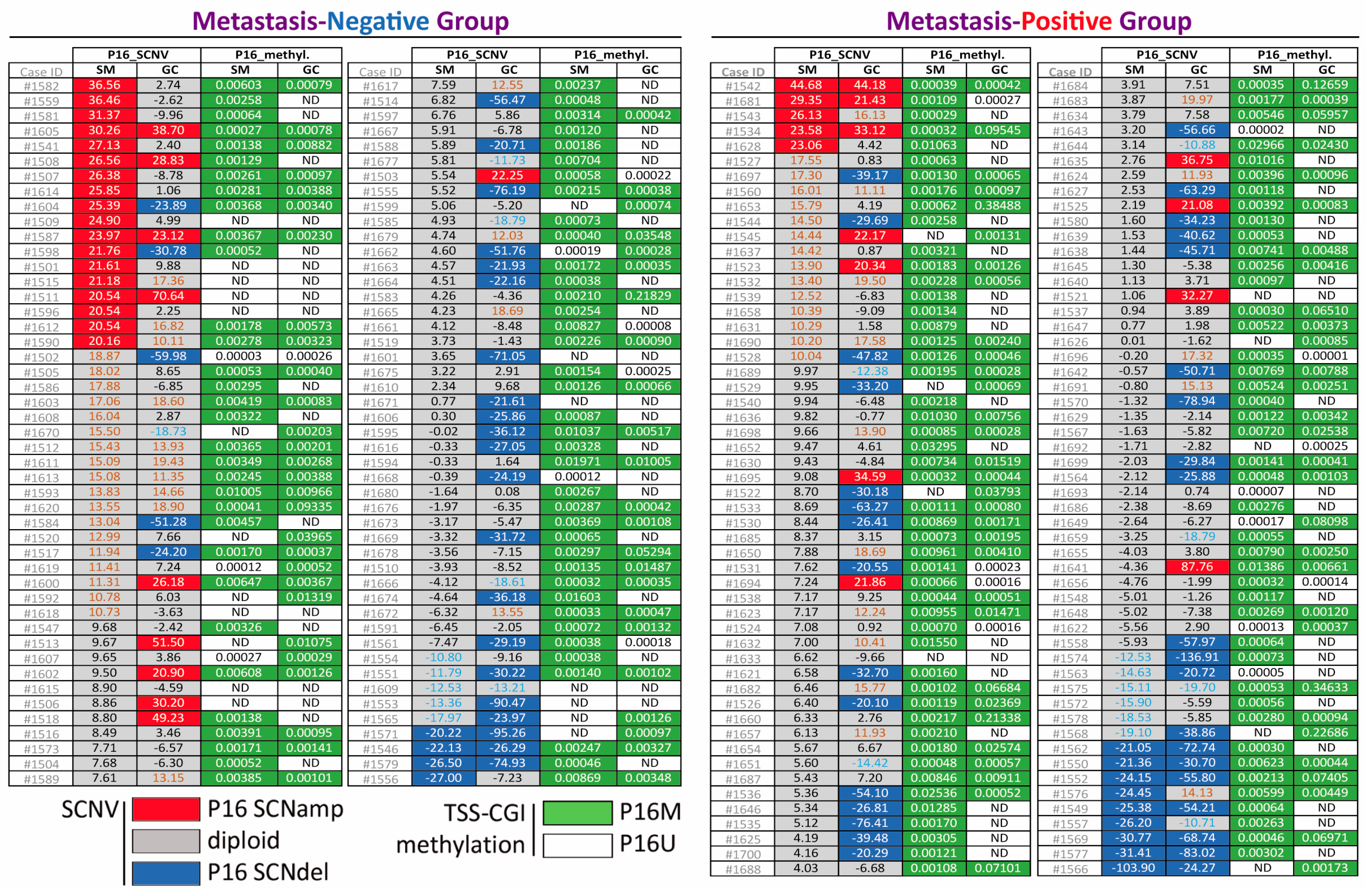
The results of P16 CN and TSS-CGI methylation analyses were obtained with P16-specific droplet digital PCR and MethyLight assays for GC, SM, and WBC samples from all 200 patients (Figure 1). A considerable frequency of P16 SCNamp was observed in both SMs and GCs (11.5% vs. 10.5%). Moreover, P16 SCNdel mostly occurred in GCs rather than SMs (30.5% vs. 6.5%, p < 0.001) (Table 1).
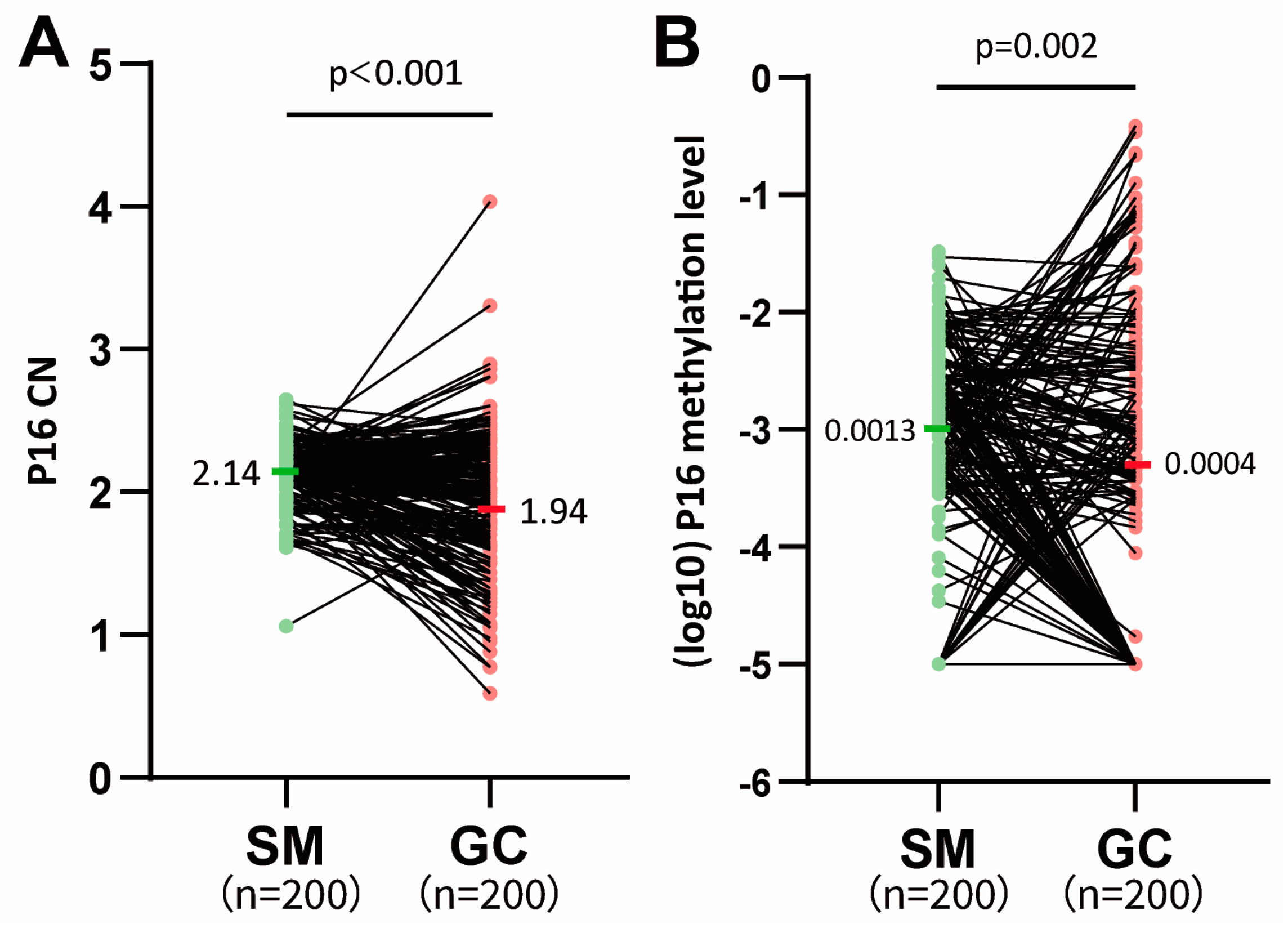
The average P16 CN value was significantly greater in SMs than in GCs (Figure 2A). Similarly, the percentage of P16-methylated samples and the overall prevalence of P16 methylation were significantly greater in SMs than in GCs (81.0% vs. 56.0%, p < 0.001; median, 0.0013 vs. 0.0004, p = 0.002; Figure 2B), although the P16 methylation level for P16M samples was slightly lower in SMs than in GCs (median, 0.0018 vs. 0.0020; Table 2).

3.2. P16 SCNamp Coupled with P16M, Whereas P16 SCNdel Coupled with P16U in Gastric Tissues

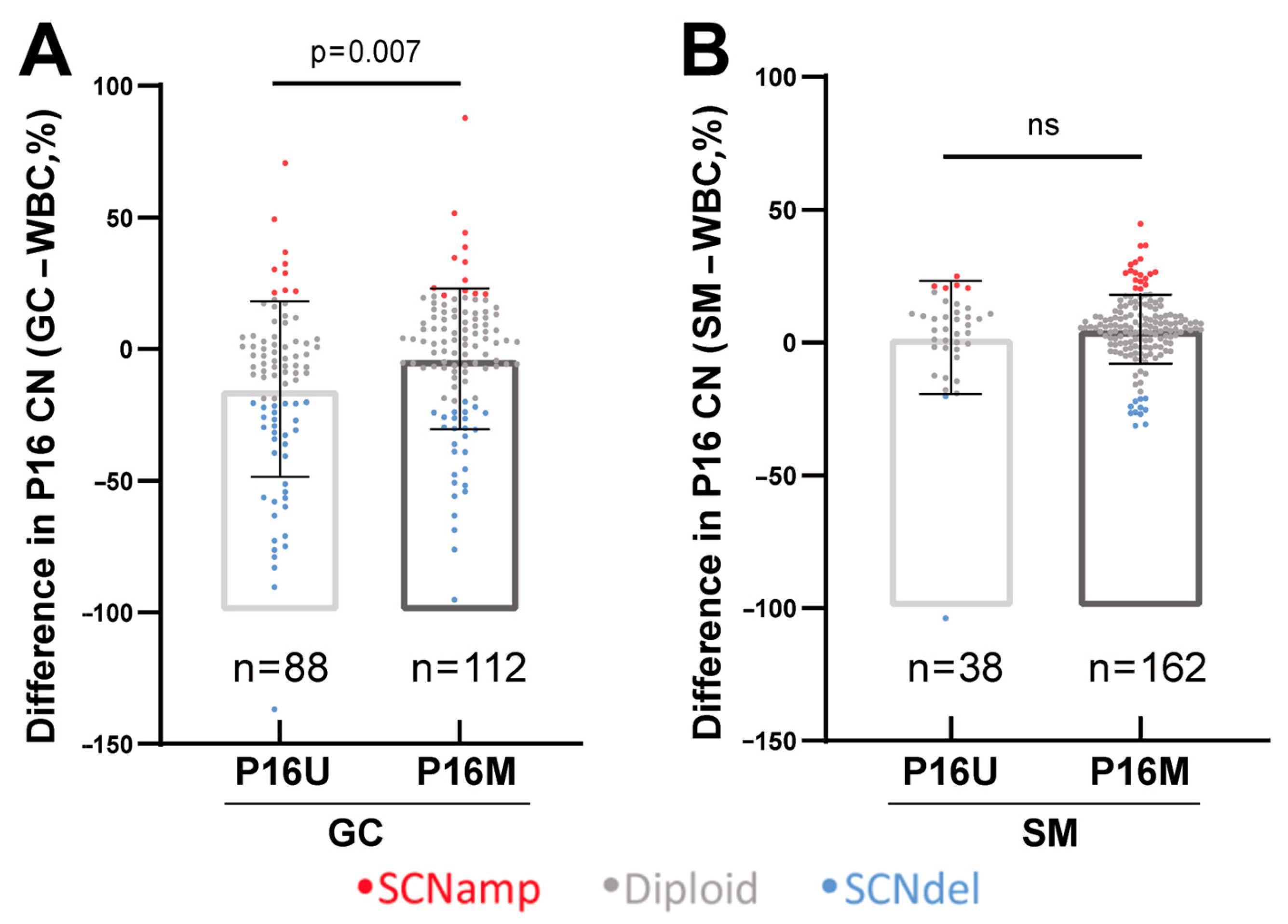
We further compared the level of P16 CN (relative to that in WBCs) in GC and SM samples with and without P16 methylation. We found that the average P16 CN was significantly greater in P16M GC samples (n = 112) than in P16U GC samples (n = 88) (Figure 3A). A similar but nonsignificant difference was also observed in the SM samples (Figure 3B). Notably, more P16 SCNdel was detected in P16U GC samples (34/88 = 38.6%) than in P16M GC samples (27/112 = 24.1%, p = 0.027). These results suggest that P16 SCNdel is closely coupled with P16U, whereas P16 SCNamp is coupled with P16M in gastric cancer tissues from GC patients.

3.3. P16 SCNVs and P16M in GC or SM Samples Are Complementarily Associated with GC Metastasis

Both the average P16 CN value and the P16 SCNamp-positive rate were significantly greater in SMs from patients without vs. with metastasis (2.14 vs. 2.05, p = 0.002 for P16 CN; 19.1% vs. 4.7%, p = 0.004 for P16 SCNamp; Table 1).
In addition, the average P16 CN value and P16 SCNamp-positive rate were significantly greater in poorly differentiated GC samples than in well- or moderately differentiated GC samples (1.96 vs. 1.76, p = 0.004 for P16 CN; 22.9% vs. 45.1%, p = 0.006 for P16 SCNdel; Table 1).
A significant difference in the prevalence of P16 methylation was observed between pTNM I–II and III–IV stage GCs (0.0013 vs. 0.0036, p = 0.037; Table 1); a marginally significant difference also occurred in GCs with or without lymph node metastasis (0.0025 vs. 0.0013, p = 0.097; Table 1); and a difference in the P16 methylation level in SMs was found between poorly and well/moderately differentiated patients (0.0021 vs. 0.0013, p = 0.018; Table 2).
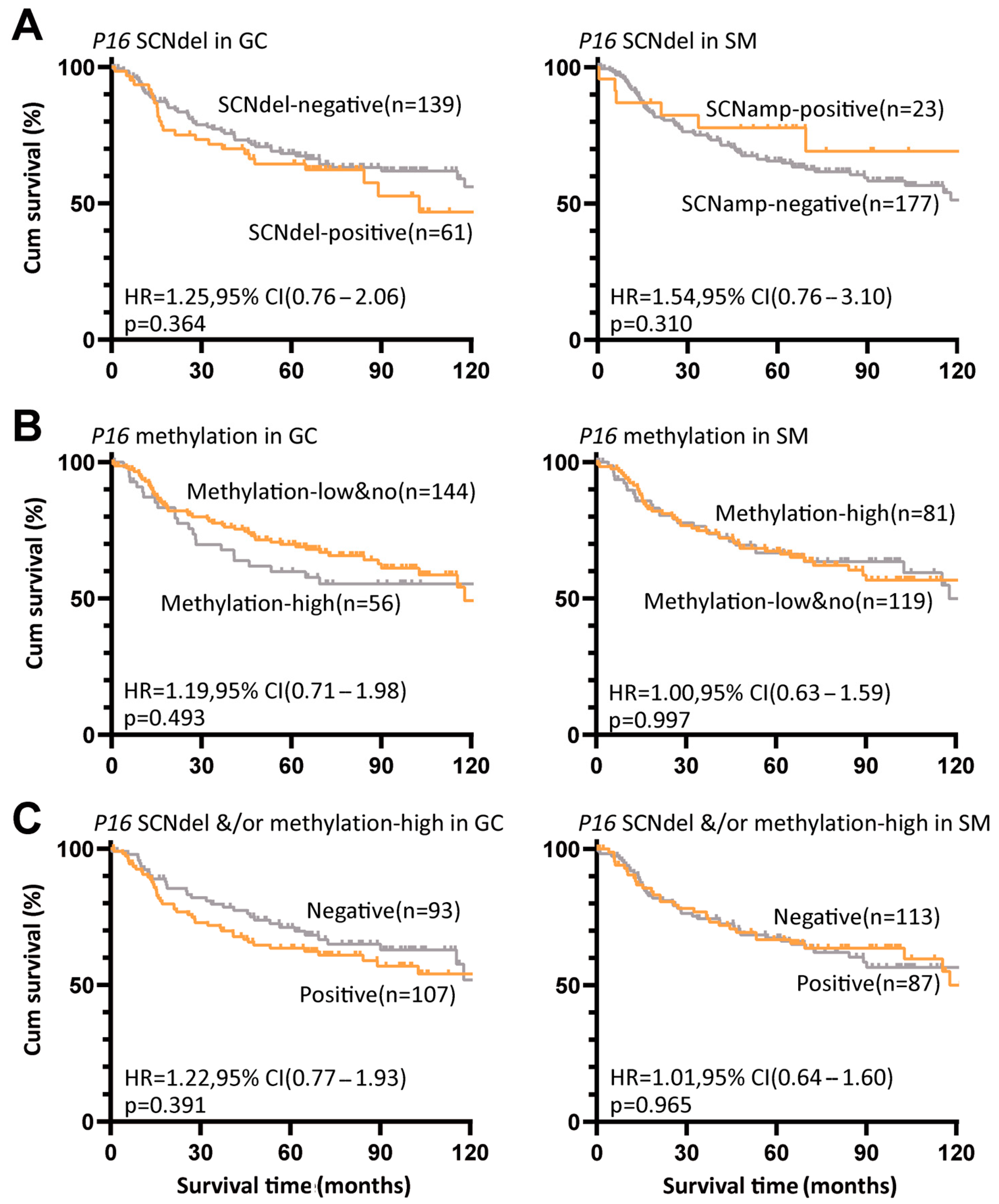
In addition, we further investigated whether the overall survival of patients was associated with P16 SCNVs and methylation. We found that the overall survival of patients with P16 SCNamp-positive SMs or SCNdel-negative GCs was longer than that of patients with SCNamp-negative SMs or SCNdel-positive GCs, but the difference was not statistically significant (Figure 4A). Similar differences in overall survival were also observed between patients with P16 methylation-high and P16 methylation-low/no GCs (Figure 4B). In the combination analysis, no synergistic effect was detected between P16 SCNdel and methylation-high GCs or SMs (Figure 4C).
Taken together, our findings demonstrate that both P16 SCNV and methylation in gastric samples are consistently associated with GC metastasis.

4. Discussions

Tumor suppressor genes are frequently inactivated both genetically and epigenetically in cancer genomes. Inactivation of one copy of tumor suppressor genes by germline point mutations is often subsequently accompanied by epigenetic inactivation of the wild-type copy of these mutant genes by DNA methylation in adult cells, which causes familial cancer [19]. For example, TSS-CGI hypermethylation serves as a frequent “second hit” for wild-type copies of these genes in inherited tumors and consequently causes hereditary diffuse GC and lobular breast cancer [20,21]. However, it is not known whether the SCNVs of tumor suppressor genes, including P16, are derived from TSS-CGI-methylated or nonmethylated genes in sporadic cancer genomes. Here, we report for the first time, to the best of our knowledge, that more P16 SCNdel was detected in P16U GC samples, whereas more P16 SCNamp was detected in P16M gastric samples. In addition, our findings indicate that GC metastasis is significantly associated with a decrease in P16 CN and an increase in P16 TSS-CGI methylation in gastric samples from GC patients.
As with the CDH1 gene, one-allele inactivation of CDKN2A/P16 leads to a high predisposition to familial cancers, indicating that it is a haplotype-insufficient gene [19,20,21]. CDH1 is frequently inactivated in adult cells harboring a germline mutation of one CDH1 allele [20,21]. Similar phenomena also occur in P16. For example, one P16 allele is inactivated by a frame-shift mutation and another P16 allele is inactivated by DNA methylation in human colon HCT116 cancer cells [22]. It is not known whether there is causality between frame-shift mutation and DNA methylation in P16.
Although we observed a correlation between P16 SCNamp and TSS-CGI methylation in gastric tissues from 200 patients in this study, we do not know whether both P16 SCNamp and TSS-CGI methylation occur at the same alleles or within the same cells. Whether these are two consequent or independent events is worthy of further study.
We previously reported that P16 methylation or SCNdel increases the risk of GC metastasis [5,7,8]. In the present study, we simultaneously analyzed the states of P16 methylation and SCNVs in GC and SM samples and reported that the levels of both P16 CN and methylation correlated with GC lymph metastasis, suggesting a true role for P16 inactivation in cancer metastasis. Our findings are consistent with studies using mouse models [7,11,23]. That P16 SCNamp is coupled with DNA methylation might also contribute to the lack of significant difference in overall survival if amplified P16 alleles are silenced by DNA methylation. A correlation between GC metastasis and P16 CN or DNA methylation was observed at the same time point without interference from clinical management or socioeconomic status whereas a correlation between overall survival and P16 alterations was observed at different time points with interference from these factors. The interference effect may account for the inconsistency between metastasis and overall survival.
Copy number deletion of CDKN2A/B is linked to early recurrence of meningioma. Although genome-wide DNA methylation and homozygous CDKN2A/B deletions are used for the classification of central nervous system tumors [24,25], whether a synergetic effect exists between CDKN2A/P16 TSS-CGI methylation and heterozygous deletion and whether P16 DNA methylation alone are prognosis factors are unknown.
In our previous study involving 80 GC patients [5], which was also included in the present study, we reported that the P16 SCNamp in SMs correlated not only with a low risk of GC metastasis but also with long overall survival. However, in this study involving 200 GC patients, we observed that the P16 SCNamp in SMs correlated only with a low risk of GC metastasis, but we did not observe a significant difference in overall survival. The small number of patients with P16 SCNamp in SMs (23/200 = 11.5%) may account for the fluctuation.

5. Conclusions

Our study involving 200 GC patients revealed that P16 SCNVs are coupled with the methylation status of the P16 TSS-CGI in GC development and that SCNdel and TSS-CGI methylation complementarily inactivate P16 and are associated with GC metastasis. While P16 SCNdel coupled with TSS-CGI nonmethylation in gastric tissue samples, P16 SCNamp coupled with TSS-CGI methylation in the samples implies that the amplified P16 alleles may be silenced by DNA methylation during GC development.

Supplementary Materials

The following supporting information can be downloaded at: https://www.mdpi.com/article/10.3390/cancers18101605/s1, Data File S1: Information for 200 patients.

Author Contributions

Conceptualization, D.D.; methodology, J.Z. and L.D.; validation, Z.Y. and J.Z.; formal analysis, Z.Y., J.Z., and L.D.; resources, J.Q. and L.G.; data curation, Z.Y. and D.D.; writing—original draft preparation, D.D. and Z.Y.; writing—review and editing, D.D.; visualization, Z.Y. and D.D.; supervision, D.D.; project administration, D.D.; funding acquisition, D.D. All authors have read and agreed to the published version of the manuscript.

Funding

This work was supported by the National Natural Science Foundation of China (grant number 82372586).

Institutional Review Board Statement

The Institute Review Board of the Peking University Cancer Hospital and Institute approved the study (protocol code #2023KT141 on 25 September 2023).

Informed Consent Statement

The patients provided written informed consent to participate in this study.

Data Availability Statement

The original contributions presented in this study are included in the article. Further inquiries can be directed to the corresponding author.

Conflicts of Interest

The authors declare that they have no competing interests.

Abbreviations

The following abbreviations are used in this manuscript:
CNCopy number
GCgastric carcinoma
P16MP16 methylation positive
P16UP16 methylation negative
SCNampsomatic copy number amplification
SCNdelsomatic copy number deletion
SCNVssomatic copy number variation
SMsurgical margin
TSS-CGICpG islands around the transcription starting site
WBCwhite blood cell

References

  1. Sun, Y.; Deng, D.; You, W.-C.; Bai, H.; Zhang, L.; Zhou, J.; Shen, L.; Ma, J.-L.; Xie, Y.-Q.; Li, J.-Y. Methylation of p16 CpG Islands Associated with Malignant Transformation of Gastric Dysplasia in a Population-Based Study. Clin. Cancer Res. 2004, 10, 5087–5093. [Google Scholar] [CrossRef]
  2. Cao, J.; Zhou, J.; Gao, Y.; Gu, L.; Meng, H.; Liu, H.; Deng, D. Methylation of p16 CpG Island Associated with Malignant Progression of Oral Epithelial Dysplasia: A Prospective Cohort Study. Clin. Cancer Res. 2009, 15, 5178–5183. [Google Scholar] [CrossRef]
  3. Liu, H.; Liu, X.-W.; Dong, G.; Zhou, J.; Liu, Y.; Gao, Y.; Liu, X.-Y.; Gu, L.; Sun, Z.; Deng, D. P16 Methylation as an Early Predictor for Cancer Development from Oral Epithelial Dysplasia: A Double-blind Multicentre Prospective Study. EBioMedicine 2015, 2, 432–437. [Google Scholar] [CrossRef] [PubMed]
  4. Zhang, X.; Li, P.; Gan, Y.; Xiang, S.; Gu, L.; Zhou, J.; Zhou, X.; Wu, P.; Zhang, B.; Deng, D. Driving effect of P16 methylation on telomerase reverse transcriptase-mediated immortalization and transformation of normal human fibroblasts. Chin. Med. J. 2024, 138, 332–342. [Google Scholar] [CrossRef] [PubMed]
  5. Luo, D.; Zhang, B.; Lv, L.; Xiang, S.; Liu, Y.; Ji, J.; Deng, D. Methylation of CpG islands of p16 associated with progression of primary gastric carcinomas. Lab. Investig. 2006, 86, 591–598. [Google Scholar] [CrossRef]
  6. Fan, Z.; Zhou, J.; Tian, Y.; Qin, Y.; Liu, Z.; Gu, L.; Dawsey, S.M.; Wei, W.; Deng, D. Somatic CDKN2A copy number variations are associated with the prognosis of esophageal squamous cell dysplasia. Chin. Med. J. 2024, 137, 980–989. [Google Scholar] [CrossRef]
  7. Qiao, J.; Tian, Y.; Cheng, X.; Liu, Z.; Zhou, J.; Gu, L.; Zhang, B.; Zhang, L.; Ji, J.; Xing, R.; et al. CDKN2A Deletion Leading to Hematogenous Metastasis of Human Gastric Carcinoma. Front. Oncol. 2021, 11, 801219. [Google Scholar] [CrossRef]
  8. Deng, L.; Zhou, J.; Sun, Y.; Hu, Y.; Qiao, J.; Liu, Z.; Gu, L.; Lin, D.; Zhang, L.; Deng, D. CDKN2A somatic copy number amplification in normal tissues surrounding gastric carcinoma reduces cancer metastasis risk in droplet digital PCR analysis. Gastric Cancer 2024, 27, 986–997. [Google Scholar] [CrossRef]
  9. Merlo, A.; Herman, J.G.; Mao, L.; Lee, D.J.; Gabrielson, E.; Burger, P.C.; Baylin, S.B.; Sidransky, D. 5′ CpG island methylation is associated with transcriptional silencing of the tumour suppressor p16/CDKN2/MTS1 in human cancers. Nat. Med. 1995, 1, 686–692. [Google Scholar] [CrossRef] [PubMed]
  10. Mao, L.; Lee, J.S.; Fan, Y.H.; Ro, J.Y.; Batsakis, J.G.; Lippman, S.; Hittelman, W.; Hong, W.K. Frequent microsatellite alterations at chromosomes 9p21 and 3p14 in oral premalignant lesions and their value in cancer risk assessment. Nat. Med. 1996, 2, 682–685. [Google Scholar] [CrossRef]
  11. Cui, C.; Gan, Y.; Gu, L.; Wilson, J.; Liu, Z.; Zhang, B.; Deng, D. P16-specific DNA methylation by engineered zinc finger methyltransferase inactivates gene transcription and promotes cancer metastasis. Genome Biol. 2015, 16, 252. [Google Scholar] [CrossRef] [PubMed]
  12. Serrano, M.; Hannon, G.J.; Beach, D. A new regulatory motif in cell-cycle control causing specific inhibition of cyclin D/CDK4. Nature 1993, 366, 704–707. [Google Scholar] [CrossRef] [PubMed]
  13. Weng, W.; Zhang, B.; Deng, D. P16INK4A drives RB1 degradation by UTP14A-catalyzed K810 ubiquitination. iScience 2024, 27, 110882. [Google Scholar] [CrossRef] [PubMed]
  14. Witkiewicz, A.K.; Venkata, S.A.K.; Knudsen, E.S.; Kumarasamy, V. RB loss sensitizes triple-negative breast cancer to apoptosis induced by cellular stress. Cell Death Discov. 2025, 11, 543. [Google Scholar] [CrossRef]
  15. Zamalloa, L.G.; Pruitt, M.M.; Hermance, N.M.; Gali, H.; Flynn, R.L.; Manning, A.L. RB loss sensitizes cells to replication-associated DNA damage after PARP inhibition by trapping. Life Sci. Alliance 2023, 6, e202302067. [Google Scholar] [CrossRef]
  16. Gadhikar, M.A.; Zhang, J.; Shen, L.; Rao, X.; Wang, J.; Zhao, M.; Kalu, N.N.; Johnson, F.M.; Byers, L.A.; Heymach, J.; et al. CDKN2A/p16 Deletion in Head and Neck Cancer Cells Is Associated with CDK2 Activation, Replication Stress, and Vulnerability to CHK1 Inhibition. Cancer Res. 2018, 78, 781–797. [Google Scholar] [CrossRef]
  17. Zhou, J.; Cao, J.; Lu, Z.; Liu, H.; Deng, D. A 115-bp MethyLight assay for detection of p16 (CDKN2A) methylation as a diagnostic biomarker in human tissues. BMC Med. Genet. 2011, 12, 67. [Google Scholar] [CrossRef]
  18. Tian, Y.; Zhou, J.; Qiao, J.; Liu, Z.; Gu, L.; Zhang, B.; Lu, Y.; Xing, R.; Deng, D. Detection of somatic copy number deletion of the CDKN2A gene by quantitative multiplex PCR for clinical practice. Front. Oncol. 2022, 12, 1038380. [Google Scholar] [CrossRef]
  19. Esteller, M.; Fraga, M.F.; Guo, M.; Garcia-Foncillas, J.; Hedenfalk, I.; Godwin, A.K.; Trojan, J.; Vaurs-Barrière, C.; Bignon, Y.J.; Ramus, S.; et al. DNA methylation patterns in hereditary human cancers mimic sporadic tumorigenesis. Hum. Mol. Genet. 2001, 10, 3001–3007. [Google Scholar] [CrossRef] [PubMed]
  20. Machado, J.C.; Oliveira, C.; Carvalho, R.; Soares, P.; Berx, G.; Caldas, C.; Seruca, R.; Carneiro, F.; Sobrinho-Simöes, M. E-cadherin gene (CDH1) promoter methylation as the second hit in sporadic diffuse gastric carcinoma. Oncogene 2001, 20, 1525–1528. [Google Scholar] [CrossRef]
  21. Corso, G.; Magnoni, F.; Molin, M.D.; Marino, E.; Nicosia, L.; Pesapane, F.; Noonan, D.M.; Albini, A. Second-hit CDH1 gene mechanisms in hereditary diffuse gastric and lobular breast cancer syndrome: Frequency and impact on tumorigenesis. Hum. Mol. Genet. 2025, 34, 1345–1352. [Google Scholar] [CrossRef] [PubMed]
  22. Qin, S.; Li, Q.; Zhou, J.; Liu, Z.; Su, N.; Wilson, J.; Lu, Z.; Deng, D. Homeostatic maintenance of allele-specific p16 methylation in cancer cells accompanied by dynamic focal methylation and hydroxymethylation. PLoS ONE 2014, 9, E97785. [Google Scholar] [CrossRef]
  23. Chen, S.; Sanjana, N.E.; Zheng, K.; Shalem, O.; Lee, K.; Shi, X.; Scott, D.A.; Song, J.; Pan, J.Q.; Weissleder, R.; et al. Genome-wide CRISPR Screen in a Mouse Model of Tumor Growth and Metastasis. Cell 2015, 160, 1246–1260. [Google Scholar] [CrossRef] [PubMed]
  24. Capper, D.; Jones, D.; Sill, M.; Hovestadt, V.; Schrimpf, D.; Sturm, D.; Koelsche, C.; Sahm, F.; Chaves, L.; Reuss, D.E.; et al. DNA methylation-based classification of central nervous system tumors. Nature 2018, 555, 469–474. [Google Scholar] [CrossRef]
  25. Ippen, F.M.; Hielscher, T.; Patel, A.; Friedel, D.; Göbel, K.; Sievers, P.; Acker, T.; Snuderl, M.; Brandner, S.; Weller, M.; et al. The prognostic impact of CDKN2A/B hemizygous deletions in meningioma. Neuro Oncol. 2026. [Google Scholar] [CrossRef]
Figure 1. Detailed results of P16 SCNV and methylation analyses for GC and SM samples from all 200 patients with and without metastasis. The exact differences in P16 CNs between WBCs and GCs or SMs and P16 methylation levels are listed for each GC or SM sample. SCNamp (marked in red) or SCNdel (marked in blue), somatic copy number amplification or deletion, respectively; P16M (marked in green) or P16U (marked in white), P16 TSS-CGI methylation-positive or -negative, respectively.
Cancers 18 01605 g001
Figure 2. Comparison of P16 CN and TSS-CGI methylation levels in GC and paired SM samples from 200 patients. (A) P16 CN level (relative to WBC); (B) level of methylated P16 (relative to COL2A1); GC and paired SM samples from the same patient are linked with a black line. The average P16 CN and P16 methylation values (median) are labeled.
Cancers 18 01605 g002
Figure 3. Comparison of differences in P16 CN between gastric tissue samples with and without P16 methylation from 200 patients. Percentage change in the P16 CN in (A) GCs and (B) SMs relative to that in WBCs; the SCNV types are labeled with different colors. P16M and P16U, P16 TSS-CGI methylation-positive and -negative, respectively. ns, not significant.
Cancers 18 01605 g003
Figure 4. Overall survival curves for GC patients with different states of P16 SCNVs and TSS-CGI methylation in gastric tissues according to K–M analyses. (A) Overall survival curves for patients with and without P16 SCNdel in GCs or SCNamp in SMs; (B) Overall survival curves for patients with and without P16 methylation-high in GCs or SMs; (C) Overall survival curves for patients with and without P16 SCNdel &/or methylation-high in GCs or SMs. The hazard ratio (HR), 95% CI, and p-value are labeled according to log-rank univariate analysis.
Cancers 18 01605 g004
Table 1. Prevalence of somatic copy number variations (SCNVs) of the P16 gene in GC and SM samples from 200 patients.
GCSM
P16 CN aCase Number for P16 SCNV (%) bP16 CNCase Number for P16 SCNV (%)
nMean ± SDp Value cSCNdelDiploidSCNampp Value dMean ± SDp ValueSCNdelDiploidSCNampp Value
Age (yr)≤60801.95 ± 0.410.16420 (25.0)49 (61.3)11 (13.7)0.2492.08 ± 0.230.5086 (7.5)65 (81.3)9 (11.2)0.895
 >601201.86 ± 0.48 41 (34.2)69 (57.5)10 (8.3) 2.10 ± 0.22 7 (5.8)99 (82.5)14 (11.7) 
SexMale1401.89 ± 0.480.92444 (31.4)81 (57.9)15 (10.7)0.8802.10 ± 0.220.8338 (5.7)115 (82.1)17 (12.2)0.736
 Female601.90 ± 0.39 17 (28.3)37 (61.7)6 (10.0) 2.09 ± 0.22 5 (8.3)49 (81.7)6 (10.0) 
NeoadjuvantYes641.95 ± 0.450.19317 (26.6)37 (57.8)10 (15.6)0.2402.09 ± 0.270.8574 (6.3)49 (76.6)11 (17.1)0.224
chemotherapyNo1361.86 ± 0.46 44 (32.4)81 (59.6)11 (8.0) 2.09 ± 0.19 9 (6.6)115 (84.6)12 (8.8) 
GC locationNoncardiac1411.92 ± 0.430.19241 (29.1)84 (59.6)16 (11.3)0.7152.09 ± 0.230.63510 (7.1)116 (82.3)15 (10.6)0.752
 Cardiac591.83 ± 0.51 20 (33.9)34 (57.6)5 (8.5) 2.10 ± 0.21 3 (5.1)48 (81.4)8 (13.5) 
Differentiation eWell or mod.711.76 ± 0.50 0.004 32 (45.1)32 (45.1)7 (9.8)0.0062.07 ± 0.270.4567 (9.9)54 (76.1)10 (14.0)0.186
 Poor1181.96 ± 0.43 27 (22.9)77 (65.3)14 (11.8) 2.10 ± 0.18 6 (5.1)102 (86.4)10 (8.5) 
pTNM stageI–II1171.91 ± 0.450.55834 (29.1)71 (60.7)12 (10.2)0.8422.12 ± 0.230.0208 (6.8)89 (76.1)20 (17.1)0.012
 III-IV831.87 ± 0.46 27 (32.5)47 (56.6)9 (10.9) 2.05 ± 0.21 5 (6.0)75 (90.4)3 (3.6) 
Local invasionT1–2451.86 ± 0.460.57317 (37.8)24 (53.3)4 (8.9)0.4802.10 ± 0.260.7066 (13.3)32 (71.1)7 (15.6)0.054
 T3–41551.90 ± 0.46 44 (28.4)94 (60.6)17 (11.0) 2.09 ± 0.21 7 (4.5)132 (85.2)16 (10.3) 
LymphN0941.91 ± 0.450.58926 (27.7)58 (61.7)10(10.6)0.7082.14 ± 0.220.0024 (4.3)72 (76.6)18 (19.1)0.004
metastasisN1−X f1061.88 ± 0.47 35 (33.0)60 (56.6)11 (10.4) 2.05 ± 0.21 9 (8.5)92 (86.8)5 (4.7) 
(Total) 2001.89 ± 0.46 61 (30.5) g118 (59.0)21 (10.5) 2.09 ± 0.22 13 (6.5)164 (82.0)23 (11.5) 
a P16 copy number (CN) in GC or SM was adjusted by that of WBC from the same patient; b somatic copy number variations in P16 relative to WBC from the same patient; SCNdel or SCNamp: the difference in P16 CN between WBC and tested tissue is ≤ 80% or ≥ 120% and p < 0.05 according to Student’s t test; c Student’s t test; d chi-square test; e no differentiation information for 11 cases; f including 7 cases with distant metastasis; g GC vs. SM, p < 0.001.
Table 2. The prevalence of P16 methylation in gastric adenocarcinoma (GC) and surgical margin (SM) tissue samples from 200 patients.
Prevalence of P16 Methylation
GCSM
nPositive Rate (%)Methylation Level (Median, 25–75%) a,bp Value cPositive Rate (%)Methylation Level (Median, 25–75%)p Value c
Age (yr)≤608052 (65.0)0.20 (0.08–0.71)0.58069 (86.3)0.18 (0.07–0.37)0.524
 >6012060 (50.0)0.20 (0.07–2.19) 93 (77.5)0.19 (0.07–0.39) 
SexMale14078 (55.7)0.14 (0.07–1.48)0.437111 (79.3)0.17 (0.07–0.33)0.164
 Female6034 (56.7)0.34 (0.08–0.98) 51 (85.0)0.23 (0.07–0.62) 
NeoadjuvantYes6433 (51.6)0.12 (0.06–0.52)0.29348 (75.0)0.14 (0.05–0.27) 0.011
chemotherapyNo13679 (58.1)0.32 (0.08–1.47) 114 (83.8)0.21 (0.09–0.60) 
GC locationNoncardiac14185 (60.3)0.20 (0.08–0.99)0.724119 (84.4)0.19 (0.07–0.42)0.383
 Cardiac5927 (45.8)0.12 (0.07–3.79) 43 (72.9)0.14 (0.06–0.31)
DifferentiationWell or mod.7130 (42.3)0.19 (0.08–1.65)0.87356 (78.9)0.13 (0.06–0.29)0.018
 Poor11875 (63.6)0.20 (0.07–1.32) 99 (83.9)0.21 (0.11–0.40) 
pTNM stageI–II11764 (54.7)0.13 (0.06–0.51)0.03790 (76.9)0.21 (0.07–0.37)0.950
 III–IV8348 (57.8)0.36 (0.08–2.57) 72 (86.7)0.17 (0.07–0.52) 
Local invasionT1–24525 (55.6)0.13 (0.06–1.14)0.66339 (86.7)0.21 (0.07–0.37)0.842
 T3–415587 (56.1)0.20 (0.08–1.08) 123 (79.4)0.18 (0.07–0.39) 
LymphN09451 (54.3)0.13 (0.07–0.52)0.09770 (74.5)0.23 (0.07–0.37)0.627
metastasisN1−X10661 (57.5)0.25 (0.07–2.56) 92 (86.8)0.16 (0.07–0.52) 
(Total) 200112 (56.0) d0.20 (0.07–1.06) 162 (81.0)0.18 (0.07–0.37) 
a for P16M samples; b ×10−2; c Mann–Whitney test; d GC vs. SM, p = 0.002.
Disclaimer/Publisher’s Note: The statements, opinions and data contained in all publications are solely those of the individual author(s) and contributor(s) and not of MDPI and/or the editor(s). MDPI and/or the editor(s) disclaim responsibility for any injury to people or property resulting from any ideas, methods, instructions or products referred to in the content.