Breast Cancer Milieu Maneuvers Cancer-Associated Macrophages to Synergize Neoplastic Repertoires


Simple Summary
Abstract
1. Introduction
1.1. Introduction of Breast Cancer
1.2. Introduction of Tumor Microenvironment (TME) and Cancer-Associated Macrophages (TAMs)
2. Tumor Microenvironmental Factors Influence Polarization of TAMs
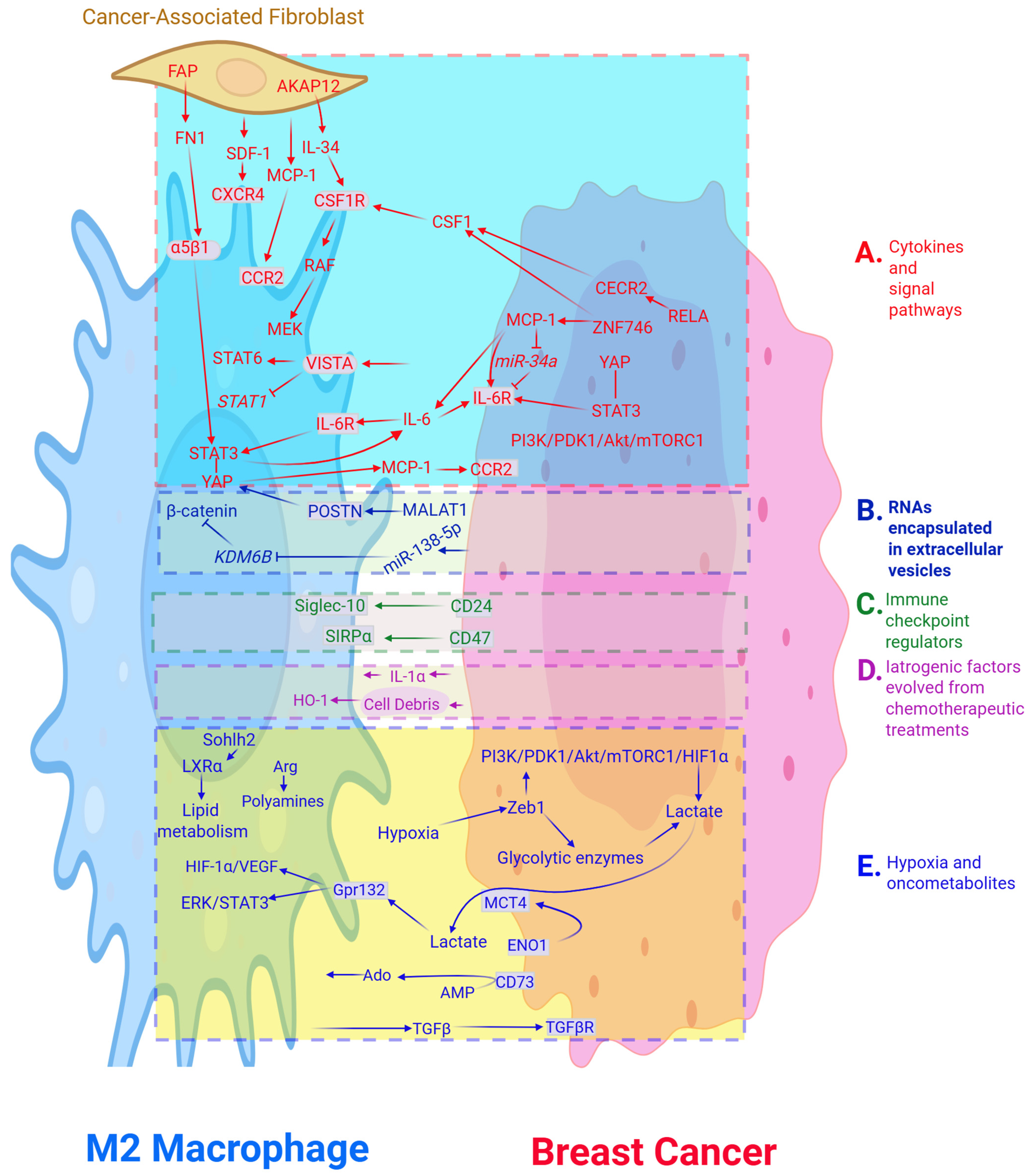
2.1. Cytokines and Signal Pathways Interplay Between Malignant BC and TAMs Can Orchestrate M2 Polarization
2.1.1. Colony Stimulating Factor 1 (CSF1) from BC Binds Receptor (CSF1R) on TAMs
2.1.2. Crosstalk Between Signal Transducer and Activator of Transcription (STAT)3, IL-6, and Yes-Associated Protein (YAP) Pathways Regulate TAM Polarization

2.1.3. Plasticity of TAMs Can Be Modulated by Signaling Cascades Comprising Phosphatidylinositol 3-Kinase (PI3K)/Phosphoinositide-Dependent Kinase 1 (PDK)1/Protein Kinase B (Akt)/Mammalian Target of Rapamycin Complex (mTORC)1 and Zinc Finger Protein 746 (ZNF746)
2.1.4. Epigenetic Perturbations Influence TAM Polarization Through Aberrant Signaling Pathways
2.1.5. Factors Evolved from Cancer-Associated Fibroblasts (CAFs) Favor M2 Polarization
2.2. Plasticity of TAMs Can Be Modulated by RNAs Encapsulated in EVs
2.3. Immune Checkpoint Blockades (ICBs) Maneuver TAM Polarization
2.4. Iatrogenic Factors Evolved from Post-Chemotherapeutic Treatments Augment TAM Polarization Towards M2
2.4.1. Heme Oxygenase-1 (HO-1)
2.4.2. IL-1α
2.5. Hypoxia and Oncometabolites Govern TAM Polarization
2.5.1. Hypoxia Favors M2 Polarization
2.5.2. Lactate Metabolism Governs M2 Polarization
2.5.3. Arginine Metabolism Regulates M2 Polarization
2.5.4. Adenosine Generated by Cluster of Differentiation (CD)73 Orchestrates M2 Polarization
2.5.5. Lipid Metabolism Steers M2 Polarization
3. Advancements in TAM Studies
4. Pitfalls of TAM-Targeting Therapies
4.1. Low Specificity Results in Off-Target Side Effects
4.2. Compensatory Feedback Pathways Confer Unsatisfied Efficacy in Treatment Regimens
4.3. Leaping Translation and Knowledge Gaps Prior to Achieving Clinal Efficacies
5. Conclusions and Future Directions

| Therapy | Target | BC Subtype Studied | Rationale | Reference(s) |
|---|---|---|---|---|
| CSF1R inhibitor | CSF1R | TNBC | CSF1 augments polarization of TAMs toward M2. | [39] |
| CSF1R/MAPK dual inhibition | CSF1R and MAPK | TNBC | MAPK transduces CSF1R signal. | [41] |
| Antisense oligodeoxynucleotide | STAT3 | HER2+ and TNBC | STAT3 transmits IL-6 signal favoring M2 polarization. | [42] |
| Resveratrol | IL-6 and STAT3 | TNBC | IL-6 activates STAT3 and induces M2 polarization. | [44] |
| IPI-549 | PI3K-γ | Luminal B | PI3K-γ activates PDK1/Akt/mTORC1 in M2. | [27,49] |
| NVS-CECR2–1 Bromosporine | CECR2 | TNBC | CECR2 is abrogated to hinder M2 and metastasis. | [51,52] |
| Paricalcitol | KDM6B | TNBC | Restoration of KDM6B promotes M1 polarization epigenetically. | [54] |
| Anti-IL-34 antibody | IL-34-CSF1R signaling | TNBC | IL-34 stimulates CSF1R to promote M2 polarization. | [57] |
| Cilengitide | Ablation of FN1–integrin α5β1 | TNBC | FN1-α5β1 induces M2 polarization. | [58] |
| Verteporfin | YAP | TNBC | YAP executes MALAT1-induced M2 polarization. | [63] |
| MCP-1-neutralizing antibody or RS102895 | MCP-1 and CCR2 respectively | TNBC | MCP-1/CCR2 pathway blockade attenuates BC invasiveness. | [67] |
| Anti-CD24 antibody | CD24 | TNBC | CD24 binds Siglec-10 on macrophages to suppress phagocytosis. | [70] |
| SHP099 | SHP2 | TNBC | SHP2 conveys CD47-SIRPα antiphagocytic signal. | [73] |
| Anti-CD47 antibody | CD47 | TNBC | CD47 binds TAMs to inhibit phagocytosis. | [74] |
| High-affinity SIRPα variant with cGAMP in nanovesicles | Hijacks SIRPα on TAMs with STING | TNBC | Blockade of CD47-SIRPα signaling alleviates checkpoint modulators as cGAMP activates STING/IRF3 to favor M1. | [78] |
| Anti-SIRPα antibody | SIRPα | TNBC | CD47-SIRPα abrogated signaling to inactivate checkpoint regulators. | [76] |
| Anti-CD24/anti-CD47 bispecific antibody | CD24 and CD47 | TNBC | Dual blockades for antiphagocytotic signals. | [77] |
| Entinostat | HDAC | HER2+ | Epigenetic reprogramming of TAMs. | [80] |
| ZnPPIX | HO-1 | TNBC | HO-1 favors M2 polarization. | [84,87] |
| Anti-IL-1α antibody | IL-1α | Luminal B | IL-1α promotes M2. | [90] |
| YC-1 | HIF-1α | TNBC | HIF-1α promotes glycolysis, angiogenesis, and immune tolerance. | [96] |
| Bimetallic nanoshell | hypoxia | TNBC | Pt-catalyzed oxygen generation hinders HIF-1α, aside from photothermal therapy and enhanced drug delivery. | [97] |
| Selumetinib | ERK | TBNC | ERK favors M2 polarization in response to lactate accumulation. | [103] |
| Stattic | STAT3 | TNBC | STAT3 is pivotal for M2 polarization and multiple processes of cancer development. | [103] |
| Withanolide D | ERK/STAT3 | TNBC | Both targeted modulators are imperative for M2 polarization. | [103] |
| MEDI-TGFβR | CD73 and TGFβ | TNBC | Simultaneous inhibition of TGFβ and CD73 signaling to attenuate immunosuppressive adenosine. | [109] |
| Etomoxir | Carnitine Palmitoyltransferase-1 | TBNC | Diminished key enzymes involved in FAO. | [123] |
| immeNPs | Reprogram fatty acid metabolism | TBNC | Attenuation of FAO to induce M2-to-M1 shift. | [124] |
| Vismodegib | Hedgehog | TBNC | Inhibition of FAO promotes M1. | [125] |
Author Contributions
Funding
Data Availability Statement
Acknowledgments
Conflicts of Interest
References
- Filho, A.M.; Laversanne, M.; Ferlay, J.; Colombet, M.; Pineros, M.; Znaor, A.; Parkin, D.M.; Soerjomataram, I.; Bray, F. The GLOBOCAN 2022 cancer estimates: Data sources, methods, and a snapshot of the cancer burden worldwide. Int. J. Cancer 2025, 156, 1336–1346. [Google Scholar] [CrossRef]
- Kondov, B.; Milenkovikj, Z.; Kondov, G.; Petrushevska, G.; Basheska, N.; Bogdanovska-Todorovska, M.; Tolevska, N.; Ivkovski, L. Presentation of the Molecular Subtypes of Breast Cancer Detected By Immunohistochemistry in Surgically Treated Patients. Open Access Maced. J. Med. Sci. 2018, 6, 961–967. [Google Scholar] [CrossRef]
- Tsang, J.Y.S.; Tse, G.M. Molecular Classification of Breast Cancer. Adv. Anat. Pathol. 2020, 27, 27–35. [Google Scholar] [CrossRef]
- Balkrishna, A.; Mittal, R.; Bishayee, A.; Kumar, A.P.; Bishayee, A. miRNA signatures affecting the survival outcome in distant metastasis of triple-negative breast cancer. Biochem. Pharmacol. 2025, 231, 116683. [Google Scholar] [CrossRef] [PubMed]
- Ross, E.; Swallow, J.; Kerr, A.; Chekar, C.K.; Cunningham-Burley, S. Diagnostic layering: Patient accounts of breast cancer classification in the molecular era. Soc. Sci. Med. 2021, 278, 113965. [Google Scholar] [CrossRef] [PubMed]
- Relation, T.; Li, Y.; Fisher, J.L.; Tsung, A.; Oppong, B.; Eskander, M.F.; Obeng-Gyasi, S. Inflammatory breast cancer, trimodal treatment, and mortality: Does where you live matter? Surgery 2022, 171, 687–692. [Google Scholar] [CrossRef] [PubMed]
- Anilkumar, K.V.; Rema, L.P.; John, M.C.; Vanesa John, T.; George, A. miRNAs in the prognosis of triple-negative breast cancer: A review. Life Sci. 2023, 333, 122183. [Google Scholar] [CrossRef]
- Doodmani, S.M.; Safari, M.H.; Akbari, M.; Farahani, N.; Alimohammadi, M.; Aref, A.R.; Tajik, F.; Maghsoodlou, A.; Daneshi, S.; Tabari, T.; et al. Metastasis and chemoresistance in breast cancer: Crucial function of ZEB1/2 proteins. Pathol. Res. Pract. 2025, 267, 155838. [Google Scholar] [CrossRef]
- Imani, S.; Farghadani, R.; Roozitalab, G.; Maghsoudloo, M.; Emadi, M.; Moradi, A.; Abedi, B.; Jabbarzadeh Kaboli, P. Reprogramming the breast tumor immune microenvironment: Cold-to-hot transition for enhanced immunotherapy. J. Exp. Clin. Cancer Res. 2025, 44, 131. [Google Scholar] [CrossRef]
- Purnomosari, D.; Nabila, B.Z.; Widyarini, S.; Mustofa. Targeting immune cells in tumor microenvironment in triple negative breast cancer therapy: Future perspective to overcome doxorubicin resistance and toxicity. Med. Oncol. 2025, 42, 150. [Google Scholar] [CrossRef]
- Olingy, C.E.; Dinh, H.Q.; Hedrick, C.C. Monocyte heterogeneity and functions in cancer. J. Leukoc. Biol. 2019, 106, 309–322. [Google Scholar] [CrossRef] [PubMed]
- Veglia, F.; Sanseviero, E.; Gabrilovich, D.I. Myeloid-derived suppressor cells in the era of increasing myeloid cell diversity. Nat. Rev. Immunol. 2021, 21, 485–498. [Google Scholar] [CrossRef]
- Sanchez-Leon, M.L.; Jimenez-Cortegana, C.; Silva Romeiro, S.; Garnacho, C.; de la Cruz-Merino, L.; Garcia-Dominguez, D.J.; Hontecillas-Prieto, L.; Sanchez-Margalet, V. Defining the Emergence of New Immunotherapy Approaches in Breast Cancer: Role of Myeloid-Derived Suppressor Cells. Int. J. Mol. Sci. 2023, 24, 5208. [Google Scholar] [CrossRef]
- Mehta, A.K.; Kadel, S.; Townsend, M.G.; Oliwa, M.; Guerriero, J.L. Macrophage Biology and Mechanisms of Immune Suppression in Breast Cancer. Front. Immunol. 2021, 12, 643771. [Google Scholar] [CrossRef]
- Wang, C.; Xue, L.; Zhu, W.; Liu, L.; Zhang, S.; Luo, D. Lactate from glycolysis regulates inflammatory macrophage polarization in breast cancer. Cancer Immunol. Immunother. 2023, 72, 1917–1932. [Google Scholar] [CrossRef] [PubMed]
- Obeid, E.; Nanda, R.; Fu, Y.X.; Olopade, O.I. The role of tumor-associated macrophages in breast cancer progression (review). Int. J. Oncol. 2013, 43, 5–12. [Google Scholar] [CrossRef] [PubMed]
- Larionova, I.; Tuguzbaeva, G.; Ponomaryova, A.; Stakheyeva, M.; Cherdyntseva, N.; Pavlov, V.; Choinzonov, E.; Kzhyshkowska, J. Tumor-Associated Macrophages in Human Breast, Colorectal, Lung, Ovarian and Prostate Cancers. Front. Oncol. 2020, 10, 566511. [Google Scholar] [CrossRef]
- Fernando, V.; Zheng, X.; Sharma, V.; Sweef, O.; Choi, E.S.; Furuta, S. Reprogramming of breast tumor-associated macrophages with modulation of arginine metabolism. Life Sci. Alliance 2024, 7, e202302339. [Google Scholar] [CrossRef] [PubMed]
- Boutilier, A.J.; Elsawa, S.F. Macrophage Polarization States in the Tumor Microenvironment. Int. J. Mol. Sci. 2021, 22, 6995. [Google Scholar] [CrossRef]
- Zhang, X.; Li, S.; Malik, I.; Do, M.H.; Ji, L.; Chou, C.; Shi, W.; Capistrano, K.J.; Zhang, J.; Hsu, T.W.; et al. Reprogramming tumour-associated macrophages to outcompete cancer cells. Nature 2023, 619, 616–623. [Google Scholar] [CrossRef]
- Zhou, L.; Zhao, T.; Zhang, R.; Chen, C.; Li, J. New insights into the role of macrophages in cancer immunotherapy. Front. Immunol. 2024, 15, 1381225. [Google Scholar] [CrossRef] [PubMed]
- Elfstrum, A.K.; Bapat, A.S.; Schwertfeger, K.L. Defining and targeting macrophage heterogeneity in the mammary gland and breast cancer. Cancer Med. 2024, 13, e7053. [Google Scholar] [CrossRef] [PubMed]
- Patni, H.; Chaudhary, R.; Kumar, A. Unleashing nanotechnology to redefine tumor-associated macrophage dynamics and non-coding RNA crosstalk in breast cancer. Nanoscale 2024, 16, 18274–18294. [Google Scholar] [CrossRef]
- Zhou, L.; Tian, Y.; Guo, F.; Yu, B.; Li, J.; Xu, H.; Su, Z. LincRNA-p21 knockdown reversed tumor-associated macrophages function by promoting MDM2 to antagonize* p53 activation and alleviate breast cancer development. Cancer Immunol. Immunother. 2020, 69, 835–846. [Google Scholar] [CrossRef]
- Sousa, S.; Brion, R.; Lintunen, M.; Kronqvist, P.; Sandholm, J.; Monkkonen, J.; Kellokumpu-Lehtinen, P.L.; Lauttia, S.; Tynninen, O.; Joensuu, H.; et al. Human breast cancer cells educate macrophages toward the M2 activation status. Breast Cancer Res. 2015, 17, 101. [Google Scholar] [CrossRef]
- Wang, L.; Wang, W.; Hu, D.; Liang, Y.; Liu, Z.; Zhong, T.; Wang, X. Tumor-derived extracellular vesicles regulate macrophage polarization: Role and therapeutic perspectives. Front. Immunol. 2024, 15, 1346587. [Google Scholar] [CrossRef]
- He, Y.; Du, J.; Dong, Z. Myeloid deletion of phosphoinositide-dependent kinase-1 enhances NK cell-mediated antitumor immunity by mediating macrophage polarization. Oncoimmunology 2020, 9, 1774281. [Google Scholar] [CrossRef]
- Ayoub, N.M.; Al-Shami, K.M.; Yaghan, R.J. Immunotherapy for HER2-positive breast cancer: Recent advances and combination therapeutic approaches. Breast Cancer (Dove Med. Press) 2019, 11, 53–69. [Google Scholar] [CrossRef]
- Nalio Ramos, R.; Missolo-Koussou, Y.; Gerber-Ferder, Y.; Bromley, C.P.; Bugatti, M.; Nunez, N.G.; Tosello Boari, J.; Richer, W.; Menger, L.; Denizeau, J.; et al. Tissue-resident FOLR2(+) macrophages associate with CD8(+) T cell infiltration in human breast cancer. Cell 2022, 185, 1189–1207.e1125. [Google Scholar] [CrossRef]
- Laviron, M.; Petit, M.; Weber-Delacroix, E.; Combes, A.J.; Arkal, A.R.; Barthelemy, S.; Courau, T.; Hume, D.A.; Combadiere, C.; Krummel, M.F.; et al. Tumor-associated macrophage heterogeneity is driven by tissue territories in breast cancer. Cell Rep. 2022, 39, 110865. [Google Scholar] [CrossRef] [PubMed]
- Jin, H.; Meng, X.; Feng, J. Mechanisms of tumor-associated macrophages in breast cancer and treatment strategy. Front. Immunol. 2025, 16, 1560393. [Google Scholar] [CrossRef]
- Wu, T.; Liao, Y. Roles of tumor-associated macrophages in triple-negative breast cancer progression. Front. Immunol. 2025, 16, 1677363. [Google Scholar] [CrossRef]
- Mohammad, S.I.; Theab, E.Y.; Vasudevan, A.; Bishoyi, A.K.; Ballal, S.; Al-Hetty, H.; Shankhyan, A.; A, A.; Panigrahi, R.; Yasin, H.A. Breast cancer exosomes: Managing macrophage polarization and immune regulation in the tumor microenvironment. Semin. Oncol. 2025, 52, 152365. [Google Scholar] [CrossRef]
- Zhang, Q.; Sioud, M. Tumor-Associated Macrophage Subsets: Shaping Polarization and Targeting. Int. J. Mol. Sci. 2023, 24, 7493. [Google Scholar] [CrossRef]
- Little, A.C.; Pathanjeli, P.; Wu, Z.; Bao, L.; Goo, L.E.; Yates, J.A.; Oliver, C.R.; Soellner, M.B.; Merajver, S.D. IL-4/IL-13 Stimulated Macrophages Enhance Breast Cancer Invasion Via Rho-GTPase Regulation of Synergistic VEGF/CCL-18 Signaling. Front. Oncol. 2019, 9, 456. [Google Scholar] [CrossRef]
- Liu, Y.; Ji, X.; Kang, N.; Zhou, J.; Liang, X.; Li, J.; Han, T.; Zhao, C.; Yang, T. Tumor necrosis factor alpha inhibition overcomes immunosuppressive M2b macrophage-induced bevacizumab resistance in triple-negative breast cancer. Cell Death Dis. 2020, 11, 993. [Google Scholar] [CrossRef]
- Hung, C.H.; Chen, F.M.; Lin, Y.C.; Tsai, M.L.; Wang, S.L.; Chen, Y.C.; Chen, Y.T.; Hou, M.F. Altered monocyte differentiation and macrophage polarization patterns in patients with breast cancer. BMC Cancer 2018, 18, 366. [Google Scholar] [CrossRef] [PubMed]
- Richardsen, E.; Uglehus, R.D.; Johnsen, S.H.; Busund, L.T. Macrophage-colony stimulating factor (CSF1) predicts breast cancer progression and mortality. Anticancer Res. 2015, 35, 865–874. [Google Scholar] [PubMed]
- Rodriguez-Perdigon, M.; Jimaja, S.; Haeni, L.; Bruns, N.; Rothen-Rutishauser, B.; Ruegg, C. Polymersomes-Mediated Delivery of CSF1R Inhibitor to Tumor Associated Macrophages Promotes M2 to M1-like Macrophage Repolarization. Macromol. Biosci. 2022, 22, e2200168. [Google Scholar] [CrossRef]
- Alhudaithi, S.S.; Almuqbil, R.M.; Zhang, H.; Bielski, E.R.; Du, W.; Sunbul, F.S.; Bos, P.D.; da Rocha, S.R.P. Local Targeting of Lung-Tumor-Associated Macrophages with Pulmonary Delivery of a CSF-1R Inhibitor for the Treatment of Breast Cancer Lung Metastases. Mol. Pharm. 2020, 17, 4691–4703. [Google Scholar] [CrossRef] [PubMed]
- Ramesh, A.; Brouillard, A.; Kumar, S.; Nandi, D.; Kulkarni, A. Dual inhibition of CSF1R and MAPK pathways using supramolecular nanoparticles enhances macrophage immunotherapy. Biomaterials 2020, 227, 119559. [Google Scholar] [CrossRef] [PubMed]
- Gagliardi, M.; Kean, R.; Dai, B.; Augustine, J.J.; Roberts, M.; Fleming, J.; Hooper, D.C.; Ashizawa, A.T. BP1003 Decreases STAT3 Expression and Its Pro-Tumorigenic Functions in Solid Tumors and the Tumor Microenvironment. Biomedicines 2024, 12, 1901. [Google Scholar] [CrossRef] [PubMed]
- Weng, Y.S.; Tseng, H.Y.; Chen, Y.A.; Shen, P.C.; Al Haq, A.T.; Chen, L.M.; Tung, Y.C.; Hsu, H.L. MCT-1/miR-34a/IL-6/IL-6R signaling axis promotes EMT progression, cancer stemness and M2 macrophage polarization in triple-negative breast cancer. Mol. Cancer 2019, 18, 42. [Google Scholar] [CrossRef]
- Cheuk, I.W.; Chen, J.; Siu, M.; Ho, J.C.; Lam, S.S.; Shin, V.Y.; Kwong, A. Resveratrol enhanced chemosensitivity by reversing macrophage polarization in breast cancer. Clin. Transl. Oncol. 2022, 24, 854–863. [Google Scholar] [CrossRef]
- Kim, T.; Yang, S.J.; Hwang, D.; Song, J.; Kim, M.; Kyum Kim, S.; Kang, K.; Ahn, J.; Lee, D.; Kim, M.Y.; et al. A basal-like breast cancer-specific role for SRF-IL6 in YAP-induced cancer stemness. Nat. Commun. 2015, 6, 10186. [Google Scholar] [CrossRef]
- Wang, C.; Shen, N.; Guo, Q.; Tan, X.; He, S. YAP/STAT3 inhibited CD8(+) T cells activity in the breast cancer immune microenvironment by inducing M2 polarization of tumor-associated macrophages. Cancer Med. 2023, 12, 16295–16309. [Google Scholar] [CrossRef]
- Jin, S.; Liu, W.; He, X.; Zhang, Y.; Chen, W.; Wu, Y.; Liu, J. VISTA deficiency exerts anti-tumor effects in breast cancer through regulating macrophage polarization. Int. Immunopharmacol. 2024, 136, 112365. [Google Scholar] [CrossRef]
- Du, J.; Yang, M.; Chen, S.; Li, D.; Chang, Z.; Dong, Z. PDK1 promotes tumor growth and metastasis in a spontaneous breast cancer model. Oncogene 2016, 35, 3314–3323. [Google Scholar] [CrossRef] [PubMed]
- Song, Y.; Bugada, L.; Li, R.; Hu, H.; Zhang, L.; Li, C.; Yuan, H.; Rajanayake, K.K.; Truchan, N.A.; Wen, F.; et al. Albumin nanoparticle containing a PI3Kgamma inhibitor and paclitaxel in combination with alpha-PD1 induces tumor remission of breast cancer in mice. Sci. Transl. Med. 2022, 14, eabl3649. [Google Scholar] [CrossRef]
- Liu, L.; Zhao, W.Y.; Zheng, X.Y. ZNF746 promotes M2 macrophage polarisation and favours tumour progression in breast cancer via the Jagged1/Notch pathway. Cell. Signal. 2023, 112, 110892. [Google Scholar] [CrossRef]
- Zhang, M.; Liu, Z.Z.; Aoshima, K.; Cai, W.L.; Sun, H.; Xu, T.; Zhang, Y.; An, Y.; Chen, J.F.; Chan, L.H.; et al. CECR2 drives breast cancer metastasis by promoting NF-kappaB signaling and macrophage-mediated immune suppression. Sci. Transl. Med. 2022, 14, eabf5473. [Google Scholar] [CrossRef]
- Cen, Y.; Chen, Y.; Li, X.; Chen, X.; Yu, B.; Yan, M.; Yan, N.; Cheng, H.; Li, S. Optical controlled and nuclear targeted CECR2 competitor to downregulate CSF-1 for metastatic breast cancer immunotherapy. Biomaterials 2024, 308, 122568. [Google Scholar] [CrossRef] [PubMed]
- Xun, J.; Du, L.; Gao, R.; Shen, L.; Wang, D.; Kang, L.; Chen, C.; Zhang, Z.; Zhang, Y.; Yue, S.; et al. Cancer-derived exosomal miR-138-5p modulates polarization of tumor-associated macrophages through inhibition of KDM6B. Theranostics 2021, 11, 6847–6859. [Google Scholar] [CrossRef]
- Du, L.; Dai, B.; Liu, X.; Zhou, D.; Yan, H.; Shen, T.; Wang, D.; Tan, X. KDM6B regulates M2 polarization of macrophages by modulating the stability of nuclear beta-catenin. Biochim. Biophys. Acta Mol. Basis Dis. 2023, 1869, 166611. [Google Scholar] [CrossRef] [PubMed]
- Gok Yavuz, B.; Gunaydin, G.; Gedik, M.E.; Kosemehmetoglu, K.; Karakoc, D.; Ozgur, F.; Guc, D. Cancer associated fibroblasts sculpt tumour microenvironment by recruiting monocytes and inducing immunosuppressive PD-1(+) TAMs. Sci. Rep. 2019, 9, 3172. [Google Scholar] [CrossRef]
- Gelman, I.H. Emerging Roles for SSeCKS/Gravin/AKAP12 in the Control of Cell Proliferation, Cancer Malignancy, and Barriergenesis. Genes Cancer 2010, 1, 1147–1156. [Google Scholar] [CrossRef]
- Liu, Z.; Hu, S.; Zhao, X.; Xu, W.; Ju, F.; Gu, M.; Weng, J.; Du, Y. AKAP12 positive fibroblast determines immunosuppressive contexture and immunotherapy response in patients with TNBC by promoting macrophage M2 polarization. J. Immunother. Cancer 2024, 12, e009877. [Google Scholar] [CrossRef] [PubMed]
- Chen, W.; Jiang, M.; Zou, X.; Chen, Z.; Shen, L.; Hu, J.; Kong, M.; Huang, J.; Ni, C.; Xia, W. Fibroblast Activation Protein (FAP)(+) cancer-associated fibroblasts induce macrophage M2-like polarization via the Fibronectin 1-Integrin alpha5beta1 axis in breast cancer. Oncogene 2025, 44, 2396–2412. [Google Scholar] [CrossRef]
- Voloshin, T.; Fremder, E.; Shaked, Y. Small but mighty: Microparticles as mediators of tumor progression. Cancer Microenviron. 2014, 7, 11–21. [Google Scholar] [CrossRef]
- Paolillo, M.; Comincini, S.; Schinelli, S. Fostering “Education”: Do Extracellular Vesicles Exploit Their Own Delivery Code? Cells 2021, 10, 1741. [Google Scholar] [CrossRef]
- Ghorbaninezhad, F.; Vanan, A.G.; Rostami, S.; Vaezi, F.; Doachi, R.; Hafshejani, Z.A.; Ehteshaminia, Y.; Nouri, M.; Mohammadi, N.G.; Talebileili, M.; et al. Long non-coding RNAs: Key orchestrators of macrophage polarization in breast cancer. Cancer Cell Int. 2025, 25, 372. [Google Scholar] [CrossRef]
- Wang, Z.; Katsaros, D.; Biglia, N.; Shen, Y.; Fu, Y.; Loo, L.W.M.; Jia, W.; Obata, Y.; Yu, H. High expression of long non-coding RNA MALAT1 in breast cancer is associated with poor relapse-free survival. Breast Cancer Res. Treat. 2018, 171, 261–271. [Google Scholar] [CrossRef] [PubMed]
- Wang, X.; Jian, Q.; Zhang, Z.; Gu, J.; Wang, X.; Wang, Y. Effect of tumor-derived extracellular vesicle-shuttled lncRNA MALAT1 on proliferation, invasion and metastasis of triple-negative breast cancer by regulating macrophage M2 polarization via the POSTN/Hippo/YAP axis. Transl. Oncol. 2024, 49, 102076. [Google Scholar] [CrossRef] [PubMed]
- Pan, Z.; Tian, Y.; Cao, C.; Niu, G. The Emerging Role of YAP/TAZ in Tumor Immunity. Mol. Cancer Res. 2019, 17, 1777–1786. [Google Scholar] [CrossRef]
- Lee, J.Y.; Chang, J.K.; Dominguez, A.A.; Lee, H.P.; Nam, S.; Chang, J.; Varma, S.; Qi, L.S.; West, R.B.; Chaudhuri, O. YAP-independent mechanotransduction drives breast cancer progression. Nat. Commun. 2019, 10, 1848. [Google Scholar] [CrossRef]
- Yoshimura, T. The production of monocyte chemoattractant protein-1 (MCP-1)/CCL2 in tumor microenvironments. Cytokine 2017, 98, 71–78. [Google Scholar] [CrossRef]
- Zhang, Y.; Fan, Y.; Jing, X.; Zhao, L.; Liu, T.; Wang, L.; Zhang, L.; Gu, S.; Zhao, X.; Teng, Y. OTUD5-mediated deubiquitination of YAP in macrophage promotes M2 phenotype polarization and favors triple-negative breast cancer progression. Cancer Lett. 2021, 504, 104–115. [Google Scholar] [CrossRef]
- Swoboda, A.; Nanda, R. Immune Checkpoint Blockade for Breast Cancer. Cancer Treat. Res. 2018, 173, 155–165. [Google Scholar]
- He, Y.; Liu, Q.; Luo, Z.; Hu, Q.; Wang, L.; Guo, Z. Role of Tumor-Associated Macrophages in Breast Cancer Immunotherapy. Front. Biosci. (Landmark Ed.) 2025, 30, 26995. [Google Scholar] [CrossRef]
- Barkal, A.A.; Brewer, R.E.; Markovic, M.; Kowarsky, M.; Barkal, S.A.; Zaro, B.W.; Krishnan, V.; Hatakeyama, J.; Dorigo, O.; Barkal, L.J.; et al. CD24 signalling through macrophage Siglec-10 is a target for cancer immunotherapy. Nature 2019, 572, 392–396. [Google Scholar] [CrossRef] [PubMed]
- He, J.; Zhang, F.; Wu, B.; Yu, W. ST8SIA6 Sialylates CD24 to Enhance Its Membrane Localization in BRCA. Cells 2024, 14, 9. [Google Scholar] [CrossRef]
- Willingham, S.B.; Volkmer, J.P.; Gentles, A.J.; Sahoo, D.; Dalerba, P.; Mitra, S.S.; Wang, J.; Contreras-Trujillo, H.; Martin, R.; Cohen, J.D.; et al. The CD47-signal regulatory protein alpha (SIRPa) interaction is a therapeutic target for human solid tumors. Proc. Natl. Acad. Sci. USA 2012, 109, 6662–6667. [Google Scholar] [CrossRef]
- Ramesh, A.; Kumar, S.; Nandi, D.; Kulkarni, A. CSF1R- and SHP2-Inhibitor-Loaded Nanoparticles Enhance Cytotoxic Activity and Phagocytosis in Tumor-Associated Macrophages. Adv. Mater. 2019, 31, e1904364. [Google Scholar] [CrossRef]
- Chen, M.; Miao, Y.; Qian, K.; Zhou, X.; Guo, L.; Qiu, Y.; Wang, R.; Gan, Y.; Zhang, X. Detachable Liposomes Combined Immunochemotherapy for Enhanced Triple-Negative Breast Cancer Treatment through Reprogramming of Tumor-Associated Macrophages. Nano Lett. 2021, 21, 6031–6041. [Google Scholar] [CrossRef] [PubMed]
- Amer, H.T.; Stein, U.; El Tayebi, H.M. The Monocyte, a Maestro in the Tumor Microenvironment (TME) of Breast Cancer. Cancers 2022, 14, 5460. [Google Scholar] [CrossRef] [PubMed]
- Kulkarni, A.; Chandrasekar, V.; Natarajan, S.K.; Ramesh, A.; Pandey, P.; Nirgud, J.; Bhatnagar, H.; Ashok, D.; Ajay, A.K.; Sengupta, S. A designer self-assembled supramolecule amplifies macrophage immune responses against aggressive cancer. Nat. Biomed. Eng. 2018, 2, 589–599. [Google Scholar] [CrossRef]
- Yang, Y.; Wu, H.; Yang, Y.; Kang, Y.; He, R.; Zhou, B.; Guo, H.; Zhang, J.; Li, J.; Ge, C.; et al. Dual blockade of CD47 and CD24 signaling using a novel bispecific antibody fusion protein enhances macrophage immunotherapy. Mol. Ther. Oncolytics 2023, 31, 100747. [Google Scholar] [CrossRef]
- Rao, L.; Wu, L.; Liu, Z.; Tian, R.; Yu, G.; Zhou, Z.; Yang, K.; Xiong, H.G.; Zhang, A.; Yu, G.T.; et al. Hybrid cellular membrane nanovesicles amplify macrophage immune responses against cancer recurrence and metastasis. Nat. Commun. 2020, 11, 4909. [Google Scholar] [CrossRef]
- Zhu, M.; Tang, X.; Zhu, Z.; Gong, Z.; Tang, W.; Hu, Y.; Cheng, C.; Wang, H.; Sarwar, A.; Chen, Y.; et al. STING activation in macrophages by vanillic acid exhibits antineoplastic potential. Biochem. Pharmacol. 2023, 213, 115618. [Google Scholar] [CrossRef] [PubMed]
- Sidiropoulos, D.N.; Rafie, C.I.; Jang, J.K.; Castanon, S.; Baugh, A.G.; Gonzalez, E.; Christmas, B.J.; Narumi, V.H.; Davis-Marcisak, E.F.; Sharma, G.; et al. Entinostat Decreases Immune Suppression to Promote Antitumor Responses in a HER2+ Breast Tumor Microenvironment. Cancer Immunol. Res. 2022, 10, 656–669. [Google Scholar] [CrossRef]
- Wanderley, C.W.; Colon, D.F.; Luiz, J.P.M.; Oliveira, F.F.; Viacava, P.R.; Leite, C.A.; Pereira, J.A.; Silva, C.M.; Silva, C.R.; Silva, R.L.; et al. Paclitaxel Reduces Tumor Growth by Reprogramming Tumor-Associated Macrophages to an M1 Profile in a TLR4-Dependent Manner. Cancer Res. 2018, 78, 5891–5900. [Google Scholar] [CrossRef] [PubMed]
- Skourti, E.; Seip, K.; Mensali, N.; Jabeen, S.; Juell, S.; Oynebraten, I.; Pettersen, S.; Engebraaten, O.; Corthay, A.; Inderberg, E.M.; et al. Chemoresistant tumor cell secretome potentiates immune suppression in triple negative breast cancer. Breast Cancer Res. 2025, 27, 131. [Google Scholar] [CrossRef]
- Kim, S.H.; Saeidi, S.; Zhong, X.; Gwak, S.Y.; Muna, I.A.; Park, S.A.; Kim, S.H.; Na, H.K.; Joe, Y.; Chung, H.T.; et al. Breast cancer cell debris diminishes therapeutic efficacy through heme oxygenase-1-mediated inactivation of M1-like tumor-associated macrophages. Neoplasia 2020, 22, 606–616. [Google Scholar] [CrossRef]
- Deng, R.; Wang, S.M.; Yin, T.; Ye, T.H.; Shen, G.B.; Li, L.; Zhao, J.Y.; Sang, Y.X.; Duan, X.G.; Wei, Y.Q. Inhibition of tumor growth and alteration of associated macrophage cell type by an HO-1 inhibitor in breast carcinoma-bearing mice. Oncol. Res. 2013, 20, 473–482. [Google Scholar] [CrossRef]
- Tan, Q.; Wang, H.; Hu, Y.; Hu, M.; Li, X.; Aodengqimuge; Ma, Y.; Wei, C.; Song, L. Src/STAT3-dependent heme oxygenase-1 induction mediates chemoresistance of breast cancer cells to doxorubicin by promoting autophagy. Cancer Sci. 2015, 106, 1023–1032. [Google Scholar] [CrossRef] [PubMed]
- Tan, Q.; Qin, Q.; Huang, Z.; Lian, B.; Mo, Q.; Wei, C. Predictive and prognostic effect of HO-1 expression in breast cancer patients undergoing neoadjuvant chemotherapy. Breast Cancer Res. Treat. 2022, 193, 393–403. [Google Scholar] [CrossRef]
- Kim, S.H.; Kim, S.J.; Park, J.; Joe, Y.; Lee, S.E.; Saeidi, S.; Zhong, X.; Kim, S.H.; Park, S.A.; Na, H.K.; et al. Reprograming of Tumor-Associated Macrophages in Breast Tumor-Bearing Mice under Chemotherapy by Targeting Heme Oxygenase-1. Antioxidants 2021, 10, 470. [Google Scholar] [CrossRef]
- Liu, S.; Lee, J.S.; Jie, C.; Park, M.H.; Iwakura, Y.; Patel, Y.; Soni, M.; Reisman, D.; Chen, H. HER2 Overexpression Triggers an IL1alpha Proinflammatory Circuit to Drive Tumorigenesis and Promote Chemotherapy Resistance. Cancer Res. 2018, 78, 2040–2051. [Google Scholar] [CrossRef] [PubMed]
- Raja, M.R.K.; Gupta, G.; Atkinson, G.; Kathrein, K.; Armstrong, A.; Gower, M.; Roninson, I.; Broude, E.; Chen, M.; Ji, H.; et al. Host-derived Interleukin 1alpha induces an immunosuppressive tumor microenvironment via regulating monocyte-to-macrophage differentiation. bioRxiv 2024. [Google Scholar] [CrossRef] [PubMed]
- Hanggi, K.; Li, J.; Gangadharan, A.; Liu, X.; Celias, D.P.; Osunmakinde, O.; Keske, A.; Davis, J.; Ahmad, F.; Giron, A.; et al. Interleukin-1alpha release during necrotic-like cell death generates myeloid-driven immunosuppression that restricts anti-tumor immunity. Cancer Cell 2024, 42, 2015–2031.e2011. [Google Scholar] [CrossRef]
- Keerthi Raja, M.R.; Gupta, G.; Atkinson, G.; Kathrein, K.; Armstrong, A.; Gower, R.M.; Roninson, I.B.; Broude, E.V.; Chen, M.; Ji, H.; et al. Host-derived interleukin-1alpha drives tumor immunosuppression by reprogramming tumor-associated myeloid cells. npj Breast Cancer 2026, 12, 26. [Google Scholar] [CrossRef]
- Tripathi, C.; Tewari, B.N.; Kanchan, R.K.; Baghel, K.S.; Nautiyal, N.; Shrivastava, R.; Kaur, H.; Bhatt, M.L.; Bhadauria, S. Macrophages are recruited to hypoxic tumor areas and acquire a pro-angiogenic M2-polarized phenotype via hypoxic cancer cell derived cytokines Oncostatin M and Eotaxin. Oncotarget 2014, 5, 5350–5368. [Google Scholar] [CrossRef] [PubMed]
- Zhang, L.J.; Huang, R.; Shen, Y.W.; Liu, J.; Wu, Y.; Jin, J.M.; Zhang, H.; Sun, Y.; Chen, H.Z.; Luan, X. Enhanced anti-tumor efficacy by inhibiting HIF-1alpha to reprogram TAMs via core-satellite upconverting nanoparticles with curcumin mediated photodynamic therapy. Biomater. Sci. 2021, 9, 6403–6415. [Google Scholar] [CrossRef]
- Jiang, H.; Wei, H.; Wang, H.; Wang, Z.; Li, J.; Ou, Y.; Xiao, X.; Wang, W.; Chang, A.; Sun, W.; et al. Zeb1-induced metabolic reprogramming of glycolysis is essential for macrophage polarization in breast cancer. Cell Death Dis. 2022, 13, 206. [Google Scholar] [CrossRef]
- Zheng, X.D.; Li, H.Y.; Gao, S.Y.; Wang, Q.; Liu, J.B. High hypoxia inducible factor-1alpha expression is associated with reduced survival in patients with breast cancer: A meta-analysis. World J. Clin. Oncol. 2025, 16, 105691. [Google Scholar] [CrossRef] [PubMed]
- Li, Y.; Zhang, M.Z.; Zhang, S.J.; Sun, X.; Zhou, C.; Li, J.; Liu, J.; Feng, J.; Lu, S.Y.; Pei-Jun, L.; et al. HIF-1alpha inhibitor YC-1 suppresses triple-negative breast cancer growth and angiogenesis by targeting PlGF/VEGFR1-induced macrophage polarization. Biomed. Pharmacother. 2023, 161, 114423. [Google Scholar] [CrossRef] [PubMed]
- Zhang, L.Y.; Chen, X.T.; Li, R.T.; Meng, W.; Huang, G.Q.; Chen, Y.J.; Ge, F.J.; Zhang, Q.; Quan, Y.J.; Zhang, C.T.; et al. Overcoming hypoxia-induced breast cancer drug resistance: A novel strategy using hollow gold-platinum bimetallic nanoshells. J. Nanobiotechnol. 2025, 23, 85. [Google Scholar] [CrossRef]
- Kolb, D.; Kolishetti, N.; Surnar, B.; Sarkar, S.; Guin, S.; Shah, A.S.; Dhar, S. Metabolic Modulation of the Tumor Microenvironment Leads to Multiple Checkpoint Inhibition and Immune Cell Infiltration. ACS Nano 2020, 14, 11055–11066. [Google Scholar] [CrossRef]
- Liu, Y.; Xu, R.; Gu, H.; Zhang, E.; Qu, J.; Cao, W.; Huang, X.; Yan, H.; He, J.; Cai, Z. Metabolic reprogramming in macrophage responses. Biomark. Res. 2021, 9, 1. [Google Scholar] [CrossRef]
- Lin, Y.S.; Chang, H.Y.; Hong, W.Z.; Chen, J.Y.; Huang, W.C.; Yuan, T.T.; Ke, T.W.; Tsai, Y.Y.; Chen, T.H.; Liang, J.A.; et al. Targeting ENO1 reprograms macrophage polarization to trigger antitumor immunity and improves the therapeutic effect of radiotherapy. Cell Death Dis. 2026, 17, 194. [Google Scholar] [CrossRef]
- Chen, P.; Zuo, H.; Xiong, H.; Kolar, M.J.; Chu, Q.; Saghatelian, A.; Siegwart, D.J.; Wan, Y. Gpr132 sensing of lactate mediates tumor-macrophage interplay to promote breast cancer metastasis. Proc. Natl. Acad. Sci. USA 2017, 114, 580–585. [Google Scholar] [CrossRef]
- Colegio, O.R.; Chu, N.Q.; Szabo, A.L.; Chu, T.; Rhebergen, A.M.; Jairam, V.; Cyrus, N.; Brokowski, C.E.; Eisenbarth, S.C.; Phillips, G.M.; et al. Functional polarization of tumour-associated macrophages by tumour-derived lactic acid. Nature 2014, 513, 559–563. [Google Scholar] [CrossRef] [PubMed]
- Mu, X.; Shi, W.; Xu, Y.; Xu, C.; Zhao, T.; Geng, B.; Yang, J.; Pan, J.; Hu, S.; Zhang, C.; et al. Tumor-derived lactate induces M2 macrophage polarization via the activation of the ERK/STAT3 signaling pathway in breast cancer. Cell Cycle 2018, 17, 428–438. [Google Scholar] [PubMed]
- Wang, J.X.; Choi, S.Y.C.; Niu, X.; Kang, N.; Xue, H.; Killam, J.; Wang, Y. Lactic Acid and an Acidic Tumor Microenvironment suppress Anticancer Immunity. Int. J. Mol. Sci. 2020, 21, 8363. [Google Scholar] [CrossRef]
- Ren, G.; Zheng, X.; Bommarito, M.; Metzger, S.; Walia, Y.; Letson, J.; Schroering, A.; Kalinoski, A.; Weaver, D.; Figy, C.; et al. Reduced Basal Nitric Oxide Production Induces Precancerous Mammary Lesions via ERBB2 and TGFbeta. Sci. Rep. 2019, 9, 6688. [Google Scholar]
- Yang, H.; Yao, F.; Davis, P.F.; Tan, S.T.; Hall, S.R.R. CD73, Tumor Plasticity and Immune Evasion in Solid Cancers. Cancers 2021, 13, 177. [Google Scholar] [CrossRef] [PubMed]
- Buisseret, L.; Pommey, S.; Allard, B.; Garaud, S.; Bergeron, M.; Cousineau, I.; Ameye, L.; Bareche, Y.; Paesmans, M.; Crown, J.P.A.; et al. Clinical significance of CD73 in triple-negative breast cancer: Multiplex analysis of a phase III clinical trial. Ann. Oncol. 2018, 29, 1056–1062. [Google Scholar] [CrossRef]
- Petruk, N.; Wood, S.L.; Gregory, W.; Lopez-Guajardo, A.; Oliva, M.; Mella, M.; Sandholm, J.; Jukkola, A.; Brown, J.E.; Selander, K.S. Increased primary breast tumor expression of CD73 is associated with development of bone metastases and is a potential biomarker for adjuvant bisphosphonate use. Sci. Rep. 2025, 15, 9449. [Google Scholar] [CrossRef]
- Xing, Y.; Ren, Z.Q.; Jin, R.; Liu, L.; Pei, J.P.; Yu, K. Therapeutic efficacy and mechanism of CD73-TGFbeta dual-blockade in a mouse model of triple-negative breast cancer. Acta Pharmacol. Sin. 2022, 43, 2410–2418. [Google Scholar] [CrossRef]
- Thapa, B.; Lee, K. Metabolic influence on macrophage polarization and pathogenesis. BMB Rep. 2019, 52, 360–372. [Google Scholar] [CrossRef]
- Mehla, K.; Singh, P.K. Metabolic Regulation of Macrophage Polarization in Cancer. Trends Cancer 2019, 5, 822–834. [Google Scholar] [CrossRef]
- Griess, B.; Mir, S.; Datta, K.; Teoh-Fitzgerald, M. Scavenging reactive oxygen species selectively inhibits M2 macrophage polarization and their pro-tumorigenic function in part, via Stat3 suppression. Free Radic. Biol. Med. 2020, 147, 48–60. [Google Scholar] [PubMed]
- Hoy, A.J.; Nagarajan, S.R.; Butler, L.M. Tumour fatty acid metabolism in the context of therapy resistance and obesity. Nat. Rev. Cancer 2021, 21, 753–766. [Google Scholar] [CrossRef]
- Niu, Z.; Shi, Q.; Zhang, W.; Shu, Y.; Yang, N.; Chen, B.; Wang, Q.; Zhao, X.; Chen, J.; Cheng, N.; et al. Caspase-1 cleaves PPARgamma for potentiating the pro-tumor action of TAMs. Nat. Commun. 2017, 8, 766. [Google Scholar] [CrossRef]
- Liu, Z.; Gao, Z.; Li, B.; Li, J.; Ou, Y.; Yu, X.; Zhang, Z.; Liu, S.; Fu, X.; Jin, H.; et al. Lipid-associated macrophages in the tumor-adipose microenvironment facilitate breast cancer progression. Oncoimmunology 2022, 11, 2085432. [Google Scholar]
- Rohrig, F.; Schulze, A. The multifaceted roles of fatty acid synthesis in cancer. Nat. Rev. Cancer 2016, 16, 732–749. [Google Scholar] [CrossRef]
- Ringel, A.E.; Drijvers, J.M.; Baker, G.J.; Catozzi, A.; Garcia-Canaveras, J.C.; Gassaway, B.M.; Miller, B.C.; Juneja, V.R.; Nguyen, T.H.; Joshi, S.; et al. Obesity Shapes Metabolism in the Tumor Microenvironment to Suppress Anti-Tumor Immunity. Cell 2020, 183, 1848–1866 e1826. [Google Scholar] [CrossRef]
- Ferraro, G.B.; Ali, A.; Luengo, A.; Kodack, D.P.; Deik, A.; Abbott, K.L.; Bezwada, D.; Blanc, L.; Prideaux, B.; Jin, X.; et al. Fatty Acid Synthesis Is Required for Breast Cancer Brain Metastasis. Nat. Cancer 2021, 2, 414–428. [Google Scholar] [PubMed]
- Yan, J.; Horng, T. Lipid Metabolism in Regulation of Macrophage Functions. Trends Cell Biol. 2020, 30, 979–989. [Google Scholar] [CrossRef]
- Dai, Q.; Wu, W.; Amei, A.; Yan, X.; Lu, L.; Wang, Z. Regulation and characterization of tumor-infiltrating immune cells in breast cancer. Int. Immunopharmacol. 2021, 90, 107167. [Google Scholar] [PubMed]
- Dong, H.; Zhou, M.; Sun, Q.; Ren, Y.; Ma, L. Macrophages in obesity-related breast cancer: Mechanistic insights and therapeutic opportunities. Breast Cancer Res. 2025, 27, 210. [Google Scholar] [CrossRef]
- Zhang, R.; Shen, Y.; Zhang, Q.; Feng, X.; Liu, X.; Huo, X.; Sun, J.; Hao, J. TRIM21-mediated Sohlh2 ubiquitination suppresses M2 macrophage polarization and progression of triple-negative breast cancer. Cell Death Dis. 2023, 14, 850. [Google Scholar]
- He, X.; Deng, T.; Li, J.; Guo, R.; Wang, Y.; Li, T.; Zang, S.; Li, J.; Zhang, L.; Li, M.; et al. A core-satellite micellar system against primary tumors and their lymphatic metastasis through modulation of fatty acid metabolism blockade and tumor-associated macrophages. Nanoscale 2023, 15, 8320–8336. [Google Scholar] [CrossRef]
- Liu, C.; Zhou, Y.; Guo, D.; Huang, Y.; Ji, X.; Li, Q.; Chen, N.; Fan, C.; Song, H. Reshaping Intratumoral Mononuclear Phagocytes with Antibody-Opsonized Immunometabolic Nanoparticles. Adv. Sci. 2023, 10, e2303298. [Google Scholar] [CrossRef]
- Hinshaw, D.C.; Hanna, A.; Lama-Sherpa, T.; Metge, B.; Kammerud, S.C.; Benavides, G.A.; Kumar, A.; Alsheikh, H.A.; Mota, M.; Chen, D.; et al. Hedgehog Signaling Regulates Metabolism and Polarization of Mammary Tumor-Associated Macrophages. Cancer Res. 2021, 81, 5425–5437. [Google Scholar] [CrossRef]
- Yang, S.; Wang, M.; Hua, Y.; Li, J.; Zheng, H.; Cui, M.; Huang, N.; Liu, Q.; Liao, Q. Advanced insights on tumor-associated macrophages revealed by single-cell RNA sequencing: The intratumor heterogeneity, functional phenotypes, and cellular interactions. Cancer Lett. 2024, 584, 216610. [Google Scholar] [CrossRef]
- Wang, Q.; Ma, W. Revisiting TAM polarization: Beyond M1- and M2-type TAM toward clinical precision in macrophage-targeted therapy. Exp. Mol. Pathol. 2025, 143, 104982. [Google Scholar] [PubMed]
- Liu, V.; Sandor, K.; Yan, P.K.; Miao, M.; Yin, Y.; Stickels, R.R.; Chen, A.Y.; Hiam-Galvez, K.; Gutierrez, J.; Zhang, W.; et al. Clonal lineage tracing of innate immune cells in human cancer. bioRxiv 2025. [Google Scholar] [CrossRef] [PubMed]
- Nguyen, T.D.T.; Lee, A.J.; Park, H.J.; Shah, N.; Mandzhieva, B.; Lee, D.S.; Jung, I.; Park, W.Y. Pan-Cancer Single-Cell RNA Sequencing Analysis Refines Multi-Origin Monocyte and Macrophage Lineages. Cancer Immunol. Res. 2026, 14, 350–366. [Google Scholar] [CrossRef] [PubMed]
- Cassetta, L.; Fragkogianni, S.; Sims, A.H.; Swierczak, A.; Forrester, L.M.; Zhang, H.; Soong, D.Y.H.; Cotechini, T.; Anur, P.; Lin, E.Y.; et al. Human Tumor-Associated Macrophage and Monocyte Transcriptional Landscapes Reveal Cancer-Specific Reprogramming, Biomarkers, and Therapeutic Targets. Cancer Cell 2019, 35, 588–602.e510. [Google Scholar] [CrossRef]
- Li, Z.; Yu, Q.; Zhu, Q.; Yang, X.; Li, Z.; Fu, J. Applications of machine learning in tumor-associated macrophages. Front. Immunol. 2022, 13, 985863. [Google Scholar] [CrossRef] [PubMed]
- Wang, Q.; Yu, Y.; Ruan, L.; Huang, M.; Chen, W.; Sun, X.; Liu, J.; Jiang, Z. Integrated single-cell and bulk transcriptomic analysis identifies a novel macrophage subtype associated with poor prognosis in breast cancer. Cancer Cell Int. 2025, 25, 119. [Google Scholar] [CrossRef]
- Guiducci, C.; Vicari, A.P.; Sangaletti, S.; Trinchieri, G.; Colombo, M.P. Redirecting in vivo elicited tumor infiltrating macrophages and dendritic cells towards tumor rejection. Cancer Res. 2005, 65, 3437–3446. [Google Scholar] [CrossRef]
- Benner, B.; Good, L.; Quiroga, D.; Schultz, T.E.; Kassem, M.; Carson, W.E.; Cherian, M.A.; Sardesai, S.; Wesolowski, R. Pexidartinib, a Novel Small Molecule CSF-1R Inhibitor in Use for Tenosynovial Giant Cell Tumor: A Systematic Review of Pre-Clinical and Clinical Development. Drug Des. Dev. Ther. 2020, 14, 1693–1704. [Google Scholar] [CrossRef]
- Chen, D.; Yang, X.W.; Fu, J.; Zhang, D.Z.; Chen, G.Q.; Cai, W.; Xie, W.L. A disproportionality analysis of adverse events caused by pexidartinib from the FDA adverse event reporting system. Sci. Rep. 2025, 15, 31689. [Google Scholar] [CrossRef]
- Li, D.; Rudloff, U. Emerging therapeutics targeting tumor-associated macrophages for the treatment of solid organ cancers. Expert. Opin. Emerg. Drugs 2025, 30, 109–147. [Google Scholar] [CrossRef]
- Zhao, L.; Feng, C.; Gao, Y.J.; He, T. Blocking the IL-6 pathway to treat immune checkpoint inhibitor-induced inflammatory arthritis (Review). Mol. Med. Rep. 2025, 32, 250. [Google Scholar] [CrossRef]
- Rossi, J.F.; Lu, Z.Y.; Jourdan, M.; Klein, B. Interleukin-6 as a therapeutic target. Clin. Cancer Res. 2015, 21, 1248–1257. [Google Scholar] [CrossRef] [PubMed]
- Polara, R.; Ganesan, R.; Pitson, S.M.; Robinson, N. Cell autonomous functions of CD47 in regulating cellular plasticity and metabolic plasticity. Cell Death Differ. 2024, 31, 1255–1266. [Google Scholar] [CrossRef] [PubMed]
- Krishnamoorthy, M.; Seelige, R.; Brown, C.R.; Chau, N.; Nielsen Viller, N.; Johnson, L.D.S.; Linderoth, E.; Wang, J.C.Y.; Dillon, C.P.; Abayasiriwardana, K.; et al. Maplirpacept: A CD47 decoy receptor with minimal red blood cell binding and robust anti-tumor efficacy. Front. Immunol. 2025, 16, 1518787. [Google Scholar] [CrossRef]
- Shen, W.; Shi, P.; Dong, Q.; Zhou, X.; Chen, C.; Sui, X.; Tian, W.; Zhu, X.; Wang, X.; Jin, S.; et al. Discovery of a novel dual-targeting D-peptide to block CD24/Siglec-10 and PD-1/PD-L1 interaction and synergize with radiotherapy for cancer immunotherapy. J. Immunother. Cancer 2023, 11, e007068. [Google Scholar]
- Huang, S.; Zhang, X.; Wei, Y.; Xiao, Y. Checkpoint CD24 function on tumor and immunotherapy. Front. Immunol. 2024, 15, 1367959. [Google Scholar] [CrossRef]
- Andon, F.T.; Rosales Sanchez, A.; Pensado-Lopez, A.; Garcia-Campelo, R.; Takimoto, C.H. Engineering macrophages for effective and safe targeting of CD47 cancer cells in the tumor microenvironment. J. Immunother. Cancer 2026, 14, e014457. [Google Scholar] [CrossRef]
- Chen, G.Y.; Brown, N.K.; Zheng, P.; Liu, Y. Siglec-G/10 in self-nonself discrimination of innate and adaptive immunity. Glycobiology 2014, 24, 800–806. [Google Scholar]
- Voets, E.; Parade, M.; Lutje Hulsik, D.; Spijkers, S.; Janssen, W.; Rens, J.; Reinieren-Beeren, I.; van den Tillaart, G.; van Duijnhoven, S.; Driessen, L.; et al. Functional characterization of the selective pan-allele anti-SIRPalpha antibody ADU-1805 that blocks the SIRPalpha-CD47 innate immune checkpoint. J. Immunother. Cancer 2019, 7, 340. [Google Scholar] [CrossRef]
- Maute, R.; Xu, J.; Weissman, I.L. CD47-SIRPalpha-targeted therapeutics: Status and prospects. Immunooncol. Technol. 2022, 13, 100070. [Google Scholar] [CrossRef]
- Son, J.; Hsieh, R.C.; Lin, H.Y.; Krause, K.J.; Yuan, Y.; Biter, A.B.; Welsh, J.; Curran, M.A.; Hong, D.S. Inhibition of the CD47-SIRPalpha axis for cancer therapy: A systematic review and meta-analysis of emerging clinical data. Front. Immunol. 2022, 13, 1027235. [Google Scholar]
- Dizman, N.; Buchbinder, E.I. Cancer Therapy Targeting CD47/SIRPalpha. Cancers 2021, 13, 6229. [Google Scholar] [PubMed]
- Giricz, O.; Mo, Y.; Dahlman, K.B.; Cotto-Rios, X.M.; Vardabasso, C.; Nguyen, H.; Matusow, B.; Bartenstein, M.; Polishchuk, V.; Johnson, D.B.; et al. The RUNX1/IL-34/CSF-1R axis is an autocrinally regulated modulator of resistance to BRAF-V600E inhibition in melanoma. JCI Insight 2018, 3, e120422. [Google Scholar] [PubMed]
- Lee, J.H.; Chen, T.W.; Hsu, C.H.; Yen, Y.H.; Yang, J.C.; Cheng, A.L.; Sasaki, S.I.; Chiu, L.L.; Sugihara, M.; Ishizuka, T.; et al. A phase I study of pexidartinib, a colony-stimulating factor 1 receptor inhibitor, in Asian patients with advanced solid tumors. Investig. New Drugs 2020, 38, 99–110. [Google Scholar] [CrossRef] [PubMed]
- Tishler, H.; Ziman, S.; Cheng, K.; Wang, K.; Sanghvi, N.; Adler, L.; Stelzer, G.; Maniriho, H.; Dassa, B.; Bab-Dinitz, E.; et al. Inhibition of Tumor Microenvironment-Driven JAK-STAT Signaling Enhances Response to Arginine Deprivation Therapy in Triple-Negative Breast Cancer. Cells 2025, 15, 25. [Google Scholar] [CrossRef]
- Walk, R.M.; Elliott, S.T.; Blanco, F.C.; Snyder, J.A.; Jacobi, A.M.; Rose, S.D.; Behlke, M.A.; Salem, A.K.; Vukmanovic, S.; Sandler, A.D. T-cell activation is enhanced by targeting IL-10 cytokine production in toll-like receptor-stimulated macrophages. Immunotargets Ther. 2012, 1, 13–23. [Google Scholar]
- Vicari, A.P.; Chiodoni, C.; Vaure, C.; Ait-Yahia, S.; Dercamp, C.; Matsos, F.; Reynard, O.; Taverne, C.; Merle, P.; Colombo, M.P.; et al. Reversal of tumor-induced dendritic cell paralysis by CpG immunostimulatory oligonucleotide and anti-interleukin 10 receptor antibody. J. Exp. Med. 2002, 196, 541–549. [Google Scholar] [CrossRef] [PubMed]
- Yuan, R.; Li, S.; Geng, H.; Wang, X.; Guan, Q.; Li, X.; Ren, C.; Yuan, X. Reversing the polarization of tumor-associated macrophages inhibits tumor metastasis. Int. Immunopharmacol. 2017, 49, 30–37. [Google Scholar] [CrossRef] [PubMed]
- Shi, J.; Zhang, Y.; Zhao, N.; Seki, E.; Ma, L.; Kocic, G.; Li, X.; Terzic, J.; Zheng, T. Precision targeting of STING: Challenges, innovations, and clinical outlook for cancer therapy. Innovation 2026, 7, 101074. [Google Scholar] [CrossRef]
- Kiemer, A.K.; Senaratne, R.H.; Hoppstadter, J.; Diesel, B.; Riley, L.W.; Tabeta, K.; Bauer, S.; Beutler, B.; Zuraw, B.L. Attenuated activation of macrophage TLR9 by DNA from virulent mycobacteria. J. Innate Immun. 2009, 1, 29–45. [Google Scholar] [CrossRef] [PubMed]
- Monnier, M.; Paolini, L.; Vinatier, E.; Mantovani, A.; Delneste, Y.; Jeannin, P. Antitumor strategies targeting macrophages: The importance of considering the differences in differentiation/polarization processes between human and mouse macrophages. J. Immunother. Cancer 2022, 10, e005560. [Google Scholar] [CrossRef]
- Strizova, Z.; Benesova, I.; Bartolini, R.; Novysedlak, R.; Cecrdlova, E.; Foley, L.K.; Striz, I. M1/M2 macrophages and their overlaps—Myth or reality? Clin. Sci. 2023, 137, 1067–1093. [Google Scholar] [CrossRef]
- Wang, J.; Zhu, N.; Su, X.; Gao, Y.; Yang, R. Novel tumor-associated macrophage populations and subpopulations by single cell RNA sequencing. Front. Immunol. 2023, 14, 1264774. [Google Scholar] [CrossRef]
- Cheng, S.; Li, Z.; Gao, R.; Xing, B.; Gao, Y.; Yang, Y.; Qin, S.; Zhang, L.; Ouyang, H.; Du, P.; et al. A pan-cancer single-cell transcriptional atlas of tumor infiltrating myeloid cells. Cell 2021, 184, 792–809.e723. [Google Scholar] [CrossRef]
- Xie, Z.; Zheng, G.; Niu, L.; Du, K.; Li, R.; Dan, H.; Duan, L.; Wu, H.; Ren, G.; Dou, X.; et al. SPP1 (+) macrophages in colorectal cancer: Markers of malignancy and promising therapeutic targets. Genes Dis. 2025, 12, 101340. [Google Scholar] [CrossRef] [PubMed]
- Zhang, S.; Peng, W.; Wang, H.; Xiang, X.; Ye, L.; Wei, X.; Wang, Z.; Xue, Q.; Chen, L.; Su, Y.; et al. C1q(+) tumor-associated macrophages contribute to immunosuppression through fatty acid metabolic reprogramming in malignant pleural effusion. J. Immunother. Cancer 2023, 11, e007441. [Google Scholar] [CrossRef]
- Hou, L.; Jiang, M.; Li, Y.; Cheng, J.; Liu, F.; Han, X.; Guo, J.; Feng, L.; Li, Z.; Yi, J.; et al. Targeting SPP1(+) macrophages via the SPP1-CD44 axis reveals a key mechanism of immune suppression and tumor progression in ovarian cancer. Int. Immunopharmacol. 2025, 160, 114906. [Google Scholar] [CrossRef] [PubMed]
- Kantarjian, H.M.; Giles, F.J.; Bhalla, K.N.; Pinilla-Ibarz, J.; Larson, R.A.; Gattermann, N.; Ottmann, O.G.; Hochhaus, A.; Radich, J.P.; Saglio, G.; et al. Nilotinib is effective in patients with chronic myeloid leukemia in chronic phase after imatinib resistance or intolerance: 24-month follow-up results. Blood 2011, 117, 1141–1145. [Google Scholar] [CrossRef]
- Pagan, F.L.; Hebron, M.L.; Wilmarth, B.; Torres-Yaghi, Y.; Lawler, A.; Mundel, E.E.; Yusuf, N.; Starr, N.J.; Arellano, J.; Howard, H.H.; et al. Pharmacokinetics and pharmacodynamics of a single dose Nilotinib in individuals with Parkinson’s disease. Pharmacol. Res. Perspect. 2019, 7, e00470. [Google Scholar] [CrossRef] [PubMed]
Disclaimer/Publisher’s Note: The statements, opinions and data contained in all publications are solely those of the individual author(s) and contributor(s) and not of MDPI and/or the editor(s). MDPI and/or the editor(s) disclaim responsibility for any injury to people or property resulting from any ideas, methods, instructions or products referred to in the content. |
© 2026 by the authors. Licensee MDPI, Basel, Switzerland. This article is an open access article distributed under the terms and conditions of the Creative Commons Attribution (CC BY) license.
Share and Cite
Lin, H.-J.; Liu, Y.; Langevin, B.; Lin, J. Breast Cancer Milieu Maneuvers Cancer-Associated Macrophages to Synergize Neoplastic Repertoires. Cancers 2026, 18, 1596. https://doi.org/10.3390/cancers18101596
Lin H-J, Liu Y, Langevin B, Lin J. Breast Cancer Milieu Maneuvers Cancer-Associated Macrophages to Synergize Neoplastic Repertoires. Cancers. 2026; 18(10):1596. https://doi.org/10.3390/cancers18101596
Chicago/Turabian StyleLin, Huey-Jen, Yingguang Liu, Brooke Langevin, and Jiayuh Lin. 2026. "Breast Cancer Milieu Maneuvers Cancer-Associated Macrophages to Synergize Neoplastic Repertoires" Cancers 18, no. 10: 1596. https://doi.org/10.3390/cancers18101596
APA StyleLin, H.-J., Liu, Y., Langevin, B., & Lin, J. (2026). Breast Cancer Milieu Maneuvers Cancer-Associated Macrophages to Synergize Neoplastic Repertoires. Cancers, 18(10), 1596. https://doi.org/10.3390/cancers18101596