Clinical Impact of Staple-Line Oversewing in Totally Mechanical Collard Cervical Anastomosis for Esophageal Cancer
 ,
,
Simple Summary
Abstract
1. Introduction
2. Materials and Methods
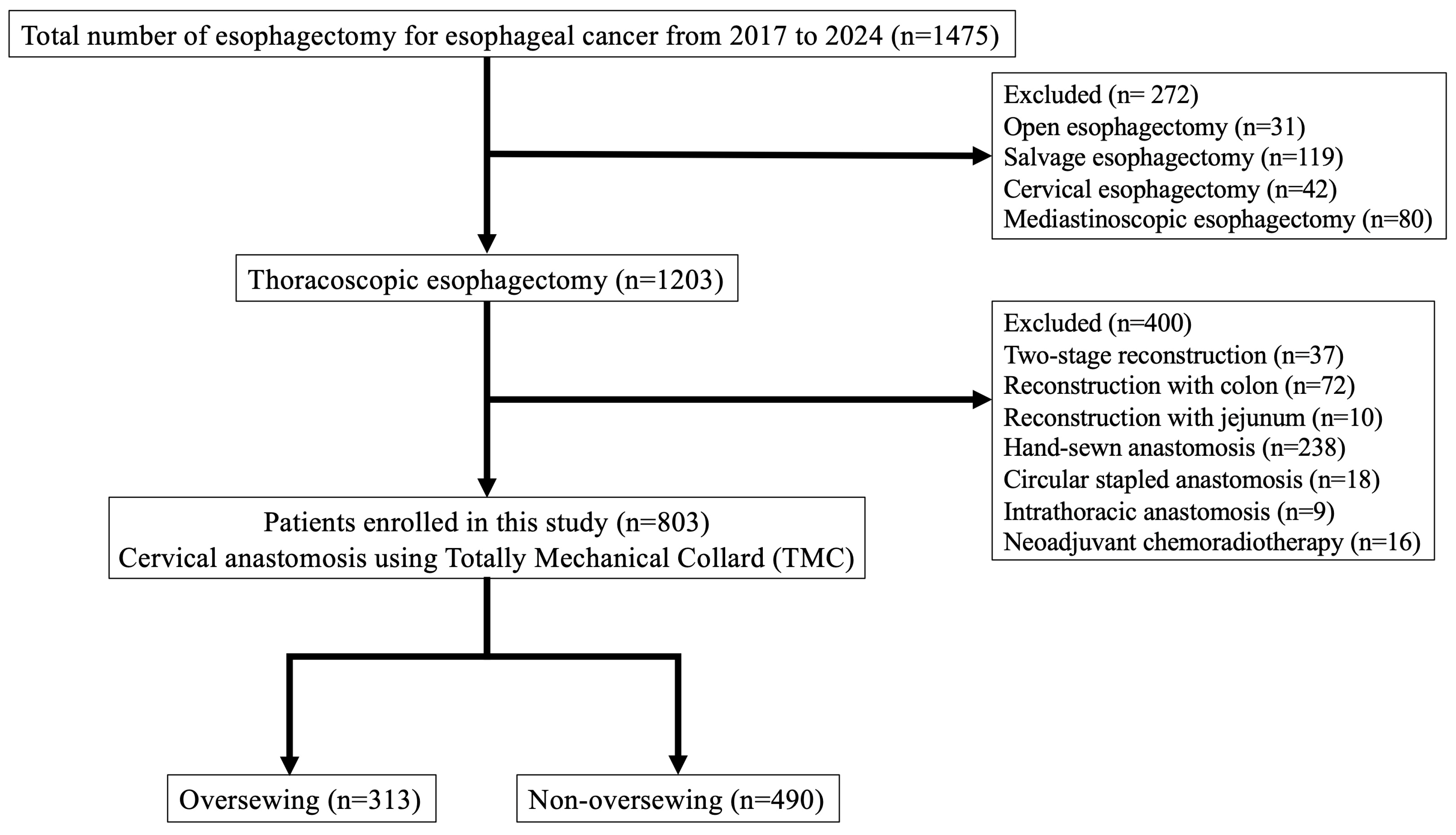
2.1. Study Design and Patient Selection
2.2. Surgical Procedure
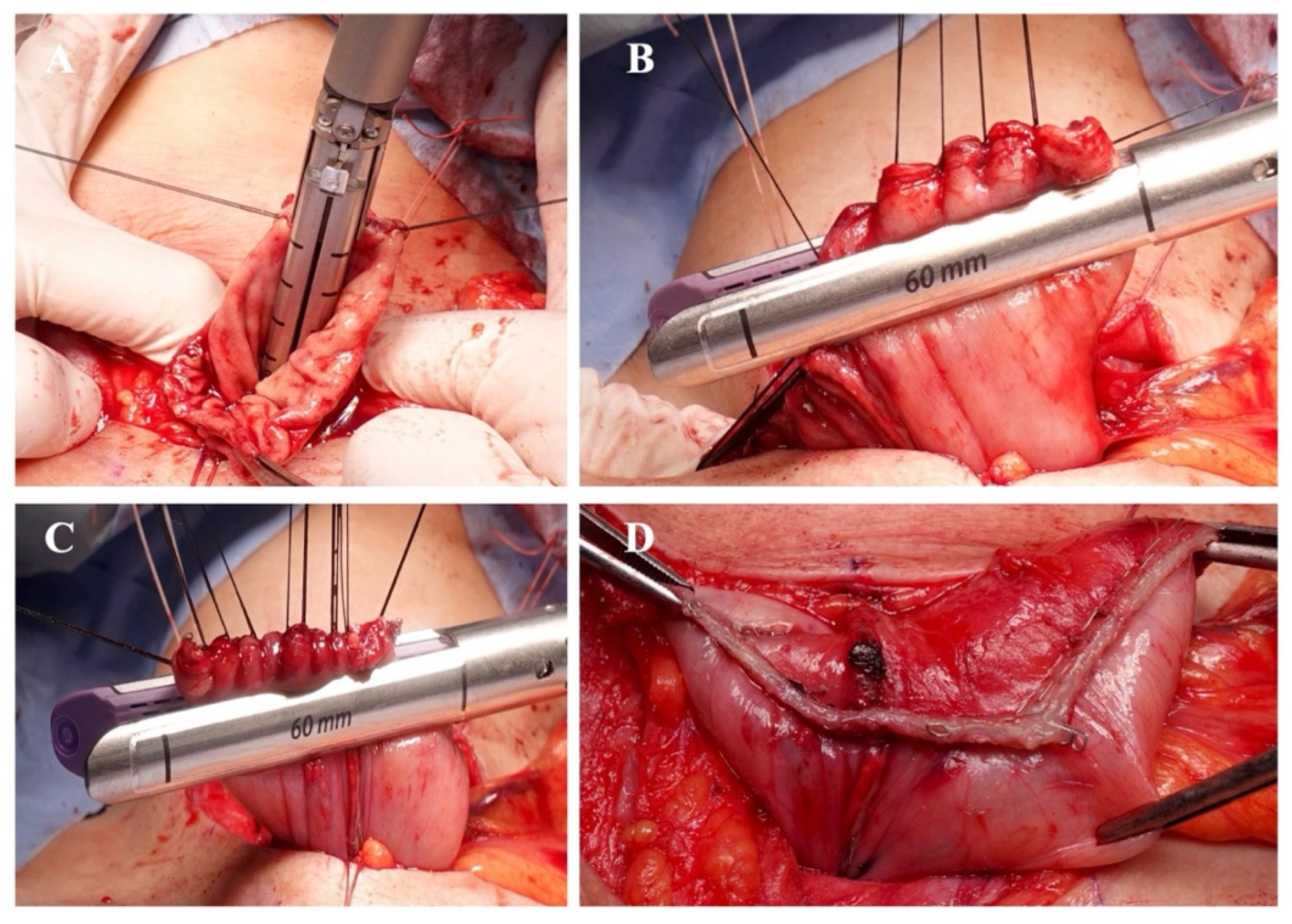
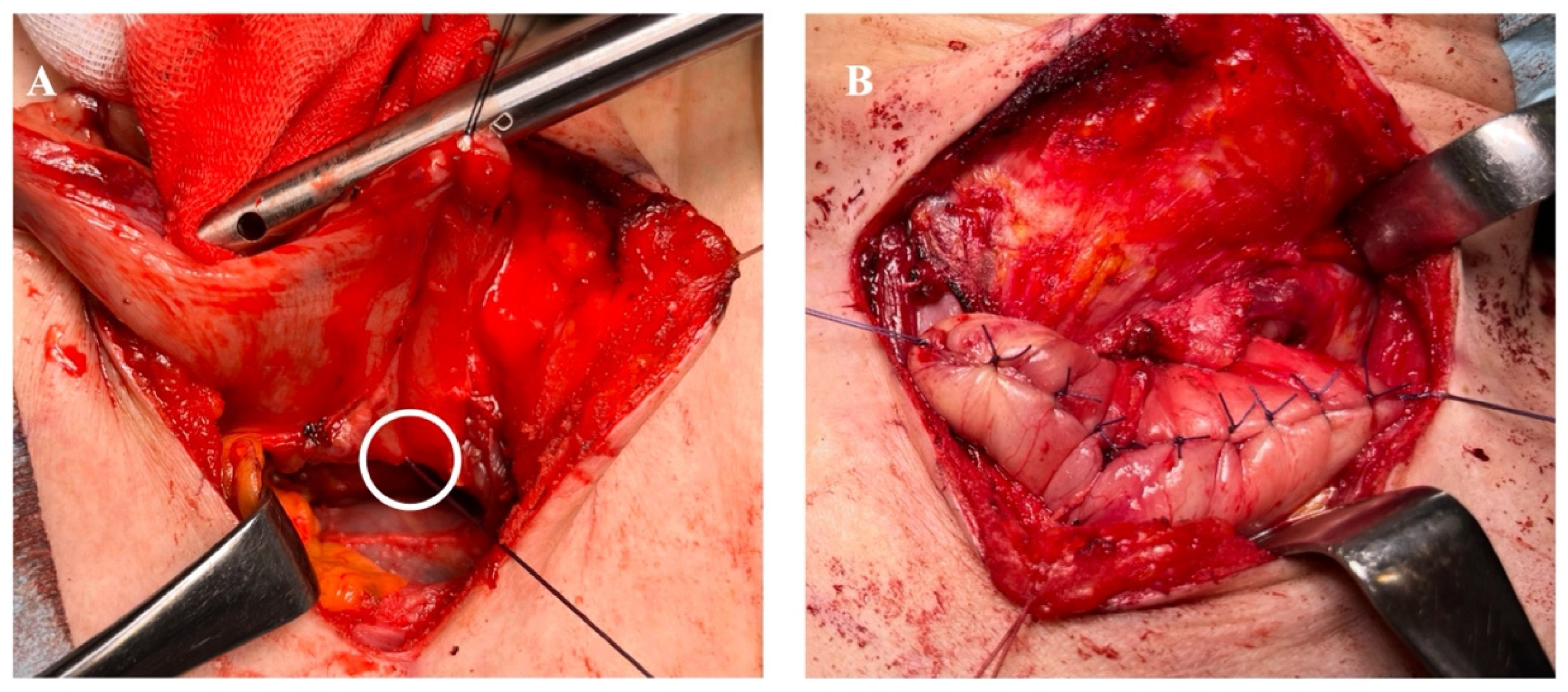
2.3. Anastomotic Technique (TMC and Oversewing Modification)
2.4. Postoperative Management
2.5. Outcome Measures
2.6. Definitions
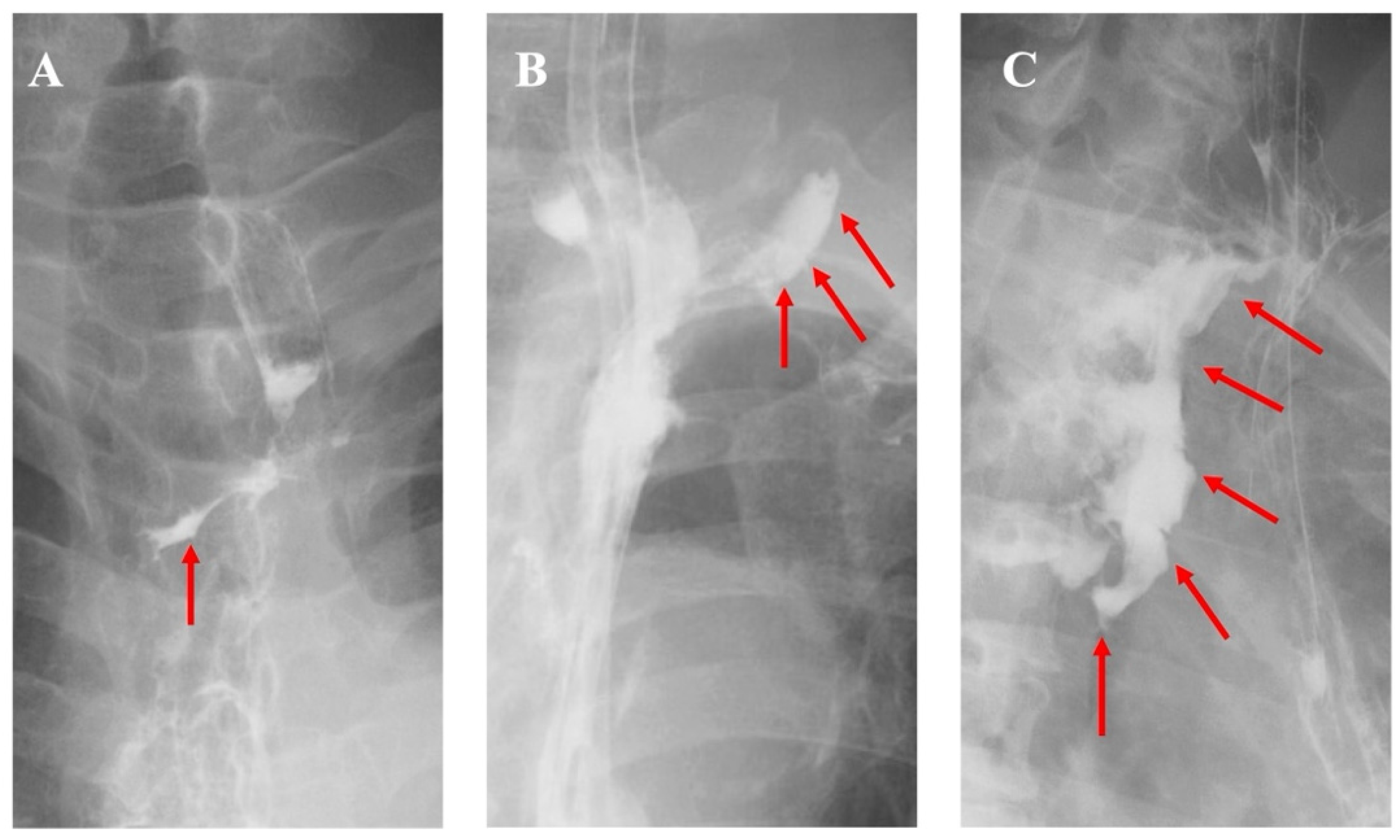
2.7. Management of Anastomotic Leakage
2.8. Statistical Analysis
2.9. Use of Generative Artificial Intelligence
3. Results
3.1. Patient Characteristics
3.2. Operative Outcomes
3.3. Postoperative Outcomes
3.4. Risk Factors for Anastomotic Leakage
3.5. Severity and Clinical Course of Anastomotic Leakage
4. Discussion
5. Conclusions
Author Contributions
Funding
Institutional Review Board Statement
Informed Consent Statement
Data Availability Statement
Acknowledgments
Conflicts of Interest
References
- Oesophago-Gastric Anastomotic Audit (OGAA) Collaborative: Writing Committee. Mortality from Esophagectomy for Esophageal Cancer across Low, Middle, and High-Income Countries: An International Cohort Study. Eur. J. Surg. Oncol. 2021, 47, 1481–1488. [Google Scholar] [CrossRef]
- Ohkura, Y.; Miyata, H.; Konno, H.; Udagawa, H.; Ueno, M.; Shindoh, J.; Kumamaru, H.; Wakabayashi, G.; Gotoh, M.; Mori, M. Development of a Model Predicting the Risk of Eight Major Postoperative Complications after Esophagectomy Based on 10,826 Cases in the Japan National Clinical Database. J. Surg. Oncol. 2020, 121, 313–321. [Google Scholar] [CrossRef] [PubMed]
- Straatman, J.; Abu Hejley, A.; Klevebro, F.; Fuchs, H.; Gisbertz, S.S.; Schmidt, T.; Bruns, C.J.; van Berge Henegouwen, M.I.; Nafteux, P.; Nilsson, M.; et al. Analysis of In-Hospital Mortality Following Transthoracic Esophagectomy for Cancer. Dis. Esophagus 2025, 38, doaf076. [Google Scholar] [CrossRef]
- Matsubara, T.; Ueda, M.; Nagao, N.; Takahashi, T.; Nakajima, T.; Nishi, M. Cervicothoracic Approach for Total Mesoesophageal Dissection in Cancer of the Thoracic Esophagus. J. Am. Coll. Surg. 1998, 187, 238–245. [Google Scholar] [CrossRef]
- Udagawa, H.; Ueno, M.; Shinohara, H.; Haruta, S.; Kaida, S.; Nakagawa, M.; Tsurumaru, M. The Importance of Grouping of Lymph Node Stations and Rationale of Three-Field Lymphoadenectomy for Thoracic Esophageal Cancer: Rationale for Three-Field Esophagectomy. J. Surg. Oncol. 2012, 106, 742–747. [Google Scholar] [CrossRef]
- van Workum, F.; Verstegen, M.H.P.; Klarenbeek, B.R.; Bouwense, S.A.W.; van Berge Henegouwen, M.I.; Daams, F.; Gisbertz, S.S.; Hannink, G.; Haveman, J.W.; Heisterkamp, J.; et al. Intrathoracic vs Cervical Anastomosis after Totally or Hybrid Minimally Invasive Esophagectomy for Esophageal Cancer: A Randomized Clinical Trial: A Randomized Clinical Trial. JAMA Surg. 2021, 156, 601–610. [Google Scholar] [CrossRef] [PubMed]
- Biere, S.S.A.Y.; Maas, K.W.; Cuesta, M.A.; van der Peet, D.L. Cervical or Thoracic Anastomosis after Esophagectomy for Cancer: A Systematic Review and Meta-Analysis. Dig. Surg. 2011, 28, 29–35. [Google Scholar] [CrossRef]
- Chen, B.; Xia, P.; Tang, W.; Huang, S. Which Anastomotic Techniques Is the Best Choice for Cervical Esophagogastric Anastomosis in Esophagectomy? A Bayesian Network Meta-Analysis. J. Gastrointest. Surg. 2023, 27, 422–432. [Google Scholar] [CrossRef] [PubMed]
- Davey, M.G.; Donlon, N.E.; Elliott, J.A.; Robb, W.B.; Bolger, J.C. Optimal Oesophagogastric Anastomosis Techniques for Oesophageal Cancer Surgery—A Systematic Review and Network Meta-Analysis of Randomised Clinical Trials. Eur. J. Surg. Oncol. 2025, 51, 109600. [Google Scholar] [CrossRef]
- Collard, J.M.; Romagnoli, R.; Goncette, L.; Otte, J.B.; Kestens, P.J. Terminalized Semimechanical Side-to-Side Suture Technique for Cervical Esophagogastrostomy. Ann. Thorac. Surg. 1998, 65, 814–817. [Google Scholar] [CrossRef] [PubMed]
- Liu, H.; Shan, L.; Wang, J.; Zhai, R.; Zhu, Y.; Yao, F. Totally Mechanical Collard versus Circular Stapled Cervical Esophagogastric Anastomosis for Minimally Invasive Esophagectomy. Surg. Endosc. 2023, 37, 891–901. [Google Scholar] [CrossRef]
- Hosoi, T.; Abe, T.; Higaki, E.; Fujieda, H.; Nagao, T.; Ito, S.; Komori, K.; Iwase, M.; Oze, I.; Shimizu, Y. Circular Stapled Technique versus Modified Collard Technique for Cervical Esophagogastric Anastomosis after Esophagectomy: A Randomized Controlled Trial: A Randomized Controlled Trial. Ann. Surg. 2022, 276, 30–37. [Google Scholar] [CrossRef]
- Takeoka, T.; Miyata, H.; Sugimura, K.; Kanemura, T.; Sugase, T.; Yamamoto, M.; Shinno, N.; Hara, H.; Fujii, Y.; Mukai, Y.; et al. Modified Collard Technique Is More Effective than Circular Stapled for Cervical Esophagogastric Anastomosis in Prevention of Anastomotic Stricture: A Propensity Score-Matched Study. Dis. Esophagus 2023, 36, doac077. [Google Scholar] [CrossRef] [PubMed]
- Hirano, Y.; Fujita, T.; Sato, K.; Kurita, D.; Sato, T.; Ishiyama, K.; Fujiwara, H.; Oguma, J.; Daiko, H. Totally Mechanical Collard Technique for Cervical Esophagogastric Anastomosis Reduces Stricture Formation Compared with Circular Stapled Anastomosis. World J. Surg. 2020, 44, 4175–4183. [Google Scholar] [CrossRef]
- Sugimura, K.; Miyata, H.; Matsunaga, T.; Asukai, K.; Yanagimoto, Y.; Takahashi, Y.; Tomokuni, A.; Yamamoto, K.; Hirofumi, A.; Nishimura, J.; et al. Comparison of the Modified Collard and Hand-Sewn Anastomosis for Cervical Esophagogastric Anastomosis after Esophagectomy in Esophageal Cancer Patients: A Propensity Score-Matched Analysis. Ann. Gastroenterol. Surg. 2019, 3, 104–113. [Google Scholar] [CrossRef] [PubMed]
- Li, X.-K.; Xu, Y.; Cong, Z.-Z.; Luo, J.; Zhou, H.; Ji, S.-G.; Diao, Y.-F.; Wu, W.-J.; Qiang, Y.; Qian, J.-J.; et al. Modified Collard versus End-to-Side Hand-Sewn Anastomosis for Cervical Anastomosis after McKeown Esophagectomy. Thorac. Cancer 2020, 11, 2909–2915. [Google Scholar] [CrossRef] [PubMed]
- Goto, H.; Oshikiri, T.; Koterazawa, Y.; Sawada, R.; Ikeda, T.; Harada, H.; Urakawa, N.; Hasegawa, H.; Kanaji, S.; Yamashita, K.; et al. The Totally Mechanical Collard Technique for Cervical Esophagogastric Anastomosis Reduces Anastomotic Stricture Compared with Triangular Anastomosis in Minimally Invasive Esophagectomy with Gastric Conduit Reconstruction through the Retrosternal Route: A Propensity Score-Matched Study. Esophagus 2025, 22, 59–67. [Google Scholar]
- Tu, D.-H.; Qu, R.; Ping, W.; Yang, G.; Fu, X.; Cai, Y. Anastomosis Oversewing Technique to Prevent Leakage after Oesophagectomy: A Propensity Score-Matched Analysis. Eur. J. Cardiothorac. Surg. 2022, 61, 990–998. [Google Scholar] [CrossRef]
- Kanamori, J.; Okada, N.; Fujiwara, H.; Mayanagi, S.; Fujita, T.; Nagino, M.; Daiko, H. Leak Grading and Percutaneous Transanastomotic Drainage for the Treatment of Cervical Anastomotic Leakage after Esophagectomy. Dis. Esophagus 2017, 30, 1–7. [Google Scholar] [CrossRef]
- Dindo, D.; Demartines, N.; Clavien, P.-A. Classification of Surgical Complications: A New Proposal with Evaluation in a Cohort of 6336 Patients and Results of a Survey. Ann. Surg. 2004, 240, 205–213. [Google Scholar] [CrossRef] [PubMed]
- Wittekind, C. 2010 TNM system: On the 7th edition of TNM classification of malignant tumors: Zur 7. Auflage der TNM-Klassifikation maligner Tumoren. Pathologe 2010, 31, 331–332. [Google Scholar] [CrossRef]
- Li, Z.; Wang, G.; Mao, T.; Peng, L.; Wang, W.; Lv, W.; Huang, Y.; Fang, C.; Wu, J.; Li, J.; et al. Fibrin Sealant for Prophylaxis of Cervical Anastomotic Leakage after McKeown Esophagectomy for Esophageal or Esophagogastric Junction Cancer (PLACE030): A Phase III Multicenter Randomized Clinical Trial. Int. J. Surg. 2026, 112, 9787–9796. [Google Scholar] [CrossRef] [PubMed]
- Yoshida, N.; Eto, K.; Matsumoto, T.; Kosumi, K.; Imamura, Y.; Iwatsuki, M.; Baba, Y.; Miyamoto, Y.; Watanabe, M.; Baba, H. Omental Flap Wrapping around the Esophagogastric Anastomosis and Association with Anastomotic Leak in Esophagectomy for Esophageal Cancer: A Propensity Score-Matching Analysis. J. Am. Coll. Surg. 2023, 236, 189–197. [Google Scholar] [CrossRef]
- Xue, X.; Yan, Y.; Ma, Y.; Yuan, Y.; Li, C.; Lang, X.; Xu, Z.; Chen, H.; Zhang, H. Stem-Cell Therapy for Esophageal Anastomotic Leakage by Autografting Stromal Cells in Fibrin Scaffold: Stem-Cell Therapy for EAL. Stem Cells Transl. Med. 2019, 8, 548–556. [Google Scholar] [CrossRef]
- Booka, E.; Kikuchi, H.; Hiramatsu, Y.; Takeuchi, H. The Impact of Infectious Complications after Esophagectomy for Esophageal Cancer on Cancer Prognosis and Treatment Strategy. J. Clin. Med. 2021, 10, 4614. [Google Scholar] [CrossRef] [PubMed]
- Ma, Z.; Zheng, J.; Wang, H.; Chen, C.; Yue, J.; Duan, X.; Jiang, H. A Novel Classification of Esophageal Anastomotic Leaks and Its Impact on Healing Time after Esophagogastrostomy. Cancer Res. Treat. 2026. [Google Scholar] [CrossRef]
- Kamarajah, S.K.; Lin, A.; Tharmaraja, T.; Bharwada, Y.; Bundred, J.R.; Nepogodiev, D.; Evans, R.P.T.; Singh, P.; Griffiths, E.A. Risk Factors and Outcomes Associated with Anastomotic Leaks Following Esophagectomy: A Systematic Review and Meta-Analysis. Dis. Esophagus 2020, 33, doz089. [Google Scholar] [CrossRef]
- Noma, K.; Shirakawa, Y.; Kanaya, N.; Okada, T.; Maeda, N.; Ninomiya, T.; Tanabe, S.; Sakurama, K.; Fujiwara, T. Visualized Evaluation of Blood Flow to the Gastric Conduit and Complications in Esophageal Reconstruction. J. Am. Coll. Surg. 2018, 226, 241–251. [Google Scholar] [CrossRef]
- Fujita, T.; Shigeno, T.; Kajiyama, D.; Sato, K.; Fujiwara, N.; Daiko, H. A Novel Device to Assess the Oxygen Saturation and Congestion Status of the Gastric Conduit in Thoracic Esophagectomy. BMC Surg. 2024, 24, 17. [Google Scholar] [CrossRef] [PubMed]
- Sohda, M.; Miyazaki, T.; Watanabe, T.; Nakazawa, N.; Ubukata, Y.; Kuriyama, K.; Hara, K.; Sakai, M.; Sano, A.; Yokobori, T.; et al. Utility of Thermography of Reconstructed Gastric Conduit for Predicting Postoperative Anastomotic Leakage after Esophagectomy for Esophageal Cancer. Anticancer Res. 2021, 41, 453–458. [Google Scholar] [CrossRef] [PubMed]
- Inoue, S.; Yoshida, T.; Nishino, T.; Goto, M.; Furukita, Y.; Yamamoto, Y.; Fujiwara, S.; Minato, T.; Sumitomo, H.; Yuasa, Y.; et al. The Sterno-Tracheal Distance Is an Important Factor of Anastomotic Leakage of Retrosternal Gastric Tube Reconstruction after Esophagectomy. Esophagus 2020, 17, 264–269. [Google Scholar] [CrossRef] [PubMed]
- Yang, Y.; Li, B.; Yi, J.; Hua, R.; Chen, H.; Tan, L.; Li, H.; He, Y.; Guo, X.; Sun, Y.; et al. Robot-Assisted versus Conventional. Minimally Invasive Esophagectomy for Resectable Esophageal Squamous Cell Carcinoma: Early Results of a Multicenter Randomized Controlled Trial: The RAMIE Trial. Ann. Surg. 2022, 275, 646–653. [Google Scholar] [CrossRef] [PubMed]
- Tsunoda, S.; Hosogi, H.; Matsufuji, S.; Yoda, Y.; Shibasaki, S.; Ohuchida, K.; Okabe, H.; Nishigori, T.; Kanaya, S.; Noshiro, H.; et al. Short- and Long-Term Outcomes of Robotic versus Conventional Minimally Invasive Esophagectomy for Esophageal Cancer: A Multicenter Propensity Score-Matched Cohort Study. Ann. Surg. Oncol. 2026, 33, 4267–4276. [Google Scholar] [CrossRef] [PubMed]



| Characteristic | Oversewing (n = 313) | Non-Oversewing (n = 490) | p Value |
|---|---|---|---|
| Age (years) | 65.7 ± 9.6 | 64.9 ± 9.2 | 0.236 |
| Sex | |||
| Male | 238 (76.1%) | 394 (80.4%) | 0.157 |
| Female | 75 (23.9%) | 96 (19.6%) | |
| BMI (kg/m2) | 22.4 ± 3.5 | 22.4 ± 3.3 | 0.951 |
| SMI (kg/m2) | 7.3 ± 1.1 | 7.5 ± 1.2 | 0.124 |
| HGS (kg) | 30.8 ± 7.7 | 29.5 ± 7.7 | 0.074 |
| Smoker at diagnosis | 84 (26.8%) | 158 (32.2%) | 0.232 |
| Performance status | |||
| 0 | 285 (91.1%) | 446 (91.0%) | 0.838 |
| 1 | 26 (8.3%) | 41 (8.4%) | |
| 2 | 2 (0.6%) | 2 (0.4%) | |
| 3 | 0 (0%) | 1 (0.2%) | |
| Comorbidities | |||
| Cardiovascular | 10 (3.1%) | 8 (1.6%) | 0.151 |
| Cerebrovascular | 13 (4.2%) | 22 (4.5%) | 0.861 |
| COPD | 9 (2.9%) | 26 (5.3%) | 0.112 |
| DM | 36 (11.5%) | 66 (13.5%) | 0.448 |
| Renal | 6 (1.9%) | 15 (3.0%) | 0.372 |
| Chronic steroid use | 3 (0.9%) | 6 (1.2%) | 0.749 |
| Albumin (g/dL) | 3.9 ± 0.3 | 4.0 ± 0.4 | 0.508 |
| Hemoglobin (g/dL) | 12.0 ± 1.6 | 12.3 ± 1.6 | 0.724 |
| PNI | 46.4 ± 4.9 | 47.4 ± 5.3 | 0.157 |
| HbA1c (%) | 5.6 ± 0.6 | 5.7 ± 0.6 | 0.323 |
| VC (L) | 3.4 ± 0.8 | 3.5 ± 0.7 | 0.062 |
| FEV1 (L) | 2.4 ± 0.6 | 2.6 ± 0.6 | 0.889 |
| Tumor location | |||
| Upper | 32 (10.2%) | 60 (12.2%) | 0.525 |
| Middle | 159 (50.8%) | 255 (52.1%) | |
| Lower | 122 (39.0%) | 175 (35.7%) | |
| Histologic type | |||
| SCC | 278 (88.8%) | 422 (86.1%) | 0.281 |
| AC | 35 (11.2%) | 68 (13.9%) | |
| Neoadjuvant chemotherapy | 253 (80.8%) | 376 (76.7%) | 0.187 |
| Clinical stage | |||
| I | 74 (23.6%) | 119 (24.3%) | 0.892 |
| II | 65 (20.8%) | 111 (22.7%) | |
| III | 135 (43.1%) | 204 (41.6%) | |
| IV | 39 (12.5%) | 56 (11.4%) |
| Characteristic | Oversewing (n = 313) | Non-Oversewing (n = 490) | p Value |
|---|---|---|---|
| Surgical approach | |||
| Thoracoscopic | 152 (48.6%) | 352 (71.8%) | <0.001 |
| Robot-assisted | 161 (51.4%) | 138 (28.2%) | |
| Operation time (min) | |||
| Total | 394 ± 70 | 354 ± 74 | <0.001 |
| Thoracic | 162 ± 52 | 149 ± 54 | 0.008 |
| Estimated blood loss (mL) | 76 (48–126) | 74 (45–137) | 0.784 |
| Intraoperative blood transfusion | 13 (4.2%) | 22 (4.5%) | 0.861 |
| Reconstruction route | |||
| Retrosternal | 297 (94.9%) | 479 (97.8%) | 0.085 |
| Posterior mediastinal | 15 (4.8%) | 10 (2.0%) | |
| Antethoracic | 1 (0.3%) | 1 (0.2%) | |
| Field of lymph node dissection | |||
| 2 fields | 42 (13.4%) | 46 (9.4%) | 0.082 |
| 3 fields | 271 (86.6%) | 444 (90.6%) | |
| Residual tumor | |||
| R0 | 307 (98.2%) | 463 (94.5%) | 0.068 |
| R1 | 3 (0.9%) | 5 (1.0%) | |
| R2 | 3 (0.9%) | 22 (4.5%) | |
| Lymph node yield | |||
| Total | 48 ± 13 | 48 ± 13 | — |
| Thoracic | 21 ± 6 | 21 ± 7 | 0.958 |
| Characteristic | Oversewing (n = 313) | Non-Oversewing (n = 490) | p Value |
|---|---|---|---|
| Anastomotic leakage | 14 (4.4%) | 40 (8.1%) | 0.043 |
| Anastomotic stricture | |||
| Overall | 11 (3.5%) | 26 (5.3%) | 0.300 |
| Severe | 8 (2.5%) | 16 (3.2%) | 0.710 |
| Pneumonia | 41 (13.1%) | 107 (21.8%) | 0.002 |
| Vocal cord paralysis | 25 (7.9%) | 63 (12.8%) | 0.036 |
| Arrhythmia | 10 (3.1%) | 25 (5.1%) | 0.218 |
| Reoperation | 5 (1.6%) | 5 (1.0%) | 0.523 |
| Wound infection | 8 (2.5%) | 34 (6.9%) | 0.005 |
| Chylothorax | 5 (1.6%) | 14 (2.8%) | 0.342 |
| Total complications | 179 (57.1%) | 346 (70.6%) | <0.001 |
| Severe complications (grade ≥ III) | 52 (16.6%) | 124 (25.3%) | 0.003 |
| 90-day mortality | 2 (0.6%) | 3 (0.6%) | 1.000 |
| ICU stay (days) | 3 (2–3) | 3 (2–3) | 0.439 |
| Postoperative hospital stay (days) | 13 (11–17) | 13.5 (11–17) | 0.366 |
| 30-day readmission | 14 (4.4%) | 24 (4.9%) | 0.865 |
Disclaimer/Publisher’s Note: The statements, opinions and data contained in all publications are solely those of the individual author(s) and contributor(s) and not of MDPI and/or the editor(s). MDPI and/or the editor(s) disclaim responsibility for any injury to people or property resulting from any ideas, methods, instructions or products referred to in the content. |
© 2026 by the authors. Licensee MDPI, Basel, Switzerland. This article is an open access article distributed under the terms and conditions of the Creative Commons Attribution (CC BY) license.
Share and Cite
Ishiyama, K.; Nozaki, R.; Kakuta, R.; Igaue, S.; Akimoto, E.; Utsunomiya, D.; Kurita, D.; Seto, Y.; Daiko, H. Clinical Impact of Staple-Line Oversewing in Totally Mechanical Collard Cervical Anastomosis for Esophageal Cancer. Cancers 2026, 18, 1513. https://doi.org/10.3390/cancers18101513
Ishiyama K, Nozaki R, Kakuta R, Igaue S, Akimoto E, Utsunomiya D, Kurita D, Seto Y, Daiko H. Clinical Impact of Staple-Line Oversewing in Totally Mechanical Collard Cervical Anastomosis for Esophageal Cancer. Cancers. 2026; 18(10):1513. https://doi.org/10.3390/cancers18101513
Chicago/Turabian StyleIshiyama, Koshiro, Ryoko Nozaki, Ryota Kakuta, Shota Igaue, Eigo Akimoto, Daichi Utsunomiya, Daisuke Kurita, Yasuyuki Seto, and Hiroyuki Daiko. 2026. "Clinical Impact of Staple-Line Oversewing in Totally Mechanical Collard Cervical Anastomosis for Esophageal Cancer" Cancers 18, no. 10: 1513. https://doi.org/10.3390/cancers18101513
APA StyleIshiyama, K., Nozaki, R., Kakuta, R., Igaue, S., Akimoto, E., Utsunomiya, D., Kurita, D., Seto, Y., & Daiko, H. (2026). Clinical Impact of Staple-Line Oversewing in Totally Mechanical Collard Cervical Anastomosis for Esophageal Cancer. Cancers, 18(10), 1513. https://doi.org/10.3390/cancers18101513