Spontaneous cSCC Murine Model Shows Limited Response to PD-1 Blockade and Radiation Combination Therapy
 , , ,
, , ,
Simple Summary
Abstract
1. Introduction
2. Materials and Methods
2.1. Chemicals and Reagents
2.2. Animals
2.3. In Vivo Skin Tumorigenesis
2.4. Tumor Treatment via Intraperitoneal (IP) Injections
2.5. Tumor Measurement and Calculations
2.6. Histological Analysis—Morphology
2.7. Histological Analysis—Multiplex
2.8. Statistical Analysis
2.9. Lymphatic Mapping
2.10. Radiation
3. Results
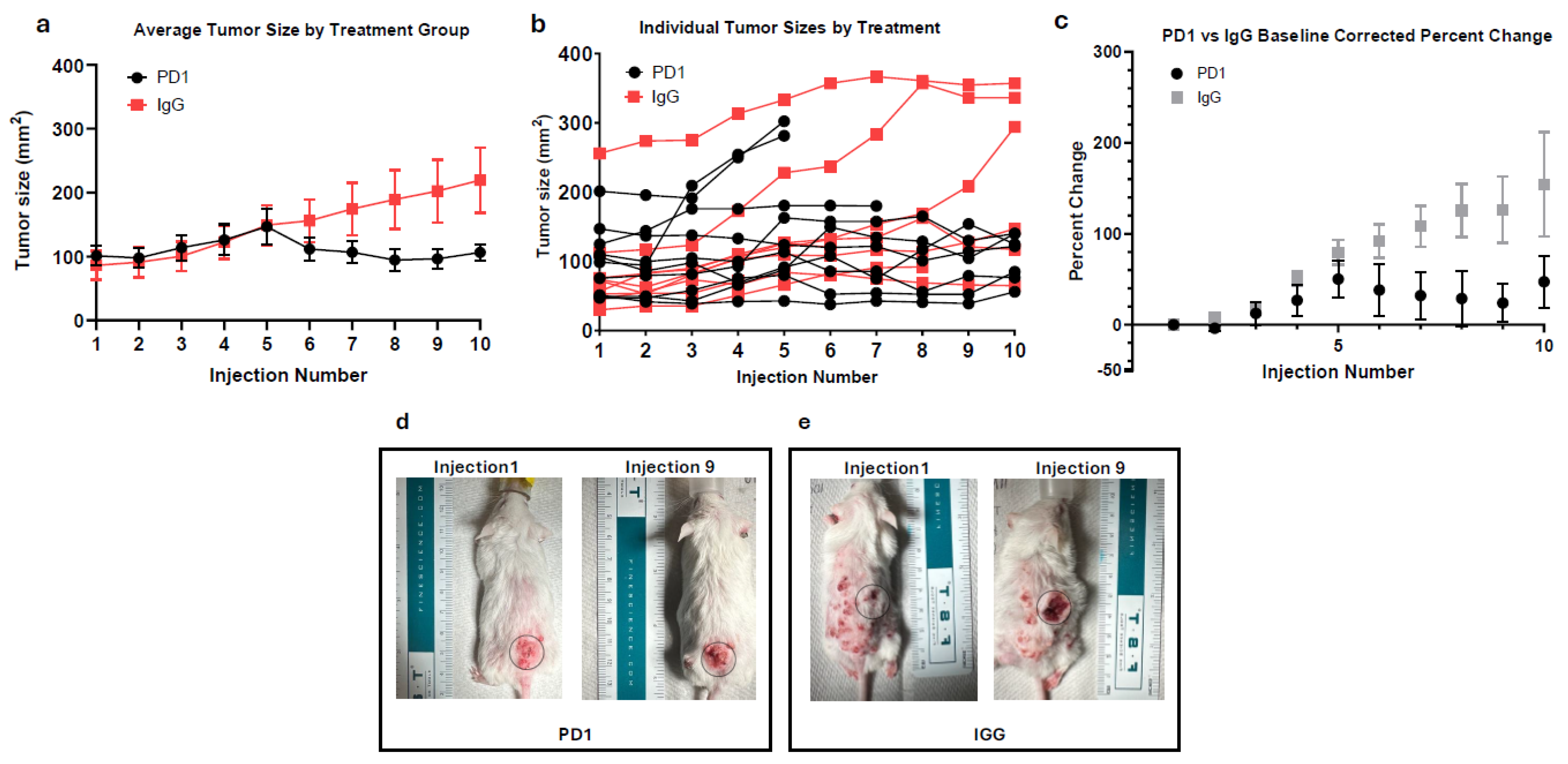
3.1. PD1 Treatment Reduces Growth Rate of cSCC Lesions
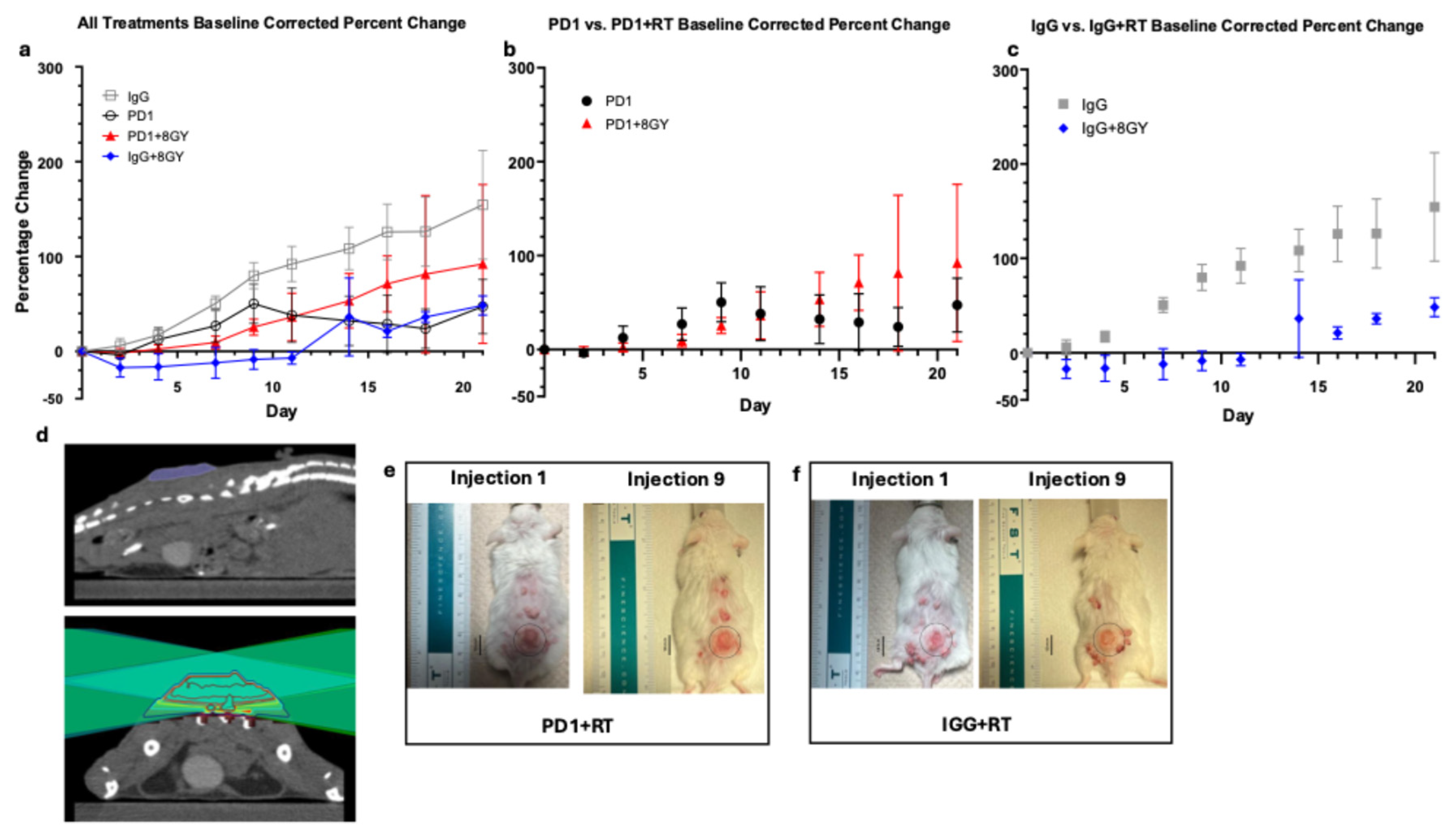
3.2. Combinatory Anti-PD1 and Radiation Therapy Slows Growth Rate in Both Anti-PD1 and IgG-Treated Mice
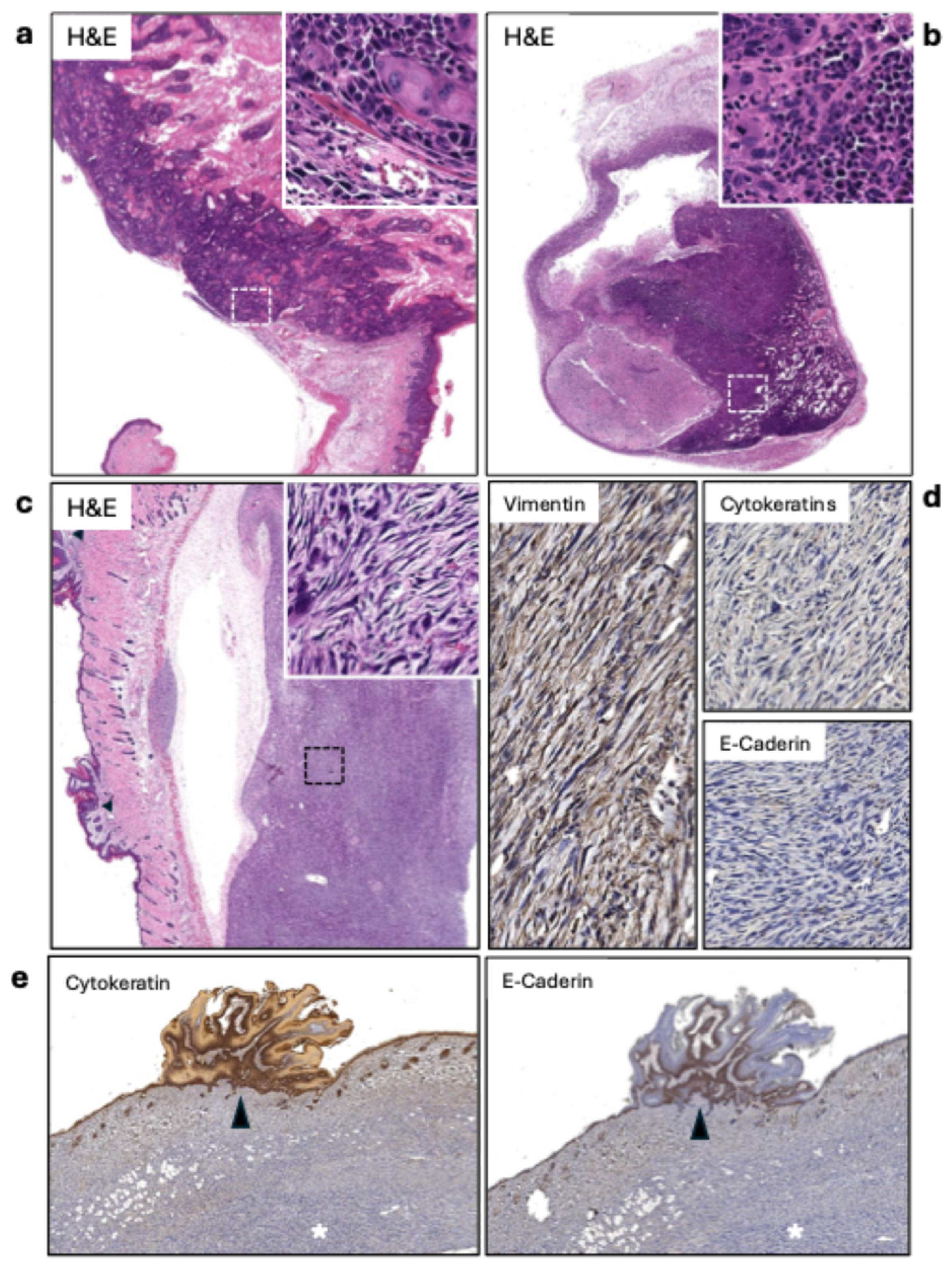
3.3. Sarcomatous Morphology Associated with Irradiated Tumors and Metastasis Incidence in Sentinel Lymph Nodes
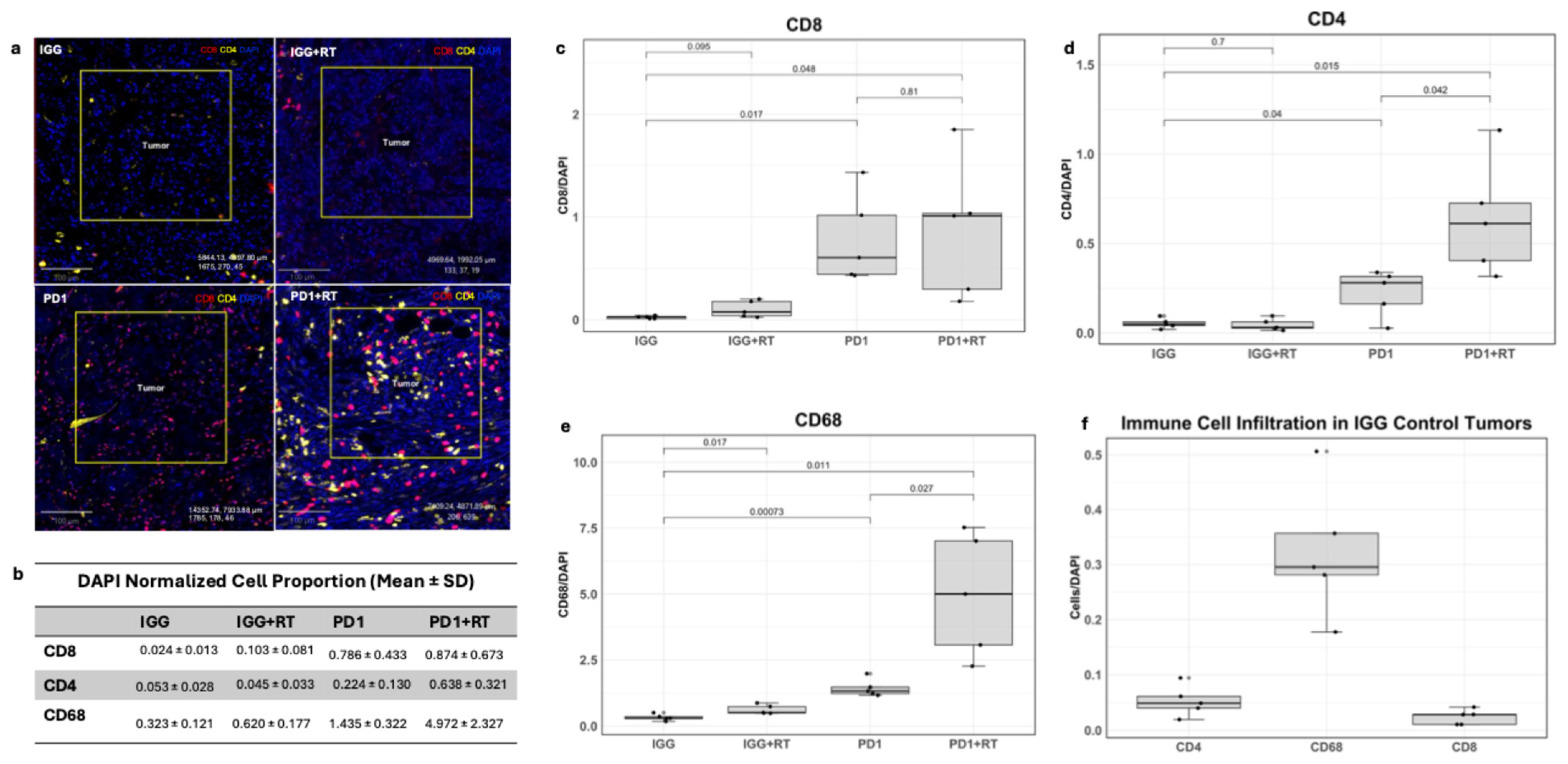
3.4. Anti-PD1 and Radiation Combinatory Treatment Significantly Increases Immune Infiltrate in Tumor Center
3.4.1. CD8
3.4.2. CD4
3.4.3. CD68
4. Discussion
5. Conclusions
Author Contributions
Funding
Institutional Review Board Statement
Informed Consent Statement
Data Availability Statement
Conflicts of Interest
Abbreviations
| cSCC | Cutaneous squamous cell carcinoma |
| RT | Radiation Therapy |
| PD1 | Programmed cell death protein 1 |
| IgG | Immunoglobulin G |
| Gy | Gray |
| DMBA | 7,12-dimethylbenzo[a]anthracene |
| TPA | 12-O-tetradecanoylphorbol-13-acetate |
References
- Hosseini, T.M.; Park, S.J.; Guo, T. The Mutational and Microenvironmental Landscape of Cutaneous Squamous Cell Carcinoma: A Review. Cancers 2024, 16, 2904. [Google Scholar] [CrossRef] [PubMed]
- Waldman, A.; Schmults, C. Cutaneous Squamous Cell Carcinoma. Hematol. Clin. N. Am. 2019, 33, 1–12. [Google Scholar] [CrossRef] [PubMed]
- Wang, M.; Gao, X.; Zhang, L. Recent global patterns in skin cancer incidence, mortality, and prevalence. Chin. Med J. 2024, 138, 185–192. [Google Scholar] [CrossRef]
- Corchado-Cobos, R.; García-Sancha, N.; González-Sarmiento, R.; Pérez-Losada, J.; Cañueto, J. Cutaneous Squamous Cell Carcinoma: From Biology to Therapy. Int. J. Mol. Sci. 2020, 21, 2956. [Google Scholar] [CrossRef]
- Fania, L.; Didona, D.; Di Pietro, F.R.; Verkhovskaia, S.; Morese, R.; Paolino, G.; Donati, M.; Ricci, F.; Coco, V.; Ricci, F.; et al. Cutaneous Squamous Cell Carcinoma: From Pathophysiology to Novel Therapeutic Approaches. Biomedicines 2021, 9, 171. [Google Scholar] [CrossRef]
- Que, S.K.T.; Zwald, F.O.; Schmults, C.D. Cutaneous squamous cell carcinoma: Incidence, Risk Factors, Diagnosis, and Staging. J. Am. Acad. Dermatol. 2018, 78, 237–247. [Google Scholar] [CrossRef]
- Jung, K.; Narwal, M.; Min, S.Y.; Keam, B.; Kang, H. Squamous cell carcinoma of head and neck: What internists should know. Korean J. Intern. Med. 2020, 35, 1031–1044. [Google Scholar] [CrossRef]
- Burton, K.A.; Ashack, K.A.; Khachemoune, A. Cutaneous Squamous Cell Carcinoma: A Review of High-Risk and Metastatic Disease. Am. J. Clin. Dermatol. 2016, 17, 491–508. [Google Scholar] [CrossRef]
- Grob, J.-J.; Gonzalez, R.; Basset-Seguin, N.; Vornicova, O.; Schachter, J.; Joshi, A.; Meyer, N.; Grange, F.; Piulats, J.M.; Bauman, J.R.; et al. Pembrolizumab Monotherapy for Recurrent or Metastatic Cutaneous Squamous Cell Carcinoma: A Single-Arm Phase II Trial (KEYNOTE-629). J. Clin. Oncol. 2020, 38, 2916–2925. [Google Scholar] [CrossRef]
- Dantoing, E.; Piton, N.; Salaün, M.; Thiberville, L.; Guisier, F. Anti-PD1/PD-L1 Immunotherapy for Non-Small Cell Lung Cancer with Actionable Oncogenic Driver Mutations. Int. J. Mol. Sci. 2021, 22, 6288. [Google Scholar] [CrossRef]
- Shalhout, S.Z.; Emerick, K.S.; Kaufman, H.L.; Miller, D.M. Immunotherapy for Non-melanoma Skin Cancer. Curr. Oncol. Rep. 2021, 23, 1–10. [Google Scholar] [CrossRef]
- Lei, Q.; Wang, D.; Sun, K.; Wang, L.; Zhang, Y. Resistance Mechanisms of Anti-PD1/PDL1 Therapy in Solid Tumors. Front. Cell Dev. Biol. 2020, 8, 672. [Google Scholar] [CrossRef]
- Seidel, J.A.; Otsuka, A.; Kabashima, K. Anti-PD-1 and Anti-CTLA-4 Therapies in Cancer: Mechanisms of Action, Efficacy, and Limitations. Front. Oncol. 2018, 8, 86. [Google Scholar] [CrossRef]
- Anwaar, S.; Ashraf, A.; Jahfali, S.; Yunis, J.; Cruz, J.L.G.; Wells, J.W. Immunomodulation of UVB-induced regulatory T cells prevents the establishment of squamous cell carcinoma. J. Immunother. Cancer 2025, 13, e013118. [Google Scholar] [CrossRef]
- Hughes, B.G.; Guminski, A.; Bowyer, S.; Migden, M.R.; Schmults, C.D.; Khushalani, N.I.; Chang, A.L.S.; Grob, J.-J.; Lewis, K.D.; Ansstas, G.; et al. A phase 2 open-label study of cemiplimab in patients with advanced cutaneous squamous cell carcinoma (EMPOWER-CSCC-1): Final long-term analysis of groups 1, 2, and 3, and primary analysis of fixed-dose treatment group 6. J. Am. Acad. Dermatol. 2024, 92, 68–77. [Google Scholar] [CrossRef] [PubMed]
- Gross, N.D.; Miller, D.M.; Khushalani, N.I.; Divi, V.; Ruiz, E.S.; Lipson, E.J.; Meier, F.; Su, Y.B.; Swiecicki, P.L.; Atlas, J.; et al. Neoadjuvant Cemiplimab for Stage II to IV Cutaneous Squamous-Cell Carcinoma. N. Engl. J. Med. 2022, 387, 1557–1568. [Google Scholar] [CrossRef]
- Rischin, D.; Porceddu, S.; Day, F.; Brungs, D.P.; Christie, H.; Jackson, J.E.; Stein, B.N.; Su, Y.B.; Ladwa, R.; Adams, G.; et al. Adjuvant Cemiplimab or Placebo in High-Risk Cutaneous Squamous-Cell Carcinoma. N. Engl. J. Med. 2025, 393, 774–785. [Google Scholar] [CrossRef]
- Aoto, Y.; Okumura, K.; Hachiya, T.; Hase, S.; Wakabayashi, Y.; Ishikawa, F.; Sakakibara, Y. Time-Series Analysis of Tumorigenesis in a Murine Skin Carcinogenesis Model. Sci. Rep. 2018, 8, 12994. [Google Scholar] [CrossRef]
- Abel, E.L.; Angel, J.M.; Kiguchi, K.; DiGiovanni, J. Multi-stage chemical carcinogenesis in mouse skin: Fundamentals and applications. Nat. Protoc. 2009, 4, 1350–1362. [Google Scholar] [CrossRef]
- Dessinioti, C.; Pitoulias, M.; Stratigos, A.J. Epidemiology of advanced cutaneous squamous cell carcinoma. J. Eur. Acad. Dermatol. Venereol. 2021, 36, 39–50. [Google Scholar] [CrossRef] [PubMed]
- Yin, Z.; Zhang, H.; Zhang, K.; Yue, J.; Tang, R.; Wang, Y.; Deng, Q.; Yu, Q. Impacts of combining PD-L1 inhibitor and radiotherapy on the tumour immune microenvironment in a mouse model of esophageal squamous cell carcinoma. BMC Cancer 2025, 25, 1–15. [Google Scholar] [CrossRef]
- Li, F.; Li, C.; Cai, X.; Xie, Z.; Zhou, L.; Cheng, B.; Zhong, R.; Xiong, S.; Li, J.; Chen, Z.; et al. The association between CD8+ tumor-infiltrating lymphocytes and the clinical outcome of cancer immunotherapy: A systematic review and meta-analysis. eClinicalMedicine 2021, 41, 101134. [Google Scholar] [CrossRef] [PubMed]
- Seminerio, I.; Kindt, N.; Descamps, G.; Bellier, J.; Lechien, J.R.; Mat, Q.; Pottier, C.; Journé, F.; Saussez, S. High infiltration of CD68+ macrophages is associated with poor prognoses of head and neck squamous cell carcinoma patients and is influenced by human papillomavirus. Oncotarget 2018, 9, 11046–11059. [Google Scholar] [CrossRef]
- Zhang, Q.W.; Liu, L.; Gong, C.-Y.; Shi, H.-S.; Zeng, Y.-H.; Wang, X.-Z.; Zhao, Y.-W.; Wei, Y.-Q. Prognostic Significance of Tumor-Associated Macrophages in Solid Tumor: A Meta-Analysis of the Literature. PLoS ONE 2012, 7, e50946. [Google Scholar] [CrossRef] [PubMed]
- Dong, Q.; Zhang, Z.; Li, S.; Liang, L. Mechanisms of immunotherapy in cutaneous squamous cell carcinoma in the tumor microenvironment. Front. Immunol. 2025, 16, 1660272. [Google Scholar] [CrossRef]
- Bennett, C.; McLean, L.S.; Lim, A.M.; Bressel, M.; Guminski, A.; Hughes, B.G.; Bowyer, S.E.; Stein, B.; Rischin, D. Extended follow-up outcomes of patients with advanced cutaneous squamous cell carcinoma treated with cemiplimab on EMPOWER-CSCC-1: A retrospective cohort study. J. Am. Acad. Dermatol. 2025. [Google Scholar] [CrossRef]
- García-Sancha, N.; Corchado-Cobos, R.; Bellido-Hernández, L.; Román-Curto, C.; Cardeñoso-Álvarez, E.; Pérez-Losada, J.; Orfao, A.; Cañueto, J. Overcoming Resistance to Immunotherapy in Advanced Cutaneous Squamous Cell Carcinoma. Cancers 2021, 13, 5134. [Google Scholar] [CrossRef]
- Wong, K.; Bumpstead, S.; Van Der Weyden, L.; Reinholdt, L.G.; Wilming, L.G.; Adams, D.J.; Keane, T.M. Sequencing and characterization of the FVB/NJ mouse genome. Genome Biol. 2012, 13, R72. [Google Scholar] [CrossRef]
- Phadke, M.S.; Chen, Z.; Li, J.; Mohamed, E.; Davies, M.A.; Smalley, I.; Duckett, D.R.; Palve, V.; Czerniecki, B.J.; Forsyth, P.A.; et al. Targeted Therapy Given after Anti–PD-1 Leads to Prolonged Responses in Mouse Melanoma Models through Sustained Antitumor Immunity. Cancer Immunol. Res. 2021, 9, 554–567. [Google Scholar] [CrossRef] [PubMed]
- Li, H.Y.; McSharry, M.; Bullock, B.; Nguyen, T.T.; Kwak, J.; Poczobutt, J.M.; Sippel, T.R.; Heasley, L.E.; Weiser-Evans, M.C.; Clambey, E.T.; et al. The Tumor Microenvironment Regulates Sensitivity of Murine Lung Tumors to PD-1/PD-L1 Antibody Blockade. Cancer Immunol. Res. 2017, 5, 767–777. [Google Scholar] [CrossRef]
- Jang, J.Y.; Lee, B.; Huang, M.; Seo, C.; Choi, J.; Shin, Y.S.; Woo, H.G.; Kim, C. Immune checkpoint inhibitor monotherapy is sufficient to promote microenvironmental normalization via the type I interferon pathway in PD-L1-expressing head and neck cancer. Mol. Oncol. 2024, 18, 1923–1939. [Google Scholar] [CrossRef] [PubMed]
- Hsu, C.-Y.; Yanagi, T.; Maeda, T.; Nishihara, H.; Miyamoto, K.; Kitamura, S.; Tokuchi, K.; Ujiie, H. Eribulin inhibits growth of cutaneous squamous cell carcinoma cell lines and a novel patient-derived xenograft. Sci. Rep. 2023, 13, 1–11. [Google Scholar] [CrossRef] [PubMed]
- Li, C.; Sun, C.; Lohcharoenkal, W.; Ali, M.M.; Xing, P.; Zheng, W.; Görgens, A.; Gustafsson, M.O.; EL Andaloussi, S.; Sonkoly, E.; et al. Cutaneous squamous cell carcinoma-derived extracellular vesicles exert an oncogenic role by activating cancer-associated fibroblasts. Cell Death Discov. 2023, 9, 1–12. [Google Scholar] [CrossRef] [PubMed]
- Capasso, A.; Lang, J.; Pitts, T.M.; Jordan, K.R.; Lieu, C.H.; Davis, S.L.; Diamond, J.R.; Kopetz, S.; Barbee, J.; Peterson, J.; et al. Characterization of immune responses to anti-PD-1 mono and combination immunotherapy in hematopoietic humanized mice implanted with tumor xenografts. J. Immunother. Cancer 2019, 7, 37. [Google Scholar] [CrossRef]



| Number (%) n = 20 | |
|---|---|
| Total Sarcoma Morphology | 3(15.0) |
| IgG (n = 5) | 0 (0.0) |
| Anti-PD1 (n = 7) | 0 (0.0) |
| IgG + RT (n = 3) | 1 (33.3) |
| Anti-PD1 + RT (n = 5) | 2 (40.0) |
| Number (%) n = 22 | |
|---|---|
| Metastasis | 7 (31.82) |
| IgG | 1 (14.29) |
| Anti-PD1 | 2 (28.57) |
| IgG + RT | 1 (14.29 |
| Anti-PD1 + RT | 2 (28.27) |
| No Treatment | 1 (14.29) |
| No Metastasis | 15 (68.18) |
Disclaimer/Publisher’s Note: The statements, opinions and data contained in all publications are solely those of the individual author(s) and contributor(s) and not of MDPI and/or the editor(s). MDPI and/or the editor(s) disclaim responsibility for any injury to people or property resulting from any ideas, methods, instructions or products referred to in the content. |
© 2025 by the authors. Licensee MDPI, Basel, Switzerland. This article is an open access article distributed under the terms and conditions of the Creative Commons Attribution (CC BY) license.
Share and Cite
Hosseini, T.M.; Ho, L.; Pham, T.B.; Molinolo, A.; Jones, R.; Vera, D.; Sharabi, A.; Park, S.J.; Guo, T. Spontaneous cSCC Murine Model Shows Limited Response to PD-1 Blockade and Radiation Combination Therapy. Cancers 2026, 18, 146. https://doi.org/10.3390/cancers18010146
Hosseini TM, Ho L, Pham TB, Molinolo A, Jones R, Vera D, Sharabi A, Park SJ, Guo T. Spontaneous cSCC Murine Model Shows Limited Response to PD-1 Blockade and Radiation Combination Therapy. Cancers. 2026; 18(1):146. https://doi.org/10.3390/cancers18010146
Chicago/Turabian StyleHosseini, Tara M., Laura Ho, Tammy B. Pham, Alfredo Molinolo, Riley Jones, David Vera, Andrew Sharabi, Soo J. Park, and Theresa Guo. 2026. "Spontaneous cSCC Murine Model Shows Limited Response to PD-1 Blockade and Radiation Combination Therapy" Cancers 18, no. 1: 146. https://doi.org/10.3390/cancers18010146
APA StyleHosseini, T. M., Ho, L., Pham, T. B., Molinolo, A., Jones, R., Vera, D., Sharabi, A., Park, S. J., & Guo, T. (2026). Spontaneous cSCC Murine Model Shows Limited Response to PD-1 Blockade and Radiation Combination Therapy. Cancers, 18(1), 146. https://doi.org/10.3390/cancers18010146