
Sarcomatoid and Aggressive Variants in High R.E.N.A.L. Score T1b RCC: Outcomes After Laparoscopic and Robotic Radical Nephrectomy


Simple Summary
Abstract
1. Introduction
2. Materials and Methods
2.1. Study Design and Patient Population
2.2. Surgical Technique
2.3. Follow-Up Protocol
2.4. Statistical Analysis
3. Results
3.1. Patient Demographics and Tumor Characteristics
3.2. Perioperative Outcomes
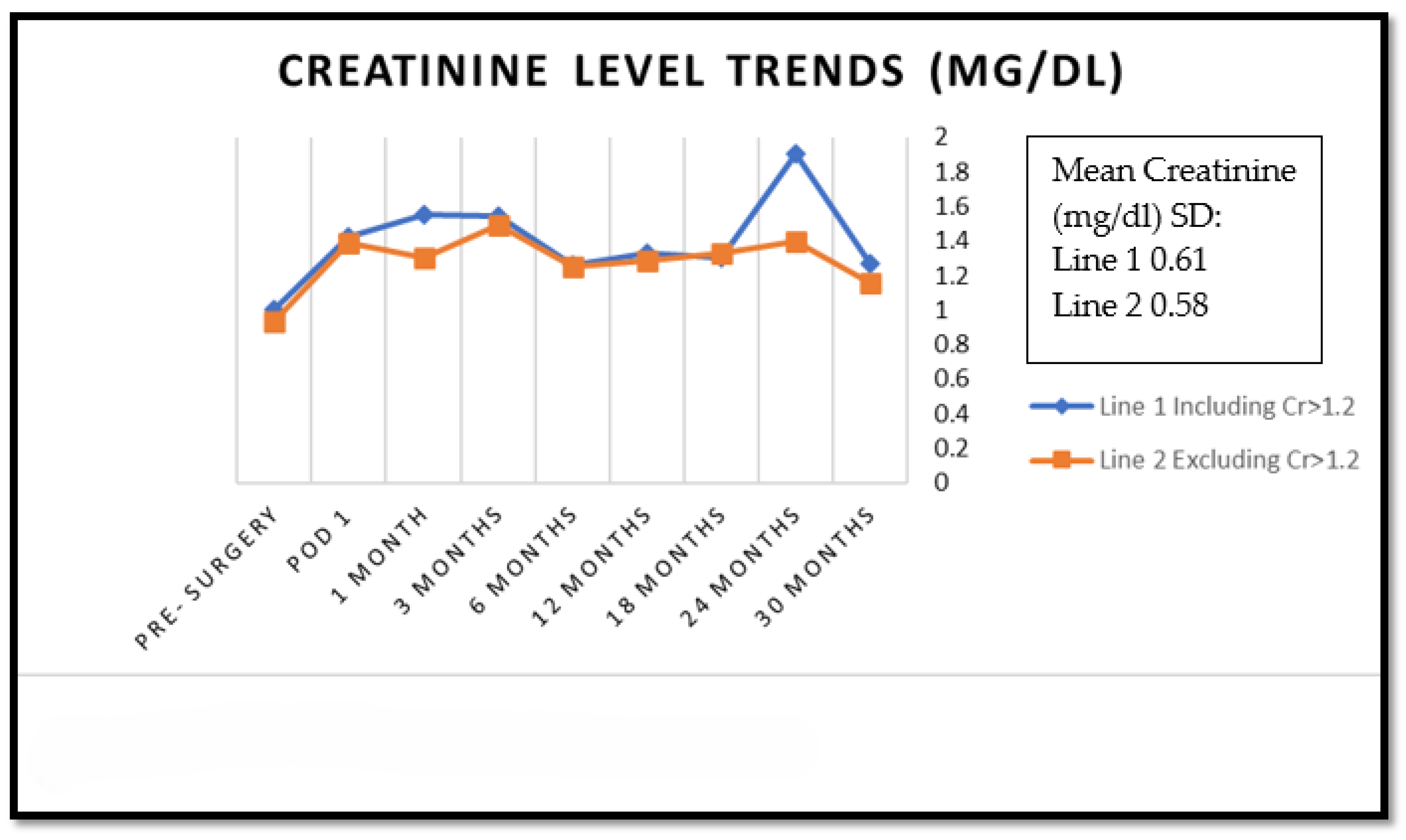
3.3. Renal Function Outcomes
3.4. Pathological Findings
3.5. Survival
- Short-Term Survival (2.5 Years)
- Overall Survival (OS): 100%
- Cancer-Specific Survival (CSS): 100%
- Long-Term Survival (5 Years)
- 5-Year Overall Survival (OS): 89.5%
- 5-Year Cancer-Specific Survival (CSS): 97.4%
4. Discussion
- Radical Nephrectomy (RN):
- Pros:
- Oncological Control: RN provides excellent oncological control by completely removing the affected kidney, which may reduce the risk of local recurrence [10].
- Surgical Simplicity: RN is generally less technically challenging than PN, potentially resulting in shorter operative times and lower immediate surgical risks.
- Cons:
- Renal Function Decline: Removal of the entire kidney can lead to a significant decline in renal function, increasing the risk of chronic kidney disease and its associated complications [12].
- Long-Term Health Risks: Studies have linked RN to higher rates of cardiovascular events and overall mortality, likely due to the resultant reduction in renal function [12].
- Overall Recurrence Rates:
- Partial Nephrectomy (PN) vs. Radical Nephrectomy (RN):
- Positive Surgical Margins (PSMs):
- Tumor Complexity:
- Risk Assessment Tools:
- Aggressiveness in High R.E.N.A.L. Score RCC:
- Tumor Grade Correlation: Higher R.E.N.A.L. scores have been associated with more aggressive tumor pathology. A study evaluating the efficacy of the R.E.N.A.L. nephrometry score found that larger tumor sizes and higher R, E, and L scores were more likely to be associated with high-grade pathological outcomes [15].
- Surgical Complexity: Tumors with high R.E.N.A.L. scores (10–12) are considered highly complex, often posing significant challenges during nephron-sparing surgeries like partial nephrectomy. Such complexity may increase the risk of perioperative complications and influence the choice between partial and radical nephrectomy [16].
- Predictive Value: The R.E.N.A.L. nephrometry score serves as a valuable tool in preoperative planning, helping to predict the aggressiveness of renal masses and guiding the surgical approach. Higher scores may indicate a need for more extensive surgical intervention and vigilant postoperative monitoring due to the increased risk of aggressive tumor behavior [17].
- Multifocality:
- Survival:
- Study Limitations
5. Conclusions
Author Contributions
Funding
Institutional Review Board Statement
Informed Consent Statement
Data Availability Statement
Acknowedgement:
Conflicts of Interest
Abbreviations
| LRN | laparoscopic radical nephrectomy |
| RCC | renal cell carcinoma |
| BMI | body mass index |
| OS | overall survival |
| CSS | cancer-specific survival |
| RN | radical nephrectomy |
| PN | partial nephrectomy |
| MFS | metastasis-free survival |
References
- Curti, B.; Jana, B.R.P.; Javeed, M.; Sachdeva, K.; Makhoul, I.; Perry, M.; Talavera, F.; Hu, W. Renal Cell Carcinoma. Medscape Reference. WebMD. 2014. Available online: https://www.medscape.com (accessed on 22 September 2025).
- European Association of Urology (EAU). EAU Guidelines: Renal Cell Carcinoma. Eur. Urol. 2023, 978, 94–92671-19-6. [Google Scholar]
- Znaor, A.; Lortet-Tieulent, J.; Laversanne, M.; Jemal, A.; Bray, F. International variations and trends in renal cell carcinoma incidence and mortality. Eur. Urol. 2015, 67, 519–530. [Google Scholar] [CrossRef]
- Amin, M.B.; Greene, F.L.; Edge, S.B.; Compton, C.C.; Gershenwald, J.E.; Brookland, R.K.; Meyer, L.; Gress, D.M.; Byrd, D.R.; Winchester, D.P. The eighth edition AJCC cancer staging manual: Continuing to build a bridge from a population-based to a more personalized approach to cancer staging. CA Cancer J. Clin. 2017, 67, 93–99. [Google Scholar] [CrossRef]
- Kutikov, A.; Uzzo, R.G. The R.E.N.A.L. nephrometry score: A comprehensive standardized system for quantitating renal tumor size, location, and depth. J. Urol. 2009, 182, 844–853. [Google Scholar] [CrossRef]
- Kutikov, A.; Smaldone, M.C.; Egleston, B.L.; Manley, B.J.; Canter, D.J.; Simhan, J.; Boorjian, S.A.; Viterbo, R.; Chen, D.Y.; Greenberg, R.E.; et al. Anatomic features of enhancing renal masses predict malignant and high-grade pathology: A preoperative nomogram using the RENAL Nephrometry score. Eur. Urol. 2011, 60, 241–248. [Google Scholar] [CrossRef] [PubMed]
- Canter, D.; Kutikov, A.; Manley, B.; Egleston, B.; Simhan, J.; Smaldone, M.; Teper, E.; Viterbo, R.; Chen, D.Y.; Greenberg, R.E.; et al. Utility of the R.E.N.A.L. nephrometry scoring system in objectifying treatment decision-making of the enhancing renal mass. Urology 2011, 78, 1089–1094. [Google Scholar] [CrossRef]
- Heller, N.; Tejpaul, R.; Isensee, F.; Benidir, T.; Hofmann, M.; Blake, P.; Rengal, Z.; Moore, K.; Sathianathen, N.; Kalapara, A.; et al. Computer-generated R.E.N.A.L. nephrometry scores yield comparable predictive results to those of human-expert scores in predicting oncologic and perioperative outcomes. J. Urol. 2022, 207, 1105–1115. [Google Scholar] [CrossRef]
- Powles, T.; Albiges, L.; Bex, A.; Comperat, E.; Grünwald, V.; Kanesvaran, R.; Kitamura, H.; McKay, R.; Porta, C.; Procopio, G.; et al. Renal cell carcinoma: ESMO clinical practice guideline for diagnosis, treatment and follow-up. Ann. Oncol. 2024, 35, 692–706. [Google Scholar] [CrossRef] [PubMed]
- Yang, F.; Zhou, Q.; Xing, N. Comparison of survival and renal function between partial and radical laparoscopic nephrectomy for T1b renal cell carcinoma. J. Cancer Res. Clin. Oncol. 2020, 146, 261–272. [Google Scholar] [CrossRef] [PubMed]
- Kim, H.; Kim, J.K.; Ye, C.; Choi, J.H.; Lee, H.; Oh, J.J.; Lee, S.; Hong, S.K.; Byun, S.-S. Recurrence after radical and partial nephrectomy in high complex renal tumor using propensity score matched analysis. Sci. Rep. 2021, 11, 2919. [Google Scholar] [CrossRef]
- Jiang, Y.L.; Peng, C.X.; Wang, H.Z.; Qian, L.-J. Comparison of the long-term follow-up and perioperative outcomes of partial nephrectomy and radical nephrectomy for 4 cm to 7 cm renal cell carcinoma: A systematic review and meta-analysis. BMC Urol. 2019, 19, 48. [Google Scholar] [CrossRef]
- Tyson, M.D.; Chang, S.S. Optimal surveillance strategies after surgery for renal cell carcinoma. J. Natl. Compr. Cancer Netw. 2017, 15, 835–840. [Google Scholar] [CrossRef] [PubMed]
- Kattan, M.W.; Reuter, V.; Motzer, R.J.; Katz, J.; Russo, P. A postoperative prognostic nomogram for renal cell carcinoma. J. Urol. 2001, 166, 63–67. [Google Scholar] [CrossRef] [PubMed]
- Chen, S.H.; Wu, Y.P.; Li, X.D.; Lin, T.; Guo, Q.-Y.; Chen, Y.-H.; Huang, J.-B.; Wei, Y.; Xue, X.-Y.; Zheng, Q.-S.; et al. R.E.N.A.L. nephrometry score: A preoperative risk factor predicting the Fuhrman grade of clear-cell renal carcinoma. J. Cancer 2017, 8, 3725–3732. [Google Scholar] [CrossRef]
- Lin, B.H.; Chen, S.H.; Ruan, Z.T.; Gao, R.-C.; Qiu, Q.-R.; Chen, Y.-H.; Zheng, Q.-S.; Wei, Y.; Xue, X.-Y.; Xu, N. A novel classification system of renal hilar tumors for surgical guidance: Technique, outcome, and safety. Ann. Surg. Oncol. 2024, 31, 5794–5803. [Google Scholar] [CrossRef] [PubMed]
- Millet, I.; Doyon, F.C.; Pages, E.; Thuret, R.; Taourel, P. Morphometric scores for renal tumors: What does the radiologist need to know? Eur. J. Radiol. 2014, 83, 1303–1310. [Google Scholar] [CrossRef]
- Cheville, J.C.; Lohse, C.M.; Zincke, H.; Weaver, A.L.; Leibovich, B.C.; Frank, I.; Blute, M.L. Sarcomatoid renal cell carcinoma: An examination of underlying histologic subtype and an analysis of associations with patient outcome. Am. J. Surg. Pathol. 2004, 28, 435–441. [Google Scholar] [CrossRef]
- Mian, B.M.; Bhadkamkar, N.; Slaton, J.W.; Pisters, P.W.; Daliani, D.; Swanson, D.A.; Pisters, L.L. Prognostic factors and survival of patients with sarcomatoid renal cell carcinoma. J. Urol. 2002, 167, 65–70. [Google Scholar] [CrossRef]
- de Peralta-Venturina, M.; Moch, H.; Amin, M.; Tamboli, P.; Hailemariam, S.; Mihatsch, M.; Javidan, J.; Stricker, H.; Ro, J.Y.; Amin, M.B. Sarcomatoid differentiation in renal cell carcinoma: A study of 101 cases. Am. J. Surg. Pathol. 2001, 25, 275–284. [Google Scholar] [CrossRef]
- Adeniran, A.J.; Shuch, B.; Humphrey, P.A. Sarcomatoid and Rhabdoid Renal Cell Carcinoma: Clinical, Pathologic, and Molecular Genetic Features. Am. J. Surg. Pathol. 2024, 48, e65–e88. [Google Scholar] [CrossRef] [PubMed]
- Flammia, R.S.; Anceschi, U.; Tufano, A.; Tuderti, G.; Ferriero, M.C.; Brassetti, A.; Mari, A.; Di Maida, F.; Minervini, A.; Derweesh, I.H.; et al. Is hypertension associated with worse renal functional outcomes after minimally invasive partial nephrectomy? J. Clin. Med. 2022, 11, 1243. [Google Scholar] [CrossRef] [PubMed]
- Richards, K.A.; Negron, E.; Cohn, J.A.; Steinberg, Z.; Eggener, S.E.; Shalhav, A.L. The impact of body mass index on renal functional outcomes following minimally invasive partial nephrectomy. J. Endourol. 2014, 28, 1338–1344. [Google Scholar] [CrossRef] [PubMed]
- Li, G.; Zhu, D.; Gao, H.; Chen, H.; Li, Y.; Niu, Y. Oncologic outcomes of nephron-sparing surgery in patients with T1 multifocal renal cell carcinoma. Clin. Transl. Oncol. 2019, 21, 760–765. [Google Scholar] [CrossRef]
- Yang, T.; Zheng, H.; Chen, S.; Gong, M.; Liu, Y.; Zhou, W.; Ye, J.; Pan, X.; Cui, X. Impact of tumor multiplicity on the prognosis of patients with primary renal cell carcinoma: A SEER database analysis. Clin. Exp. Med. 2024, 24, 194. [Google Scholar] [CrossRef] [PubMed]


| Age (years) (Mean) | 66.9 |
| BMI (Mean) | 29.4 |
| Gender (M/F) | 62/56 |
| Laterality (R/L) | 53/65 |
| Mean R.E.N.A.L. Score | 10.02 |
| Tumor Diameter by CT (cm) | 6 |
| Tumor Diameter by Pathology (cm) | 4.7 |
| Diabetes Mellitus | 4 (3.4%) |
| Hypertension | 20 (16.9%) |
| No. | 118 |
| Blood Loss (mL) | 75.2 |
| Operative Time (min) | 151.6 |
| Hospital Stay (days) | 3.2 |
| Complications | 9 |
| Incisional Hernia | 3 |
| Deep Vein Thrombosis | 1 |
| Atrial Fibrillation | 1 |
| Ileus | 1 |
| Spleen Bleeding | 1 |
| Wound Infection | 1 |
| Trocar Site Hematoma | 1 |
| Preoperative | POD 1 | One Month | 3 Months | 6 Months | 1 Year | p Value (ANOVA) |
|---|---|---|---|---|---|---|
| 1 | 1.42 | 1.55 | 1.54 | 1.26 | 1.33 | 0.051 |
| ** | 1.42 | 1.55 | 1.54 | 1.26 | 1.33 | 0.991 |
| 18 months | 24 months | 30 months | ||||
| 1.3 | 1.9 | 1.27 | 0.989 | |||
| Pre-op to 30 months post-op | ** | ** | ** | ** | ** | 0.59 |
| POD 1 to 30 months | ** | ** | ** | ** | ** | 0.969 |
| Creatinine Level Trends Summary, Excluding Patients with Renal Failure | ||||||
| Pre-op | POD 1 | One month | 3 months | 6 months | 1 year | p value (ANOVA) |
| 0.93 | 1.39 | 1.3 | 1.49 | 1.25 | 1.29 | 0.0074 |
| ** | 1.39 | 1.3 | 1.49 | 1.25 | 1.29 | 0.993 |
| 18 months | 24 months | 30 months | ||||
| 1.33 | 1.4 | 1.16 | 0.989 | |||
| Pre-op to 30 months | ** | ** | ** | ** | ** | 0.433 Kruskal–Wallis Test |
| POD 1 to 30 months | ** | ** | ** | ** | ** | 0.428 Kruskal–Wallis Test |
| Grade 3 | Multiple Tumors | Adrenal Involved | Lymph Node Involved | T3a | T3b | Total (%) |
|---|---|---|---|---|---|---|
| 12 | 8 | 1 | 1 | 8 | 1 | 31 (26.3%) |
| Angiosarcoma | UCC | |||||
| 2 | 2 | 4 (3.4%) | ||||
| Total | 35 (29.7%) | |||||
| Angiomyolipoma | Oncocytoma | |||||
| 2 | 4 | 6 (5.1%) |
| Patients (n) | OS (2.5 Years) | CSS (2.5 Years) | 5-Year OS from the Date of Surgery | 5-Year CSS from the Date of Surgery |
| 100 | 100% | 100% | 68/76 (89.5%) | 74/76 (97.4%) |
Disclaimer/Publisher’s Note: The statements, opinions and data contained in all publications are solely those of the individual author(s) and contributor(s) and not of MDPI and/or the editor(s). MDPI and/or the editor(s) disclaim responsibility for any injury to people or property resulting from any ideas, methods, instructions or products referred to in the content. |
© 2025 by the authors. Licensee MDPI, Basel, Switzerland. This article is an open access article distributed under the terms and conditions of the Creative Commons Attribution (CC BY) license (https://creativecommons.org/licenses/by/4.0/).
Share and Cite
Asali, M.; Asali, G.; Batash, R.; Schaffer, M. Sarcomatoid and Aggressive Variants in High R.E.N.A.L. Score T1b RCC: Outcomes After Laparoscopic and Robotic Radical Nephrectomy. Cancers 2025, 17, 3918. https://doi.org/10.3390/cancers17243918
Asali M, Asali G, Batash R, Schaffer M. Sarcomatoid and Aggressive Variants in High R.E.N.A.L. Score T1b RCC: Outcomes After Laparoscopic and Robotic Radical Nephrectomy. Cancers. 2025; 17(24):3918. https://doi.org/10.3390/cancers17243918
Chicago/Turabian StyleAsali, Murad, Galeb Asali, Ron Batash, and Moshe Schaffer. 2025. "Sarcomatoid and Aggressive Variants in High R.E.N.A.L. Score T1b RCC: Outcomes After Laparoscopic and Robotic Radical Nephrectomy" Cancers 17, no. 24: 3918. https://doi.org/10.3390/cancers17243918
APA StyleAsali, M., Asali, G., Batash, R., & Schaffer, M. (2025). Sarcomatoid and Aggressive Variants in High R.E.N.A.L. Score T1b RCC: Outcomes After Laparoscopic and Robotic Radical Nephrectomy. Cancers, 17(24), 3918. https://doi.org/10.3390/cancers17243918