Efficacy of Adjuvant Chemotherapy for T1-2 Stage III Colorectal Cancer

 , ,
, ,
Simple Summary
Abstract
1. Introduction
2. Materials and Methods
2.1. Patients and Data
2.2. Outcomes and Statistical Analysis
2.3. Generative Artificial Intelligence
3. Results
3.1. Patient Characteristics
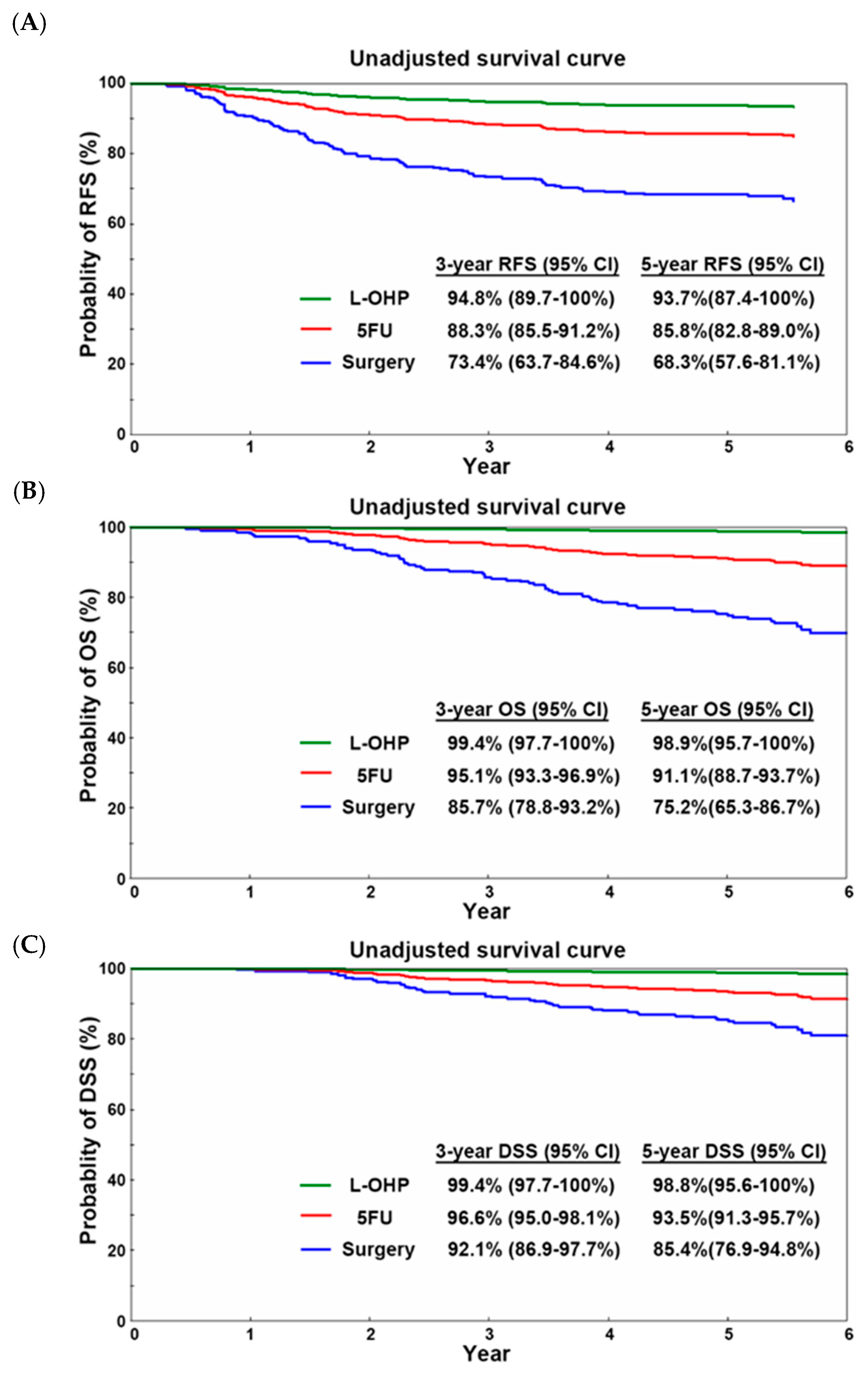
3.2. Survival Analysis Before Propensity Score Matching
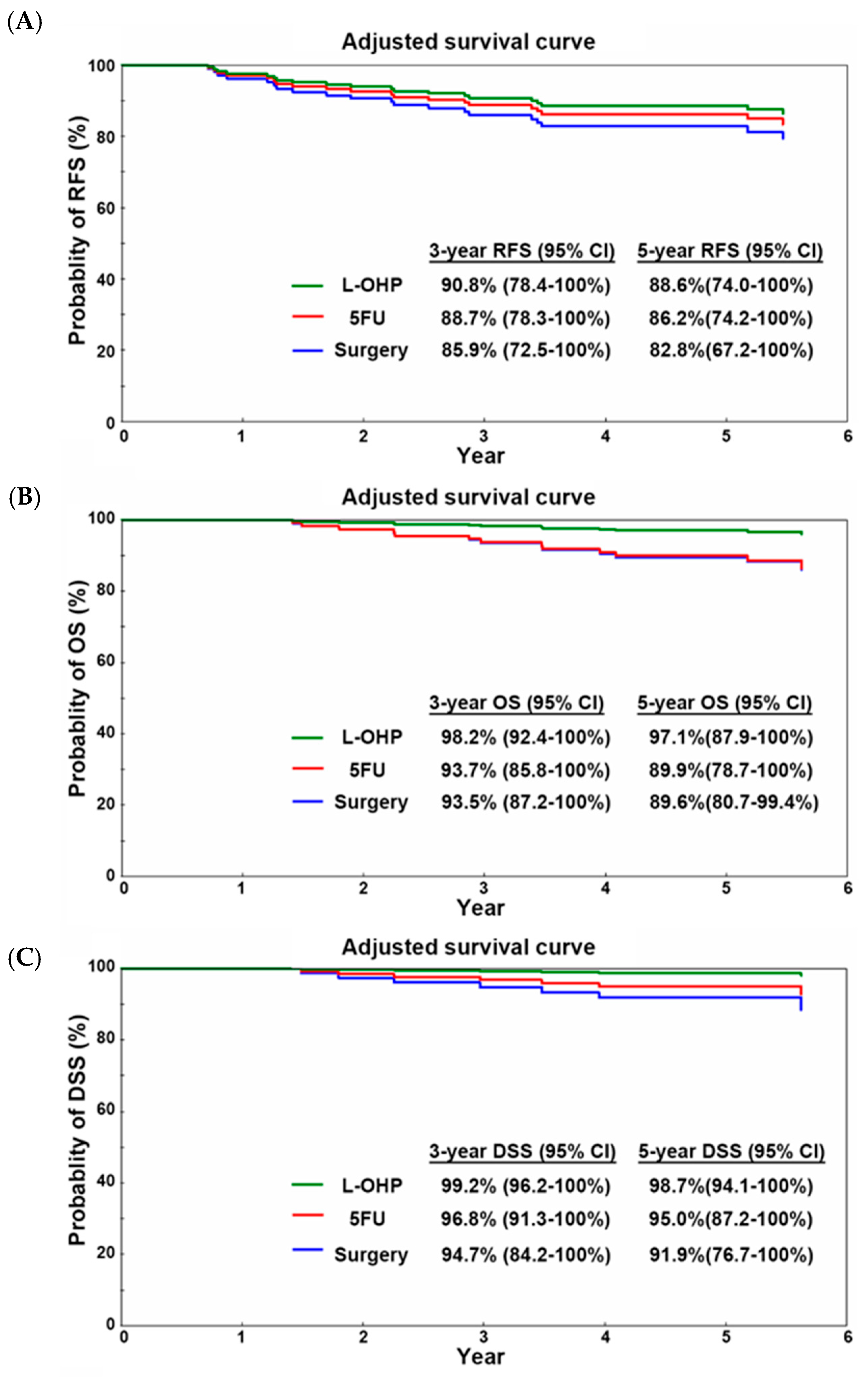
3.3. Analysis of Treatment Efficacy After Propensity Score Matching with Consideration of the Study Period
3.4. Multivariate Analysis
4. Discussion
5. Conclusions
Author Contributions
Funding
Institutional Review Board Statement
Informed Consent Statement
Data Availability Statement
Acknowledgments
Conflicts of Interest
Abbreviations
| 5FU | Fluorouracil |
| CI | confidence interval |
| DFS | disease-free survival |
| DSS | disease-specific survival |
| HRs | Hazard ratios |
| JFMC | Japanese Foundation for Multidisciplinary Treatment of Cancer |
| L-OHP | oxaliplatin |
| OS | overall survival |
| RFS | relapse-free survival |
References
- Sakamoto, J.; Ohashi, Y.; Hamada, C.; Buyse, M.; Burzykowski, T.; Piedbois, P. Meta-Analysis Group of the Japanese Society for Cancer of the Colon and Rectum; Meta-Analysis Group in Cancer. Efficacy of oral adjuvant therapy after resection of colorectal cancer: 5-year results from three randomized trials. J. Clin. Oncol. 2004, 22, 484–492. [Google Scholar]
- Gill, S.; Loprinzi, C.L.; Sargent, D.J.; Thomé, S.D.; Alberts, S.R.; Haller, D.G.; Benedetti, J.; Francini, G.; Shepherd, L.E.; Francois Seitz, J.; et al. Pooled analysis of fluorouracil-based adjuvant therapy for stage II and III colon cancer: Who benefits and by how much? J. Clin. Oncol. 2004, 22, 1797–1806. [Google Scholar] [CrossRef]
- Teranishi, N.; Uetake, H. The Current Status of Adjuvant Chemotherapy for Colorectal Cancer in Japan: A Paradigm Shift from Oral Fluoropyridine Single Therapy to the Oxaliplatin Regimen. Cancers 2025, 17, 518. [Google Scholar] [CrossRef] [PubMed]
- Shah, M.A.; Renfro, L.A.; Allegra, C.J.; André, T.; de Gramont, A.; Schmoll, H.J.; Haller, D.G.; Alberts, S.R.; Yothers, G.; Sargent, D.J. Impact of patient factors on recurrence risk and time dependency of oxaliplatin benefit in patients with colon cancer: Analysis from modern-era adjuvant studies in the ACCENT database. J. Clin. Oncol. 2016, 34, 843–853. [Google Scholar] [CrossRef]
- Baxter, N.N.; Kennedy, E.B.; Bergsland, E.; Berlin, J.; George, T.J.; Gill, S.; Gold, P.J.; Hantel, A.; Jones, L.; Lieu, C.; et al. Adjuvant therapy for stage II colon cancer: ASCO guideline update. J. Clin. Oncol. 2022, 40, 892–910. [Google Scholar] [CrossRef] [PubMed]
- Lieu, C.; Kennedy, E.B.; Bergsland, E.; Berlin, J.; George, T.J.; Gill, S.; Gold, P.J.; Hantel, A.; Jones, L.; Mahmoud, N.; et al. Duration of oxaliplatin-containing adjuvant therapy for stage III colon cancer: ASCO clinical practice guideline. J. Clin. Oncol. 2019, 37, 1436–1447. [Google Scholar] [CrossRef] [PubMed]
- Sugimoto, K.; Sakamoto, K.; Tsuchiya, T.; Takahashi, T.; Ohge, H.; Sato, T.; Taguri, M.; Morita, S.; Sadahiro, S. Prognostic factors in patients with high-risk stage II colon cancer after curative resection: A post hoc analysis of the JFMC46-1201 trial. Int. J. Color. Dis. 2023, 38, 260. [Google Scholar] [CrossRef]
- Bregni, G.; Akin Telli, T.; Camera, S.; Deleporte, A.; Moretti, L.; Bali, A.M.; Liberale, G.; Holbrechts, S.; Hendlisz, A.; Sclafani, F. Adjuvant chemotherapy for rectal cancer: Current evidence and recommendations for clinical practice. Cancer Treat. Rev. 2020, 83, 101948. [Google Scholar] [CrossRef]
- Costas-Chavarri, A.; Nandakumar, G.; Temin, S.; Lopes, G.; Cervantes, A.; Cruz Correa, M.; Engineer, R.; Hamashima, C.; Ho, G.F.; Huitzil, F.D.; et al. Treatment of patients with early-stage colorectal cancer: ASCO resource-stratified guideline. J. Glob. Oncol. 2019, 5, 1–19. [Google Scholar] [CrossRef]
- NCCN Clinical Practice Guidelines in Oncology (NCCN Guidelines®) Rectal Cancer. Version 4.2025. Available online: https://www.nccn.org/professionals/physician_gls/pdf/rectal.pdf (accessed on 24 November 2025).
- Kusumoto, T.; Ishiguro, M.; Nakatani, E.; Yoshida, M.; Inoue, T.; Nakamoto, Y.; Shiomi, A.; Takagane, A.; Sunami, E.; Shinozaki, H.; et al. Updated 5-year survival and exploratory T × N subset analyses of ACTS-CC trial: A randomised controlled trial of S-1 versus tegafur-uracil/leucovorin as adjuvant chemotherapy for stage III colon cancer. ESMO Open 2018, 3, e000428. [Google Scholar] [CrossRef]
- Chu, Q.D.; Zhou, M.; Medeiros, K.L.; Peddi, P.; Kavanaugh, M.; Wu, X.C. Poor survival in stage IIB/C (T4N0) compared to stage IIIA (T1-2 N1, T1N2a) colon cancer persists even after adjusting for adequate lymph nodes retrieved and receipt of adjuvant chemotherapy. BMC Cancer 2016, 16, 460. [Google Scholar] [CrossRef] [PubMed]
- Hashiguchi, Y.; Hase, K.; Kotake, K.; Ueno, H.; Shinto, E.; Mochizuki, H.; Yamamoto, J.; Sugihara, K. Evaluation of the seventh edition of the tumour, node, metastasis (TNM) classification for colon cancer in two nationwide registries of the United States and Japan. Color. Dis. 2012, 14, 1065–1074. [Google Scholar] [CrossRef] [PubMed]
- Ganapathi, A.M.; Speicher, P.J.; Englum, B.R.; Castleberry, A.W.; Migaly, J.; Hsu, D.S.; Mantyh, C.R. Adjuvant chemotherapy for T1 node-positive colon cancers provides significant survival benefit. Dis. Colon. Rectum 2014, 57, 1341–1348. [Google Scholar] [CrossRef]
- Pian, G.; Oh, S.Y. Is the prognosis of T1-2N1 colon cancer the same as that of T1-2N0 colon cancer after curative surgery? Scand. J. Gastroenterol. 2023, 58, 1286–1294. [Google Scholar] [CrossRef]
- Yan, W.; Zhou, H.; Shi, S.; Lin, J.; Lin, Q. Association between chemotherapy and survival in t1 colon cancer with lymph node metastasis. A propensity-score matched analysis. Front. Oncol. 2021, 11, 699400. [Google Scholar] [CrossRef] [PubMed]
- Sadahiro, S.; Tsuchiya, T.; Sasaki, K.; Kondo, K.; Katsumata, K.; Nishimura, G.; Kakeji, Y.; Baba, H.; Sato, S.; Koda, K.; et al. Randomized phase III trial of treatment duration for oral uracil and tegafur plus leucovorin as adjuvant chemotherapy for patients with stage IIB/III colon cancer. Final results of JFMC33-0502. Ann. Oncol. 2015, 26, 2274–2280. [Google Scholar] [CrossRef]
- Oki, E.; Murata, A.; Yoshida, K.; Maeda, K.; Ikejiri, K.; Munemoto, Y.; Sasaki, K.; Matsuda, C.; Kotake, M.; Suenaga, T.; et al. A randomized phase III trial comparing S-1 versus UFT as adjuvant chemotherapy for stage II/III rectal cancer (JFMC35-C1: ACTS-RC). Ann. Oncol. 2016, 27, 1266–1272. [Google Scholar] [CrossRef]
- Tomita, N.; Kunieda, K.; Maeda, A.; Hamada, C.; Yamanaka, T.; Sato, T.; Yoshida, K.; Boku, N.; Nezu, R.; Yamaguchi, S.; et al. Phase III randomised trial comparing 6 vs. 12-month of capecitabine as adjuvant chemotherapy for patients with stage III colon cancer. Final results of the JFMC37-0801 study. Br. J. Cancer 2019, 120, 689–696. [Google Scholar] [CrossRef]
- Yoshino, T.; Kotaka, M.; Shinozaki, K.; Touyama, T.; Manaka, D.; Matsui, T.; Ishigure, K.; Hasegawa, J.; Inoue, K.; Munemoto, Y.; et al. JOIN trial. Treatment outcome and recovery status of peripheral sensory neuropathy during a 3-year follow-up in patients receiving modified FOLFOX6 as adjuvant treatment for stage II/III colon cancer. Cancer Chemother. Pharmacol. 2019, 84, 1269–1277. [Google Scholar] [CrossRef]
- Japanese Society for Cancer of the Colon and Rectum. Japanese Classification of Colorectal, Appendiceal, and Anal Carcinoma: The 3d English Edition [Secondary Publication]. J. Anus Rectum Colon 2019, 30, 175–195. [Google Scholar]
- Hida, J.; Yasutomi, M.; Maruyama, T.; Fujimoto, K.; Uchida, T.; Okuno, K. The extent of lymph node dissection for colon carcinoma: The potential impact on laparoscopic surgery. Cancer 1997, 80, 188–192. [Google Scholar] [CrossRef]
- Shimada, Y.; Takii, Y.; Maruyama, S.; Ohta, T. Intramural and mesorectal distal spread detected by whole-mount sections in the determination of optimal distal resection margin in patients undergoing surgery for rectosigmoid or rectal cancer without preoperative therapy. Dis. Colon Rectum 2011, 54, 1510–1520. [Google Scholar] [CrossRef]
- Ueno, H.; Hase, K.; Shiomi, A.; Shiozawa, M.; Ito, M.; Sato, T.; Hashiguchi, Y.; Kusumi, T.; Kinugasa, Y.; Ike, H.; et al. Optimal bowel resection margin in colon cancer surgery: Prospective multicentre cohort study with lymph node and feeding artery mapping. Lancet Reg. Health West. Pac. 2023, 33, 100680. [Google Scholar] [CrossRef]
- Kotake, K.; Mizuguchi, T.; Moritani, K.; Wada, O.; Ozawa, H.; Oki, I.; Sugihara, K. Impact of D3 lymph node dissection on survival for patients with T3 and T4 colon cancer. Int. J. Color. Dis. 2014, 29, 847–852. [Google Scholar] [CrossRef]
- Sobrero, A.F.; Puccini, A.; Shi, Q.; Grothey, A.; Andrè, T.; Shields, A.F.; Souglakos, I.; Yoshino, T.; Iveson, T.; Ceppi, M.; et al. A new prognostic and predictive tool for shared decision making in stage III colon cancer. Eur. J. Cancer 2020, 138, 182–188. [Google Scholar] [CrossRef]
- Grothey, A.; Sobrero, A.F.; Shields, A.F.; Yoshino, T.; Paul, J.; Taieb, J.; Souglakos, J.; Shi, Q.; Kerr, R.; Labianca, R.; et al. Duration of Adjuvant Chemotherapy for Stage III Colon Cancer. N. Engl. J. Med. 2018, 378, 1177–1188. [Google Scholar] [CrossRef]
- Yin, J.; Salem, M.E.; Dixon, J.G.; Jin, Z.; Cohen, R.; DeGramont, A.; Van Cutsem, E.; Taieb, J.; Alberts, S.R.; Wolmark, N.; et al. Reevaluating disease-free survival as an endpoint vs. overall survival in stage III adjuvant colon cancer trials. J. Natl. Cancer Inst. 2022, 114, 60–67. [Google Scholar] [CrossRef] [PubMed]
- Takeshita, E.; Ishibashi, K.; Koda, K.; Oda, N.; Yoshimatsu, K.; Sato, Y.; Oya, M.; Yamaguchi, S.; Nakajima, H.; Momma, T.; et al. The updated five-year overall survival and long-term oxaliplatin-related neurotoxicity assessment of the FACOS study. Surg. Today 2021, 51, 1309–1319. [Google Scholar] [CrossRef]
- Yoshino, T.; Yamanaka, T.; Oki, E.; Kotaka, M.; Manaka, D.; Eto, T.; Hasegawa, J.; Takagane, A.; Nakamura, M.; Kato, T.; et al. Efficacy and long-term peripheral sensory neuropathy of 3 vs. 6 months of oxaliplatin-based adjuvant chemotherapy for colon cancer. The ACHIEVE phase 3 randomized clinical trial. JAMA Oncol. 2019, 5, 1574–1581. [Google Scholar] [CrossRef]
- Hashiguchi, Y.; Muro, K.; Saito, Y.; Ito, Y.; Ajioka, Y.; Hamaguchi, T.; Hasegawa, K.; Hotta, K.; Ishida, H.; Ishiguro, M.; et al. Japanese Society for Cancer of the Colon and Rectum (JSCCR) guidelines 2019 for the treatment of colorectal cancer. Int. J. Clin. Oncol. 2020, 25, 1–42. [Google Scholar] [CrossRef]
- Kinugasa, Y.; Uehara, K.; Yamaguchi, K.; Saito, Y.; Murofushi, K.; Sugai, T.; Ishiguro, M.; Ishihara, S.; Ueno, H.; Oka, S.; et al. Japanese Society for Cancer of the Colon and Rectum (JSCCR) guidelines 2024 for the treatment of colorectal cancer. Int. J. Clin. Oncol. 2025, 30, 2410–2463. [Google Scholar] [CrossRef] [PubMed]
- Cheung, W.Y.; Shi, Q.; O’Connell, M.; Cassidy, J.; Blanke, C.D.; Kerr, D.J.; Meyers, J.; Van Cutsem, E.; Alberts, S.R.; Yothers, G.; et al. The predictive and prognostic value of sex in early-stage colon cancer: A pooled analysis of 33,345 patients from the ACCENT database. Clin. Color. Cancer 2013, 12, 179–187. [Google Scholar] [CrossRef]
- Lee, Y.C.; Lee, Y.L.; Chuang, J.P.; Lee, J.C. Differences in survival between colon and rectal cancer from SEER data. PLoS ONE 2013, 8, e78709. [Google Scholar] [CrossRef] [PubMed]
- Lykke, J.; Rosenberg, J.; Jess, P.; Roikjaer, O.; Danish Colorectal Cancer Group. Lymph. node yield and tumour subsite are associated with survival in stage I–III colon cancer. Results from a national cohort study. World J. Surg. Oncol. 2019, 17, 62. [Google Scholar] [CrossRef]
- Tsukamoto, S.; Fujita, S.; Ota, M.; Mizusawa, J.; Shida, D.; Kanemitsu, Y.; Ito, M.; Shiomi, A.; Komori, K.; Ohue, M.; et al. Long-term follow-up of the randomized trial of mesorectal excision with or without lateral lymph node dissection in rectal cancer (JCOG0212). Br. J. Surg. 2020, 107, 586–594. [Google Scholar] [CrossRef]
- Gao, X.; Wang, C.; Yu, Y.; Singh, D.; Yang, L.; Zhou, Z. Lateral lymph node dissection reduces local recurrence of locally advanced lower rectal cancer in the absence of preoperative neoadjuvant chemoradiotherapy. A systematic review and meta-analysis. World J. Surg. Oncol. 2020, 18, 304. [Google Scholar] [CrossRef]
- Benson, A.B., 3rd; Schrag, D.; Somerfield, M.R.; Cohen, A.M.; Figueredo, A.T.; Flynn, P.J.; Krzyzanowska, M.K.; Maroun, J.; McAllister, P.; Van Cutsem, E.; et al. American Society of Clinical Oncology recommendations on adjuvant chemotherapy for stage II colon cancer. J. Clin. Oncol. 2024, 22, 3408–3419. [Google Scholar] [CrossRef] [PubMed]
- Cohen, R.; Taieb, J.; Fiskum, J.; Yothers, G.; Goldberg, R.; Yoshino, T.; Alberts, S.; Allegra, C.; de Gramont, A.; Seitz, J.F.; et al. Microsatellite Instability in Patients With Stage III Colon Cancer Receiving Fluoropyrimidine With or Without Oxaliplatin: An ACCENT Pooled Analysis of 12 Adjuvant Trials. J. Clin. Oncol. 2021, 39, 642–651. [Google Scholar] [CrossRef]
- Huynh, J.C.; Schwab, E.; Ji, J.; Kim, E.; Joseph, A.; Hendifar, A.; Cho, M.; Gong, J. Recent Advances in Targeted Therapies for Advanced Gastrointestinal Malignancies. Cancers 2020, 12, 1168. [Google Scholar] [CrossRef]
- Johnson, D.; Chee, C.E.; Wong, W.; Lam, R.C.T.; Tan, I.B.H.; Ma, B.B.Y. Current advances in targeted therapy for metastatic colorectal cancer—Clinical translation and future directions. Cancer Treat. Rev. 2024, 125, 102700. [Google Scholar] [CrossRef]
- Wu, H.; Deng, M.; Xue, D.; Guo, R.; Zhang, C.; Gao, J.; Li, H. PD-1/PD-L1 inhibitors for early and middle stage microsatellite high-instability and stable colorectal cancer: A review. Int. J. Color. Dis. 2024, 39, 83. [Google Scholar] [CrossRef] [PubMed]
- Kotani, D.; Oki, E.; Nakamura, Y.; Yukami, H.; Mishima, S.; Bando, H.; Shirasu, H.; Yamazaki, K.; Watanabe, J.; Kotaka, M.; et al. Molecular residual disease and efficacy of adjuvant chemotherapy in patients with colorectal cancer. Nat. Med. 2023, 29, 127–134. [Google Scholar] [CrossRef] [PubMed]



| Number and Proportion | Standardized Difference | p Value | |||||||
|---|---|---|---|---|---|---|---|---|---|
| Surgery Alone (n = 57) | 5FU (n = 486) | L-OHP (n = 61) | Total (n = 604) | Surgery Alone vs. 5FU | Surgery Alone vs. L-OHP | 5FU vs. L-OHP | |||
| Sex | |||||||||
| male | 29 (50.9%) | 255 (52.5%) | 26 (42.6%) | 310 (51.3%) | 0.03 | 0.17 | 0.20 | 0.35 | |
| female | 28 (49.1%) | 231 (47.5%) | 35 (57.4%) | 294 (48.7%) | |||||
| Age (year) | |||||||||
| <70 | 50 (87.7%) | 370 (76.1%) | 50 (82.0%) | 470 (77.8%) | 0.30 | 0.16 | 0.14 | 0.10 | |
| ≥70 | 7 (12.3%) | 116 (23.9%) | 11 (18.0%) | 134 (22.2%) | |||||
| Tumor location | |||||||||
| colon | 25 (43.9%) | 271 (55.8%) | 40 (65.6%) | 336 (55.6%) | 0.24 | 0.45 | 0.20 | 0.06 | |
| rectum | 32 (56.1%) | 215 (44.2%) | 21 (34.4%) | 268 (44.4%) | |||||
| T stage | |||||||||
| T1 | 5 (8.8%) | 158 (32.5%) | 27 (44.3%) | 190 (31.5%) | 0.61 | 0.88 | 0.24 | <0.01 | |
| T2 | 52 (91.2%) | 328 (67.5%) | 34 (55.7%) | 414 (68.5%) | |||||
| Lymph node dissection | |||||||||
| D2 | 27 (47.4%) | 220 (45.3%) | 27 (44.3%) | 274 (45.4%) | 0.04 | 0.06 | 0.02 | 0.94 | |
| D3 | 30 (52.6%) | 266 (54.7%) | 34 (55.7%) | 330 (54.6%) | |||||
| Number and Proportion | Standardized Difference | p Value | |||||||
|---|---|---|---|---|---|---|---|---|---|
| Surgery Alone (n = 41) | 5-FU (n = 41) | L-OHP (n = 41) | Total (n = 123) | Surgery Alone vs. 5FU | Surgery Alone vs. L-OHP | 5FU vs. L-OHP | |||
| Sex | |||||||||
| male | 17 (41.5%) | 17 (41.5%) | 15 (36.6%) | 49 (39.8%) | 0.00 | 0.10 | 0.10 | 0.87 | |
| female | 24 (58.5%) | 24 (58.5%) | 26 (63.4%) | 74 (60.2%) | |||||
| Age (year) | |||||||||
| <70 | 34 (82.9%) | 35 (85.4%) | 36 (87.8%) | 105 (85.4%) | 0.07 | 0.14 | 0.07 | 0.82 | |
| ≥70 | 7 (17.1%) | 6 (14.6%) | 5 (12.2%) | 18 (14.6%) | |||||
| Tumor location | |||||||||
| colon | 23 (56.1%) | 22 (53.7%) | 23 (56.1%) | 68 (55.3%) | 0.05 | 0.00 | 0.05 | 0.97 | |
| rectum | 18 (43.9%) | 19 (46.3%) | 18 (43.9%) | 55 (44.7%) | |||||
| T stage | |||||||||
| T1 | 5 (12.2%) | 6 (14.6%) | 7 (17.1%) | 18 (14.6%) | 0.07 | 0.14 | 0.07 | 0.82 | |
| T2 | 36 (87.8%) | 35 (85.4%) | 34 (82.9%) | 105 (85.4%) | |||||
| Lymph node dissection | |||||||||
| D2 | 20 (48.8%) | 19 (46.3%) | 21 (51.2%) | 60 (48.8%) | 0.05 | 0.05 | 0.10 | 0.91 | |
| D3 | 21 (51.2%) | 22 (53.7%) | 20 (48.8%) | 63 (51.2%) | |||||
| HR (95% Confidence Interval) | p Value | ||
|---|---|---|---|
| Pre-matching | |||
| RFS (vs. surgery alone) | |||
| L-OHP | 0.17 (0.05–0.54) | <0.01 | |
| 5FU | 0.40 (0.24–0.67) | <0.01 | |
| OS (vs. surgery alone) | |||
| L-OHP | 0.04 (0.00–0.71) | 0.03 | |
| 5FU | 0.33 (0.19–0.57) | <0.01 | |
| DSS (vs. surgery alone) | |||
| L-OHP | 0.07 (0.00–1.37) | 0.08 | |
| 5FU | 0.43 (0.21–0.88) | 0.02 | |
| Post-matching | |||
| RFS (vs. surgery alone) | |||
| L-OHP | 0.64 (0.06–6.40) | 0.70 | |
| 5FU | 0.79 (0.13–4.65) | 0.79 | |
| OS (vs. surgery alone) | |||
| L-OHP | 0.26 (0.01–11.57) | 0.49 | |
| 5FU | 0.97 (0.15–6.08) | 0.97 | |
| DSS (vs. surgery alone) | |||
| L-OHP | 0.16 (0.00–18.99) | 0.45 | |
| 5FU | 0.60 (0.02–16.15) | 0.76 | |
| Variables | HR (95% Confidence Interval) | p Value | |
|---|---|---|---|
| Chemotherapy | 5-FU vs. Surgery alone | 0.65 (0.35–1.23) | 0.19 |
| L-OHP vs. Surgery alone | 0.37 (0.10–1.34) | 0.13 | |
| Sex | Female vs. male | 0.61 (0.40–0.93) | 0.02 |
| Age | 70 or above or 70> | 1.46 (0.89–2.39) | 0.13 |
| Location | Rectum vs. Colon | 2.19 (1.40–3.43) | <0.01 |
| Histology | Other vs. Well-Mod | 0.73 (0.25–2.16) | 0.57 |
| T stage | T2 vs. T1 | 1.39 (0.81–2.41) | 0.24 |
| Lymph node dissection | D3 vs. D2 | 0.79 (0.52–1.21) | 0.28 |
| Study period | j33-41 vs. j07-15 | 0.61 (0.34–1.10) | 0.10 |
| Lymphatic invasion | ly(+)/ly(−) + unknown | 1.04 (0.63–1.71) | 0.88 |
| Venous invasion | v(+)/v(−) + unknown | 1.11 (0.65–1.92) | 0.70 |
Disclaimer/Publisher’s Note: The statements, opinions and data contained in all publications are solely those of the individual author(s) and contributor(s) and not of MDPI and/or the editor(s). MDPI and/or the editor(s) disclaim responsibility for any injury to people or property resulting from any ideas, methods, instructions or products referred to in the content. |
© 2025 by the authors. Licensee MDPI, Basel, Switzerland. This article is an open access article distributed under the terms and conditions of the Creative Commons Attribution (CC BY) license (https://creativecommons.org/licenses/by/4.0/).
Share and Cite
Maeda, H.; Oba, K.; Kashiwabara, K.; Aoyama, T.; Mayanagi, S.; Kanda, M.; Honda, M.; Muto, M.; Sakamoto, J.; Yamagishi, H.; et al. Efficacy of Adjuvant Chemotherapy for T1-2 Stage III Colorectal Cancer. Cancers 2025, 17, 3856. https://doi.org/10.3390/cancers17233856
Maeda H, Oba K, Kashiwabara K, Aoyama T, Mayanagi S, Kanda M, Honda M, Muto M, Sakamoto J, Yamagishi H, et al. Efficacy of Adjuvant Chemotherapy for T1-2 Stage III Colorectal Cancer. Cancers. 2025; 17(23):3856. https://doi.org/10.3390/cancers17233856
Chicago/Turabian StyleMaeda, Hiromichi, Koji Oba, Kosuke Kashiwabara, Toru Aoyama, Shuhei Mayanagi, Mitsuro Kanda, Michitaka Honda, Masaru Muto, Junichi Sakamoto, Hisakazu Yamagishi, and et al. 2025. "Efficacy of Adjuvant Chemotherapy for T1-2 Stage III Colorectal Cancer" Cancers 17, no. 23: 3856. https://doi.org/10.3390/cancers17233856
APA StyleMaeda, H., Oba, K., Kashiwabara, K., Aoyama, T., Mayanagi, S., Kanda, M., Honda, M., Muto, M., Sakamoto, J., Yamagishi, H., & Yoshikawa, T. (2025). Efficacy of Adjuvant Chemotherapy for T1-2 Stage III Colorectal Cancer. Cancers, 17(23), 3856. https://doi.org/10.3390/cancers17233856