When Should We Biopsy? A Risk Factor-Based Predictive Model for EIN and Endometrial Cancer


Simple Summary
Abstract
1. Introduction
2. Materials and Methods
3. Results
3.1. Cohort and Baseline Characteristics
3.2. Histopathology
3.3. Multivariable Modeling
3.4. Predicted Probabilities
4. Discussion
5. Conclusions
Supplementary Materials
Author Contributions
Funding
Institutional Review Board Statement
Informed Consent Statement
Data Availability Statement
Conflicts of Interest
Abbreviations
| AH | Atypical Hyperplasia |
| AUB | Abnormal Uterine Bleeding |
| BMI | Body Mass Index |
| EC | Endometrial Cancer |
| EIN | Endometrial Intraepithelial Neoplasia |
| EMT | Endometrial Thickness |
| MHT | Menopausal Hormone Therapy |
| PCOS | Polycystic Ovary Syndrome |
| PMB | Postmenopausal Bleeding |
| WPRO | World Health Organization Western Pacific Regional Office |
References
- Makker, V.; MacKay, H.; Ray-Coquard, I.; Levine, D.A.; Westin, S.N.; Aoki, D.; Oaknin, A.; Ledermann, J.A. Endometrial Cancer. Nat. Rev. Dis. Primers 2021, 7, 88. [Google Scholar] [CrossRef]
- Bray, F.; Laversanne, M.; Sung, H.; Ferlay, J.; Siegel, R.L.; Soerjomataram, I.; Jemal, A. Global cancer statistics 2022: GLOBOCAN estimates of incidence and mortality worldwide for 36 cancers in 185 countries. CA A Cancer J. Clin. 2024, 74, 229–263. [Google Scholar] [CrossRef]
- Liu, L.; Habeshian, T.S.; Zhang, J.; Peeri, N.C.; Du, M.; De Vivo, I.; Setiawan, V.W. Differential trends in rising endometrial cancer incidence by age, race, and ethnicity. JNCI Cancer Spectr. 2023, 7, pkad001. [Google Scholar] [CrossRef] [PubMed]
- Wijayabahu, A.T.; Shiels, M.S.; Arend, R.C.; Clarke, M.A. Uterine cancer incidence trends and 5-year relative survival by race/ethnicity and histology among women under 50 years. Am. J. Obstet. Gynecol. 2024, 231, 526.e1–526.e22. [Google Scholar] [CrossRef] [PubMed]
- Nees, L.K.; Heublein, S.; Steinmacher, S.; Juhasz-Böss, I.; Brucker, S.; Tempfer, C.B.; Wallwiener, M. Endometrial Hyperplasia as a Risk Factor of Endometrial Cancer. Arch. Gynecol. Obstet. 2022, 306, 407–421. [Google Scholar] [CrossRef] [PubMed]
- Giannella, L.; Grelloni, C.; Bernardi, M.; Cicoli, C.; Lavezzo, F.; Sartini, G.; Natalini, L.; Bordini, M.; Petrini, M.; Petrucci, J.; et al. Atypical Endometrial Hyperplasia and Concurrent Cancer: A Comprehensive Overview on a Challenging Clinical Condition. Cancers 2024, 16, 914. [Google Scholar] [CrossRef]
- Doherty, M.T.; Sanni, O.B.; Coleman, H.G.; Cardwell, C.R.; McCluggage, W.G.; Quinn, D.; Wylie, J.; McMenamin, Ú.C. Concurrent and future risk of endometrial cancer in women with endometrial hyperplasia: A systematic review and meta-analysis. PLoS ONE 2020, 15, e0232231. [Google Scholar] [CrossRef]
- Miyata, H.; Shirai, K.; Muraki, I.; Iso, H.; Tamakoshi, A. Associations of Body Mass Index, Weight Change, Physical Activity, and Sedentary Behavior with Endometrial Cancer Risk Among Japanese Women: The Japan Collaborative Cohort Study. J. Epidemiol. 2021, 31, 621–627. [Google Scholar] [CrossRef]
- Kawachi, A.; Shimazu, T.; Budhathoki, S.; Sawada, N.; Yamaji, T.; Iwasaki, M.; Inoue, M.; Tsugane, S. Association of BMI and height with the risk of endometrial cancer, overall and by histological subtype: A population-based prospective cohort study in Japan. Eur. J. Cancer Prev. 2019, 28, 196–202. [Google Scholar] [CrossRef]
- Liu, F.; Cheung, E.C.; Lao, T.T. Obesity increases endometrial cancer risk in Chinese women with postmenopausal bleeding. Menopause 2021, 28, 1093–1098. [Google Scholar] [CrossRef]
- Johnson, J.-E.; Daley, D.; Tarta, C.; Stanciu, P.I. Risk of endometrial cancer in patients with polycystic ovarian syndrome: A meta-analysis. Oncol. Lett. 2023, 25, 168. [Google Scholar] [CrossRef] [PubMed]
- Jaya-Bodestyne, S.L.; Goh, M.S.; Gwan, M.C.H.; Chonkar, S.P.; Merchant, K.; Mathur, M. To do or not to do?—Endometrial biopsy in younger women with abnormal uterine bleeding. Eur. J. Obstet. Gynecol. Reprod. Biol. X 2025, 25, 100368. [Google Scholar] [CrossRef] [PubMed]
- Katagiri, R.; Iwasaki, M.; Abe, S.K.; Islam, R.; Rahman, S.; Saito, E.; Merritt, M.A.; Choi, J.-Y.; Shin, A.; Sawada, N.; et al. Reproductive Factors and Endometrial Cancer Risk Among Women. JAMA Netw. Open 2023, 6, e2332296. [Google Scholar] [CrossRef] [PubMed]
- Wang, L.; Quan, S.; Bai, E.; Yang, X. Analysis of clinical data of different endometrial pathological types in perimenopausal women with abnormal uterine bleeding. Front. Oncol. 2024, 14, 1370681. [Google Scholar] [CrossRef]
- World Health Organization; International Association for the Study of Obesity; International Obesity Task Force. The Asia-Pacific Perspective: Redefining Obesity and Its Treatment; Health Communications Australia: Sydney, Australia, 2000. [Google Scholar]
- Tan, K. Appropriate Body-Mass Index for Asian Populations and Its Implications for Policy and Intervention Strategies. Lancet 2004, 363, 157–163. [Google Scholar] [CrossRef]
- Whitaker, L.; Critchley, H.O. Abnormal Uterine Bleeding. Best Pract. Res. Clin. Obstet. Gynaecol. 2016, 34, 54–65. [Google Scholar] [CrossRef]
- ESHRE/ASRM Rotterdam Consensus Workshop Group. Revised 2003 Consensus on Diagnostic Criteria and Long-Term Health Risks Related to Polycystic Ovary Syndrome (PCOS). Fertil. Steril. 2004, 81, 19–25. [Google Scholar] [CrossRef]
- Liu, W.; Bai, W. Association of endometrial thickness with lesions in postmenopausal asymptomatic women: Risk factors and diagnostic thresholds. BMC Women’s Health 2025, 25, 105. [Google Scholar] [CrossRef]
- Riley, R.D.; Snell, K.I.; Ensor, J.; Burke, D.L.; Harrell, F.E., Jr.; Moons, K.G.M.; Collins, G.S. Minimum Sample Size for Developing a Multivariable Prediction Model: Part II—Binary and Time-to-Event Outcomes. Stat. Med. 2019, 38, 1276–1296. [Google Scholar] [CrossRef]
- Riley, R.D.; Ensor, J.; I E Snell, K.; E Harrell, F.; Martin, G.P.; Reitsma, J.B.; Moons, K.G.M.; Collins, G.; van Smeden, M. Calculating the sample size required for developing a clinical prediction model. BMJ 2020, 368, m441. [Google Scholar] [CrossRef]
- Hazelwood, E.; Sanderson, E.; Tan, V.Y.; Ruth, K.S.; Frayling, T.M.; Dimou, N.; Gunter, M.J.; Dossus, L.; Newton, C.; Ryan, N.; et al. Identifying molecular mediators of the relationship between body mass index and endometrial cancer risk: A Mendelian randomization analysis. BMC Med. 2022, 20, 125. [Google Scholar] [CrossRef]
- Renehan, A.G.; Tyson, M.; Egger, M.; Heller, R.F.; Zwahlen, M. Body-mass index and incidence of cancer: A systematic review and meta-analysis of prospective observational studies. Lancet 2008, 371, 569–578. [Google Scholar] [CrossRef]
- World Cancer Research Fund/American Institute for Cancer Research. Diet, Nutrition, Physical Activity and Endometrial Cancer; World Cancer Research Fund International: London, UK, 2018. [Google Scholar]
- American College of Obstetricians and Gynecologists. ACOG Committee Opinion No. 734: The Role of Transvaginal Ultraso-nography in Evaluating the Endometrium of Women with Postmenopausal Bleeding. Obstet. Gynecol. 2018, 131, 945–946. [Google Scholar] [CrossRef]
- Chee, R.K.; Koshy, R.M.; Haidey, J.; Murad, M.H.; Low, G.; Wilson, M.P. Re-evaluating Endometrial Thickness in Symptomatic Postmenopausal Patients for Excluding Cancer: Systematic Review and Meta-Analysis. J. Am. Coll. Radiol. 2024, 22, 425–435. [Google Scholar] [CrossRef]
- Kaur, H.; Qadri, S.; Nevill, A.M.; Ewies, A.A. The optimal endometrial thickness threshold for prediction of endometrial cancer in postmenopausal women without bleeding remains uncertain–Systematic review and meta-analysis. J. Gynecol. Obstet. Hum. Reprod. 2024, 53, 102831. [Google Scholar] [CrossRef]
- Amiri, M.; Bidhendi-Yarandi, R.; Fallahzadeh, A.; Marzban, Z.; Tehrani, F.R. Risk of endometrial, ovarian, and breast cancers in women with polycystic ovary syndrome: A systematic review and meta-analysis. Int. J. Reprod. Biomed. 2022, 20, 893. [Google Scholar] [CrossRef]
- Emanuel, R.H.; Roberts, J.; Docherty, P.D.; Lunt, H.; Campbell, R.E.; Möller, K. A review of the hormones involved in the endocrine dysfunctions of polycystic ovary syndrome and their interactions. Front. Endocrinol. 2022, 13, 1017468. [Google Scholar] [CrossRef]
- Jang, S.; Hwang, S.O. The risk factors for premalignant and malignant endometrial polyps in premenopausal and postmenopausal women and trends over the past decade: A retrospective study in a single center, South Korea. Eur. J. Obstet. Gynecol. Reprod. Biol. 2024, 295, 118–123. [Google Scholar] [CrossRef] [PubMed]
- McGowan, M.A.; Davies, J.M.; Addley, S.; Honeyman, L.J.; Kolhe, S.N.; Phillips, A.J. Does the presence of single compared to multiple endometrial polyps alter the risk of cancer in post-menopausal women? Eur. J. Obstet. Gynecol. Reprod. Biol. 2022, 279, 118–121. [Google Scholar] [CrossRef] [PubMed]
- Friberg, E.; Orsini, N.; Mantzoros, C.S.; Wolk, A. Diabetes mellitus and risk of endometrial cancer: A meta-analysis. Diabetologia 2007, 50, 1365–1374. [Google Scholar] [CrossRef] [PubMed]
- Arthur, R.S.; Kabat, G.C.; Kim, M.Y.; Wild, R.A.; Shadyab, A.H.; Wactawski-Wende, J.; Ho, G.Y.F.; Reeves, K.W.; Kuller, L.H.; Luo, J.; et al. Metabolic syndrome and risk of endometrial cancer in postmenopausal women: A prospective study. Cancer Causes Control 2019, 30, 355–363. [Google Scholar] [CrossRef]
- Vitale, S.G.; Angioni, S.; D’Alterio, M.N.; Ronsini, C.; Saponara, S.; De Franciscis, P.; Riemma, G. Risk of endometrial malignancy in women treated for breast cancer: The BLUSH prediction model—Evidence from a comprehensive multicentric retrospective cohort study. Climacteric 2024, 27, 482–488. [Google Scholar] [CrossRef]
- Ronsini, C.; Iavarone, I.; Vastarella, M.G.; Della Corte, L.; Andreoli, G.; Bifulco, G.; Cobellis, L.; De Franciscis, P. SIR-EN-New Biomarker for Identifying Patients at Risk of Endometrial Carcinoma in Abnormal Uterine Bleeding at Menopause. Cancers 2024, 16, 3567. [Google Scholar] [CrossRef]



| Group | Benign (N = 1137) | EIN/EC (N = 55) | Total (N = 1192) | p |
|---|---|---|---|---|
| Age | 43.0 [36.0;49.0] | 44.0 [34.5;61.0] | 43.0 [36.0;49.0] | 0.377 |
| Postmenopausal status | 0.003 | |||
| no | 951 (83.6%) | 37 (67.3%) | 988 (82.9%) | |
| yes | 186 (16.4%) | 18 (32.7%) | 204 (17.1%) | |
| BMI (kg/m2) | 23.2 [21.1;26.2] | 28.8 [22.8;33.0] | 23.3 [21.2;26.6] | <0.001 |
| BMI_WPRO 1 | <0.001 | |||
| Under weight | 53 (4.7%) | 2 (3.6%) | 55 (4.6%) | |
| Normal | 491 (43.2%) | 13 (23.6%) | 504 (42.3%) | |
| Overweight | 200 (17.6%) | 4 (7.3%) | 204 (17.1%) | |
| Obese I | 282 (24.8%) | 12 (21.8%) | 294 (24.7%) | |
| Obese II | 111 (9.8%) | 24 (43.6%) | 135 (11.3%) | |
| Nulliparous | 0.015 | |||
| no | 824 (72.5%) | 31 (56.4%) | 855 (71.7%) | |
| yes | 313 (27.5%) | 24 (43.6%) | 337 (28.3%) | |
| AUB | 0.003 | |||
| absent | 318 (28.0%) | 5 (9.1%) | 323 (27.1%) | |
| present | 819 (72.0%) | 50 (90.9%) | 869 (72.9%) | |
| PCOS | <0.001 | |||
| no | 1028 (90.4%) | 41 (74.5%) | 1069 (89.7%) | |
| yes | 109 (9.6%) | 14 (25.5%) | 123 (10.3%) | |
| Diabetes | 0.003 | |||
| absent | 1088 (95.7%) | 47 (85.5%) | 1135 (95.2%) | |
| present | 49 (4.3%) | 8 (14.5%) | 57 (4.8%) | |
| Hypertension | <0.001 | |||
| absent | 1004 (88.3%) | 39 (70.9%) | 1043 (87.5%) | |
| present | 133 (11.7%) | 16 (29.1%) | 149 (12.5%) | |
| COCs/IUD/MHT use | 0.213 | |||
| no | 1028 (90.4%) | 53 (96.4%) | 1081 (90.7%) | |
| yes | 109 (9.6%) | 2 (3.6%) | 111 (9.3%) | |
| Multiple polyps | 0.001 | |||
| absent | 877 (77.1%) | 31 (56.4%) | 908 (76.2%) | |
| present | 260 (22.9%) | 24 (43.6%) | 284 (23.8%) | |
| Tamoxifen use | 1.000 | |||
| no | 1077 (94.7%) | 53 (96.4%) | 1130 (94.8%) | |
| yes | 60 (5.3%) | 2 (3.6%) | 62 (5.2%) | |
| EMT (mm) | 10.4 [7.1;14.0] | 13.0 [8.4;19.2] | 10.5 [7.2;14.2] | 0.002 |
| EMT (category) | <0.001 | |||
| <15 mm | 898 (79.0%) | 33 (60.0%) | 931 (78.1%) | |
| 15 mm–19.9 mm | 164 (14.4%) | 9 (16.4%) | 173 (14.5%) | |
| ≥20 mm | 75 (6.6%) | 13 (23.6%) | 88 (7.4%) |
| Benign group | 1137 (95.4%) |
| Endometrial polyp | 682 (57.2%) |
| Disordered proliferative/secretory phase | 96 (8.1%) |
| Submucosal leiomyoma | 84 (7.0%) |
| Proliferative phase | 84 (7.0%) |
| Secretory phase | 76 (6.4%) |
| Atrophy | 27 (2.3%) |
| Endometrial hyperplasia without atypia (EH) | 21 (1.8%) |
| Inactive | 17 (1.4%) |
| Acute and chronic endometritis | 16 (1.3%) |
| Glandular and stromal breakdown | 12 (1.0%) |
| Adenomyomatous polyp | 7 (0.6%) |
| Others * | 15 (1.3%) |
| Premalignant/malignant group | 55 (4.6%) |
| Atypical hyperplasia/endometrial intraepithelial neoplasia (AH/EIN) | 24 (2.0%) |
| Endometrioid adenocarcinoma grade 1 (EC) | 15 (1.3%) |
| Endometrioid adenocarcinoma grade 2 (EC) | 7 (0.6%) |
| Endometrioid adenocarcinoma grade 3 (EC) | 5 (0.4%) |
| Serous carcinoma | 3 (0.2%) |
| Clear cell carcinoma | 1 (0.1%) |
| Variable | Continuous Model | Categorical Model | ||
|---|---|---|---|---|
| aOR (95% CI) | p | aOR (95% CI) | p | |
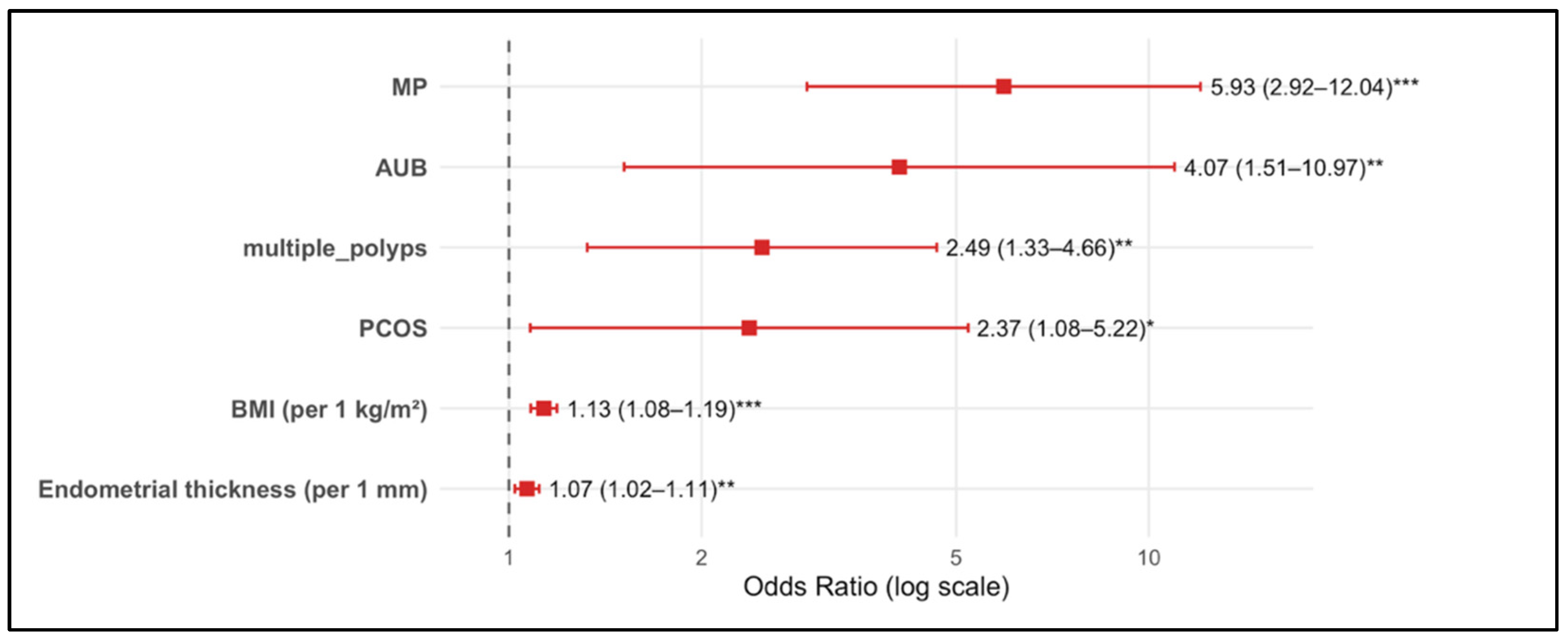
| Postmenopausal status | 5.93 (2.92–12.04) | <0.001 | 5.96 (2.87–12.37) | <0.001 |
| BMI (per 1 kg/m2) | 1.13 (1.08–1.19) | <0.001 | ||
| BMI_WPRO: Obese II vs. Normal | 5.17 (2.43–11.01) | <0.001 | ||
| BMI_WPRO: Under vs. Normal | 1.50 (0.32–7.07) | 0.610 | ||
| BMI_WPRO: Obese I vs. Normal | 1.17 (0.50–2.70) | 0.720 | ||
| BMI_WPRO: Over vs. Normal | 0.64 (0.20–2.07) | 0.461 | ||
| AUB | 4.07 (1.51–10.97) | 0.005 | 4.11 (1.51–11.2) | 0.006 |
| Multiple polyps | 2.49 (1.33–4.66) | 0.005 | 2.97 (1.59–5.56) | <0.001 |
| PCOS | 2.37 (1.08–5.22) | 0.032 | 2.91 (1.36–6.22) | 0.006 |
| EMT (mm) | 1.07 (1.02–1.11) | 0.004 | ||
| EMT ≥ 20 mm vs. EMT < 15 mm | 2.74 (1.23–6.06) | 0.013 | ||
| 15 mm–19.9 mm vs. EMT < 15 mm | 1.11 (0.49–2.49) | 0.804 | ||
Disclaimer/Publisher’s Note: The statements, opinions and data contained in all publications are solely those of the individual author(s) and contributor(s) and not of MDPI and/or the editor(s). MDPI and/or the editor(s) disclaim responsibility for any injury to people or property resulting from any ideas, methods, instructions or products referred to in the content. |
© 2025 by the authors. Licensee MDPI, Basel, Switzerland. This article is an open access article distributed under the terms and conditions of the Creative Commons Attribution (CC BY) license (https://creativecommons.org/licenses/by/4.0/).
Share and Cite
Jang, S.; Hwang, S.O. When Should We Biopsy? A Risk Factor-Based Predictive Model for EIN and Endometrial Cancer. Cancers 2025, 17, 3809. https://doi.org/10.3390/cancers17233809
Jang S, Hwang SO. When Should We Biopsy? A Risk Factor-Based Predictive Model for EIN and Endometrial Cancer. Cancers. 2025; 17(23):3809. https://doi.org/10.3390/cancers17233809
Chicago/Turabian StyleJang, Shina, and Sung Ook Hwang. 2025. "When Should We Biopsy? A Risk Factor-Based Predictive Model for EIN and Endometrial Cancer" Cancers 17, no. 23: 3809. https://doi.org/10.3390/cancers17233809
APA StyleJang, S., & Hwang, S. O. (2025). When Should We Biopsy? A Risk Factor-Based Predictive Model for EIN and Endometrial Cancer. Cancers, 17(23), 3809. https://doi.org/10.3390/cancers17233809