Robot-Assisted Radical Prostatectomy for Locally Advanced Prostate Cancer: Oncological Potential and Limitations as the Primary Treatment
by
 , , , , ,
Noriyoshi Miura
1,* ,
,
Masaki Shimbo
2,
Kensuke Shishido
1,
Shota Nobumori
1,
Naoya Sugihara
1,
Takatora Sawada
1,
Shunsuke Haga
1,
Haruna Arai
1,
Keigo Nishida
1,
Osuke Arai
1,
Tomoya Onishi
1,
Ryuta Watanabe
1,
Kenichi Nishimura
1,
Tetsuya Fukumoto
1,
Yuki Miyauchi
1,
Tadahiko Kikugawa
1,
Takato Nishino
2,
Fumiyasu Endo
2,
Kazunori Hattori
2 and
Takashi Saika
1 1
Department of Urology, Ehime University Graduate School of Medicine, Toon 791-0295, Japan
2
Department of Urology, St. Luke’s International Hospital, Tokyo 104-8560, Japan
*
Author to whom correspondence should be addressed.
Cancers 2025, 17(20), 3286; https://doi.org/10.3390/cancers17203286
Submission received: 21 September 2025
/
Revised: 5 October 2025
/
Accepted: 8 October 2025
/
Published: 10 October 2025
(This article belongs to the Special Issue Robot-Assisted Surgery for Urologic Cancer)
Simple Summary
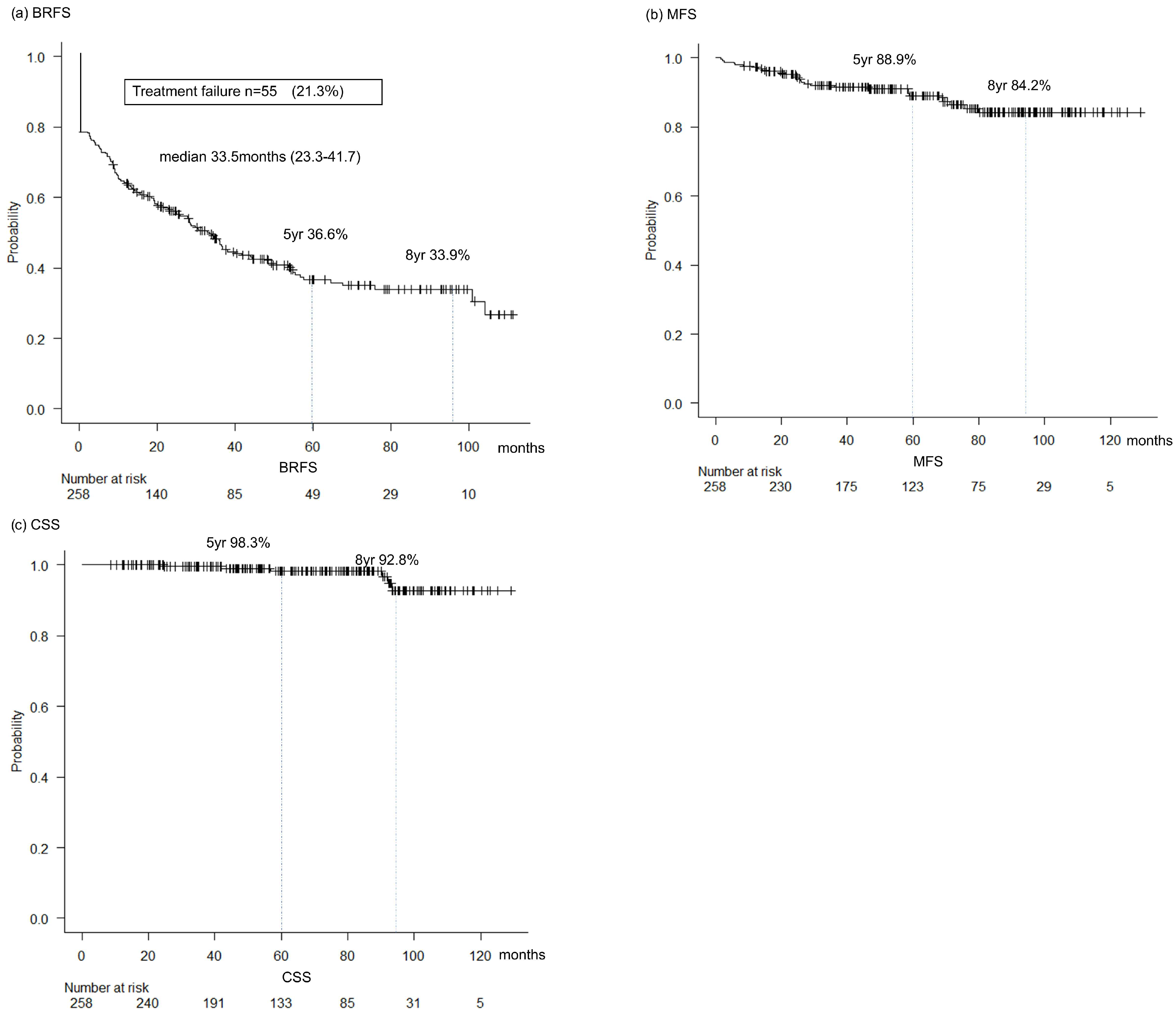
Prostate cancer is one of the most common cancers in men, and those with locally advanced disease are often treated with a combination of surgery, radiation, and systemic therapy. However, the long-term benefits of surgery alone are less clear. This study aimed to assess the safety and outcomes of robot-assisted radical prostatectomy (RARP) performed without additional systemic treatment. We analyzed 258 men with high-risk features—such as advanced clinical stage, high PSA levels, or aggressive biopsy results—who underwent RARP between 2012 and 2022. After a median follow-up of approximately 5 years, the 5-year survival rates were 36.6% for biochemical recurrence-free survival, 88.9% for metastasis-free survival, and 98.3% for cancer-specific survival. Factors linked to poorer outcomes included very high PSA, advanced stage, multiple high-grade biopsy cores, lymphovascular invasion, and lymph node involvement. These findings suggest that surgery alone may be effective for select patients, whereas multimodal therapy would be required in others.
Abstract
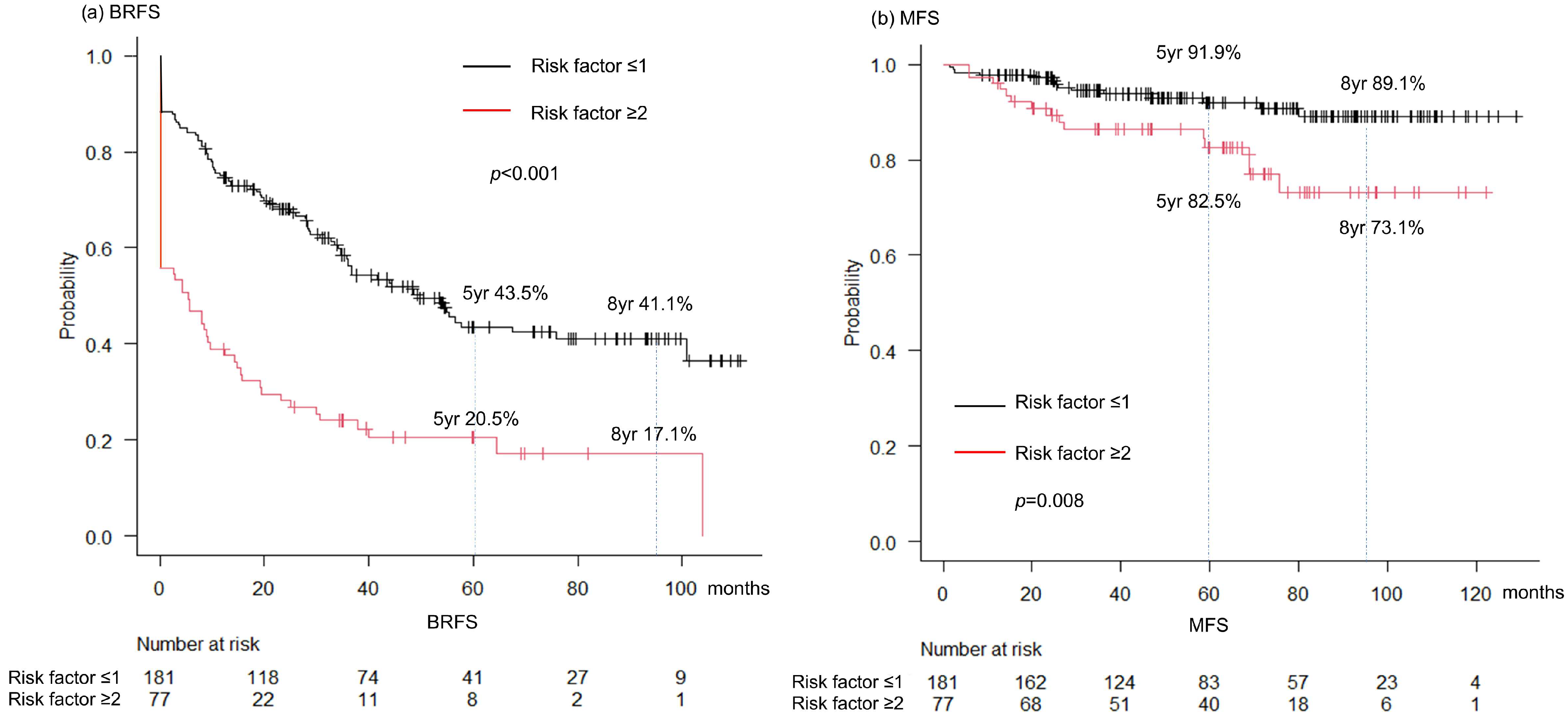
Background: Locally advanced prostate cancer (PCa) is commonly treated with multimodal therapy; however, long-term outcomes of surgery alone are poorly defined. We investigated the potential and limitations of robot-assisted radical prostatectomy (RARP) as primary treatment without perioperative systemic therapy in patients with locally advanced PCa. Methods: We retrospectively analyzed 258 patients who underwent RARP with extended pelvic lymph node dissection between 2012 and 2022 with locally advanced PCa, defined as present if at least one of the following was met: clinical stage cT3b–T4; primary Gleason pattern 5; >4 biopsy cores with Grade Group 4 or 5; or more than one NCCN high-risk characteristic. Patients who received neoadjuvant or adjuvant therapy were excluded. Endpoints included biochemical recurrence-free survival, metastasis-free survival, cancer-specific survival, and predictors of persistent PSA. Results: Median follow-up was 60.6 months. Pathological stage ≥ pT3a occurred in 63.6% and nodal involvement (pN1) in 27.1%. Five-year BRFS, MFS, and CSS were 36.6%, 88.9%, and 98.3%, respectively. Persistent PSA occurred in 21.3%. Preoperative predictors included PSA > 40 ng/mL, clinical stage ≥ cT3a, and >4 biopsy cores with a Gleason score of 8–10; patients with ≥2 features had significantly poorer BRFS and MFS. Postoperative predictors of recurrence were pathological stage, lymphovascular invasion, and nodal involvement. Conclusions: RARP alone provided durable long-term cancer control in selected men with locally advanced PCa, whereas patients with multiple adverse features were unlikely to be cured with surgery alone. Careful risk stratification may identify candidates for surgical monotherapy and help avoid overtreatment, while others may benefit from multimodal therapy.