Assessment of Psychological Burden in Individuals with Hereditary Risk of Pancreatic Cancer Under Surveillance: Evaluation of Distress 3 Years After Enrollment

 ,
,  , ,
, ,  and
and
Simple Summary
Abstract
1. Introduction
2. Methods
2.1. Study Design and Data Collection
2.2. Procedures
2.3. Questionnaires
2.3.1. Perceived Stress Scale (PSS)
2.3.2. General Self-Efficacy Scale (GSES)
2.3.3. Coping Orientation to Problems Experienced (Brief COPE)
2.3.4. The Multidimensional Scale of Perceived Social Support (MSPSS)
2.4. Statistical Analysis
3. Results
3.1. Outcomes of the Distress Assessment Conducted After 36 Months
3.1.1. Perceived Stress Scale (PSS)
3.1.2. General Self-Efficacy Scale (GSES)
3.1.3. Coping Orientation to Problems Experienced (Brief COPE)
3.1.4. The Multidimensional Scale of Perceived Social Support (MSPSS)
3.2. Outcomes of the Psychological Evaluation Conducted After 36 Months
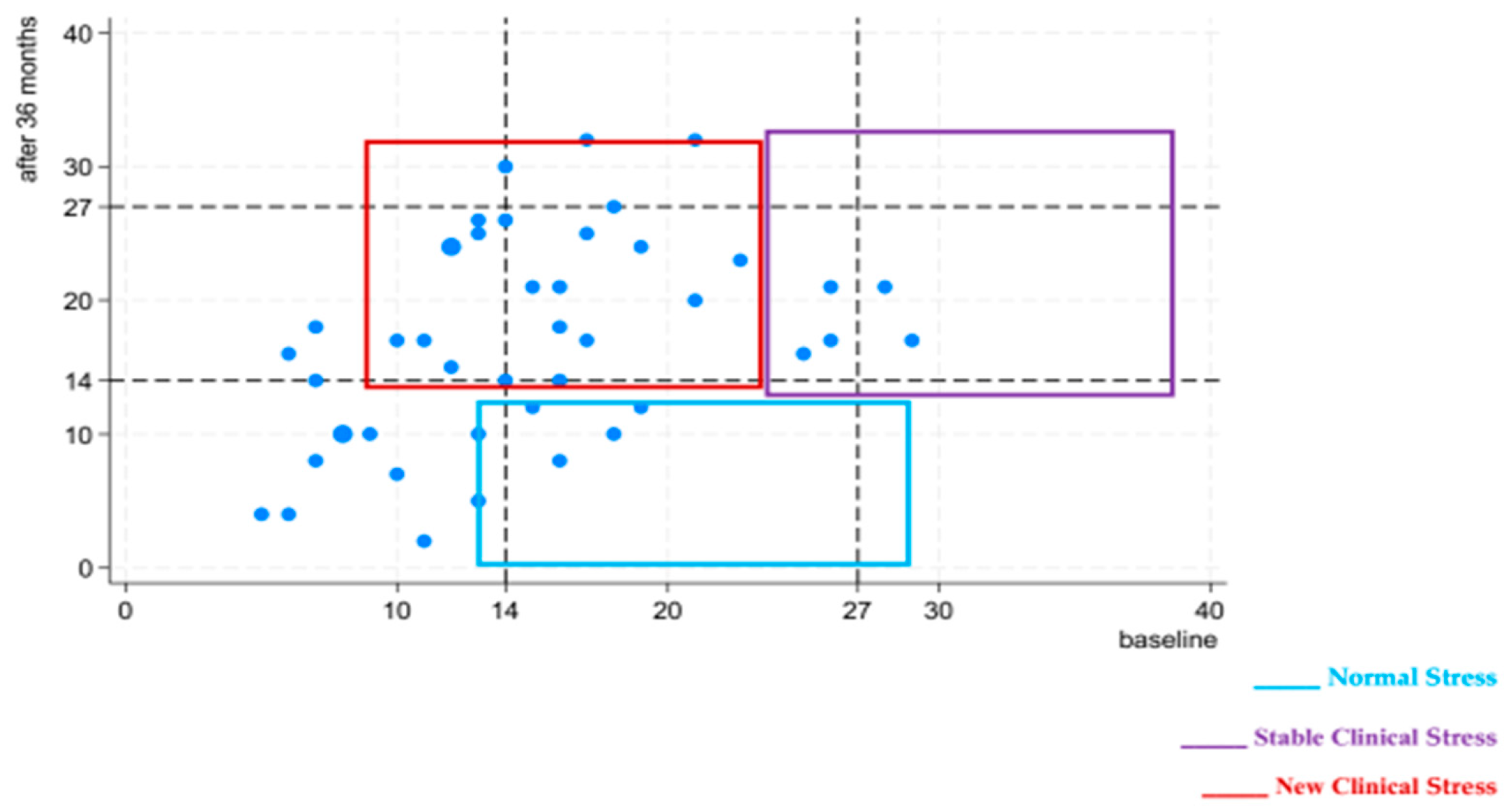
- Normal Stress: individuals with a PSS score below 14;
- Stable Clinical Stress: individuals with elevated stress both at baseline and at follow-up (PSS at follow-up >14 and PSS at baseline >14);
- New Clinical Stress: individuals who developed elevated stress at follow-up for the first time (PSS at follow-up >14 and PSS at baseline <14).
4. Discussion
- -
- implement annual psychological screenings to regularly evaluate the psychological burden, thereby facilitating early identification of needs and preventing the progression from adaptive to pathological stress responses;
- -
- promote targeted interventions for individuals experiencing distress—preferably group-based approaches such as relaxation techniques, mindfulness practices, cognitive-behavioural therapy focused on stress reduction, and resilience training—to support patients throughout the surveillance process, enhance their well-being, and improve stress management skills.
4.1. Broader Context and Future Research Directions
4.2. Limits of the Study
5. Conclusions
Author Contributions
Funding
Institutional Review Board Statement
Informed Consent Statement
Data Availability Statement
Acknowledgments
Conflicts of Interest
Abbreviations
| PC | Pancreatic Cancer |
| HRIs | High-Risk Individuals |
| IRFARPC | Italian Registry of Families at Risk of Pancreatic Cancer |
| MRCP | Magnetic Resonance Cholangiopancreatography |
References
- Wood, L.D.; Canto, M.I.; Jaffee, E.M.; Simeone, D.M. Pancreatic Cancer: Pathogenesis, Screening, Diagnosis, and Treatment. Gastroenterology 2022, 163, 386–402.e1. [Google Scholar] [CrossRef] [Scilit]
- Blackford, A.L.; Canto, M.I.; Klein, A.P.; Hruban, R.H.; Goggins, M. Recent Trends in the Incidence and Survival of Stage 1A Pancreatic Cancer: A Surveillance, Epidemiology, and End Results Analysis. J. Natl. Cancer Inst. 2020, 112, 1162–1169. [Google Scholar] [CrossRef] [Scilit]
- Strobel, O.; Neoptolemos, J.; Jäger, D.; Büchler, M.W. Optimizing the Outcomes of Pancreatic Cancer Surgery. Nat. Rev. Clin. Oncol. 2019, 16, 11–26. [Google Scholar] [CrossRef] [Scilit]
- Kleeff, J.; Korc, M.; Apte, M.; La Vecchia, C.; Johnson, C.D.; Biankin, A.V.; Neale, R.E.; Tempero, M.; Tuveson, D.A.; Hruban, R.H.; et al. Pancreatic Cancer. Nat. Rev. Dis. Primer 2016, 2, 16022. [Google Scholar] [CrossRef] [Scilit]
- Siegel, R.L.; Miller, K.D.; Fuchs, H.E.; Jemal, A. Cancer Statistics, 2021. CA Cancer J. Clin. 2021, 71, 7–33. [Google Scholar] [CrossRef] [Scilit]
- Kommalapati, A.; Tella, S.; Goyal, G.; Ma, W.; Mahipal, A. Contemporary Management of Localized Resectable Pancreatic Cancer. Cancers 2018, 10, 24. [Google Scholar] [CrossRef] [Scilit]
- Hijioka, S.; Morizane, C.; Takaori, K.; Okusaka, T. Study Protocol for a Multi-Institutional Prospective Surveillance Study among Kindreds with Familial Pancreatic Cancer and Individuals with Hereditary Pancreatic Cancer Syndrome: The Diamond Study. Pancreatology 2022, 22, 534–538. [Google Scholar] [CrossRef] [Scilit]
- Bartsch, D.K.; Matthäi, E.; Mintziras, I.; Bauer, C.; Figiel, J.; Sina-Boemers, M.; Gress, T.M.; Langer, P.; Slater, E.P. The German National Case Collection for Familial Pancreatic Cancer (FaPaCa). Dtsch. Ärztebl. Int. 2021, 118, 163–168. [Google Scholar] [CrossRef] [Scilit] [PubMed]
- Gonda, T.A.; Everett, J.N.; Wallace, M.; Simeone, D.M.; Amundadottir, L.; Beyer, G.; Bi, Y.; Brentnall, T.; Carpizo, D.; Carrato, A.; et al. Recommendations for a More Organized and Effective Approach to the Early Detection of Pancreatic Cancer from the PRECEDE (Pancreatic Cancer Early Detection) Consortium. Gastroenterology 2021, 161, 1751–1757. [Google Scholar] [CrossRef] [Scilit] [PubMed]
- Dbouk, M.; Katona, B.W.; Brand, R.E.; Chak, A.; Syngal, S.; Farrell, J.J.; Kastrinos, F.; Stoffel, E.M.; Blackford, A.L.; Rustgi, A.K.; et al. The Multicenter Cancer of Pancreas Screening Study: Impact on Stage and Survival. J. Clin. Oncol. 2022, 40, 3257–3266. [Google Scholar] [CrossRef] [Scilit] [PubMed]
- Paiella, S.; Capurso, G.; Carrara, S.; Secchettin, E.; Casciani, F.; Frigerio, I.; Zerbi, A.; Archibugi, L.; Bonifacio, C.; Malleo, G.; et al. Outcomes of a 3-Year Prospective Surveillance in Individuals at High Risk of Pancreatic Cancer. Am. J. Gastroenterol. 2024, 119, 739–747. [Google Scholar] [CrossRef] [Scilit] [PubMed]
- Blackford, A.L.; Canto, M.I.; Dbouk, M.; Hruban, R.H.; Katona, B.W.; Chak, A.; Brand, R.E.; Syngal, S.; Farrell, J.; Kastrinos, F.; et al. Pancreatic Cancer Surveillance and Survival of High-Risk Individuals. JAMA Oncol. 2024, 10, 1087. [Google Scholar] [CrossRef] [Scilit]
- Klatte, D.C.F.; Boekestijn, B.; Onnekink, A.M.; Dekker, F.W.; Van Der Geest, L.G.; Wasser, M.N.J.M.; Feshtali, S.; Mieog, J.S.D.; Luelmo, S.A.C.; Morreau, H.; et al. Surveillance for Pancreatic Cancer in High-Risk Individuals Leads to Improved Outcomes: A Propensity Score-Matched Analysis. Gastroenterology 2023, 164, 1223–1231.e4. [Google Scholar] [CrossRef] [Scilit]
- Zogopoulos, G.; Haimi, I.; Sanoba, S.A.; Everett, J.N.; Wang, Y.; Katona, B.W.; Farrell, J.J.; Grossberg, A.J.; Paiella, S.; Klute, K.A.; et al. The Pancreatic Cancer Early Detection (PRECEDE) Study Is a Global Effort to Drive Early Detection: Baseline Imaging Findings in High-Risk Individuals. J. Natl. Compr. Canc. Netw. 2024, 22, 158–166. [Google Scholar] [CrossRef] [Scilit]
- Wardle, J.; Williamson, S.; Sutton, S.; Biran, A.; McCaffery, K.; Cuzick, J.; Atkin, W. Psychological Impact of Colorectal Cancer Screening. Health Psychol. 2003, 22, 54–59. [Google Scholar] [CrossRef] [PubMed]
- Absetz, P.; Aro, A.R.; Sutton, S.R. Experience with Breast Cancer, Pre-screening Perceived Susceptibility and the Psychological Impact of Screening. Psychooncology 2003, 12, 305–318. [Google Scholar] [CrossRef] [Scilit]
- Andersen, M.R.; Drescher, C.W.; Zheng, Y.; Bowen, D.J.; Wilson, S.; Young, A.; McIntosh, M.; Mahony, B.S.; Lowe, K.A.; Urban, N. Changes in Cancer Worry Associated with Participation in Ovarian Cancer Screening. Psychooncology 2007, 16, 814–820. [Google Scholar] [CrossRef] [Scilit]
- Maheu, C.; Vodermaier, A.; Rothenmund, H.; Gallinger, S.; Ardiles, P.; Semotiuk, K.; Holter, S.; Thayalan, S.; Esplen, M.J. Pancreatic Cancer Risk Counselling and Screening: Impact on Perceived Risk and Psychological Functioning. Fam. Cancer 2010, 9, 617–624. [Google Scholar] [CrossRef] [Scilit] [PubMed]
- Konings, I.C.A.W.; Sidharta, G.N.; Harinck, F.; Aalfs, C.M.; Poley, J.; Kieffer, J.M.; Kuenen, M.A.; Smets, E.M.A.; Wagner, A.; Van Hooft, J.E.; et al. Repeated Participation in Pancreatic Cancer Surveillance by High-risk Individuals Imposes Low Psychological Burden. Psychooncology 2016, 25, 971–978. [Google Scholar] [CrossRef] [Scilit]
- Harinck, F.; Nagtegaal, T.; Kluijt, I.; Aalfs, C.; Smets, E.; Poley, J.-W.; Wagner, A.; Van Hooft, J.; Fockens, P.; Bruno, M.; et al. Feasibility of a Pancreatic Cancer Surveillance Program from a Psychological Point of View. Genet. Med. 2011, 13, 1015–1024. [Google Scholar] [CrossRef] [Scilit]
- Cazacu, I.; Luzuriaga Chavez, A.; Saftoiu, A.; Bhutani, M. Psychological Impact of Pancreatic Cancer Screening by EUS or Magnetic Resonance Imaging in High-Risk Individuals: A Systematic Review. Endosc. Ultrasound 2019, 8, 17. [Google Scholar] [CrossRef] [Scilit]
- Paiella, S.; Marinelli, V.; Secchettin, E.; Mazzi, M.A.; Ferretto, F.; Casolino, R.; Bassi, C.; Salvia, R. The Emotional Impact of Surveillance Programs for Pancreatic Cancer on High-risk Individuals: A Prospective Analysis. Psychooncology 2020, 29, 1004–1011. [Google Scholar] [CrossRef] [Scilit] [PubMed]
- Paiella, S.; Capurso, G.; Cavestro, G.M.; Butturini, G.; Pezzilli, R.; Salvia, R.; Signoretti, M.; Crippa, S.; Carrara, S.; Frigerio, I.; et al. Results of First-Round of Surveillance in Individuals at High-Risk of Pancreatic Cancer from the AISP (Italian Association for the Study of the Pancreas) Registry. Am. J. Gastroenterol. 2019, 114, 665–670. [Google Scholar] [CrossRef] [Scilit] [PubMed]
- Cohen, S.; Kessler, R.C.; Gordon, L.U. Measuring Stress: A Guide for Health and Social Scientists; Oxford University Press: New York, NY, USA, 1995; ISBN 978-0-19-508641-6. [Google Scholar]
- Cohen, S.; Kamarck, T.; Mermelstein, R. A Global Measure of Perceived Stress. J. Health Soc. Behav. 1983, 24, 385. [Google Scholar] [CrossRef] [Scilit] [PubMed]
- Halioua, B.; Bantman, P.; Rimmer, R.; Ghozlan, E.; Vaislic, M.; Halioua, D.; Amson, F.; Taieb, C.; Prasquier, R.; Gutthman, J.-F.; et al. International Study of the Perceived Stress and Psychological Impact of the 7 October Attacks on Holocaust Survivors. Eur. J. Psychotraumatol. 2025, 16, 2428025. [Google Scholar] [CrossRef] [Scilit]
- Fossati, A. Italian Perceived Stress Scale. Available online: https://www.cmu.edu/dietrich/psychology/stress-immunity-disease-lab/scales/.doc/italian_pss_10_with_info.doc (accessed on 1 March 2019).
- Mondo, M.; Sechi, C.; Cabras, C. Psychometric Evaluation of Three Versions of the Italian Perceived Stress Scale. Curr. Psychol. 2021, 40, 1884–1892. [Google Scholar] [CrossRef] [Scilit]
- Schwarzer, R.; Jerusalem, M. Generalized Self-Efficacy Scale. In Measures in Health Psychology: A User’s Portfolio; Causal and Control Beliefs; NFER-NELSON: Windsor, UK; pp. 35–37.
- Sibilia, L.; Schwarzer, R.; Jerusalem, M. Italian Adaptation of the General Self-Efficacy Scale. Available online: http://userpage.fu-berlin.de/health/italian.htm (accessed on 1 March 2019).
- Carver, C.S. You Want to Measure Coping but Your Protocol’ Too Long: Consider the Brief Cope. Int. J. Behav. Med. 1997, 4, 92–100. [Google Scholar] [CrossRef] [Scilit]
- Carver, C.S.; Scheier, M.F.; Weintraub, J.K. Assessing Coping Strategies: A Theoretically Based Approach. J. Pers. Soc. Psychol. 1989, 56, 267–283. [Google Scholar] [CrossRef] [Scilit]
- Bongelli, R.; Fermani, A.; Canestrari, C.; Riccioni, I.; Muzi, M.; Bertolazzi, A.; Burro, R. Italian Validation of the Situational Brief Cope Scale (I-Brief Cope). PLoS ONE 2022, 17, e0278486. [Google Scholar] [CrossRef] [Scilit]
- Cooper, C.; Katona, C.; Orrell, M.; Livingston, G. Coping Strategies and Anxiety in Caregivers of People with Alzheimer’s Disease: The LASER-AD Study. J. Affect. Disord. 2006, 90, 15–20. [Google Scholar] [CrossRef] [Scilit]
- Zimet, G.D.; Dahlem, N.W.; Zimet, S.G.; Farley, G.K. The Multidimensional Scale of Perceived Social Support. J. Pers. Assess. 1988, 52, 30. [Google Scholar] [CrossRef] [Scilit]
- Zimet, G.D.; Powell, S.S.; Farley, G.K.; Werkman, S.; Berkoff, K.A. Psychometric Characteristics of the Multidimensional Scale of Perceived Social Support. J. Pers. Assess. 1990, 55, 610–617. [Google Scholar] [CrossRef] [Scilit] [PubMed]
- Prezza, M.; Principato, M.C. La Rete e Il Sostegno Sociale. In Conoscere la Comunità: L’Analisi Degli Ambienti di vita Quotidiana; Strumenti; il Mulino: Bologna, Italy, 2002; pp. 193–233. [Google Scholar]
- Bancroft, E.K.; Page, E.C.; Brook, M.N.; Pope, J.; Thomas, S.; Myhill, K.; Helfand, B.T.; Talaty, P.; Ong, K.-R.; Douglas, E.; et al. The Psychosocial Impact of Prostate Cancer Screening for BRCA1 and BRCA2 Carriers. BJU Int. 2024, 134, 484–500. [Google Scholar] [CrossRef] [Scilit] [PubMed]
- Liao, B.; Xu, D.; Tan, Y.; Chen, X.; Cai, S. Association of Mental Distress with Chronic Diseases in 1.9 Million Individuals: A Population-Based Cross-Sectional Study. J. Psychosom. Res. 2022, 162, 111040. [Google Scholar] [CrossRef] [Scilit] [PubMed]
- Joshi, P.; Bhandari, S.; Tk, A.; Kaur, S.; Bhargava, R.; Tansir, G.; Rastogi, S. A Qualitative Study to Assess the Psychological Experiences and Coping Strategies of Families Affected with Li-Fraumeni Syndrome in the Indian Population. Rare Tumors 2023, 15, 20363613231186300. [Google Scholar] [CrossRef] [Scilit]



| Scale | Task | Number of Items | Item Range | Score Calculation | Score Range |
|---|---|---|---|---|---|
| PSS | Perceived Stress | 10 | 0–4 | sum of items | 0–40 |
| PSS-H | Perceived Helplessness | 6 | 0–4 | sum of items | 0–24 |
| PSS-L | Lack of Self-efficacy | 4 | 0–4 | sum of items | 0–16 |
| GSES | General Self-efficacy | 10 | 1–4 | sum of items | 10–40 |
| Brief-COPE | Coping strategies | 28 | 1–4 | sum of items | 28–112 |
| COPE-emotions | Emotion-focused strategies | 10 | 1–4 | sum of items | 10–40 |
| COPE-problems | Problem-focused strategies | 6 | 1–4 | sum of items | 6–24 |
| COPE-dysfunctional | Dysfunctional strategies | 12 | 1–4 | sum of items | 12–48 |
| MSPSS | Multidimensional Scale of Perceived Social Support | 12 | 1–6 | mean of items | 1–6 |
| MSPSS-family | Family support | 4 | 1–6 | mean of items | 1–6 |
| MSPSS-friends | Friend support | 4 | 1–6 | mean of items | 1–6 |
| MSPSS other-person | Significant person support | 4 | 1–6 | mean of items | 1–6 |
| Follow-Up | Baseline | Difference | St Dev | t-Test | p-Value | |
|---|---|---|---|---|---|---|
| PSS-total | 16.91 | 14.83 | −2.08 | 7.63 | −1.80 | 0.08 |
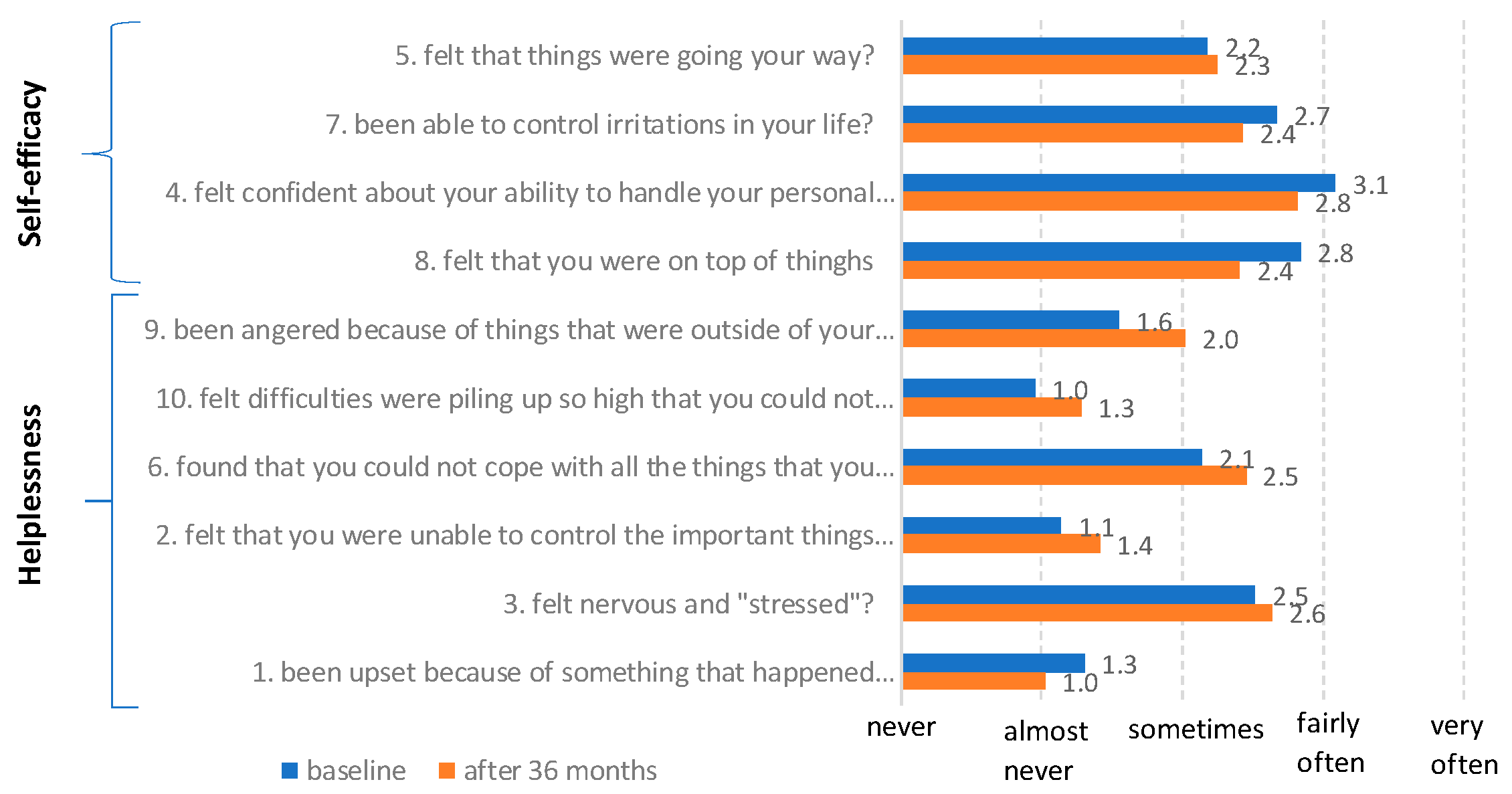
| PSS- Perceived Helplessness | 10.82 | 9.59 | −1.23 | 5.79 | −1.41 | 0.17 |
| PSS- Lack of Self-Efficacy | 6.09 | 5.24 | −0.85 | 3.57 | −1.57 | 0.12 |
| GSES | 28.09 | 31.95 | 3.86 | 4.44 | 5.77 | <0.01 |
| COPE-total | 61.39 | 64.00 | 2.61 | 8.64 | 2.00 | 0.05 |
| COPE-emotions | 22.52 | 23.16 | 0.64 | 4.80 | 0.88 | 0.38 |
| COPE-problems | 17.45 | 18.80 | 1.34 | 3.28 | 2.71 | <0.01 |
| COPE-dysfunctional | 21.41 | 22.05 | 0.64 | 4.80 | 0.88 | 0.38 |
| MSPSS-total | 4.27 | 4.63 | 0.36 | 1.16 | 2.04 | 0.05 |
| MSPSS-family | 4.67 | 4.76 | 0.08 | 1.51 | 0.35 | 0.73 |
| MSPSS-friends | 3.80 | 4.35 | 0.55 | 1.46 | 2.49 | 0.02 |
| MSPSS-other persons | 4.33 | 4.79 | 0.45 | 1.52 | 1.95 | 0.06 |
| STRATEGIES | Follow-Up | Baseline | Difference | St Deviation | t-Test | p-Value |
|---|---|---|---|---|---|---|
| EMOTIONAL-FOCUSED | ||||||
| Use of emotional support | 4.14 | 4.33 | 0.18 | 2.0 | 0.60 | 0.55 |
| Positive reframe | 4.52 | 4.89 | 0.36 | 2.0 | 1.20 | 0.23 |
| Acceptance | 6.30 | 6.45 | 0.16 | 1.5 | 0.71 | 0.48 |
| Religion | 3.64 | 3.91 | 0.27 | 1.8 | 0.99 | 0.32 |
| Humour | 3.93 | 3.57 | −0.36 | 1.6 | −1.49 | 0.14 |
| PROBLEM-FOCUSED | ||||||
| Active coping | 6.55 | 7.07 | 0.52 | 1.8 | 1.88 | 0.07 |
| Planning | 6.50 | 7.18 | 0.68 | 1.4 | 3.28 | <0.01 |
| Use of instrumental support | 4.41 | 4.48 | 0.07 | 1.8 | 0.26 | 0.80 |
| DYSFUNCTIONAL COPING | ||||||
| Venting | 4.59 | 4.68 | 0.09 | 1.9 | 0.28 | 0.78 |
| Denial | 2.32 | 2.84 | 0.52 | 1.5 | 2.38 | 0.02 |
| Substance use | 2.0 | 2.0 | 0.00 | n.c. | ||
| Behavioural disengagement | 2.43 | 2.50 | 0.70 | 1.4 | 0.33 | 0.74 |
| Self-distraction | 4.70 | 5.00 | 0.30 | 2.5 | 0.77 | 0.45 |
| Self-blame | 5.36 | 5.02 | −0.34 | 1.8 | −1.24 | 0.22 |
| Normal Stress (PSS fu < 14) | Stable Clinical Stress (PSS fu > 14 & PSS bs > 14) | New Clinical Stress (PSS fu > 14 & PSS bs < 14) | |
|---|---|---|---|
| N (%) | 14 (32%) | 20 (46%) | 10 (22%) |
| PSS baseline score | 11.3 (4.5) | 19.6 (4.9) | 10.3 (2.7) |
| Age | 54.6 (10.5) | 56.3 (11.7) | 59.9 (9.4) |
| Gender: female male | 9 (64%) 5 (36%) | 12 (60%) 8 (40%) | 8 (80%) 2 (20%) |
| Family member Loss: yes | 1 (7%) | 6 (30%) | 0 (00%) |
| GSES FU score | 32.2 (5.8) | 25.8 (5.4) | 27.0 (3.4) |
| COPE total FU score | 61.1 (8.8) | 58.4 (10.0) | 67.7 (7.2) |
| COPE-emotions FU score | 23.2 (5.1) | 20.7 (6.3) | 25.3 (5.7) |
| COPE-problems follow-up score | 17.6 (2.9) | 16.4 (3.4) | 19.4 (1.5) |
| COPE-dysfunctional follow-up score | 20.4 (2.8) | 21.4 (3.2) | 23.0 (2.4) |
| MSPSS total FU score | 4.7 (0.9) | 3.6 (1.3) | 5.0 (0.4) |
| MSPSS family FU score | 5.3 (1.0) | 3.9 (1.4) | 5.5 (0.5) |
| MSPSS friends FU score | 4.1 (1.0) | 3.3 (1.3) | 4.4 (0.7) |
| MSPSS other-person FU score | 4.8 (1.0) | 3.6 (1.6) | 5.2 (0.4) |
Disclaimer/Publisher’s Note: The statements, opinions and data contained in all publications are solely those of the individual author(s) and contributor(s) and not of MDPI and/or the editor(s). MDPI and/or the editor(s) disclaim responsibility for any injury to people or property resulting from any ideas, methods, instructions or products referred to in the content. |
© 2025 by the authors. Licensee MDPI, Basel, Switzerland. This article is an open access article distributed under the terms and conditions of the Creative Commons Attribution (CC BY) license (https://creativecommons.org/licenses/by/4.0/).
Share and Cite
Marinelli, V.; Mazzi, M.A.; Maggioni, O.; Venturini, E.; Rimondini, M.; Milella, M.; Paiella, S.; Salvia, R. Assessment of Psychological Burden in Individuals with Hereditary Risk of Pancreatic Cancer Under Surveillance: Evaluation of Distress 3 Years After Enrollment. Cancers 2025, 17, 3014. https://doi.org/10.3390/cancers17183014
Marinelli V, Mazzi MA, Maggioni O, Venturini E, Rimondini M, Milella M, Paiella S, Salvia R. Assessment of Psychological Burden in Individuals with Hereditary Risk of Pancreatic Cancer Under Surveillance: Evaluation of Distress 3 Years After Enrollment. Cancers. 2025; 17(18):3014. https://doi.org/10.3390/cancers17183014
Chicago/Turabian StyleMarinelli, Veronica, Maria Angela Mazzi, Olga Maggioni, Elisa Venturini, Michela Rimondini, Michele Milella, Salvatore Paiella, and Roberto Salvia. 2025. "Assessment of Psychological Burden in Individuals with Hereditary Risk of Pancreatic Cancer Under Surveillance: Evaluation of Distress 3 Years After Enrollment" Cancers 17, no. 18: 3014. https://doi.org/10.3390/cancers17183014
APA StyleMarinelli, V., Mazzi, M. A., Maggioni, O., Venturini, E., Rimondini, M., Milella, M., Paiella, S., & Salvia, R. (2025). Assessment of Psychological Burden in Individuals with Hereditary Risk of Pancreatic Cancer Under Surveillance: Evaluation of Distress 3 Years After Enrollment. Cancers, 17(18), 3014. https://doi.org/10.3390/cancers17183014