Immunohistochemistry for Skin Cancers: A Comprehensive Approach to the Diagnosis of Squamous Cell Carcinoma
by
 , , and
Vlad-Mihai Voiculescu
1,2 ,
,
Radu-Marian Marinescu
1,*,
Sorin Dutulescu
1,3 and
Florica Stăniceanu
1,3 1
Department of Dermatology, “Carol Davila” University of Medicine and Pharmacy, 050474 Bucharest, Romania
2
Elias Emergency University Hospital, 011461 Bucharest, Romania
3
Pathology Department, “Matei Bals” National Institute for Infectious Diseases, 021105 Bucharest, Romania
*
Author to whom correspondence should be addressed.
Cancers 2025, 17(10), 1629; https://doi.org/10.3390/cancers17101629
Submission received: 21 April 2025
/
Revised: 4 May 2025
/
Accepted: 5 May 2025
/
Published: 12 May 2025
(This article belongs to the Section Cancer Immunology and Immunotherapy)
Simple Summary
Squamous cell carcinoma (SCC) encompasses a diverse group of epithelial malignancies with varying morphology, biological behavior, and clinical implications. Although histopathological examination remains the cornerstone of diagnosis, immunohistochemistry (IHC) has become indispensable in confirming squamous differentiation, guiding differential diagnosis, and offering prognostic insight. This systematic review aims to synthesize and organize current evidence on the most frequently used IHC markers in SCC across various anatomical sites, including their diagnostic performance, role in distinguishing mimickers, and utility in staging and risk stratification.
Abstract
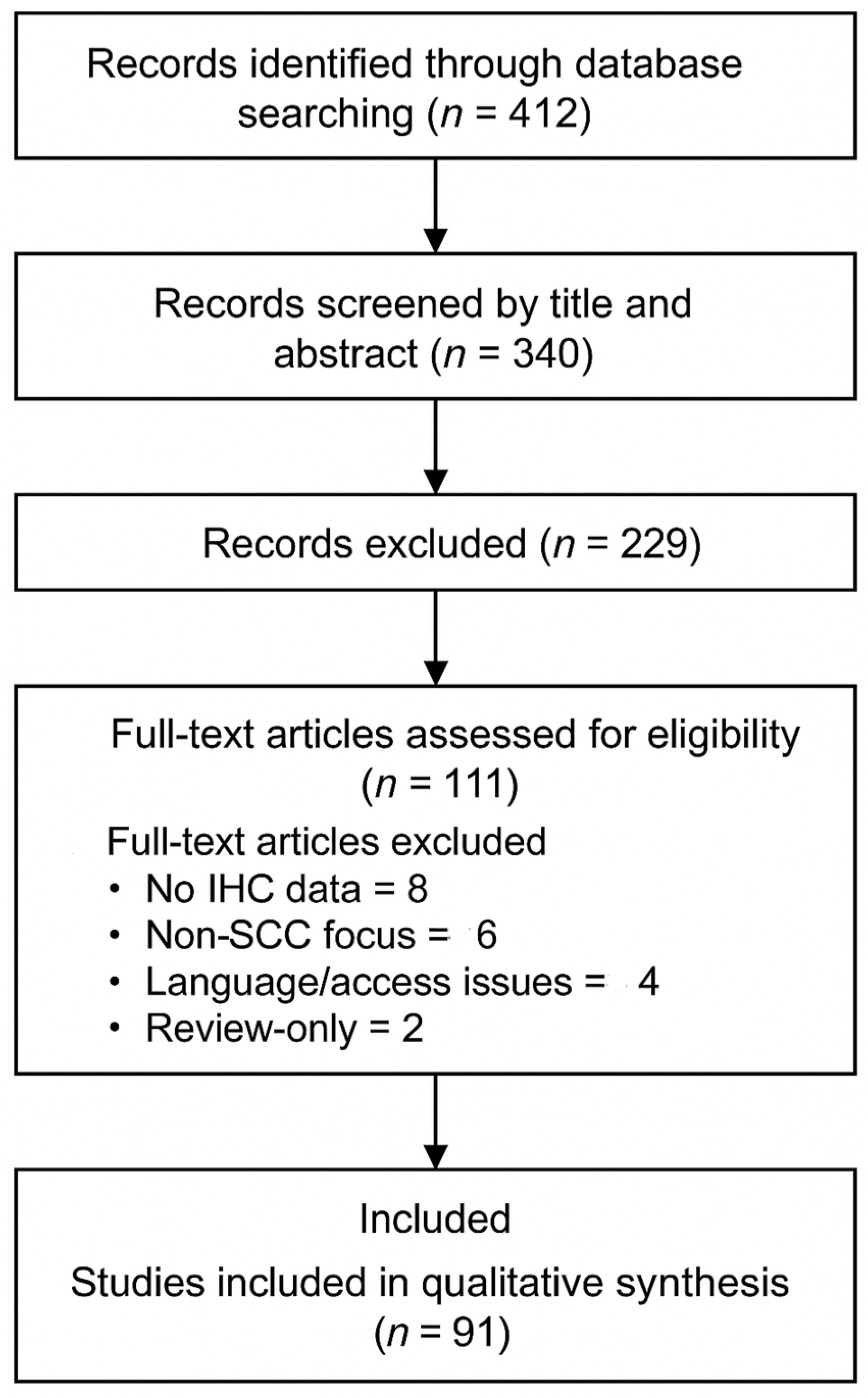
Background: Squamous cell carcinoma (SCC) is a heterogeneous group of epithelial malignancies with varied morphologies and clinical behaviors. While histopathology is the diagnostic gold standard, it can be limited in distinguishing SCC from morphologic mimics. Immunohistochemistry (IHC) has therefore become a critical adjunct, enhancing diagnostic accuracy and providing prognostic insights. Objective: This narrative review aims to evaluate the diagnostic, differential, and prognostic roles of commonly used IHC markers in SCC, with particular emphasis on their utility in distinguishing SCC from histologic mimickers across different anatomical sites. Methods: One hundred and five peer-reviewed articles were analyzed for their relevance to the immunohistochemical characterization of SCC. Markers were categorized based on their diagnostic function, role in differential diagnosis, and prognostic value. Results: Key markers such as p40, p63, CK5/6, and DSG3 consistently demonstrated high sensitivity and specificity for SCC, reinforcing their value in confirming squamous differentiation. Conversely, exclusion markers like Ber-EP4, CK7, TTF-1, S100, and SOX10 were essential in ruling out basal cell carcinoma, adenocarcinoma, and melanoma. Additionally, markers such as Ki-67, p16, and CD44 offered prognostic information regarding tumor aggressiveness, HPV status, and therapy response. These findings confirm the critical role of IHC not only in diagnosing SCC but also in resolving complex differential diagnoses. Conclusions: IHC markers serve as indispensable tools in the diagnostic workup of SCC, particularly in distinguishing it from other neoplasms with overlapping histologic features. The clear correlation between marker expression and diagnostic categories supports the systematic use of IHC to improve diagnostic precision and inform prognosis. Future integration with molecular diagnostics may further refine personalized treatment approaches in SCC.
Keywords:
squamous cell carcinoma; immunohistochemistry; skin cancer