Updates in the Management of Richter Transformation


Tisch Cancer Institute, Icahn School of Medicine at Mount Sinai, New York, NY 10029, USA
*
Author to whom correspondence should be addressed.
†
These authors contributed equally to this work.
Cancers 2025, 17(1), 95; https://doi.org/10.3390/cancers17010095
Submission received: 2 December 2024
/
Revised: 23 December 2024
/
Accepted: 24 December 2024
/
Published: 31 December 2024
(This article belongs to the Special Issue Updates in Chronic Lymphocytic Leukemia: 10 Years of Paradigm Change and Outlook for the Future)
Simple Summary
Richter transformation (RT) describes a rare progression of chronic lymphocytic leukemia (CLL) to an aggressive lymphoma. When RT directly evolves from the preceding CLL, termed clonally related RT, as is most often the case, patients are susceptible to particularly poor outcomes, with poor responses to traditional chemoimmunotherapy and short survival. As such, there is an urgent need to expand our treatment arsenal for RT. In recent years, clinical trials have investigated a multitude of novel drug combinations to treat RT. These include agents that block lymphoma pro-survival pathways, antibodies that facilitate tumor cell recognition by innate T-cells, and the infusion of T-cells that are genetically altered to target lymphoma. This review aims to provide a comprehensive update on various novel RT treatment strategies under investigation that have demonstrated promising efficacy and safety outcomes.
Abstract
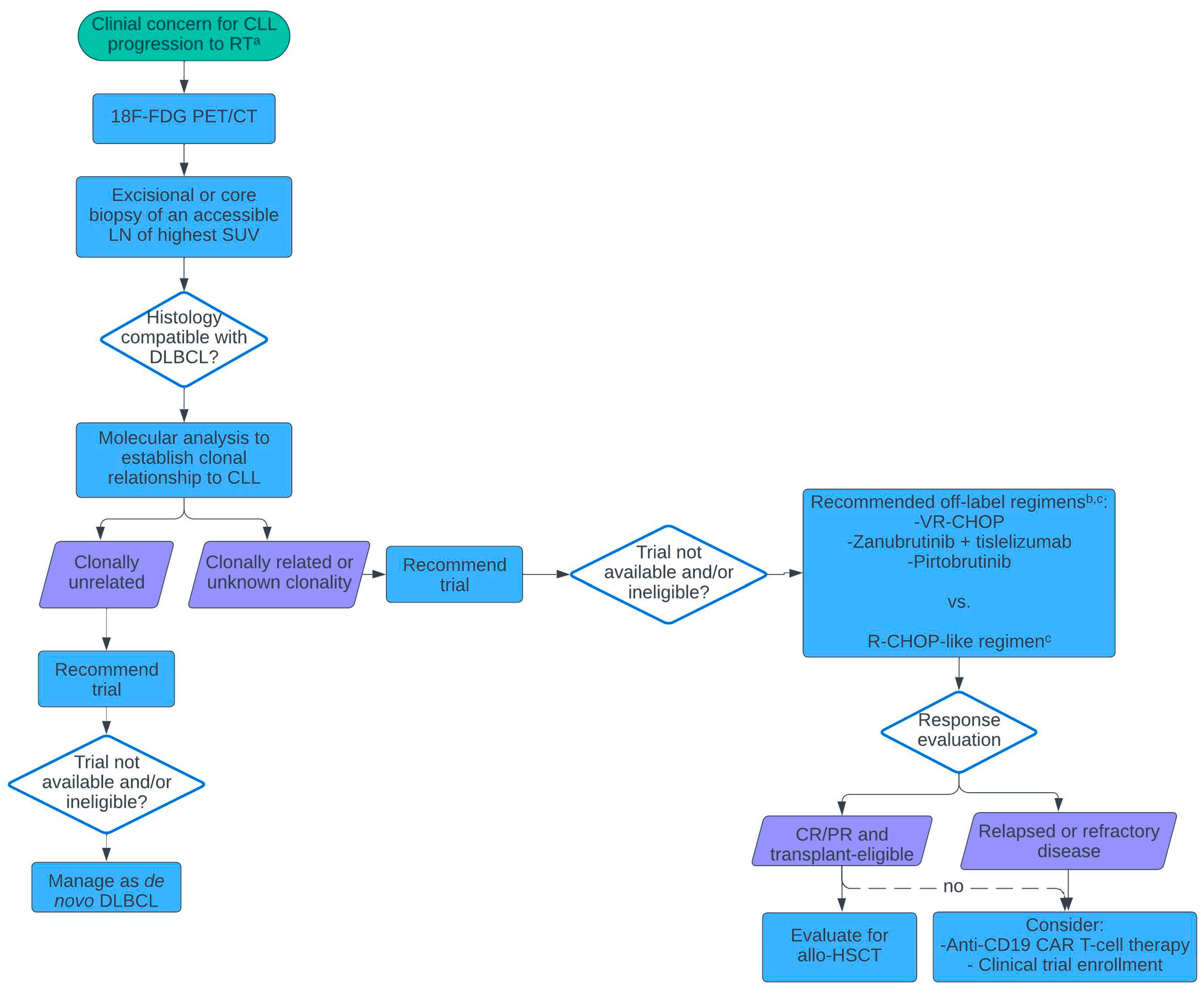
Richter transformation (RT) is a rare albeit devastating complication of chronic lymphocytic leukemia/small lymphocytic lymphoma (CLL). RT is defined as an aggressive lymphoma, typically diffuse large B-cell lymphoma, in the setting of CLL. A clonal relationship to the preceding CLL clone is detected in the majority of RT cases and confers more aggressive clinicopathologic kinetics, resistance to standard chemoimmunotherapy regimens, and inferior survival. Taken together, these considerations precipitate a significant unmet need for novel therapeutic strategies that improve the outcomes of patients with RT. Through this review, we will explore current data on emerging regimens targeting BTK, BCL-2, CD79, CD20, PI3K, and PD-1—both as single agents and as combination therapies with or without concurrent chemoimmunotherapy. Furthermore, we will review the role of bispecific T-cell engagers, anti-CD19 chimeric antigen receptor T-cell therapies, and hematopoietic stem cell transplantation in RT. To guide therapeutic decision-making, we will outline an algorithmic approach to the management of RT, with particular emphasis on prioritization of clinical trial enrollment and utilization of an ever-evolving array of novel therapies.
Keywords:
Richter transformation; targeted therapies; CLL