Axillary Surgery for Breast Cancer in 2024


1
Breast Surgery, University Hospital Basel, 4031 Basel, Switzerland
2
Faculty of Medicine, University of Basel, 4001 Basel, Switzerland
*
Author to whom correspondence should be addressed.
Cancers 2024, 16(9), 1623; https://doi.org/10.3390/cancers16091623
Submission received: 21 March 2024
/
Revised: 18 April 2024
/
Accepted: 21 April 2024
/
Published: 23 April 2024
(This article belongs to the Special Issue Clinical Research and Progress in the Treatment of Breast Cancer)
Simple Summary
Historically, all patients with breast cancer (BC) underwent radical removal of lymph nodes under the armpit and up to the neck. Since the 1990s, axillary surgery has become increasingly de-escalated, and few indications for axillary lymph node dissection (ALND) remain. Patients with small BC (<2 cm) and unremarkable clinical examination through palpation and ultrasound may safely forego any axillary surgery. For patients with clinically node-negative BC and up to two positive lymph nodes found on sentinel lymph node biopsy, ALND can be safely avoided. If no residual tumor cells are found in the lymph nodes after neoadjuvant chemotherapy (NACT), ALND is not necessary. Ongoing studies are investigating whether axillary radiotherapy can provide similar survival outcomes to ALND in patients with clinically node-positive BC or in patients with residual nodal disease after NACT.
Abstract
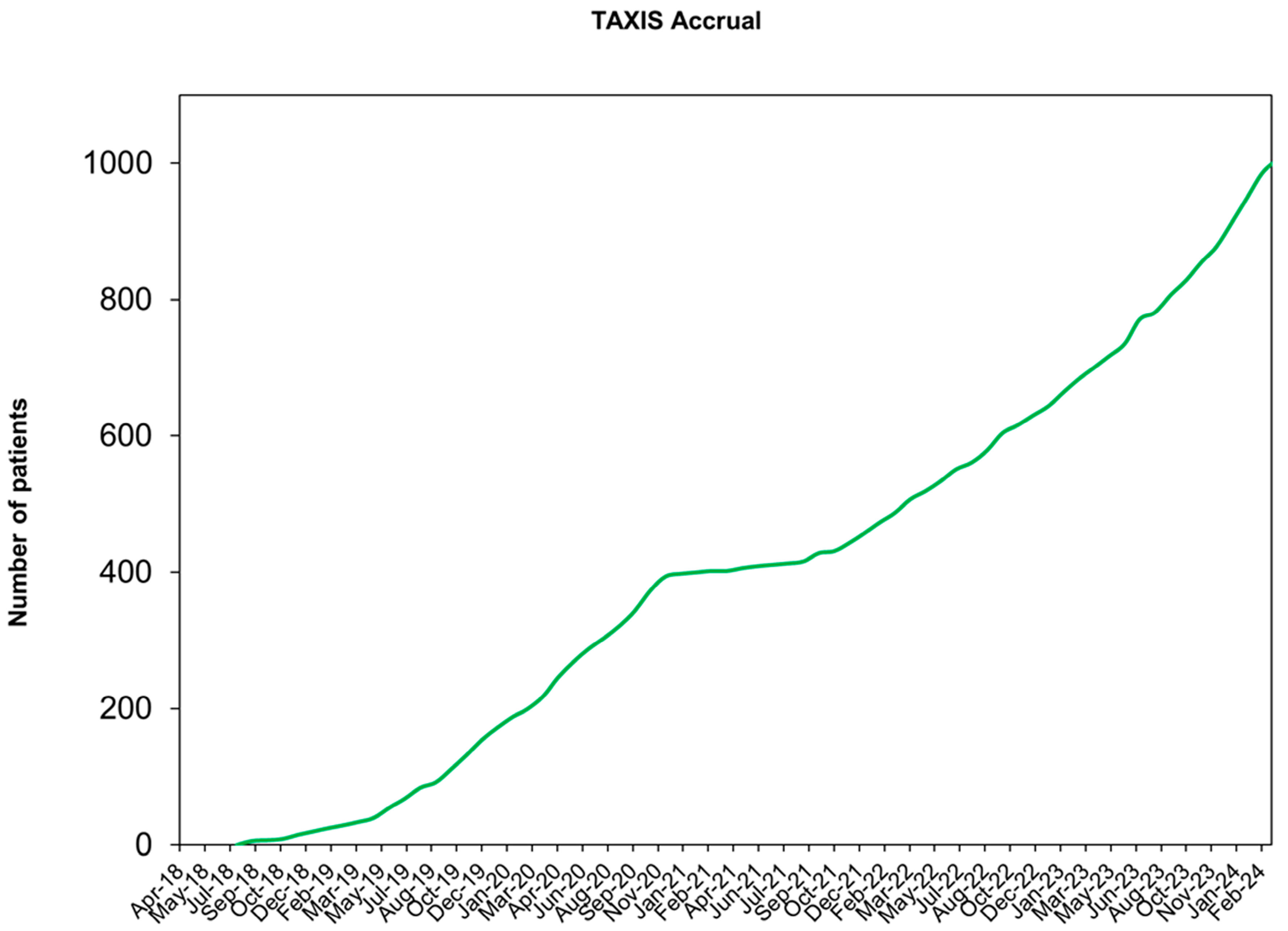
Axillary surgery for patients with breast cancer (BC) in 2024 is becoming increasingly specific, moving away from the previous ‘one size fits all’ radical approach. The goal is to spare morbidity whilst maintaining oncologic safety. In the upfront surgery setting, a first landmark randomized controlled trial (RCT) on the omission of any surgical axillary staging in patients with unremarkable clinical examination and axillary ultrasound showed non-inferiority to sentinel lymph node (SLN) biopsy (SLNB). The study population consisted of 87.8% postmenopausal patients with estrogen receptor-positive, human epidermal growth factor receptor 2-negative BC. Patients with clinically node-negative breast cancer and up to two positive SLNs can safely be spared axillary dissection (ALND) even in the context of mastectomy or extranodal extension. In patients enrolled in the TAXIS trial, adjuvant systemic treatment was shown to be similar with or without ALND despite the loss of staging information. After neoadjuvant chemotherapy (NACT), targeted lymph node removal with or without SLNB showed a lower false-negative rate to determine nodal pathological complete response (pCR) compared to SLNB alone. However, oncologic outcomes do not appear to differ in patients with nodal pCR determined by either one of the two concepts, according to a recently published global, retrospective, real-world study. Real-world studies generally have a lower level of evidence than RCTs, but they are feasible quickly and with a large sample size. Another global real-world study provides evidence that even patients with residual isolated tumor cells can be safely spared from ALND. In general, few indications for ALND remain. Three randomized controlled trials are ongoing for patients with clinically node-positive BC in the upfront surgery setting and residual disease after NACT. Pending the results of these trials, ALND remains indicated in these patients.