Liquid Biopsy for Detection of Pancreaticobiliary Cancers by Functional Enrichment and Immunofluorescent Profiling of Circulating Tumor Cells and Their Clusters
by
 , and
, and
Andrew Gaya
1,*, 
Nitesh Rohatgi
2,
Sewanti Limaye
3,
Aditya Shreenivas
4,
Ramin Ajami
5,
Dadasaheb Akolkar
6,
Vineet Datta
6, 
Ajay Srinivasan
6 and
Darshana Patil
6 1
Department of Clinical Oncology, Cromwell Hospital, London SW5 0TU, UK
2
Department of Medical Oncology, Fortis Memorial Research Institute, Gurugram 122002, HR, India
3
Department of Medical and Precision Oncology, Sir HN Reliance Foundation Hospital and Research Centre, Mumbai 400004, MH, India
4
Department of Medicine, Medical College of Wisconsin, Milwaukee, WI 53226, USA
5
Department of Oncology, The Royal Free Hospital, London NW3 2QG, UK
6
Department of Research and Innovation, Datar Cancer Genetics, Nasik 422010, MH, India
*
Author to whom correspondence should be addressed.
Cancers 2024, 16(7), 1400; https://doi.org/10.3390/cancers16071400
Submission received: 8 March 2024
/
Revised: 27 March 2024
/
Accepted: 31 March 2024
/
Published: 2 April 2024
(This article belongs to the Special Issue Cancer Biomarkers: Recent Progress, Innovations and Future Clinical Implications)
Simple Summary
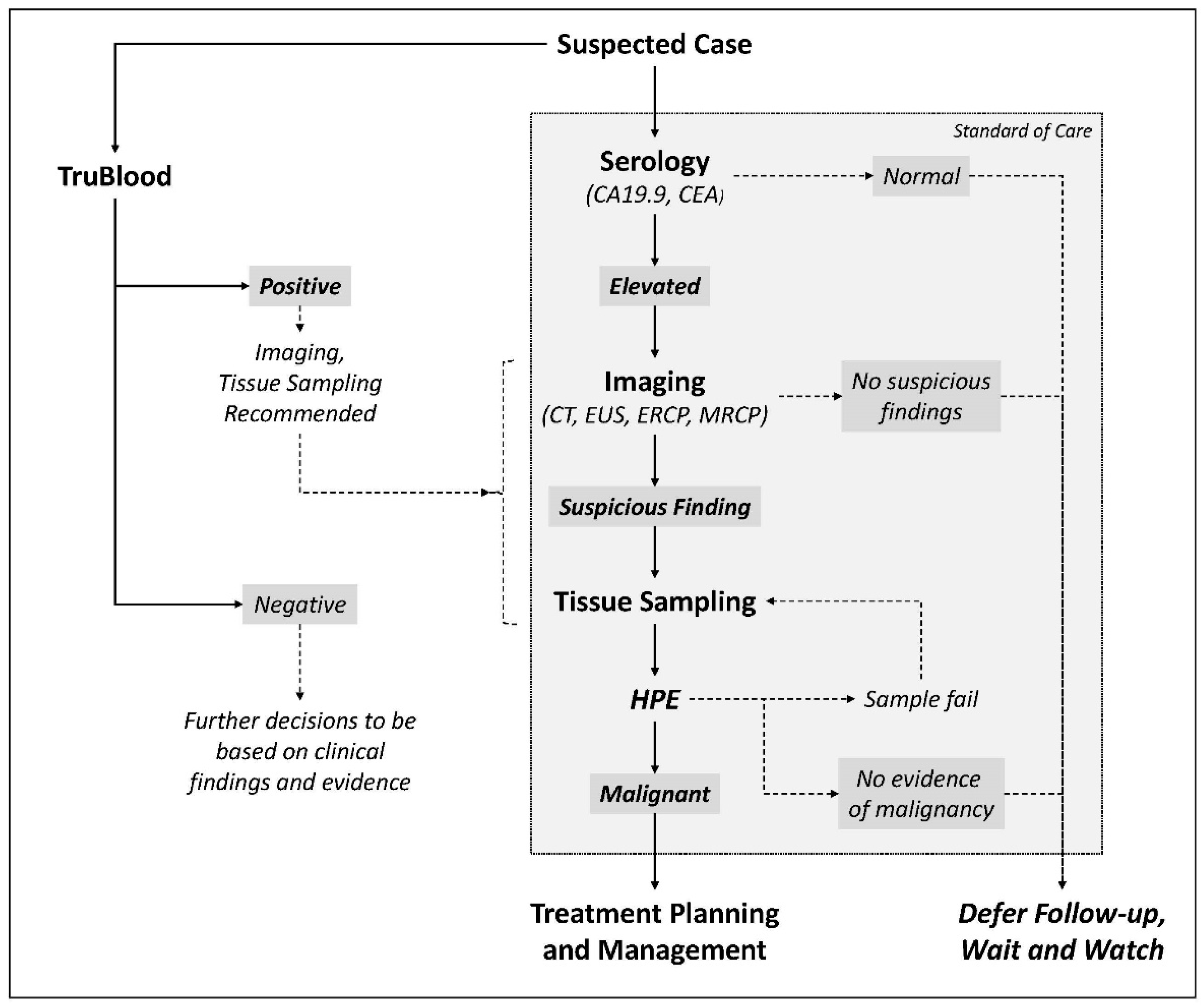
Cancers of the pancreas, gallbladder and bile duct (pancreaticobiliary tract) are often aggressive with poor survival. However, these cancers are not easily identifiable or detected because of vague (non-specific) symptoms and the absence of accurate blood tests. The diagnosis of these cancers involves imaging or endoscopy followed by sampling (biopsy) of suspected tissue for histopathological examination (HPE). Where the tissue sample is not of acceptable quality or is insufficient, the diagnosis (and treatment) can be hindered or delayed. In this manuscript, we describe a blood test that can detect pancreaticobiliary tract cancers with high accuracy. The test may be able to facilitate timely diagnosis of these cancers in suspected patients, especially where tissue-sampling-based diagnosis has been inconclusive or is not possible.
Abstract
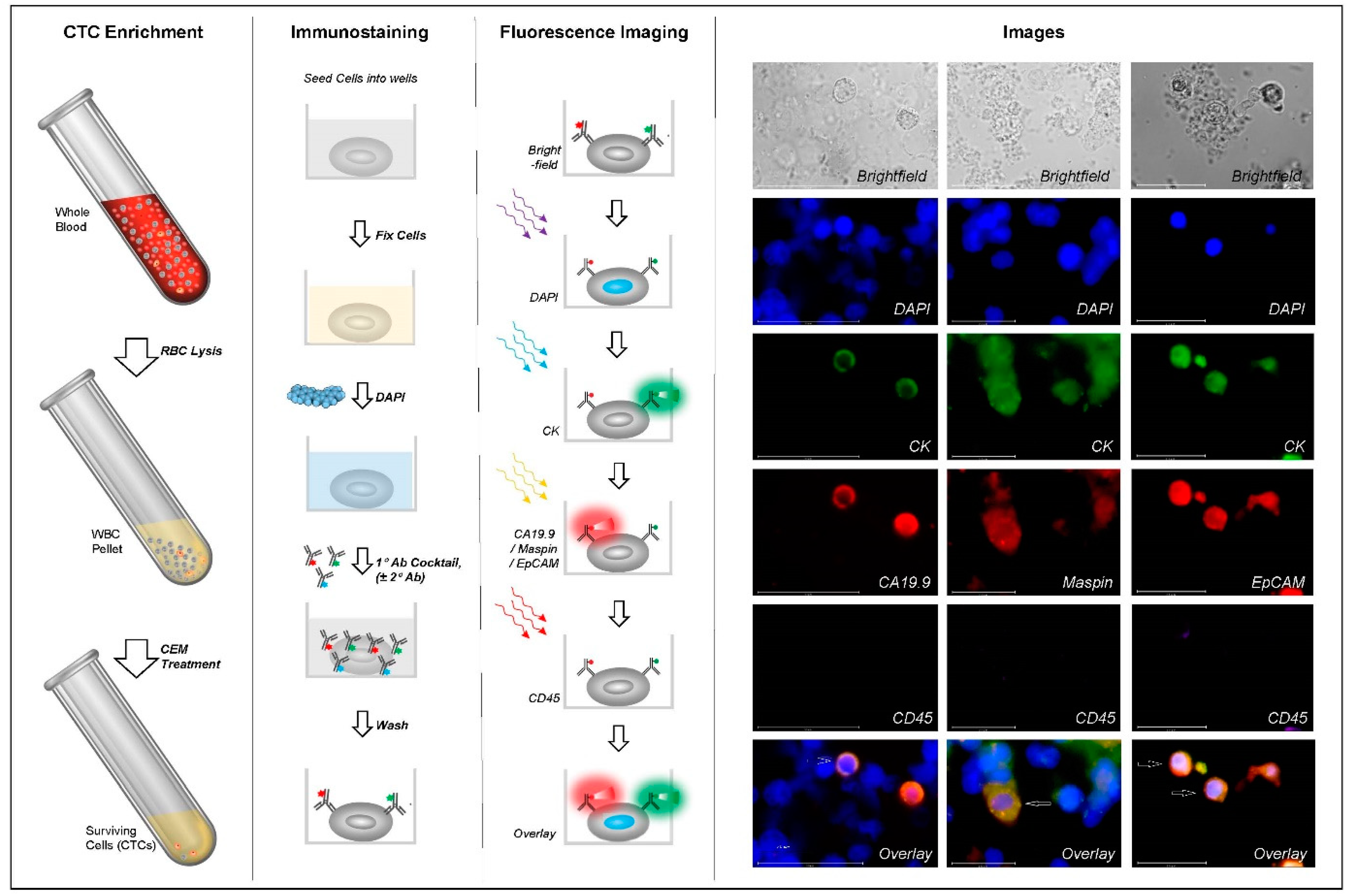
Circulating tumor cells (CTCs) have historically been used for prognostication in oncology. We evaluate the performance of liquid biopsy CTC assay as a diagnostic tool in suspected pancreaticobiliary cancers (PBC). The assay utilizes functional enrichment of CTCs followed by immunofluorescent profiling of organ-specific markers. The performance of the assay was first evaluated in a multicentric case-control study of blood samples from 360 participants, including 188 PBC cases (pre-biopsy samples) and 172 healthy individuals. A subsequent prospective observational study included pre-biopsy blood samples from 88 individuals with suspicion of PBC and no prior diagnosis of cancer. CTCs were harvested using a unique functional enrichment method and used for immunofluorescent profiling for CA19.9, Maspin, EpCAM, CK, and CD45, blinded to the tissue histopathological diagnosis. TruBlood® malignant or non-malignant predictions were compared with tissue diagnoses to establish sensitivity and specificity. The test had 95.9% overall sensitivity (95% CI: 86.0–99.5%) and 92.3% specificity (95% CI: 79.13% to 98.38%) to differentiate PBC (n = 49) from benign conditions (n = 39). The high accuracy of the CTC-based TruBlood test demonstrates its potential clinical application as a diagnostic tool to assist the effective detection of PBC when tissue sampling is unviable or inconclusive.