Lead-Time Corrected Effect on Breast Cancer Survival in Germany by Mode of Detection


1
Institute of Social Medicine and Epidemiology, University of Luebeck, 23562 Luebeck, Germany
2
Institute of Cancer Epidemiology, University of Luebeck, 23562 Luebeck, Germany
*
Author to whom correspondence should be addressed.
Cancers 2024, 16(7), 1326; https://doi.org/10.3390/cancers16071326
Submission received: 23 January 2024
/
Revised: 20 March 2024
/
Accepted: 26 March 2024
/
Published: 28 March 2024
(This article belongs to the Special Issue The Anglesio Prize in Cancer Epidemiology and Cancer Registration)
Simple Summary
An important component in the study of survival in breast cancer patients is how the tumor is detected. This involves examining whether and to what extent survival differs when the tumor is detected, for example, by screening or by symptoms. In such an analysis, it is important to note that survival times are influenced by several biases. One important factor is the bias due to the so-called lead time, i.e., the time by which the diagnosis has been brought forward by screening. Therefore, survival may appear to be longer even if earlier diagnosis did not affect disease progression. We examine whether there is a remaining survival difference after correction for bias that could be attributable to the mode of detection, for example, because of higher quality of care. These results can then be used to further improve the survival of breast cancer patients.
Abstract
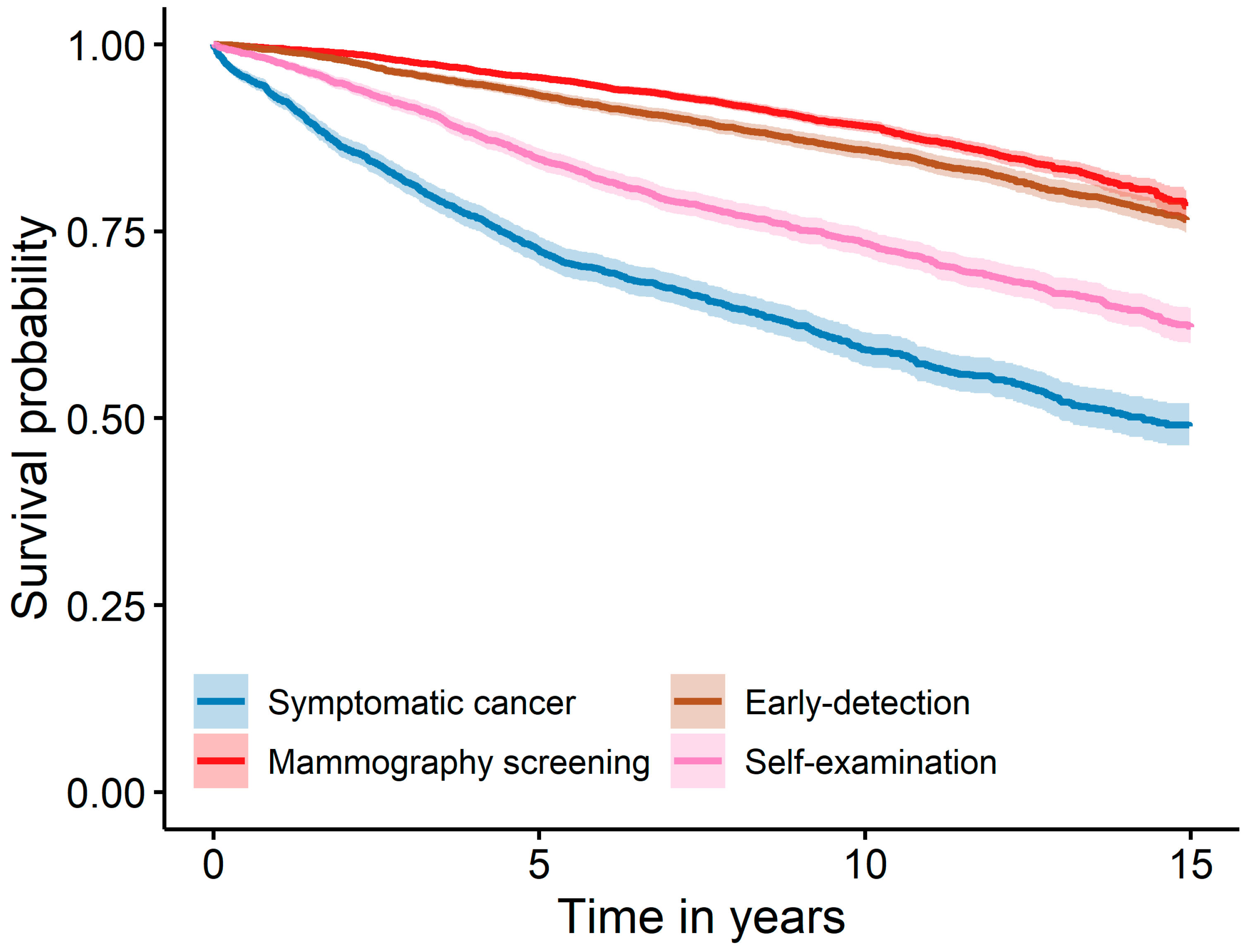
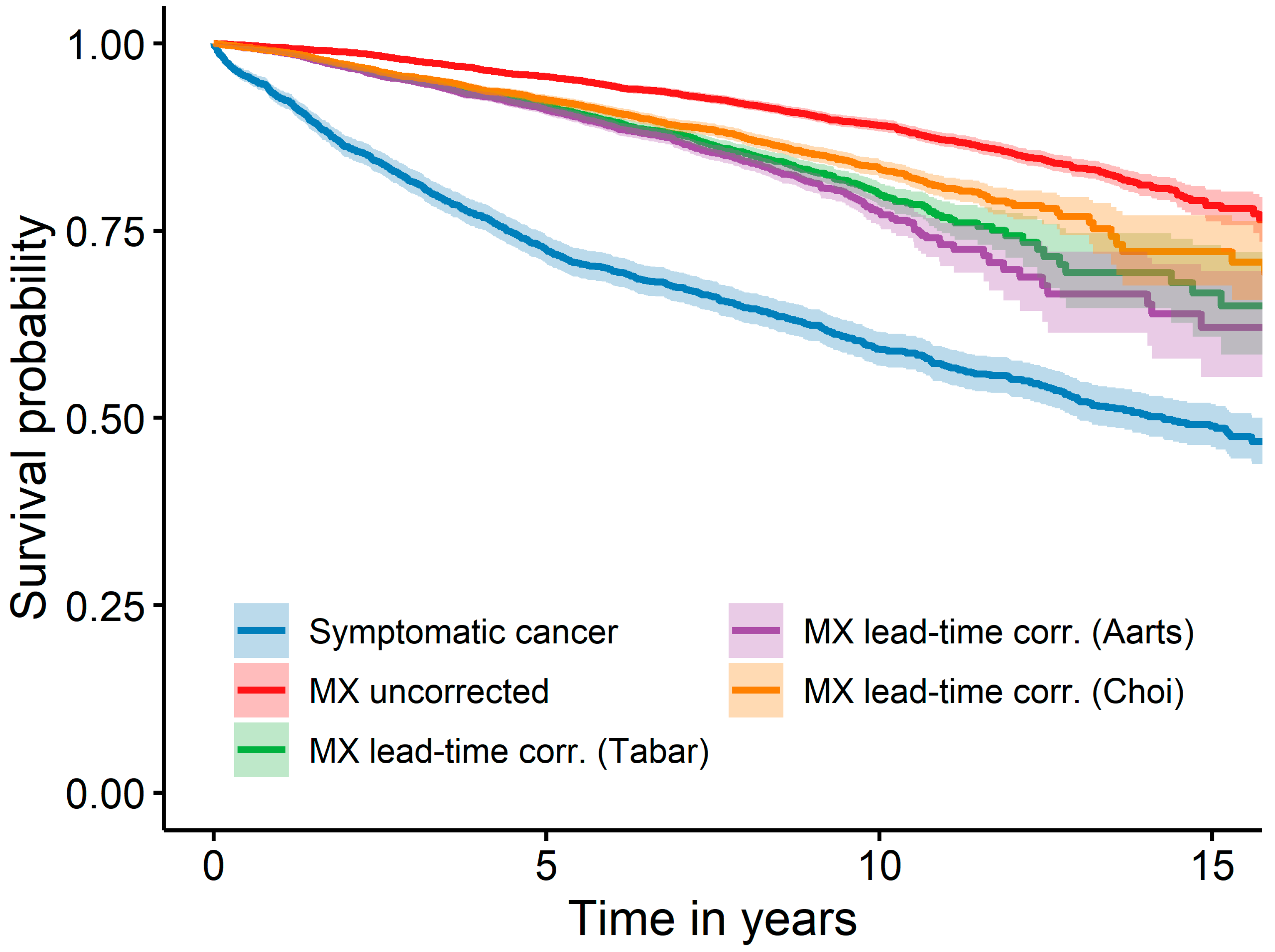
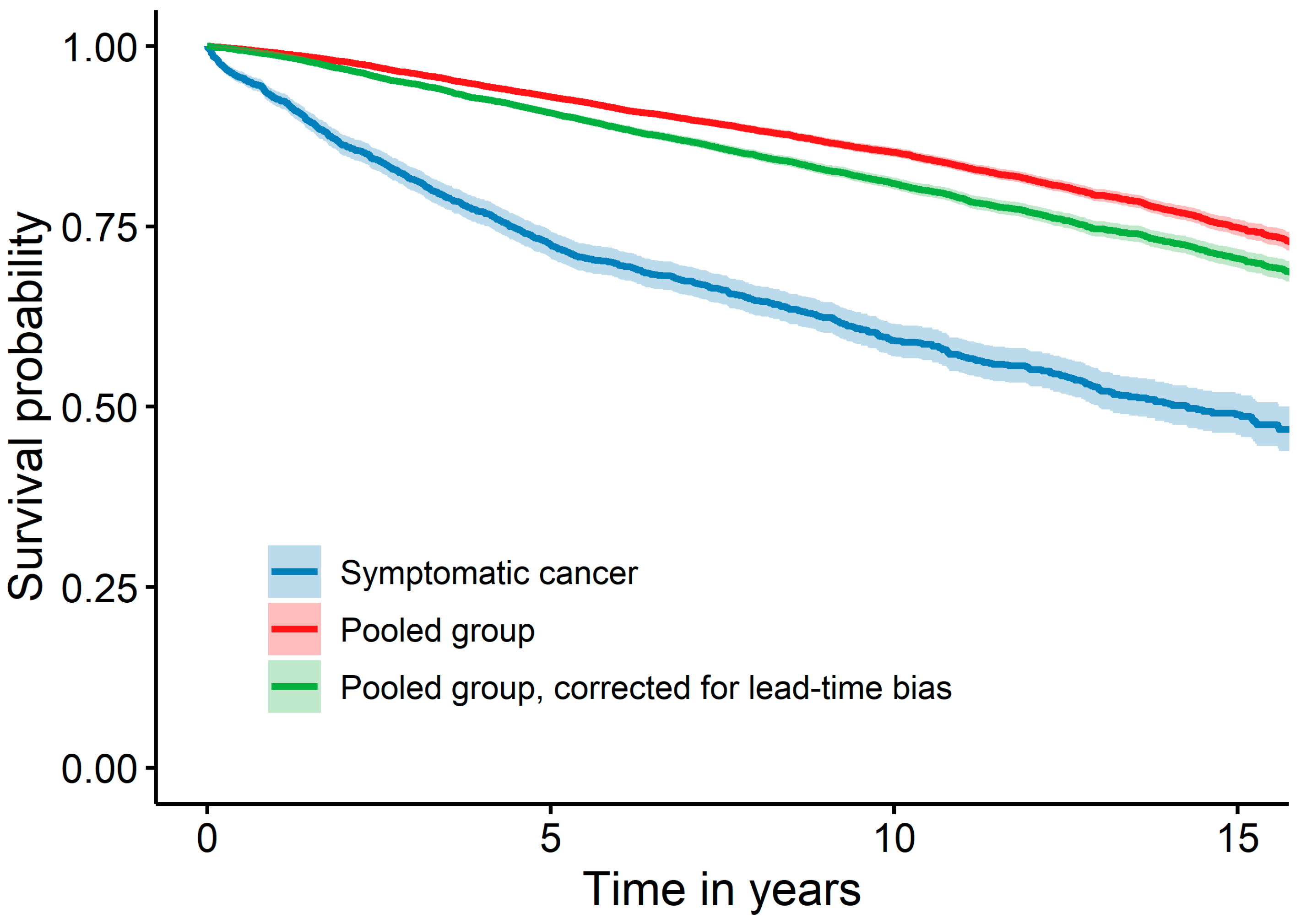
(1) Background: Screen-detected breast cancer patients tend to have better survival than patients diagnosed with symptomatic cancer. The main driver of improved survival in screen-detected cancer is detection at earlier stage. An important bias is introduced by lead time, i.e., the time span by which the diagnosis has been advanced by screening. We examine whether there is a remaining survival difference that could be attributable to mode of detection, for example, because of higher quality of care. (2) Methods: Women with a breast cancer (BC) diagnosis in 2000–2022 were included from a population-based cancer registry from Schleswig-Holstein, Germany, which also registers the mode of cancer detection. Mammography screening was available from 2005 onwards. We compared the survival for BC detected by screening with symptomatic BC detection using Kaplan–Meier, unadjusted Cox regressions, and Cox regressions adjusted for age, grading, and UICC stage. Correction for lead time bias was carried out by assuming an exponential distribution of the period during which the tumor is asymptomatic but screen-detectable (sojourn time). We used a common estimate and two recently published estimates of sojourn times. (3) Results: The analysis included 32,169 women. Survival for symptomatic BC was lower than for screen-detected BC (hazard ratio (HR): 0.23, 95% confidence interval (CI): 0.21–0.25). Adjustment for prognostic factors and lead time bias with the commonly used sojourn time resulted in an HR of 0.84 (CI: 0.75–0.94). Using different sojourn times resulted in an HR of 0.73 to 0.90. (4) Conclusions: Survival for symptomatic BC was only one quarter of screen-detected tumors, which is obviously biased. After adjustment for lead-time bias and prognostic variables, including UICC stage, survival was 27% to 10% better for screen-detected BC, which might be attributed to BC screening. Although this result fits quite well with published results for other countries with BC screening, further sources for residual confounding (e.g., self-selection) cannot be ruled out.
Keywords:
mammography; screening; survival; detection mode; lead time