


Simple Summary
Leukostasis in hyperleukocytotic acute myeloid leukemia (AML) is a medical emergency. The optimal treatment strategy and the potential benefits of incorporating emergency leukapheresis (LA) are still unclear. In our retrospective study, we observed a striking difference in the outcome of FLT3-ITD mutated (mut) AML patients undergoing LA in the early phase of treatment compared to patients with FLT3 wildtype (wt). Knowledge of mutational status might guide treatment decisions in the early phase of hyperleukocytosis.
Abstract
Purpose: We aimed to identify subsets of patients who benefit from emergency LA and to establish a therapeutic algorithm for AML patients with hyperleukocytosis. Methods: In this single-center retrospective cohort study, a total of 20 consecutive patients underwent LA because of their clinical symptoms. Overall survival (OS) analysis was conducted using the Kaplan–Meier plot method. Univariate and multivariate analyses (using multiple logistic regression) were performed. At the time of diagnosis, all patients received a standard diagnostic workup for AML including FLT3-ITD mutational analysis. Results: FLT3-ITD mut AML patients receiving LA had a median OS of 437 days (range 5–2379 days) with a corresponding 14-day survival of 92.3%, while FLT3 wt AML patients displayed a significantly lower median OS of only 5 days (range 1–203 days) with a corresponding 14-day survival of 14.3% (p = 0.0001). Conclusions: Among patients with clinical symptoms of leukostasis, the subset of FLT3-ITD mut AML patients showed a better outcome with lower early mortality after emergency LA. Based on these observations, we established a therapeutic algorithm for AML patients with hyperleukocytosis.
1. Introduction
Despite huge advances in the understanding of acute myeloid leukemia (AML) biology and in the development of novel therapies, the prognosis of the disease remains dismal, with an age-dependent 5-year survival of only 15–35% among patients [1].
Early mortality is also determined by unique complications, such as leukostasis in the setting of hyperleukocytosis (occurring in approx. 10% of all AML patients [2]), defined as a peripheral blood leukocyte count higher than 100,000/µL. Leukostasis leads to increased blood viscosity and obstruction of capillary beds, which further leads to tissue hypoxia with consecutive organ failure and eventually death. Therefore, leukostasis is considered to be a medical emergency that requires immediate intervention. Besides rapid cytoreduction by hydroxyurea and/or cytarabine, leukapheresis (LA) is a well-established method for rapid leukocytoreduction, but its benefits or effectiveness still remain controversial in the literature (see Table 1). Therefore, there is an urgent need to optimize the treatment of hyperleukocytosis. LA grants the possibility of very rapid ‘debulking’ of the leukemic tumor burden and is usually well-tolerated. Although LA lowers leukocyte counts much faster than cytoreductive chemotherapy, its effect is usually very short-lasting and requires concomitant systemic therapy to reduce blast production and replenishment into the peripheral blood. There are also several limitations to the widespread use of LA, such as its availability, relatively high cost of the procedure and the need for well-trained personnel.
AML with hyperleukocytosis displays unique genomic features. The most common molecular genetic abnormalities in cytogenetically normal AML are Fms related tyrosine kinase receptor 3 (FLT3), nucleophosmin 1 (NPM1) and tet methylcytosine dioxygenase 2 (TET2) mutations [3]. Cytogenetic abnormalities associated with hyperleukocytosis are rearrangements involving the 11q23 locus (mixed-lineage-leukemia or MLL gene) or inv(16) [4]. Although not considered a significant risk factor by the European LeukemiaNet (ELN), and therefore not included in their risk classification, hyperleukocytosis seems to harbor an independent negative effect on outcomes in de novo AML [5].
Table 1.
Literature review of leukapheresis trials in AML patients.
The purpose of this study was to investigate the role of LA in the initial treatment of AML patients with leukostasis in hyperleukocytosis. Furthermore, we aimed to identify subsets of patients who could benefit from emergency LA and to establish a therapeutic algorithm for AML patients presenting with hyperleukocytosis and symptomatic leukostasis.
2. Methods
2.1. Trial Population and Design
The study cohort consisted of twenty consecutive patients with hyperleukocytic AML who were treated with LA at the Heidelberg University Hospital between July 2014 and October 2022, as well as ten consecutive patients (September 2015–October 2022) with hyperleukocytosis treated without LA. The decision to perform LA was driven by the presence of symptomatic disease. The primary endpoints were early mortality at 14 days, one-year survival and overall survival. All data were obtained by electronic chart review. Written informed consent according to the Declaration of Helsinki for data analysis and for the leukapheresis procedure was obtained from all patients who were able to consent at the time of diagnosis. Exception from informed consent applied to unconscious/intubated patients. The local ethics committee approved the data collection and analysis.
2.2. Genetic Analysis
As a standard procedure, all patient samples obtained at the time of diagnosis were subjected to a cytogenetic and molecular genetic analysis by means of Giemsa stain-based karyotyping, fluorescence in situ hybridization and polymerase chain reaction testing.
2.3. Leukapheresis Procedure
Cytoreductive leukapheresis was performed via central venous or peripheral venous catheter(s) using Spectra Optia® devices (Terumo, Tokyo, Japan). Two to four times of a patient’s total blood volume was processed during a single leukapheresis session with a leukapheresis duration of three to five hours. During the procedure, acid citrate dextrose solution A (ACD-A) was used as an anticoagulant at a ratio blood to anticoagulant of 12–15:1.
2.4. Statistical Methods
Survival curves for overall survival were estimated using the Kaplan–Meier method and compared between groups using the log-rank test. Categorical variables were described by absolute and relative frequencies. For continuous variables, the Student’s t-test was applied. Survival times calculations and the aforementioned tests were performed using GraphPad Prism software (release 9.3.1; San Diego, CA, USA). SPSS was used for univariate analysis (using Fisher’s exact test) and multivariate analysis using multiple logistic regression with 95%-confidence intervals. Significance levels were set at 0.05. Data were analyzed as of 15 July 2023.
3. Results
3.1. Cytoreductive Performance of Leukapheresis and Chemotherapy
Overall, 42 leukapheresis procedures were performed on 20 patients in this single-center, retrospective cohort study. The average number of LA sessions per patient was 2.1, with five of the twenty patients receiving only one LA, eight patients receiving two LAs, and seven patients receiving three LAs. The average WBC count before and after the first apheresis was 236.2/nL (range, 115.3–586.1/nL; standard deviation 109.4/nL) and 139.9/nL (range, 69.2–472.1/nL; standard deviation 91.8/nL), respectively, resulting in an average reduction in WBC count of 43.1 percent (range, 12.1–62.2) achieved by the first LA procedure alone. The average WBC count after the last LA session was 92.1/nL (range, 47.5–288.7/nL), resulting in an average total reduction in WBC count of 57.8 percent (range, 27.2–92.4). LA proved to be safe; there were no severe adverse events, fatalities, or complications of the indwelling catheters associated with the LA procedure.
Additionally, data of patients with hyperleukocytosis treated without LA were juxtaposed with the group of patients treated with LA. The average WBC count before and 48 h after initiation of treatment was 181.1/nL (range, 104.6–409.0/nL; standard deviation 90.3/L) and 132.6/nL (range, 80.9–287.9/nL; standard deviation 70.5/nL), respectively, resulting in an average reduction in WBC count of 24.4 percent (range, −24.8–63.9). While WBC count was comparable in both groups, the relative leukocyte count reduction was significantly higher in the LA group (p = 0.0096), indicating a very rapid and effective means of cytoreduction.
3.2. Patient Characteristics
Detailed individual and summarized patient characteristics are given in Table 2 and Table 3 (as well as in Table 4 and Table 5). Both of the differently treated cohorts were balanced with respect to age (LA: mean 58 years, range 18–80 years; non-LA: mean 58 years, range 30–80 years) and leukocyte counts (see above) with a male/female ratio of 1:1. Non-favorable risk AML according to the International Consensus Classification of myeloid neoplasms and acute leukemia 2022 [26] was present in 85% of patients in the LA cohort and in 70% of patients in the non-LA cohort. FLT3-ITD mutations were more commonly found in the LA-treated patients (13/20; 65% vs. 3/10; 30% in the non-LA cohort), whereas FLT3-TKD was only found in one patient in the LA cohort. Cytogenetic and molecular genetic aberrations are listed in Table 2 and Table 4. All patients in the LA cohort had symptomatic disease with probable pulmonary or cerebral leukostasis contributing to respiratory (60% of symptomatic patients) or neurological compromise (50% of symptomatic patients), while in the non-leukapheresis cohort, only 3/10 patients had clinical symptoms (10% dyspnea, 20% respiratory failure). All patients in both cohorts received cytoreductive treatment, most with hydroxyurea (HU) or cytarabine, or both.
Table 2.
Patient characteristics of leukapheresis cohort.
Table 3.
Summarized patient characteristics of leukapheresis cohort.
Table 4.
Patient characteristics of non-leukapheresis cohort.
Table 5.
Summarized patient characteristics of non-leukapheresis cohort.
3.3. Outcome after Cytoreduction/Leukapheresis
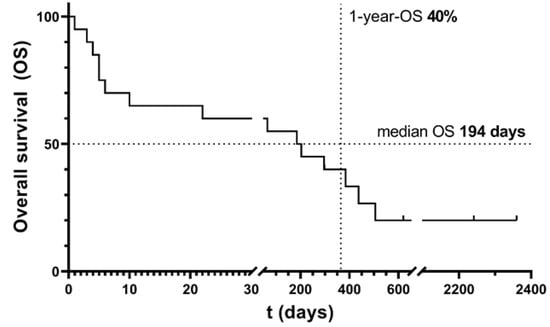
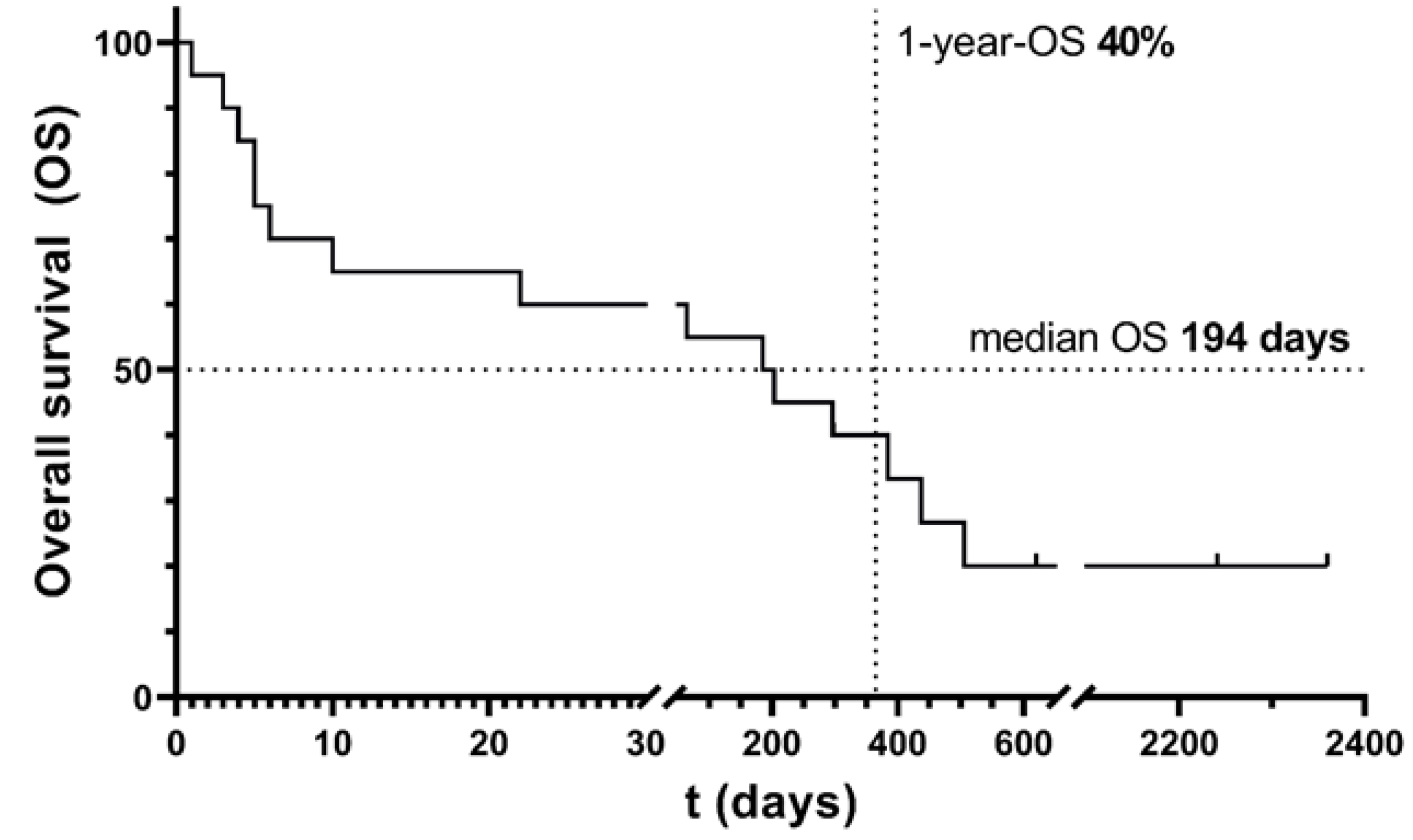
The median OS in the LA group was 194 days (range 1–2379 days; see Figure 1). The total 14-day survival and total 1-year survival were 65% and 40%, respectively. The total 14-day survival in the non-LA group was 90%, with a median OS of 412 days (range 11–2865 days), and the 1-year survival was 60%. Direct comparison of OS and early mortality between the LA and non-LA groups is not possible due to 1:1 matched pairing of patients not being applicable.
Figure 1.
Overall survival of AML patients with hyperleukocytosis undergoing leukapheresis. Notice the different phases: early mortality in the first two weeks, a plateau of leukostasis survivors, a step-by-step decline (late mortality; disease- and therapy-associated), and a second plateau with long-term survivors. N = 20.
3.4. Prognostic Factors for Early Death: FLT3 Mutational Status
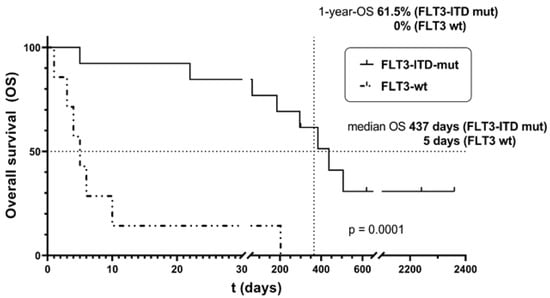
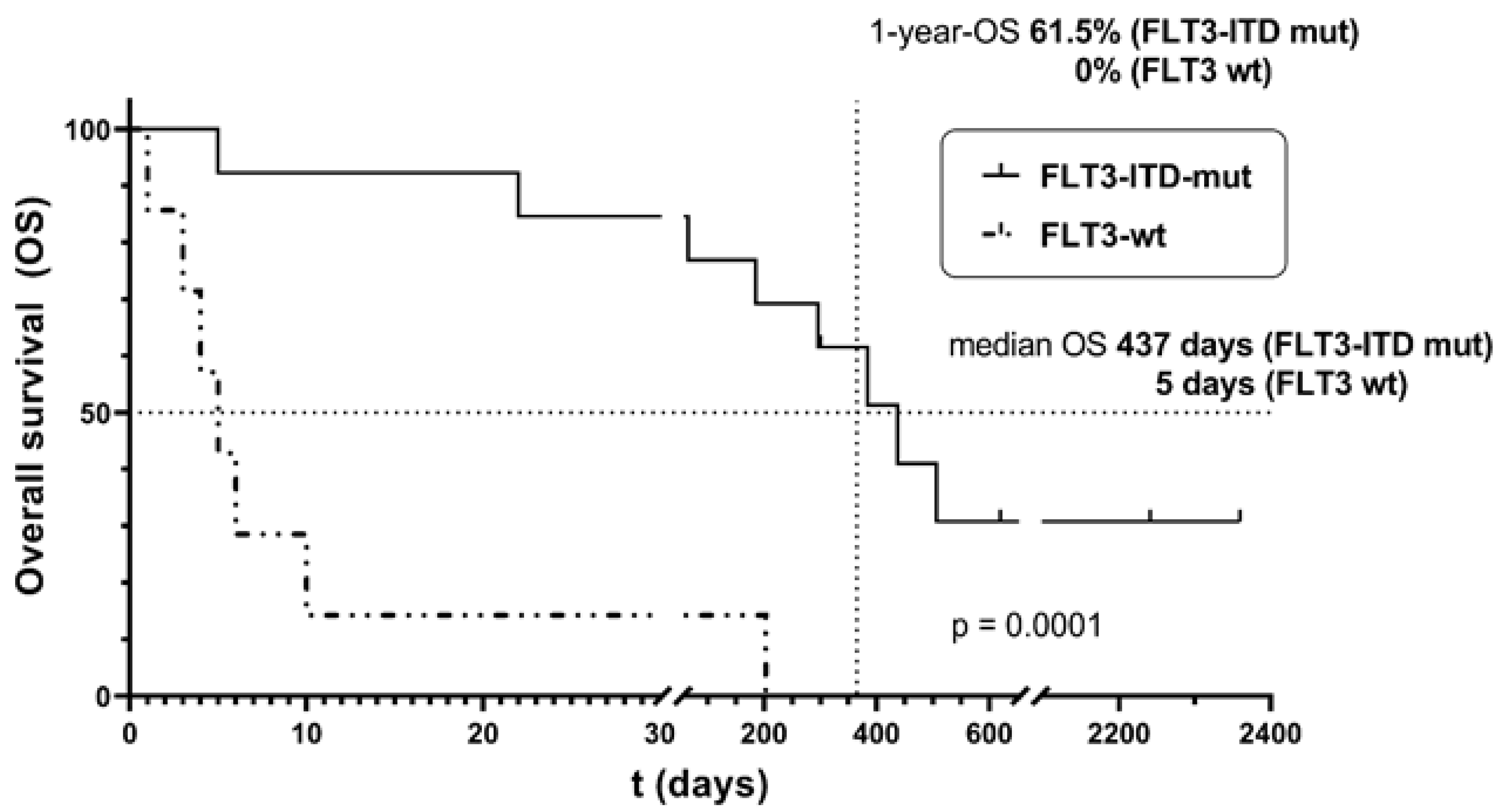
We identified FLT3 wt status to be predictive of early death in AML with hyperleukocytosis. FLT3-ITD mut AML patients treated with LA had a median OS of 437 days (range 5–2379 days) with a corresponding 14-day survival of 92.3%, while FLT3 wt AML patients displayed a significantly lower median OS of only 5 days (range 1–203 days) with a corresponding 14-day survival of 14.3% (log-rank test of OS data; p = 0.0001; see Figure 2). WBC counts in both FLT3-ITD mut and wt patients were comparable in both cohorts (LA or non-LA) before treatment initiation. Differences in outcome depending on FLT3 status are not explained or confounded by different WBC counts. Endothelial activation and stress index (EASIX) scores reflecting organ damage (especially renal function) and microcirculation compromise pre-treatment did not differ between the LA and non-LA cohorts or between the FLT3 mut/wt subgroups of both cohorts, despite showing a tendency to higher score values in the LA cohort (57.2 vs. 27.5; p = 0.1390). This is most likely explained by these patients having symptomatic disease with active/impending leukostasis, leading to the decision to perform LA (see discussion). The total 1-year survival in the LA-treated group was 61.5% in FLT3 mut AML patients, whereas none of the FLT3 wt AML patients presenting with hyperleukocytosis receiving LA survived up to one year after initial diagnosis.
Figure 2.
Overall survival of AML patients with hyperleukocytosis undergoing leukapheresis separated by FLT3 mutational status. Almost all patients not surviving the first 14 days after diagnosis had FLT3 wt AML. Log-rank test: p = 0.0001.
3.5. Univariate and Multivariate Analysis of 14-Day Survival
Fisher’s exact test was performed as univariate analysis regarding possible associations between age (≥60 vs. <60 years), FLT3 mutational status, relative leukocyte reduction achieved by the first LA session (≥50% vs. <50%) and 14-day survival. In patients with hyperleukocytic AML, the presence of a FLT3-ITD mutation is associated with a significantly different 14-day survival (p = 0.007), whereas age and relative leukocyte reduction are not associated with any differences in early mortality.
Subsequently, multiple logistic regression as multivariate analysis was performed to identify prognostic markers of early mortality displayed by 14-day survival rates (Table 6). In patients with hyperleukocytic AML, the presence of a FLT3-ITD mutation (Odds ratio 19.02, 95% CI 1.48–682.6; p = 0.0424) confers a significantly superior 14-day survival. No association was found for other independent variables, such as age or the relative leukocyte reduction achieved by the first LA session.
Table 6.
Uni- and multivariate analysis of parameters influencing 14-day survival.
4. Discussion
Mortality in AML patients can be separated into two phases: early and late mortality. Late mortality is determined by the natural biological course of the disease and is mostly due to relapse or transplant-associated complications, e.g., chronic graft-versus-host-disease. Early mortality is usually due to infectious complications, hemorrhage or (multi-)organ failure (due to leukostasis, among other causes). As mentioned previously, despite many advances in supportive care, early mortality has remained unchanged over the last few decades. Newer approaches to counteract damage induced by leukostasis include targeting the blast adhesion itself rather than solely reducing the peripheral WBC count [4] or the use of anti-inflammatory agents, e.g., dexamethasone [27].
The literature on LA is summarized in Table 1. As shown in the studies by Kuo et al. [15,28], the survival curves of patients with hyperleukocytosis are shifted to a certain delta at a very early timepoint [28]. After these early lethal events, the survival curve run in parallel to that of patients without hyperleukocytosis, with similar dynamics and plateaus. Hyperleukocytosis and its treatment (regardless of the method of cytoreduction) only seem to prognostically influence the early phase of the disease course. Beyond the first weeks, there seems to be no impact on long-term outcomes. If a patient survives the initial critical phase, the further course is dictated by the natural biological behavior of the disease and its genetic features.
The decision to perform an emergency LA was usually driven by the presence of leukostasis symptoms. Since the occurrence and severity of symptoms can vary widely, the clinical diagnosis of leukostasis was not established with a uniform algorithm but in a rather individual manner. There are several pitfalls in establishing the diagnosis of (especially pulmonary) leukostasis due to the broad differential diagnosis of respiratory failure, e.g., pneumonia, sepsis or fluid overload. Leukostasis, however, in most cases remains a clinical diagnosis (of suspicion or exclusion). In our patients, LA was not performed prophylactically or solely on the basis of a high WBC count, since there is no strong evidence for prophylactic LA. Attempts to develop a straight-forward algorithm have been made in the past [29], but usually lack objective parameters to use for decision guidance. Establishing such an algorithm is especially difficult due to the rarity of this condition and the lack of larger study cohorts. To fully grasp the real benefit-to-harm ratio of a procedure like LA in this case, other factors, i.e., cost-effectiveness and LA-related risks/complications, have to be taken into account in each individual case. All limitations associated with the nature of a retrospective cohort study should be taken into consideration when interpreting the results. Furthermore, we only had a limited sample size of 20 patients undergoing LA, which may not be adequate for analyzing all confounders. On the other hand, given the rarity of the studied clinical scenario, our sample size is comparably one of the larger cohorts in the literature, therefore contributing new and valuable information in this difficult-to-study population.
All patients treated with LA had symptoms of leukostasis. This is in contrast to the chemotherapy-only group, in which approximately one-third of patients had symptoms that could be attributed to leukostasis, making the patients in the LA group automatically more morbid and prone to further complications (related to more severe deterioration of organ function). This is reflected by the higher EASIX scores [30] of patients treated with LA (Table 2 and Table 3) when compared to the non-LA group (Table 4 and Table 5). From all patients undergoing LA, almost only the patients with FLT3-ITD mut AML survived the first 14 days after diagnosis. Regarding the striking survival difference in the early phase, one might hypothesize that FLT3-ITD mut hyperleukocytosis has a more ‘benign’ course. Alternatively, FLT3-ITD mut AML patients might benefit more from LA than FLT3 wt AML patients (Figure 2). In both cohorts, FLT3 wt patients showed a trend towards higher EASIX score values. Again, in this case, it is quite difficult to differentiate the main contributing factors causing the EASIX scores. Whether the FLT3 wt blasts intrinsically cause more endothelial damage, leading to a more ‘malignant’ form of leukostasis, or whether the FLT3 wt AML patients had more endothelial dysfunction due to other factors (infection, chemotherapy toxicity) cannot be fully deciphered.
There are several studies (e.g., Cuttner et al., 1980 [31]) highlighting the relevance of a (myelo-)monocytic differentiation when it comes to hyperleukocytosis and leukostasis syndrome. (Myelo-)monocytic morphology is thought to result in more adhesive blasts, compromising the microcirculation in vital tissues. In this study, unfortunately, the specific morphological features (or formerly FAB classification) were documented only in a minority of cases (due to the steadily decreasing significance of the morphological classification of AML in clinical practice), and therefore could not be analyzed as an independent parameter.
Blast biology has a significant impact on leukostasis severity. The expression of surface markers such as cluster of differentiation 11c (CD11c) on leukemic blasts is associated with a high risk of early death in AML patients with hyperleukocytosis [12]. CD11c is a member of the integrin family mediating cell adhesion, which may contribute to more tissue damage. This observation leads to the hypothesis that the extremely heterogeneous types of AML regarding long-term prognosis also differ in their initial presentation and biological behavior in the short-term early treatment period. Certain driver mutations can influence the proliferation activity and are more likely to induce a hyperproliferative state more than others. For example, core-binding-factor leukemia, defined by the recurrent cytogenetic abnormality inv(16), also frequently presents with hyperleukocytosis, but displays a much lower early mortality rate and a 5-year OS of approx. 80%. Despite being considered high-risk regarding early mortality [32], there is almost no difference in OS between patients presenting with and without hyperleukocytosis. Considering the CR rates of up to 93%, the induction mortality risk of 5% and approx. 25% of inv(16)-mut AML patients presenting with hyperleukocytosis [33], and assuming that all induction deaths happen in patients with hyperleukocytosis, the maximum early mortality is approx. 20% in patients with hyperleukocytosis. In contrast, in the literature as well as in our study, early mortality in patients with hyperleukocytosis reaches almost 40%. This is in line with the assumption that not only absolute WBC counts but also differences in genetic features could influence the harmfulness of hyperleukocytosis.
To our knowledge, this is the first paper studying the potential impact of LA depending on molecular genetic features. Our observations are in line with prior studies, in which FLT3-ITD mutations are more commonly found in hyperleukocytosis. The outcome of patients with FLT3-ITD mut AML (regardless of concomitant NPM1 mutation) seems to be better in the early phase. However, our study does not allow for drawing conclusions regarding the effectiveness of the LA procedure itself. Nevertheless, our observational findings could be the first step to creating a basis for the ‘fine tuning’ of decision making in hyperleukocytotic AML, since there are no other established parameters for this specific clinical scenario.
Our study indicates that FLT3-ITD mut AML patients with hyperleukocytosis could particularly benefit from LA, or that the hyperleukocytosis in these patients may be less damaging to vital organs, resulting in lower early mortality rates. In a study by Sritana and Auewarakul, blasts of FLT3-mut AML patients showed markedly low or no CD11c expression [34]. This observation could explain the difference in short-term survival that we also see in our study between FLT3-ITD mut and FLT3 wt AML patients presenting with hyperleukocytosis. One could hypothesize that if FLT3-ITD mut blasts are less likely to cause severe leukostasis (e.g., due to less adhesive properties), the LA procedure itself might cause less additional endothelial damage. Furthermore, the hyperproliferative quality of FLT3-ITD mut AML leading to higher average blast percentages in the peripheral blood could allow the apheresis machine to more efficiently remove circulating blasts into the apheresate. Further studies are needed to validate this hypothesis and to better understand the pathophysiology of leukostasis in different subsets of AML defined by genetic features. To use FLT3 mutational status or the most likely associated CD11c-expression as a tool for treatment decisions, rapid diagnostic methods have to be available. As described before, hyperleukocytosis with consecutive leukostasis is a medical emergency. Hence, without point-of-care testing, our hypothesis relating to FLT3 mutational status cannot be incorporated into a treatment algorithm meaningfully. This remains an important limitation of our results and their transferability to a real-world scenario.
LA remains a method for rapid symptom control and is an attempt to avert permanent organ damage. Other predictive parameters are yet to be identified that are rapidly available in the emergency case of leukostasis. Furthermore, there is limited evidence for a survival benefit in symptomatic patients versus asymptomatic patients. Since we do not know from our results whether the LA procedure itself may negatively influence the survival of FLT3 wt patients with hyperleukocytosis or not, routinely performing LA cannot be recommended. Symptomatic leukostasis seems to be the crucial factor indicating severe disease and impending organ failure defining the risk of early death, rather than the method of cytoreduction.
To develop a reliable algorithm that integrates LA into the treatment of symptomatic hyperleukocytotic disease (with somehow proven diagnosis and exclusion of the common differential diagnoses) would have to be studied systemically in a prospective manner in an interventional trial, via the head-to-head comparison of patients undergoing LA versus chemotherapy only in a randomized fashion. So far, no study has been able to clearly answer the question of a benefit from LA, as not only patients with symptomatic leukostasis but also with asymptomatic hyperleukocytosis were included. Theoretically, it is possible that patients without leukostasis may also benefit from LA; the overall role of leukapheresis in the setting of hyperleukocytic AML remains unclear.
5. Conclusions
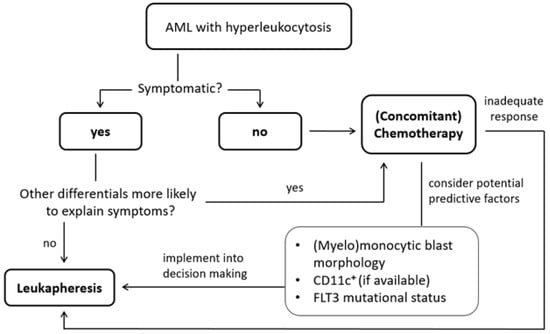
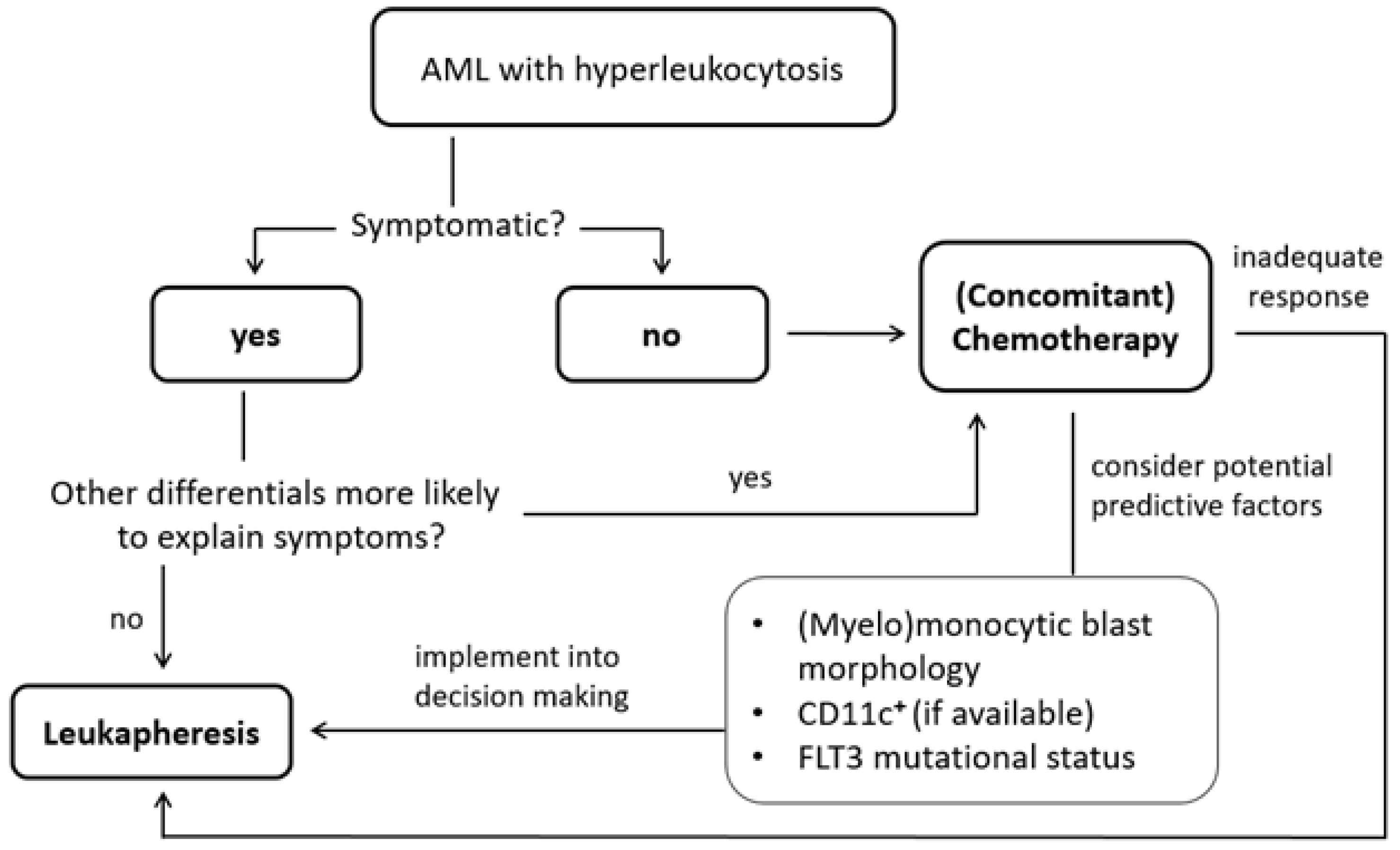
FLT3-ITD mutated AML patients show less early mortality than FLT3 wt patients, although the causal relation remains to be elucidated. If rapid (point-of-care, e.g., in-house real-time polymerase chain reaction) molecular genetic testing is available, the mutational status could guide treatment decisions in the critical early phase of cytoreduction at the time of diagnosis. Since most patients receive more than one LA session, early knowledge of FLT3 mutational status might help in the earlier termination of LA to avoid LA-associated complications (e.g., hemorrhage, electrolyte disturbances) and might allow the development of a more cost-effective approach considering the limited availability and personnel resources. Consequently, we propose the following algorithm, as depicted in Figure 3.
Figure 3.
Proposed treatment algorithm for the initial treatment of hyperleukocytic AML. Firstly, and most importantly, the presence of clinical symptoms of leukostasis should be assessed. If symptoms are attributable to probable leukostasis (compatible with the diagnosis of leukostasis according to Novotny’s grading system [35]) without other more likely differential diagnoses, urgent leukapheresis should be considered. In the case of asymptomatic (=non-leukostatic) hyperleukocytosis, and if other differentials are similarly or more likely in symptomatic disease, risk factors (i.a., FLT3 wt status) should be evaluated to further guide decision making. Concomitant cytoreductive chemotherapy is obligatory and must be initiated without delay while the patient is evaluated for risk factors, i.e., (myelo-)monocytic blast morphology, FLT3 status or CD11c expression. As explained, the presence of a FLT3-ITD mutation is ambiguous in its significance—it is a risk factor for hyperleukocytosis but also defines a subset of leukapheresis-treated patients with improved early mortality rate. In patients with risk factors or inadequate response to chemotherapy (with a maximum doses of cytoreductive agents as tolerated/as possible with regard to tumor lysis syndrome), leukapheresis can be considered as an add-on strategy.
Author Contributions
Conceptualization, K.M.N.F. and A.S.; Data curation, K.M.N.F. and A.S.; Formal analysis, K.M.N.F. and A.S.; Supervision, M.S. and A.S.; Validation, T.S. and M.S.; Writing—original draft, K.M.N.F.; Writing—review and editing, T.S., M.S., C.M.-T. and A.S. All authors have read and agreed to the published version of the manuscript.
Funding
This research received no external funding.
Institutional Review Board Statement
The local ethics committee of the University Hospital Heidelberg approved the data collection and analysis (reference number S-148/2023). This study was performed in accordance with the ethical standards as laid out in the 1964 Declaration of Helsinki and its later amendments or comparable ethical standards.
Informed Consent Statement
This study was performed in accordance with the ethical standards as laid out in the 1964 Declaration of Helsinki and its later amendments or comparable ethical standards.
Data Availability Statement
The data generated in the present study are included in the figures and tables of this article.
Acknowledgments
The authors would like to thank all patients and nurses participating in this study.
Conflicts of Interest
A.S.: Travel grants from Hexal and Jazz Pharmaceuticals. Research grant from Therakos/Mallinckrodt. Consultancy BMS, Janssen-Cilag. Co-founder and part-time employee of TolerogenixX Ltd. of TolerogenixX Ltd. M.S.: research grants from Apogenix, Hexal and Novartis. Travel grants from Hexal and Kite. Financial support for educational activities and conferences from bluebird bio, Kite and Novartis. Advisory board member of MSD. (Co-)PI of clinical trials of MSD, GSK, Kite and BMS. Co-Founder and shareholder of TolerogenixX Ltd. T.S.: Consultant Abbvie, Takeda, Astellas, Amgen, Bristol-Myers Squibb, Gilead, Ridgeline Discoveries. Honorarium: Pfizer, Abbvie, Jazz Pharmaceuticals. Financial support congress participation: Abbvie, Jazz Pharmaceuticals. C.M.-T.: consulting role with Janssen and research funding from Janssen. None of these relationships were related to the development of this manuscript. K.M.N.F. declared no conflict of interest.
References
- Kantarjian, H.; Kadia, T.; DiNardo, C.; Daver, N.; Borthakur, G.; Jabbour, E.; Garcia-Manero, G.; Konopleva, M. Acute myeloid leukemia: Current progress and future directions. Blood Cancer J. 2021, 11, 41. [Google Scholar] [CrossRef] [Scilit] [PubMed]
- Pastore, F.; Pastore, A.; Wittmann, G.; Hiddemann, W.; Spiekermann, K. The role of therapeutic leukapheresis in hyperleukocytotic AML. PLoS ONE 2014, 9, e95062. [Google Scholar] [CrossRef] [Scilit] [PubMed]
- Pastore, F.; Pastore, A.; Rothenberg-Thurley, M.; Metzeler, K.H.; Ksienzyk, B.; Schneider, S.; Bohlander, S.K.; Braess, J.; Sauerland, M.C.; Gorlich, D.; et al. Molecular profiling of patients with cytogenetically normal acute myeloid leukemia and hyperleukocytosis. Cancer 2022, 128, 4213–4222. [Google Scholar] [CrossRef] [Scilit] [PubMed]
- Bewersdorf, J.P.; Zeidan, A.M. Hyperleukocytosis and Leukostasis in Acute Myeloid Leukemia: Can a Better Understanding of the Underlying Molecular Pathophysiology Lead to Novel Treatments? Cells 2020, 9, 2310. [Google Scholar] [CrossRef] [Scilit] [PubMed]
- Tien, F.M.; Hou, H.A.; Tsai, C.H.; Tang, J.L.; Chen, C.Y.; Kuo, Y.Y.; Li, C.C.; Lin, C.T.; Yao, M.; Huang, S.Y.; et al. Hyperleukocytosis is associated with distinct genetic alterations and is an independent poor-risk factor in de novo acute myeloid leukemia patients. Eur. J. Haematol. 2018, 101, 86–94. [Google Scholar] [CrossRef] [Scilit] [PubMed]
- Cuttner, J.; Holland, J.F.; Norton, L.; Ambinder, E.; Button, G.; Meyer, R.J. Therapeutic leukapheresis for hyperleukocytosis in acute myelocytic leukemia. Med. Pediatr. Oncol. 1983, 11, 76–78. [Google Scholar] [CrossRef] [Scilit] [PubMed]
- Porcu, P.; Danielson, C.F.; Orazi, A.; Heerema, N.A.; Gabig, T.G.; McCarthy, L.J. Therapeutic leukapheresis in hyperleucocytic leukaemias: Lack of correlation between degree of cytoreduction and early mortality rate. Br. J. Haematol. 1997, 98, 433–436. [Google Scholar] [CrossRef] [Scilit]
- Thiebaut, A.; Thomas, X.; Belhabri, A.; Anglaret, B.; Archimbaud, E. Impact of pre-induction therapy leukapheresis on treatment outcome in adult acute myelogenous leukemia presenting with hyperleukocytosis. Ann. Hematol. 2000, 79, 501–506. [Google Scholar] [CrossRef] [Scilit]
- Giles, F.J.; Shen, Y.; Kantarjian, H.M.; Korbling, M.J.; O’Brien, S.; Anderlini, P.; Donato, M.; Pierce, S.; Keating, M.J.; Freireich, E.J.; et al. Leukapheresis reduces early mortality in patients with acute myeloid leukemia with high white cell counts but does not improve long- term survival. Leuk. Lymphoma 2001, 42, 67–73. [Google Scholar] [CrossRef] [Scilit]
- Tan, D.; Hwang, W.; Goh, Y.T. Therapeutic leukapheresis in hyperleukocytic leukaemias—The experience of a tertiary institution in Singapore. Ann. Acad. Med. Singap. 2005, 34, 229–234. [Google Scholar] [CrossRef] [Scilit]
- Chang, M.C.; Chen, T.Y.; Tang, J.L.; Lan, Y.J.; Chao, T.Y.; Chiu, C.F.; Ho, H.T. Leukapheresis and cranial irradiation in patients with hyperleukocytic acute myeloid leukemia: No impact on early mortality and intracranial hemorrhage. Am. J. Hematol. 2007, 82, 976–980. [Google Scholar] [CrossRef] [Scilit] [PubMed]
- Bug, G.; Anargyrou, K.; Tonn, T.; Bialleck, H.; Seifried, E.; Hoelzer, D.; Ottmann, O.G. Impact of leukapheresis on early death rate in adult acute myeloid leukemia presenting with hyperleukocytosis. Transfusion 2007, 47, 1843–1850. [Google Scholar] [CrossRef] [Scilit] [PubMed]
- De Santis, G.C.; de Oliveira, L.C.; Romano, L.G.; Almeida Prado Bde, P., Jr.; Simoes, B.P.; Rego, E.M.; Covas, D.T.; Falcao, R.P. Therapeutic leukapheresis in patients with leukostasis secondary to acute myelogenous leukemia. J. Clin. Apher. 2011, 26, 181–185. [Google Scholar] [CrossRef] [Scilit] [PubMed]
- Berber, I.; Kuku, I.; Erkurt, M.A.; Kaya, E.; Bag, H.G.; Nizam, I.; Koroglu, M.; Ozgul, M.; Bazna, S. Leukapheresis in acute myeloid leukemia patients with hyperleukocytosis: A single center experience. Transfus. Apher. Sci. 2015, 53, 185–190. [Google Scholar] [CrossRef] [Scilit] [PubMed]
- Kuo, K.H.M.; Callum, J.L.; Panzarella, T.; Jacks, L.M.; Brandwein, J.; Crump, M.; Curtis, J.E.; Gupta, V.; Lipton, J.H.; Minden, M.D.; et al. A retrospective observational study of leucoreductive strategies to manage patients with acute myeloid leukaemia presenting with hyperleucocytosis. Br. J. Haematol. 2015, 168, 384–394. [Google Scholar] [CrossRef] [Scilit] [PubMed]
- Malkan, U.Y.; Ozcebe, O.I. Leukapheresis do not improve early death rates in acute myeloid leukemia patients with hyperleukocytosis. Transfus. Apher. Sci. 2017, 56, 880–882. [Google Scholar] [CrossRef] [Scilit] [PubMed]
- Nan, X.; Qin, Q.; Gentille, C.; Ensor, J.; Leveque, C.; Pingali, S.R.; Phan, A.T.; Rice, L.; Iyer, S. Leukapheresis reduces 4-week mortality in acute myeloid leukemia patients with hyperleukocytosis—A retrospective study from a tertiary center. Leuk. Lymphoma 2017, 58, 2110–2117. [Google Scholar] [CrossRef] [Scilit]
- Choi, M.H.; Choe, Y.H.; Park, Y.; Nah, H.; Kim, S.; Jeong, S.H.; Kim, H.O. The effect of therapeutic leukapheresis on early complications and outcomes in patients with acute leukemia and hyperleukocytosis: A propensity score-matched study. Transfusion 2018, 58, 208–216. [Google Scholar] [CrossRef] [Scilit]
- Rinaldi, I.; Sari, R.M.; Tedhy, V.U.; Winston, K. Leukapheresis Does Not Improve Early Survival Outcome of Acute Myeloid Leukemia with Leukostasis Patients—A Dual-Center Retrospective Cohort Study. J. Blood Med. 2021, 12, 623–633. [Google Scholar] [CrossRef] [Scilit]
- Blum, W.; Porcu, P. Therapeutic apheresis in hyperleukocytosis and hyperviscosity syndrome. Semin. Thromb. Hemost. 2007, 33, 350–354. [Google Scholar] [CrossRef] [Scilit]
- Ganzel, C.; Becker, J.; Mintz, P.D.; Lazarus, H.M.; Rowe, J.M. Hyperleukocytosis, leukostasis and leukapheresis: Practice management. Blood Rev. 2012, 26, 117–122. [Google Scholar] [CrossRef] [Scilit] [PubMed]
- Ali, A.M.; Mirrakhimov, A.E.; Abboud, C.N.; Cashen, A.F. Leukostasis in adult acute hyperleukocytic leukemia: A clinician’s digest. Hematol. Oncol. 2016, 34, 69–78. [Google Scholar] [CrossRef] [Scilit] [PubMed]
- Shallis, R.M.; Stahl, M.; Bewersdorf, J.P.; Hendrickson, J.E.; Zeidan, A.M. Leukocytapheresis for patients with acute myeloid leukemia presenting with hyperleukocytosis and leukostasis: A contemporary appraisal of outcomes and benefits. Expert Rev. Hematol. 2020, 13, 489–499. [Google Scholar] [CrossRef] [Scilit] [PubMed]
- Stahl, M.; Shallis, R.M.; Wei, W.; Montesinos, P.; Lengline, E.; Neukirchen, J.; Bhatt, V.R.; Sekeres, M.A.; Fathi, A.T.; Konig, H.; et al. Management of hyperleukocytosis and impact of leukapheresis among patients with acute myeloid leukemia (AML) on short- and long-term clinical outcomes: A large, retrospective, multicenter, international study. Leukemia 2020, 34, 3149–3160. [Google Scholar] [CrossRef] [Scilit] [PubMed]
- Rinaldi, I.; Sutandyo, N.; Winston, K. Comparison of early mortality between leukapheresis and non-leukapheresis in adult acute myeloid leukemia patients with hyperleukocytosis: A systematic review and meta-analysis. Hematology 2022, 27, 141–149. [Google Scholar] [CrossRef] [Scilit] [PubMed]
- Arber, D.A.; Orazi, A.; Hasserjian, R.P.; Borowitz, M.J.; Calvo, K.R.; Kvasnicka, H.M.; Wang, S.A.; Bagg, A.; Barbui, T.; Branford, S.; et al. International Consensus Classification of Myeloid Neoplasms and Acute Leukemias: Integrating morphologic, clinical, and genomic data. Blood 2022, 140, 1200–1228. [Google Scholar] [CrossRef] [Scilit] [PubMed]
- Cerrano, M.; Chevret, S.; Raffoux, E.; Rabian, F.; Sebert, M.; Valade, S.; Itzykson, R.; Lemiale, V.; Ades, L.; Boissel, N.; et al. Benefits of dexamethasone on early outcomes in patients with acute myeloid leukemia with hyperleukocytosis: A propensity score matched analysis. Ann. Hematol. 2023, 102, 761–768. [Google Scholar] [CrossRef] [Scilit]
- Kuo, K.H.M.; Callum, J.; Brandwein, J.; Crump, M.; Curtis, J.E.; Gupta, V.; Lipton, J.H.; Pantalony, D.; Schimmer, A.; Schuh, A.; et al. Management of Hyperleukocytosis in Acute Myelogenous Leukemia Using Hydroxyurea Rather Than Leukopheresis. Blood 2006, 108, 2007. [Google Scholar] [CrossRef] [Scilit]
- Röllig, C.; Ehninger, G. How I treat hyperleukocytosis in acute myeloid leukemia. Blood 2015, 125, 3246–3252. [Google Scholar] [CrossRef] [Scilit]
- Luft, T.; Benner, A.; Terzer, T.; Jodele, S.; Dandoy, C.E.; Storb, R.; Kordelas, L.; Beelen, D.; Gooley, T.; Sandmaier, B.M.; et al. EASIX and mortality after allogeneic stem cell transplantation. Bone Marrow Transplant. 2020, 55, 553–561. [Google Scholar] [CrossRef] [Scilit]
- Cuttner, J.; Conjalka, M.S.; Reilly, M.; Goldberg, J.; Reisman, A.; Meyer, R.J.; Holland, J.F. Association of monocytic leukemia in patients with extreme leukocytosis. Am. J. Med. 1980, 69, 555–558. [Google Scholar] [CrossRef] [Scilit] [PubMed]
- Schlenk, R.F.; Benner, A.; Krauter, J.; Buchner, T.; Sauerland, C.; Ehninger, G.; Schaich, M.; Mohr, B.; Niederwieser, D.; Krahl, R.; et al. Individual patient data-based meta-analysis of patients aged 16 to 60 years with core binding factor acute myeloid leukemia: A survey of the German Acute Myeloid Leukemia Intergroup. J. Clin. Oncol. 2004, 22, 3741–3750. [Google Scholar] [CrossRef] [Scilit] [PubMed]
- Talami, A.; Bettelli, F.; Pioli, V.; Giusti, D.; Gilioli, A.; Colasante, C.; Galassi, L.; Giubbolini, R.; Catellani, H.; Donatelli, F.; et al. How to Improve Prognostication in Acute Myeloid Leukemia with CBFB-MYH11 Fusion Transcript: Focus on the Role of Molecular Measurable Residual Disease (MRD) Monitoring. Biomedicines 2021, 9, 953. [Google Scholar] [CrossRef] [Scilit] [PubMed]
- Sritana, N.; Auewarakul, C.U. KIT and FLT3 receptor tyrosine kinase mutations in acute myeloid leukemia with favorable cytogenetics: Two novel mutations and selective occurrence in leukemia subtypes and age groups. Exp. Mol. Pathol. 2008, 85, 227–231. [Google Scholar] [CrossRef] [Scilit]
- Novotny, J.R.; Muller-Beissenhirtz, H.; Herget-Rosenthal, S.; Kribben, A.; Duhrsen, U. Grading of symptoms in hyperleukocytic leukaemia: A clinical model for the role of different blast types and promyelocytes in the development of leukostasis syndrome. Eur. J. Haematol. 2005, 74, 501–510. [Google Scholar] [CrossRef] [Scilit]

Disclaimer/Publisher’s Note: The statements, opinions and data contained in all publications are solely those of the individual author(s) and contributor(s) and not of MDPI and/or the editor(s). MDPI and/or the editor(s) disclaim responsibility for any injury to people or property resulting from any ideas, methods, instructions or products referred to in the content. |
© 2023 by the authors. Licensee MDPI, Basel, Switzerland. This article is an open access article distributed under the terms and conditions of the Creative Commons Attribution (CC BY) license (https://creativecommons.org/licenses/by/4.0/).