Incidental Node Metastasis as an Independent Factor of Worse Disease-Free Survival in Patients with Papillary Thyroid Carcinoma
by
 , , and
Renan Aguera Pinheiro
1,*,
Ana Kober Leite
1,2,
Beatriz Godoi Cavalheiro
1,
Evandro Sobroza de Mello
3,4,
Luiz Paulo Kowalski
1 and
and
Leandro Luongo Matos
1,2,5 1
Head and Neck Surgery Department, Instituto do Câncer do Estado de São Paulo, Hospital das Clínicas da Faculdade de Medicina da Universidade de São Paulo, São Paulo 05403-000, Brazil
2
Faculdade Israelita de Ciências da Saúde Albert Einstein, São Paulo 05653-120, Brazil
3
Pathology Department, Instituto do Câncer do Estado de São Paulo, São Paulo 01246-000, Brazil
4
Laboratório de Investigação Médica 14 (LIM14), Faculdade de Medicina da Universidade de São Paulo, São Paulo 01246-903, Brazil
5
Laboratório de Investigação Médica 28 (LIM28), Faculdade de Medicina da Universidade de São Paulo, São Paulo 01246-903, Brazil
*
Author to whom correspondence should be addressed.
Cancers 2023, 15(3), 943; https://doi.org/10.3390/cancers15030943
Submission received: 22 December 2022
/
Revised: 25 January 2023
/
Accepted: 30 January 2023
/
Published: 2 February 2023
(This article belongs to the Special Issue Advances in Understanding the Immune Network of Thyroid Cancers)
Simple Summary
Papillary thyroid cancer is treated mainly by thyroidectomy surgery. The surrounding lymph nodes are not usually resected unless it is known before surgery that they are metastatic, and then all adjacent lymph nodes are resected (named the central compartment neck dissection). However, some lymph nodes could be incidentally resected with the thyroid, sometimes containing metastasis, but this does not mean that the central compartment neck dissection was performed properly. This study aimed to test whether these patients with incidental metastatic nodes had higher treatment failure rates. We found that they indeed had higher rates of treatment failure, even when compared to patients with clinically evident central compartment node metastasis that were submitted to proper neck dissection. We suggest that these patients must be closely followed to detect signs of treatment failure early and to provide prompt treatment.
Abstract
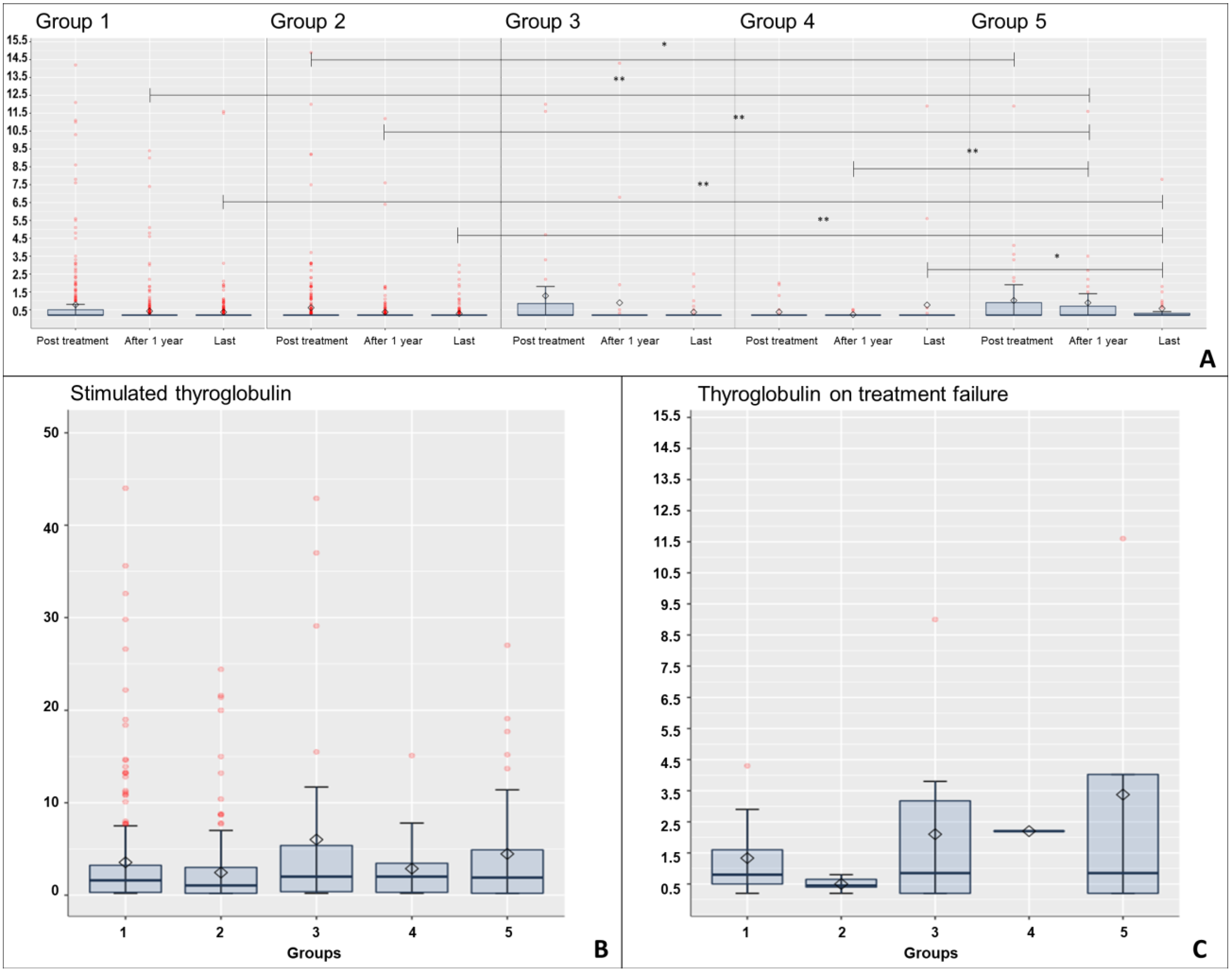
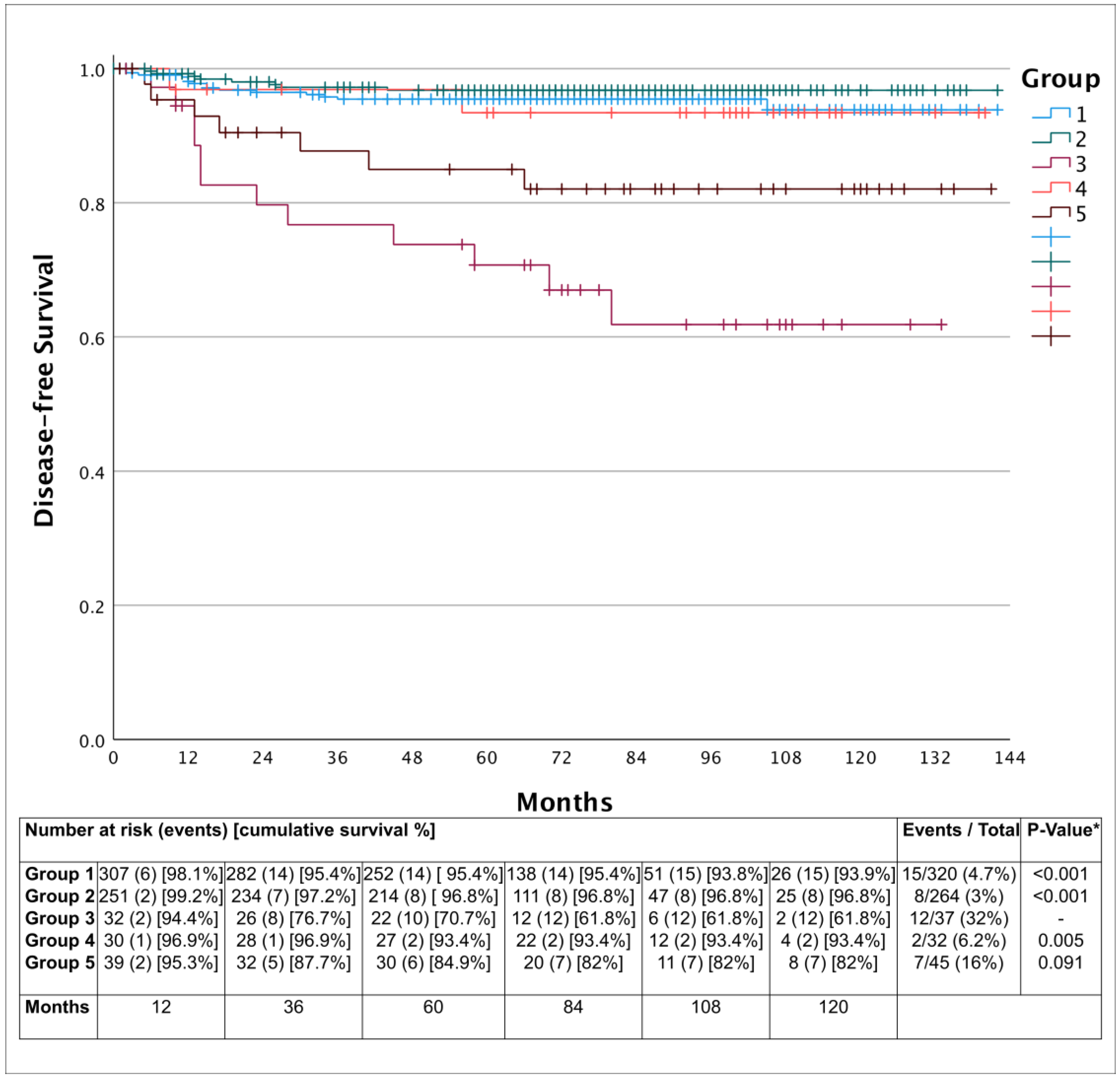
Introduction: Papillary thyroid carcinoma (PTC) have high node metastasis rates. Occasionally after thyroidectomy, the pathological report reveals node metastasis unintentionally resected. The present study aimed to evaluate the prognosis of these patients. Methods: A retrospective cohort of patients submitted to thyroidectomy with or without central compartment neck dissection (CCND) due to PTC with a minimum follow-up of five years. Results: A total of 698 patients were included: 320 Nx, 264 pN0-incidental, 37 pN1a-incidental, 32 pN0-CCND and 45 pN1a-CCND. Patients with node metastasis were younger, had larger tumors, higher rates of microscopic extra-thyroidal extension, and angiolymphatic invasion and most received radioiodine therapy. Treatment failure was higher in patients pN1a-incidental and pN1a-CCND (32% and 16%, respectively; p < 0.001—Chi-square test). Disease-free survival (DFS) was lower in patients pN1a-incidental compared to patients Nx and pN0-incidental (p < 0.001 vs. Nx and pN0-incidental and p = 0.005 vs. pN0-CCND) but similar when compared to patients pN1a-CCND (p = 0.091)—Log-Rank test. Multivariate analysis demonstrated as independent risk factors: pT4a (HR = 5.524; 95%CI: 1.380–22.113; p = 0.016), pN1a-incidental (HR = 3.691; 95%CI: 1.556–8.755; p = 0.003), microscopic extra-thyroidal extension (HR = 2.560; 95%CI: 1.303–5.030; p = 0.006) and angiolymphatic invasion (HR = 2.240; 95%CI: 1.077–4.510; p = 0.030). Conclusion: Patients that were pN1a-incidental were independently associated with lower DFS.