Are Thalamic Intrinsic Lesions Operable? No-Man’s Land Revisited by the Analysis of a Large Retrospective, Mono-Institutional, Cohort
by
 , , , , , , , , , , , ,
Paolo Ferroli
1,†, 
Francesco Restelli
1,*,†,
Giacomo Bertolini
1,
Emanuele Monti
1,
Jacopo Falco
1,
Giulio Bonomo
1,2,
Irene Tramacere
3,
Bianca Pollo
4,
Chiara Calatozzolo
4,
Monica Patanè
4,
Silvia Schiavolin
5,
Morgan Broggi
1 ,
,
Francesco Acerbi
1,
Alessandra Erbetta
6,
Silvia Esposito
7,
Elio Mazzapicchi
1,
Emanuele La Corte
1,8 ,
,
Ignazio Gaspare Vetrano
1,9 ,
,
Giovanni Broggi
1,10 and
Marco Schiariti
1 1
Department of Neurosurgery, Fondazione IRCCS Istituto Neurologico Carlo Besta, 20133 Milan, Italy
2
Department of Neurological Surgery, Policlinico “G. Rodolico–S. Marco”, University Hospital, 95123 Catania, Italy
3
Department of Research and Clinical Development, Scientific Directorate, Fondazione IRCCS Istituto Neurologico Carlo Besta, 20133 Milan, Italy
4
Unit of Neuropathology, Fondazione IRCCS Istituto Neurologico Carlo Besta, 20133 Milan, Italy
5
Public Health and Disability Unit–Scientific Directorate, Fondazione IRCCS Istituto Neurologico Carlo Besta, 20133 Milan, Italy
6
Unit of Neuroradiology, Fondazione IRCCS Istituto Neurologico Carlo Besta, 20133 Milan, Italy
7
Department of Paediatric Neuroscience, Fondazione IRCCS Istituto Neurologico Carlo Besta, 20133 Milan, Italy
8
Department of Neurosurgery, Alma Mater Studiorum, University of Bologna, 40126 Bologna, Italy
9
Department of Biomedical Sciences for Health, University of Milan, 20133 Milan, Italy
10
IEN Foundation, 20100 Milan, Italy
*
Author to whom correspondence should be addressed.
†
These authors contributed equally to this work and share first authorship.
Cancers 2023, 15(2), 361; https://doi.org/10.3390/cancers15020361
Submission received: 29 November 2022
/
Revised: 30 December 2022
/
Accepted: 4 January 2023
/
Published: 5 January 2023
(This article belongs to the Special Issue Biomarkers, Diagnostic Tools, Treatment Outcomes, and Late Complications in Neuro-Oncology)
Simple Summary
Thalamic gliomas are rare neoplasms that represent a major surgical challenge and are characterized by poor postoperative survival. Surgical resection, although associated with improved overall survival (OS), is not always feasible. The aim of our retrospective study was to analyze the associations between possible prognostic factors such as tumor volume, histological grade, the extent of resection, performance status and OS. Surgical removal was demonstrated to be an important prognostic factor when gross total resection/subtotal resection was obtained. Furthermore, patients with a stable 3-month performance status after surgery demonstrated to have a better prognosis in terms of OS. In conclusion, in such kinds of tumors, a precise evaluation of the predictors of the 3-month postoperative Performance Status appears to be crucial in choosing between performing a biopsy or attempting the surgical removal of the tumor.
Abstract
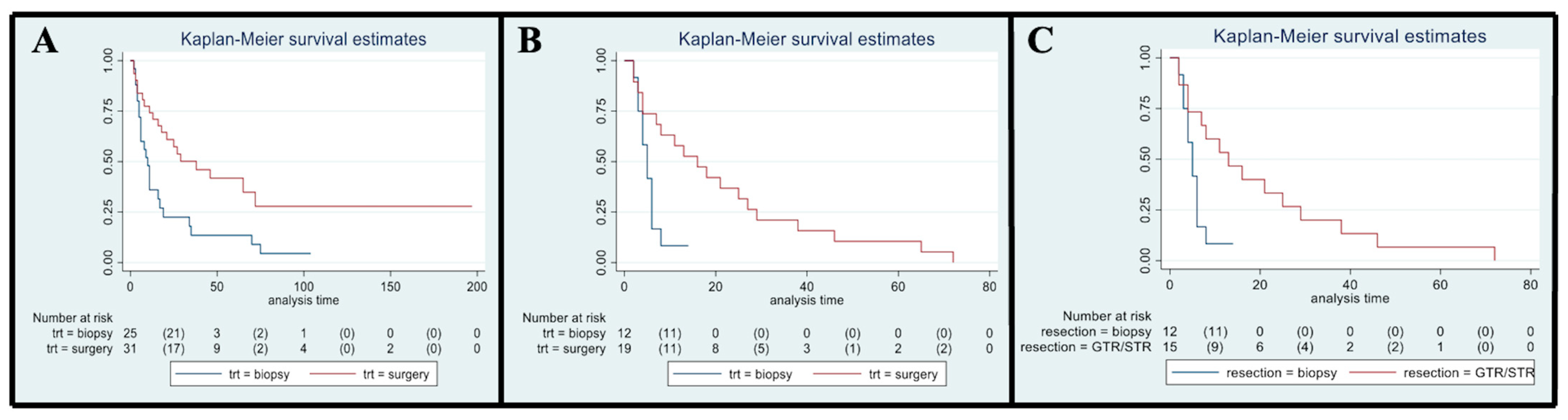
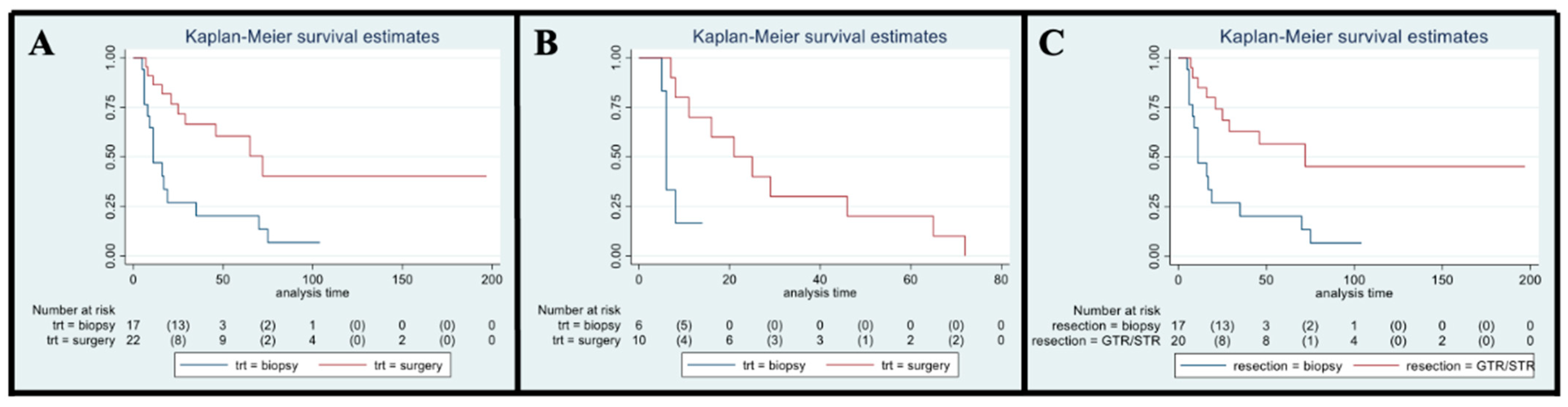
Thalamic gliomas represent a heterogeneous subset of deep-seated lesions for which surgical removal is advocated, although clear prognostic factors linked to advantages in performance status or overall survival are still lacking. We reviewed our Institutional Cancer Registry, identifying patients who underwent surgery for thalamic gliomas between 2006 and 2020. Associations between possible prognostic factors such as tumor volume, grade, the extent of resection and performance status (PS), and overall survival (OS) were evaluated using univariate and multivariate survival analyses. We found 56 patients: 31 underwent surgery, and 25 underwent biopsy. Compared to biopsy, surgery resulted positively associated with an increase in the OS (hazard ratio, HR, at multivariate analysis 0.30, 95% confidence interval, CI, 0.12–0.75). Considering the extent of resection (EOR), obtaining GTR/STR appeared to offer an OS advantage in high-grade gliomas (HGG) patients submitted to surgical resection if compared to biopsy, although we did not find statistical significance at multivariate analysis (HR 0.53, 95% CI 0.17–1.59). Patients with a stable 3-month KPS after surgery demonstrated to have a better prognosis in terms of OS if compared to biopsy (multivariate HR 0.17, 95% CI, 0.05–0.59). Age and histological grades were found to be prognostic factors for this condition (p = 0.04 and p = 0.004, respectively, chi-square test). Considering the entire cohort, p53 positivity (univariate HR 2.21, 95% CI 1.01–4.82) and ATRX positivity (univariate HR 2.69, 95% CI 0.92–7.83) resulted associated with a worse prognosis in terms of OS. In this work, we demonstrated that surgery aimed at tumor resection might offer a stronger survival advantage when a stable 3-month KPS after surgery is achieved.
Keywords:
brain tumors; outcome; thalamic gliomas