Consensus Recommendations for the Clinical Management of Hematological Malignancies in Patients with DNA Double Stranded Break Disorders
by
 , , , , , ,
Agata Pastorczak
1,* ,
,
Andishe Attarbaschi
2,3,
Simon Bomken
4,5,
Arndt Borkhardt
6,
Jutte van der Werff ten Bosch
7,
Sarah Elitzur
8,
Andrew R. Gennery
4,5,
Eva Hlavackova
9,10,
Arpád Kerekes
10,
Zdenka Křenová
9,
Wojciech Mlynarski
1,
Tomasz Szczepanski
11,
Tessa Wassenberg
12 and
Jan Loeffen
13 1
Department of Pediatrics, Oncology and Hematology, Medical University of Lodz, 91-738 Lodz, Poland
2
Department of Pediatrics, Pediatric Hematology and Oncology, St. Anna Children’s Hospital, Medical University of Vienna, 1090 Vienna, Austria
3
Department of Pediatrics and Adolescent Medicine, Medical University of Vienna, 1090 Vienna, Austria
4
Great North Children’s Hospital, Newcastle upon Tyne Hospitals NHS Foundation Trust, Newcastle upon Tyne NE7 7DN, UK
5
Translational and Clinical Research Institute, Newcastle University, Newcastle upon Tyne NE2 4HH, UK
6
Department of Pediatric Oncology, Hematology and Clinical Immunology, University Children’s Hospital, Medical Faculty, Heinrich Heine University, 40225 Düsseldorf, Germany
7
Department of Pediatric Hematology, Oncology and Immunology, University Hospital Brussels, 1090 Jette Brussels, Belgium
8
Pediatric Hematology-Oncology, Schneider Children’s Medical Center, Petach Tikvah 4920235, Israel
9
Department of Pediatric Oncology, University Hospital and Faculty of Medicine, Masaryk University, 662 63 Brno, Czech Republic
10
Department of Clinical Immunology and Allergology, St. Anne’s University Hospital in Brno, Faculty of Medicine, Masaryk University, 662 63 Brno, Czech Republic
11
Department of Pediatric Hematology and Oncology, Medical University of Silesia (SUM), 41-800 Zabrze, Poland
12
Department of Neurology and Child Neurology, Donders Institute for Brain, Cognition and Behavior, Radboud University Medical Center, 6525 GA Nijmegen, The Netherlands
13
Princess Máxima Center for Pediatric Oncology, 3584 CS Utrecht, The Netherlands
*
Author to whom correspondence should be addressed.
Cancers 2022, 14(8), 2000; https://doi.org/10.3390/cancers14082000
Submission received: 4 March 2022
/
Revised: 8 April 2022
/
Accepted: 11 April 2022
/
Published: 14 April 2022
(This article belongs to the Special Issue Non-Hodgkin Lymphoma in Children)
Simple Summary
Ataxia Telangiectasia (AT) and Nijmegen breakage syndrome (NBS) are the most common DNA repair disorders (DNARDs), characterized by an exceedingly high risk for developing hematological malignancies and poor outcomes. Clinical management of lymphoproliferative diseases in AT and NBS is complicated due to the competing challenges of delivery of optimal cancer treatment and management of excessive toxicities. AT and NBS are rare genetic entities in the general population, thus gaining extensive experience in treatment of these patients is difficult. Additionally, no treatment guidelines for lymphoproliferative diseases have been specifically designed for this group of patients as yet. In this review we formulate clinical recommendations, considering the most critical aspects related to the management of lymphoproliferative disorders in AT and NBS and we concisely present the current state of knowledge about the biology and outcomes of leukemia and lymphoma in these DNARDs.
Abstract
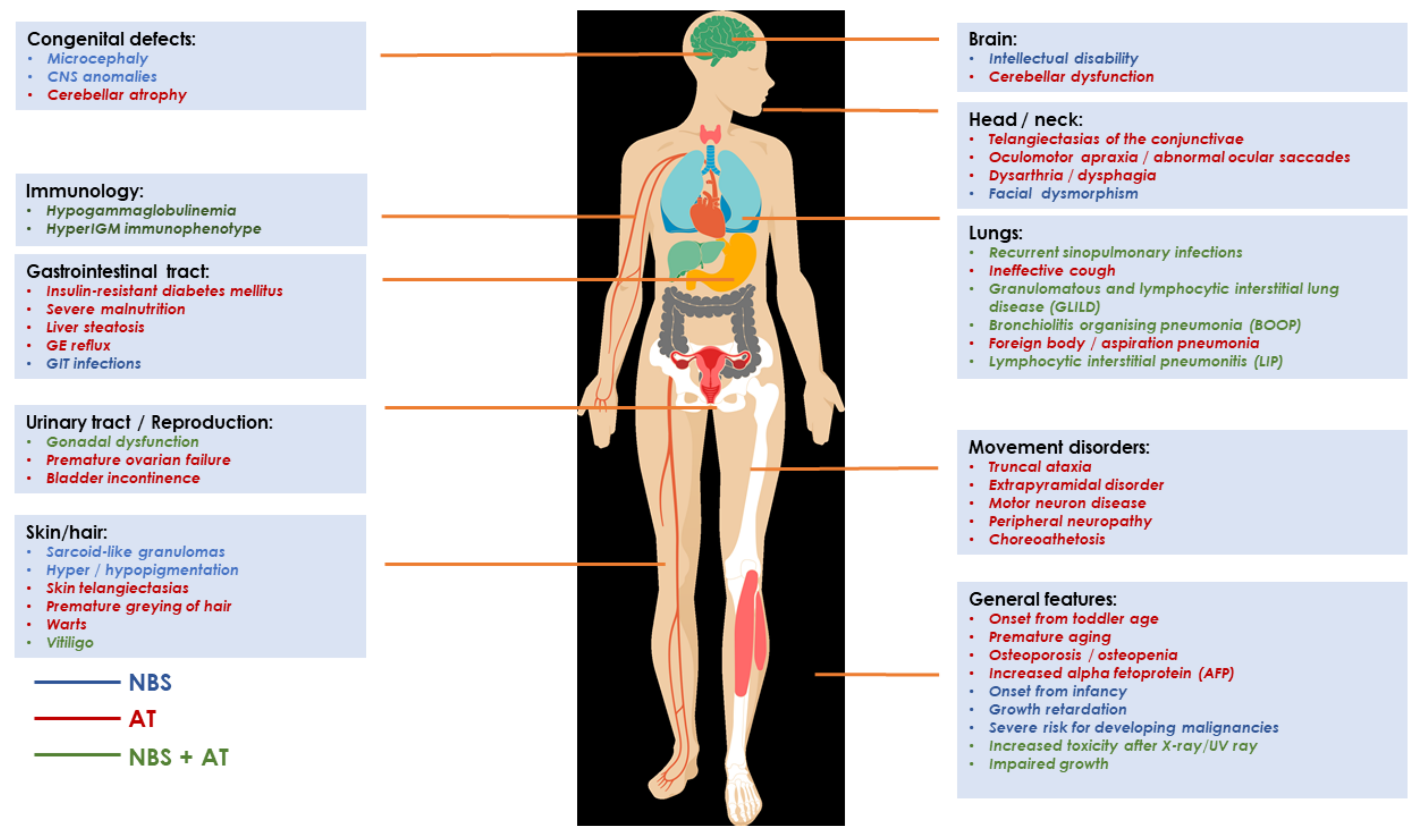
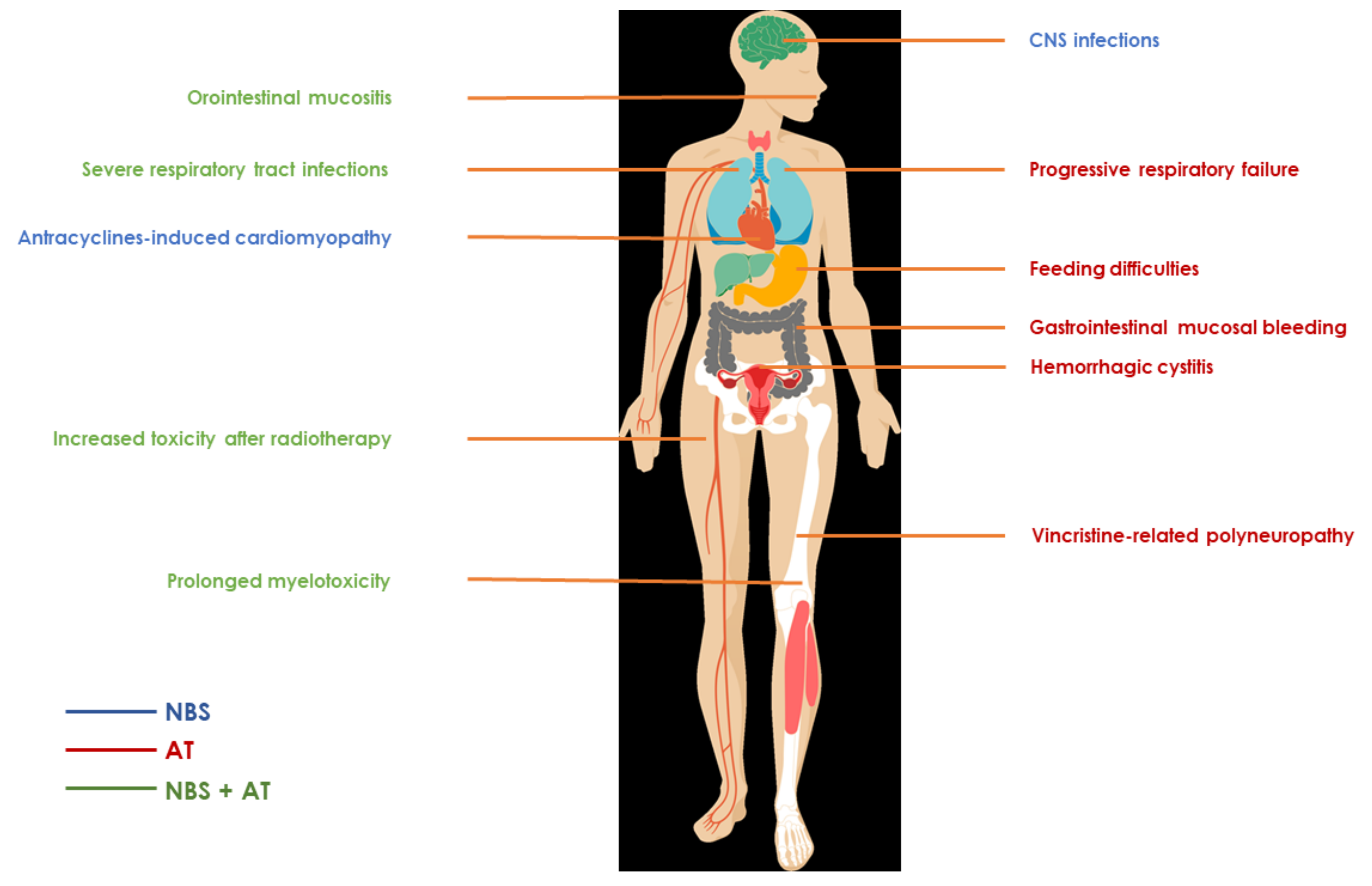
Patients with double stranded DNA repair disorders (DNARDs) (Ataxia Telangiectasia (AT) and Nijmegen Breakage syndrome (NBS)) are at a very high risk for developing hematological malignancies in the first two decades of life. The most common neoplasms are T-cell lymphoblastic malignancies (T-cell ALL and T-cell LBL) and diffuse large B cell lymphoma (DLBCL). Treatment of these patients is challenging due to severe complications of the repair disorder itself (e.g., congenital defects, progressive movement disorders, immunological disturbances and progressive lung disease) and excessive toxicity resulting from chemotherapeutic treatment. Frequent complications during treatment for malignancies are deterioration of pre-existing lung disease, neurological complications, severe mucositis, life threating infections and feeding difficulties leading to significant malnutrition. These complications make modifications to commonly used treatment protocols necessary in almost all patients. Considering the rarity of DNARDs it is difficult for individual physicians to obtain sufficient experience in treating these vulnerable patients. Therefore, a team of experts assembled all available knowledge and translated this information into best available evidence-based treatment recommendations.