The Risk Analyses of Lymph Node Metastasis and Recurrence for Submucosal Invasive Colorectal Cancer: Novel Criteria to Skip Completion Surgery
by
 , , , , and
Takanori Ozeki
1,†, 
Takaya Shimura
1,*,† ,
,
Tomonori Ozeki
2,
Masahide Ebi
2,
Hiroyasu Iwasaki
1,
Hiroyuki Kato
3,
Shingo Inaguma
3,
Yusuke Okuda
1,
Takahito Katano
1,
Hirotada Nishie
1,
Satoru Takahashi
3 and
Hiromi Kataoka
1 1
Department of Gastroenterology and Metabolism, Nagoya City University Graduate School of Medical Sciences, Nagoya 467-8601, Japan
2
Department of Gastroenterology, Aichi Medical University, Nagakute 480-1195, Japan
3
Department of Experimental Pathology and Tumor Biology, Nagoya City University Graduate School of Medical Sciences, Nagoya 467-8601, Japan
*
Author to whom correspondence should be addressed.
†
These authors contributed equally to this work.
Cancers 2022, 14(3), 822; https://doi.org/10.3390/cancers14030822
Submission received: 29 December 2021
/
Revised: 29 January 2022
/
Accepted: 4 February 2022
/
Published: 6 February 2022
(This article belongs to the Special Issue Colorectal Cancer Early Detection, Diagnosis, and Staging)
Simple Summary
Completion surgery is recommended for patients with submucosal invasive colorectal cancer (pT1 CRC) with known risk factors for lymph node metastasis (LNM). However, completion surgery would be able to be skipped for more of the population with very low risk for LNM and recurrence. The present study thus analyzed both short- and long-term outcomes for high-risk pT1 CRC patients who underwent surgery, showing that lymphovascular invasion was a potential independent risk factor for LNM, and rectal cancer and undifferentiated histology were independent risk factors for poor relapse-free survival in patients with high-risk pT1 CRC. No LNMs were observed in pT1 CRCs with an SM invasion depth ≤2000 µm that had no other risk factors except for budding. Based on the results, novel criteria to skip completion surgery for high-risk pT1 CRC have been established in the current study, which were also validated in an independent validation cohort.
Abstract
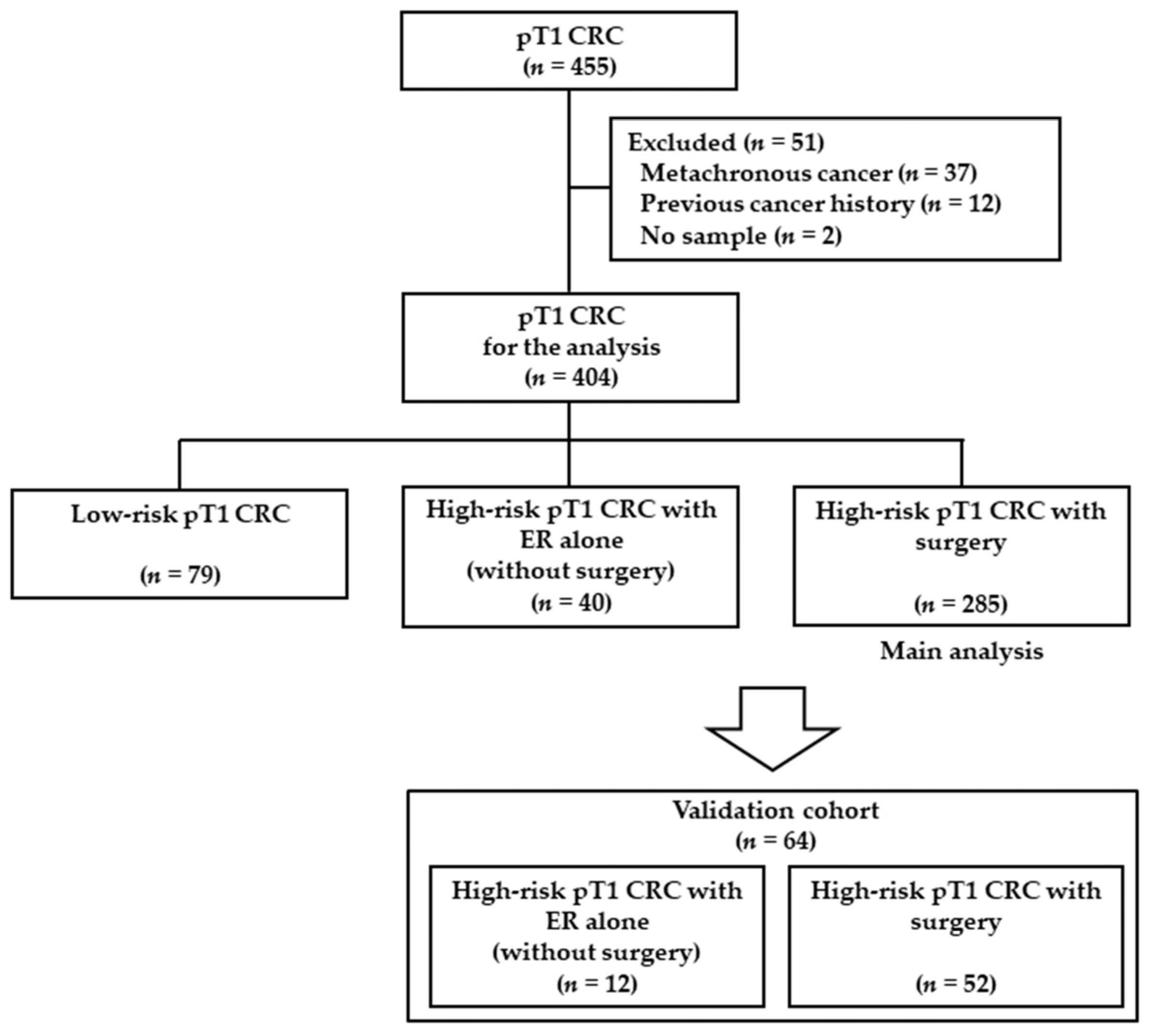
(1) Background: Additional surgical resection after endoscopic resection (ER) is recommended for patients with submucosal invasive colorectal cancer (pT1 CRC) who have risk factors for lymph node metastasis (LNM) (high-risk pT1 CRC). This study aimed to identify risk factors for LNM and metastatic recurrence and to determine the low-risk population for whom additional surgery can be omitted among high-risk pT1 CRCs. (2) Methods: We retrospectively identified 404 patients with pT1 CRC who underwent ER or surgery, and patients were divided into three groups: low-risk (n = 79); high-risk pT1 with ER (n = 40); and high-risk with surgery (n = 285). We also enrolled another 64 patients with high-risk pT1 CRC in an independent validation cohort. (3) Results: In the high-risk with surgery group, LNM was seen in 11.2%, and vascular and lymphatic invasions were significantly independent risk factors for LNM on multivariate analysis. No LNMs were observed in pT1 CRCs with a negative vertical margin and SM invasion depth ≤2000 µm that had no other risk factors except for budding. Five patients developed metastatic recurrence in the high-risk with surgery group, and rectal cancer and undifferentiated histology were significantly independent risk factors for poor relapse-free survival. No LNM or recurrent cases were seen in high-risk pT1 CRCs that met these criteria: differentiated adenocarcinoma, no lymphovascular invasion, colon cancer, SM invasion depth ≤2000 μm, and a negative vertical margin, which were validated in an independent validation cohort. (4) Conclusions: Completion surgery may be skipped for high-risk pT1 CRCs that meet our proposed criteria.