The Hypercoagulable Profile of Patients with Bone Tumors: A Pilot Observational Study Using Rotational Thromboelastometry
by
 , , , , , and
Andreas G. Tsantes
1,* ,
,
Ilectra Loukopoulou
1, 
Dimitrios V. Papadopoulos
2,
Ioannis G. Trikoupis
3,
Anastasios G. Roustemis
3,
Stavros Goumenos
3,
Rozeta Sokou
1 ,
,
Konstantina A. Tsante
1,
Anastasios G. Kriebardis
4 ,
,
Panagiotis Koulouvaris
3,
Dimitra Houhoula
1,
Daniele Piovani
5,6,
Panayiotis J. Papagelopoulos
3,
Stefanos Bonovas
5,6 and
and
Argirios E. Tsantes
1 
1
Laboratory of Haematology and Blood Bank Unit, “Attiko” Hospital, School of Medicine, National and Kapodistrian University of Athens, 15772 Athens, Greece
2
Department of Orthopaedic Surgery, Geisinger Medical Center, Danville, PA 17822, USA
3
First Department of Orthopaedics, School of Medicine, National and Kapodistrian University of Athens, 15772 Athens, Greece
4
Laboratory of Reliability and Quality Control in Laboratory Hematology, Department of Biomedical Science, School of Health and Caring Science, University of West Attica, 12243 Athens, Greece
5
Department of Biomedical Sciences, Humanitas University, Pieve Emanuele, 20072 Milan, Italy
6
IRCCS Humanitas Research Hospital, Rozzano, 20089 Milan, Italy
*
Author to whom correspondence should be addressed.
Cancers 2022, 14(16), 3930; https://doi.org/10.3390/cancers14163930
Submission received: 9 July 2022
/
Revised: 12 August 2022
/
Accepted: 12 August 2022
/
Published: 15 August 2022
Simple Summary
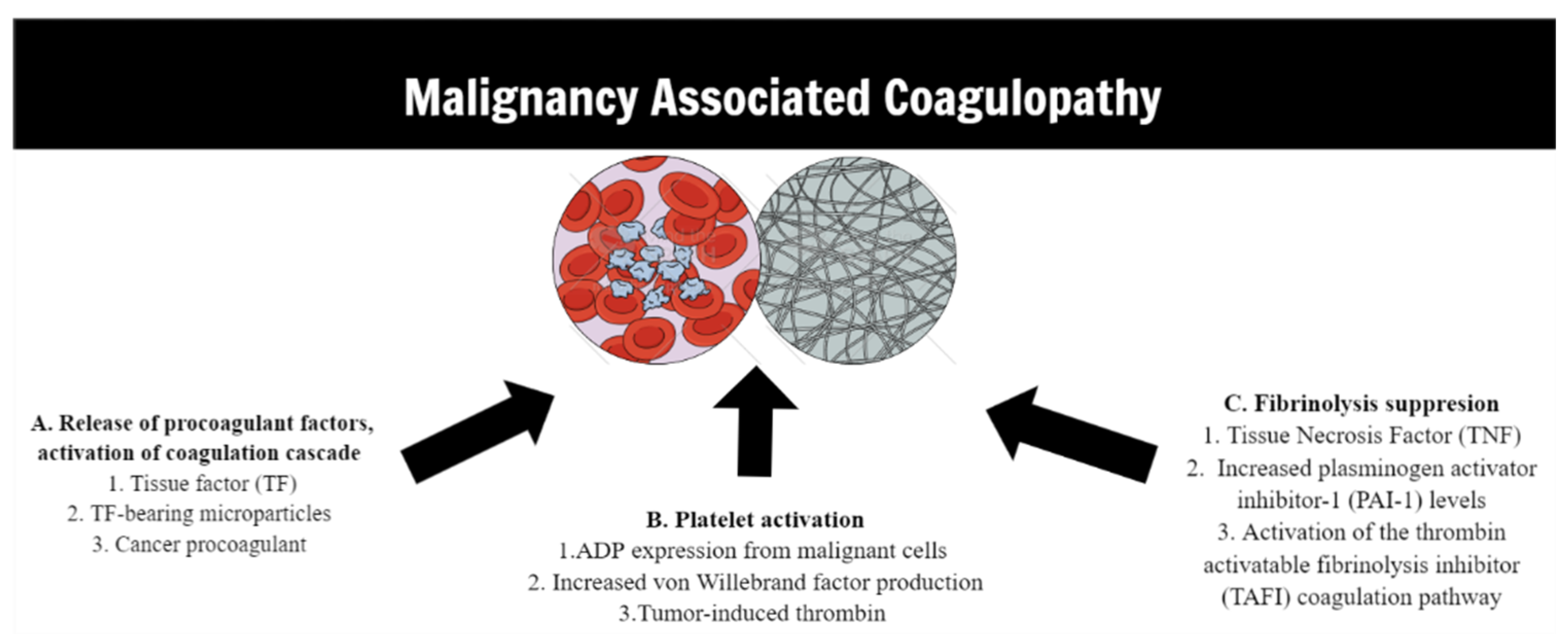
Malignancy-associated coagulopathy (MAC) in surgical patients with bone tumors is associated with thromboembolic complications. Rotational thromboelastometry can provide a detailed evaluation of the mechanisms involved in MAC and may allow for more effective thromboprophylactic measures. The ROTEM results indicate that the hypercoagulable state in patients with bone tumors is caused by the malignancy-associated activation of the coagulation cascade, platelet activation, and hypofibrinolysis.
Abstract
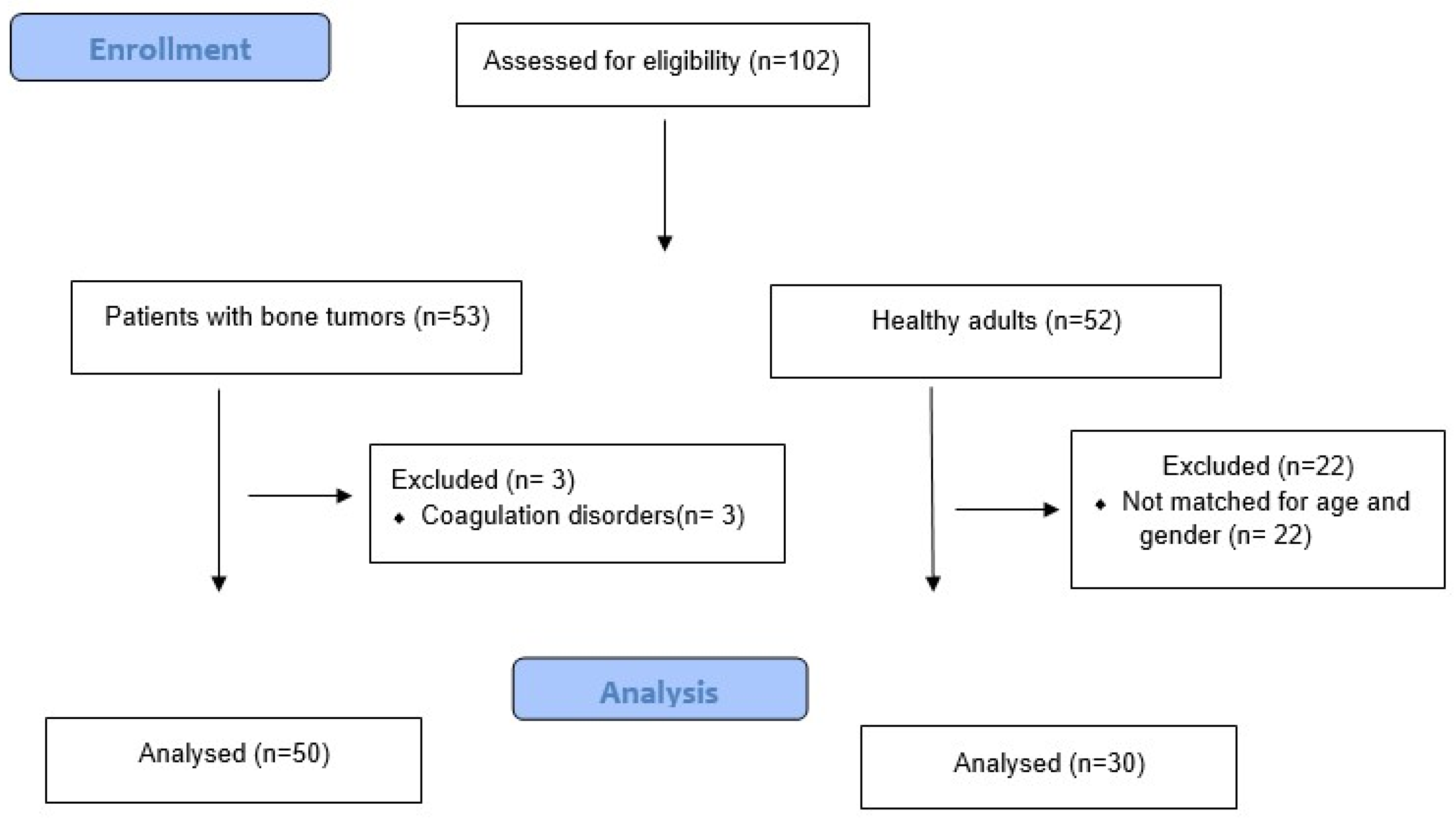
Introduction: A detailed evaluation of the malignancy-associated coagulopathy (MAC) in surgical patients with bone tumors may allow for more effective thromboprophylactic measures. The purpose of this study was to assess the perioperative hemostatic changes in patients with bone tumors, using rotational thromboelastometry (ROTEM). Methods: An observational study was performed, including 50 patients with bone tumors who underwent oncologic resection and 30 healthy controls, matched for age and gender. The preoperative and postoperative laboratory evaluation of coagulation in both groups included conventional coagulation tests and a ROTEM analysis. The results of the conventional coagulation tests and the ROTEM analysis were compared between the two groups. Results: The results of the conventional coagulation tests were comparable between the tumor patients and the healthy controls. However, compared to the healthy adults, the tumor patients had lower CT (p < 0.001) and CFT (p < 0.001) values suggesting a rapid induction of the coagulation cascade, elevated A10 (p < 0.001) and MCF (p < 0.001) values indicating a higher clot strength and platelet activation, and elevated LI60 (p < 0.001) values indicating hypofibrinolysis in patients with bone tumors. The multiple linear regression analysis (controlling for potential confounding factors) confirmed the independent association of bone tumors with these hemostatic changes. Conclusions: Our results support the advantageous use of a ROTEM in patients with bone tumors over conventional coagulation tests because the qualitative changes in the hemostatic profile of these patients that can be detected by a ROTEM analysis cannot be identified by conventional tests. The ROTEM results indicate that the hypercoagulable state in patients with bone tumors is caused by the malignancy-associated activation of the coagulation cascade, platelet activation, and hypofibrinolysis.