Cost-Effectiveness of Immune Checkpoint Inhibitors in Urothelial Carcinoma—A Review
1
Department of Urology, University of California San Diego, La Jolla, CA 92093, USA
2
Department of Medicine, University of Chicago, Chicago, IL 60612, USA
3
Department of Surgery, University of Chicago, Chicago, IL 60637, USA
*
Author to whom correspondence should be addressed.
Cancers 2022, 14(1), 73; https://doi.org/10.3390/cancers14010073
Submission received: 25 November 2021
/
Revised: 11 December 2021
/
Accepted: 14 December 2021
/
Published: 24 December 2021
(This article belongs to the Special Issue Advances in Immunotherapy for Genitourinary Malignancies)
Simple Summary
Urothelial carcinoma is a malignancy that originates in the genitourinary tract. It is a heterogeneous disease that can present at different stages, and the treatment options vary in efficacy. Advances in immunotherapy stimulated adoption in urothelial carcinoma, and published trials have shown promising results when compared to conventional therapies. However, oncologic drugs are historically costly, and immunotherapy is no exception. A cost-effectiveness analysis is a standardized method of weighing the clinical benefits of an intervention against the financial burden to obtain a composite proposed value. Multiple investigators have assessed immunotherapy in urothelial carcinoma, but no consensus has been reached. Here, we aim to review the literature of the available cost-effectiveness studies to summarize the results and determine the current value of systemic immunotherapy compared to standard treatment. Positive findings will support continued efforts to adopt immunotherapy, whereas negative findings will identify potential gaps for improvement in cost-effectiveness.
Abstract
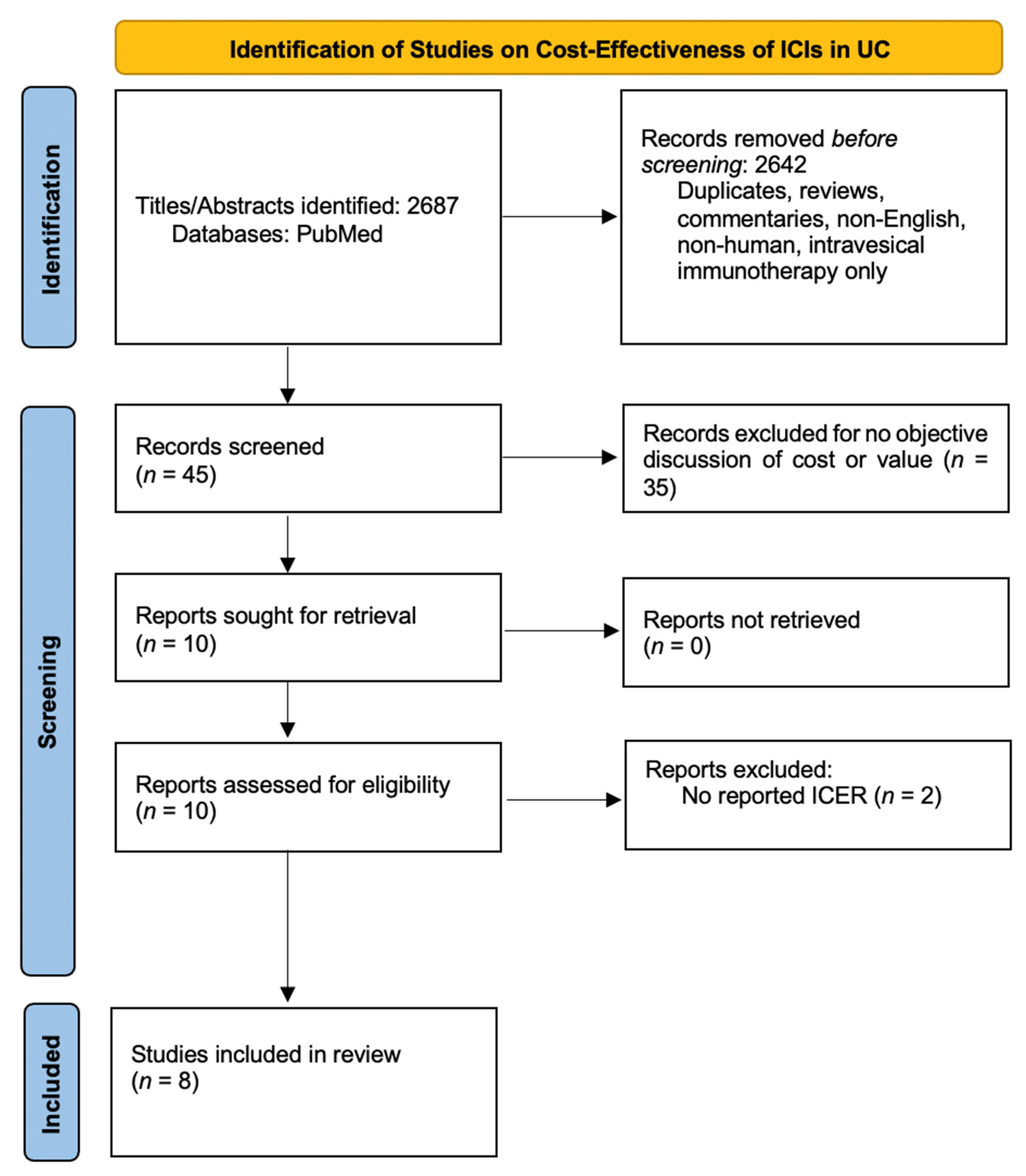
Over the last decade, an increasing number of immune checkpoint inhibitors (ICIs) have been assessed for therapeutic efficacy in urothelial carcinoma (UC). The high cost has prompted multiple cost-effectiveness analyses for the various disease stages, with no established consensus. We reviewed the literature to assess the available cost-effectiveness studies and summarize their findings. Studies were filtered for a calculated incremental cost-effectiveness ratio (ICER) to standardize comparison. Over 2600 articles were narrowed to eight primary investigations: one for BCG-refractory non-muscle invasive (NMI), one for neoadjuvant therapy in muscle-invasive (MI), and six for advanced disease. Cost-effectiveness was not achieved for NMI disease. Atezolizumab met the willingness-to-pay (WTP) threshold as neoadjuvant therapy for MI disease compared to chemotherapy, but with multiple limitations on the interpretation. Of the six studies on advanced disease, the results were mixed. This was at least partially attributable to varied methodologies including extrapolated time horizons, inconsistent cost inputs, and different WTP thresholds. Overall, the aggregate results were not compelling enough to establish ICIs as cost-effective compared to conventional chemotherapy. Value may improve with continued investigation into long-term outcomes, refined patient selection, and pricing discounts.
Keywords:
bladder; urothelial; cancer; cost; value; immunotherapy; systemic