Comparative O-GlcNAc Proteomic Analysis Reveals a Role of O-GlcNAcylated SAM68 in Lung Cancer Aggressiveness
by
 , , and
Chia-Hung Lin
1,† ,
,
Chen-Chung Liao
2,†,
Shu-Ying Wang
3,
Chia-Yi Peng
4,
Yi-Chen Yeh
1,
Mei-Yu Chen
4,5,6,* and
Teh-Ying Chou
1,3,4,6,* 1
Department of Pathology and Laboratory Medicine, Taipei Veterans General Hospital, Taipei 11227, Taiwan
2
Metabolomics-Proteomics Research Center, National Yang Ming Chiao Tung University, Taipei 11221, Taiwan
3
Institute of Clinical Medicine, College of Medicine, National Yang Ming Chiao Tung University, Taipei 11221, Taiwan
4
Institute of Biochemistry and Molecular Biology, College of Life Sciences, National Yang Ming Chiao Tung University, Taipei 11221, Taiwan
5
Faculty of Medicine, School of Medicine, National Yang Ming Chiao Tung University, Taipei 11221, Taiwan
6
Cancer Progression Research Center, National Yang Ming Chiao Tung University, Taipei 11221, Taiwan
*
Authors to whom correspondence should be addressed.
†
These authors contributed equally to this work.
Cancers 2022, 14(1), 243; https://doi.org/10.3390/cancers14010243
Submission received: 11 November 2021
/
Revised: 19 December 2021
/
Accepted: 30 December 2021
/
Published: 4 January 2022
(This article belongs to the Special Issue O-GlcNAcylation and Cancer)
Simple Summary
Lung cancer claims the most lives annually among cancers; to date, invasion and metastasis still pose challenges to effective treatment. O-GlcNAcylation, an enzymatic modification of proteins after biosynthesis, modulates the functions of many proteins. Aberrant O-GlcNAcylation is linked to pathogenic mechanisms of cancer, including invasion and metastasis. However, little is known about the profile of O-GlcNAcylated proteins involved in cancer aggressiveness. Here, by comparing profiles of O-GlcNAcylated proteins from two lung cancer cell lines different in their invasive potential, we identified candidates for O-GlcNAcylated proteins that may be involved in cancer aggressiveness. One of these candidates, SAM68, was further characterized. Results confirmed O-GlcNAcylation of SAM68; functional analyses on SAM68 with mutations at O-GlcNAcylation sites suggested a role of O-GlcNAcylated SAM68 in modulating lung cancer cell migration/invasion. Future elucidation of the functional significance of differential O-GlcNAcylation of proteins identified in this study may provide new insights into mechanisms of lung cancer progression.
Abstract
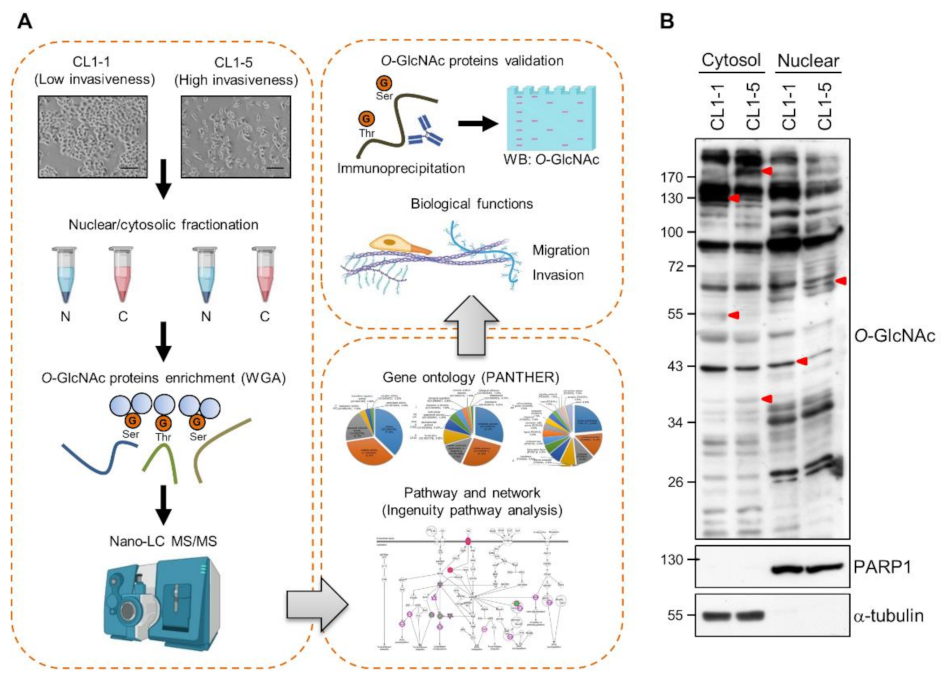
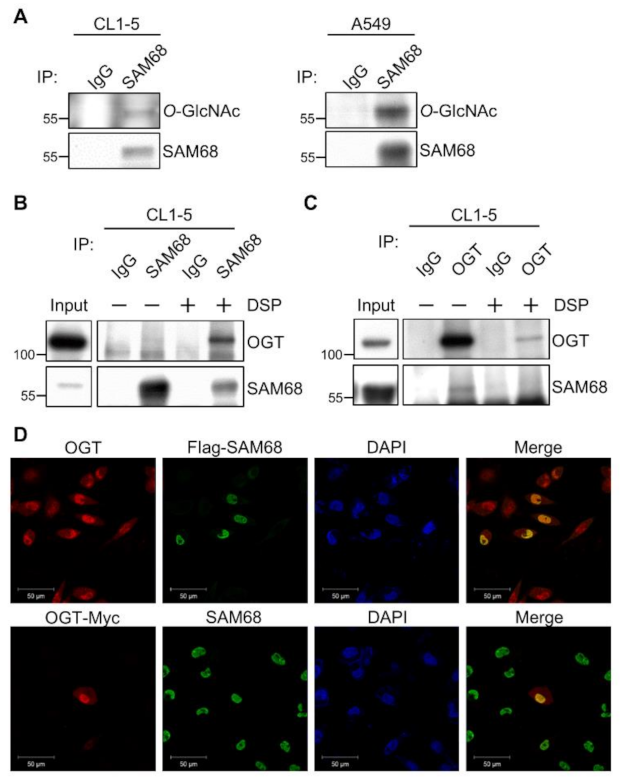
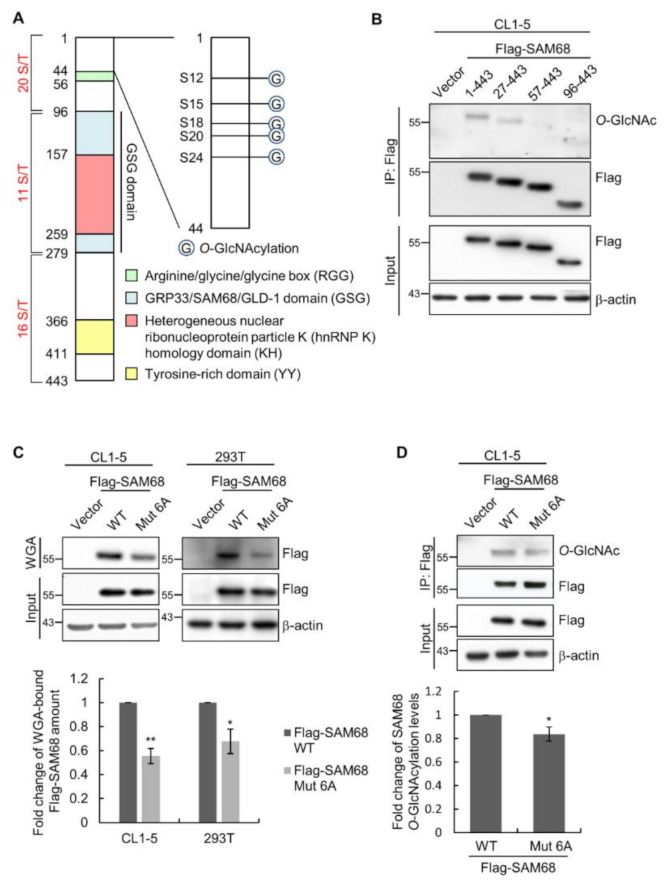
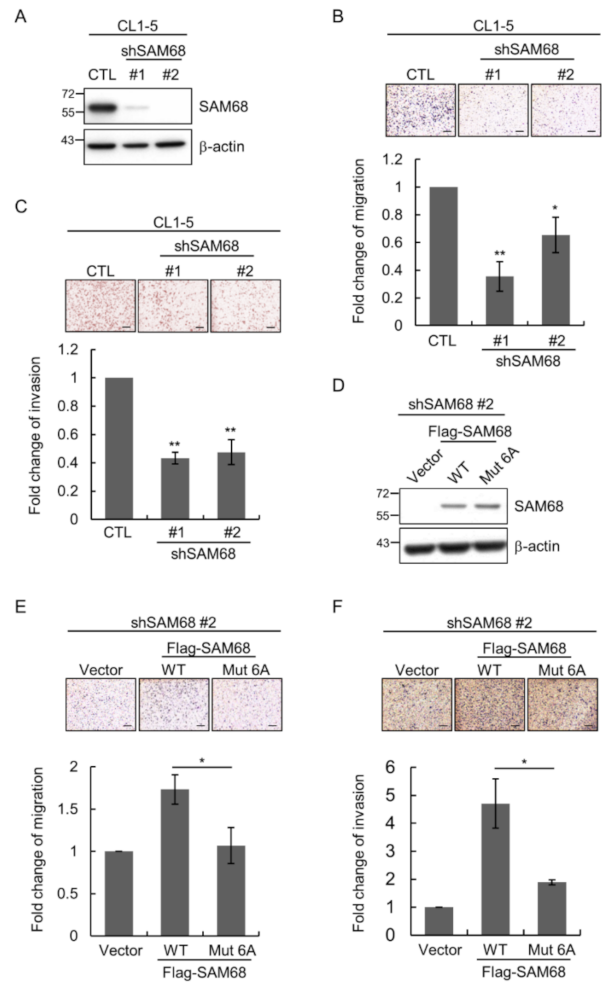
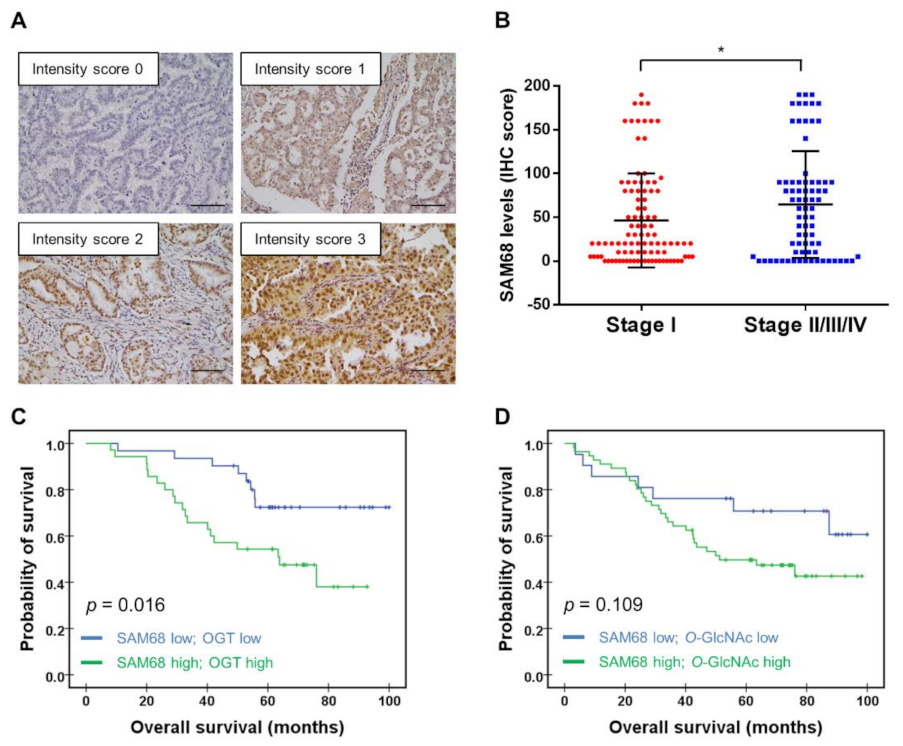
O-GlcNAcylation is a reversible and dynamic post-translational protein modification catalyzed by O-GlcNAc transferase (OGT). Despite the reported association of O-GlcNAcylation with cancer metastasis, the O-GlcNAc proteome profile for cancer aggressiveness remains largely uncharacterized. Here, we report our comparative O-GlcNAc proteome profiling of two differentially invasive lung adenocarcinoma cell lines, which identified 158 down-regulated and 106 up-regulated candidates in highly invasive cells. Among these differential proteins, a nuclear RNA-binding protein, SAM68 (SRC associated in mitosis of 68 kDa), was further investigated. Results showed that SAM68 is O-GlcNAcylated and may interact with OGT in the nucleus. Eleven O-GlcNAcylation sites were identified, and data from mutant analysis suggested that multiple serine residues in the N-terminal region are important for O-GlcNAcylation and the function of SAM68 in modulating cancer cell migration and invasion. Analysis of clinical specimens found that high SAM68 expression was associated with late cancer stages, and patients with high-OGT/high-SAM68 expression in their tumors had poorer overall survival compared to those with low-OGT/low-SAM68 expression. Our study revealed an invasiveness-associated O-GlcNAc proteome profile and connected O-GlcNAcylated SAM68 to lung cancer aggressiveness.
Keywords:
invasiveness; lung adenocarcinoma; O-GlcNAc transferase; O-GlcNAcylation; SAM68