Circulating Cell-Free DNA Combined to Magnetic Resonance Imaging for Early Detection of HCC in Patients with Liver Cirrhosis
by
 , ,
, ,
Marianna Alunni-Fabbroni
1,* ,
,
Sabine Weber
2, 
Osman Öcal
1,
Max Seidensticker
1,
Julia Mayerle
2,
Peter Malfertheiner
1,2 and
Jens Ricke
1 1
Department of Radiology, University Hospital, LMU Munich, 81377 Munich, Germany
2
Department of Medicine II, University Hospital, LMU Munich, 81377 Munich, Germany
*
Author to whom correspondence should be addressed.
Cancers 2021, 13(3), 521; https://doi.org/10.3390/cancers13030521
Submission received: 12 December 2020
/
Revised: 13 January 2021
/
Accepted: 21 January 2021
/
Published: 29 January 2021
(This article belongs to the Collection Advances in the Management of Hepatocellular Carcinoma)
Simple Summary
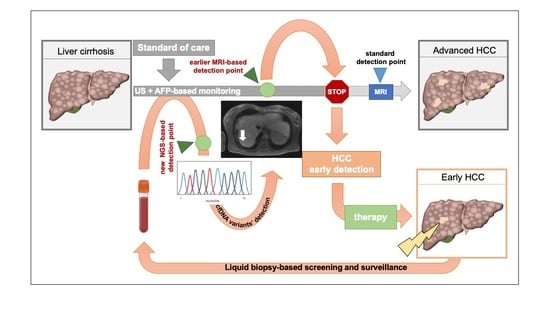
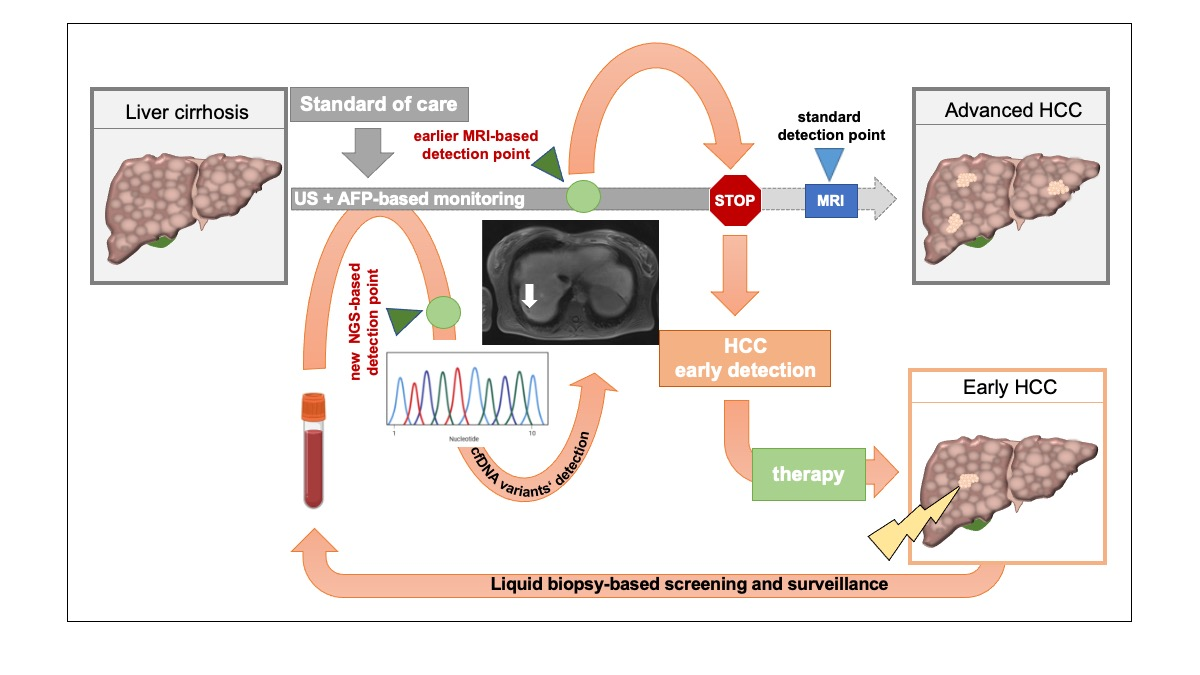
Liver cirrhosis can develop into malignant disease over time. Frequent monitoring would be advisable to detect the earliest signs of HCC progress resulting in a possible earlier treatment of the patient. Our study showed that the combination of genetic analysis of DNA freely circulating in the blood of the cirrhotic patients with MRI can represent a powerful strategy to timely identify suspect lesions, which can then be followed up more closely and thus potentially be treated earlier. In this way, personalized medicine can be applied to liver diseases such as cirrhosis.
Abstract
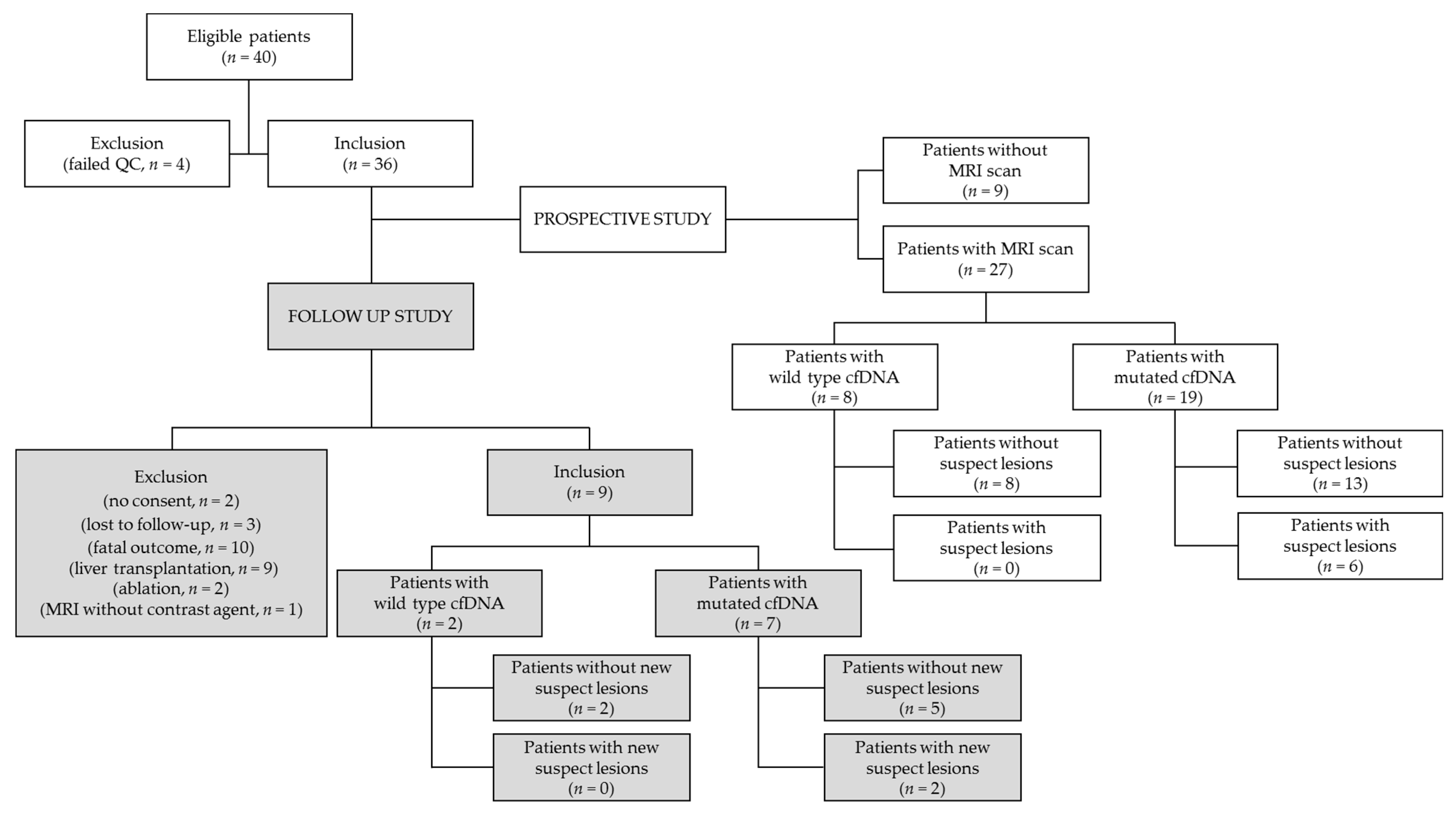
Liquid biopsy based on circulating cell-free DNA (cfDNA) is a promising non-invasive tool for the prognosis of hepatocellular cancer (HCC). In this exploratory study we investigated whether cfDNA and gene variants associated with HCC may be found in patients with liver cirrhosis (LC) and thus identify those at an increased risk for HCC. A cohort of 40 LC patients with no suspect neoplastic lesions was included in this study. Next generation sequencing (NGS) of cfDNA isolated from plasma was performed on a panel of 597 selected genes. Images of the patients who underwent MRI with hepatospecific contrast media during the study period were retrospectively re-evaluated (imaging was not part of the prospective study). cfDNA was detected in the plasma of 36 patients with LC. NGS-based analyses identified 20 variants in different combinations. Re-evaluation of the MRI images that were available for a proportion of the patients (n = 27) confirmed the absence of lesions in 8 cases carrying cfDNA without variants. In 6 of 19 patients with identified variants and MRI images available, MRI revealed a precursor lesion compatible with HCC and new lesions were discovered at follow-up in two patients. These precursor lesions were amenable for curative treatments. Mutation analysis revealed selective HCC related gene mutations in a subset of patients with LC, raising the suspect that these patients were at an increased risk for HCC development. MRI findings confirmed suspect nodular lesions of early stage HCC not detected with current standard screening procedures, which were only seen in patients carrying cfDNA variants. This opens a perspective for an HCC screening strategy combining both liquid biopsy and MRI in patients with LC.
Keywords:
liver cirrhosis; MRI; HCC; liquid biopsy; circulating cell-free DNA