Determination of Additional Surgery after Non-Curative Endoscopic Submucosal Dissection in Patients with Early Gastric Cancer: A Practically Modified Application of the eCura System
by
 , , , and
Sejin Lee
1 ,
,
Jeong Ho Song
2,3,
Sung Hyun Park
2,3,
Minah Cho
2,3,
Yoo Min Kim
2,3,
Hyoung-Il Kim
2,3 and
Woo Jin Hyung
2,3,* 1
Department of Surgery, Jeonbuk National University Hospital, Jeonju 54907, Korea
2
Department of Surgery, Yonsei University College of Medicine, Seoul 03722, Korea
3
Gastric Cancer Center, Yonsei Cancer Center, Yonsei University Health System, Seoul 03722, Korea
*
Author to whom correspondence should be addressed.
Cancers 2021, 13(22), 5768; https://doi.org/10.3390/cancers13225768
Submission received: 16 October 2021
/
Revised: 11 November 2021
/
Accepted: 15 November 2021
/
Published: 17 November 2021
(This article belongs to the Special Issue New Technologies and Advancements in Gastro-Esophageal Cancer Surgery)
Simple Summary
Recent treatment guidelines for gastric cancer recommended additional surgery for patients with non-curative endoscopic submucosal dissection (ESD). However, this strategy may be too excessive since few patients have lymph node metastasis (LNM). In this study, we modified the eCura system, a risk-scoring system for LNM after non-curative ESD, by classifying lymphatic invasion and venous invasion as a single entity of lymphovascular invasion. By using the modified eCura system, patients after non-curative ESD were simply categorized into high- and low-risk groups as lymph node metastasis depending on whether the tumor had lymphovascular invasion and other risk factors or not. Moreover, there was no intermediate-risk group, which could not recommend the appropriate treatment modality in the eCura system.
Abstract
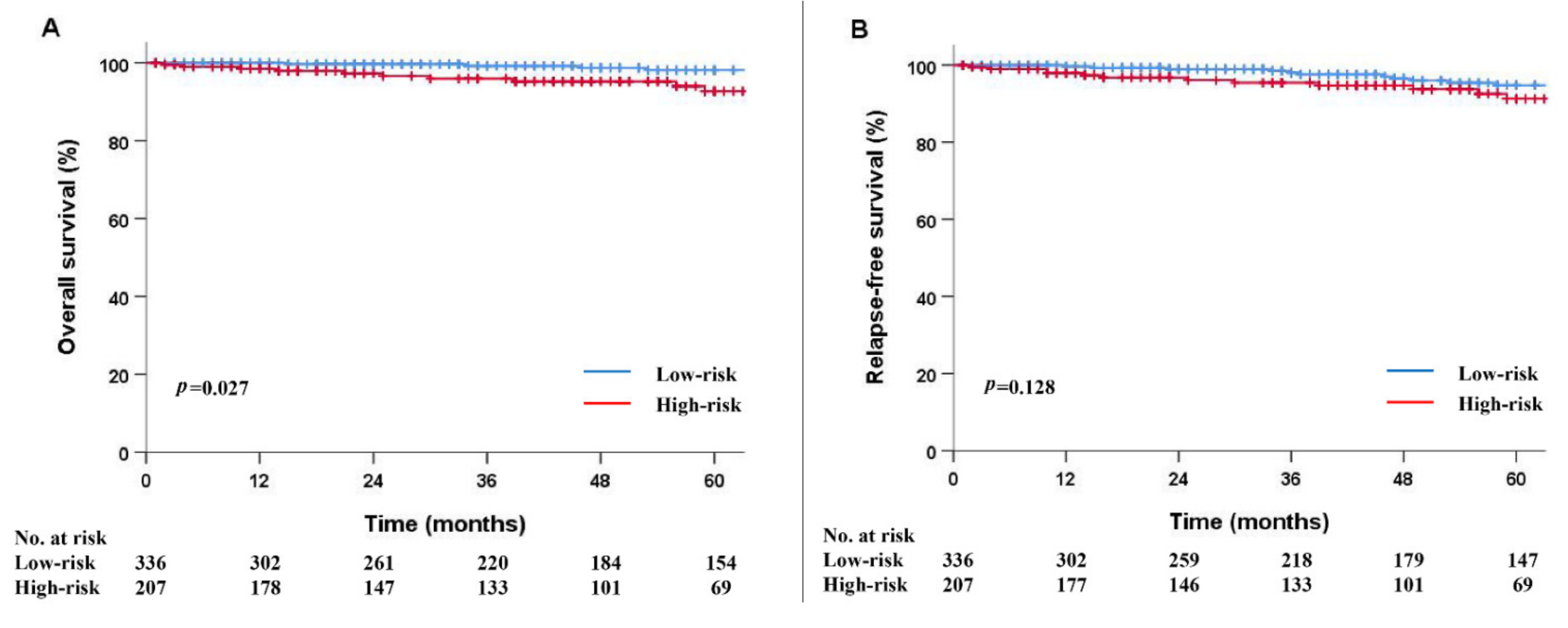
Background: Additional surgery after non-curative endoscopic submucosal dissection (ESD) may be excessive as few patients have lymph node metastasis (LNM). It is necessary to develop a risk stratification system for LNM after non-curative ESD, such as the eCura system, which was introduced in the Japanese gastric cancer treatment guidelines. However, the eCura system requires venous and lymphatic invasion to be separately assessed, which is difficult to distinguish without special immunostaining. In this study, we practically modified the eCura system by classifying lymphatic and venous invasion as lymphovascular invasion (LVI). Method: We retrospectively reviewed 543 gastric cancer patients who underwent radical gastrectomy after non-curative ESD between 2006 and 2019. LNM was evaluated according to LVI as well as size >30 mm, submucosal invasion ≥500 µm, and vertical margin involvement, which were used in the eCura system. Results: LNM was present in 8.1% of patients; 3.6%, 2.3%, 7.4%, 18.3%, and 61.5% of patients with no, one, two, three, and four risk factors had LNM, respectively. The LNM rate in the patients with no risk factors (3.6%) was not significantly different from that in patients with one risk factor (2.3%, p = 0.523). Among patients with two risk factors, the LNM rate without LVI was significantly lower than with LVI (2.4% vs. 10.7%, p = 0.027). Among patients with three risk factors, the LNM rate without LVI was lower than with LVI (0% vs. 20.8%, p = 0.195), although not statistically significantly. Based on LNM rates according to risk factors, patients with LVI and other factors were assigned to the high-risk group (LNM, 17.4%) while other patients as a low-risk group (LNM, 2.4%). Conclusions: Modifying the eCura system by classifying lymphatic and venous invasion as LVI successfully stratified LNM risk after non-curative ESD. Moreover, the high-risk group can be simply identified based on LVI and the presence of other risk factors.
Keywords:
non-curative ESD; lymph node metastasis; eCura system