


In Uveal Melanoma, Angiopoietin-2 but Not Angiopoietin-1 Is Increased in High-Risk Tumors, Providing a Potential Druggable Target
 , and
, and
Simple Summary
Abstract
1. Introduction
2. Materials and Methods
2.1. Study Population
2.2. Immunohistochemical Staining
2.3. Gene Expression Analysis
2.4. Protein Expression Analysis in Aqueous Humor
2.5. Statistical Analysis
3. Results
3.1. Distribution of ANG-1 and ANG-2 Gene Expression in UM Tissue
3.2. Presence of ANG-1 and ANG-2 Protein in Aqueous Humor
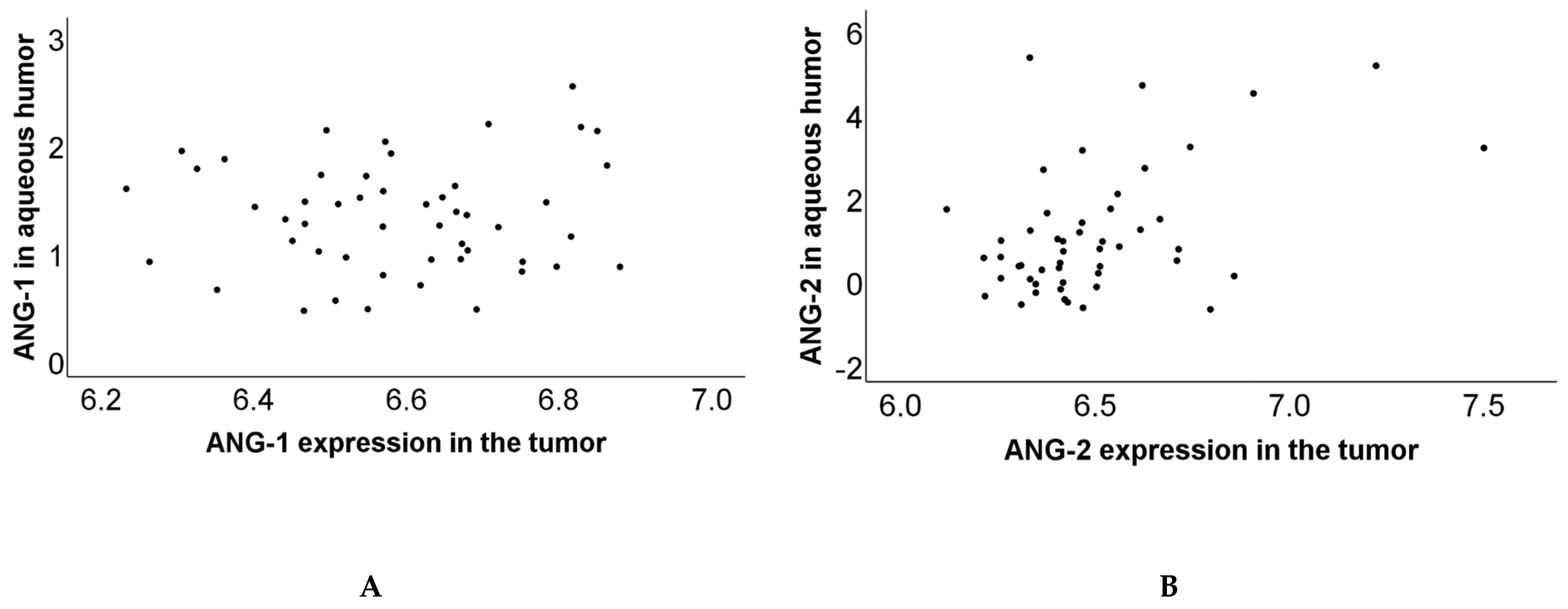
3.3. Correlation of Protein and Gene Expression
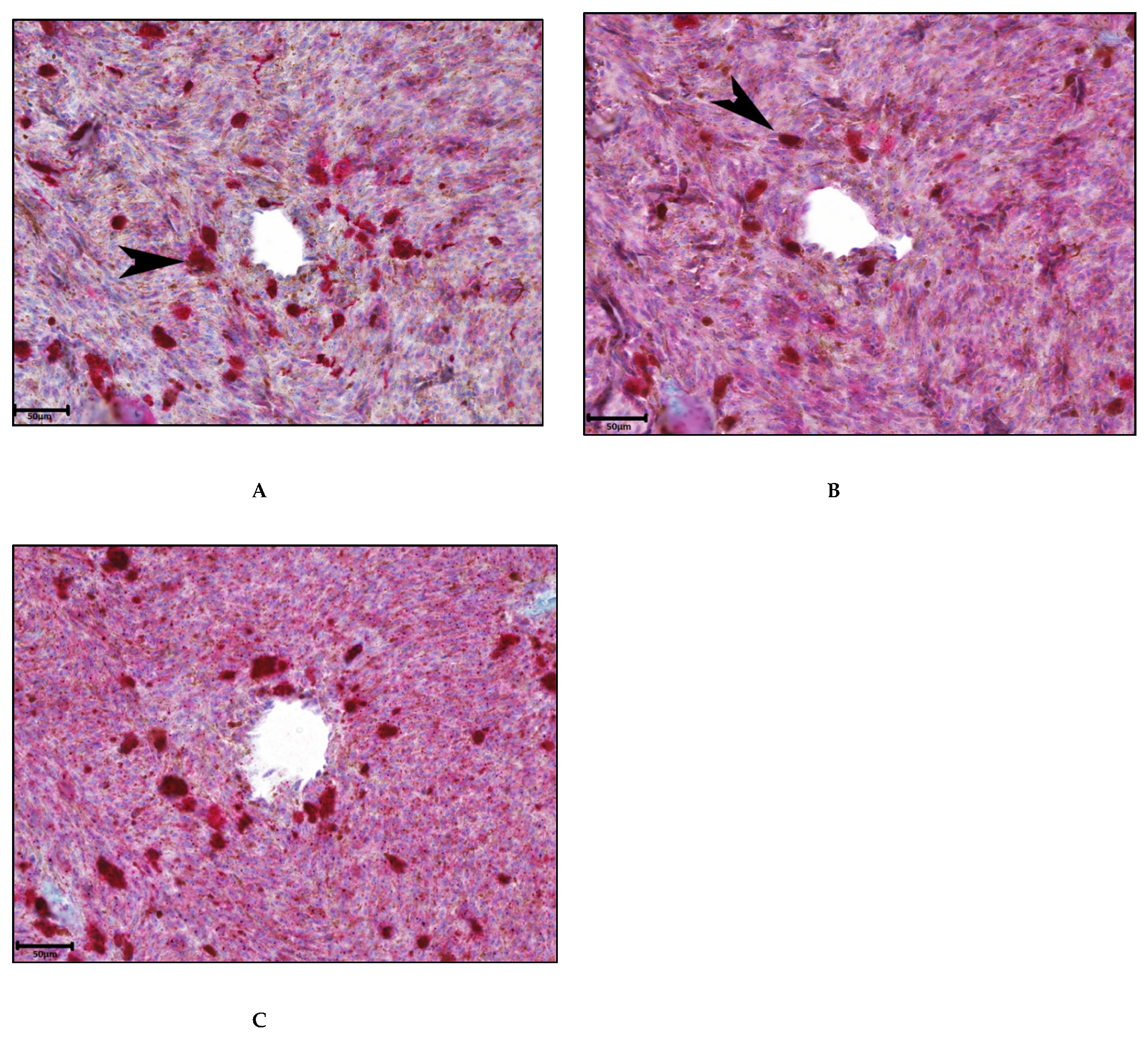
3.4. Association between ANG-2 and Inflammation
4. Discussion
5. Conclusions
Author Contributions
Funding
Institutional Review Board Statement
Informed Consent Statement
Data Availability Statement
Acknowledgments
Conflicts of Interest
References
- Singh, A.D.; Turell, M.E.; Topham, A.K. Uveal melanoma: Trends in incidence, treatment, and survival. Ophthalmology 2011, 118, 1881–1885. [Google Scholar] [CrossRef] [Scilit]
- Diener-West, M.; Reynolds, S.M.; Agugliaro, D.J.; Caldwell, R.; Cumming, K.; Earle, J.D.; Hawkins, B.S.; Hayman, J.A.; Jaiyesimi, I.; Jampol, L.M.; et al. Development of metastatic disease after enrollment in the COMS trials for treatment of choroidal melanoma: Collaborative Ocular Melanoma Study Group Report No. 26. Arch. Ophthalmol. 2005, 123, 1639–1643. [Google Scholar] [PubMed]
- Kaliki, S.; Shields, C.L.; Shields, J.A. Uveal melanoma: Estimating prognosis. Indian J. Ophthalmol. 2015, 63, 93–102. [Google Scholar] [CrossRef] [Scilit] [PubMed]
- Eskelin, S.; Pyrhonen, S.; Summanen, P.; Hahka-Kemppinen, M.; Kivela, T. Tumor doubling times in metastatic malignant melanoma of the uvea: Tumor progression before after treatment. Ophthalmology 2000, 107, 1443–1449. [Google Scholar] [CrossRef] [Scilit]
- Diener-West, M.; Hawkins, B.S.; Markowitz, J.A.; Schachat, A.P. A review of mortality from choroidal melanoma II A meta-analysis of 5-year mortality rates following enucleation, 1966 through 1988. Arch. Ophthalmol. 1992, 110, 245–250. [Google Scholar] [CrossRef] [Scilit] [PubMed]
- Missotten, G.S.; Notting, I.C.; Schlingemann, R.O.; Zijlmans, H.J.; Lau, C.; Eilers, P.H.; Keunen, J.E.; Jager, M.J. Vascular endothelial growth factor a in eyes with uveal melanoma. Arch. Ophthalmol. 2006, 124, 1428–1434. [Google Scholar] [CrossRef] [Scilit]
- Amaro, A.; Gangemi, R.; Piaggio, F.; Angelini, G.; Barisione, G.; Ferrini, S.; Pfeffer, U. The biology of uveal melanoma. Cancer Metastasis Rev. 2017, 36, 109–140. [Google Scholar] [CrossRef] [Scilit] [PubMed]
- Brouwer, N.J.; Gezgin, G.; Wierenga, A.P.A.; Bronkhorst, I.H.G.; Marinkovic, M.; Luyten, G.P.M.; Versluis, M.; Kroes, W.G.M.; van der Velden, P.A.; Verdijk, R.M.; et al. Tumour Angiogenesis Uveal Melanoma Is Relat. Genet. Evolution. Cancers 2019, 11, 979. [Google Scholar] [CrossRef] [Scilit]
- Brouwer, N.J.; Wierenga, A.P.A.; Gezgin, G.; Marinkovic, M.; Luyten, G.P.M.; Kroes, W.G.M.; Versluis, M.; van der Velden, P.A.; Verdijk, R.M.; Jager, M.J. Ischemia Is Related to Tumour Genetics in Uveal Melanoma. Cancers 2019, 11, 1004. [Google Scholar] [CrossRef] [Scilit]
- Sheidow, T.G.; Hooper, P.L.; Crukley, C.; Young, J.; Heathcote, J.G. Expression of vascular endothelial growth factor in uveal melanoma and its correlation with metastasis. Br. J. Ophthalmol. 2000, 84, 750–756. [Google Scholar] [CrossRef] [Scilit]
- Mallikarjuna, K.; Pushparaj, V.; Biswas, J.; Krishnakumar, S. Expression of epidermal growth factor receptor, ezrin, hepatocyte growth factor, and c-Met in uveal melanoma: An immunohistochemical study. Curr. Eye Res. 2007, 32, 281–290. [Google Scholar] [CrossRef] [Scilit]
- Barak, V.; Pe’er, J.; Kalickman, I.; Frenkel, S. VEGF as a biomarker for metastatic uveal melanoma in humans. Curr. Eye Res. 2011, 36, 386–390. [Google Scholar] [CrossRef] [Scilit] [PubMed]
- El Filali, M.; Missotten, G.S.; Maat, W.; Ly, L.V.; Luyten, G.P.; van der Velden, P.A.; Jager, M.J. Regulation of VEGF-A in uveal melanoma. Invest. Ophthalmol. Vis. Sci. 2010, 51, 2329–2337. [Google Scholar] [CrossRef] [Scilit]
- Blom, D.J.; Luyten, G.P.; Mooy, C.; Kerkvliet, S.; Zwinderman, A.H.; Jager, M.J. Human leukocyte antigen class I expression. Marker Poor Progn Uveal Melanoma. Invest. Ophthalmol. Vis. Sci. 1997, 38, 1865–1872. [Google Scholar] [PubMed]
- Ericsson, C.; Seregard, S.; Bartolazzi, A.; Levitskaya, E.; Ferrone, S.; Kiessling, R.; Larsson, O. Association of HLA class I and class II antigen expression and mortality in uveal melanoma. Invest. Ophthalmol. Vis. Sci. 2001, 42, 2153–2156. [Google Scholar]
- De la Cruz, P.O., Jr.; Specht, C.S.; McLean, I.W. Lymphocytic infiltration in uveal malignant melanoma. Cancers 1990, 65, 112–115. [Google Scholar] [CrossRef] [Scilit]
- Makitie, T.; Summanen, P.; Tarkkanen, A.; Kivela, T. Tumor-infiltrating macrophages (CD68(+) cells) and prognosis in malignant uveal melanoma. Invest. Ophthalmol. Vis. Sci. 2001, 42, 1414–1421. [Google Scholar] [PubMed]
- Guruvayoorappan, C. Tumor versus tumor-associated macrophages: How hot is the link? Integr. Cancer Ther. 2008, 7, 90–95. [Google Scholar] [CrossRef] [Scilit] [PubMed]
- Maat, W.; Ly, L.V.; Jordanova, E.S.; de Wolff-Rouendaal, D.; Schalij-Delfos, N.E.; Jager, M.J. Monosomy of chromosome 3 and an inflammatory phenotype occur together in uveal melanoma. Invest. Ophthalmol. Vis. Sci. 2008, 49, 505–510. [Google Scholar] [CrossRef] [Scilit] [PubMed]
- Bronkhorst, I.H.; Ly, L.V.; Jordanova, E.S.; Vrolijk, J.; Versluis, M.; Luyten, G.P.; Jager, M.J. Detection of M2-macrophages in uveal melanoma and relation with survival. Invest. Ophthalmol. Vis. Sci. 2011, 52, 643–650. [Google Scholar] [CrossRef] [Scilit]
- Fagiani, E.; Christofori, G. Angiopoietins in angiogenesis. Cancer Lett. 2013, 328, 18–26. [Google Scholar] [CrossRef] [Scilit]
- Fantin, A.; Vieira, J.M.; Gestri, G.; Denti, L.; Schwarz, Q.; Prykhozhij, S.; Peri, F.; Wilson, S.W.; Ruhrberg, C. Tissue macrophages act as cellular chaperones for vascular anastomosis downstream of VEGF-mediated endothelial tip cell induction. Blood 2010, 116, 829–840. [Google Scholar] [CrossRef] [Scilit]
- Holash, J.; Maisonpierre, P.C.; Compton, D.; Boland, P.; Alexander, C.R.; Zagzag, D.; Yancopoulos, G.D.; Wiegand, S.J. Vessel cooption, regression, and growth in tumors mediated by angiopoietins and VEGF. Science 1999, 284, 1994–1998. [Google Scholar] [CrossRef] [Scilit]
- Kallio, P.; Jokinen, E.; Högström, J.; Das, S.; Heino, S.; Lähde, M.; Brodkin, J.; Korhonen, E.A.; Alitalo, K. Blocking Angiopoietin-2 promotes vascular damage and growth inhibition in mouse tumors treated with small doses of radiation. Cancer Res. 2020, 80, 2639–2650. [Google Scholar] [CrossRef] [Scilit]
- Kashyap, A.S.; Schmittnaegel, M.; Rigamonti, N.; Pais-Ferreira, D.; Mueller, P.; Buchi, M.; Ooi, C.H.; Kreuzaler, M.; Hirschmann, P.; Guichard, A.; et al. Optimized antiangiogenic reprogramming of the tumor microenvironment potentiates CD40 immunotherapy. Proc. Natl. Acad. Sci. USA 2020, 117, 541–551. [Google Scholar] [CrossRef] [Scilit] [PubMed]
- Thomas, M.; Augustin, H.G. The role of the Angiopoietins in vascular morphogenesis. Angiogenesis 2009, 12, 125–137. [Google Scholar] [CrossRef] [Scilit]
- Bach, F.; Uddin, F.J.; Burke, D. Angiopoietins in malignancy. Eur. J. Surg. Oncol. 2007, 33, 7–15. [Google Scholar] [CrossRef] [Scilit]
- Machein, M.R.; Knedla, A.; Knoth, R.; Wagner, S.; Neuschl, E.; Plate, K.H. Angiopoietin-1 promotes tumor angiogenesis in a rat glioma model. Amer. J. Pathol. 2004, 165, 1557–1570. [Google Scholar] [CrossRef] [Scilit]
- Nakayama, T.; Yao, L.; Tosato, G. Mast cell-derived angiopoietin-1 plays a critical role in the growth of plasma cell tumors. J. Clin. Invest. 2004, 114, 1317–1325. [Google Scholar] [CrossRef] [PubMed]
- Chen, Y.; Wu, Y.; Zhang, X.; Zeng, H.; Liu, Y.; Wu, Q.; Chen, Y.; Zhu, G.; Pan, Q.; Jin, L.; et al. Angiopoietin-2 (Ang-2) is a useful serum tumor marker for liver cancer in the Chinese population. Clin. Chim. Acta 2018, 478, 18–27. [Google Scholar] [CrossRef] [Scilit] [PubMed]
- Stratmann, A.; Risau, W.; Plate, K.H. Cell type-specific expression of angiopoietin-1 and angiopoietin-2 suggests a role in glioblastoma angiogenesis. Am. J. Pathol. 1998, 153, 1459–1466. [Google Scholar] [CrossRef] [Scilit]
- Lee, O.H.; Xu, J.; Fueyo, J.; Fuller, G.N.; Aldape, K.D.; Alonso, M.M.; Piao, Y.; Liu, T.J.; Lang, F.F.; Bekele, B.N.; et al. Expression of the receptor tyrosine kinase Tie2 in neoplastic glial cells is associated with integrin beta1-dependent adhesion to the extracellular matrix. Mol. Cancer Res. 2006, 4, 915–926. [Google Scholar] [CrossRef] [Scilit]
- Helfrich, I.; Edler, L.; Sucker, A.; Thomas, M.; Christian, S.; Schadendorf, D.; Augustin, H.G. Angiopoietin-2 levels are associated with disease progression in metastatic malignant melanoma. Clin. Cancer Res. 2009, 15, 1384–1392. [Google Scholar] [CrossRef] [Scilit]
- Park, J.H.; Park, K.J.; Kim, Y.S.; Sheen, S.S.; Lee, K.S.; Lee, H.N.; Oh, Y.J.; Hwang, S.C. Serum angiopoietin-2 as a clinical marker for lung cancer. Chest 2007, 132, 200–206. [Google Scholar] [CrossRef] [Scilit]
- Dong, Z.; Chen, J.; Yang, X.; Zheng, W.; Wang, L.; Fang, M.; Wu, M.; Yao, M.; Yao, D. Ang-2 promotes lung cancer metastasis by increasing epithelial-mesenchymal transition. Oncotarget 2018, 9, 12705–12717. [Google Scholar] [CrossRef] [Scilit]
- Diaz-Sanchez, A.; Matilla, A.; Nunez, O.; Lorente, R.; Fernandez, A.; Rincón, D.; Campos, R.; Bañares, R.; Clemente, G. Serum angiopoietin-2 level as a predictor of tumor invasiveness in patients with hepatocellular carcinoma. Scand. J. Gastroenterol. 2013, 48, 334–343. [Google Scholar] [CrossRef] [Scilit] [PubMed]
- Holopainen, T.; Saharinen, P.; D’Amico, G.; Lampinen, A.; Eklund, L.; Sormunen, R.; Anisimov, A.; Zarkada, G.; Lohela, M.; Heloterä, H.; et al. Effects of angiopoietin-2-blocking antibody on endothelial cell-cell junctions and lung metastasis. J Nat. Cancer Inst. 2012, 104, 461–475. [Google Scholar] [CrossRef] [Scilit] [PubMed]
- Watanabe, D.; Suzuma, K.; Suzuma, I.; Ohashi, H.; Ojima, T.; Kurimoto, M.; Murakami, T.; Kimura, T.; Takagi, H. Vitreous levels of angiopoietin 2 and vascular endothelial growth factor in patients with proliferative diabetic retinopathy. Am. J. Ophthalmol. 2005, 139, 476–481. [Google Scholar] [CrossRef] [Scilit] [PubMed]
- Kivela, T.; Simpson, E.R.; Grossniklaus, H.E.; Jager, M.J.; Singh, A.D.; Caminal, J.M.; Pavlick, A.C.; Kujala, E.; Coupland, S.E.; Finger, P.T. Uveal Melanoma. In AJCC Cancer Staging Manual, 8th ed.; Amin, M.B., Edge, S., Greene, F., Byrd, D.R., Brookland, R.K., Washington, M.K., Gershenwald, J.E., Compton, C.C., Hess, K.R., Sullivan, D.C., et al., Eds.; Springer Publishing Company: New York, NY, USA, 2017; pp. 805–817. [Google Scholar]
- Gezgin, G.; Dogrusoz, M.; van Essen, T.H.; Kroes, W.G.M.; Luyten, G.P.M.; van der Velden, P.A.; Walter, V.; Verdijk, R.M.; van Hall, T.; van der Burg, S.H.; et al. Genetic evolution of uveal melanoma guides the development of an inflammatory microenvironment. Cancer Immunol. Immunother. 2017, 66, 903–912. [Google Scholar] [CrossRef] [Scilit]
- Assarsson, E.; Lundberg, M.; Holmquist, G.; Björkesten, J.; Thorsen, S.B.; Ekman, D.; Eriksson, A.; Rennel Dickens, E.; Ohlsson, S.; Edfeldt, G.; et al. Homogenous 96-plex PEA immunoassay exhibiting high sensitivity, specificity, and excellent scalability. PLoS ONE 2014, 9, e95192. [Google Scholar] [CrossRef] [Scilit]
- Wierenga, A.P.A.; Cao, J.; Mouthaan, H.; van Weeghel, C.; Verdijk, R.M.; van Duinen, S.G.; Kroes, W.G.M.; Dogrusöz, M.; Marinkovic, M.; van der Burg, S.S.H.; et al. Aqueous Humor Biomarkers Identify Three Prognostic Groups in Uveal Melanoma. Invest. Ophthalmol. Vis. Sci 2019, 60, 4740–4747. [Google Scholar] [CrossRef] [Scilit] [PubMed]
- Nell, R.J.; Menger, N.V.; Versluis, M.; Luyten, G.P.M.; Verdijk, R.M.; Madigan, M.C.; Jager, M.J.; van der Velden, P.A. Involvement of mutant and wild-type CYSLTR2 in the development and progression of uveal nevi and melanoma. BMC Cancer 2021, 21, 164. [Google Scholar] [CrossRef] [Scilit] [PubMed]
- Durante, M.A.; Rodriguez, D.A.; Kurtenbach, S.; Kuznetsov, J.N.; Sanchez, M.I.; Decatur, C.L.; Snyder, H.; Feun, L.G.; Livingstone, A.S.; Harbour, J.W. Single-cell analysis reveals new evolutionary complexity in uveal melanoma. Nat. Comm. 2020, 11, 496. [Google Scholar] [CrossRef] [Scilit]
- Wu, X.; Giobbie-Hurder, A.; Liao, X.; Connelly, C.; Connolly, E.M.; Li, J.; Manos, M.P.; Lawrence, D.; McDermott, D.; Severgnini, M.; et al. Angiopoietin-2 as a Biomarker and Target for Immune Checkpoint Therapy. Cancer Immunol. Res. 2017, 5, 17–28. [Google Scholar] [CrossRef] [Scilit]
- Leong, A.; Kim, M. The Angiopoietin-2 and TIE Pathway as a Therapeutic Target for Enhancing Antiangiogenic Therapy and Immunotherapy in Patients with Advanced Cancer. Int. J. Mol. Sci. 2020, 21, 8689. [Google Scholar] [CrossRef] [Scilit] [PubMed]
- Hu, B.; Guo, P.; Fang, Q.; Tao, H.Q.; Wang, D.; Nagane, M.; Huang, H.J.; Gunji, Y.; Nishikawa, R.; Alitalo, K.; et al. Angiopoietin-2 induces human glioma invasion through the activation of matrix metalloprotease-2. Proc. Natl. Acad. Sci. USA 2003, 100, 8904–8909. [Google Scholar] [CrossRef] [Scilit] [PubMed]
- Tanaka, S.; Mori, M.; Sakamoto, Y.; Makuuchi, M.; Sugimachi, K.; Wands, J.R. Biologic significance of angiopoietin-2 expression in human hepatocellular carcinoma. J. Clin. Investig. 1999, 103, 341–345. [Google Scholar] [CrossRef] [Scilit]
- Khan, M.; Aziz, A.A.; Shafi, N.A.; Abbas, T.; Khanani, A.M. Targeting Angiopoietin in Retinal Vascular Diseases, A Literature Review and Summary of Clinical Trials Involving Faricimab. Cells 2020, 9, 1869. [Google Scholar] [CrossRef] [Scilit]
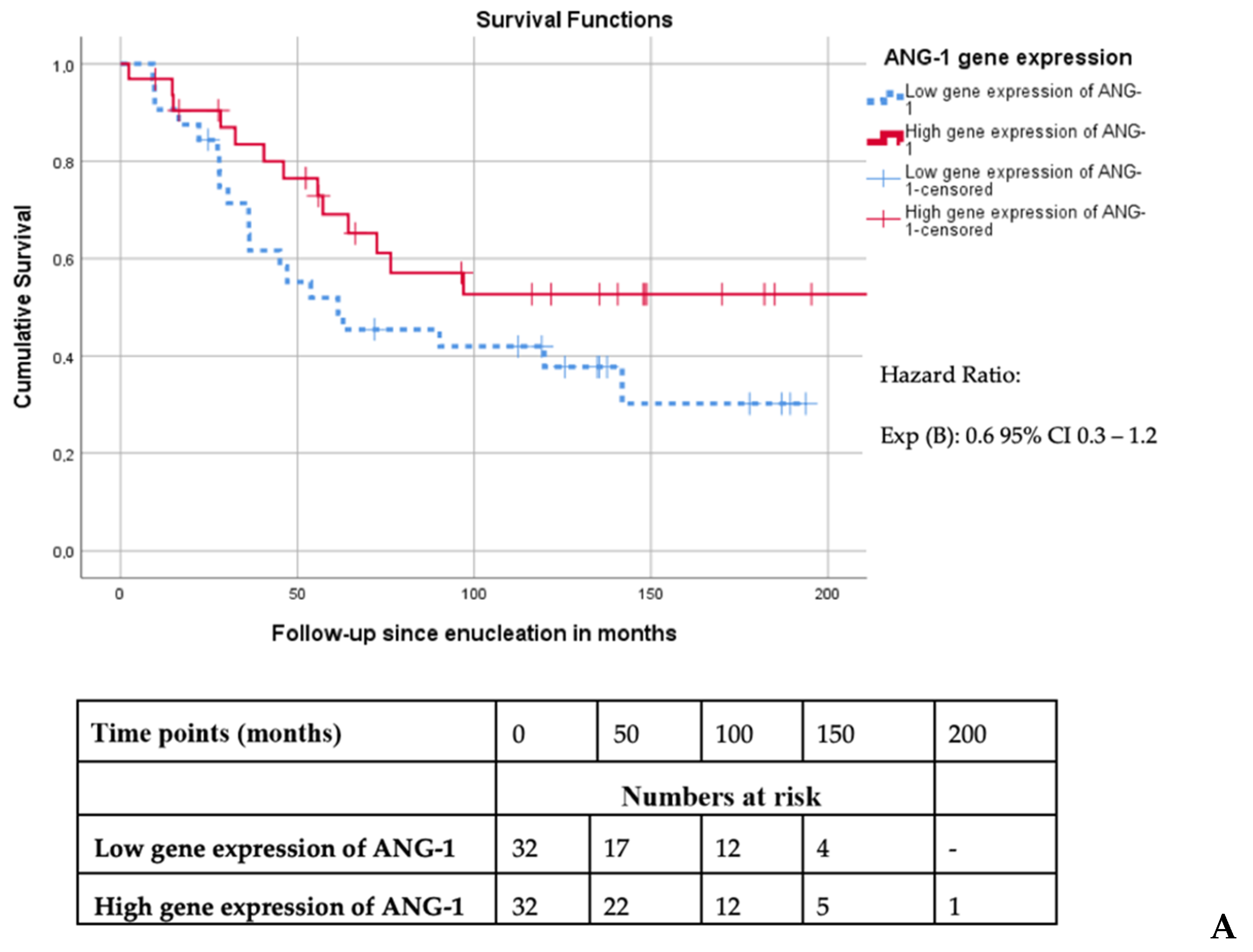
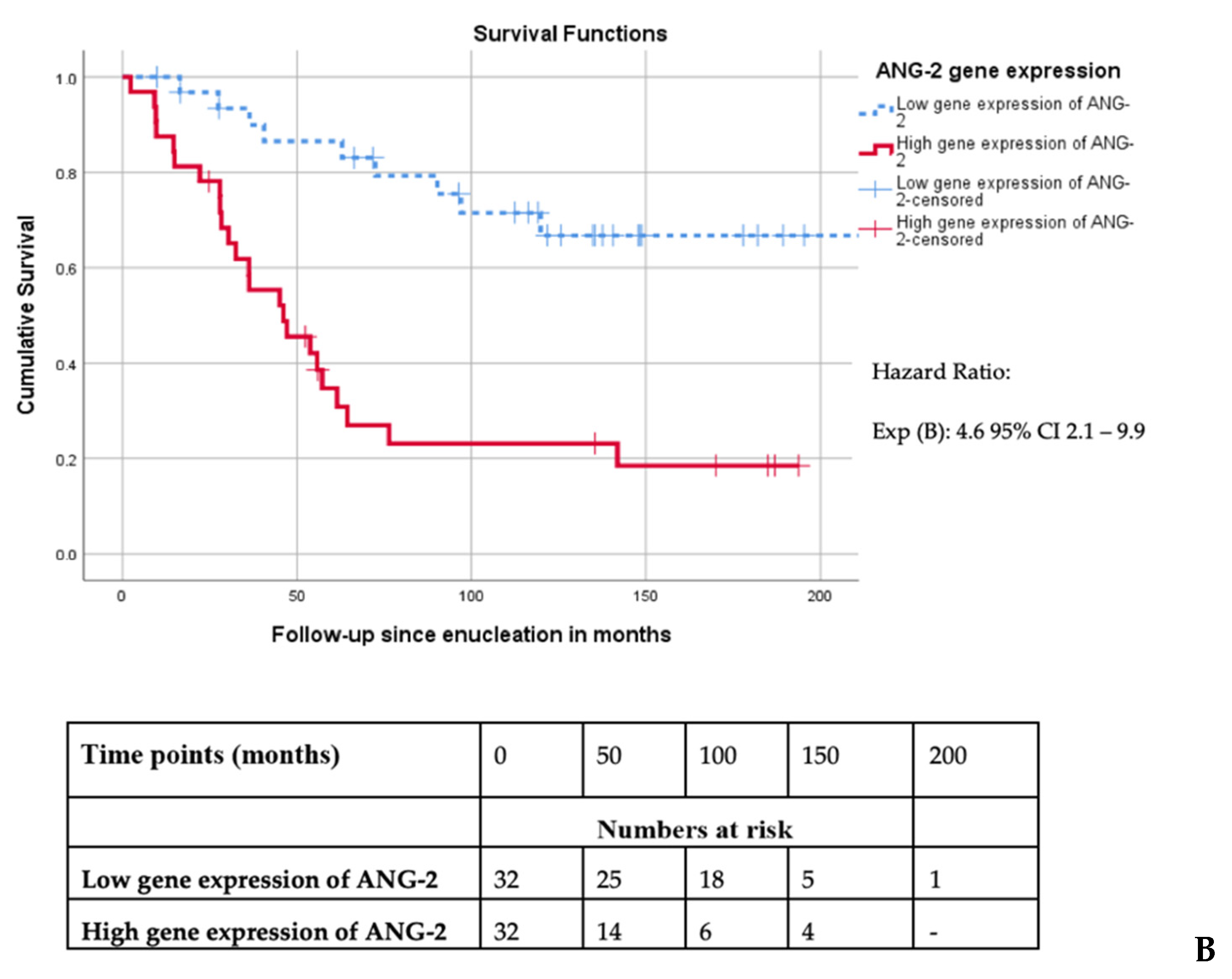
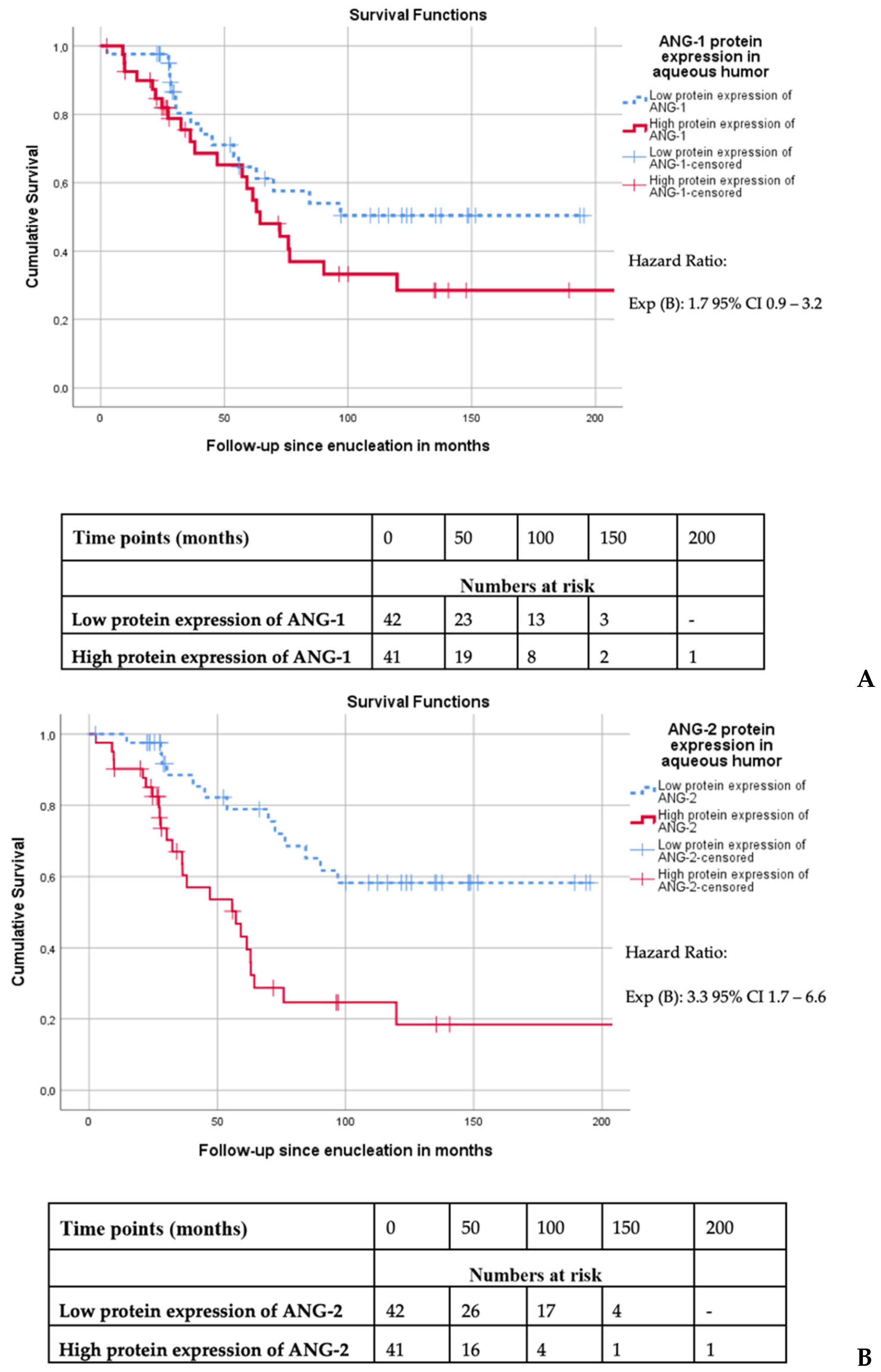

| Variables | Patients, No. (%) * | p-Value | Patients, No. (%) * | p-Value | ||
|---|---|---|---|---|---|---|
| Low Gene Expression of ANG-1 (n = 32) | High Gene Expression of ANG-1 (n = 32) | Low Gene Expression of ANG-2 (n = 32) | High Gene Expression of ANG-2 (n = 32) | |||
| Sex | 0.32 ‡ | 0.32 ‡ | ||||
| Male | 14 (44%) | 18 (56%) | 18 (56%) | 14 (44%) | ||
| Female | 18 (56%) | 14 (44%) | 14 (44%) | 18 (56%) | ||
| Age at enucleation, median (range), years | 57.8 (33.4–88.4) | 65.9 (12.8–84.8) | 0.36 § | 56.4 (12.8–84.8) | 69.1 (33.4–88.4) | 0.04 § |
| Largest basal diameter, median (range), mm | 14.0 (9.0–20.0) | 13.0 (8.0–30.0) | 0.18 § | 12.0 (8.0–18.0) | 15.0 (9.0–30.0) | 0.01 § |
| Thickness, median (range), mm | 8.5 (2.0–12.0) | 7.5 (2.0–12.0) | 0.24 § | 7.0 (2.0–12.0) | 8.5 (4.0–12.0) | 0.09 § |
| Ciliary body involvement | 0.002 ‡ | 0.12 ‡ | ||||
| No | 34 (81%) | 20 (49%) | 23 (72%) | 17 (53%) | ||
| Yes | 8 (19%) | 21 (51%) | 9 (28%) | 15 (47%) | ||
| Cell type | 0.08 ‡ | 0.04 ‡ | ||||
| Spindle | 18 (43%) | 10 (24%) | 15 (47%) | 7 (22%) | ||
| Mixed or epithelioid | 24 (57%) | 31 (76%) | 17 (53%) | 25 (78%) | ||
| AJCC staging | 0.001 ‡ | 0.02 ‡ | ||||
| I-IIB | 35 (83%) | 19 (46%) | 25 (78%) | 16 (50%) | ||
| IIIA-IIIC | 7 (17%) | 22 (54%) | 7 (22%) | 16 (50%) | ||
| Metastases | 0.21 ‡ | 0.001 ‡ | ||||
| No | 11 (34%) | 16 (50%) | 20 (63%) | 7 (22%) | ||
| Yes | 22 (66%) | 16 (50%) | 12 (38%) | 25 (78%) | ||
| Chromosome 3 status | 0.19 ‡ | 0.004 ‡ | ||||
| Disomy 3 | 9 (28%) | 14 (44%) | 17 (53%) | 6 (19%) | ||
| Monosomy 3 | 23 (72%) | 18 (56%) | 15 (47%) | 26 (81%) | ||
| Chromosome 8 status | 0.78 ‡ | 0.06 ‡ | ||||
| Normal | 9 (28%) | 10 (31%) | 13 (41%) | 6 (19%) | ||
| Gain of 8q | 23 (72%) | 22 (69%) | 19 (59%) | 26 (81%) | ||
| Variables | Patients, No. (%) * | p-Value | Patients, No. (%) * | p-Value | ||
|---|---|---|---|---|---|---|
| Low Protein Expression of ANG-1 (n = 42) | High Protein Expression of ANG-1 (n = 41) | Low Protein Expression of ANG-2 (n = 42) | High Protein Expression of ANG-2 (n = 41) | |||
| Sex | 0.51 ‡ | 0.92 ‡ | ||||
| Male | 21 (50%) | 24 (59%) | 23 (55%) | 22 (54%) | ||
| Female | 21 (50%) | 17 (42%) | 19 (45%) | 19 (46%) | ||
| Age at enucleation, median (range), years | 59.8 (12.8–77.1) | 62.3 (32.2–92.7) | 0.43 § | 54.6 (12.8–77.1) | 68.3 (34.8–92.7) | 0.002 § |
| Largest basal diameter, median (range), mm | 12.0 (8.0–20.0) | 13.0 (9.0–20.0) | 0.10 § | 12.0 (8.0–18.0) | 13.0 (9.0–20.0) | 0.04 § |
| Thickness, median (range), mm | 7.0 (2.0–12.0) | 9.0 (2.0–12.0) | 0.08 § | 7.0 (2.0–12.0) | 9.0 (2.0–12.0) | < 0.001 § |
| Ciliary body involvement | 0.50 ‡ | 0.002 ‡ | ||||
| No | 29 (69%) | 25 (61%) | 34 (81%) | 20 (49%) | ||
| Yes | 13 (31%) | 16 (39%) | 8 (19%) | 21 (51%) | ||
| Cell type | 0.70 ‡ | 0.08 ‡ | ||||
| Spindle | 15 (36%) | 13 (32%) | 18 (43%) | 10 (24%) | ||
| Mixed or epithelioid | 27 (65%) | 28 (68%) | 24 (57%) | 31 (76%) | ||
| AJCC staging | 0.76 ‡ | <0.001 ‡ | ||||
| I-IIB | 28 (67%) | 26 (63%) | 35 (83%) | 19 (46%) | ||
| IIIA-IIIC | 14 (33%) | 15 (37%) | 7 (17%) | 22 (54%) | ||
| Metastases | 0.23 ‡ | 0.04 ‡ | ||||
| No | 24 (57%) | 19 (46%) | 26 (62%) | 16 (39%) | ||
| Yes | 18 (43%) | 22 (54%) | 16 (38%) | 25 (62%) | ||
| Chromosome 3 status | 0.21 ‡ | 0.42 ‡ | ||||
| Disomy 3 | 20 (48%) | 14 (34%) | 19 (45%) | 15 (37%) | ||
| Monosomy 3 | 21 (50%) | 26 (63%) | 22 (52%) | 25 (61%) | ||
| Failed analyses | 1 (2%) | 1 (2%) | 1 (2%) | 1 (2%) | ||
| Chromosome 8 status | 0.68 ‡ | 0.37 ‡ | ||||
| Normal | 13 (31%) | 11 (27%) | 14 (33%) | 10 (24%) | ||
| Gain of 8q | 28 (67%) | 29 (71%) | 27 (64%) | 30 (73%) | ||
| Failed analyses | 1 (2%) | 1 (2%) | 1 (2%) | 1 (2%) | ||
Publisher’s Note: MDPI stays neutral with regard to jurisdictional claims in published maps and institutional affiliations. |
© 2021 by the authors. Licensee MDPI, Basel, Switzerland. This article is an open access article distributed under the terms and conditions of the Creative Commons Attribution (CC BY) license (https://creativecommons.org/licenses/by/4.0/).
Share and Cite
ten Voorde, A.M.W.; Wierenga, A.P.A.; Nell, R.J.; van der Velden, P.A.; Luyten, G.P.M.; Verdijk, R.M.; Jager, M.J. In Uveal Melanoma, Angiopoietin-2 but Not Angiopoietin-1 Is Increased in High-Risk Tumors, Providing a Potential Druggable Target. Cancers 2021, 13, 3986. https://doi.org/10.3390/cancers13163986
ten Voorde AMW, Wierenga APA, Nell RJ, van der Velden PA, Luyten GPM, Verdijk RM, Jager MJ. In Uveal Melanoma, Angiopoietin-2 but Not Angiopoietin-1 Is Increased in High-Risk Tumors, Providing a Potential Druggable Target. Cancers. 2021; 13(16):3986. https://doi.org/10.3390/cancers13163986
Chicago/Turabian Styleten Voorde, Anna M.W., Annemijn P.A. Wierenga, Rogier J. Nell, Pieter A. van der Velden, Gregorius P.M. Luyten, Robert M. Verdijk, and Martine J. Jager. 2021. "In Uveal Melanoma, Angiopoietin-2 but Not Angiopoietin-1 Is Increased in High-Risk Tumors, Providing a Potential Druggable Target" Cancers 13, no. 16: 3986. https://doi.org/10.3390/cancers13163986
APA Styleten Voorde, A. M. W., Wierenga, A. P. A., Nell, R. J., van der Velden, P. A., Luyten, G. P. M., Verdijk, R. M., & Jager, M. J. (2021). In Uveal Melanoma, Angiopoietin-2 but Not Angiopoietin-1 Is Increased in High-Risk Tumors, Providing a Potential Druggable Target. Cancers, 13(16), 3986. https://doi.org/10.3390/cancers13163986

