Hyper-Progressive Disease: The Potential Role and Consequences of T-Regulatory Cells Foiling Anti-PD-1 Cancer Immunotherapy


1
Immunology Frontier Research Center, Department of Experimental Immunology, Osaka University, Yamadaoka, Suita, Osaka 565-0871, Japan
2
Laboratory of Experimental Immunology, Institute for Frontier Life and Medical Sciences, Kyoto University, Kyoto 606-8507, Japan
*
Author to whom correspondence should be addressed.
Cancers 2021, 13(1), 48; https://doi.org/10.3390/cancers13010048
Submission received: 18 November 2020
/
Revised: 18 December 2020
/
Accepted: 23 December 2020
/
Published: 26 December 2020
(This article belongs to the Special Issue Regulatory T Cells in Tumor Environment)
Simple Summary
Since immune cells were found to attack cancer cells, strategies have been developed to sustain anti-cancer immune functions to prevent them from becoming exhausted in the midst of war. Immune checkpoint blockade therapy has gained significant traction with its ability to fast-track activation of immune cells as well as revive dormant immune cells. A prominent target for such treatment is programmed cell death protein 1 (PD-1). The natural role of PD-1 is in regulating the activity of immune cells, hence the term ‘checkpoint’. Blocking PD-1 can be effective especially when immune cells have easy access to cancer tissues. However, the immune cell population also contains cells that protect cancer cells from anti-cancer immune cells. One of these is the regulatory T-cell (Treg) subset, which is also regulated by PD-1. In this article, we review the downside of blocking PD-1 in Tregs when using PD-1 blockade therapy to treat cancer.
Abstract
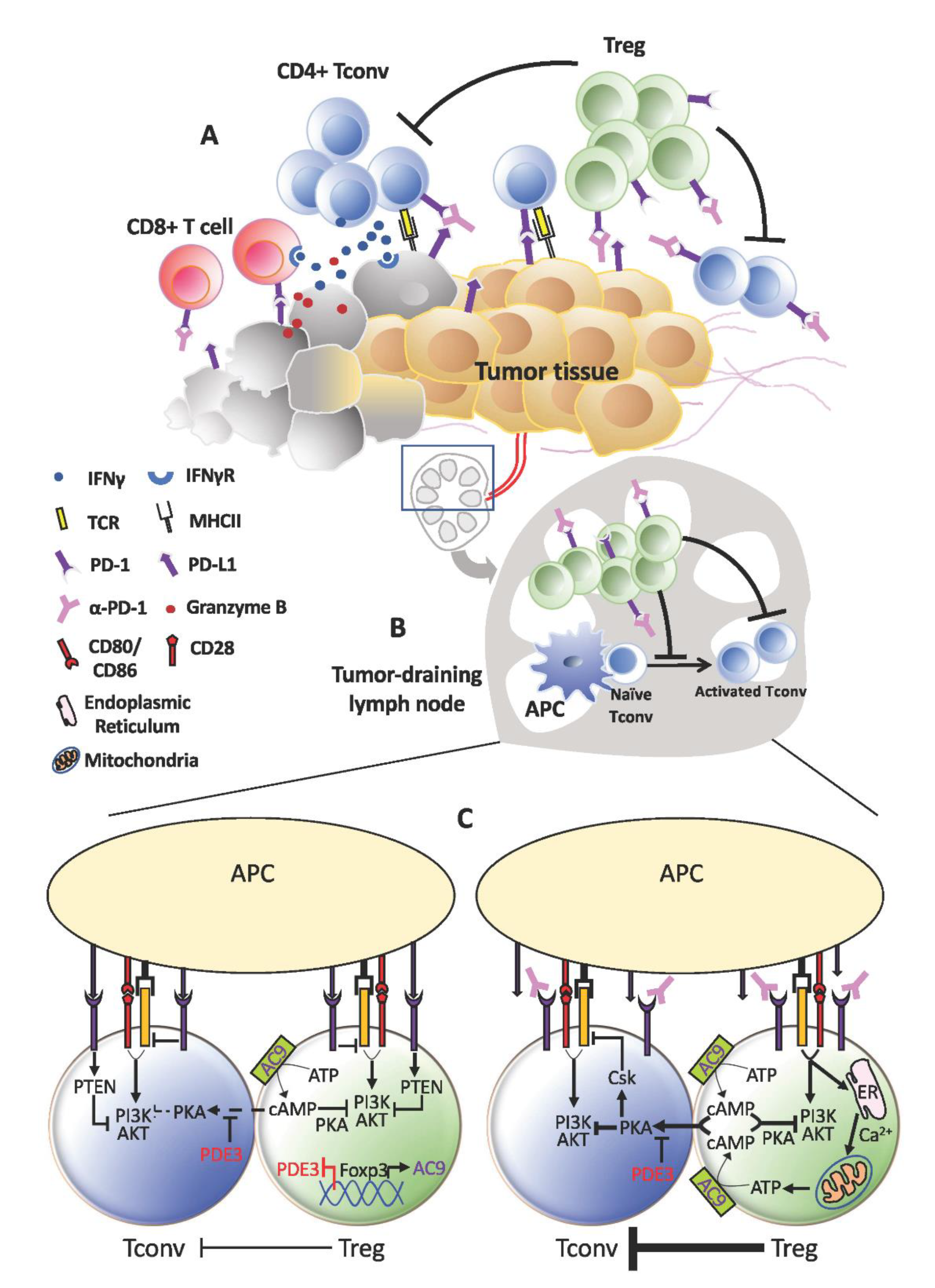
Antibody-mediated disruption of the programmed cell death protein 1 (PD-1) pathway has brought much success to the fight against cancer. Nevertheless, a significant proportion of patients respond poorly to anti-PD-1 treatment. Cases of accelerated and more aggressive forms of cancer following therapy have also been reported. Termed hyper-progressive disease (HPD), this phenomenon often results in fatality, thus requires urgent attention. Among possible causes of HPD, regulatory T-cells (Tregs) are of suspect due to their high expression of PD-1, which modulates Treg activity. Tregs are a subset of CD4+ T-cells that play a non-redundant role in the prevention of autoimmunity and is functionally dependent on the X chromosome-linked transcription factor FoxP3. In cancer, CD4+FoxP3+ Tregs migrate to tumors to suppress anti-tumor immune responses, allowing cancer cells to persist. Hence, Treg accumulation in tumors is associated with poor prognosis. In mice, the anti-tumor efficacy of anti-PD-1 can be enhanced by depleting Tregs. This suggests Tregs pose resistance to anti-PD-1 therapy. In this article, we review the relevant Treg functions that suppress tumor immunity and the potential effects anti-PD-1 could have on Tregs which are counter-productive to the treatment of cancer, occasionally causing HPD.
Keywords:
cancer; Tregs; immunosuppression; PD-1; hyper-progressive disease