Risk of Inflammatory Bowel Disease in Patients with Chronic Myeloproliferative Neoplasms: A Danish Nationwide Cohort Study
by
 , and
, and
Marie Bak
1,* ,
,
Tine Jess
2,
Esben Meulengracht Flachs
3,
Ann-Dorthe Zwisler
4,
Knud Juel
5 and
Henrik Frederiksen
6,7 1
Department of Haematology, Zealand University Hospital, University of Copenhagen, 4000 Roskilde, Denmark
2
Department of Epidemiology Research, Statens Serum Institut, 2300 Copenhagen, Denmark
3
Department of Occupational and Environmental Medicine, Bispebjerg Hospital, University of Copenhagen, 2400 Copenhagen, Denmark
4
Danish Knowledge Centre for Rehabilitation and Palliative Care, University of Southern Denmark and Odense University Hospital, 5800 Nyborg, Denmark
5
National Institute of Public Health, University of Southern Denmark, 1455 Copenhagen, Denmark
6
Department of Haematology, Odense University Hospital, 5000 Odense, Denmark
7
Department of Clinical Epidemiology, Aarhus University Hospital, 8200 Aarhus, Denmark
*
Author to whom correspondence should be addressed.
Cancers 2020, 12(9), 2700; https://doi.org/10.3390/cancers12092700
Submission received: 1 July 2020
/
Revised: 14 August 2020
/
Accepted: 19 August 2020
/
Published: 21 September 2020
(This article belongs to the Special Issue New Insights into Myeloproliferative Neoplasms)
Simple Summary
We wanted to investigate the risk of inflammatory bowel disease (IBD) in patients with Philadelphia-negative chronic myeloproliferative neoplasms (MPNs), since up to 50% of these patients experience gastrointestinal symptoms and several studies have suggested an association between hematological cancers and IBD. We included ∼8000 patients and ∼80,000 sex- and age-matched, non-MPN comparisons from the general population, and found that MPN patients were two to three times more likely to develop IBD, but the absolute risk of IBD was modest. In addition, MPN patients were also 40% more likely to have a prior diagnosis of IBD. Our results pose intriguing questions about the causal pathways linking MPN and IBD, which may include genetic, treatment-related and immune-mediated factors. Moreover, it shows that abdominal symptoms in MPN patients may not only be caused by an enlarged spleen or treatment side-effects. Conversely, persistent leucocytosis and/or increased platelets in IBD patients may reflect concomitant MPN.
Abstract
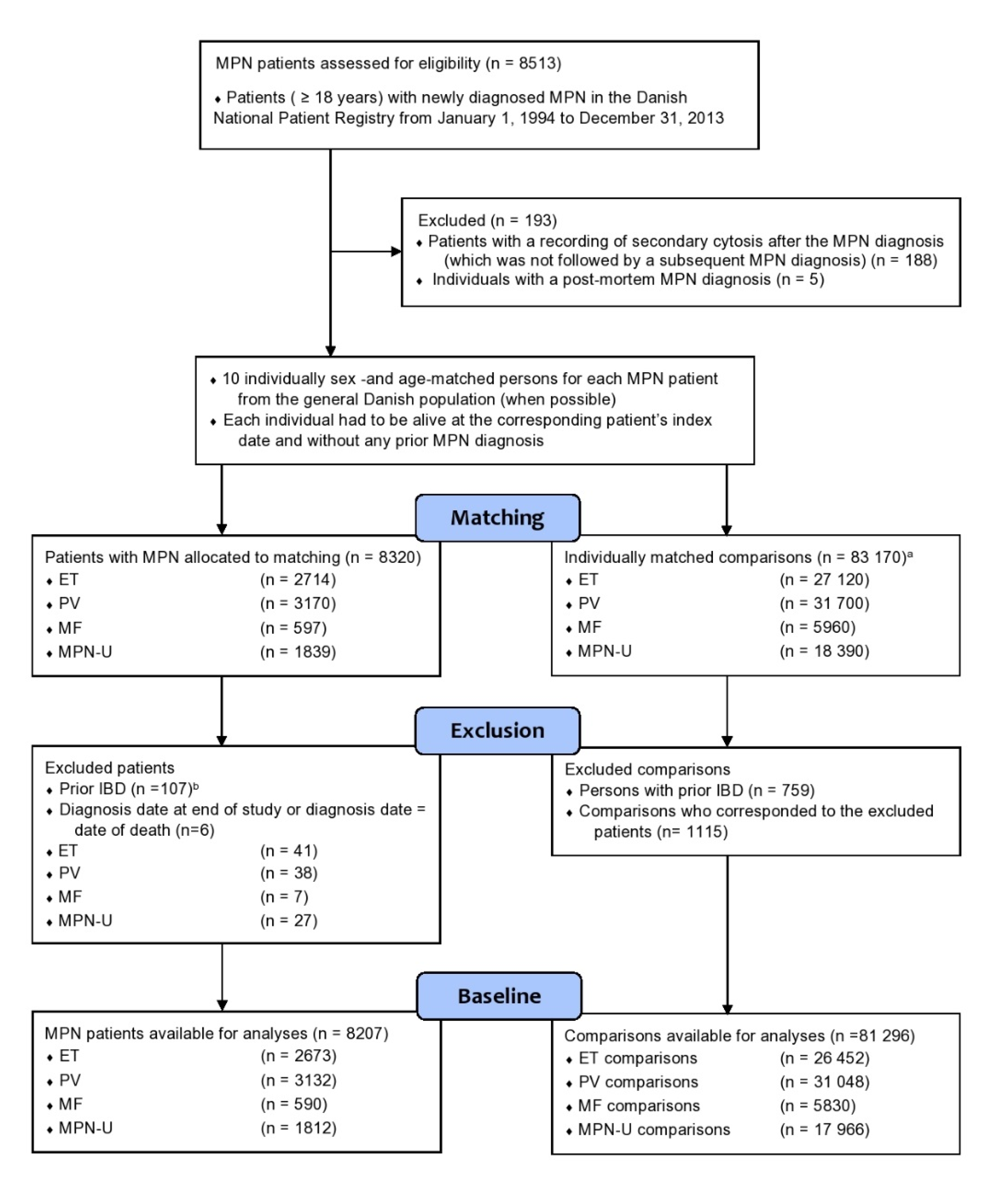
An association between hematological cancers and inflammatory bowel disease (IBD) has previously been suggested, but the risk of IBD in patients with myeloproliferative neoplasms (MPNs) is unknown. We conducted a nationwide population-based cohort study using Danish registries, to estimate the risk of IBD in individuals diagnosed with essential thrombocythemia, polycythemia vera, myelofibrosis or unclassifiable MPN during 1994–2013. MPN patients were matched 1:10 with sex- and age-matched comparisons. Everyone was followed until a diagnosis of IBD, death/emigration, or 31 December 2013. The risk of IBD overall and according to MPN subtype was calculated using Cox regression and presented as hazard ratios (HRs) with 95% confidence intervals (CI). Of 8207 MPN patients followed for 45,232 person-years, 80 were diagnosed with IBD (61 ulcerative colitis, 19 Crohn’s disease). The rate of IBD per 1000 person-years was 1.8 (95% CI:1.4–2.2) in patients vs. 0.8 (95% CI:0.7–0.8) in comparisons, and the absolute 10-year risk of IBD was 0.8% (95% CI:0.6–1.0) in patients vs. 0.4% (95% CI:0.4–0.5) in comparisons. The HR of IBD was 2.4 (95% CI:2.1–2.9) with similar HRs for ulcerative colitis and Crohn’s disease. MPN subtype risks varied from 2.1 (95% CI:1.6–2.7) to 2.8 (95% CI:2.1–3.7). Our unselected cohort study showed a more than 2-fold increased risk of IBD in MPN patients.