Review

Cisplatin Resistance in Testicular Germ Cell Tumors: Current Challenges from Various Perspectives


by
João Lobo
1,2,3,
Carmen Jerónimo
1,3,*,† and
Rui Henrique
1,2,3,*,†
1
Cancer Biology and Epigenetics Group, IPO Porto Research Center (GEBC CI-IPOP), Portuguese Oncology Institute of Porto (IPO Porto) & Porto Comprehensive Cancer Center (P.CCC), R. Dr. António Bernardino de Almeida, 4200-072 Porto, Portugal
2
Department of Pathology, Portuguese Oncology Institute of Porto (IPOP), R. Dr. António Bernardino de Almeida, 4200-072 Porto, Portugal
3
Department of Pathology and Molecular Immunology, Institute of Biomedical Sciences Abel Salazar, University of Porto (ICBAS-UP), Rua Jorge Viterbo Ferreira 228, 4050-513 Porto, Portugal
*
Authors to whom correspondence should be addressed.
Joint senior authors.
Cancers 2020, 12(6), 1601; https://doi.org/10.3390/cancers12061601

Submission received: 1 June 2020 / Revised: 13 June 2020 / Accepted: 16 June 2020 / Published: 17 June 2020

Abstract

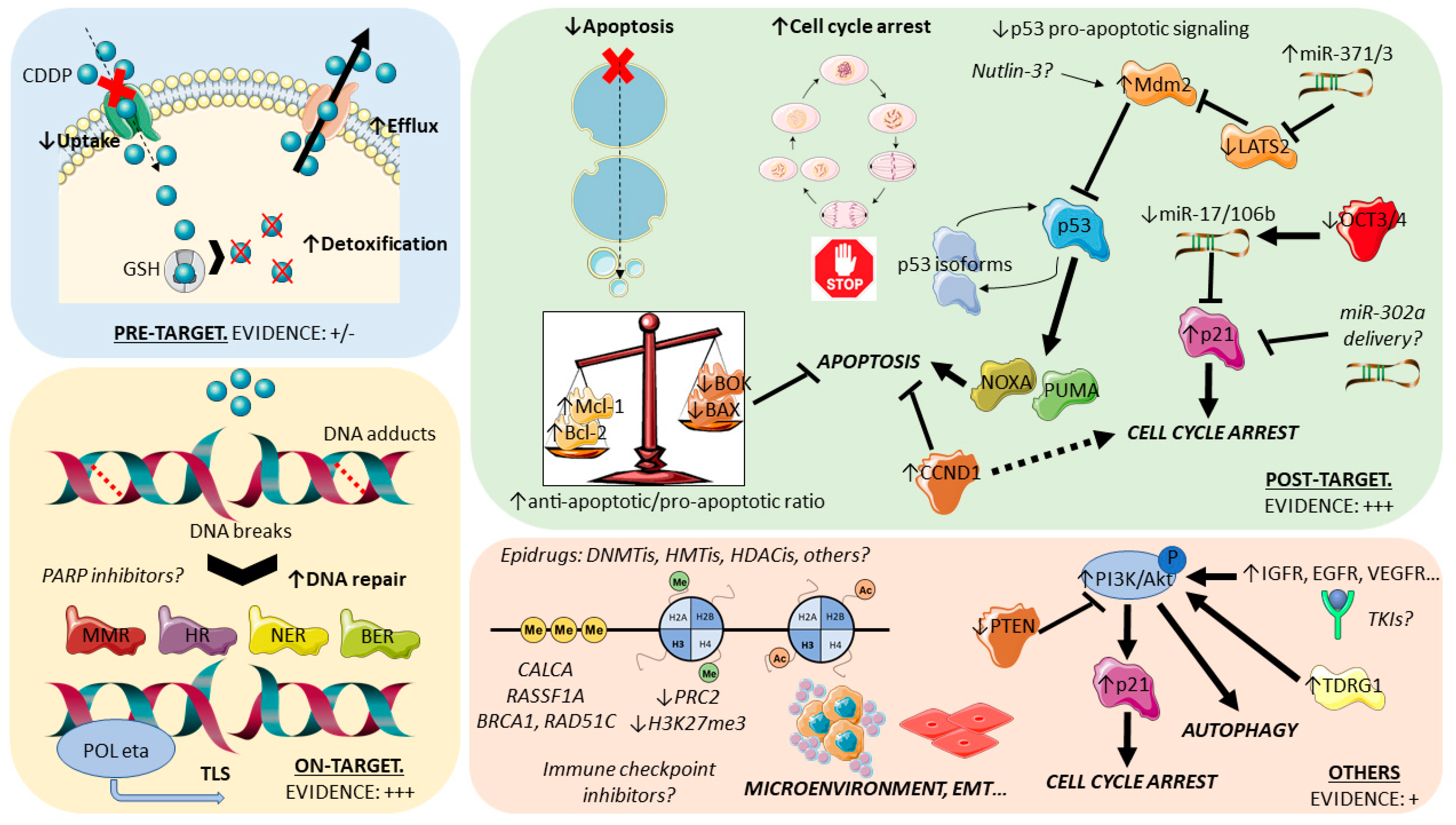
Testicular germ cell tumors share a marked sensitivity to cisplatin, contributing to their overall good prognosis. However, a subset of patients develop resistance to platinum-based treatments, by still-elusive mechanisms, experiencing poor quality of life due to multiple (often ineffective) interventions and, eventually, dying from disease. Currently, there is a lack of defined treatment opportunities for these patients that tackle the mechanism(s) underlying the emergence of resistance. Herein, we aim to provide a multifaceted overview of cisplatin resistance in testicular germ cell tumors, from the clinical perspective, to the pathobiology (including mechanisms contributing to induction of the resistant phenotype), to experimental models available for studying this occurrence. We provide a systematic summary of pre-target, on-target, post-target, and off-target mechanisms putatively involved in cisplatin resistance, providing data from preclinical studies and from those attempting validation in clinical samples, including those exploring specific alterations as therapeutic targets, some of them included in ongoing clinical trials. We briefly discuss the specificities of resistance related to teratoma (differentiated) phenotype, including the phenomena of growing teratoma syndrome and development of somatic-type malignancy. Cisplatin resistance is most likely multifactorial, and a combination of therapeutic strategies will most likely produce the best clinical benefit.
Keywords: testicular germ-cell tumors; cisplatin; resistance; targeted treatment testicular germ-cell tumors; cisplatin; resistance; targeted treatment