Polyphenol Intake and Gastric Cancer Risk: Findings from the Stomach Cancer Pooling Project (StoP)
by
 , , , , , , , , , , , , , and add
Show full author list
, , , , , , , , , , , , , and add
Show full author list
Facundo Vitelli-Storelli
1 ,
,
Marta Rossi
2,
Claudio Pelucchi
2,
Matteo Rota
3 ,
,
Domenico Palli
4,
Monica Ferraroni
2,
Nuno Lunet
5,6 ,
,
Samantha Morais
5,
Lizbeth López-Carrillo
7,
David Georgievich Zaridze
8,
Dmitry Maximovich
8,
María Rubín García
1,
Gemma Castaño-Vinyals
9,10,11,12,
Nuria Aragonés
9,13,
Manuela Garcia de la Hera
9,14,
Raúl Ulises Hernández-Ramírez
15,
Eva Negri
16,
Rossella Bonzi
2,
Mary H. Ward
17,
Areti Lagiou
18, 
Pagona Lagiou
19,20,
Malaquías López-Cervantes
21,
Paolo Boffetta
22,23,
M. Constanza Camargo
17,
Maria Paula Curado
24,
Zuo-Feng Zhang
25,
Jesus Vioque
9,14,* ,
,
Carlo La Vecchia
2 and
and
Vicente Martín Sánchez
1,9 add
Show full author list
add
Show full author list
1
Research Group in Gene-Environment Interactions and Health, Instituto de Biomedicina (IBIOMED), University of León, 24071 León, Spain
2
Department of Clinical Sciences and Community Health, University of Milan, 20122 Milan, Italy
3
Department of Molecular and Translational Medicine, University of Brescia, 25121 Brescia, Italy
4
Cancer Risk Factors and Life-Style Epidemiology Unit, Institute for Cancer Research, Prevention and Clinical Network, ISPRO, 08518 Florence, Italy
5
Department of Epidemiology, EPIUnit–Instituto de Saúde Pública da Universidade do Porto, 4050-091 Porto, Portugal
6
Departamento de Ciências da Saúde Pública e Forenses e Educação Médica, Faculdade de Medicina da Universidade do Porto, 4200-319 Porto, Portugal
7
Mexico National Institute of Public Health, Morelos 62100, Mexico
8
Department of Epidemiology and Prevention, Russian N.N. Blokhin Cancer Research Center, 115478 Moscow, Russia
9
Consortium for Biomedical Research in Epidemiology and Public Health (CIBERESP), 28029 Madrid, Spain
10
IMIM (Hospital del Mar Medical Research Institute), 08003 Barcelona, Spain
11
Department of Public health, Universitat Pompeu Fabra (UPF), 08002 Barcelona, Spain
12
Barcelona Institute for Global Health—ISGlobal, 08036 Barcelona, Spain
13
Cancer Epidemiology Section, Public Health Division, Department of Health of Madrid, 28035 Madrid, Spain
14
Department of Public Health, Instituto de Investigación Sanitaria y Biomédica de Alicante, ISABIAL-UMH, 46020 Alicante, Spain
15
Department of Biostatistics, Yale School of Public Health, New Haven, CT 06520, USA
16
Department of Biomedical and Clinical Sciences, University of Milan, 20157 Milan, Italy
17
Division of Cancer Epidemiology and Genetics, National Cancer Institute, Rockville, MD 20850, USA
18
Department of Public and Community Health, School of Health Sciences, University of West Attica, 11521 Athens, Greece
19
Department of Hygiene, Epidemiology and Medical Statistics, School of Medicine, National and Kapodistrian University of Athens, 10561 Athens, Greece
20
Department of Epidemiology, Harvard T.H. Chan School of Public Health, Boston, MA 02115, USA
21
Department of Public Health, Facultad de Medicina, UNAM, Coyoacán 04810, Mexico
22
Stony Brook Cancer Center, Stony Brook University, Stony Brook, NY 11794, USA
23
Department of Medical and Surgical Sciences, University of Bologna, 40126 Bologna, Italy
24
Centro Internacional de Pesquisa, A. C. Camargo Cancer Center, Sao Paulo 01508-010, Brazil
25
Department of Epidemiology, UCLA Fielding School of Public Health and Jonsson, Comprehensive Cancer Center, Los Angeles, CA 90095-6900, USA
*
Author to whom correspondence should be addressed.
Cancers 2020, 12(10), 3064; https://doi.org/10.3390/cancers12103064
Submission received: 1 October 2020
/
Revised: 8 October 2020
/
Accepted: 12 October 2020
/
Published: 20 October 2020
(This article belongs to the Section Cancer Epidemiology and Prevention)
Simple Summary
Gastric cancer (GC) has the fifth highest incidence of any cancer type worldwide and the third highest mortality rate, so its prevention is very important. Among dietary factors, the consumption of fruit and vegetables has been inversely related to GC risk. Phenolic compounds may exert a favorable effect on the risk of several cancer types, including gastric cancer. However, selected polyphenol classes have not been adequately investigated in relation to GC. There is, however, no comprehensive analysis of polyphenols and GC risk methods to date. In order to provide a detailed evaluation of the relationship between dietary intake of polyphenols and GC risk, we analyzed data from the Stomach cancer Pooling (StoP) Project consortium.
Abstract
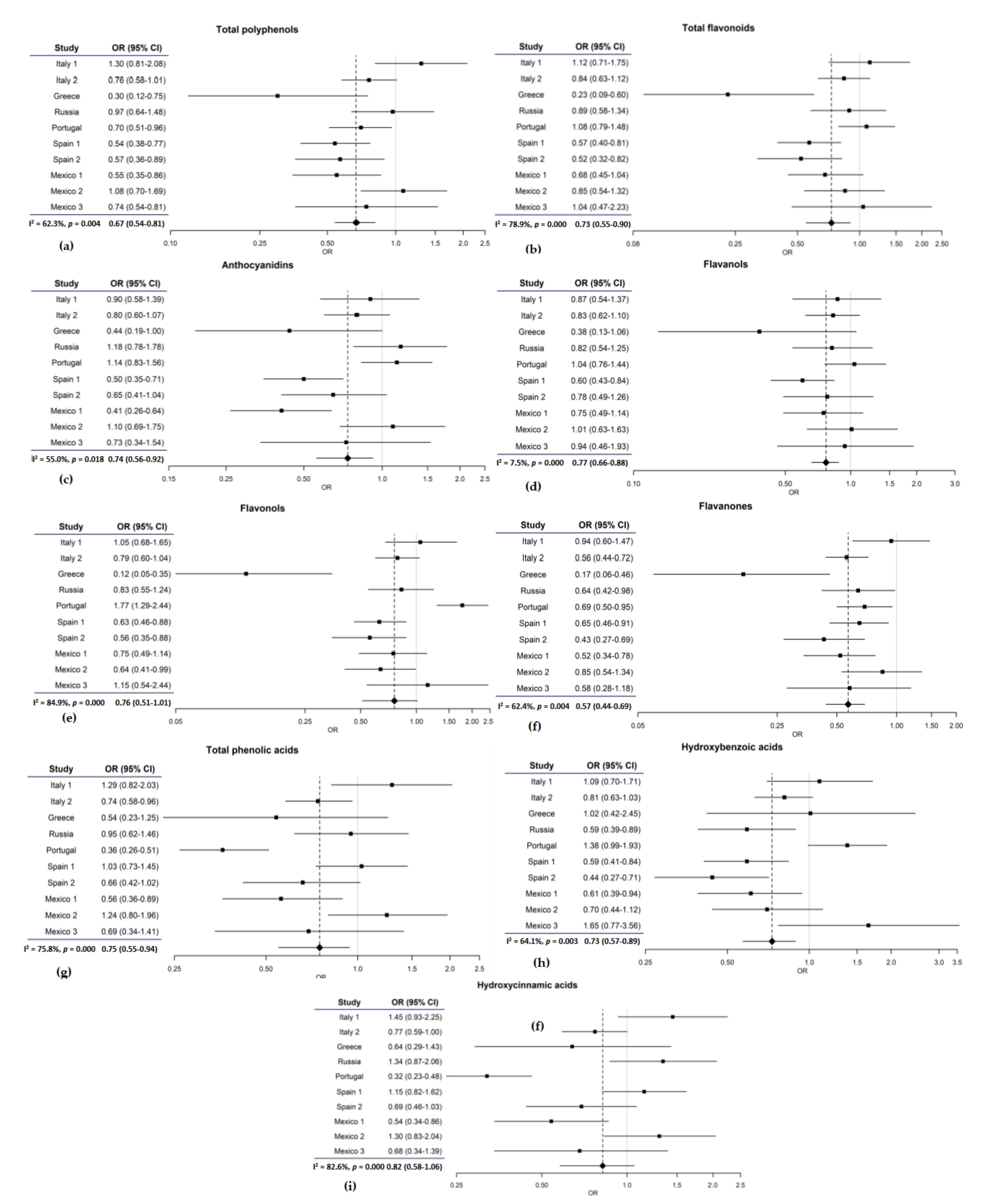
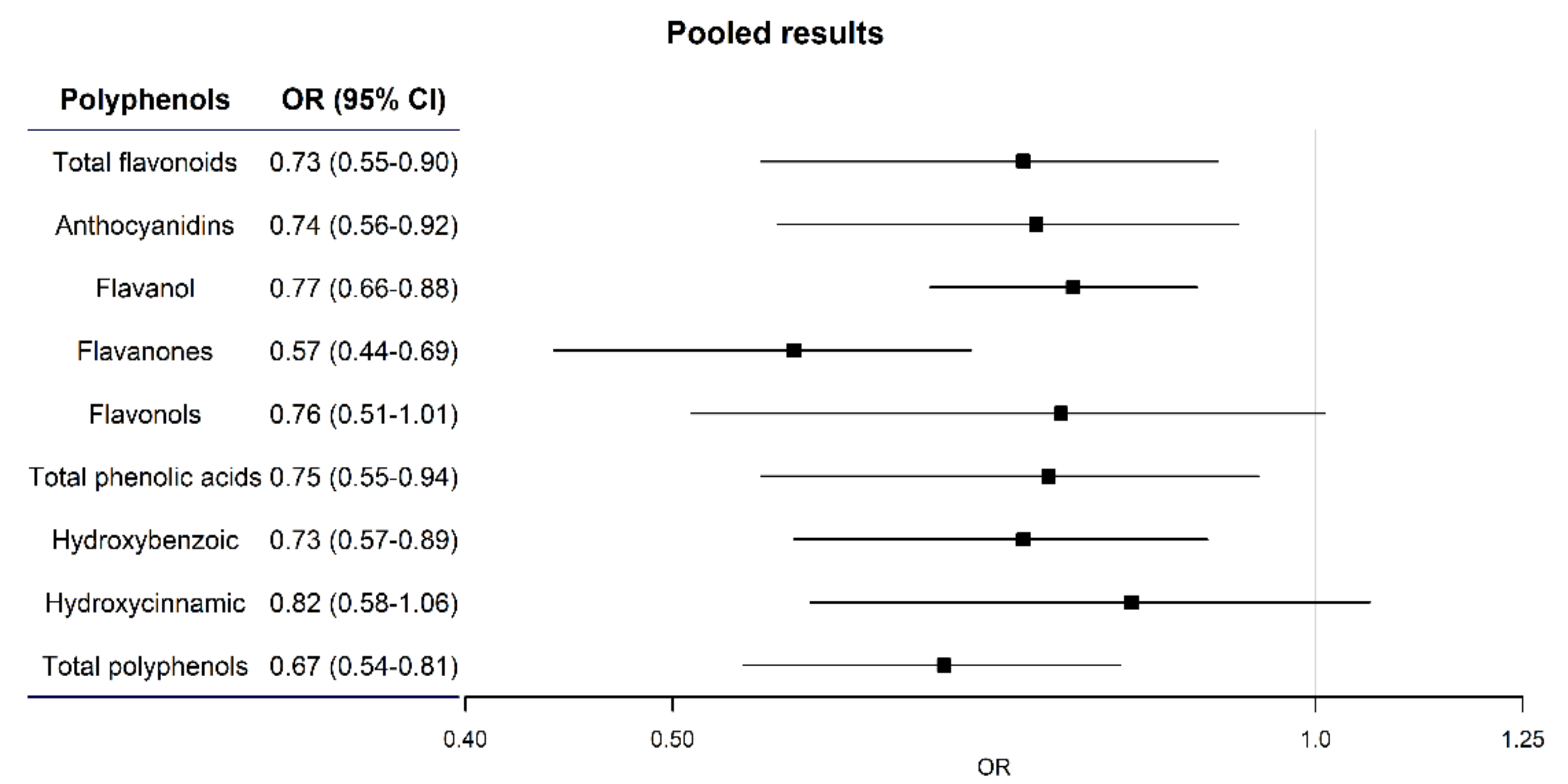
Phenolic compounds may exert a favorable effect on the risk of several cancer types, including gastric cancer (GC). However, selected polyphenol classes have not been adequately investigated in relation to GC. The aim of this study is to evaluate the association between the intake of polyphenols in relation to GC risk. We used data from the Stomach cancer Pooling (StoP) Project, including 10 studies from six countries (3471 GC cases and 8344 controls). We carried out an individual participant data pooled analysis using a two-stage approach. The summary odds ratios (ORs) of GC for each compound, and the corresponding 95% confidence intervals (95% CI), were computed by pooling study specific ORs obtained through multivariate logistic regression, using random effect models. Inverse associations with GC emerged for total polyphenols (OR = 0.67, 95% CI = 0.54–0.81, for the highest versus lowest quartile of intake), total flavonoids (OR = 0.73, 95% CI = 0.55–0.90), anthocyanidins (OR = 0.74, 95% CI = 0.56–0.92), flavanols (OR = 0.77, 95% CI = 0.66–0.88), flavanones (OR = 0.57, 95%CI = 0.44–0.69), total phenolic acids (OR = 0.75, 95%CI = 0.55–0.94), and hydroxybenzoic acids (OR = 0.73, 95%CI = 0.57–0.89). Results were consistent across strata of age, sex, social class, and smoking habit. Suggestive inverse associations were also found for flavonols (OR = 0.76, 95%CI = 0.51–1.01) and hydroxycinnamic acids (OR = 0.82, 95%CI = 0.58–1.06). Further investigations from longitudinal data are needed to confirm this association.
Keywords:
diet; epidemiology; flavonoids; gastric cancer; polyphenols