Article

Metastable States of 2D-Material-on-Metal-Islands Structures Revealed by Thermal Cycling

by
Valeriya A. Ievleva
1,2,
Valery A. Prudkoglyad
1,
Leonid A. Morgun
1 and
Aleksandr Yu. Kuntsevich
1,*
1
P.N. Lebedev Physical Institute of the Russian Academy of Sciences, 119991 Moscow, Russia
2
Department of Physics, HSE University, 101000 Moscow, Russia
*
Author to whom correspondence should be addressed.
Micromachines 2025, 16(12), 1385; https://doi.org/10.3390/mi16121385
Submission received: 19 October 2025 / Revised: 28 November 2025 / Accepted: 4 December 2025 / Published: 6 December 2025
(This article belongs to the Special Issue 2D-Materials Based Fabrication and Devices)

Abstract

The integration of 2D materials with artificially textured substrates offers exceptional opportunities for engineering novel functional devices. A straightforward technological route towards such devices is a mechanical dry or wet transfer of 2D layer or heterostructure onto prepared patterned elements with subsequent van der Waals bonding. An issue of van der Waals bond stability is crucial for device operation but is almost unexplored. In our research, we address it by studying transport properties of hBN/graphene heterostructures transferred onto metallic island arrays and subjected to thermal cycling. We reveal that heating from cryogenic to room temperature and cooling back leads to irreversible changes in electronic transport properties: the contact between metal and graphene degrades, and signatures of suspended graphene regions transport disappear. These changes are accompanied by slight movement of the flakes and atomic-force-microscope-detected breakdown of van der Waals bonds between the flake and substrate near the metal electrodes. Interestingly, a hot pressing allows us to restore the metal-to-graphene contact. We relate the observed metastability to the thermal-expansion-driven flake delamination and argue that it is accompanied by redistribution of the interfacial water or organic residues. Our findings provide useful insights into the topic of interfacial stability in van der Waals heterostructures and establish constraints for low-temperature applications of transferred 2D devices. We also add up an additional control parameter for the experimentalists in the field of 2D materials—degree of quenched disorder.

1. Introduction

Two-dimensional (2D) materials and van der Waals heterostructures (VdWH) made from them have extraordinary and highly customizable properties. For instance, transition metal dichalcogenides possess remarkable optical characteristics [1] and are considered as materials for transistor [2]; graphene serves as an infrared, plasmonic material and platform for novel low-energy physics [3]; some other 2D materials demonstrate topological [4], memristive [5], superconducting [6], magnetic behavior [7].
Mechanical transfer of individual layers enables the integration of vastly dissimilar materials, in contrast to epitaxial growth, which requires lattice-matched substrates and chemically compatible compounds. A particularly promising approach involves placing 2D materials or heterostructures on textured substrates or patterned electrodes, which leads to novel mechanical [8,9,10], electrical [11], magnetic [12], optical [13,14], thermosensitive [15], chemosensitive [16,17], photodetective [18], and energy-harvesting [19] properties. While many 2D materials degrade rapidly under ambient conditions, certain compounds such as transition metal disulfides, graphene, and hexagonal boron nitride (hBN) exhibit notable stability. However, it is not sufficient to use stable materials in order to obtain a reliably working 2D electronic device. Durability under variable environments is another critical factor for practical applications, yet it remains not completely understood for 2D materials and heterostructures.
The stability issue has been deliberately investigated for twisted 2D material-based structures [20,21]. Indeed, the ultra-low friction coefficient makes sliding of one layer with respect to another possible. This phenomenon is called superlubricity [22,23,24]. This low friction is typical for perfectly flat van der Waals material surfaces and is affected by the commensurability of the layers [25,26].
The edges and local defects increase friction [27]. Moreover, the static friction between VdW and non-VdW materials is generally higher [28,29,30,31]. The friction coefficient between a 2D material and the substrate is affected by the gas environment [32], moisture [33,34], and organic contaminants [35]. Friction strongly depends on the number of layers and has a tendency to vary with time under load [36,37]. A textured substrate generally increases the friction [38]. However, a high enough static friction at room temperature is not sufficient to provide stability of the structure under variable temperature. There are limited investigations of thermal cycling in composite graphite-based materials [39,40]. Concerning 2D materials on substrates, a trivial yet important observation of local strain induced by the difference in thermal expansion coefficients was uncovered only recently [31]. Such factors as local strain and thermal expansion during the thermal cycling remain unexplored for the flakes placed on textured surfaces.
In this work, we investigate the thermal cycling sustainability of graphene/hBN field effect structures transferred onto metallic electrodes. Through repeated cryogenic experiments, we demonstrate that metastability is a generic property of such systems. After the thermal cycling, the low-temperature conductive properties change in a definite way indicating the contamination of the graphene bottom interface and loss of the direct van der Waals contact between the graphene and the substrate. We show that this contact might be restored by a certain thermal treatment. Our findings not only impose constraints on potential device applications, but also suggest that thermally induced phase transitions in 2D-on-textured-substrate systems could lead to novel physical states.

2. Materials and Methods

2.1. Preamble: Choice of the Structures Design

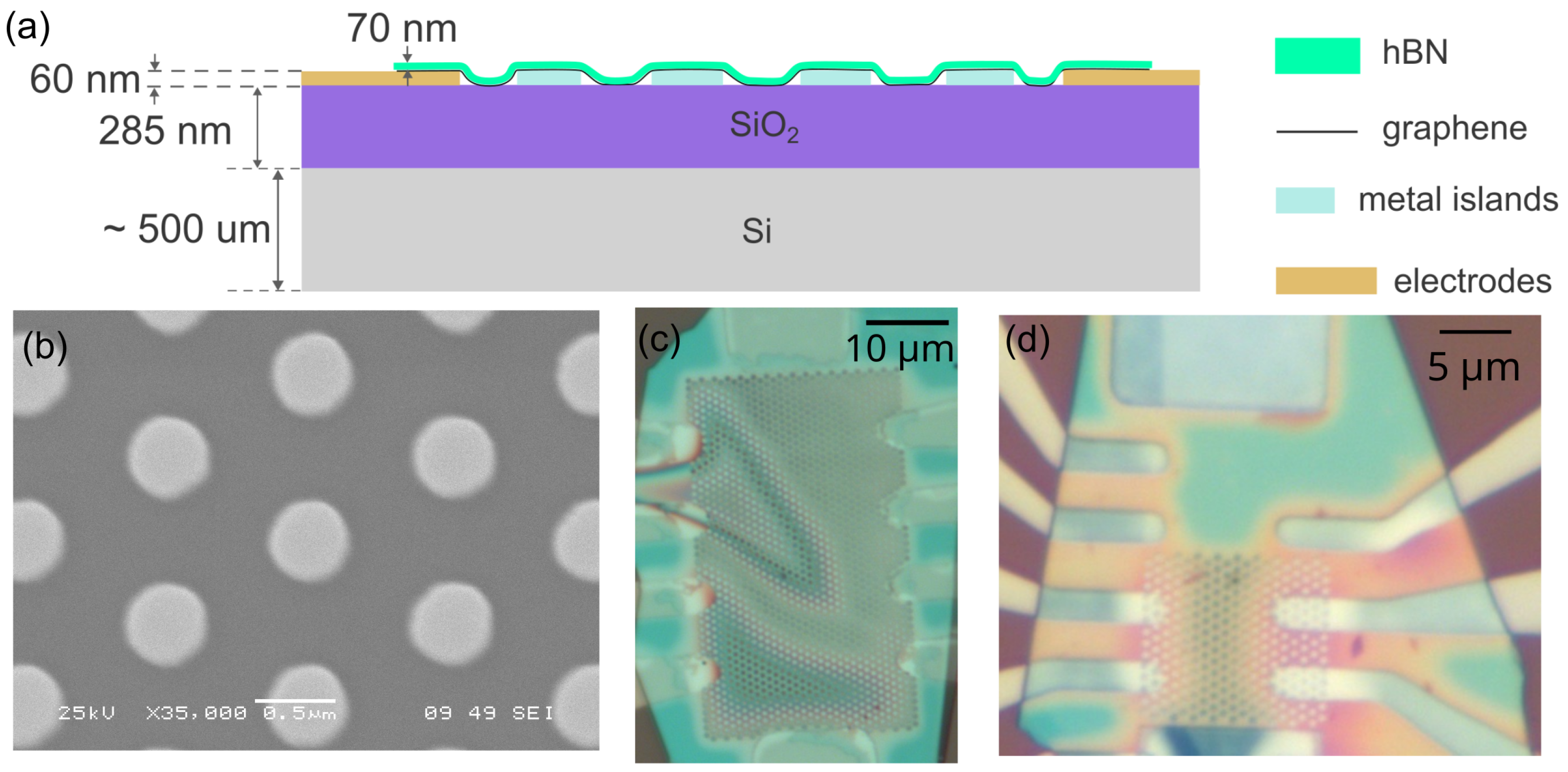
We observed the metastability on multiple samples with graphene/hBN heterostructure placed above the contacts (“bottom contact” geometry) and never observed it in the structures, where metal contacts were evaporated atop graphene (“top contact” geometry). Top contact geometry is frequently used; there are numerous publications where samples of this geometry survived several cooldowns and none of them reports metastability. Nevertheless, the bottom contact design is considered a promising approach for graphene electronics [41], and we are not aware of multiple cooldown studies for the bottom geometry. We placed graphene/hBN heterostructure onto sub-micrometer metallic islands and contact electrodes (see Figure 1a), to enable 4-terminal measurements. In this paper, we present the data for two representative samples studied in most detail. A similar geometry was used in Refs. [42,43,44,45,46,47] where Josephson effect was studied, though the metal was deposited on top. In our samples, we do not observe the Josephson effect (in the first sample due to oxidation of the superconductor; and in the second due to insufficiently low temperatures). However, we do observe metastability!

2.2. Sample Fabrication

Triangular lattices with a 1 µm period of the 500 nm diameter discs were patterned using a double-layer (PMMA/MMA) electron beam lithography on p-doped 285 nm Si/SiO2 substrates, which were preliminary cleaned with acetone/isopropanol/deionized water and allowed bottom gating. We then e-beam-evaporated 50 nm thick metallic layers and performed a lift-off. For evaporation, we used MEB 550 and MEB 400 setups by Plassys; Marolles-En-Hurepoix, France. Residual gas pressure before the evaporation was at least 5 × 10⁻⁸ mbar low, no specific substrate heating or ion beam cleaning was used. In evaporation, we used two different metals: a Nb with a 4 nm thick Pt top layer (first sample) and amorphous rhenium [48] (second sample). An image of a metal disc array is shown in Figure 1b. Using photolithography, we formed ∼70 nm thick contact electrodes of Cr/Au for the Nb/Pt sample and Ti/Pt for the Re sample. A heterostructure consisting of a mechanically exfoliated monolayer graphene and a 70 nm thick hBN flake was assembled and transferred using a hot dry method with a PPC-covered PDMS drop [49] atop of the array of islands and contacts. Sample images are shown in Figure 1c,d. Additionally, we fabricated a top gate (200 nm thick, e-beam evaporated aluminum) in the Re sample. In Figure 1d we present its image without top gate for clarity.

2.3. Characterization

Several techniques were used to characterize the samples and the 2D materials during the fabrication. Atomic force microscopy in tapping mode (Solver Pro by NT-MDT, Moscow, Russia) was used to determine hBN thickness and morphology of the structure. Scanning electron microscopes (Helios Nanolab 660 by FEI, Eindhoven, The Netherlands and JSM-6460 by JEOL, Tokyo, Japan) were used to take images of the structures and produce electron-beam lithography. Monolayer graphene was selected using Raman spectroscopy. To measure Raman spectra we used an express analyzer operating at wavelength of 532 nm (EnSpectr R532, Chernogolovka, Russia) combined with Olympus BX51 metallographic microscope, Japan. We used 50× objective with NA = 0.8.

2.4. Low-Temperature Measurements

Transport properties of the samples were measured using 4-terminal scheme at a transport current low enough to avoid overheating (below 100 nA). Lock-in detection at frequencies between 10 and 313 Hz was employed in various cryo-magnetic systems including a BlueFors dilution refrigerator, Bluefors Oy, Aalto, Finland a Cryogenic 0.3 K liquid He3 cryostat, and a Cryogenic CFMS He4 cryostat, both cryostats manufactured by Cryogenic Limited, London, UK. In the dilution refrigerator, the sample was held in vacuum, with the thermal contact to the dilution chamber provided through the Cu plate, while in the He4 or He3 cryostats the sample was placed in vapor. The cooling rates from room temperature to 4 K were 0.15 K/min, 1 K/min, and 2.5 K/min in the dilution, He4 and He3 refrigerators, respectively. We provided one cryogenic cycle from room temperature to cryogenic temperatures in each experiment described below. For magnetic field dependencies of the resistivity/Hall resistivity the field was swept from positive to negative values and the data were symmetrized/antisymmetrized, respectively.

3. Results

3.1. First Sample

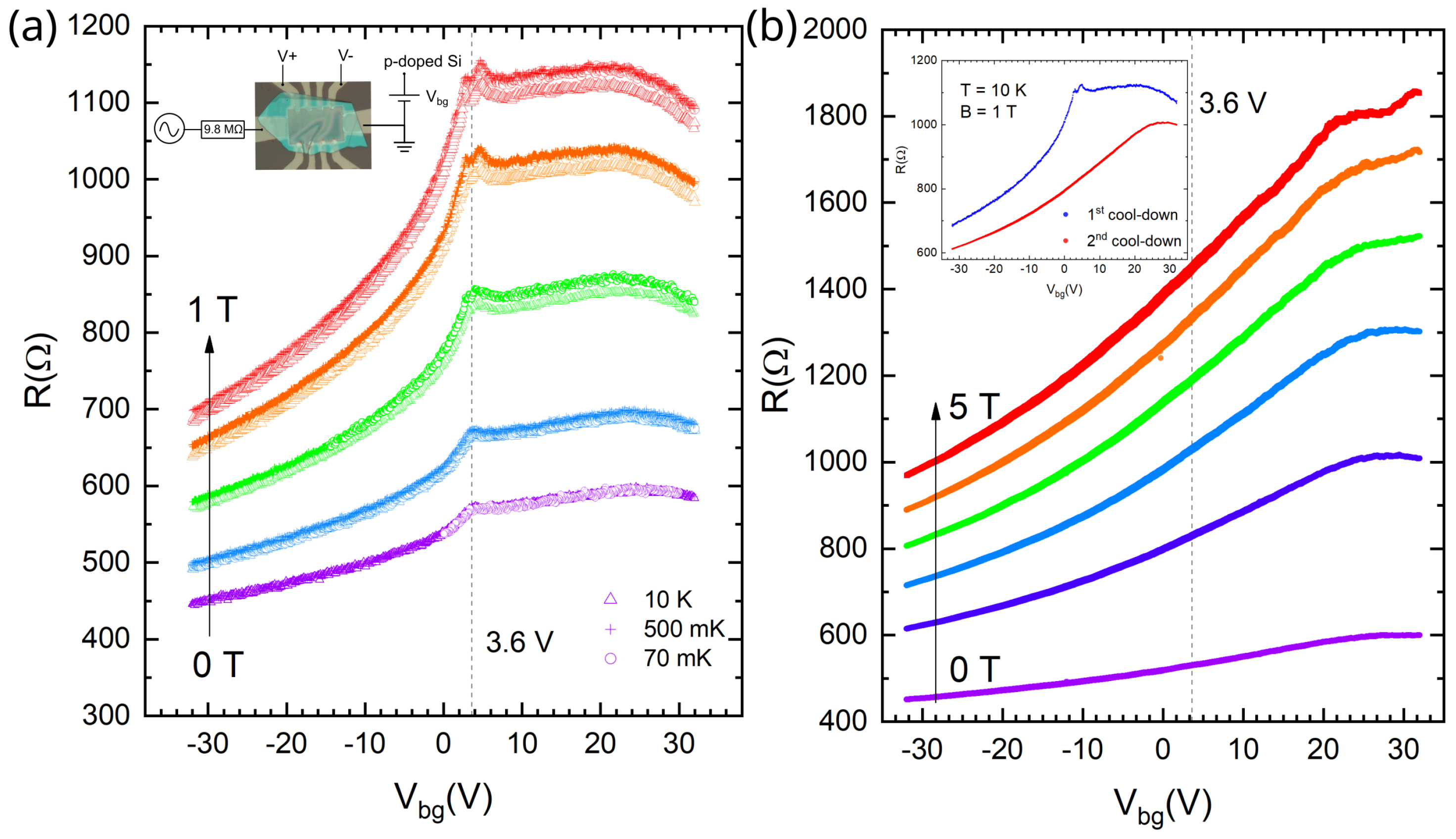
Figure 2a shows the gate voltage dependence of the Nb/Pt sample resistance during the first cooldown. At zero magnetic field, independently of temperature, two resistance peaks are observed as follows: a shallow maximum for V g 2 20 V and a feature at V g 1 3.6 V. For non-zero perpendicular magnetic field B, the feature evolves into a small sharp peak, which splits into two in B > 0.5 T.
In order to interpret the data, one should consider graphene on the islands as an effective medium consisting of three components: graphene on metal, graphene on SiO2 substrate, and suspended graphene. Suspended regions arise because a graphene/hBN heterostructure due to its finite rigidity cannot cover tightly all the metallic structures on a substrate (as shown in Figure 1a).
The conductivity of such a medium should be a combination of the conductivities of its components. We may use the following qualitative considerations. Graphene on the islands is supposed to have no gate voltage dependence of the resistance due to electric field screening by the metal. It could be either short-circuited by the metal or not, depending on the contact resistance. In this particular sample, we believe the contact resistance is rather high (see comparison with the second sample below). Graphene parts suspended near the island and contact edges are believed to be the cleanest ones [50,51] and have a charge neutrality point (CNP) at low- V g , seen as the small peak. Graphene on a SiO2 substrate produces a shallow peak far from zero gate voltage, typical for hole-doped graphene. Magnetic field usually induces positive magnetoresistance in graphene independently of gate voltage [52,53]. More interestingly, low-Vg resistivity peak splits as the magnetic field increases. This splitting does not depend on temperature at low T and hence could be explained in the following classical way.
Magnetoresistance in graphene is the highest at the CNP [54]; therefore, the resistance peak at the CNP further sharpens in a perpendicular magnetic field. Apparently, the low-Vg feature seen at zero magnetic field was actually a sum of sloping peaks originating from parts of the sample with slightly different properties. As magnetic field increased, the two constituent peaks became distinguishable. The relative sharpness of the split peaks, compared to the shallow maximum at high gate voltages, confirms the origin of the low- V g feature from the high-mobility suspended graphene regions.
After heating up to room temperature, the sample was transferred to a different cryostat and cooled down again. In Figure 2b, one can see that the low- V g features disappeared (Figure 2b, inset)! This observation means that the suspended regions lost their high mobility. Due to the rigidity of the graphene-hBN heterostructure, it is hard to suspect that suspended graphene came into contact with the SiO2 during the second cooldown. A more realistic scenario is that the suspended parts become contaminated and the mobility dropped.
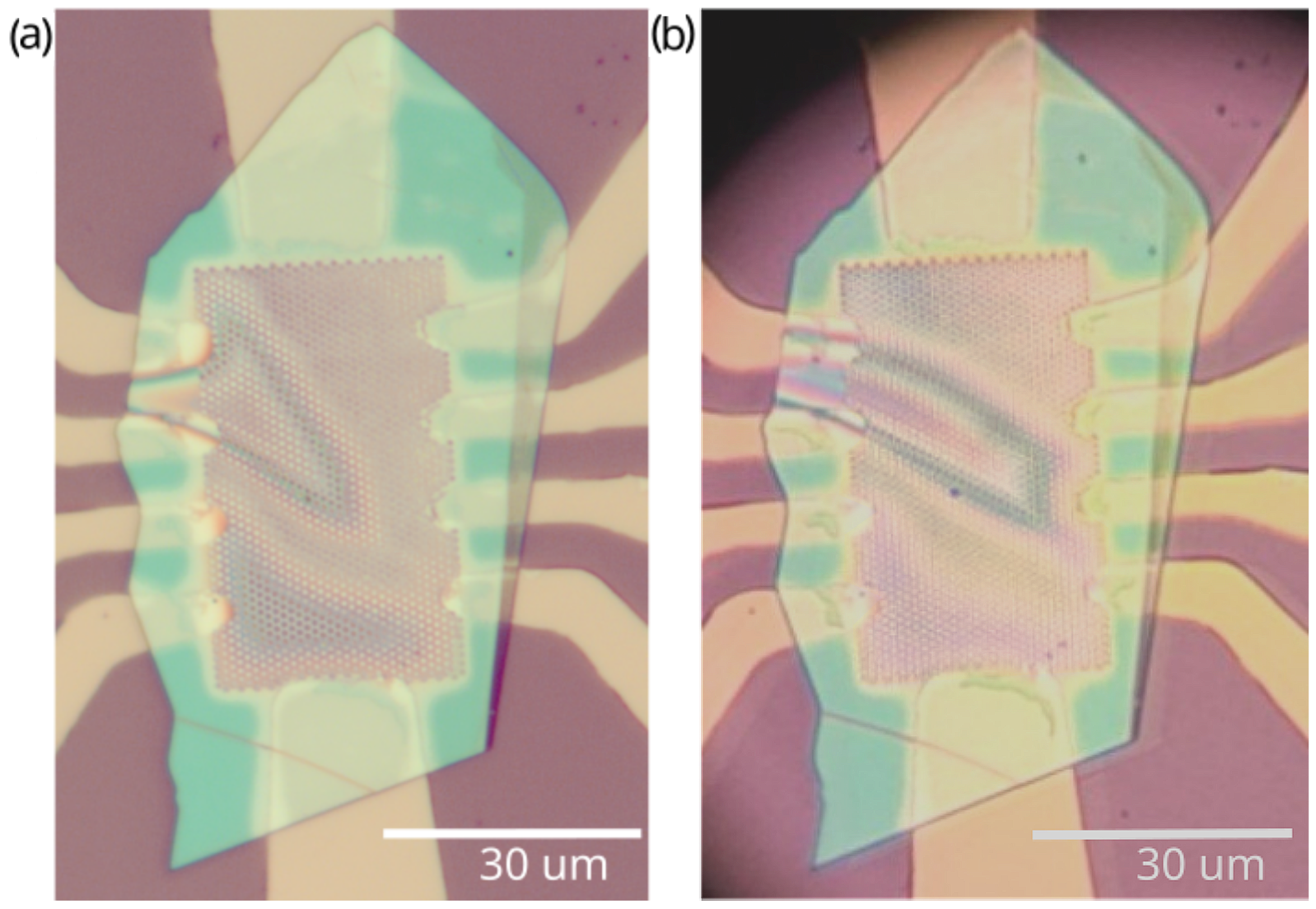
Optical microscope images in Figure 3 clearly indicate the changes. The sample was not uniform from the very beginning and a bubble in the hBN was clearly seen. This bubble appeared during the annealing, indicating that the van der Waals bond between the array of metallic islands and the graphene/hBN heterostructure is rather weak. After the cooldown, the bubble changed its shape. Careful comparison of the images in Figure 3a,b reveals numerous differences across the array of metal islands and near-contact regions. These changes signify that mechanical motion of the heterostructure takes place. This mechanical motion could be related to the disappearance of the low gate voltage feature.

3.2. Second Sample

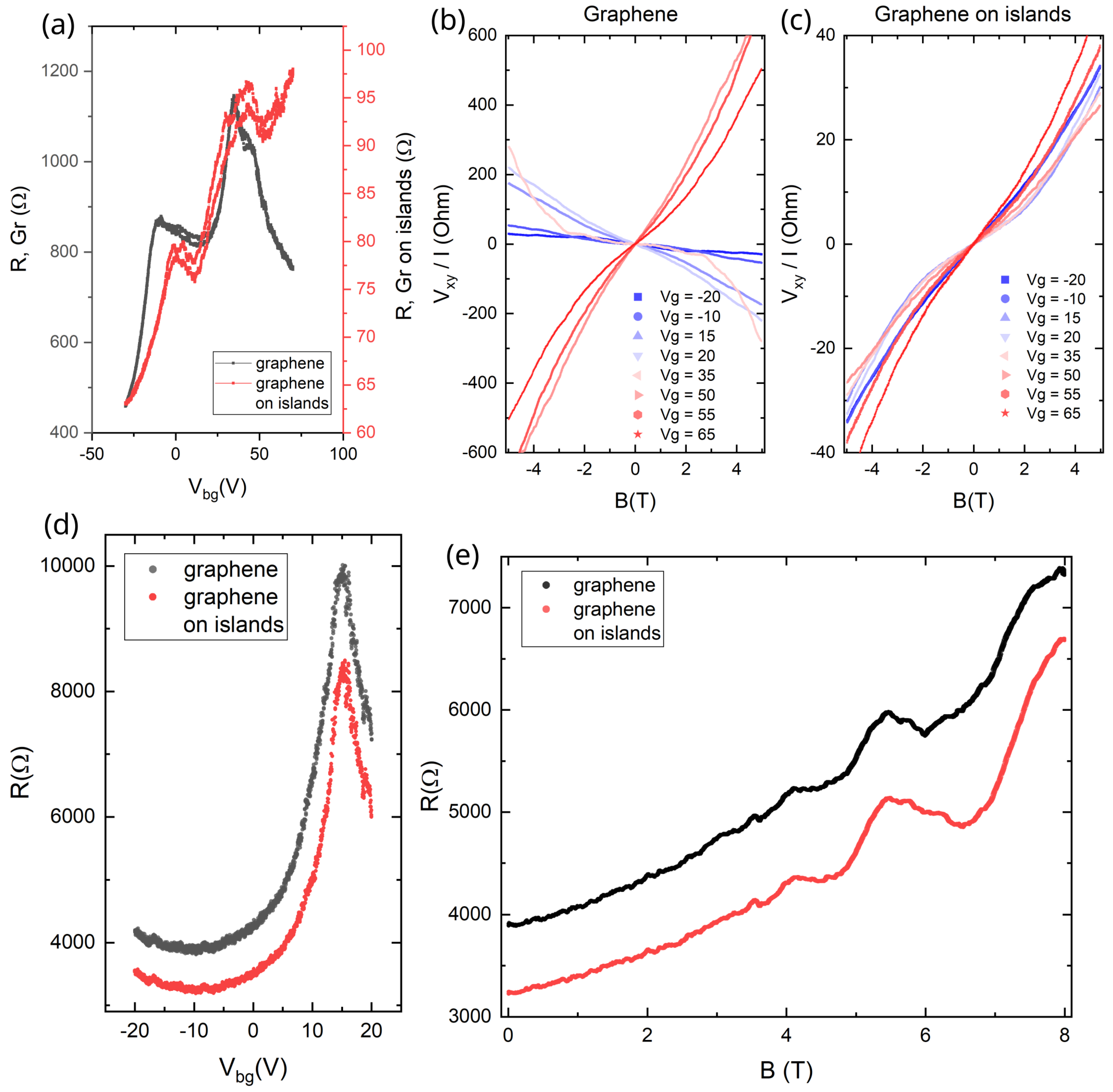
The second, rhenium-based sample during the first cooldown also demonstrated a two-peak R ( V g ) dependence, which was different in details from the Nb/Pt sample. To better understand the transport properties of the structure we intentionally fabricated two regions in series: bare graphene and graphene on metallic islands. These two areas have different transport characteristics: the resistivity of the graphene on rhenium is an order of magnitude smaller, as shown in Figure 4a, because the Re islands short-circuit and partially dope the graphene. Yet, R ( V g ) dependence for graphene on islands exhibits the same features as that of the bare graphene, clearly identifying two regions: suspended graphene and graphene on the substrate. Graphene without an array of islands has suspended regions located near the potential electrodes. As one can see in Figure 1d, the geometry of the Re sample is such that the contacts occupy a significant area of the sample. The near-contact areas are responsible for the low- V g CNPs on the black curve in Figure 4a.
The conductance between the graphene and the islands is high, as confirmed by the Hall effect data presented in Figure 4b,c. Indeed, the low-temperature Hall coefficient for the bare graphene is much larger and changes its sign with the gate voltage, while the Hall coefficient for the graphene on islands is an order of magnitude smaller, does not change sign, and does not depend strongly on the gate voltage. Qualitatively, such behavior is clear: the metal parts have low mobility and extremely high carrier density, leading to a decrease in the Hall coefficient. It is potentially possible to fit quantitatively the nonlinear Hall data using analytical theory [55]; however, such fit requires too many adjustable parameters. Therefore, in this paper, we concentrate on the metastability of the properties.
Similarly to the Nb/Pt sample, the Re sample was warmed to room temperature and cooled down for the second time. The R ( V g ) dependencies for the graphene and graphene-on-islands regions became nearly identical and exhibit a single CNP at an elevated gate voltage, as shown in Figure 4d. The resistance of the graphene on islands increased more than by an order of magnitude, signifying the loss of the electrical contact between the Re islands and the graphene. In a perpendicular magnetic field, magnetoresistance oscillations appeared (Figure 4e) with the similar parameters for both parts of the sample, showing that the system had become much more uniform. The preservation of almost the same resistivity values in the first (Nb/Pt) sample after the second cooldown suggests that the electrical contacts to the metallic islands there were poor from the very beginning.
The loss of electrical contact between the graphene and the islands after cooldown and warm-up means that the van der Waals bonds are disrupted. In the Nb/Pt sample, the clean graphene, tensed between the islands and the substrate, lost its high mobility after warming to room temperature. In the Re sample, during the second cooldown, the graphene lost electrical connection to the islands. These observations suggest that a very thin layer of water or organic contaminant intercalates between the graphene bottom surface and the substrate. Such a layer would inevitably be present at almost any surface under ambient conditions.

3.3. AFM Signatures of the Metastable State

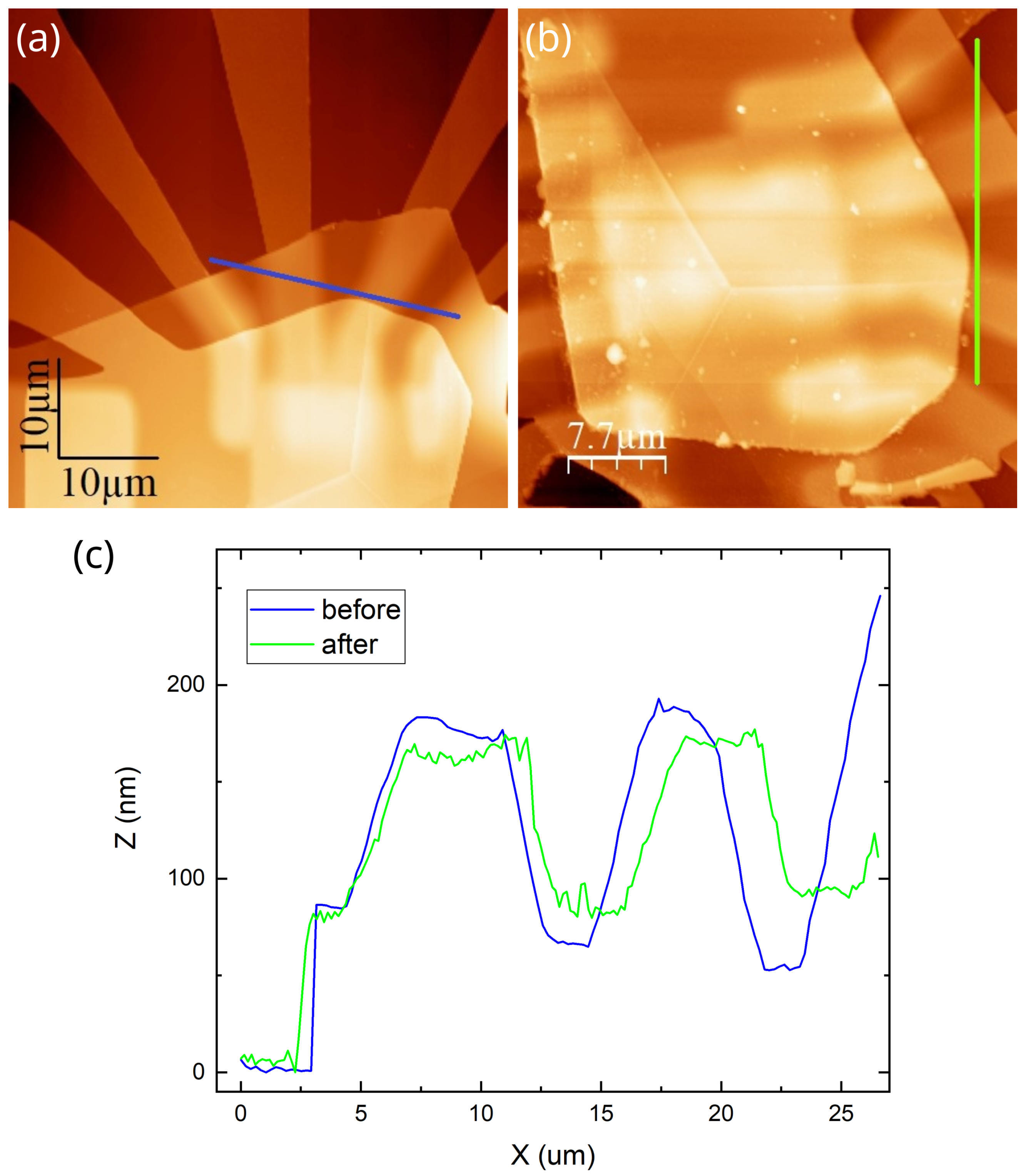
To explicitly demonstrate the changes caused by thermal cycling, we performed atomic force microscopy scans in tapping mode on the second sample before and after the first cooldown (Figure 5a,b). The finite radius of the AFM tip and the presence of the top gate electrode make the array of islands region non-informative. We therefore compare the near-contact regions without gate electrode, which is also shown to be a metastable region. It can be seen from Figure 5c that the hight of the of the stap at the contact pad edge covered with hBN decreased after the thermal cycling by several tens of nanometers. This difference could not be related to the measurement error. The thickness of neither hBN nor metal layer changed. One may assume that hBN layer, initially strained by the contact electrodes, lost its van der Waals bond to the substrate becoming less strained and suspended. Consequently, its observed thickness decreased.

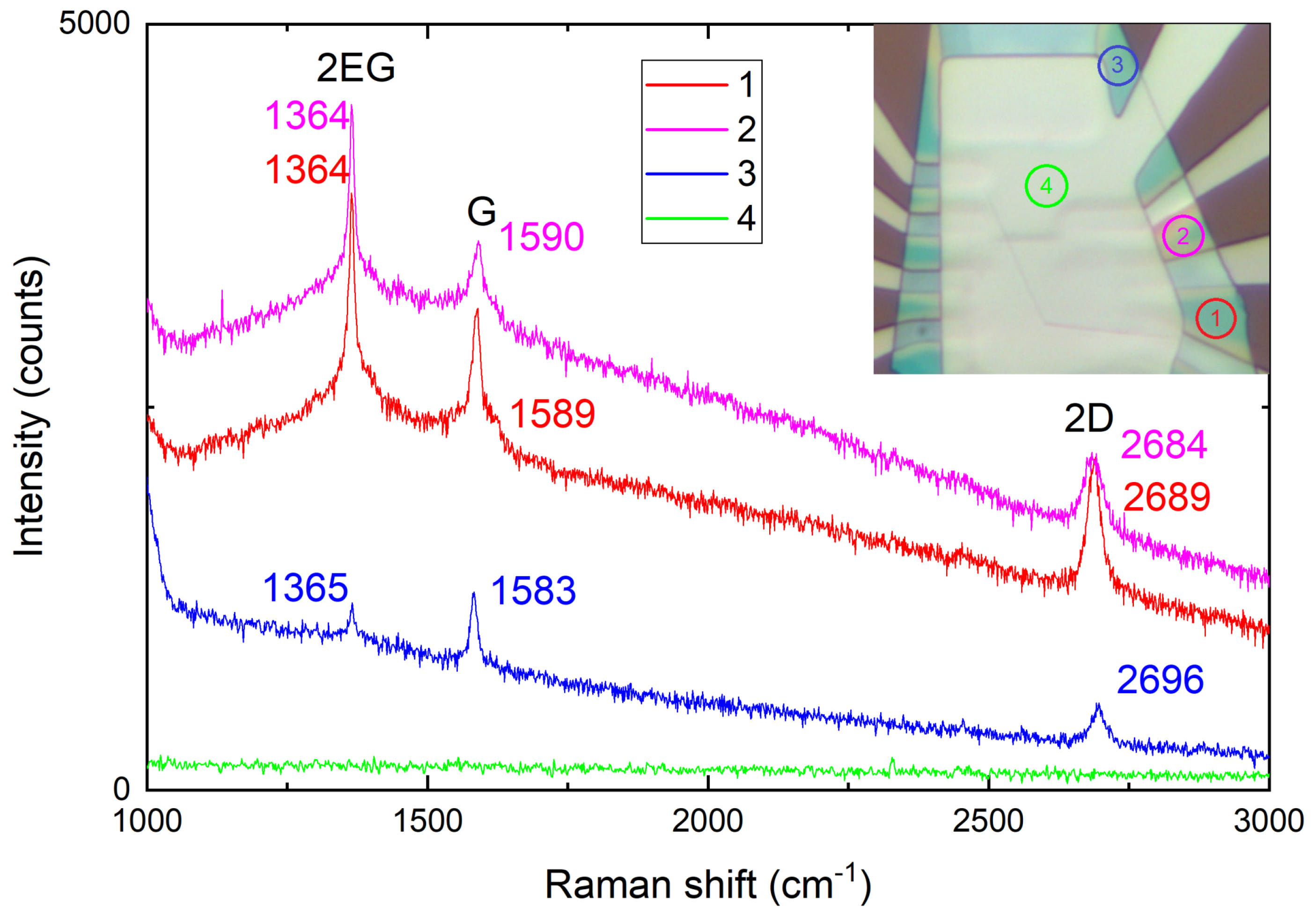
3.4. Raman Spectroscopy Detection of the Mechanical Tensions

A key element of the studied structures, that distiguish them from flat van der Waals heterostructures, is the inevitable presence of mechanical strain due to bending and static friction. A direct tool to probe this strain is Raman spectroscopy. Figure 6 shows the Raman spectra collected at different points of the Re sample after cooldown and subsequent warm up back to room temperature. Gate-electrode-covered part of the sample does not allow Raman measurements. We therefore select different points where different degree of deformation would be expected. Three peaks are clearly visible: E g 2 peak of hBN at ∼1360 cm−1, graphene G peak at ∼1590 cm−1, and graphene 2D peak at ∼2690 cm−1. The absence of D and D’ peaks indicates the high quality of the graphene. At point 3 (the blue line) we believe the influence of the metallic edge is minimal, as well as FWHM of the graphene peaks (14 cm−1 and 25 cm−1 for G and 2D peak, respectively). Near dots 1 (red line) and 2 (magenta line) in the optical image, more non-uniformity of hBN color can be seen, assuming greater height gradient and mechanical tensions. FWHM of the 2D peak equals to 28 cm−1 and 39 cm−1 for point 1 and 2. In these areas, a combined effect of the tensile strain [56] (red shift and broadening of 2D peak) and doping (blue shift of G peak) is observed [57].

3.5. Restoration of Electrical Contact by Thermal Cycling

In order to affect the possibly broken van der Waals bond, we decided to press the second, Re-based, sample with a hot PDMS drop (150 ℃ for 10 min with a force of approximately 0.5 N)—i.e., perform the same operation as during the sample assembly. This action required detaching the sample with bonded contact wires from the measurement platform, placing it on a heating stage and returning it again with re-bonding of the contacts. The operation was risky and we are not aware of anybody having conducted anything similar. To avoid damaging the sample, we did not clean it after the PDMS pressing. After this procedure, we cooled the Re sample down to helium temperatures and measured its transport characteristics for the third time.
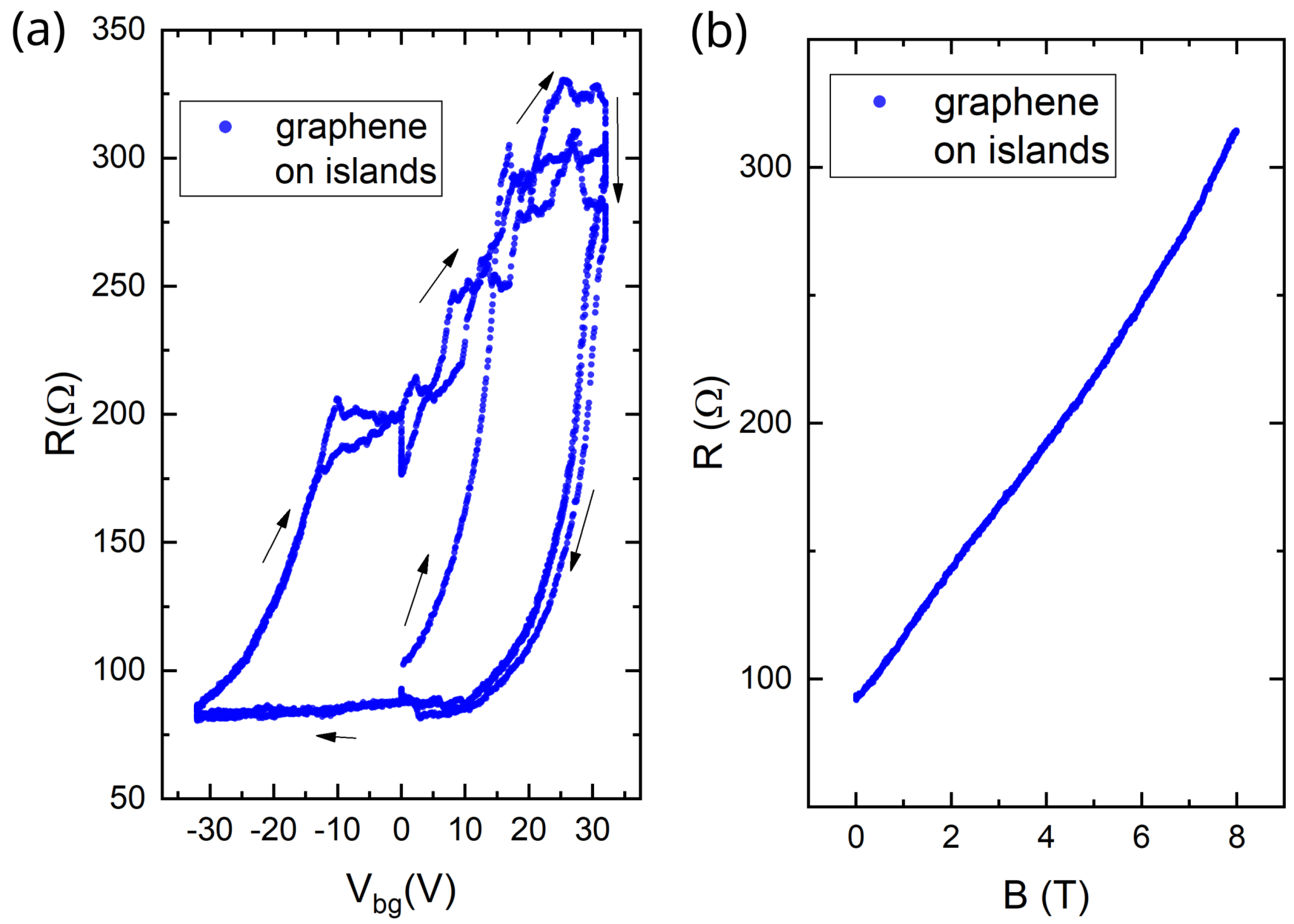
Figure 7a shows the dependence of the graphene-on-islands resistance on the gate voltage. The resistance value was restored to 100–300 Ω , compared to 4000–8000 Ω in the second cooldown, which suggests the recovery of the electrical contact between the graphene and the Re islands! Qualitatively, the difference of the R ( V g ) dependence from the first cooldown (Figure 4a) is not surprising for such a fragile sample. R ( V g ) dependence also became hysteresis-like. In Figure 7a we plot several loops and show the direction of the gate voltage sweep. Each loop does not exactly reproduce the previous. Since the sample was not cleaned after the hot pressing, we attribute this hysteresis to charge traps caused by organic contamination [58].
In Figure 7b, the resistance dependence on a perpendicular magnetic field at V g = 10 V is shown, demonstrating the absence of the oscillations seen in Figure 4e. This confirms that the islands started to be electrically connected to graphene again. Indeed, in the random potential of the islands, the graphene ceased being uniform, and was short-circuited by the islands leading to reduced magnetoresistance.

4. Discussion

4.1. Wetting Transition

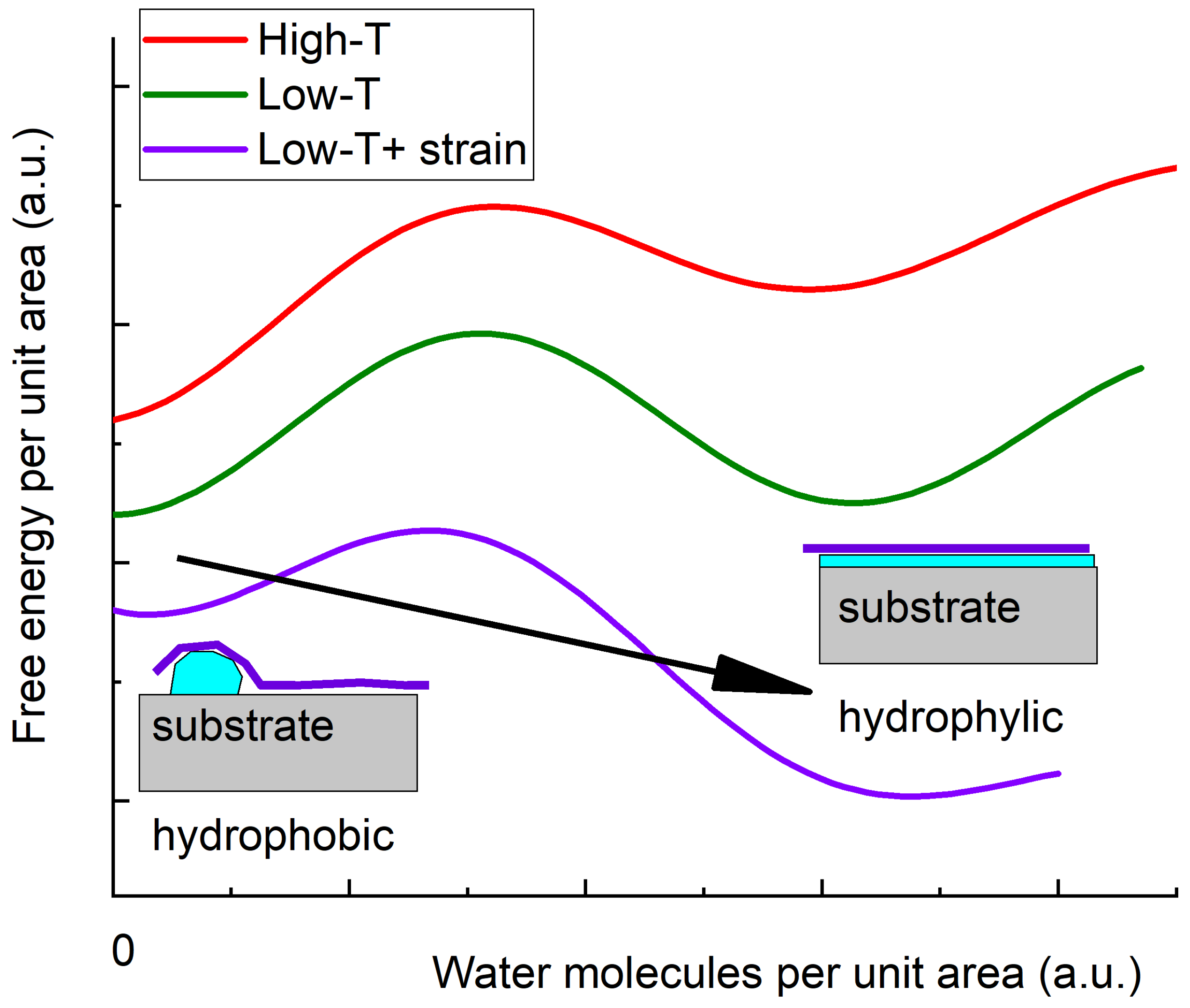
The redistribution of a few molecular layers of water or organic contaminants along with the first order nature of wetting–unwetting phase transition, can explain the disappearance of the charge neutrality peak at nearly zero gate voltage. Graphene itself is hydrophilic [59] at room temperature unless intentionally damaged [60]. However, when pressed at room or elevated temperatures to the surface of the other van der Waals material, it can undergo a hydrophobic collapse [61], causing surface water to migrate either to the structure edges or to micro- or nanometer-scale droplets. As a result, most of the interface becomes clear, including the suspended parts near the edges of the metal. This phenomenon known as self-cleansing [62] allows for the fabrication of extremely clean VdWHs by mechanical assembly. A global minimum of the free energy in a hydrophobic state at elevated temperature is shown by the red curve in Figure 8. This diagram shows the dependence of the system’s free energy on the area covered with surface water.
At lower temperatures, the interface becomes more hydrophilic owing to the decrease in the entropy factor [63]—see the green curve in Figure 8. This is a universal tendency—all surfaces demonstrate better sorption at lower temperatures. However, when the sample is cooled down for the first time, it freezes in the hydrophobic state due to a potential barrier, i.e., the first order nature of the wetting phase transition. We experimentally observe high mobility in the unwetted suspended regions and strong interaction between the graphene and the metallic islands.
In order to jump from one local minimum to another, van der Waals bonds must be broken and a potential barrier prevents their restoration.
Significant mechanical strain present in a heterostucture transferred onto a textured substrate (which is absent in the case of top contacts) further lowers the system global wetting free energy minimum (violet curve in Figure 8). However, this diagram does not explain why the changes are irreversible. The system is definitely in the unwetted state at cryogenic temperatures, and becomes wetted only after heat-up. There must be a trigger for the changes.
It can be seen from the optical microscope images in Figure 3 and confirmed by AFM measurements in Figure 5 that the hBN heterostructure moves slightly after the thermal cycling. We believe that this slight movement dynamically triggers the wetting transition pretty much like a charged particle triggers condensation in a Wilson chamber. Once a critically high strain is formed dynamically, the wetted region spreads over the entire sample.

4.2. Possible Mechanism of Delamination

To trigger wetting and move the system from one local free energy minimum to another it is crucial to break the van der Waals bonds between the substrate and the graphene/hBN heterostructure by introducing high strain. We suggest the following microscopic mechanism for this bond breaking. The assembly of the structure includes a hot pressing with a PDMS drop. The measured force of 0.5 N is applied to a 100 µm diameter spot, so the pressure under the drop, Δ P , is rather high—about 500 Bar, see Figure 9a. This pressure leads to an even higher Laplace strain T of hBN on the order of Δ P r / d , where r is the radius of curvature and d is the thickness of the hBN. When PDMS drop is removed, the strain does not relax completely, because of the static friction force F stat between the flake and the substrate, see Figure 9b, so the structure remains strained near the points of contact with the substrate and the metal. Some other regions are free of strain. Static friction between the graphene and the metal or SiO2 stabilizes the state of the structure. Then, the system is cooled down (Figure 9c).
Although the thermal expansion coefficient of the 2D heterostructures is a rather complicated matter [64], in our case, it is dominated by the hBN layer because it is two orders of magnitude thicker than graphene. Hexagonal boron nitride is remarkable for its anisotropic thermal expansion (TE) [65,66] with the in-plane TE coefficient α a being negative and the out-of-plane coefficient α c being positive. Metal, silicon, and SiO2 are characterized by a positive isotropic α . This fact is extremely important: it means that the tensile strain decreases during the cooldown, because the metal and SiO2 shrink by approximately ∼0.1% while hBN expands by about 0.05% [65]! Taking the in-plane elastic constant of hBN, c 11 , to be about 800 GPa [67], one estimates the strain reduction as relative elongation multiplied by c 11 which produces about 10 kBar. Thus, the strained part could be significantly released during the cooldown. Strain reduction leads to increase in the van der Waals contacts area, and decrease in the radius of curvature r at the point of contact, as shown in Figure 9c.
Maximal static friction always exceeds the dynamic dry friction. When the system heats up an avalanche delamination process is initiated due to the reduced radius of curvature, and the system does not stop at the state shown in Figure 9b and proceeds further to the state in Figure 9d. The delamination process occurs at relatively high temperatures where the TE coefficients are large and is accompanied by wetting; i.e., system transition to the second local minimum in Figure 8.
Noteworthy gate electrode in Re sample does not affect the above explanation because the Young’s module of the gate electrode material (amorphous aluminum) is about 25–30 GPa [68], whereas hexagonal boron nitride has 25–30 times higher in-plane rigidity [67] and their thicknesses are comparable. The delamination of the heterostructure from the substrate is evidenced by the data in Figure 5c. It begins near the metal edges. The delaminated graphene bottom surface is hydrophilic [59] and therefore becomes covered with a water layer at relatively high temperature. Anyway, the sample remains in this new minimum during the second cooldown and thereafter, as verified by multiple cooldown experiments. Note that the diagrams in Figure 8 and Figure 9 provide only a qualitative level of physical reasoning. Quantitative calculations for such a system are hindered by numerous unknown parameters, so we restrict ourselves to a general discourse. Importantly, our work highlights the complexity of phenomena in heterostructures based on 2D materials under thermal cycling.

4.3. Further Development

Our study experimentally uncovers a critical yet previously overlooked aspect of mechanically transferred 2D material structures: their metastability induced by strain, thermal expansion, and likely enhanced by interfacial water layers trapped between the substrate and the 2D flakes. This effect emerges during thermal cycling.
Notably, the effect is absent in the structures without significant strain, such as those with evaporated top contacts or 1D edge contacts. For example, in Refs. [69,70], the same sample was measured sequentially in two cryostats and the results were reproducible; in Refs. [71,72], graphene with top contacts survived after powerful current annealing. Van der Waals bond with a textured surface is different: it is generally weaker and formed with strain due to static friction. Mechanical strain at the edges of metallic islands promotes delamination during the thermal cycling.
We show that despite the fabrication simplicity and promising room-temperature applications [41], such transferred structures require further careful optimization to achieve reproducible performance. One option is to use current annealing to stabilize the electrical response [73]. The metastable state should also be responsive to laser annealing. Mechanical perturbation via atomic force microscopy at room temperature is insufficient to revert the system to its initial hydrophobic state, indicating a high energy barrier for the transition.
To reduce the influence of moisture, the assembly may be performed in a controlled, anhydrous environment (see, e.g., Refs. [74,75,76,77,78]), though complete water elimination remains challenging. However, a structure taken out of the assembly chamber would inevitably absorb water. Ultrathin metallic contacts [79] reduce strain and thus may suppress strain-induced metastability. Alternative approach involves intentional preconditioning through thermal cycling to lock the system into a stable delaminated state. These insights provide guidelines for device engineering.
Our observation discovers a useful experimental handle: the degree of disorder perceived by the electronic system; transport and optical phenomena can be studied before and after the thermal cycling and different results are expected on the same sample. These findings not only present new challenges for 2D electronics but also demand a critical re-examination of the prior studies. It appears that the breakdown of the van der Waals bond is an overlooked yet important parameter.

5. Conclusions

In summary, we performed repeated cryogenic transport measurements on graphene/hBN heterostructures transferred onto arrays of metallic islands and contact electrodes. Initial cooldown experiments revealed strong van der Waals adhesion between the graphene and the islands, as evidenced by the gate voltage and magnetic field dependencies of the resistance. However, subsequent thermal cycling between room and cryogenic temperatures disrupts this interfacial bonding, leading to markedly different transport properties characterized by enhanced uniformity and disorder. Optical microscopy confirmed structural changes after the cooldown. Atomic force microscopy provided evidences for thermal-cycling-driven delamination of the hBN/graphene heterostructure. Raman scattering confirms the existence of local strain in the structure. Hot pressing at elevated temperatures restores van der Waals adhesion. The presented observation allow us to attribute the metastability to the breakdown of van der Waals bonds due to thermal expansion. Thermally activated redistribution of interfacial water layers is evidenced from transport experiments and likely promotes the delamination. Beyond its fundamental implications, this controllable metastability opens new routes for engineering 2D systems on structured surfaces, with potential applications ranging from reconfigurable electronics to strain-sensitive quantum devices.

Author Contributions

Conceptualization, A.Y.K.; methodology, V.A.I., V.A.P. and L.A.M.; software, V.A.P. and L.A.M.; validation, V.A.I.; formal analysis, V.A.I.; investigation, V.A.I.; resources, L.A.M., V.A.P. and A.Y.K.; data curation, V.A.I.; writing—original draft preparation, V.A.I.; writing—review and editing, V.A.I. and A.Y.K.; visualization, V.A.I.; supervision, A.Y.K.; project administration, A.Y.K.; funding acquisition, A.Y.K. All authors have read and agreed to the published version of the manuscript.

Funding

This work was supported by the Russian Science Foundation under Grant No. 23-12-00340.

Data Availability Statement

The original contributions presented in this study are included in the article Further inquiries can be directed to the corresponding author.

Acknowledgments

Sample fabrication and measurements were conducted at the Shared Facility Center of the P.N. Lebedev Physical Institute.

Conflicts of Interest

The authors declare no conflicts of interest.

Abbreviations

The following abbreviations are used in this manuscript:
PMMApoly methyl methacrylate, e-beam resist
MMAmethyl methacrylate, e-beam resist underlayer
NAnumerical aperture
PDMSpolydimethylsilaxane
PPCpolypropylencarbonate
2Dtwo-dimensional
VdWHvan der Waals heterostructures
hBNhexagonal boron nitride
CNPcharge neutrality point
CFMSCryogen free measurement system by Cryogenic Co.
AFMatomic force microscopy
TEthermal expansion
FWHMfull width at half maximum (spectral characteristic)

References

  1. Mak, K.F.; Shan, J. Photonics and optoelectronics of 2D semiconductor transition metal dichalcogenides. Nat. Photon. 2016, 10, 216–226. [Google Scholar] [CrossRef]
  2. Liu, Y.; Duan, X.; Shin, H.J.; Park, S.; Huang, Y.; Duan, X. Promises and prospects of two-dimensional transistors. Nature 2021, 591, 43–53. [Google Scholar] [CrossRef]
  3. Yankowitz, M.; Ma, Q.; Jarillo-Herrero, P.; LeRoy, B.J. van der Waals heterostructures combining graphene and hexagonal boron nitride. Nat. Rev. Phys. 2019, 1, 112–125. [Google Scholar] [CrossRef]
  4. Zhang, G.; Wu, H.; Zhang, L.; Yang, L.; Xie, Y.; Guo, F.; Li, H.; Tao, B.; Wang, G.; Zhang, W.; et al. Two-dimensional van der Waals topological materials: Preparation, properties, and device applications. Small 2022, 18, 2204380. [Google Scholar] [CrossRef]
  5. Zhao, Q.; Xie, Z.; Peng, Y.P.; Wang, K.; Wang, H.; Li, X.; Wang, H.; Chen, J.; Zhang, H.; Yan, X. Current status and prospects of memristors based on novel 2D materials. Mater. Horizons 2020, 7, 1495–1518. [Google Scholar] [CrossRef]
  6. Qiu, D.; Gong, C.; Wang, S.; Zhang, M.; Yang, C.; Wang, X.; Xiong, J. Recent advances in 2D superconductors. Adv. Mater. 2021, 33, 2006124. [Google Scholar] [CrossRef]
  7. Gibertini, M.; Koperski, M.; Morpurgo, A.F.; Novoselov, K.S. Magnetic 2D materials and heterostructures. Nat. Nanotechnol. 2019, 14, 408–419. [Google Scholar] [CrossRef] [PubMed]
  8. Li, Z.Y.; Yang, W.J.; Wu, Y.P.; Wu, S.B.; Cai, Z.B. Role of humidity in reducing the friction of graphene layers on textured surfaces. Appl. Surf. Sci. 2017, 403, 362–370. [Google Scholar] [CrossRef]
  9. Shi, Z.; Shum, P.; Wasy, A.; Zhou, Z.; Li, L.K.Y. Tribological performance of few layer graphene on textured M2 steel surfaces. Surf. Coatings Technol. 2016, 296, 164–170. [Google Scholar] [CrossRef]
  10. Yilbas, B.; Ibrahim, A.; Ali, H.; Khaled, M.; Laoui, T. Effect of graphene film on laser textured alumina surface characteristics. Ceram. Int. 2017, 43, 2012–2021. [Google Scholar] [CrossRef]
  11. Calleja, F.; Ochoa, H.; Garnica, M.; Barja, S.; Navarro, J.J.; Black, A.; Otrokov, M.M.; Chulkov, E.V.; Arnau, A.; Vazquez de Parga, A.L.; et al. Spatial variation of a giant spin–orbit effect induces electron confinement in graphene on Pb islands. Nat. Phys. 2015, 11, 43–47. [Google Scholar] [CrossRef]
  12. Gao, M.; Han, X.; Liu, W.; Tian, Z.; Mei, Y.; Zhang, M.; Chu, P.K.; Kan, E.; Hu, T.; Du, Y.; et al. Graphene-mediated ferromagnetic coupling in the nickel nano-islands/graphene hybrid. Sci. Adv. 2021, 7, eabg7054. [Google Scholar] [CrossRef]
  13. Ho, Y.L.; Fong, C.F.; Wu, Y.J.; Konishi, K.; Deng, C.Z.; Fu, J.H.; Kato, Y.K.; Tsukagoshi, K.; Tung, V.; Chen, C.W. Finite-Area Membrane Metasurfaces for Enhancing Light-Matter Coupling in Monolayer Transition Metal Dichalcogenides. ACS Nano 2024, 18, 24173–24181. [Google Scholar] [CrossRef]
  14. Zhang, C.; Lin, K.; Huang, Y.; Zhang, J. Graphene-Ag hybrids on laser-textured Si surface for SERS detection. Sensors 2017, 17, 1462. [Google Scholar] [CrossRef]
  15. Pawlak, R.; Lebioda, M.; Rymaszewski, J.; Szymanski, W.; Kolodziejczyk, L.; Kula, P. A fully transparent flexible sensor for cryogenic temperatures based on high strength metallurgical graphene. Sensors 2016, 17, 51. [Google Scholar] [CrossRef]
  16. Zhu, S.; Sun, H.; Liu, X.; Zhuang, J.; Zhao, L. Room-temperature NH3 sensing of graphene oxide film and its enhanced response on the laser-textured silicon. Sci. Rep. 2017, 7, 14773. [Google Scholar] [CrossRef]
  17. Holicky, M.; Fenech-Salerno, B.; Cass, A.; Torrisi, F. Fabrication of graphene field effect transistors on complex non-planar surfaces. Appl. Phys. Lett. 2024, 125, 113301. [Google Scholar] [CrossRef]
  18. Wang, L.; Ren, Z.F.; Wang, K.Y.; He, S.J.; Luo, L.B. Graphene-pyramid textured silicon heterojunction for sensitive near-infrared light photodiode. Mater. Res. Express 2017, 4, 045022. [Google Scholar] [CrossRef]
  19. Khan, A.; Kumar, R.R.; Cong, J.; Imran, M.; Yang, D.; Yu, X. CVD graphene on textured silicon: An emerging technologically versatile heterostructure for energy and detection applications. Adv. Mater. Interfaces 2022, 9, 2100977. [Google Scholar] [CrossRef]
  20. Silva, A.; Claerbout, V.E.; Polcar, T.; Kramer, D.; Nicolini, P. Exploring the stability of twisted van der Waals heterostructures. ACS Appl. Mater. Interfaces 2020, 12, 45214–45221. [Google Scholar] [CrossRef] [PubMed]
  21. Liu, C.; Li, W.; Xue, L.; Hao, Y. Twisted graphene stabilized by organic linkers pillaring. Nanotechnology 2022, 33, 26LT01. [Google Scholar] [CrossRef]
  22. Dienwiebel, M.; Verhoeven, G.S.; Pradeep, N.; Frenken, J.W.; Heimberg, J.A.; Zandbergen, H.W. Superlubricity of graphite. Phys. Rev. Lett. 2004, 92, 126101. [Google Scholar] [CrossRef] [PubMed]
  23. Zheng, Q.; Jiang, B.; Liu, S.; Weng, Y.; Lu, L.; Xue, Q.; Zhu, J.; Jiang, Q.; Wang, S.; Peng, L. Self-retracting motion of graphite microflakes. Phys. Rev. Lett. 2008, 100, 067205. [Google Scholar] [CrossRef]
  24. Li, H.; Wang, J.; Gao, S.; Chen, Q.; Peng, L.; Liu, K.; Wei, X. Superlubricity between MoS2 monolayers. Adv. Mater. 2017, 29, 1701474. [Google Scholar] [CrossRef]
  25. Dong, Y.; Duan, Z.; Tao, Y.; Wei, Z.; Gueye, B.; Zhang, Y.; Chen, Y. Friction evolution with transition from commensurate to incommensurate contacts between graphene layers. Tribol. Int. 2019, 136, 259–266. [Google Scholar] [CrossRef]
  26. Liao, M.; Nicolini, P.; Du, L.; Yuan, J.; Wang, S.; Yu, H.; Tang, J.; Cheng, P.; Watanabe, K.; Taniguchi, T.; et al. UItra-low friction and edge-pinning effect in large-lattice-mismatch van der Waals heterostructures. Nat. Mater. 2022, 21, 47–53. [Google Scholar] [CrossRef]
  27. Berman, D.; Erdemir, A.; Sumant, A.V. Approaches for achieving superlubricity in two-dimensional materials. ACS Nano 2018, 12, 2122–2137. [Google Scholar] [CrossRef]
  28. Paolicelli, G.; Tripathi, M.; Corradini, V.; Candini, A.; Valeri, S. Nanoscale frictional behavior of graphene on SiO2 and Ni (111) substrates. Nanotechnology 2015, 26, 055703. [Google Scholar] [CrossRef] [PubMed]
  29. Wang, W.; Zhang, Y.; Wang, A. Effects of substrate on the nanoscale friction of graphene. Appl. Phys. Lett. 2023, 123, 241602. [Google Scholar] [CrossRef]
  30. Kamenskaya, T.; Eliseyev, I.; Davydov, V.Y.; Kuntsevich, A.Y. Strain in 2D TMDCs induced by metal-assisted exfoliation from the polyvinyl alcohol-covered substrate. Appl. Phys. Lett. 2024, 125, 153103. [Google Scholar] [CrossRef]
  31. Yang, S.; Liang, X.; Chen, W.; Wang, Q.; Sa, B.; Guo, Z.; Zheng, J.; Pei, J.; Zhan, H.; Wang, Q. Cooling-induced Strains in 2D Materials and Their Modulation via Interface Engineering. Adv. Mater. 2025, 37, 2417428. [Google Scholar] [CrossRef]
  32. Zaidi, H.; Richard, C.; Bui, H.S.; Tournis, S.; Aissa, M.; Bouguerra, K. Frictional Behavior of MoS2 Coatings: A Comparative Study of Dynamic and Static Friction in Vacuum and Inert Gases. Coatings 2025, 15, 500. [Google Scholar] [CrossRef]
  33. Lee, H.; Ko, J.H.; Choi, J.S.; Hwang, J.H.; Kim, Y.H.; Salmeron, M.; Park, J.Y. Enhancement of friction by water intercalated between graphene and mica. J. Phys. Chem. Lett. 2017, 8, 3482–3487. [Google Scholar] [CrossRef]
  34. Yang, Z.; Bhowmick, S.; Sen, F.G.; Banerji, A.; Alpas, A.T. Roles of sliding-induced defects and dissociated water molecules on low friction of graphene. Sci. Rep. 2018, 8, 121. [Google Scholar] [CrossRef] [PubMed]
  35. Chen, Z.; Khajeh, A.; Martini, A.; Kim, S.H. Origin of high friction at graphene step edges on graphite. ACS Appl. Mater. Interfaces 2020, 13, 1895–1902. [Google Scholar] [CrossRef] [PubMed]
  36. Wang, G.; Gao, E.; Dai, Z.; Liu, L.; Xu, Z.; Zhang, Z. Degradation and recovery of graphene/polymer interfaces under cyclic mechanical loading. Compos. Sci. Technol. 2017, 149, 220–227. [Google Scholar] [CrossRef]
  37. Curry, J.F.; Ohta, T.; DelRio, F.W.; Mantos, P.; Jones, M.R.; Babuska, T.F.; Bobbitt, N.S.; Argibay, N.; Krick, B.A.; Dugger, M.T.; et al. Structurally driven environmental degradation of friction in MoS2 films. Tribol. Lett. 2021, 69, 96. [Google Scholar] [CrossRef]
  38. Li, Q.; Lee, C.; Carpick, R.W.; Hone, J. Substrate effect on thickness-dependent friction on graphene. Phys. Status Solidi (b) 2010, 247, 2909–2914. [Google Scholar] [CrossRef]
  39. Qu, C.B.; Xiao, H.M.; Huang, G.W.; Li, N.; Li, M.; Li, F.; Li, Y.Q.; Liu, Y.; Fu, S.Y. Effects of cryo-thermal cycling on interlaminar shear strength and thermal expansion coefficient of carbon fiber/graphene oxide-modified epoxy composites. Compos. Commun. 2022, 32, 101180. [Google Scholar] [CrossRef]
  40. Jefferson Andrew, J.; Ubaid, J.; Cantwell, W.; Khan, K.; Umer, R. The Effect of Cryogenic Thermal Cycling on Impact Performance of Graphene-Enhanced Recyclable Liquid Thermoplastic/Carbon Fiber Composites for Hydrogen Storage Applications. Compos. Part C Open Access 2025, 17, 100601. [Google Scholar] [CrossRef]
  41. Cha, J.; Son, J.; Hong, J. A Bottom-Electrode Contact: The Most Suitable Structure for Graphene Electronics. Adv. Mater. Interfaces 2022, 9, 2102207. [Google Scholar] [CrossRef]
  42. Kessler, B.M.; Girit, C.O.; Zettl, A.; Bouchiat, V. Tunable Superconducting Phase Transition in Metal-Decorated Graphene Sheets. Phys. Rev. Lett. 2010, 104, 047001. [Google Scholar] [CrossRef]
  43. Allain, A.; Han, Z.; Bouchiat, V. Electrical control of the superconducting-to-insulating transition in graphene–metal hybrids. Nat. Mater. 2012, 11, 590–594. [Google Scholar] [CrossRef]
  44. Han, Z.; Allain, A.; Arjmandi-Tash, H.; Tikhonov, K.; Feigel’man, M.; Sacépé, B.; Bouchiat, V. Collapse of superconductivity in a hybrid tin–graphene Josephson junction array. Nat. Phys. 2014, 10, 380–386. [Google Scholar] [CrossRef]
  45. Richardson, C.L.; Edkins, S.D.; Berdiyorov, G.R.; Chua, C.J.; Griffiths, J.P.; Jones, G.A.C.; Buitelaar, M.R.; Narayan, V.; Sfigakis, F.; Smith, C.G.; et al. Vortex detection and quantum transport in mesoscopic graphene Josephson-junction arrays. Phys. Rev. B 2015, 91, 245418. [Google Scholar] [CrossRef]
  46. Sun, Y.; Xiao, H.; Zhang, M.; Xue, Z.; Mei, Y.; Xie, X.; Hu, T.; Di, Z.; Wang, X. Double quantum criticality in superconducting tin arrays-graphene hybrid. Nat. Commun. 2018, 9, 2159. [Google Scholar] [CrossRef]
  47. Gupta, S.; Jana, S.P.; Pervin, R.; Gupta, A.K. Gate-tunable crossover between vortex-interaction and pinning dominated regimes in Josephson-coupled lead islands on graphene. Phys. Rev. B 2024, 110, 024506. [Google Scholar] [CrossRef]
  48. Tarkaeva, E.; Ievleva, V.; Prishchepa, A.; Zhukova, E.; Terentiev, A.; Kuntsevich, A.Y. High-performance amorphous superconducting rhenium films by e-beam evaporation. J. Appl. Phys. 2025, 138, 123904. [Google Scholar] [CrossRef]
  49. Martanov, S.G.; Zhurbina, N.K.; Pugachev, M.V.; Duleba, A.I.; Akmaev, M.A.; Belykh, V.V.; Kuntsevich, A.Y. Making van der Waals heterostructures assembly accessible to everyone. Nanomaterials 2020, 10, 2305. [Google Scholar] [CrossRef]
  50. Bolotin, K.I.; Sikes, K.; Jiang, Z.; Klima, M.; Fudenberg, G.; Hone, J.; Kim, P.; Stormer, H.L. Ultrahigh electron mobility in suspended graphene. Solid State Commun. 2008, 146, 351–355. [Google Scholar] [CrossRef]
  51. Dai, Y.; Xue, T.; Han, X.; Huang, X.; Zhang, D.; Huang, M.; Yan, J.; Zhao, J.; Laxmi, V.; Liu, L.; et al. Suspended 2d materials: A short review. Crystals 2023, 13, 1337. [Google Scholar] [CrossRef]
  52. Friedman, A.L.; Tedesco, J.L.; Campbell, P.M.; Culbertson, J.C.; Aifer, E.; Perkins, F.K.; Myers-Ward, R.L.; Hite, J.K.; Eddy, C.R., Jr.; Jernigan, G.G.; et al. Quantum linear magnetoresistance in multilayer epitaxial graphene. Nano Lett. 2010, 10, 3962–3965. [Google Scholar] [CrossRef] [PubMed]
  53. Gopinadhan, K.; Shin, Y.J.; Jalil, R.; Venkatesan, T.; Geim, A.K.; Neto, A.H.C.; Yang, H. Extremely large magnetoresistance in few-layer graphene/boron–nitride heterostructures. Nat. Commun. 2015, 6, 8337. [Google Scholar] [CrossRef]
  54. Cho, S.; Fuhrer, M.S. Charge transport and inhomogeneity near the minimum conductivity point in graphene. Phys. Rev. B 2008, 77, 081402. [Google Scholar] [CrossRef]
  55. Kuntsevich, A.Y.; Shupletsov, A.V.; Rakhmanov, A.L. Simple mechanism that breaks the Hall-effect linearity at low temperatures. Phys. Rev. B 2020, 102, 155426. [Google Scholar] [CrossRef]
  56. Neumann, C.; Reichardt, S.; Venezuela, P.; Drögeler, M.; Banszerus, L.; Schmitz, M.; Watanabe, K.; Taniguchi, T.; Mauri, F.; Beschoten, B.; et al. Raman spectroscopy as probe of nanometre-scale strain variations in graphene. Nat. Commun. 2015, 6, 8429. [Google Scholar] [CrossRef]
  57. Bruna, M.; Ott, A.K.; Ijäs, M.; Yoon, D.; Sassi, U.; Ferrari, A.C. Doping Dependence of the Raman Spectrum of Defected Graphene. ACS Nano 2014, 8, 7432–7441. [Google Scholar] [CrossRef]
  58. Egginger, M.; Bauer, S.; Schwödiauer, R.; Neugebauer, H.; Sariciftci, N.S. Current versus gate voltage hysteresis in organic field effect transistors. Monatsh. Chem. 2009, 140, 735–750. [Google Scholar] [CrossRef]
  59. Hong, G.; Han, Y.; Schutzius, T.M.; Wang, Y.; Pan, Y.; Hu, M.; Jie, J.; Sharma, C.S.; Muller, U.; Poulikakos, D. On the mechanism of hydrophilicity of graphene. Nano Lett. 2016, 16, 4447–4453. [Google Scholar] [CrossRef]
  60. Zhong, M.; Li, S.; Zou, Y.; Fan, H.; Jiang, Y.; Qiu, C.; Luo, J.; Yang, L. Hydrophobic Surface Array Structure Based on Laser-Induced Graphene for Deicing and Anti-Icing Applications. Micromachines 2024, 15, 285. [Google Scholar] [CrossRef]
  61. Wakolbinger, S.; Geisenhof, F.R.; Winterer, F.; Palmer, S.; Crimmann, J.G.; Watanabe, K.; Taniguchi, T.; Trixler, F.; Weitz, R.T. Locally-triggered hydrophobic collapse induces global interface self-cleaning in van-der-Waals heterostructures at room-temperature. 2D Mater. 2020, 7, 035002. [Google Scholar] [CrossRef]
  62. Haigh, S.J.; Gholinia, A.; Jalil, R.; Romani, S.; Britnell, L.; Elias, D.C.; Novoselov, K.S.; Ponomarenko, L.A.; Geim, A.K.; Gorbachev, R. Cross-sectional imaging of individual layers and buried interfaces of graphene-based heterostructures and superlattices. Nat. Mater. 2012, 11, 764–767. [Google Scholar] [CrossRef]
  63. Wang, H.J.; Xi, X.K.; Kleinhammes, A.; Wu, Y. Temperature-induced hydrophobic-hydrophilic transition observed by water adsorption. Science 2008, 322, 80–83. [Google Scholar] [CrossRef]
  64. Zhang, R.S.; Jiang, J.W. Effect of misfit strain on the thermal expansion coefficient of graphene/MoS2 van der Waals heterostructures. Phys. Chem. Chem. Phys. 2022, 24, 156–162. [Google Scholar] [CrossRef]
  65. Paszkowicz, W.; Pelka, J.; Knapp, M.; Szyszko, T.; Podsiadlo, S. Lattice parameters and anisotropic thermal expansion of hexagonal boron nitride in the 10–297.5 K temperature range. Appl. Phys. A 2002, 75, 431–435. [Google Scholar] [CrossRef]
  66. Perottoni, C.A.; Zorzi, J.E. Thermal Expansion of Hexagonal Boron Nitride. Phys. Status Solidi (b) 2025, 262, 2400409. [Google Scholar] [CrossRef]
  67. Bosak, A.; Serrano, J.; Krisch, M.; Watanabe, K.; Taniguchi, T.; Kanda, H. Elasticity of hexagonal boron nitride: Inelastic x-ray scattering measurements. Phys. Rev. B 2006, 73, 041402. [Google Scholar] [CrossRef]
  68. Read, D.T.; Cheng, Y.W.; Keller, R.R.; McColskey, J.D. Tensile properties of free-standing aluminum thin films. Scr. Mater. 2001, 45, 583–589. [Google Scholar] [CrossRef]
  69. Fong, K.C.; Wollman, E.E.; Ravi, H.; Chen, W.; Clerk, A.A.; Shaw, M.; Leduc, H.; Schwab, K. Measurement of the Electronic Thermal Conductance Channels and Heat Capacity of Graphene at Low Temperature. Phys. Rev. X 2013, 3, 041008. [Google Scholar] [CrossRef]
  70. Alexander-Webber, J.; Huang, J.; Maude, D.K.; Janssen, T.; Tzalenchuk, A.; Antonov, V.; Yager, T.; Lara-Avila, S.; Kubatkin, S.; Yakimova, R.; et al. Giant quantum Hall plateaus generated by charge transfer in epitaxial graphene. Sci. Rep. 2016, 6, 30296. [Google Scholar] [CrossRef]
  71. Balci, O.; Kocabas, C. Rapid thermal annealing of graphene-metal contact. Appl. Phys. Lett. 2012, 101, 243105. [Google Scholar] [CrossRef]
  72. Dorgan, V.E.; Behnam, A.; Conley, H.J.; Bolotin, K.I.; Pop, E. High-field electrical and thermal transport in suspended graphene. Nano Lett. 2013, 13, 4581–4586. [Google Scholar] [CrossRef]
  73. Wang, H.; Wu, Y.; Cong, C.; Shang, J.; Yu, T. Hysteresis of Electronic Transport in Graphene Transistors. ACS Nano 2010, 4, 7221–7228. [Google Scholar] [CrossRef]
  74. Cao, Y.; Mishchenko, A.; Yu, G.; Khestanova, E.; Rooney, A.; Prestat, E.; Kretinin, A.; Blake, P.; Shalom, M.B.; Woods, C.; et al. Quality heterostructures from two-dimensional crystals unstable in air by their assembly in inert atmosphere. Nano Lett. 2015, 15, 4914–4921. [Google Scholar] [CrossRef]
  75. Fan, S.; Vu, Q.A.; Tran, M.D.; Adhikari, S.; Lee, Y.H. Transfer assembly for two-dimensional van der Waals heterostructures. 2D Mater. 2020, 7, 022005. [Google Scholar] [CrossRef]
  76. Masubuchi, S.; Sakano, M.; Tanaka, Y.; Wakafuji, Y.; Yamamoto, T.; Okazaki, S.; Watanabe, K.; Taniguchi, T.; Li, J.; Ejima, H.; et al. Dry pick-and-flip assembly of van der Waals heterostructures for microfocus angle-resolved photoemission spectroscopy. Sci. Rep. 2022, 12, 10936. [Google Scholar] [CrossRef]
  77. Duleba, A.; Pugachev, M.; Blumenau, M.; Martanov, S.; Naumov, M.; Shupletsov, A.; Kuntsevich, A. Inert-Atmosphere Microfabrication Technology for 2D Materials and Heterostructures. Micromachines 2024, 15, 94. [Google Scholar] [CrossRef]
  78. Wang, W.; Clark, N.; Hamer, M.; Carl, A.; Tovari, E.; Sullivan-Allsop, S.; Tillotson, E.; Gao, Y.; de Latour, H.; Selles, F.; et al. Clean assembly of van der Waals heterostructures using silicon nitride membranes. Nat. Electron. 2023, 6, 981–990. [Google Scholar] [CrossRef]
  79. Xie, L.; Liao, M.; Wang, S.; Yu, H.; Du, L.; Tang, J.; Zhao, J.; Zhang, J.; Chen, P.; Lu, X.; et al. Graphene-contacted ultrashort channel monolayer MoS2 transistors. Adv. Mater. 2017, 29, 1702522. [Google Scholar] [CrossRef] [PubMed]
Figure 1. The samples. (a) Schematics of the vertical cross-section of the samples under study. (b) SEM image of a triangular lattice of Re islands. The same geometry was used for Nb/Pt islands. (c) First (Nb/Pt) sample. (d) Second (Re) sample before top-gate electrode patterning. Two areas are seen: bare graphene (top) and graphene on islands (bottom).
Micromachines 16 01385 g001
Figure 2. First (Nb/Pt) sample. (a) Gate voltage dependencies of the resistance in perpendicular magnetic field obtained during the first cooldown. Magnetic field amplitudes consequently from violet to red are 0, 0.2, 0.5, 0.8, and 1 T. For each color, there are three almost coincident data sets corresponding to three temperatures: 70 mK (circles), 500 mK (crosses), and 10 K (triangles). Inset: four-point measurement scheme. (b) Results of the same measurements after the second cooldown. Magnetic field amplitudes from violet to red are 0, 1, 2, 3, 4, and 5 T. The measurements are taken at 10 K. Inset: a direct comparison of the dependencies obtained in a first and in a second cooldown at B = 1 T, T = 10 K.
Micromachines 16 01385 g002
Figure 3. Visual changes in the Nb/Pt sample. A microphotograph of the sample (a) before and (b) after the first cryogenic cycle of measurements.
Micromachines 16 01385 g003
Figure 4. Low temperature properties of graphene-on-Re sample. (ac) first cooldown, (d,e) second cooldown: (a) R ( V g ) dependencies of bare graphene (black) and graphene on islands (red) at T = 10 K; the Hall resistance dependence on magnetic fields at different gate voltages at T = 10 K of bare graphene (b) and graphene on islands (c); (d) R ( V g ) dependencies and (e) the magnetoresistance oscillations in perpendicular magnetic field at V g = 10 V for bare graphene (black) and graphene on islands (red) at T = 0.3 K.
Micromachines 16 01385 g004
Figure 5. AFM scans of the graphene-on-Re sample before and after the first cooldown—panels (a) and (b), respectively. Panel (c) shows the compararison cross-section along the blue and green lines, shown in panels (a) and (b), respectively.
Micromachines 16 01385 g005
Figure 6. Raman scattering spectra of different points of the Re sample after measurements. Under top gate (green line), no signal could be collected due to the light reflection. Near the peaks, their Raman shifts are written.
Micromachines 16 01385 g006
Figure 7. The third cooldown of the Re sample: (a) a hysteresis-like dependence of resistance on gate voltage in graphene on islands, and (b) a dependence of resistance on perpendicular magnetic field at V g = 10 V in graphene on islands. All measurements are taken at T = 0.3 K.
Micromachines 16 01385 g007
Figure 8. Free energy dependence on surface area covered with water at different temperatures.
Micromachines 16 01385 g008
Figure 9. Schematics of van der Waals bond formation and key aspects of different stages.
Micromachines 16 01385 g009
Disclaimer/Publisher’s Note: The statements, opinions and data contained in all publications are solely those of the individual author(s) and contributor(s) and not of MDPI and/or the editor(s). MDPI and/or the editor(s) disclaim responsibility for any injury to people or property resulting from any ideas, methods, instructions or products referred to in the content.