

Acoustic Manipulation of Bio-Particles at High Frequencies: An Analytical and Simulation Approach

Abstract
1. Introduction
2. Methods
2.1. Theory
2.2. FEM Approach
2.3. Material Model
2.4. Convergence and Validation
3. Results and Discussion
3.1. ARF Exerted on BPs in High Frequencies
3.2. One-Directional Standing Acoustic Waves
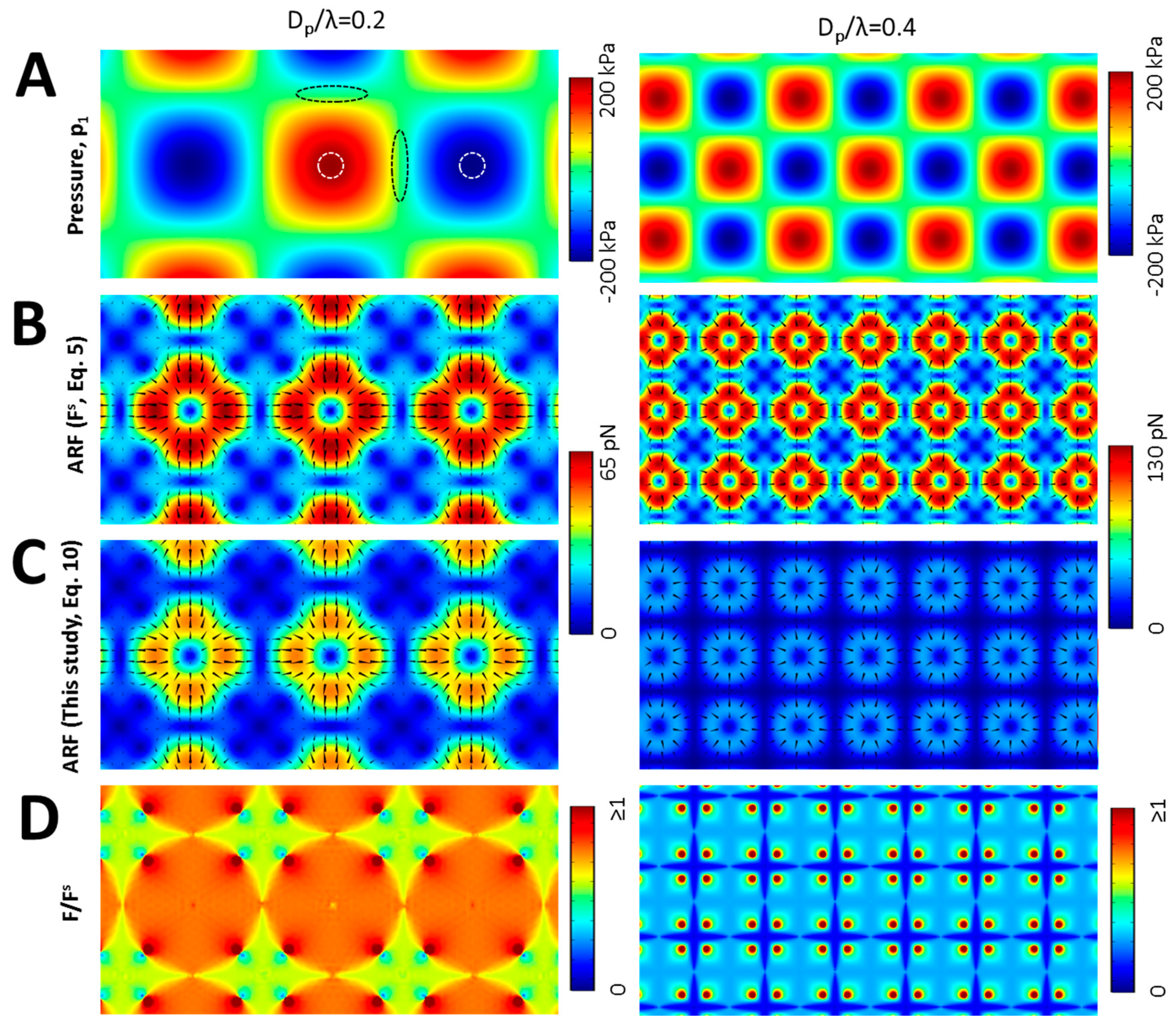
3.3. Multidirectional Standing Acoustic Waves
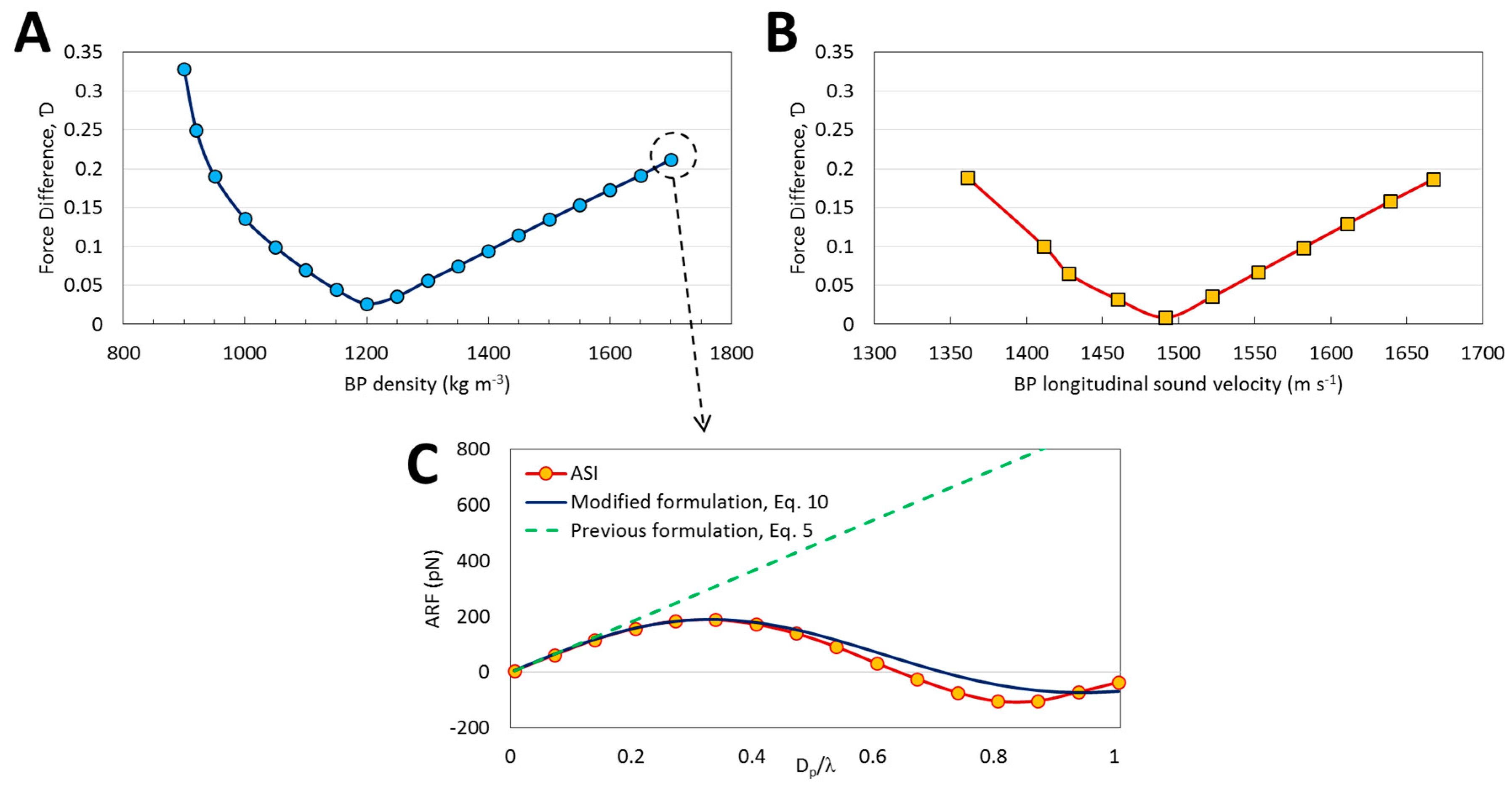
3.4. Range of Validity
4. Conclusions
Supplementary Materials
Acknowledgments
Author Contributions
Conflicts of interest
References
- Antfolk, M.; Laurell, T. Continuous flow microfluidic separation and processing of rare cells and bioparticles found in blood—A review. Anal. Chim. Acta 2017, 965, 9–35. [Google Scholar] [CrossRef] [Scilit] [PubMed]
- Jubery, T.Z.; Srivastava, S.K.; Dutta, P. Dielectrophoretic separation of bioparticles in microdevices: A review. Electrophoresis 2014, 35, 691–713. [Google Scholar] [CrossRef] [Scilit] [PubMed]
- Gholizadeh, S.; Draz, M.S.; Zarghooni, M.; Sanati-Nezhad, A.; Ghavami, S.; Shafiee, H.; Akbari, M. Microfluidic approaches for isolation, detection, and characterization of extracellular vesicles: Current status and future directions. Biosens. Bioelectron. 2017, 91, 588–605. [Google Scholar] [CrossRef] [Scilit] [PubMed]
- Lee, K.; Shao, H.; Weissleder, R.; Lee, H. Acoustic purification of extracellular microvesicles. ACS Nano 2015, 9, 2321–2327. [Google Scholar] [CrossRef] [Scilit] [PubMed]
- Shao, H.; Chung, J.; Balaj, L.; Charest, A.; Bigner, D.D.; Carter, B.S.; Hochberg, F.H.; Breakefield, X.O.; Weissleder, R.; Lee, H. Protein typing of circulating microvesicles allows real-time monitoring of glioblastoma therapy. Nat. Med. 2012, 18, 1835–1840. [Google Scholar] [CrossRef] [Scilit] [PubMed]
- Li, P.; Mao, Z.; Peng, Z.; Zhou, L.; Chen, Y.; Huang, P.-H.; Truica, C.I.; Drabick, J.J.; El-Deiry, W.S.; Dao, M. Acoustic separation of circulating tumor cells. Proc. Natl. Acad. Sci. USA 2015, 112, 4970–4975. [Google Scholar] [CrossRef] [Scilit] [PubMed]
- Xia, Y.; Tang, Y.; Yu, X.; Wan, Y.; Chen, Y.; Lu, H.; Zheng, S.-Y. Label-free virus capture and release by a microfluidic device integrated with porous silicon nanowire forest. Small 2017, 13, 1603135. [Google Scholar] [CrossRef] [Scilit] [PubMed]
- Barani, A.; Paktinat, H.; Janmaleki, M.; Mohammadi, A.; Mosaddegh, P.; Fadaei-Tehrani, A.; Sanati-Nezhad, A. Microfluidic integrated acoustic waving for manipulation of cells and molecules. Biosens. Bioelectron. 2016, 85, 714–725. [Google Scholar] [CrossRef] [Scilit] [PubMed]
- Guven, S.; Chen, P.; Inci, F.; Tasoglu, S.; Erkmen, B.; Demirci, U. Multiscale assembly for tissue engineering and regenerative medicine. Trends Biotechnol. 2015, 33, 269–279. [Google Scholar] [CrossRef] [Scilit] [PubMed]
- Hasan, A.; Saliba, J.; Modarres, H.P.; Bakhaty, A.; Nasajpour, A.; Mofrad, M.R.; Sanati-Nezhad, A. Micro and nanotechnologies in heart valve tissue engineering. Biomaterials 2016, 103, 278–292. [Google Scholar] [CrossRef] [Scilit] [PubMed]
- Maltsev, V.P.; Semyanov, K.A. Characterisation of Bio-Particles from Light Scattering; De Gruyter: Berlin, Germany, 2004; Volume 6, pp. 5779–5787. [Google Scholar]
- Chen, G.D.; Alberts, C.J.; Rodriguez, W.; Toner, M. Concentration and purification of human immunodeficiency virus type 1 virions by microfluidic separation of superparamagnetic nanoparticles. Anal. Chem. 2009, 82, 723–728. [Google Scholar] [CrossRef] [Scilit] [PubMed]
- Ding, X.; Li, P.; Lin, S.-C.S.; Stratton, Z.S.; Nama, N.; Guo, F.; Slotcavage, D.; Mao, X.; Shi, J.; Costanzo, F. Surface acoustic wave microfluidics. Lab Chip 2013, 13, 3626–3649. [Google Scholar] [CrossRef] [Scilit] [PubMed]
- Ding, X.; Lin, S.-C.S.; Kiraly, B.; Yue, H.; Li, S.; Chiang, I.-K.; Shi, J.; Benkovic, S.J.; Huang, T.J. On-chip manipulation of single microparticles, cells, and organisms using surface acoustic waves. Proc. Natl. Acad. Sci. USA 2012, 109, 11105–11109. [Google Scholar] [CrossRef] [Scilit] [PubMed]
- Guo, F.; Mao, Z.; Chen, Y.; Xie, Z.; Lata, J.P.; Li, P.; Ren, L.; Liu, J.; Yang, J.; Dao, M. Three-dimensional manipulation of single cells using surface acoustic waves. Proc. Natl. Acad. Sci. USA 2016, 113, 1522–1527. [Google Scholar] [CrossRef] [Scilit] [PubMed]
- Bouyer, C.; Chen, P.; Güven, S.; Demirtaş, T.T.; Nieland, T.J.; Padilla, F.; Demirci, U. A bio-acoustic levitational (BAL) assembly method for engineering of multilayered, 3d brain-like constructs, using human embryonic stem cell derived neuro-progenitors. Adv. Mater. 2016, 28, 161–167. [Google Scholar] [CrossRef] [Scilit] [PubMed]
- Garvin, K.A.; Dalecki, D.; Yousefhussien, M.; Helguera, M.; Hocking, D.C. Spatial patterning of endothelial cells and vascular network formation using ultrasound standing wave fields. J. Acoust. Soc. Am. 2013, 134, 1483–1490. [Google Scholar] [CrossRef] [Scilit] [PubMed]
- Naseer, S.M.; Manbachi, A.; Samandari, M.; Walch, P.; Gao, Y.; Zhang, Y.S.; Davoudi, F.; Wang, W.; Abrinia, K.; Cooper, J.M.; et al. Surface acoustic waves induced micropatterning of cells in gelatin methacryloyl (gelma) hydrogels. Biofabrication 2017, 9, 015020. [Google Scholar] [CrossRef] [Scilit] [PubMed]
- Wu, M.; Mao, Z.; Chen, K.; Bachman, H.; Chen, Y.; Rufo, J.; Ren, L.; Li, P.; Wang, L.; Huang, T.J. Acoustic separation of nanoparticles in continuous flow. Adv. Funct. Mater. 2017, 27. [Google Scholar] [CrossRef] [Scilit]
- Collins, D.J.; Morahan, B.; Garcia-Bustos, J.; Doerig, C.; Plebanski, M.; Neild, A. Two-dimensional single-cell patterning with one cell per well driven by surface acoustic waves. Nat. Commun. 2015, 6, 8686. [Google Scholar] [CrossRef] [Scilit] [PubMed]
- King, L.V. On the acoustic radiation pressure on spheres. In Proceedings of the Royal Society of London A: Mathematical, Physical and Engineering Sciences; The Royal Society: London, UK, 1934; Volume 147, pp. 212–240. [Google Scholar]
- Yosioka, K.; Kawasima, Y. Acoustic radiation pressure on a compressible sphere. Acta Acust. United Acust. 1955, 5, 167–173. [Google Scholar]
- Gor’Kov, L. On the forces acting on a small particle in an acoustical field in an ideal fluid. Sov. Phys. Dokl. 1962, 6, 773. [Google Scholar]
- Muller, P.B.; Barnkob, R.; Jensen, M.J.H.; Bruus, H. A numerical study of microparticle acoustophoresis driven by acoustic radiation forces and streaming-induced drag forces. Lab Chip 2012, 12, 4617–4627. [Google Scholar] [CrossRef] [Scilit] [PubMed]
- Karlsen, J.T.; Bruus, H. Forces acting on a small particle in an acoustical field in a thermoviscous fluid. Phys. Rev. E 2015, 92, 043010. [Google Scholar] [CrossRef] [Scilit] [PubMed]
- Settnes, M.; Bruus, H. Forces acting on a small particle in an acoustical field in a viscous fluid. Phys. Rev. E 2012, 85, 016327. [Google Scholar] [CrossRef] [Scilit] [PubMed]
- Hasegawa, T.; Yosioka, K. Acoustic-radiation force on a solid elastic sphere. J. Acoust. Soc. Am. 1969, 46, 1139–1143. [Google Scholar] [CrossRef] [Scilit]
- Hasegawa, T. Acoustic radiation force on a sphere in a quasistationary wave field—Theory. J. Acoust. Soc. Am. 1979, 65, 32–40. [Google Scholar] [CrossRef] [Scilit]
- Glynne-Jones, P.; Mishra, P.P.; Boltryk, R.J.; Hill, M. Efficient finite element modeling of radiation forces on elastic particles of arbitrary size and geometry. J. Acoust. Soc. Am. 2013, 133, 1885–1893. [Google Scholar] [CrossRef] [Scilit] [PubMed]
- Drinkwater, B.W. Dynamic-field devices for the ultrasonic manipulation of microparticles. Lab Chip 2016, 16, 2360–2375. [Google Scholar] [CrossRef] [Scilit] [PubMed]
- Cai, F.; Meng, L.; Jiang, C.; Pan, Y.; Zheng, H. Computation of the acoustic radiation force using the finite-difference time-domain method. J. Acoust. Soc. Am. 2010, 128, 1617–1622. [Google Scholar] [CrossRef] [Scilit] [PubMed]
- Grinenko, A.; Wilcox, P.; Courtney, C.; Drinkwater, B. Acoustic radiation force analysis using finite difference time domain method. J. Acoust. Soc. Am. 2012, 131, 3664–3670. [Google Scholar] [CrossRef] [Scilit] [PubMed]
- Bruus, H. Acoustofluidics 2: Perturbation theory and ultrasound resonance modes. Lab Chip 2012, 12, 20–28. [Google Scholar] [CrossRef] [Scilit] [PubMed]
- Ai, Y.; Sanders, C.K.; Marrone, B.L. Separation of escherichia coli bacteria from peripheral blood mononuclear cells using standing surface acoustic waves. Anal. Chem. 2013, 85, 9126–9134. [Google Scholar] [CrossRef] [Scilit] [PubMed]
- Muller, P.B.; Bruus, H. Numerical study of thermoviscous effects in ultrasound-induced acoustic streaming in microchannels. Phys. Rev. E 2014, 90, 043016. [Google Scholar] [CrossRef] [Scilit] [PubMed]
- Bruus, H. Acoustofluidics 7: The acoustic radiation force on small particles. Lab Chip 2012, 12, 1014–1021. [Google Scholar] [CrossRef] [Scilit] [PubMed]
- Samandari, M.; Abrinia, K.; Mokhtari-Dizaji, M.; Tamayol, A. Ultrasound induced strain cytoskeleton rearrangement: An experimental and simulation study. J. Biomech. 2017, 60, 39–47. [Google Scholar] [CrossRef] [Scilit] [PubMed]
- Hartono, D.; Liu, Y.; Tan, P.L.; Then, X.Y.S.; Yung, L.-Y.L.; Lim, K.-M. On-chip measurements of cell compressibility via acoustic radiation. Lab Chip 2011, 11, 4072–4080. [Google Scholar] [CrossRef] [Scilit] [PubMed]
- Nama, N.; Barnkob, R.; Mao, Z.; Kähler, C.J.; Costanzo, F.; Huang, T.J. Numerical study of acoustophoretic motion of particles in a pdms microchannel driven by surface acoustic waves. Lab Chip 2015, 15, 2700–2709. [Google Scholar] [CrossRef] [Scilit] [PubMed]
- Morley, M.J. Derivation of physical properties of muscle tissue from adiabatic pressure-induced temperature measurements. Int. J. Food Sci. Technol. 1986, 21, 269–277. [Google Scholar] [CrossRef] [Scilit]
- Rabin, Y.; Plitz, J. Thermal expansion of blood vessels and muscle specimens permeated with dmso, dp6, and vs55 at cryogenic temperatures. Ann. Biomed. Eng. 2005, 33, 1213–1228. [Google Scholar] [CrossRef] [Scilit] [PubMed]
- Rodrigues, D.B.; Maccarini, P.F.; Salahi, S.; Colebeck, E.; Topsakal, E.; Pereira, P.J.S.; Limão-Vieira, P.; Stauffer, P.R. Numerical 3d modeling of heat transfer in human tissues for microwave radiometry monitoring of brown fat metabolism. Proc. SPIE 2013, 8584. [Google Scholar] [CrossRef] [Scilit]
- O’Brien, W.D. Ultrasound—biophysics mechanisms. Prog. Biophys. Mol. Biol. 2007, 93, 212–255. [Google Scholar] [PubMed]
- Ding, X.; Peng, Z.; Lin, S.-C.S.; Geri, M.; Li, S.; Li, P.; Chen, Y.; Dao, M.; Suresh, S.; Huang, T.J. Cell separation using tilted-angle standing surface acoustic waves. Proc. Natl. Acad. Sci. USA 2014, 111, 12992–12997. [Google Scholar] [CrossRef] [Scilit] [PubMed]
- Wang, H.; Liu, Z.; Shin, D.M.; Chen, Z.; Cho, Y.; Jang, D.-Y.; Kim, Y.-J.; Han, A. Acoustophoretic force-based compressibility measurement of cancer cells having different metastatic potential. In Proceedings of the Meetings on Acoustics ICA2013, Montreal, QC, Canada, 2–7 June 2013; ASA: Monroe, MI, USA, 2013. [Google Scholar]
- Gesellchen, F.; Bernassau, A.; Dejardin, T.; Cumming, D.; Riehle, M. Cell patterning with a heptagon acoustic tweezer–application in neurite guidance. Lab Chip 2014, 14, 2266–2275. [Google Scholar] [CrossRef] [Scilit] [PubMed]
- Guo, F.; Li, P.; French, J.B.; Mao, Z.; Zhao, H.; Li, S.; Nama, N.; Fick, J.R.; Benkovic, S.J.; Huang, T.J. Controlling cell–cell interactions using surface acoustic waves. Proc. Natl. Acad. Sci. USA 2015, 112, 43–48. [Google Scholar] [CrossRef] [Scilit] [PubMed]
- Kinsler, L.E. Fundamentals of Acoustics, 4th ed.; Wiley: Hoboken, NJ, USA, 2000; ISBN 978-0-471-84789-2. [Google Scholar]

| Property | Fluid (a) | BP | Symbol | Unit |
|---|---|---|---|---|
| Density | 1.0 × 10³ | 1.079 × 10³ (c) | kg m−3 | |
| Shear modulus | - | 1.67 × 10³ (c) | G | Pa |
| Isentropic compressibility | 4.433 × 10⁻¹⁰ (b) | 3.78 × 10⁻¹⁰ (c) | β | Pa−1 |
| Thermal expansion | 2.748 × 10⁻⁴ | 2.0 × 10⁻⁴ (d) | α | K−1 |
| Specific heat capacity at constant pressure | 4.181 × 10³ | 3.421 × 10³ (e) | hc | J kg−1K−1 |
| Ratio of specific heats | 1.012 | 1.012 (f) | γ | 1 |
| Thermal conductivity | 6.095 × 10⁻¹ | 4.9 × 10⁻¹ (e) | kt | Wm−1K−1 |
| Longitudinal (compressional) wave speed | 1.502 × 10³ | 1.566 × 10³ (g) | c | m s−1 |
| Transvers (shear) wave speed | - | 1.244 × 10³ (h) | cs | m s−1 |
| Shear viscosity | 8.538 × 10⁻⁴ | - | μ | Pa s |
| Bulk viscosity | 2.4 × 10⁻³ | - | μb | Pa s |
© 2017 by the authors. Licensee MDPI, Basel, Switzerland. This article is an open access article distributed under the terms and conditions of the Creative Commons Attribution (CC BY) license (http://creativecommons.org/licenses/by/4.0/).
Share and Cite
Samandari, M.; Abrinia, K.; Sanati-Nezhad, A. Acoustic Manipulation of Bio-Particles at High Frequencies: An Analytical and Simulation Approach. Micromachines 2017, 8, 290. https://doi.org/10.3390/mi8100290
Samandari M, Abrinia K, Sanati-Nezhad A. Acoustic Manipulation of Bio-Particles at High Frequencies: An Analytical and Simulation Approach. Micromachines. 2017; 8(10):290. https://doi.org/10.3390/mi8100290
Chicago/Turabian StyleSamandari, Mohamadmahdi, Karen Abrinia, and Amir Sanati-Nezhad. 2017. "Acoustic Manipulation of Bio-Particles at High Frequencies: An Analytical and Simulation Approach" Micromachines 8, no. 10: 290. https://doi.org/10.3390/mi8100290
APA StyleSamandari, M., Abrinia, K., & Sanati-Nezhad, A. (2017). Acoustic Manipulation of Bio-Particles at High Frequencies: An Analytical and Simulation Approach. Micromachines, 8(10), 290. https://doi.org/10.3390/mi8100290

