1. Introduction
Adaptive optics (AO) [
1,
2] is an optical technique that improves imaging quality by compensating for wavefront aberrations caused by atmospheric turbulence, optical imperfections, and other environmental disturbances. Owing to its excellent wavefront correction capability, AO has been widely applied in astronomical observation, biological microscopy, laser beam transmission, free-space optical communication, and high-resolution imaging [
3,
4,
5,
6]. Recent advances in adaptive optics have further extended its applications beyond conventional wavefront correction toward more flexible optical field regulation and performance optimization. For example, adaptive optics has been applied in advanced optical manufacturing processes, where accurate wavefront manipulation is essential for improving processing efficiency and precision [
7]. Moreover, intensity-based adaptive optics has demonstrated the potential of using intensity information as feedback for optical optimization, providing new possibilities for sensor-independent adaptive correction strategies [
8]. The fundamental principle of an AO system is to compensate for aberrated wavefronts using a wavefront corrector. Among the commonly used wavefront correction devices, deformable mirrors (DMs) [
9,
10,
11,
12] have become one of the most widely adopted components. In particular, micro-electro-mechanical system (MEMS) deformable mirrors feature a compact structure, high actuator integration, fast response, and high control accuracy. By applying appropriate control signals to individual actuators, the mirror surface can be dynamically deformed to compensate for wavefront aberrations induced by atmospheric turbulence, optical system errors, and other disturbances. For multi-actuator MEMS deformable mirrors, the wavefront fitting capability and closed-loop correction performance are jointly determined by the actuator configuration, response characteristics, and the control algorithm.
Unlike conventional AO systems, wavefront sensorless AO systems eliminate the need for a wavefront sensor and directly construct a closed-loop feedback based on image quality metrics. The control algorithm generates the driving signals for the deformable mirror to compensate for wavefront aberrations. Among the existing control methods, the stochastic parallel gradient descent (SPGD) algorithm [
13,
14,
15] is widely adopted because of its simple implementation, parallel architecture, and strong robustness. However, the conventional SPGD algorithm employs a fixed gain coefficient, which often results in slow convergence, limited adaptability, and local oscillations under varying turbulence conditions or complex wavefront aberrations. These limitations restrict its application in real-time wavefront correction.
Conventional SPGD algorithms usually employ fixed gain coefficients, which may result in slow convergence or insufficient adaptability under complex wavefront aberration conditions. Therefore, an optimization strategy with adaptive parameter adjustment capability is desirable for improving the convergence performance of SPGD-based AO control systems. Relativistic Adaptive Gradient Descent (RAD), proposed by Lyu et al. [
16] in 2024, is an adaptive optimization algorithm with high computational efficiency and adaptive parameter adjustment capability. In addition to adaptively adjusting the gain coefficient, RAD introduces a parameter update velocity constraint to alleviate the influence of abnormal gradients, thereby improving optimization stability and promoting faster convergence. These characteristics make RAD a promising optimization strategy for enhancing the convergence performance of SPGD-based control algorithms.
Motivated by the advantages of RAD, this study incorporates the RAD optimizer into the conventional SPGD framework and proposes a RAD-SPGD control algorithm for wavefront sensorless AO systems. A simulation model and a physical experimental platform based on a 97-element MEMS deformable mirror are established to evaluate the proposed algorithm. The convergence speed, correction performance, and adaptability under different turbulence conditions are systematically investigated and compared with those of the conventional SPGD algorithm. The proposed method is expected to improve the real-time closed-loop control performance of wavefront sensorless AO systems.
2. RAD-SPGD Control Algorithm
The stochastic parallel gradient descent (SPGD) algorithm is a model-free optimization method that estimates the gradient direction of the control parameters by applying random perturbations and evaluating the corresponding variation in the system performance metric. In a wavefront sensorless adaptive optics system, the control parameter is the voltage vector applied to the deformable mirror, and the optimization objective is to improve the image-quality metric obtained from the imaging detector.
In the k-th iteration, the control voltage vector applied to the
N actuators of the deformable mirror can be expressed as
where
is the control voltage vector in the k-th iteration, alpha is the gain coefficient,
denotes the random perturbation voltage vector applied to the deformable mirror, and
is the variation in the system performance metric.
During each SPGD iteration, a random perturbation voltage
is first generated. The positive perturbation voltage
is applied to the deformable mirror, and the corresponding detector image is acquired to calculate the performance metric
. Subsequently, the negative perturbation voltage
is applied, and the corresponding performance metric
is obtained. The variation in the performance metric is then calculated as
The control voltage vector is then calculated according to Equation (1) and applied to the deformable mirror. The detector image is acquired to evaluate the correction effect, thereby completing the k-th iteration. If the predefined termination condition is satisfied, the closed-loop control process is terminated, and the correction is completed; otherwise, the system proceeds to the next iteration.
Although SPGD is simple to implement and has strong robustness, its gain coefficient is usually fixed. When the turbulence intensity changes or the wavefront aberration becomes large, a fixed gain cannot simultaneously ensure fast convergence and stable correction, which may lead to slow convergence or local oscillation. To improve the convergence efficiency and correction stability of wavefront sensorless adaptive optics systems, this study introduces the relativistic adaptive gradient descent (RAD) optimizer into the SPGD control framework and proposes the RAD-SPGD control algorithm.
The RAD-SPGD method updates the control parameters by using the long-term stability of a conformal symplectic integrator. In addition, this method combines the exponential moving average with bias correction, making it applicable to general non-convex stochastic optimization problems. This strategy can reduce the influence of abnormal gradient perturbations and stabilize the closed-loop convergence process of the adaptive optics system. The gradient estimate of the first iteration is first obtained according to Equation (2), and the subsequent RAD-SPGD iteration starts from . The RAD-SPGD-based control method for the adaptive optics system mainly consists of the following three stages.
- 1.
First-order momentum update. The first-order momentum represents the exponential moving average of the gradient estimate and reflects the accumulated update direction of the control parameters. In the RAD optimizer, the update velocity of each parameter is adjusted according to the corresponding momentum term. This feature provides parameter-wise adaptive capability and is beneficial for stable convergence in non-convex stochastic optimization. The first-order momentum update rule is given by
where
denotes the first-order momentum in the k-th iteration, and
is the first-order momentum coefficient.
- 2.
Second-order momentum update. The second-order momentum describes the exponential moving average of the squared gradient estimate and is used to adaptively adjust the update amplitude of the control parameters according to the gradient magnitude. The second-order momentum is updated as
where
denotes the second-order momentum in the k-th iteration, and
is the second-order momentum coefficient.
During parameter initialization, the first-order momentum
and the second-order momentum
are generally initialized to zero. This zero initialization may introduce estimation bias in the early stage of the algorithm, thereby affecting the accuracy of parameter updates and the stability of system convergence. Therefore, bias correction is required for the momentum terms. Specifically, the first-order and second-order momentum terms are corrected as follows:
where
and
denote the bias-corrected first-order momentum and second-order momentum, respectively. Through the above correction, the estimation bias introduced by zero initialization in the initial stage of the algorithm can be reduced, thereby improving the stability of the parameter update process.
- 3.
Control parameter update. After the first-order momentum, second-order momentum, and their bias-corrected forms are obtained, the control parameters of RAD-SPGD are further updated. The update rule for the control parameter is expressed as
where
denotes the adaptive gain term,
denotes the bias-corrected first-order momentum term,
denotes the velocity coefficient, which controls the magnitude of the adaptive update by regulating the gradient normalization term. A larger enhances the gradient normalization effect, reduces the update amplitude in each iteration, and improves the stability of the algorithm. In contrast, a smaller weakens the update constraint and increases the response speed, but may introduce a higher risk of oscillation during the iterative process. Therefore, plays a balancing role between convergence speed and stability in RAD-SPGD.
represents a stability factor introduced into the adaptive gradient normalization term. It regulates the denominator of the update equation to prevent numerical instability caused by excessively small values and limits abnormal update steps. In both the numerical simulations and physical experiments, the parameters were set as
= 0.9,
= 0.999,
= 0.04 and
= 0.75. The four parameters were initially selected according to the recommended settings of the original RAD algorithm and further verified through parameter searching in the proposed AO system. The initial value of
was set to 10
−16, and in the k-th iteration it was defined as
In summary, RAD-SPGD retains the advantages of SPGD, including independence from a wavefront sensor, simple implementation, and strong robustness. Meanwhile, by introducing adaptive gain regulation, bias correction, and a constraint on the parameter update velocity, the proposed method can effectively reduce the influence of abnormal gradient perturbations and improve the stability and convergence speed of closed-loop correction in wavefront sensorless adaptive optics systems.
3. System Description
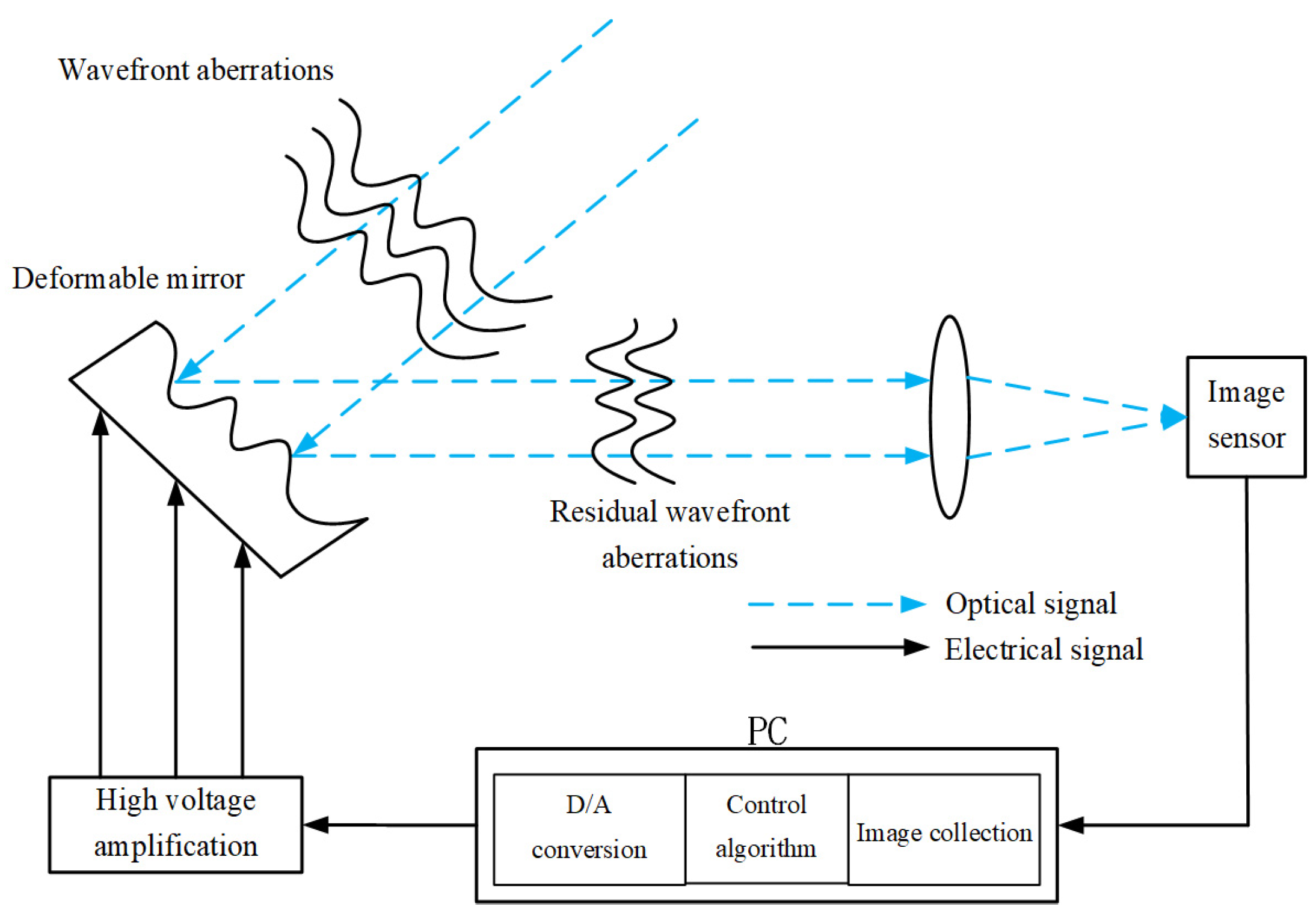
The RAD-SPGD-based wavefront sensorless AO system is shown in
Figure 1. It mainly consists of a wavefront corrector, namely a 97-element MEMS deformable mirror, an image sensor, and a control module. The distorted wavefront is reflected by the deformable mirror and then imaged onto the image sensor through an imaging lens. The control module acquires the imaging information from the image sensor and generates the control signals for the deformable mirror using the RAD-SPGD control method. The control signals are applied to the actuators of the deformable mirror through a high-voltage amplifier, thereby producing a compensating phase. Subsequently, the residual wavefront is used as the input for further closed-loop correction until the predefined condition is satisfied.
According to the operating principle of the deformable mirror, the compensating surface profile
generated by the deformable mirror can be expressed as a linear combination of the influence functions of all actuators:
where
is the influence function of the (i)-th actuator, and
is the control voltage applied to the (i)-th actuator.
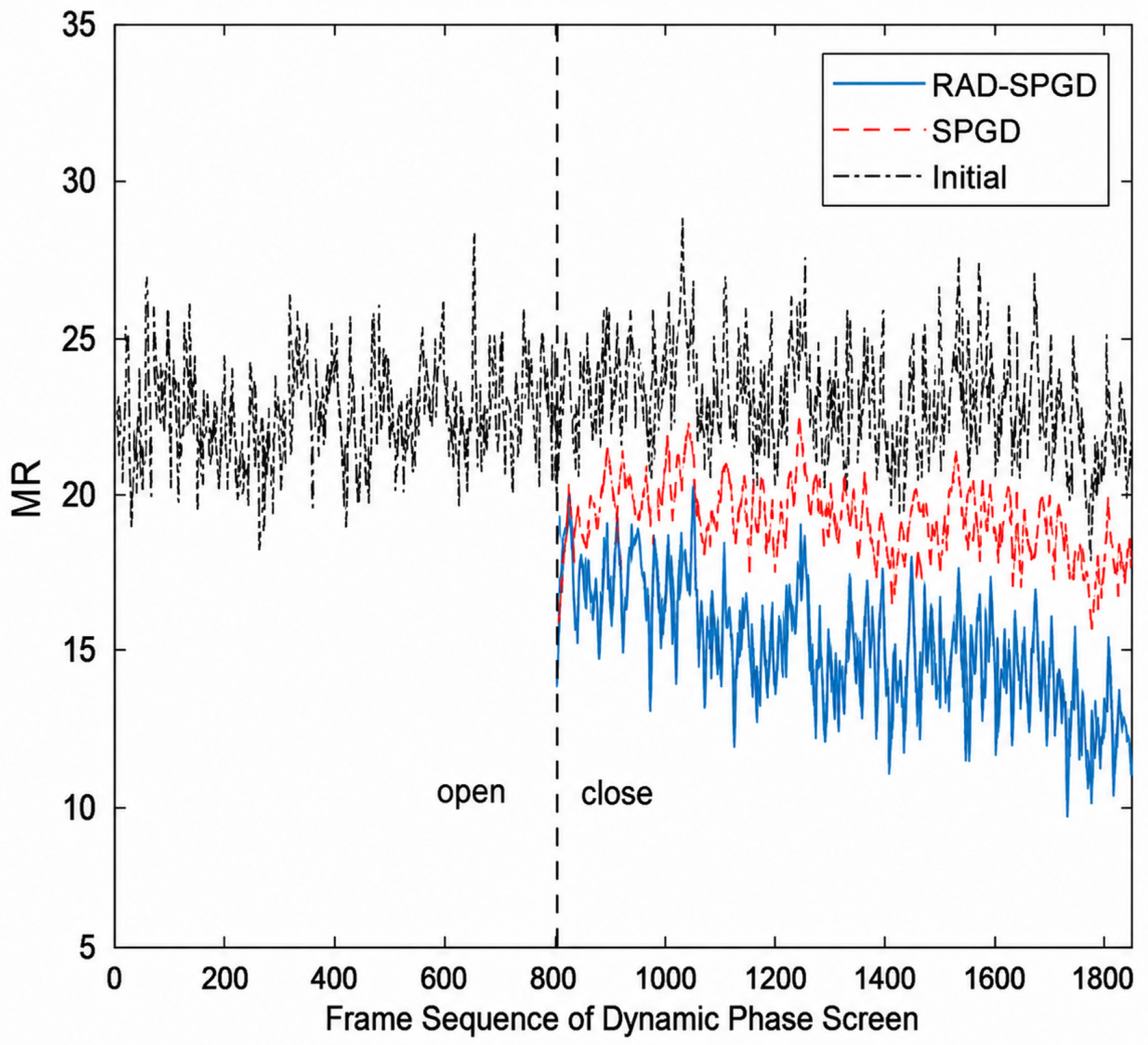
In the simulations, the Strehl ratio (SR) and mean radius (MR) were used as performance metrics to evaluate the correction performance of the AO system [
17,
18]. The SR is defined as follows:
where
is the far-field intensity distribution corresponding to the aberrated wavefront, and
is the far-field intensity distribution corresponding to the ideal plane wavefront. A larger SR indicates better correction capability of the AO system, and the maximum value of SR is 1.
The MR is defined as follows:
where
represents the distance between the spot coordinate
and the centroid
on the image plane. A smaller MR indicates a smaller aberration.
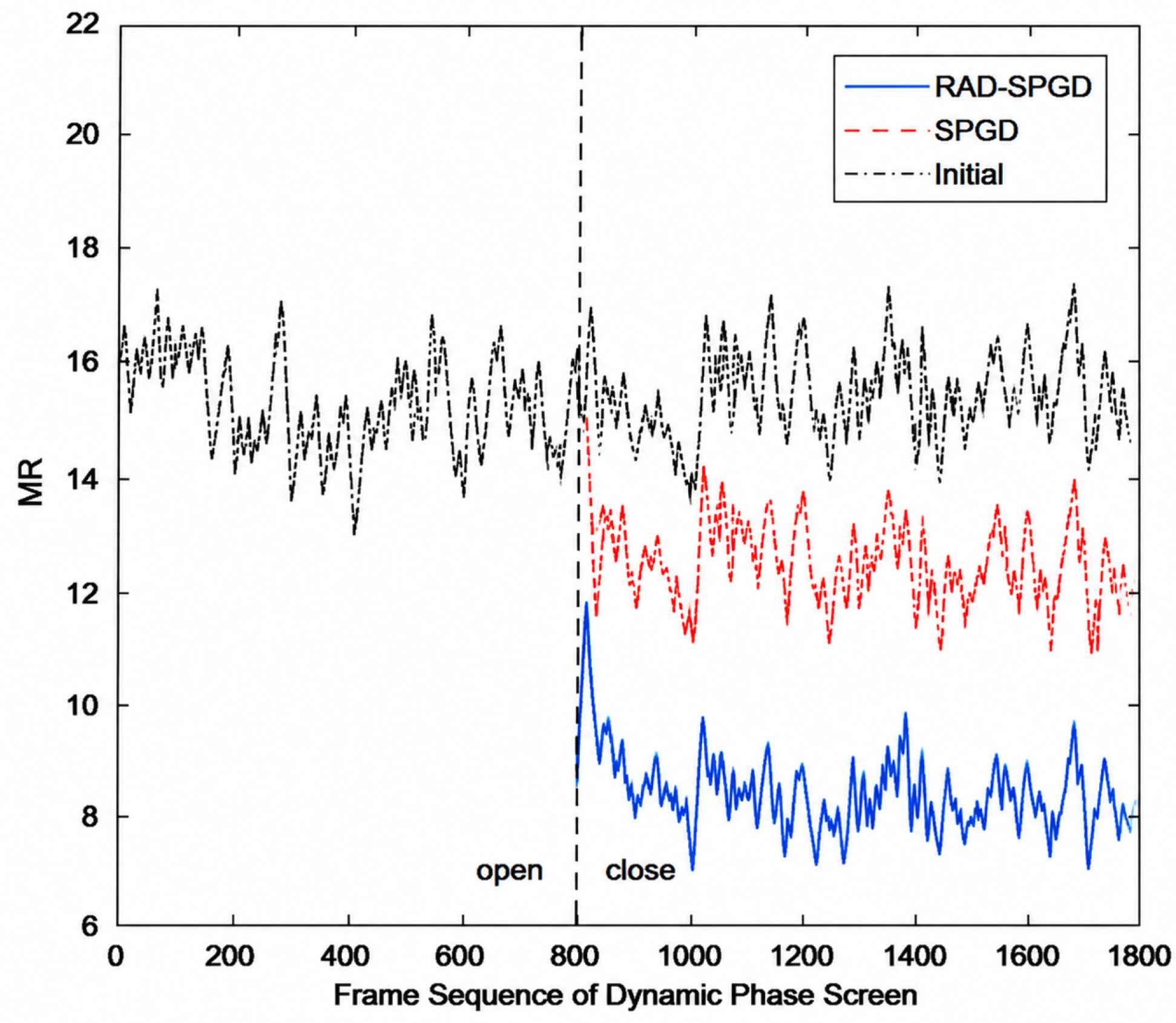
In this study, SR was adopted as the performance metric for the static aberration correction simulations, whereas MR was used for the dynamic aberration correction simulations and experimental validation to assess the correction performance of RAD-SPGD.
5. Experimental Results and Analysis
Physical experiments were conducted under the quasi-static system aberration inherent to the experimental platform to validate the proposed algorithm. In the physical experiment, the quasi-static system aberration is mainly composed of the initial surface deformation of the deformable mirror, residual optical aberrations, and alignment errors of the experimental platform. A 97-element MEMS deformable mirror (DM97-25, ALPAO) was employed as the wavefront corrector, and its main specifications are listed in
Table 1. The deformable mirror consists of 97 actuators that generate continuous mirror surface deformation for wavefront aberration compensation.
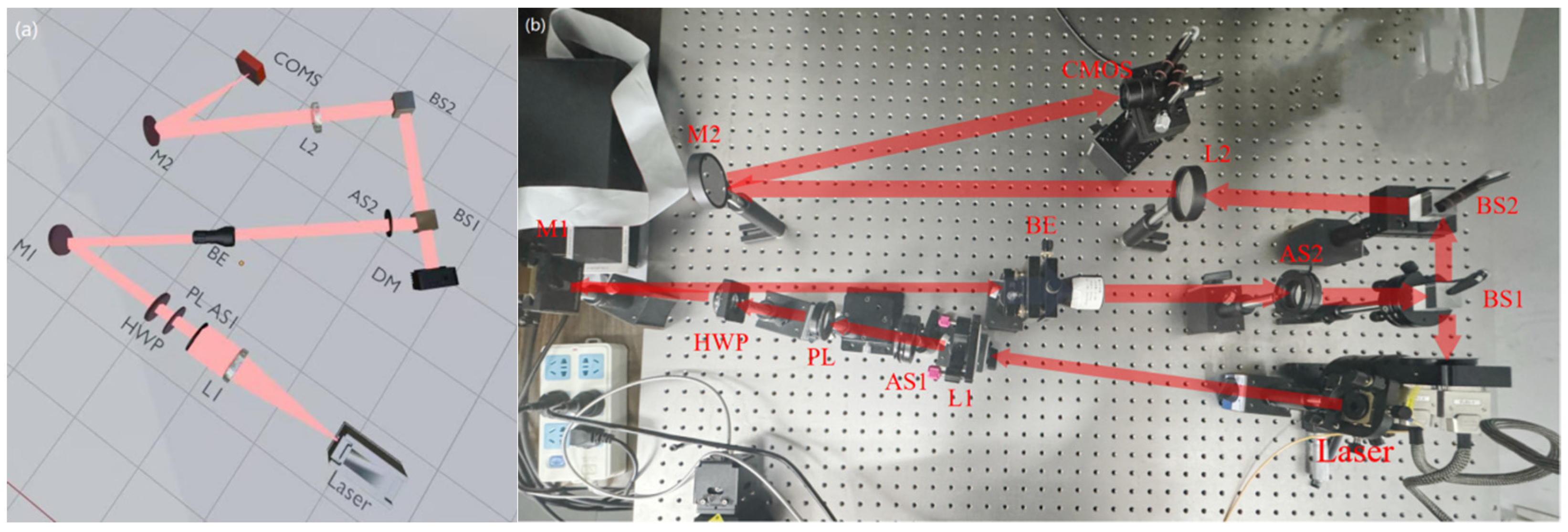
The experimental optical system is shown in
Figure 8, where
Figure 8a illustrates the optical layout and
Figure 8b presents the experimental setup. The laser beam passes through lens L1, aperture stop AS1, polarizer PL, and half-wave plate (HWP), and is then reflected by mirror M1. After passing through a 2.5× beam expander (BE), the expanded beam is reflected by beam splitter BS1 onto the deformable mirror (DM). The reflected beam subsequently passes through beam splitter BS2 and is focused by lens L2 (f = 1000 mm), before being reflected by mirror M2 onto the camera sensor. The polarizer is used to suppress the polarization noise of the laser source, while the HWP ensures proper beam polarization before reflection by M1. Under this optical configuration, the diffraction-limited Airy spot corresponds to an MR value of approximately 28 pixels.
The spot image acquired by the camera is transmitted to a computer in real time. A Prime BSI Express camera was used for focal spot image acquisition in the experiment. The camera is equipped with a 4.2-megapixel sensor with a sensor size of 13.3 mm × 13.3 mm, and the maximum acquisition frame rate is 43 fps under 16-bit operation mode. During data processing, a region of interest (ROI) was selected to facilitate focal spot visualization and MR calculation. The control algorithm calculates the image quality metric (MR) and generates the corresponding driving signals for the deformable mirror. The control signals are output through a D/A conversion board, amplified by a high-voltage amplifier, and applied to the 97 actuators of the deformable mirror to produce the required mirror surface deformation. The algorithm iteratively updates the actuator voltages until the preset maximum number of iterations or the convergence criterion is reached. All control algorithms were implemented in MATLAB R2022b.
During the closed-loop correction experiments, the 97-element MEMS deformable mirror served as the wavefront correction element, and its correction performance was jointly determined by the responses of all actuators under the applied control voltages. Based on the focal-plane spot image acquired by the camera, the control algorithm calculated the image quality metric (MR) and iteratively updated the control voltages of all actuators with the objective of minimizing the MR value. As the control voltages were continuously adjusted, the deformable mirror generated a continuous mirror surface deformation to compensate for the aberrated wavefront, thereby reducing the residual wavefront error and gradually concentrating the focal-plane spot. Therefore, the converged MR value, convergence speed, spot concentration after correction, and peak intensity were adopted to evaluate the closed-loop correction performance of the 97-element MEMS deformable mirror under different control algorithms.
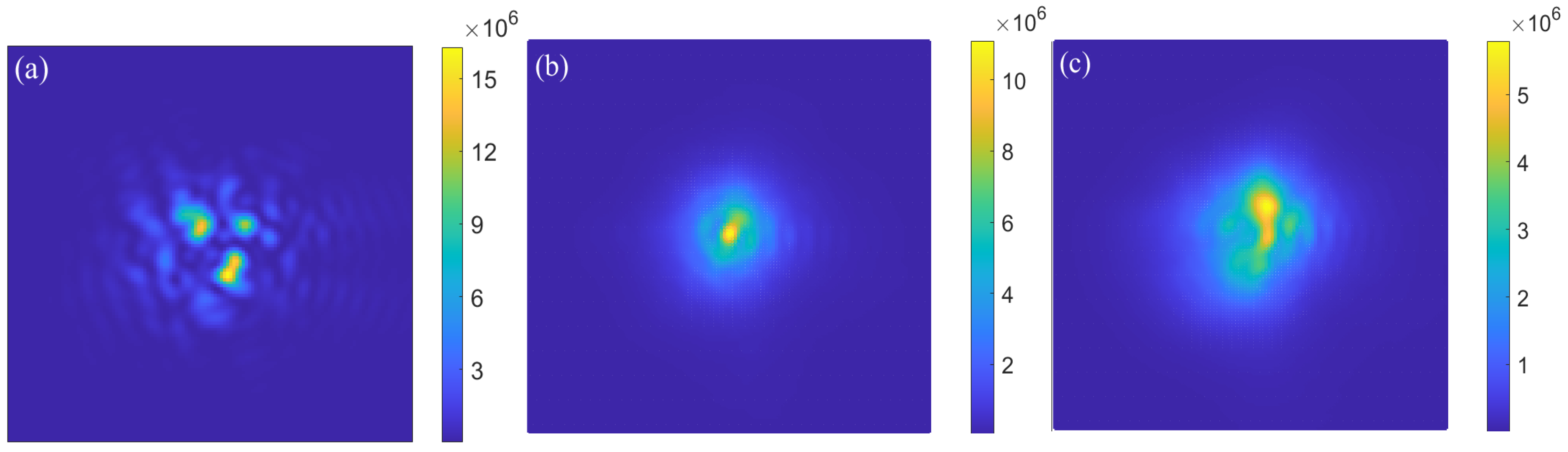
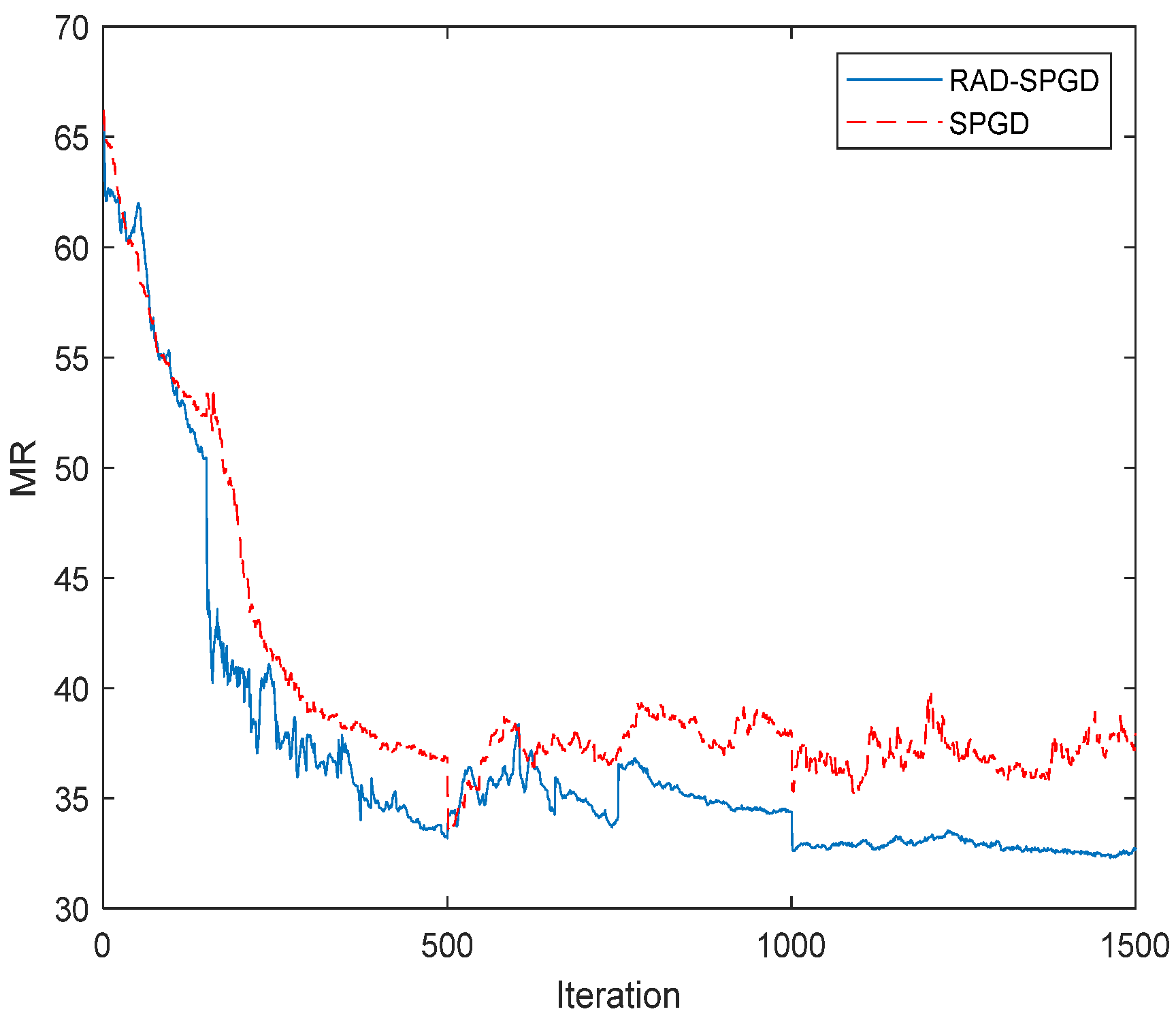
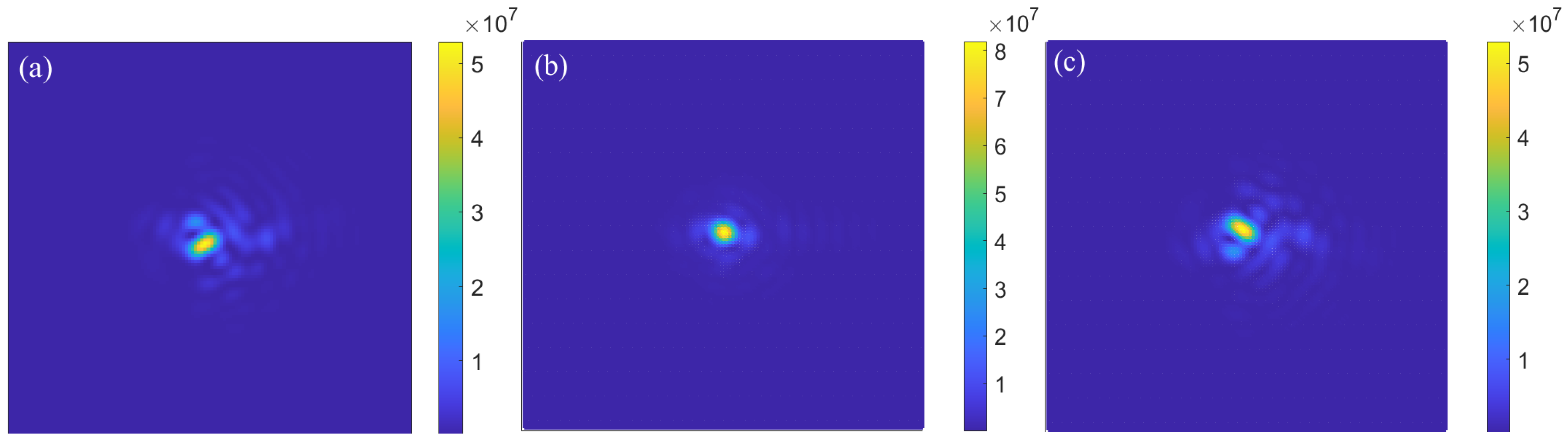
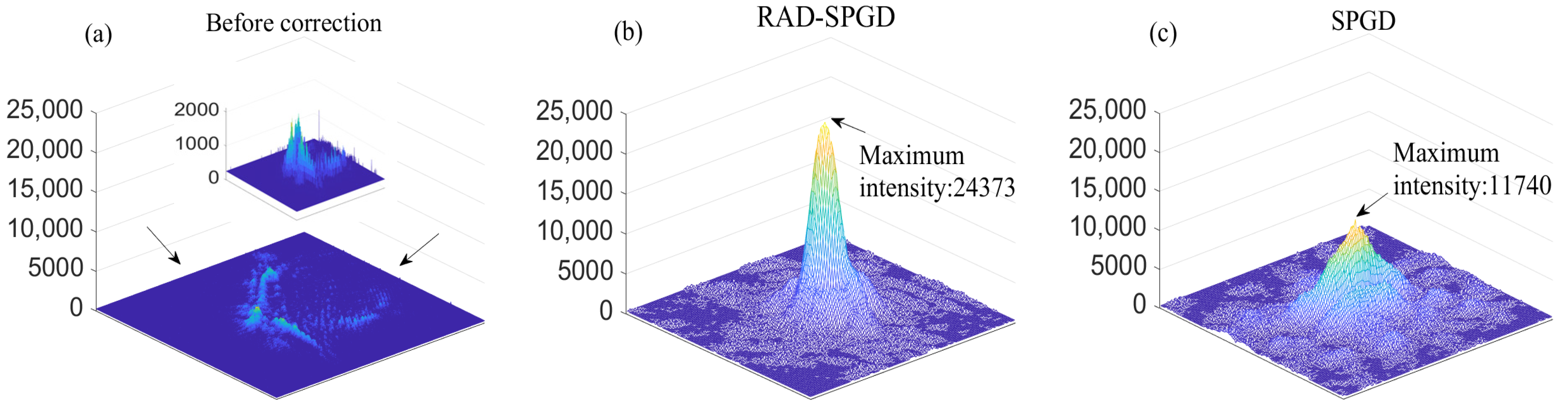
In the experiments, RAD-SPGD and SPGD were used as the control algorithms to correct the distorted wavefronts. The experimental results correspond to a single independent trial under fixed optical and acquisition conditions, and the same conditions were maintained for both RAD-SPGD and SPGD to ensure a fair comparison. The focal spot images before and after correction and the MR convergence curves are shown in
Figure 9 and
Figure 10, respectively. As shown in
Figure 9 and
Figure 10, RAD-SPGD outperforms SPGD in terms of both the focal spot distribution and the convergence behavior.
In
Figure 9, the maximum pixel intensity value of the corrected focal spot image obtained by the RAD-SPGD-based wavefront sensorless AO system was 24,373, which was higher than that obtained by SPGD (11,740). In addition, the focal spot corrected by RAD-SPGD was more concentrated and exhibited a smaller degree of dispersion. In this study, peak intensity is defined as the maximum value of the focal plane captured by the camera. All images acquired via the RAD-SPGD and SPGD algorithms were obtained under identical experimental conditions, including consistent optical configuration, camera parameters and exposure settings. No intensity normalization was performed on the collected raw images. As shown in
Figure 10, both algorithms achieved convergence after 1500 iterations. After correction, the MR value of RAD-SPGD decreased from 66.0644 to 32.74, whereas that of SPGD decreased to 37.12. Moreover, RAD-SPGD approached convergence after approximately 1000 iterations, while SPGD required approximately 1400 iterations to converge. Therefore, the correction speed of RAD-SPGD was improved by approximately 28.6% compared with SPGD. Overall, RAD-SPGD demonstrated obvious advantages over SPGD in terms of both correction performance and convergence speed.
To further evaluate the practical implementation capability of the proposed algorithm, the real-time performance and closed-loop bandwidth of the experimental system were further analyzed.
During the implementation of the algorithm, one iteration mainly consists of perturbation signal loading, deformable mirror response, camera acquisition, performance metrics, and control update. The software environment is MATLAB R2022b. Among these factors, the camera acquisition frame rate and the interpreted execution process of MATLAB (version R2022b) play dominant roles in determining the convergence speed of the system. When the hardware and software configurations are fixed, the convergence performance of different control algorithms can be compared under the same experimental conditions.
For the current experimental system, the camera frame rate is 43 fps, and the response time of the deformable mirror is 1.5 ms. The effective closed-loop correction bandwidth of the system was estimated using the following equation:
where the camera frame rate is
= 43 fps and the number of deformable mirror actuators is
N = 97. The calculated theoretical effective correction bandwidth of the system is approximately 0.15 Hz.
The current experimental platform is mainly used to verify the correction performance and convergence advantages of the RAD-SPGD algorithm, rather than to achieve high-speed real-time control. In future work, high-speed cameras, FPGA, or GPU-based hardware acceleration schemes will be considered to optimize image processing and control computation, reduce the iteration time, and further improve the closed-loop bandwidth to achieve faster wavefront correction.
6. Conclusions
A relativistic adaptive gradient descent-based stochastic parallel gradient descent (RAD-SPGD) algorithm was proposed for the closed-loop control of a 97-element MEMS deformable mirror in a wavefront sensorless adaptive optics system. Numerical simulations and physical experiments were conducted to evaluate its convergence performance and correction capability under different turbulence conditions.
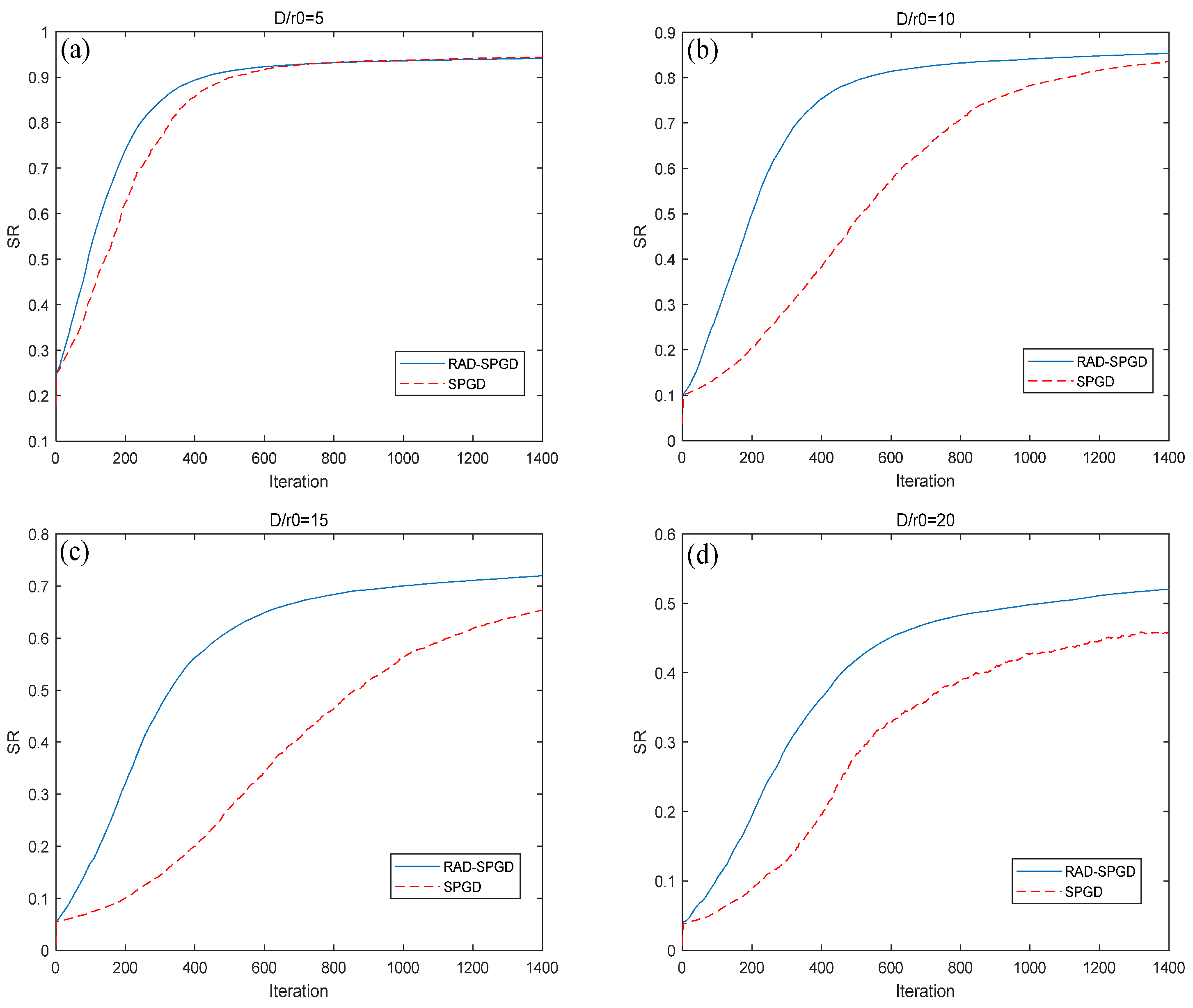
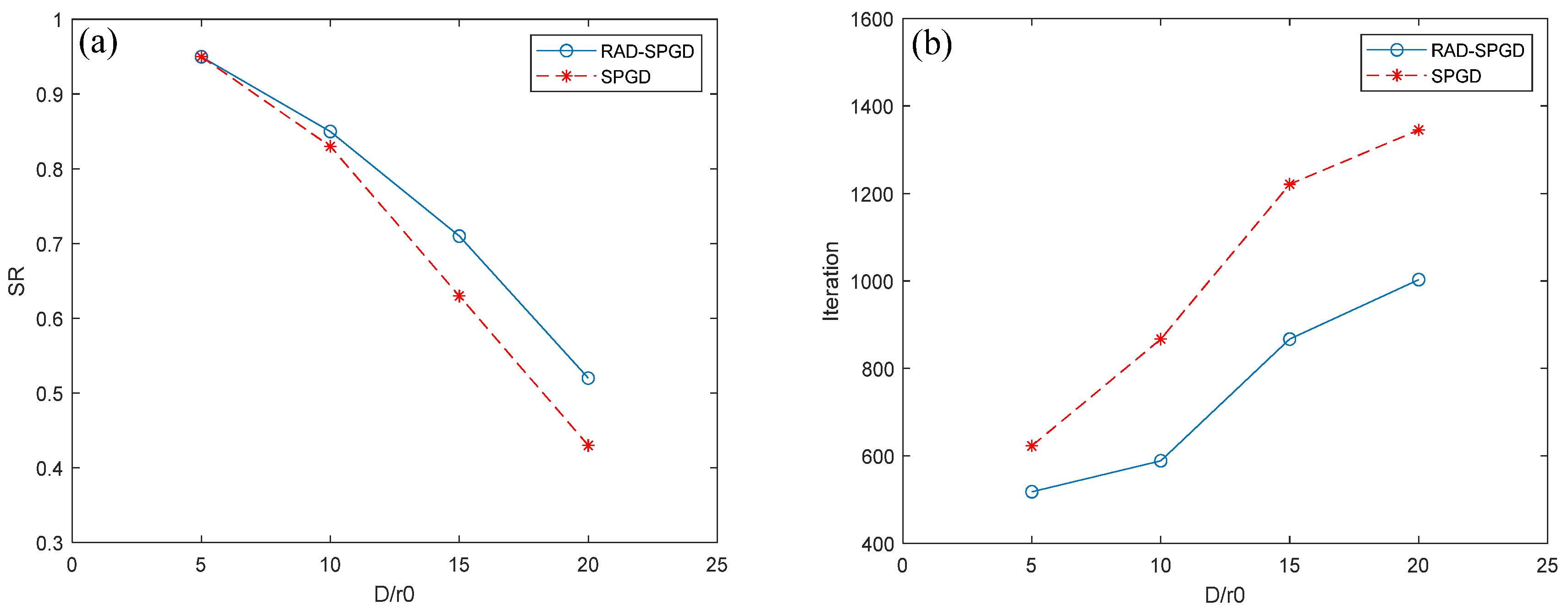
Compared with the conventional SPGD algorithm, the proposed RAD-SPGD algorithm achieved faster convergence while maintaining comparable or superior correction performance. In particular, the correction speed was improved by approximately 47%, 62%, 60%, and 58% under turbulence strengths of 5, 10, 15, and 20, respectively. In addition, RAD-SPGD exhibited better correction stability and adaptability in dynamic aberration correction. Physical experiments further verified its effectiveness, with the MR converging to 32.74, which is closer to the diffraction-limited value than that achieved by the conventional SPGD algorithm. These results demonstrate that RAD-SPGD effectively enhances the closed-loop control performance of multi-actuator MEMS deformable mirrors and provides an efficient approach for a real-time wavefront sensorless adaptive optics system. In this work, the conventional SPGD algorithm was selected as the baseline method because it is a widely used control algorithm in wavefront sensorless adaptive optics systems. The main objective of this study is to investigate the improvement introduced by integrating the RAD optimizer into the SPGD framework. Future work will further investigate the systematic comparison between RAD-SPGD and other adaptive control methods.




 ,
,