3.1. Crystal Structure and Static Charge Distribution
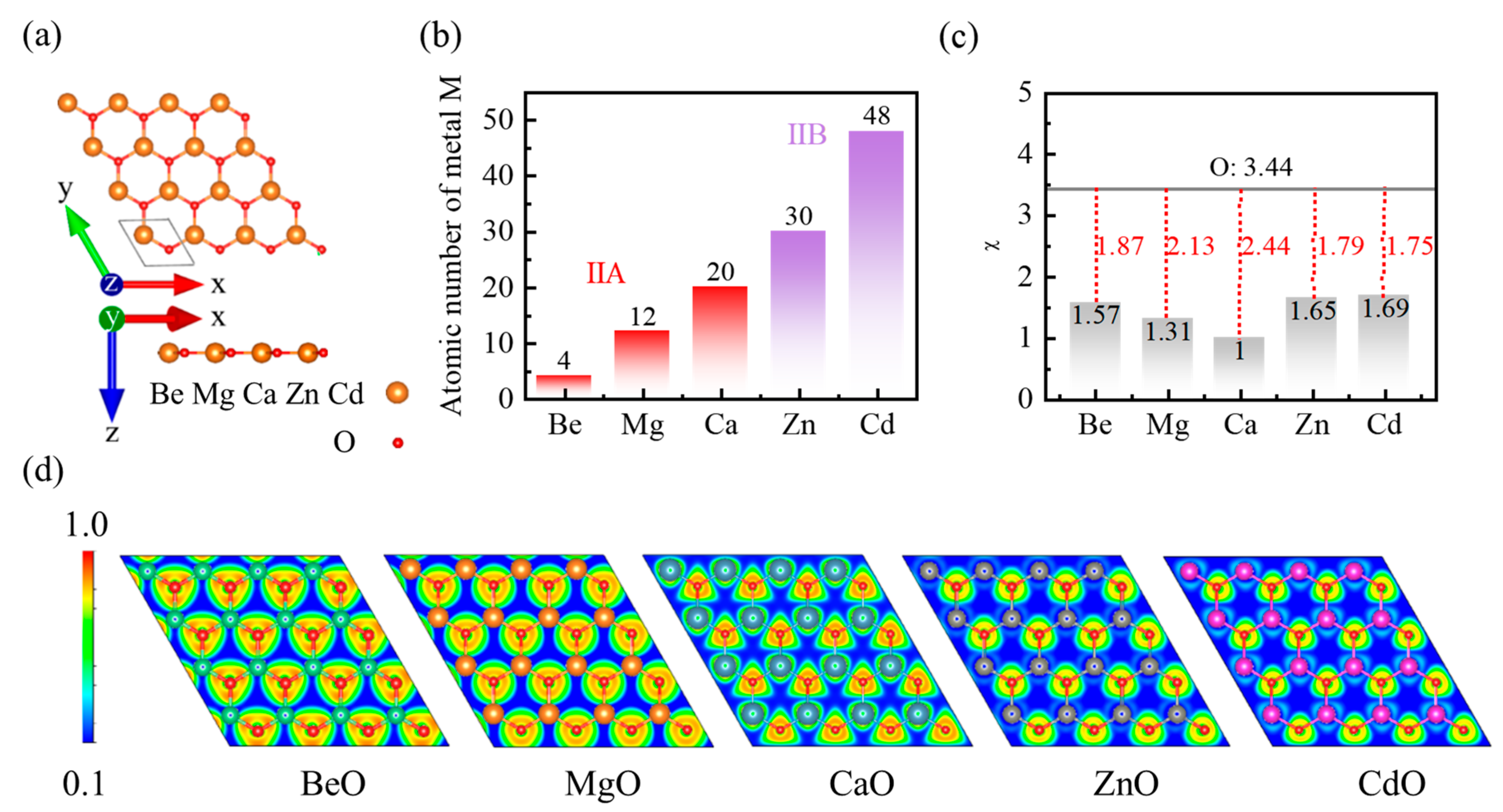
As 2D materials isostructural to the h-BN monolayer, the MO monolayers provide a key platform for investigating sliding ferroelectrics. An assessment of ionic and electronic polarization in the dielectric response is a prerequisite for understanding ferroelectric materials from this class. Accordingly, we first present the crystal structures and static charge distributions of five MO monolayers, thereby establishing the basis for our subsequent analysis of polarization mechanisms. As shown in
Figure 1a, M and O atoms are arranged in an alternating pattern, forming a non-centrosymmetric hexagonal honeycomb lattice (space group
). The absence of inversion symmetry is the structural origin of their intrinsic polar nature. After full structural relaxation, the lattice constants
a are 2.68, 3.30, 3.78, 3.29 and 3.68 Å, and the in-plane bond lengths
d are 1.55, 1.91, 2.18, 1.90 and 2.13 Å, respectively. These values agree well with previous reports [
9,
11,
18,
19,
20]; a detailed comparison of the lattice constants is provided in
Table S1. With increasing metal atomic number (
Figure 1b), both
a and
d increase monotonically within each chemical group. The choice of these five materials follows a comparative design. Since Be and Mg have no occupied d electrons, the dielectric response of the BeO and MgO monolayers predominantly stems from intrinsic elemental properties like atomic radius and electronegativity, serving as a baseline control group that effectively isolates the d-orbital effects. Although Ca is also a Group IIA element without occupied d electrons, its unoccupied 3d states are relatively low-lying, providing a key opportunity to investigate possible hybridization involving empty d orbitals and its effect on the dielectric response. By contrast, the Group IIB elements Zn and Cd, while having lattice constants and bond lengths comparable to those of Mg and Ca, possess a filled d
10 configuration, introducing pronounced d-electron effects. This is expected to substantially modify the orbital hybridization with O atoms and the electron-density distribution, thereby affecting the dielectric response.
Electronegativity difference between constituent atoms is an important driving force for charge transfer. As shown in
Figure 1c, the O atom has a high electronegativity (χ = 3.44, Pauling scale), while the electronegativities of the M atoms are Be: 1.57, Mg: 1.31, Ca: 1.00, Zn: 1.65, and Cd: 1.69, respectively. The large electronegativity difference drives electron transfer from M to O atoms, resulting in significant ionic character in the M–O bonds. To directly examine the spatial features of charge redistribution, we calculate the electron localization function (ELF) and perform Bader charge analysis. The ELF quantifies the degree of electron localization, with values approaching 1 indicating stronger localization [
21].
Figure 1d illustrates the evolution of electron localization from BeO to CdO monolayers using 2D ELF slices. For all MO monolayers, the ELF distributions suggest mixed ionic–covalent bonds, with high ELF regions present both in the M–O bonding region and around the O atoms. In the Group IIA monolayers, extremely high ELF values (red, ELF ≈ 1.0) are clearly evident in both regions. By contrast, in the Group IIB monolayers, the high ELF regions (yellow, ELF ≈ 0.8) are more strongly contracted around O atoms, while electron localization in the M–O bonding region is reduced. This redistribution indicates that, from Group IIA to Group IIB, the covalent contribution to the M–O bond decreases and the ionic character becomes more pronounced.
Quantitative Bader charge analysis indicates that the transferred charge from the metal to the O atom is 1.69, 1.63, 1.47, 1.18, and 1.19 e, corresponding to the series from BeO to CdO monolayers. The decrease in the Bader charge transfer does not directly follow the electronegativity difference trend (
Figure 1c), suggesting that static charge transfer is influenced not only by M–O electronegativity difference but also by other factors, including bond length, atomic radius, the spatial distribution of charge density, and the underlying electronic structure. Notably, although the Group IIB metals (Zn and Cd) possess relatively higher electronegativity, their Bader charge transfer remains unexpectedly low (≈1.2 e) due to the strong shielding of the valence s electrons by the filled d10 shell.
Electronegativity differences, along with ELF and Bader charge analyses, demonstrate that all M–O bonds exhibit a mixed ionic–covalent character. The d10 configuration of the Group IIB elements strongly influences charge transfer and electron localization behavior. These static properties form the physical basis for interpreting the dielectric response. Nevertheless, the macroscopic dielectric response is inherently dynamic. It encompasses not only the static charge distribution but also the charge redistribution induced by atomic displacements.
3.2. Low-Frequency Dielectric Response: Phonon Dispersion and Born Effective Charge
In the low-frequency limit, the dielectric response of materials is dominated by ionic polarization. Understanding this response requires examining two quantities that are intimately connected with lattice dynamics. The phonon spectrum reveals the lattice vibrational modes and their frequencies as a function of the wave vector, thereby providing the dynamical basis of the polarization. The BECs quantify the polarization induced per unit atomic displacement. Before carrying out these analyses, the mechanical and dynamic stability of the materials should be assessed based on their elastic constants and phonon spectrum. For the MO monolayers, the in-plane elastic constant matrix can be written as
where
C11,
C22 and
C66 are the independent elastic constants of the 2D lattice.
Table 1 lists the calculated elastic constants of the five MO monolayers, all of which meet
C11 > 0,
C66 > 0 and
C11·
C22 >
C12·
C12, fulfilling the Born–Huang criteria [
22,
23], confirming that all monolayers are mechanically stable.
Dynamical stability describes a crystal structure’s resistance to small displacements from its atomic equilibrium positions. It is typically evaluated from the phonon spectrum. A structure is dynamically stable if no imaginary phonon modes (often plotted as negative frequencies) occur. As presented in
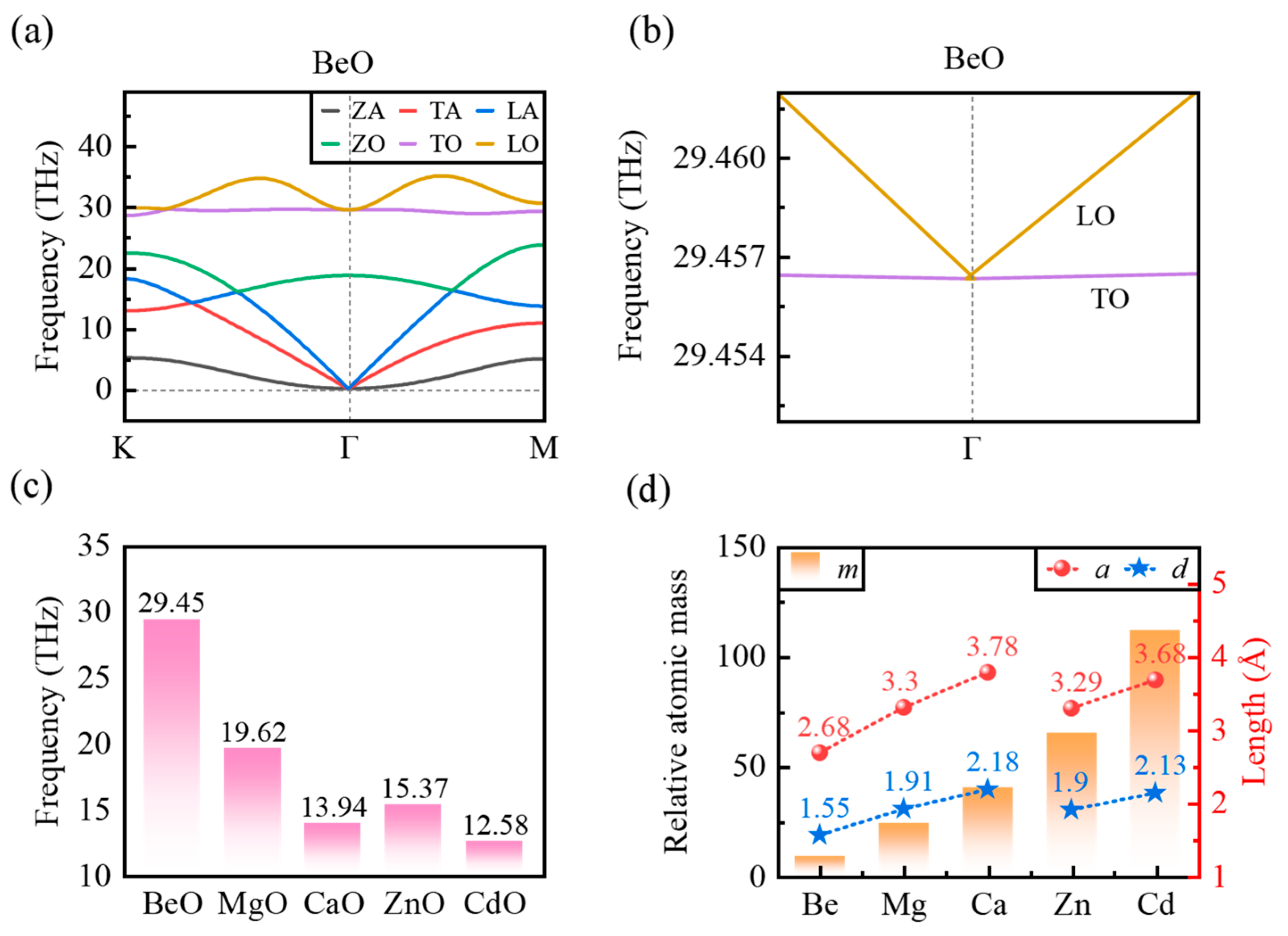
Figure S1, the phonon dispersion curves of BeO, MgO, CaO, ZnO, and CdO monolayers exhibit no negative frequencies, confirming their dynamical stability. Furthermore, the long-wavelength optical phonons reveal a key feature relevant to the low-frequency dielectric response: all monolayers display the degeneracy of the longitudinal optical (LO) and transverse optical (TO) phonons at the Γ point (
Figure 2a shows BeO as an example; see
Figure S1 for the Supplementary Materials). This behavior distinguishes it from both 3D polar crystals and non-polar materials in any dimension.
In 3D polar materials (
Figure S2a), the LO and TO phonons exhibit a pronounced LO–TO splitting at the Γ point. Physically, the ionic displacement associated with LO phonon generates a macroscopic polarization density, which in turn produces a macroscopic electric field. This field arises from long-range Coulomb (dipole–dipole) interactions and provides an additional restoring force for the LO phonon. Consequently, the LO phonon frequency increases near the Γ point, causing the LO–TO splitting [
24]. In non-polar materials, by contrast, lattice symmetry ensures LO–TO degeneracy at the Γ point. The optical branches are analytic with zero slope (
Figure S2b). Remarkably, the polar monolayers of BeO, MgO, CaO, ZnO, and CdO exhibit a third distinctive behavior for the LO and TO branches at and near the Γ point (
Figure 2b shows BeO as an example; see
Figure S3 for the Supplementary Materials). Although these monolayers are intrinsically polar, the 2D confinement prevents the macroscopic electric field that causes LO–TO splitting from being sustained at the Γ point, so that the LO and TO phonon modes become degenerate. Once the phonon wavevector deviates from the Γ point, the long-range Coulomb interaction manifests as a nonanalytic term, giving rise to a linear LO phonon dispersion with a finite group velocity and a characteristic V-shaped dispersion. The phenomenon has been observed in other 2D polar materials [
7,
25].
This unconventional LO–TO splitting is controlled by wavevector-dependent screening, with the key factor being the distinctive form of the effective 2D dielectric function [
26,
27]:
where
is the effective dielectric constant of the surrounding medium (for a free-standing monolayer in vacuum,
). The parameter
describes the material’s intrinsic screening capability, which depends on its dielectric properties and effective thickness. Due to dimensional effects, the relationship between the squared frequencies of the LO and TO phonons satisfy
Here, S is a material-dependent constant related to the effective charges, atomic masses and other factors. In the long-wavelength limit, the momentum tends to zero, the dielectric function simplifies to , which leads to . Hence, degeneracy of the LO and TO phonons is found at the Γ point. When increases from zero but remains small (, near the Γ point), . The frequency expression can then be simplified to , showing that the square of the LO phonon frequency has a linear relationship with the magnitude of momentum with a finite dispersion slope of . This unique behavior constitutes remarkable dielectric properties in 2D polar systems, distinguishing them from other material classes.
In addition, the TO phonon frequency at the Γ point also exhibits a clear trend with the metal atomic number. Specifically, as demonstrated in
Figure 2c, TO phonon frequency decreases monotonically with increasing atomic number. For Group IIA monolayers, the frequency drops from 29.45 THz (BeO) to 13.94 THz (CaO), whereas for Group IIB monolayers, it decreases from 15.37 THz (ZnO) to 12.58 THz (CdO). The corresponding resonance wavelengths for BeO, MgO, CaO, ZnO, and CdO monolayers are 10.19 μm, 15.29 μm, 21.52 μm, 19.52 μm and 23.85 μm, respectively, all falling within the mid- to far-infrared spectral range. This phonon softening originates primarily from the combined effects of the increased vibrational inertia associated with heavier cations, weakened interatomic interactions due to lattice expansion and longer bond lengths (
Figure 2d), and corresponding changes of the electronic structure [
28,
29]. From the perspective of dielectric response, the softening of the TO phonon lowers the characteristic frequency of the ionic polarization, thereby shifting the resonance peak in the dielectric function in the infrared to longer wavelengths.
The phonon analysis above identifies the lattice vibrational modes and frequencies in 2D polar materials, which are related to dielectric response. Nevertheless, a quantitative understanding of the microscopic origin of displacement-induced polarization and its contribution to the dielectric response requires an additional key physical quantity: BECs [
30]. Under zero macroscopic electric field, the BECs establish a fundamental link between the lattice dynamics and dielectric properties of materials. Generally, a larger BEC signifies a stronger polarization response induced by ionic displacements. This enhanced polarization consequently increases the material’s overall dielectric response. Using DFPT, we compute the BECs for all atoms in the MO monolayers: the results are summarized in
Table 2.
As shown in
Table 2, the BECs of the MO monolayers satisfy the acoustic sum rule (
). However, their magnitudes deviate from the nominal ionic charges of ±2 e, which stems from the partial covalency of the M–O bonds. The BECs capture not only the nominal static ionic charge but also the dynamic redistribution of the electron cloud in response to ionic displacement. This redistribution stems from changes in orbital hybridization, which is visually captured in the projected density of states of the five monolayers (
Figure S4). It directly illustrates the progressive evolution of d orbital contributions near the band edges. For the Group IIA monolayers (BeO and MgO), the unoccupied d-states of the cations lie far above the O-2p states, making p–d hybridization negligible. Hence, the covalent character in the two monolayers stems predominantly from s–p hybridization between the cation and oxygen. Upon ionic displacement, the incomplete dynamic redistribution of these bonding electrons partially cancels the core displacement dipole, reducing the BEC below 2 e (Be: 1.97 e; Mg: 1.84 e), corresponding to a weaker ionic polarization response. In contrast, the notably larger BEC of Ca (2.35 e) originates from the fact that the low-lying unoccupied 3d states actively participate in p–d hybridization at the band edge. This interaction provides an efficient channel for additional dynamic charge transfer upon ionic displacement, which generates an extra dipole moment and thereby strengthens ionic polarization. For the Group IIB monolayers, Zn and Cd possess filled d
10 configurations (Zn-3d
10, Cd-4d
10). Their even larger BECs (Zn: 2.48 e; Cd: 3.05 e) are due to strong d–p hybridization between the occupied metal d orbitals and O-2p orbitals. This hybridization induces substantial electron-density rearrangement during ionic displacement, yielding large dynamical charges and the strongest ionic polarization response. The larger BEC of Cd compared with Zn is attributed to the shallower energy level of Cd-4d orbitals relative to the Zn-3d orbitals, which enhances orbital overlap and facilitates dynamical charge transfer.
Overall, d-orbital involvement increases progressively from negligible p–d hybridization in Be/Mg, to active participation of low-lying empty 3d states in Ca, and further to strong p–d hybridization from the filled d
10 shells in Zn/Cd. This trend promotes a systematic increase in the BECs. The p–d hybridization mechanism for enhancing BECs has been reported in previous studies [
31,
32,
33]. Combined with the softening of TO phonon at the Γ point (
Figure 2c) and the variation of reduced mass and unit cell area, these factors collectively enhance the ionic dielectric response across the MO series. The quantitative decomposition of each factor’s contribution identifies phonon softening as the primary driver of the enhanced response, the Born effective charge as a significant secondary contribution, and the reduced mass and unit cell area as moderating influences (
Tables S2 and S3). Moreover, the BECs exhibit pronounced anisotropy between the in-plane and out-of-plane directions. As listed in
Table 2, the in-plane components (
) significantly exceed the out-of-plane component (
) for all monolayers (e.g., 3.05 vs. 0.40 for CdO). This anisotropy stems directly from the strong in-plane chemical bonds versus the weak out-of-plane coupling, indicating that the ionic contribution to the dielectric response in the infrared regime is dominated almost entirely by in-plane polarization. We next examine the dielectric response in the high-frequency (optical) regime. When the frequency of the external field far exceeds the characteristic lattice-vibration frequencies, ions cannot follow the rapid variation of the electric field due to their inertia. Consequently, the polarization response is dominated by electronic contributions and is described by the frequency-dependent complex dielectric function.
3.3. High-Frequency Dielectric Response: Complex Dielectric Function and Optical Property
We employ the
GW0 + BSE approach to compute the complex dielectric function
. The real part
reflects the dispersive, energy-storing polarization response, whereas the imaginary part
corresponds to the absorptive (dissipative) component.
ω denotes the photon frequency. It is worth noting that the dielectric function via the
GW0 + BSE approach captures only the electronic polarization, as BSE is solved for fixed nuclear positions. This is appropriate for the optical-frequency range, where the ionic contribution is negligible [
34]. Furthermore, key optical properties such as the absorption coefficient and refractive index can be derived from
through well-established analytical relationships, thus offering complementary insights into the frequency-dependent electronic dielectric response.
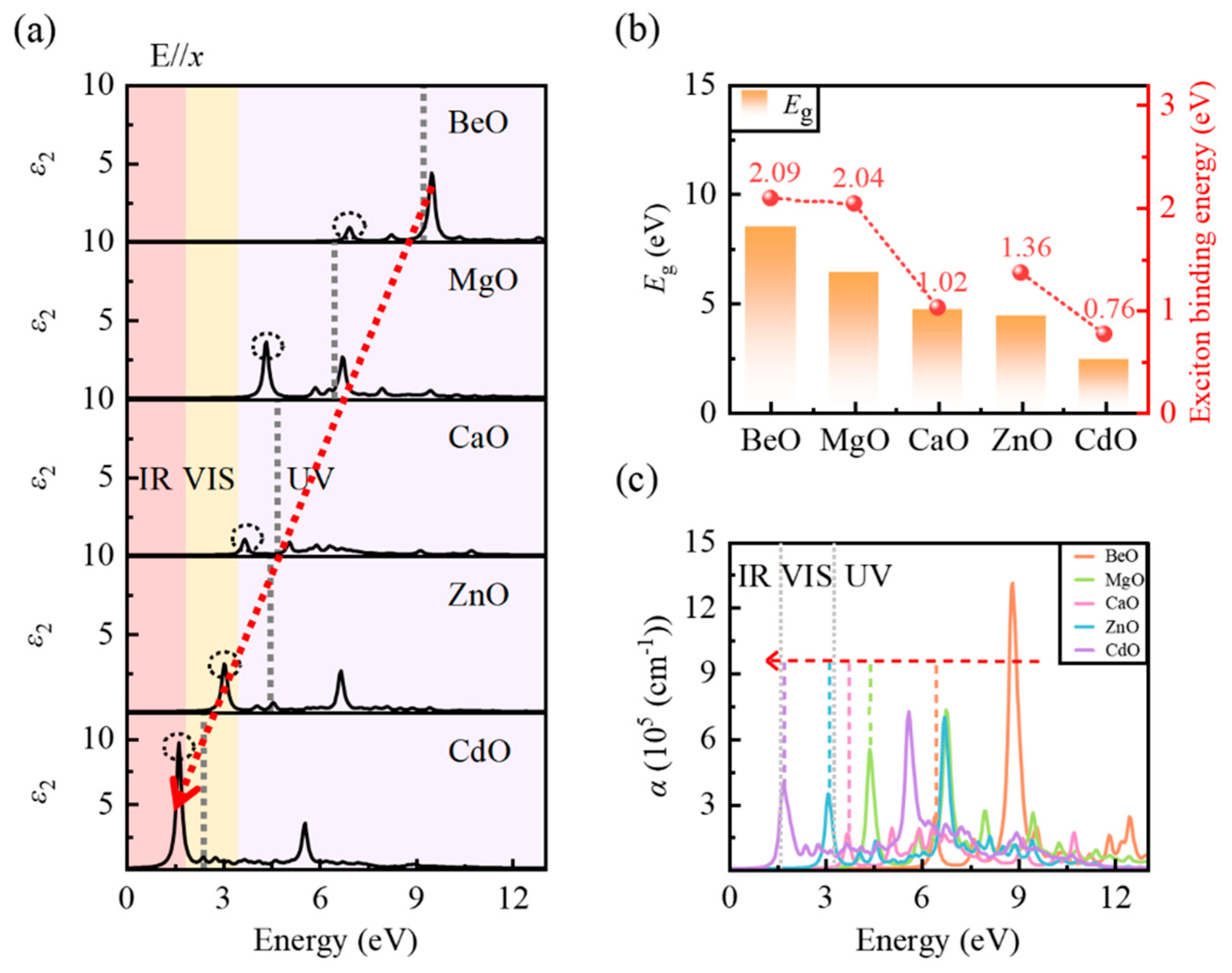
Figure 3 and
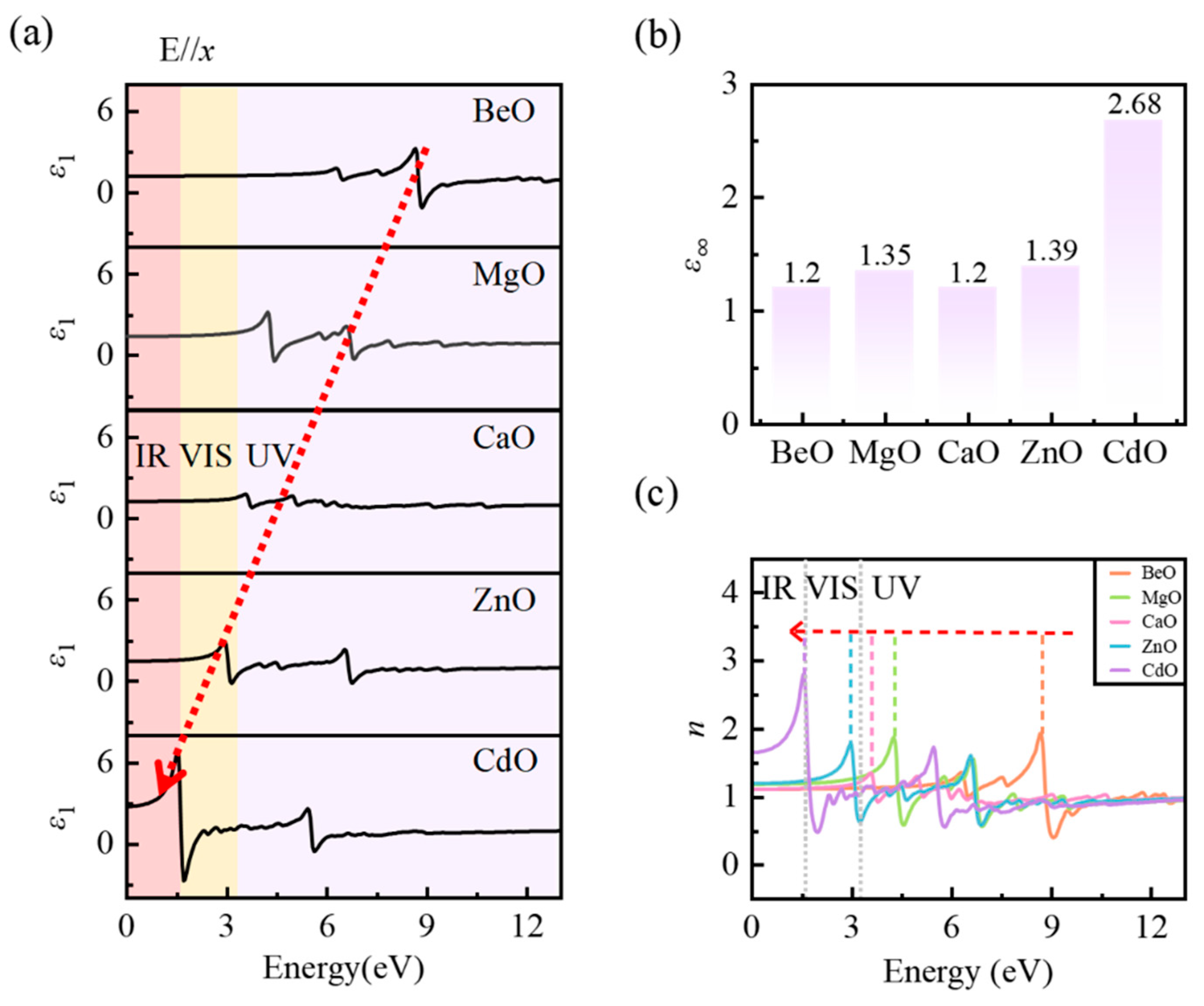
Figure 4 present the high-frequency dielectric response of the five MO monolayers dominated by electronic polarization and its evolution with increasing metal atomic number.
Figure 3 highlights
and the optical absorption coefficient
, whereas
Figure 4 details
and the refractive index
. As all monolayers are in-plane isotropic, only the case with E//
x is shown.
Figure 3a presents the imaginary part
for the MO monolayers. With increasing metal atomic number, the absorption onset and the prominent peaks in
redshift from BeO to CdO, extending the optical response from the deep-ultraviolet to the near-infrared (the convergence with respect to the k-mesh is verified in
Figure S5). This evolution closely follows the reduction of the
GW0 quasiparticle band gap (
Figure 3b), which decreases from 8.5 eV (BeO) to 2.4 eV (CdO). Notably, the dominant peak intensity exhibits completely opposite trends in group IIA and group IIB elements (
Figure 3a and
Table 3). For group IIA, the dominant peak intensity monotonically decreases with increasing atomic number. This trend is primarily attributed to the elongation of the M–O bond and the increased diffuseness of the metal valence orbitals along the series. The reduced spatial overlap between these metal orbitals and the O-2p states leads to a decrease in the optical transition matrix elements, consequently weakening the transition strength. In contrast, within group IIB, the dominant peak of CdO is stronger than that of ZnO. This is primarily because the stronger p–d repulsion in CdO reduces the band gap, so that the dominant transitions occur at lower energies and are amplified by the
factor. In addition, pronounced bound-exciton peaks (indicated by black dashed circles) are observed for all monolayers in the vicinity of the corresponding quasiparticle gaps (gray dashed lines in
Figure 3a). This feature originates from the explicit inclusion of the electron–hole Coulomb interaction, enabling a more accurate description of excitonic effects [
35]. The exciton binding energy is
where
is the exciton binding energy,
is the
GW0 quasiparticle band gap and
denotes the energy of the observed exciton peak. As shown in
Figure 3b, the exciton binding energies of the MO monolayers are generally on the order of eV, far exceeding those of the corresponding bulk counterparts (typically only several tens of meV) [
36,
37]. This enhancement is mainly due to the reduction in dielectric shielding caused by quantum confinement, which in these monolayers is dominated by the in-plane electronic polarizability [
38,
39]. Furthermore, within each family (IIA or IIB), the exciton binding energy decreases with increasing metal atomic number (
Figure 3b). This trend is because the narrowing band gap enhances the in-plane electronic polarizability and thus the dielectric screening, which weakens the electron–hole Coulomb interaction [
40].
Figure 3c displays the absorption spectra of the MO monolayers. The absorption coefficient
is determined by both the real and imaginary parts. Consistent with the evolution of
, the absorption onset and major peaks redshift progressively from the deep-ultraviolet (BeO) to the near-infrared (CdO) as the metal atomic number increases. The obtained absorption coefficients reach the order of 10
5–10
6 cm
−1, surpassing those of the corresponding bulk oxides (typically ∼10
4 cm
−1) by 1–2 orders of magnitude [
41]. This significant enhancement is due to the intrinsic quantum confinement effect in the 2D structure. Notably, the peak distribution in
(
Figure 3a) differs markedly from that in
(
Figure 3c). For all monolayers except BeO (MgO, CaO, ZnO, and CdO), the relative intensities of the characteristic peaks are reversed between the two spectra (
Table 3 and
Table 4). Taking MgO as an example, the dominant peak in
at 4.36 eV corresponds to a low-energy excitonic resonance. In contrast, in the absorption spectrum
, a higher-energy secondary transition at 6.77 eV becomes the main absorption peak and exhibits a larger absorption coefficient. This inversion indicates that optical absorption and dielectric response are not related through a simple one-to-one, monotonic correspondence. Specifically, the quantum confinement effect strengthens the electron–hole Coulomb interaction, giving rise to pronounced excitonic effects that dominate
at low energies. In contrast, for
, the explicit
ω prefactor amplifies higher-energy transitions, while the frequency-dependent refractive index
provides additional modulation. These two effects together cause the higher-energy continuum-state peaks to surpass the exciton resonance in absorption intensity. BeO is an exception. Its ultra-wide gap means the
peak at 8.77 eV already arises from continuum transitions, so no intensity inversion occurs upon conversion to
.
As discussed above regarding
, the resonant structures (absorption peaks) arise from different electronic transition processes. According to the Kramers–Kronig relations, these resonances in
determine the dispersive behavior of
.
and
collectively characterize the optical-frequency dielectric response dominated by electronic polarization.
Figure 4a presents the real part
of the MO monolayers. The peaks in
appear near the frequencies of specific electronic transitions, where the in-phase electronic polarization response is significantly enhanced. Similar to the case for
, as the metal atomic number increases and the band gap decreases, the features in
also exhibit a redshift from the deep-ultraviolet to the near-infrared. From
Table 5, the dominant peak intensity in
exhibits opposite trends for the IIA and IIB series, which agrees with the trend reported in
(
Table 3). This agreement stems from the Kramers–Kronig relations, linking the amplitude of a dispersive peak in
directly to the integrated strength and spectral position of its corresponding absorption feature in
. Notably, the energies of both the main and second peaks in
are lower than those of the corresponding peaks in
by approximately 0.08–0.12 eV (
Table 3 and
Table 5). For example, in MgO the main peaks of
and
occur at 4.24 and 4.36 eV, respectively, while the second peaks occur at 6.61 and 6.73 eV. This ~0.1 eV shift is a universal feature of the dielectric response near resonances, which is dictated by the Kramers–Kronig relations.
Figure 4b presents the electronic (high-frequency) dielectric constant
of the MO monolayers.
quantifies the purely electronic contribution to the dielectric response at frequencies above the phonon range. Because the
GW0 + BSE approach does not account for lattice dynamics, the calculated
contains only electronic polarization and excludes ionic polarization. The
values of BeO, MgO, CaO, and ZnO are confined to a narrow range of 1.2–1.4. This reflects the weak electronic dielectric response typical of wide-band-gap monolayers. In contrast, CdO exhibits a much larger
of 2.68 (about twice that of the others), indicating a substantially enhanced electronic dielectric response. This follows from the Kramers–Kronig integral, in which a 1/
ω′ kernel strongly weights low-energy excitations, making
sensitive to both the energy position and spectral weight of the peaks. For BeO, MgO, CaO, and ZnO, the increase in low-energy weighting induced by the redshift of the main peak is largely compensated by a concurrent reduction in transition strength, keeping
within the narrow range of 1.2–1.4. CdO differs in that its lowest-energy excitonic resonance combines both a large 1/
ω′ weight and a strong peak intensity, and their combined effect markedly enhances
.
This redshift, spanning from the deep-ultraviolet in BeO to the near-infrared in CdO, is also reflected in the refractive index
(
Figure 4c). As
is governed by the complex dielectric function, its spectral evolution directly reveals the frequency-dependent electronic dielectric response. The relationship between the refractive index and the dielectric function is
In the zero-frequency limit,
approaches zero, and Equation (5) reduces to
. As summarized in
Table 6, the static refractive indices of five MO monolayers are 1.09 (BeO), 1.16 (MgO), 1.09 (CaO), 1.18 (ZnO), and 1.64 (CdO), which are consistent with the
values in
Figure 4b through the relation
. The static refractive index of CdO is markedly higher than those of the other materials, further confirming its strongly enhanced electronic polarization response. It is worth noting that in our
GW0 + BSE calculations, the spin–orbit coupling effect is not included. Since the CBM derives from metal s orbitals in all five MO monolayers, the spin–orbit coupling effect affects only the valence band side. The expected corrections are confined to the order of tens of meV. This is negligibly small relative to the several-eV band gap variation across the series and insufficient to alter any of the trends we have discussed above. In addition, good agreement with literature data [
9,
10,
11,
12,
42] for several representative properties, including band gaps,
and TO phonon frequencies (
Table S1), combined with the structural comparison presented earlier, provides strong support for the overall reliability of our findings. Furthermore, although all optical properties are obtained directly from the 3D supercell output, the vacuum-independent 2D quantities confirm that all comparative trends are correct (
Figure S6).
In summary, the present study systematically elucidates the dielectric properties of the MO monolayers and establishes a complete dielectric spectrum spanning low-frequency ionic polarization to high-frequency electronic polarization, which provides an essential theoretical foundation and direct guidance for their potential applications. These monolayers adopt the same crystal structure as h-BN and are therefore well suited for the fabrication of sliding ferroelectric devices. The distinct dielectric responses of CdO monolayers, including strong ionic and electronic dielectric responses among the series, are advantageous for serving as high-κ gate dielectrics in field-effect transistors and enhancing light confinement in nanophotonic devices. In contrast, the weak dielectric screening exhibited by wide-bandgap BeO and MgO monolayers is beneficial for enhancing the tunneling electroresistance in ferroelectric tunnel junctions. In addition, the broad coverage of absorption edges from the deep-ultraviolet (BeO) to the near-infrared (CdO) makes these materials promising candidates for broadband photodetection.