Article

Fabrication of Superhydrophobic Micro–Nanostructures on Pristine SLM-Ti Surfaces

1
College of Life Sciences, Zhuhai College of Science and Technology, Zhuhai 519040, China
2
College of Chemistry, Jilin University, Changchun 130012, China
*
Author to whom correspondence should be addressed.
Micromachines 2026, 17(4), 454; https://doi.org/10.3390/mi17040454
Submission received: 27 February 2026 / Revised: 26 March 2026 / Accepted: 1 April 2026 / Published: 7 April 2026

Abstract

Superhydrophobic surfaces are typically achieved through the synergistic integration of appropriate nanostructures and low-surface-energy chemical compositions. This study presents a novel and facile method for constructing a superhydrophobic hierarchical structure directly on a pristine selective laser melting (SLM) titanium surface. The intrinsic partially melted Ti particles, which are inherent to the SLM fabrication process, were strategically utilized as a natural microscale template for the in situ growth of TiO2 nanotubes via electrochemical anodization. Three distinct micro/nano-topographies were successfully fabricated, integrating the spherical microparticles with either conventional TiO2 nanotube arrays or separated nanotube arrays. The results demonstrate that the resulting superhydrophobic behavior can be effectively regulated by two key factors: the liquid–solid contact mode at the microscale and the strength of capillary action within the nanostructures. Notably, these characteristics can be tailored by controlling the nanotube diameter and intertubular spacing. These findings contribute to a deeper understanding of the role of micro–nano hierarchical structures in engineering superhydrophobic surfaces, thereby opening new avenues for advanced applications.

1. Introduction

Inspired by natural architectures such as the self-cleaning lotus leaves and the directional water-repellency of butterfly wings, superhydrophobic surfaces have emerged as a pivotal area of materials science and surface engineering. These surfaces, typically defined by a water contact angle (WCA) greater than 150° and a sliding angle less than 10°, exhibit extreme water repellency. This unique property unlocks a vast array of transformative technological applications, ranging from self-cleaning windows and textiles [1,2] and anti-fogging optical lenses [3] to anti-biofouling coatings for marine hulls and antibacterial surfaces for medical implants [4,5], as well as spill-resistant protective gear and microfluidic devices. The fundamental origin of this exceptional wettability lies in the synergistic combination of two key factors: a hierarchical surface topography, featuring both micro- and nanoscale roughness, and a low-surface-energy chemical modification. This dual-scale architecture effectively traps air pockets beneath a water droplet, minimizing the liquid–solid contact area and resulting in the characteristic high contact angles and extreme droplet mobility, as described by the classic Cassie–Baxter model [6,7]. In recent years, various strategies have been developed to fabricate superhydrophobic surfaces with micro- and nanostructures that impart liquid-repellent functions [8,9,10].
Titanium (Ti) and its alloys stand as cornerstone materials in modern industry due to their exceptional combination of properties, including high specific strength, excellent corrosion resistance, and biocompatibility [11]. However, despite these advantages, titanium-based components face significant performance challenges that can drastically limit their service life and reliability. In biomedical settings, the native oxide layer on titanium, while biocompatible, is susceptible to bacterial adhesion and subsequent biofilm formation, leading to persistent infections and implant failure [12]. In harsh marine environments, titanium surfaces are prone to biofouling by marine organisms and accelerated corrosion in the presence of chloride ions and organic contaminants, compromising their structural integrity [13]. While fabricating superhydrophobic surfaces on titanium offers a promising route to mitigate these issues by reducing contact with corrosive media and preventing bacterial attachment, conventional modification approaches often fall short. Many existing techniques produce surfaces that, while hydrophobic, exhibit high water adhesion. This “sticky” superhydrophobicity (or parahydrophobicity) severely restricts practical utility in applications requiring self-cleaning or low drag, as the contaminants cannot be effectively carried away by moving droplets [14,15]. The challenge, therefore, lies in engineering a robust superhydrophobic state with low adhesion, which necessitates precise control over the surface’s hierarchical architecture.
This study aims to address this challenge by exploring a novel approach to construct a biomimetic hierarchical structure, directly leveraging the unique intrinsic features of additively manufactured titanium surfaces. Selective laser melting (SLM), a prominent laser powder bed fusion technique, has revolutionized the manufacturing of complex metallic components. The SLM process builds parts by selectively melting metal powder layers with a computer-controlled laser beam, enabling rapid fabrication of complex geometries [16,17]. A characteristic byproduct of this process, stemming from the partial melting of powder particles adjacent to the melt pool, is the inherent microscale roughness of as-built SLM surfaces. This roughness is predominantly dominated by the presence of numerous partially melted spherical Ti particles that are sintered or attached along the part contours [18,19]. While often considered a surface defect requiring post-processing, we recognize this inherent particle-decorated topography as a ready-made, naturally occurring microscale “template.”
Grounded in the established principles that surface roughness amplifies hydrophobicity and capillary effects modulate interfacial adhesion, we integrate micro-spherical Ti particles with either conventional TiO2 NTs or separated TiO2 SNTs to engineer SLM-Ti surfaces with tunable superhydrophobicity. The wetting behavior is primarily governed by the liquid–solid contact mode and the spatial configuration of entrapped air pockets. The micro/nano hierarchical structures are fabricated via electrochemical methods, with key morphological features—such as nanotube diameter, inter-tube spacing, and the morphology of the Ti microspheres—being controllable through adjustment of the electrochemical parameters. These structural variations alter the negative pressure associated with air pockets under different wetting regimes [20,21]. These findings provide new insights into the role of micro–nano hierarchical structures in regulating surface wettability and lay both a theoretical and experimental foundation for designing functional titanium-based surfaces tailored to diverse application requirements.

2. Materials and Methods

2.1. Materials

Square SLM-Ti samples (15 mm × 15 mm × 2 mm) were fabricated via SLM technique using a Concept Laser Mlab 200R system (Concept Laser, Lichtenfels, Germany), equipped with a 200 W Yb:YAG fiber laser featuring a spot diameter of 75 μm. Commercially available spherical pure titanium powder (>99.5% purity) with a particle size distribution of 20–40 μm was used as the feedstock. A 15 mm thick pure titanium plate served as the building substrate. The SLM process was conducted at a laser power of 200 W, a layer thickness of 25 μm, a scanning speed of 400 mm/s, and a hatch spacing (i.e., the distance between adjacent scan vectors) of 60 μm. The building chamber was evacuated and subsequently backfilled with argon prior to fabrication. Upon completion of the build, excess powder was removed from the sample surfaces. All samples were studied in their as-built state without any post-treatment, thus retaining their inherent surface roughness.

2.2. Fabrication of Micro–Nanostructures on SLM-Ti Surfaces

Micro–nanostructures were fabricated on SLM-Ti samples via electrochemical anodization using a platinum counter electrode under various conditions. Conventional TiO2 NTs were prepared by anodization at 15 V for 1 h in an electrolyte containing 0.3 wt% NH4F and 2 vol% deionized water. Separated TiO2 SNTs were synthesized by anodization at 40 V and 60 V for 40 min in an electrolyte composed of 0.5 wt% HF and 95 vol% diethylene glycol. The samples were subsequently modified with an ethanolic solution of 1H,1H,2H,2H-perfluorooctyltriethoxysilane (PTES, CF3(CF2)5CH2CH2Si(OCH2CH3)3, Aldrich). Specifically, 0.1 mL of PTES was dissolved in a mixture of 47.5 mL of ethanol and 2.5 mL of deionized water under magnetic stirring for 1 h. The SLM-Ti samples were immersed in the hydrolyzed PTES solution for 1 h to facilitate dehydration and condensation, then rinsed with ethanol, and finally heated at 100 °C for 2 h.

2.3. Characterization

The morphology of TiO2 NTs and SNTs on SLM-Ti substrates was examined using field emission scanning electron microscopy (FE-SEM, TESCAN MIRA, Brno, Czech Republic). Two-dimensional (2D) and three-dimensional (3D) optical profilometry was performed using a Leica DVM6 digital video microscope (Heerbrugg, Switzerland). Static, advancing, and receding water contact angles (WCA) were measured with an optical contact angle goniometer (SL200L2, KINO, Boston, MA, USA). For WCA and tilt angle measurements, water droplets of 5 µL and 7 µL were used, respectively. Each measurement was conducted on five independent specimens, with six distinct locations analyzed per specimen to ensure statistical reliability.

3. Results

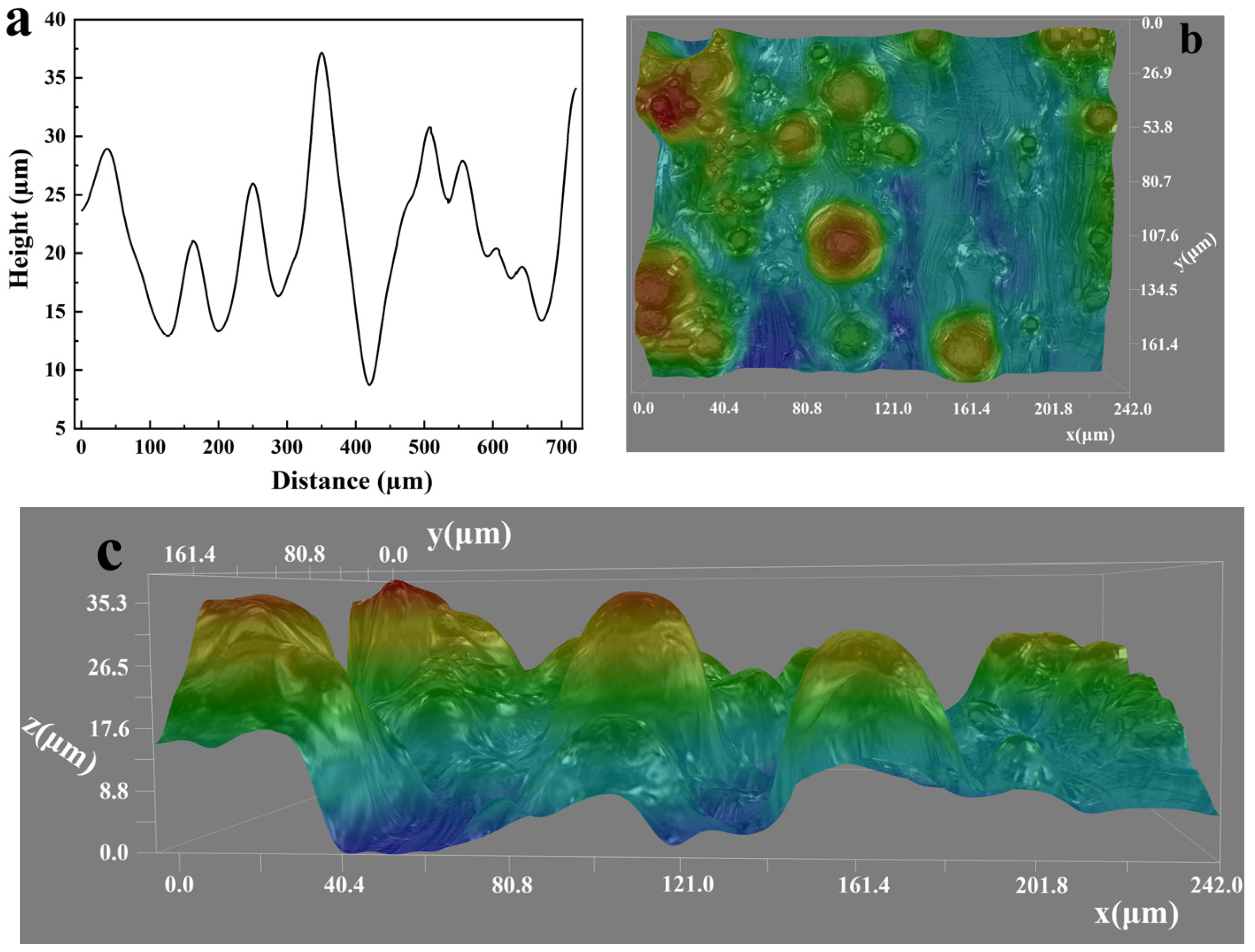
The 1D, 2D, and 3D surface profiles of the SLM-Ti substrate are presented in Figure 1. A substantial number of partially melted Ti particles were clearly observed to adhere to the substrate surface. The average peak height (Rp) and valley depth (Rv) were measured to be approximately 35.2 μm and 32.6 μm, respectively, based on five measurement points on each of the three independent specimens. Notably, this roughness scale is comparable to that of certain botanical leaf surfaces, such as lotus leaves [22].
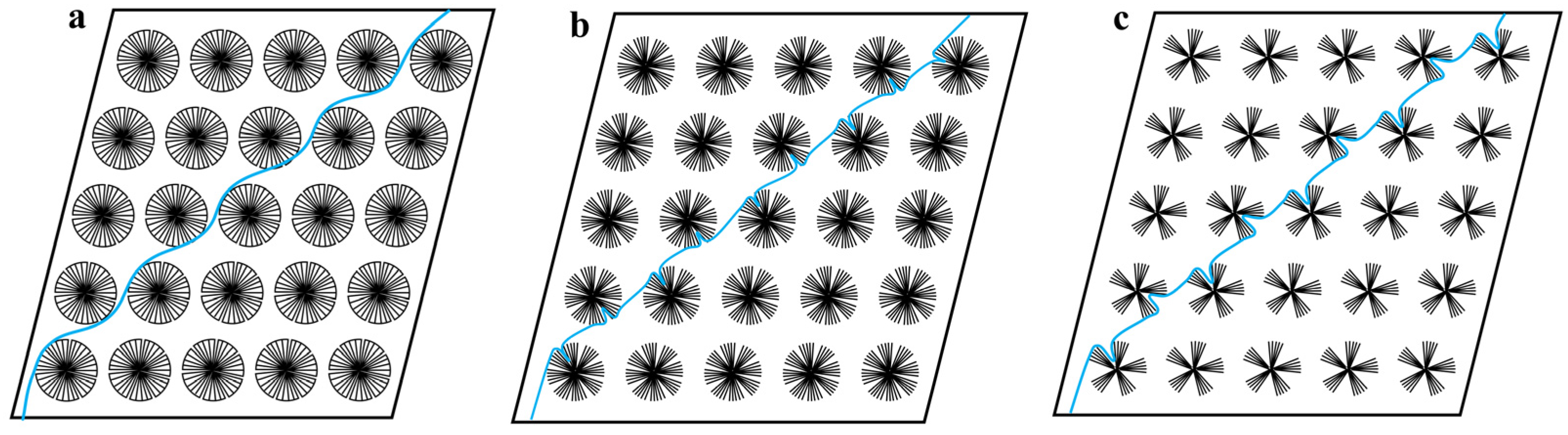
Figure 2 illustrates the design strategies of three superhydrophobic micro–nanostructure models. A key characteristic of such surfaces is the creation of abundant and spatially confined air pockets—commonly termed Cassie–Baxter air traps—which constitute the fundamental physical basis for superhydrophobicity [23]. In general, the micrometer-scale architecture dictates the liquid–solid contact mode, thereby critically determining droplet adhesion strength. Importantly, a continuous three-phase (solid–liquid–gas) contact line (TCL) induces pronounced contact angle hysteresis (CAH) and strong pinning forces, whereas a fragmented TCL markedly suppresses both CAH and adhesion.
Guided by these principles, superhydrophobic micro–nanostructure models with tunable static and dynamic WCAs were developed. Figure 2a depicts micro-spherical Ti particles featuring numerous conventional NTs, wherein air pockets are encapsulated within the closed nanotubes, giving rise to an “area contact” mode. To minimize surface adhesion, the micro–nano structural design must preclude such enclosed air pockets, as they tend to intensify capillary-induced pinning. Optimal low-adhesion architectures instead target “line contact” and “point contact” modes, distinguished by minimal solid–liquid interfacial area and maximally fragmented TCLs [24]. Accordingly, micro-spherical Ti particles incorporating dispersed TiO2 NTs and exhibiting varying degrees of cracking were rationally designed (Figure 1b,c). The microscale petal-like morphology ensures highly localized, non-wetting contact points and extreme TCL discontinuity, thereby enabling spontaneous droplet roll-off with ultralow adhesion.
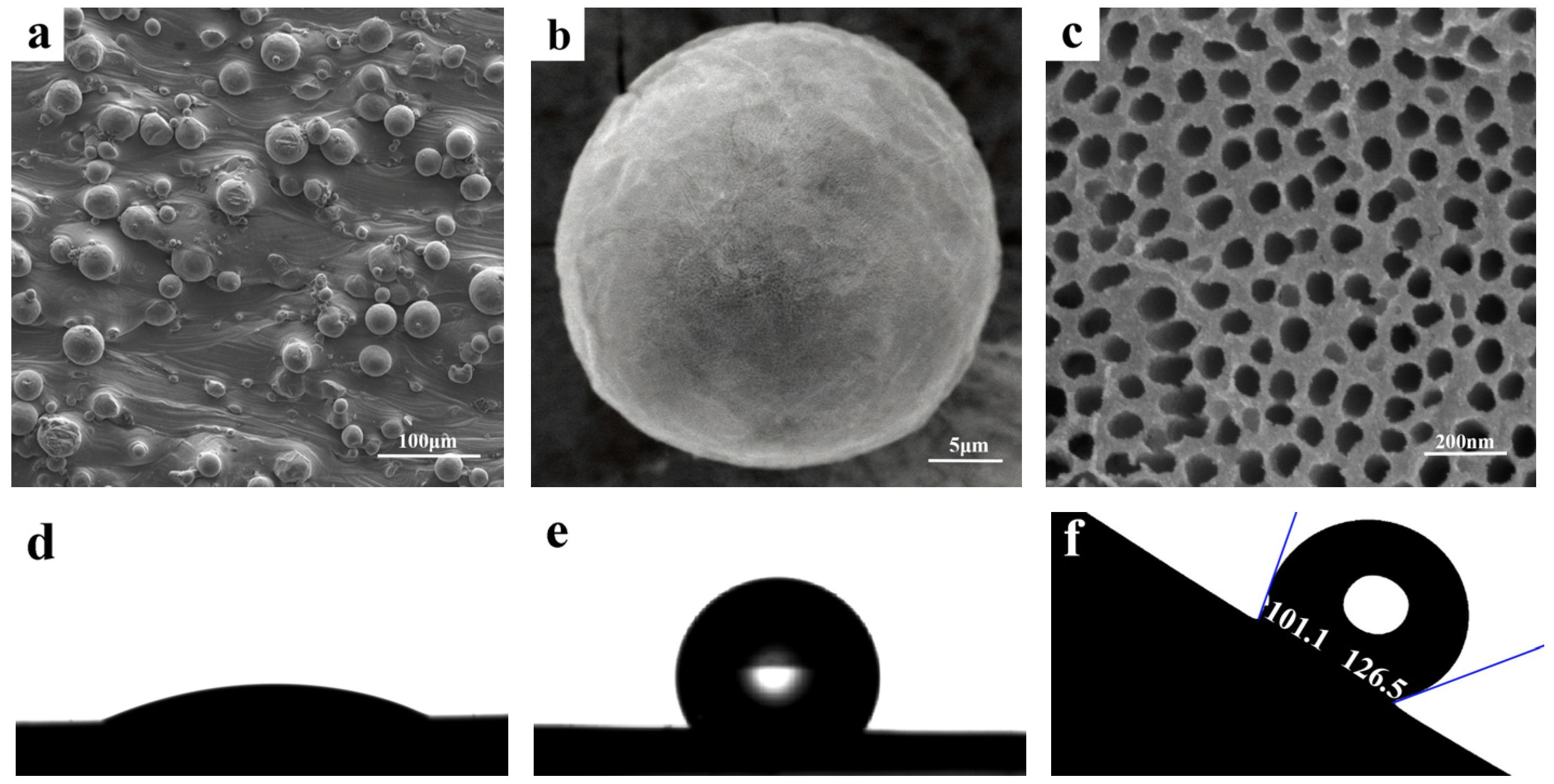
To demonstrate the effectiveness of the design strategies, three groups of micro–nanostructures were fabricated on the pristine micro-spherical particles on SLM-Ti surfaces using an electrochemical method. Figure 3a,b presents SEM images of a micro-spherical Ti particle composed of numerous TiO2 NTs (Figure 3d), obtained by anodizing an SLM-Ti sheet in 0.3 wt% NH4F electrolyte at 15 V for 1 h. A high density of well-ordered TiO2 NTs with diameters of 70.0 ± 3.5 nm are clearly visible on the surface. This nanotubular structure exhibited hydrophilicity (Figure 3d), attributed to its high surface energy and strong capillary adsorption effect [25,26].
To construct hydrophobic surfaces, the TiO2 NTs were modified with PTES. Figure 3e shows the shape of water droplets on the PTES-modified SLM-TiO2 NTs. After PTES modification, the water contact angle (WCA) of the SLM-TiO2 NTs increased from nearly 24.2° to 122.2°. The PTES-modified SLM-TiO2 NTs exhibit hydrophobic behavior, as the PTES molecules at the nanotube openings facilitate the formation of trapped (sealed) air pockets within the nanotubes [27]. As a result, the spherical droplet remained stably pinned on the surface with WCAs of θAdvancing/θReceding = 101.1°/126.5°, even when the substrate was tilted to 45° (Figure 3e).
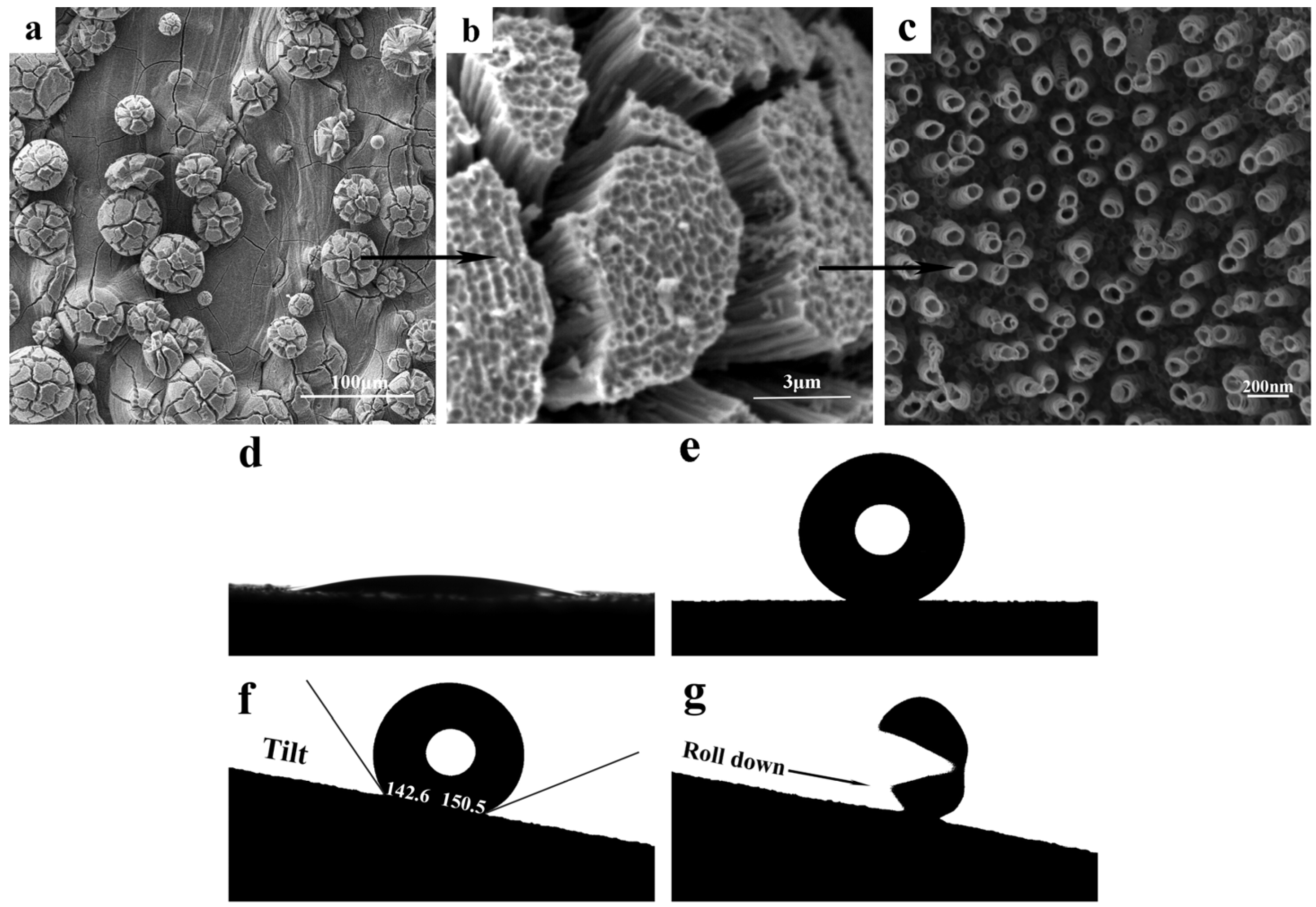
Figure 4a–c shows SEM images of divided micro-spherical Ti particles composed of TiO2 separated nanotubes (SNTs), prepared in an electrolyte containing 0.5 wt% HF and 95 vol% diethylene glycol at 40 V for 1 h. The morphological transition is realized by using two distinct electrolyte systems. Conventional TiO2 NTs are synthesized via anodization in a low-viscosity ethylene glycol-based electrolyte at 15 V, wherein balanced oxide growth and field-assisted dissolution yield adherent, vertically aligned nanotube arrays. In contrast, TiO2 SNTs are fabricated in a high-viscosity diethylene glycol-based electrolyte under higher anodization voltages (40–60 V), where restricted ion transport promotes preferential lateral etching and induces interfacial stress accumulation at the nanotube–substrate interface, ultimately triggering spontaneous delamination of the nanotube layer.
The micro-spherical Ti particles consisted of TiO2 SNTs with an average diameter of 89 ± 5 nm and an intertubular spacing of 170 ± 5 nm. The spacing between these SNTs causes the complete micro-spherical Ti particles to split into petal-like architectures, with distinct gaps retained between adjacent petals. Following surface modification with PTES, the WCA of the SNTs nanostructure increased from nearly 8.6° to 151.8° (Figure 4d,e). Although both intact and cracked Ti particles are composed of TiO2 nanotubes, distinct structural differences exist: the microscale gaps in the cracked Ti particles promote the formation of additional trapped air pockets while eliminating capillary effects. In accordance with the Cassie–Baxter model, this results in an increase in WCA.
Under static conditions, both PTES-modified SLM-TiO2 NTs and SNTs surfaces exhibit hydrophobic characteristics. However, for applications requiring water repellency, droplet mobility (dynamic wetting behavior) becomes more critical [28]. Figure 3f shows the roll-off behavior of a water droplet on the tilted SLM-TiO2 SNTs surface, captured using a video contact angle instrument. As the SLM-TiO2 SNTs surface was gradually inclined from the horizontal plane to 10°, the water droplet slid off rapidly. Contact angle hysteresis (CAH), defined as the difference between the advancing and receding CAs, is a key parameter for evaluating superhydrophobic surfaces [29,30]. Typically, a surface is considered superhydrophobic when the static CA approaches or exceeds 150° and the CAH is lower than 5° [31]. In this study, the advancing and receding WCAs on the PTES-modified SLM-TiO2 SNTs surface were measured to be 150.5° and 142.6°, respectively, corresponding to a CAH of 7.9°—slightly above the conventional threshold for superhydrophobicity. As the air trapped between the nanotubes fails to form a sealed system capable of generating negative pressure, the total adhesive force is consequently reduced.
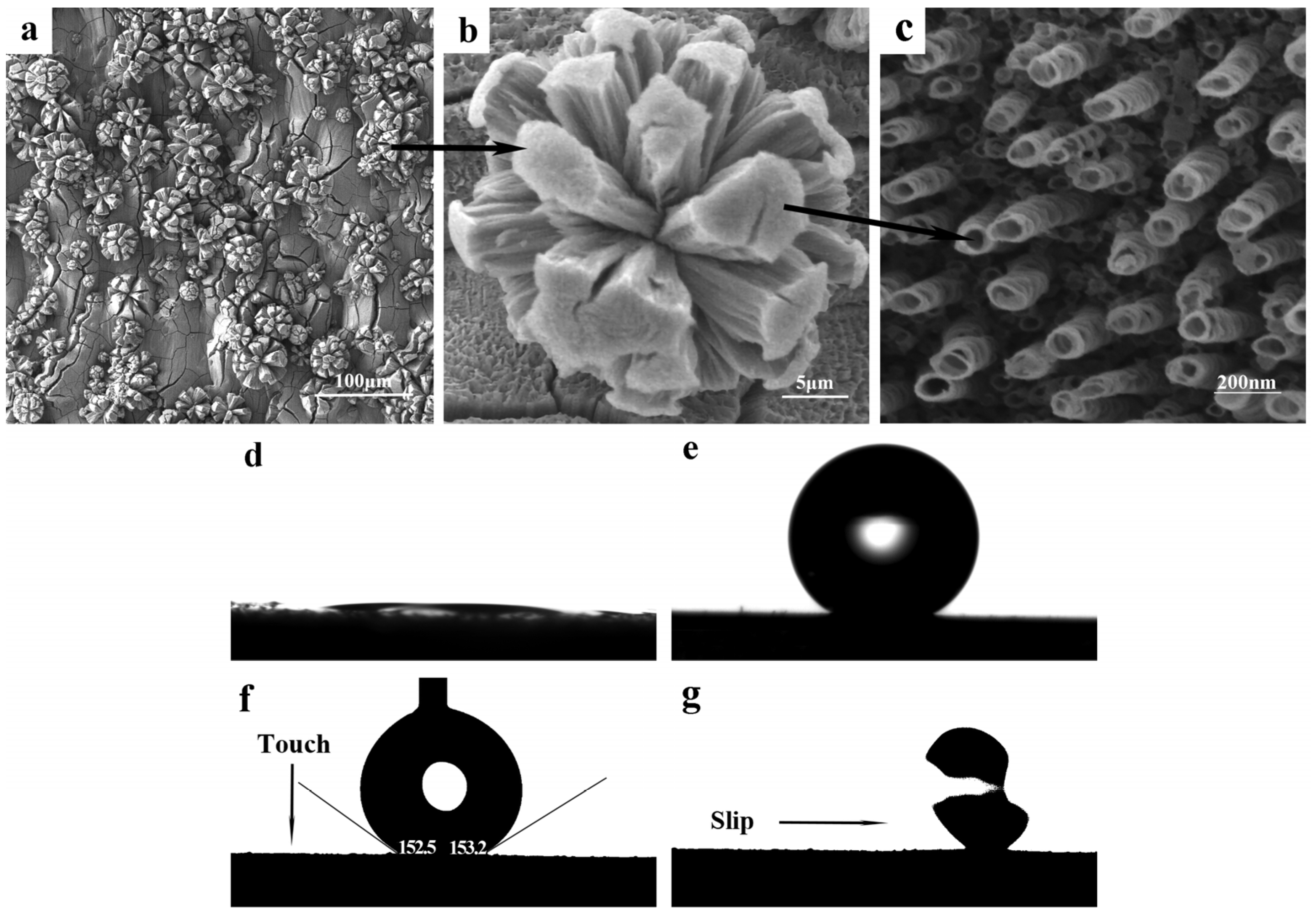
Figure 5a,b presents SEM images of cracked “petal-like” Ti particles, which were fabricated at 60 V in a 95 vol% diethylene glycol electrolyte for 40 min. As shown in Figure 5c, these “petal-like” particles consist of TiO2 SNTs with an average diameter of 115 ± 5 nm and an average intertubular spacing of 260 ± 5 nm.
This unique “petal-like” microstructure satisfies the typical liquid–solid “point-contact” design requirements (Figure 2c), enabling the entrapment of extremely large air pockets and the formation of a highly discrete TCL [32]. Following modification with PTES molecules, the surface exhibited excellent superhydrophobicity with complete non-stickiness. The apparent WCA changed from 0° to approximately 155.0°, as illustrated in Figure 5e. Moreover, for the “petal-like” Ti particles composed of TiO2 SNTs, a water droplet moved spontaneously on the horizontal SLM-TiO2 SNTs surface (Figure 5f,g), with almost no CAH, exhibiting advancing and receding angles of 152.5° and 153.2°, respectively.
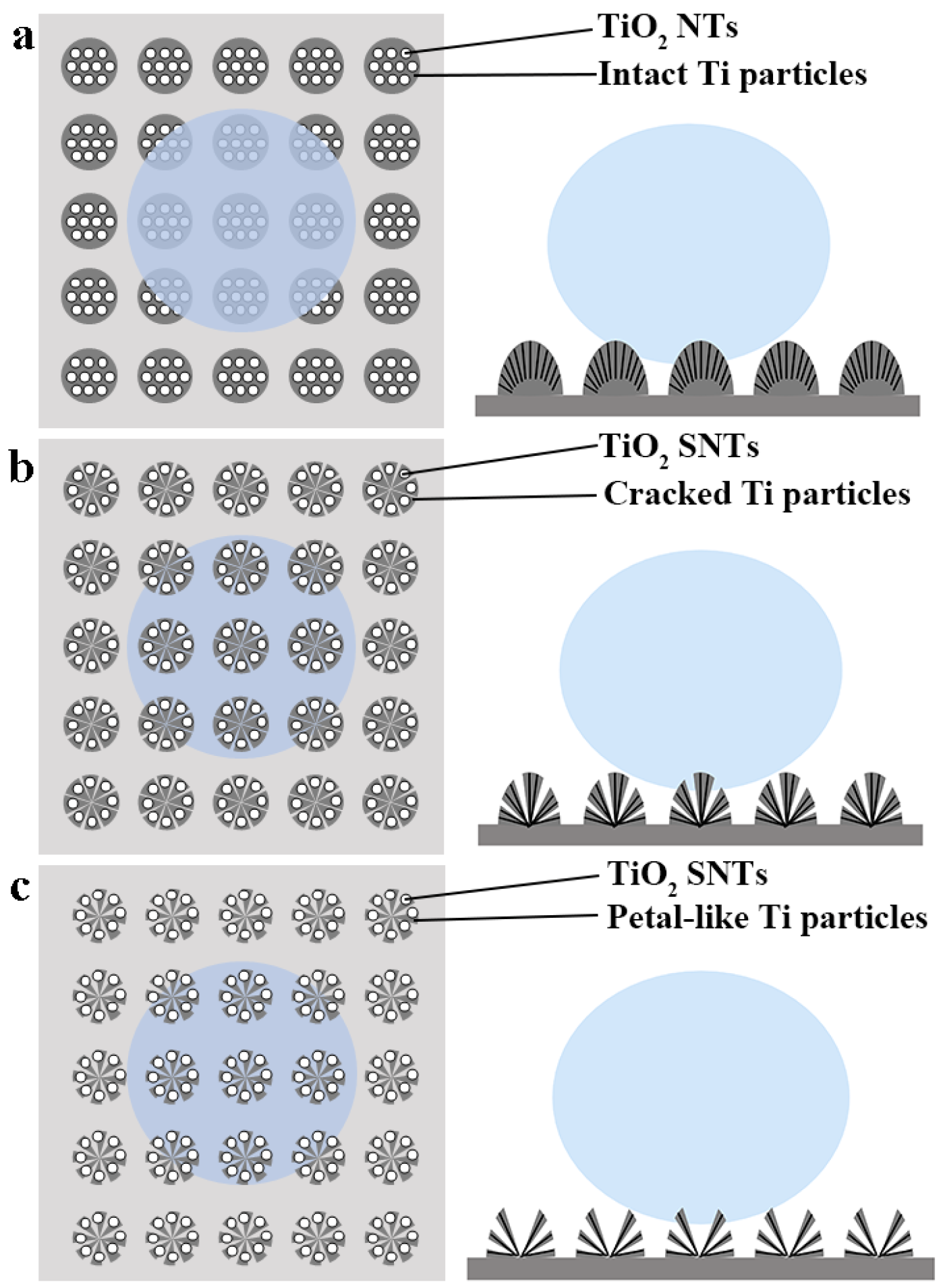
Figure 6 illustrates the three-phase contact line of a water droplet on TiO2 NTs and TiO2 SNTs surfaces. The blue lines represent a possible three-phase contact line, positioned to maximize the contact area with the surface. For the TiO2 NTs sample, the droplet diameter is on the millimeter scale, while the TiO2 nanotubes are on the nanometer scale; therefore, the contact line at the roughness scale appears nearly straight when viewed at the droplet diameter scale. The contact line may become pinned due to continuous and stable solid–liquid contact (see Figure 6a). Accordingly, the TiO2 NTs surface exhibits advancing and receding water contact angles of θAdvancing/θReceding = 101.1°/126.5°. In contrast, for the TiO2 SNTs surfaces, the three-phase contact line in Figure 6b,c is more distorted and less continuous, resulting in reduced solid–liquid contact and increased contact with air [33,34]. In this configuration, the droplet does not remain pinned prior to advancing or receding, but instead moves spontaneously, exhibiting almost no contact angle hysteresis.

4. Conclusions

This study presents a straightforward and viable approach for fabricating biomimetic superhydrophobic microstructures on SLM-Ti surfaces. Experimental results demonstrate that superhydrophobic behavior can be effectively modulated by the solid/air/liquid contact mode and the spatial configuration of trapped air pockets, both of which are governed by the morphology of microscale Ti particles. These particle configurations can be further tailored by adjusting the diameter of TiO2 nanotubes and the intertubular spacing. Notably, on “petal-like” particle surfaces assembled from TiO2 SNTs, water droplets were observed to move spontaneously across a horizontal surface with nearly zero CAH. These findings offer new insights for the rational design of advanced superhydrophobic surfaces, enabling fine control over the microstructural features of metal particles on additively manufactured metal substrates.

Author Contributions

Conceptualization, X.S.; methodology, X.S. and H.S.; validation, X.S. and H.S.; formal analysis, X.S. and H.S.; investigation, H.S.; resources, X.R.; data curation, H.S.; writing—original draft preparation, X.S.; writing—review and editing, X.S.; supervision, X.S. and X.R.; project administration, X.S. and C.Z.; funding acquisition, X.S. and C.Z. All authors have read and agreed to the published version of the manuscript.

Funding

This work was supported by the Zhuhai College of Science and Technology-Fujiang Medical Joint Laboratory Project No. ZLGC20240902, the Key Technologies R&amp D Program of Guangdong Province No. 2021ZDJS139, and the Engineering Technology Research Center for the Utilization of Functional Components of Natural products in Plants Guangdong Province Regular University No. 2022GCZX012.

Institutional Review Board Statement

Not applicable.

Informed Consent Statement

Not applicable.

Data Availability Statement

The raw data supporting the conclusions of this article will be made available by the authors on request.

Conflicts of Interest

The authors declare no conflicts of interest.

References

  1. Yu, Z.J.; Song, S.P.; Li, Y.F.; Qin, F.T.; Kuang, G.Z. Studies on Water Repellency of Super-Hydrophobic Surfaces. Adv. Mater. Res. 2014, 997, 488–491. [Google Scholar] [CrossRef]
  2. Mondal, B.; Eain, M.M.; Xu, Q.F.; Egan, V.M.; Punch, J.; Lyons, A.M. Design and Fabrication of a Hybrid Superhydrophobic-Hydrophilic Surface That Exhibits Stable Dropwise Condensation. ACS Appl. Mater. Interfaces 2015, 7, 23575–23588. [Google Scholar] [CrossRef] [PubMed]
  3. Chen, Y.; Zhang, Y.; Shi, L.; Li, J.; Xin, Y.; Yang, T.; Guo, Z. Transparent superhydrophobic/superhydrophilic coatings for self-cleaning and anti-fogging. Appl. Phys. Lett. 2012, 101, 033701. [Google Scholar] [CrossRef]
  4. He, R.; Yang, K.L.; Yuan, Z.Q.; Du, J.; Meng, S.T.; Li, C.C.; Liu, S.J.; Long, X.Y.; Su, Q. Review: Superhydrophobic antibacterial coatings in food preservation packaging. J. Mater. Sci. 2025, 60, 11221–11245. [Google Scholar] [CrossRef]
  5. Wang, Z.; Cheng, H.; Chen, R.; Wang, M.X.; Jiang, N.; Lu, Z.; Yang, H. Omnipotent antibacterial cotton fabrics with superhydrophobic and photothermal properties. Int. J. Biol. Macromol. 2025, 290, 138901. [Google Scholar] [CrossRef]
  6. Aboud, D.G.K.; Kietzig, A.M. Influence of Microstructure Topography on the Oblique Impact Dynamics of Drops on Superhydrophobic Surfaces. Langmuir 2021, 37, 4678–4689. [Google Scholar] [CrossRef]
  7. Zhang, A.; Cui, K.; Li, Z.; Chang, C.; Zhang, B.; Tian, Y.; Dong, W.; Fan, J.; Wang, S.L.; He, X. Nanodroplet impact on superhydrophobic surfaces decorated by solid nanoparticles. J. Mol. Liq. 2025, 426, 127258. [Google Scholar] [CrossRef]
  8. Li, J.; Deng, J.; Zhou, C.; Yang, J.; Shin, S.; Binks, B.P.; Cho, N. Biomimetic Superhydrophobic Surfaces by Nanoarchitectonics with Natural Sunflower Pollen. Small 2025, 21, e2409136. [Google Scholar] [CrossRef]
  9. Guo, K.; Yan, Z.; Wang, Z.; Lu, Y.; Luo, X. Electric Field-Induced Droplet Detachment and Transport on Biomimetic Superhydrophobic Surfaces with Beetle Elytra-Seta Composite Structures. Langmuir 2025, 41, 25481–25494. [Google Scholar] [CrossRef]
  10. Zhao, L.; Ruan, H.; Zhu, D.; Song, Z.; Tian, G.; Feng, X.; Li, Y.; Shi, X. Study on the fabrication and drag reduction performance of biomimetic riblet-polydimethylsiloxane-graphene composite superhydrophobic surface. Mater. Today Commun. 2025, 46, 112884. [Google Scholar] [CrossRef]
  11. Li, W.M.; Wang, S.Q.; Yang, X.; Duan, H.B.; Wang, Y.M.; Yang, Z. Research Progress on Fatigue Damage and Surface Strengthening Technology of Titanium Alloys for Aerospace Applications. Metals 2025, 15, 192. [Google Scholar] [CrossRef]
  12. Golalipour, S.; Jalalian, E.; Koosha, S.; Khorshidi, S.; Torshabi, M.; Sayyari, M. In vitro effect of anodization on surface roughness and bacterial adhesion to titanium abutments. J. Prosthet. Dent. 2025, 133, 291.e1–291.e8. [Google Scholar] [CrossRef]
  13. Romero-Serrano, M.; Romero-Ruiz, M.M.; Ríos-Santos, J.V.; Ríos-Carrasco, B.; Gil, J. Influence of alumina shot blasting induced roughness on bacterial adhesion to titanium. Clin. Oral Investig. 2025, 29, 497. [Google Scholar] [CrossRef] [PubMed]
  14. Zuo, P.; Zhu, D.; Li, F.; Tian, H.; Han, W.; Liu, T.; Yu, K.; Zhou, J.; He, X. Fabrication of Superhydrophobic Micro/Nanostructures of Titanium Alloy by Femtosecond Laser. ACS Omega 2025, 10, 33178–33191. [Google Scholar] [CrossRef] [PubMed]
  15. Wang, Y.K.; Li, J.; Guo, Y.J.; Fu, S.; Lu, Y.N. Preparation of anisotropic superhydrophobic titanium alloy surface and analysis of droplet icing performance. Colloids Surf. A Physicochem. Eng. Asp. 2025, 711, 136326. [Google Scholar] [CrossRef]
  16. Dobrzański, L.B.; Dobrzańska, J.; Dobrzański, L.A. Strength analysis of selectively laser sintered titanium alloy dental implantscaffolds for immediate implantation applications. Arch. Mater. Sci. Eng. 2025, 131, 27–41. [Google Scholar]
  17. Yue, X.; Liu, M.; Li, T.; Zhang, J.; Chen, S. Surface roughness improvement of selective laser melted Ti6Al4V using electropolishing with the dried NaCl-EG solution. Int. J. Adv. Manuf. Technol. 2025, 140, 5283–5295. [Google Scholar] [CrossRef]
  18. Al-Rubaie, K.S.; Melotti, S.; Rabelo, A.; Paiva, J.M.; Veldhuis, S.C. Machinability of SLM-produced Ti6Al4V titanium alloy parts. J. Manuf. Process. 2020, 57, 768–786. [Google Scholar] [CrossRef]
  19. Matena, J.; Petersen, S.; Gieseke, M.; Kampmann, A.; Teske, M.; Beyerbach, M.; Escobar, H.; Haferkamp, H.; Gellrich, N.C.; Nolte, I. SLM Produced Porous Titanium Implant Improvements for Enhanced Vascularization and Osteoblast Seeding. Int. J. Mol. Sci. 2015, 16, 7478–7492. [Google Scholar] [CrossRef]
  20. Zhang, H.; Du, H.; Zhu, D.; Zhao, H.; Zhang, X.; He, F.; Wang, L.; Lv, C.; Hao, P. Ice Adhesion Properties on Micropillared Superhydrophobic Surfaces. ACS Appl. Mater. Interfaces 2024, 16, 10. [Google Scholar] [CrossRef]
  21. Luo, Y.; Li, C.; Tang, W.; Mao, C.; Zhang, M.; Tang, K.; Liao, W.; Huang, J. A novel surgical diamond spherical wheel to prevent bone adhesion with superhydrophobic and super-slippery coatings. Colloids Surf. A Physicochem. Eng. Asp. 2024, 698, 134463. [Google Scholar] [CrossRef]
  22. Nosonovsky, M.; Bhushan, B. Roughness optimization for biomimetic superhydrophobic surfaces. Microsyst. Technol. 2005, 11, 535–549. [Google Scholar] [CrossRef]
  23. Erbil, H.Y.; Cansoy, C.E. Range of applicability of the Wenzel and Cassie-Baxter equations for superhydrophobic surfaces. Langmuir 2009, 25, 14135–14145. [Google Scholar] [CrossRef] [PubMed]
  24. Liu, B.; Tang, J.X.; Li, J.; Shan, Y.G.; Jiang, Y.H. Soft wetting: Modified Cassie-Baxter equation for soft superhydrophobic surfaces. Colloids Surf. A. Physicochem. Eng. Asp. 2023, 677, 132348. [Google Scholar] [CrossRef]
  25. Roach, P.; Shirtcliffe, N.J.; Newton, M.I. Progess in superhydrophobic surface development. Soft Matter 2008, 4, 224–240. [Google Scholar] [CrossRef]
  26. Feng, L.; Zhang, Z.Y.; Mai, Z.H.; Ma, Y.M.; Liu, B.Q.; Jiang, L.; Zhu, D.B. A Super-Hydrophobic and Super-Oleophilic Coating Mesh Film for the Separation of Oil and Water. Angew. Chem. Int. Ed. 2004, 43, 2012–2014. [Google Scholar] [CrossRef] [PubMed]
  27. Sun, T.L.; Wang, G.J.; Feng, L.; Liu, B.Q.; Ma, Y.M.; Jiang, L.; Zhu, D.B. Reversible Switching between Superhydrophilicity and Superhydrophobicity. Angew. Chem. 2004, 116, 361–364. [Google Scholar] [CrossRef]
  28. Masahashi, N.; Semboshi, S.; Ohtsu, N.; Oku, M. Microstructure and superhydrophilicity of anodic TiO2 films on pure titanium. Thin Solid Film. 2008, 516, 7488–7496. [Google Scholar] [CrossRef]
  29. Lau, K.K.S.; Bico, J.; Teo, K.B.K.; Chhowalla, M.; Amaratunga, G.A.J.; Milne, W.I.; McKinley, G.H.; Gleason, K.K. Superhydrophobic Carbon Nanotube Forests. Nano Lett. 2003, 3, 1701–1705. [Google Scholar] [CrossRef]
  30. Lee, D.J.; Kim, H.M.; Song, Y.S.; Youn, J.R. Water Droplet Bouncing and Superhydrophobicity Induced by Multiscale Hierarchical Nanostructures. Acs Nano 2012, 6, 7656. [Google Scholar] [CrossRef]
  31. Li, X.G.; Mao, L.Y.; Ma, X.Y. Dynamic Behavior of Water Droplet Impact on Microtextured Surfaces: The Effect of Geometrical Parameters on Anisotropic Wetting and the Maximum Spreading Diameter. Langmuir 2013, 29, 1129–1138. [Google Scholar] [CrossRef]
  32. Pu, G.; Severtson, S.J. Characterization of dynamic stick-and-break wetting behavior for various liquids on the surface of a highly viscoelastic polymer. Langmuir 2008, 24, 4685–4692. [Google Scholar] [CrossRef]
  33. Graham, P.J.; Farhangi, M.M.; Dolatabadi, A. Dynamics of droplet coalescence in response to increasing hydrophobicity. Phys. Fluids 2012, 24, 112105. [Google Scholar] [CrossRef]
  34. Toma, M.; Loget, G.; Corn, R.M. Flexible Teflon Nanocone Array Surfaces with Tunable Superhydrophobicity for Self-Cleaning and Aqueous Droplet Patterning. Acs Appl. Mater. Interfaces 2014, 6, 11110–11117. [Google Scholar] [CrossRef]
Figure 1. (a) 1D, (b) 2D, and (c) 3D surface profiles of the SLM-Ti substrate acquired using a digital microscope.
Micromachines 17 00454 g001
Figure 2. Schematics of three superhydrophobic micro–nanostructures. (a) Air trapped in conventional TiO2 NTs on intact SLM-Ti particles, featuring liquid–solid area contact. (b) Air trapped in separated TiO2 SNTs on cracked SLM-Ti particles, exhibiting liquid–solid line contact. (c) Air trapped in cracked, “petal-like” SLM-Ti particles, showing liquid–solid point contact.
Micromachines 17 00454 g002
Figure 3. (a,b) SEM images of micro-sphere Ti particles with numerous TiO2 NTs structure (c), (d) a water droplet on the superhydrophilic TiO2 surface, (e) a droplet on the superhydrophobic PTES-modified TiO2 NPA structure and (f) a water droplet on a 45° inclined positioned superhydrophobic surface.
Micromachines 17 00454 g003
Figure 4. (a,b) SEM images of micro-sphere Ti particles with separated TiO2 SNTs structure (c), (d) a water droplet on the superhydrophilic TiO2 surface, (e) a droplet on the superhydrophobic PTES-modified TiO2 SNTs structure and (f,g) a water droplet on a 10° inclined positioned superhydrophobic surface.
Micromachines 17 00454 g004
Figure 5. (a,b) SEM images of micro-sphere Ti particles with separated TiO2 SNTs structure (c), (d) a water droplet on the superhydrophilic TiO2 surface, (e) a roplet on the superhydrophobic PTES-modified TiO2 SNTs structure and (f,g) a water droplet on a horizontal positioned superhydrophobic surface.
Micromachines 17 00454 g005
Figure 6. Schematic illustration of the surface topography: (a) conventional TiO2 NTs on intact SLM-Ti particles, (b) separated TiO2 SNTs on cracked SLM-Ti particles, (c) separated TiO2 SNTs on “petal-like” SLM-Ti particles. Blue lines denote the theoretical three-phase contact lines of a sessile water droplet on each respective surface.
Micromachines 17 00454 g006
Disclaimer/Publisher’s Note: The statements, opinions and data contained in all publications are solely those of the individual author(s) and contributor(s) and not of MDPI and/or the editor(s). MDPI and/or the editor(s) disclaim responsibility for any injury to people or property resulting from any ideas, methods, instructions or products referred to in the content.