4.1. Fixed-Frequency Mode
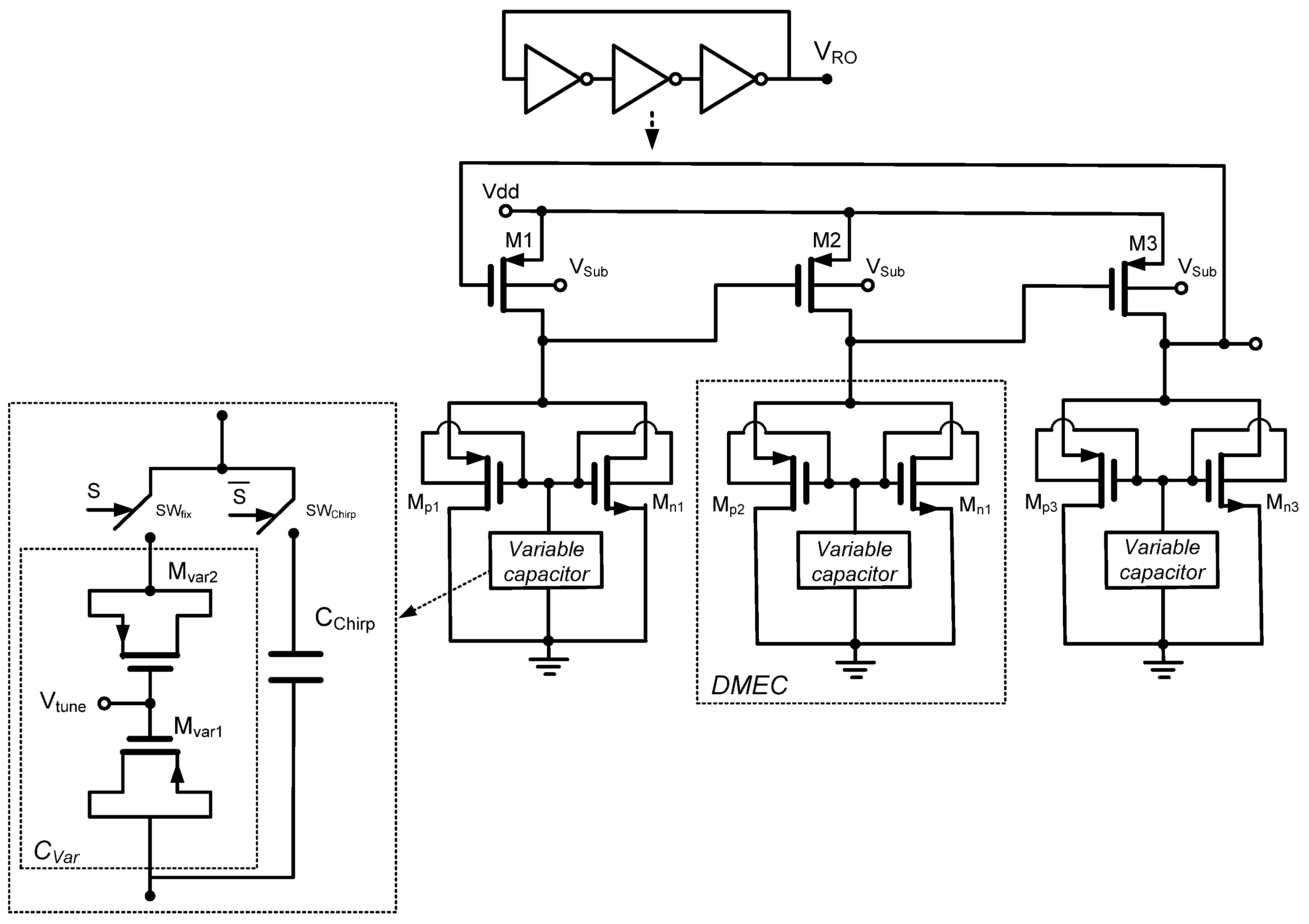
As described above, the variation in oscillation frequency is accomplished by electronically adjusting the state capacitance of the memristor emulator using inversion-mode MOS (I-MOS) varactors integrated into the DMEC core. In the proposed architecture, for the fixed operation mode, two NMOS transistors
and
are configured as I-MOS varactors, replacing the fixed state capacitor
. The drain and source terminals of both transistors are tied together to form the first terminal, which is connected to the common gate node of the DTMOS pair in the DMEC. The gate terminals of
and
are connected to form the control terminal, which is driven by the external tuning voltage
. This configuration allows the effective capacitance at the state node to be varied electronically. In this circuit configuration, when the control voltage
is increased, the varactors enter deeper inversion, thereby increasing the effective capacitance at the state node. This increased capacitance slows the rate of change in the state voltage
, which in turn increases the memristance
according to Equation (1). Since the oscillation frequency is inversely proportional to
, the overall effect is a reduction in oscillation frequency. Conversely, decreasing
reduces the varactor capacitance, leading to lower memristance and higher oscillation frequency. Thus, the I-MOS varactors provide a smooth, voltage-controlled tuning mechanism for the memristor-based oscillator, enabling wide frequency programmability in the fixed-frequency mode while maintaining the compact, two-transistor core of the DMEC.
Table 1 provides the sizing of the transistors used in the proposed dual oscillator.
The simulation results for the proposed dual-mode oscillator were obtained through systematic variation in several key design parameters: the supply voltage , the I-MOS varactor gate control voltage , applied exclusively to the PMOS pull-up transistors, and the width of the I-MOS varactor transistors.
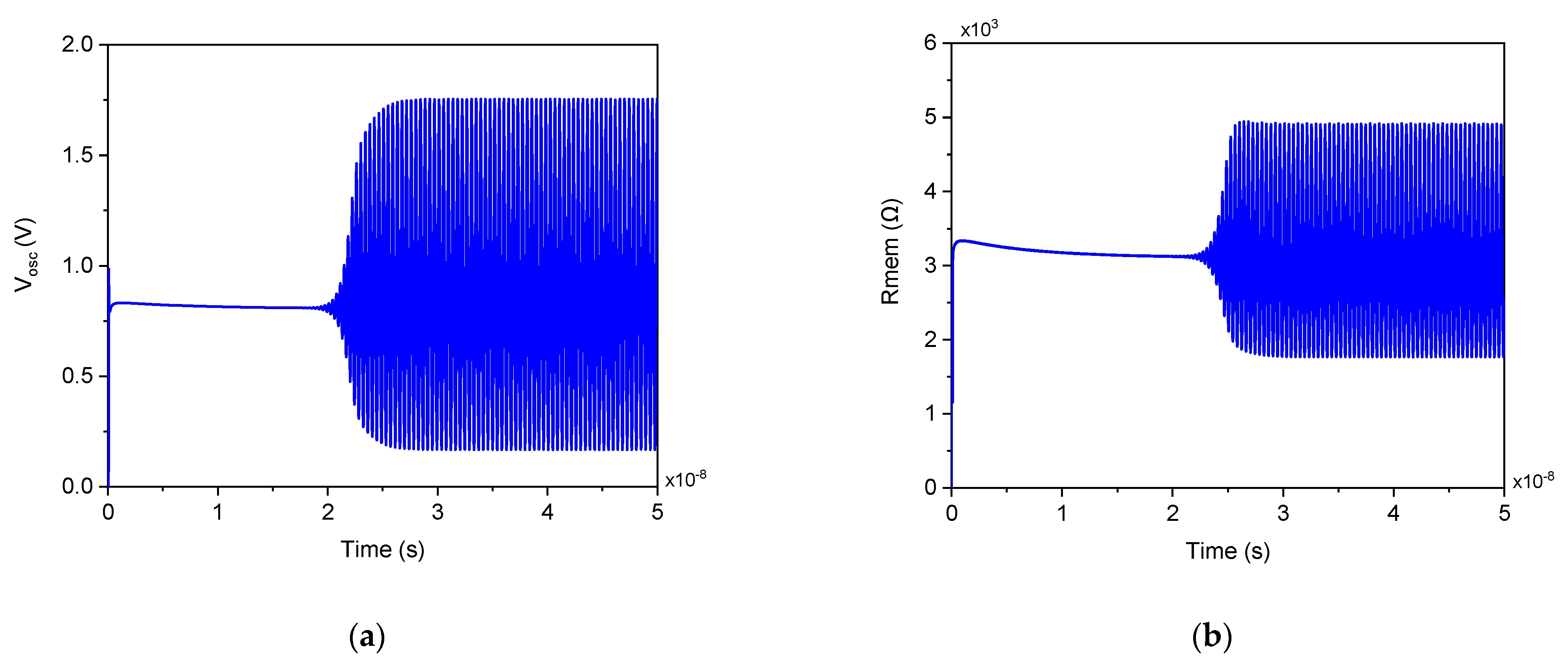
The transient simulation of the proposed dual-mode oscillator for
V and varactor width
, is depicted in
Figure 3. As shown, the output voltage exhibits a stable oscillation at approximately 3.858 GHz with a peak-to-peak amplitude of 1.58 V, while the corresponding memristance
oscillates synchronously between 1.9 kΩ and 4.91 kΩ given an average of 3.405 kΩ, confirming the dynamic, state-dependent resistance modulation intrinsic to the memristive feedback loop. As shown, transient analysis of the proposed oscillator reveals a fundamental memristive behavior: the instantaneous memristance
oscillates synchronously with the output voltage, alternating periodically between two distinct resistance states. This phenomenon arises directly from the state-governed dynamics of the DTMOS-based emulator. During each oscillation cycle, the voltage applied across the memristor drives a bidirectional current
, which continuously charges and discharges the state capacitor
according to the memristor’s governing equation
. Consequently, the state voltage
modulates rhythmically, and because the memristance is inversely proportional to
, as expressed in Equation (1),
likewise oscillates. This cyclic resistance variation is not an artifact but a signature of memristive operation; it embodies the pinched hysteresis characteristic in the time domain, confirming that the emulator behaves as a true floating memristor rather than a static linear resistor. The observed symmetry and regularity of the resistance swing further attest to the balanced push-pull action of the complementary DTMOS pair and the proper integration of the memristor into the oscillator’s feedback loop. This dynamic memristance modulation is essential for enabling the circuit’s dual-mode functionality, whether stabilizing frequency in fixed mode or generating chirps through controlled state evolution, and demonstrates the design’s fidelity to memristive system theory. Although the instantaneous memristance
oscillates between two discrete values due to the alternating conduction of the complementary DTMOS pair, the oscillation frequency remains stable because the time-averaged memristance
is constant over each full cycle. This balance results from the symmetric push–pull operation of the emulator, where the higher and lower resistance states contribute equally to the total propagation delay, yielding a fixed output frequency despite the underlying memristance modulation.
The PMOS varactors are biased such that their source/drain terminals are connected to the state node at DC voltage V. The tuning voltage is applied to the gate terminal, ranging from 0.4 V to 1.8 V. This ensures that the effective gate–source voltage sweeps from negative to positive values, moving the varactor from accumulation through depletion into inversion, thereby providing the necessary capacitance variation for frequency tuning. At low tuning voltages ( V), the PMOS varactor operates in deep accumulation, where the capacitance characteristic becomes non-ideal due to parasitic gate overlap and leakage effects. This results in a deviation from the expected monotonic frequency tuning trend, yielding slightly lower oscillation frequencies than predicted by the ideal model. For practical applications, the usable tuning range is therefore defined for V, where the varactor exhibits well-behaved inversion/accumulation transitions.
The oscillation frequency of the proposed dual-mode oscillator in fixed-frequency configuration was characterized first across a range of supply voltages (
) and substrate bias voltages (
) applied exclusively to the PMOS pull-up transistors
,
, and
of the three-stage ring oscillator core. The PMOS varactor width was fixed at
, and the tuning voltage
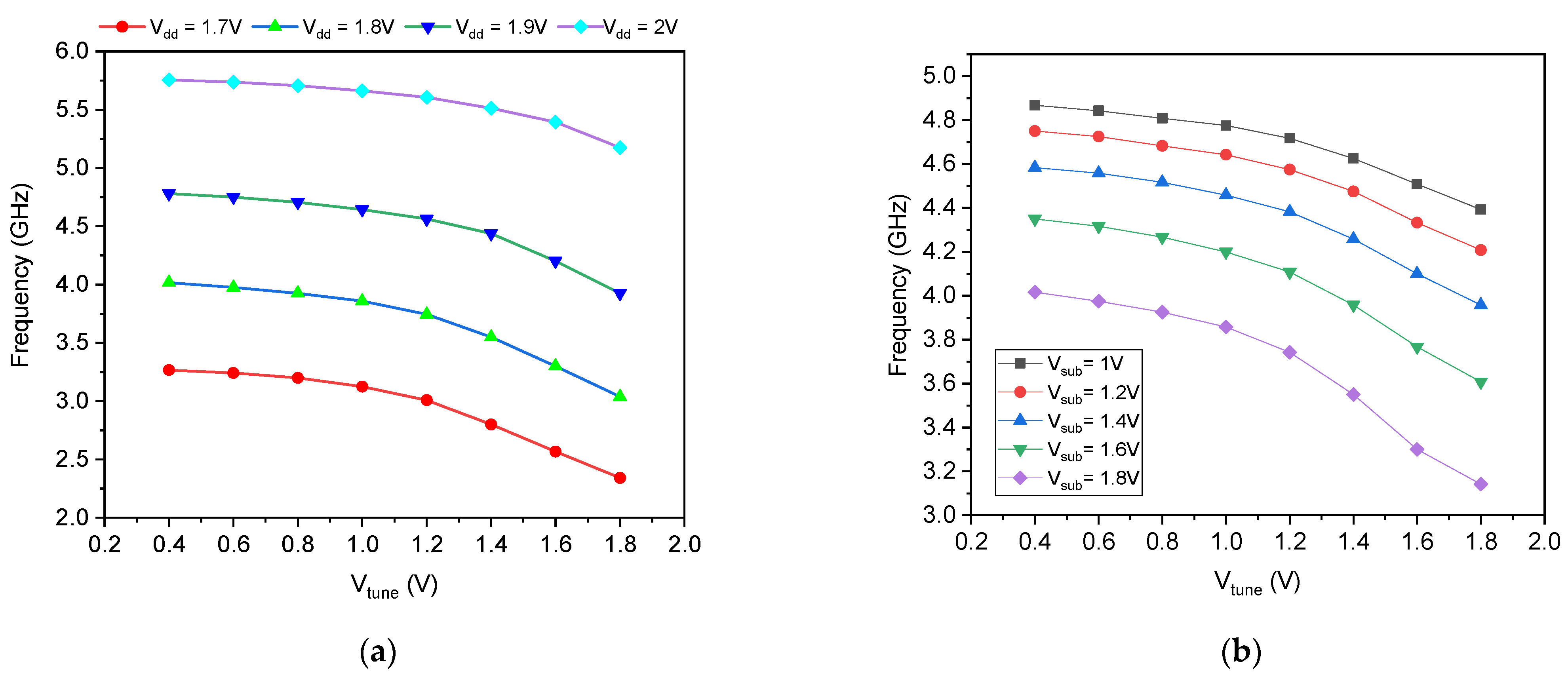
was swept from 0.4 V to 1.8 V. The complete frequency data set is summarized in
Table 2, with
Figure 4a illustrating the
dependence and
Figure 4b depicting the
dependence.
Figure 4b presents the oscillation frequency as a function of
for five different substrate bias voltages applied to the well terminals of
, with
ranging from 1.0 V to 1.8 V. In contrast to the
trend, increasing
monotonically decreases the oscillation frequency. At
V, the frequency drops from 4.867 GHz at
V to 4.017 GHz at
V, a 17.5% reduction. This inverse relationship is a direct consequence of the body effect in PMOS transistors. As
rises (moving closer to or above the source voltage
), the source–body voltage
increases, which elevates the threshold voltage
of the PMOS devices. A higher
reduces the overdrive voltage for a given
, weakening the pull-up current and increasing the rise time delay. The effect is consistent across the entire
range, with the highest frequencies always observed at the lowest
. Importantly, because
is applied only to the oscillator core transistors and not to the memristor emulator itself, this tuning mechanism operates independently of the memristor’s state, providing an orthogonal degree of frequency control without perturbing the memristive dynamics.
As shown in
Figure 4a, the oscillation frequency exhibits a strong positive correlation with
. At a fixed
V, increasing the supply voltage from 1.7 V to 2.0 V raises the frequency from 3.267 GHz to 5.756 GHz, a 76% improvement. This behavior is attributed to the increased overdrive voltage (
) of the PMOS pull-up transistors, which enhances their current-drive capability and reduces the output node rise time. Since the oscillation frequency is inversely proportional to the propagation delay per stage, any reduction in delay directly translates to higher
. Notably, the frequency sensitivity to
is more pronounced at lower
values, where the memristance is minimal and the stage delay is dominated by the PMOS drive strength. At higher
, the memristance increases and becomes the limiting factor, compressing the frequency spread across
. This behavior confirms that both the memristor and the PMOS pull-up devices contribute to the overall delay, offering two independent knobs for frequency control. The power consumption of the proposed dual-mode oscillator was characterized across supply voltage
and tuning voltage
variations. For a fixed
, the power consumption remained virtually independent of
, with measured values of 78.3 µW at
V, 111 µW at
V, 149 µW at
V, and 192 µW at
V, regardless of the specific
setting. This behavior confirms that the DMEC consumes zero static power, as its operation is purely passive and driven solely by the oscillating signal.
Furthermore, the total power consumption in our oscillator arises from three fundamental mechanisms: dynamic switching losses, short-circuit current, and any static bias currents. The dynamic switching power is dissipated primarily in the PMOS pull-up transistors as they charge and discharge the output node capacitances during each oscillation cycle. This component is inherent to any switching circuit and scales with frequency, capacitance, and supply voltage. The short-circuit power occurs during the brief interval when both the PMOS pull-up and the memristor path conduct simultaneously during switching transitions, creating a temporary direct path from supply to ground. Critically, the memristor emulator itself contributes negligibly to the total power dissipation. This is because the DTMOS-based memristor is a passive two-terminal element with no DC bias path. Unlike a conventional NMOS pull-down transistor, which requires a static connection to ground and conducts continuous subthreshold leakage, the memristor emulator conducts current only during switching events and does so symmetrically, charging the state capacitor during one half-cycle and discharging it during the next. The absence of any DC path to ground or supply also eliminates the leakage currents that typically plague conventional CMOS oscillators, particularly at elevated temperatures. The conventional oscillator dissipates significantly more power due to three factors: the NMOS pull-down transistors contribute both dynamic switching losses and static leakage, the short-circuit current is substantially larger because of the abrupt switching characteristics of complementary CMOS inverters, and the presence of direct DC paths through the NMOS devices allows continuous subthreshold conduction. In contrast, our memristor-based architecture replaces the lossy NMOS pull-down with a lossless reactive element, fundamentally altering the power dissipation profile. The memristor emulator consumes no DC power and contributes only reactive energy transfer to the system. The total power consumption is dominated by the unavoidable dynamic switching of the PMOS transistors and the reduced short-circuit current, both of which are minimized through the memristor’s gradual switching characteristics.
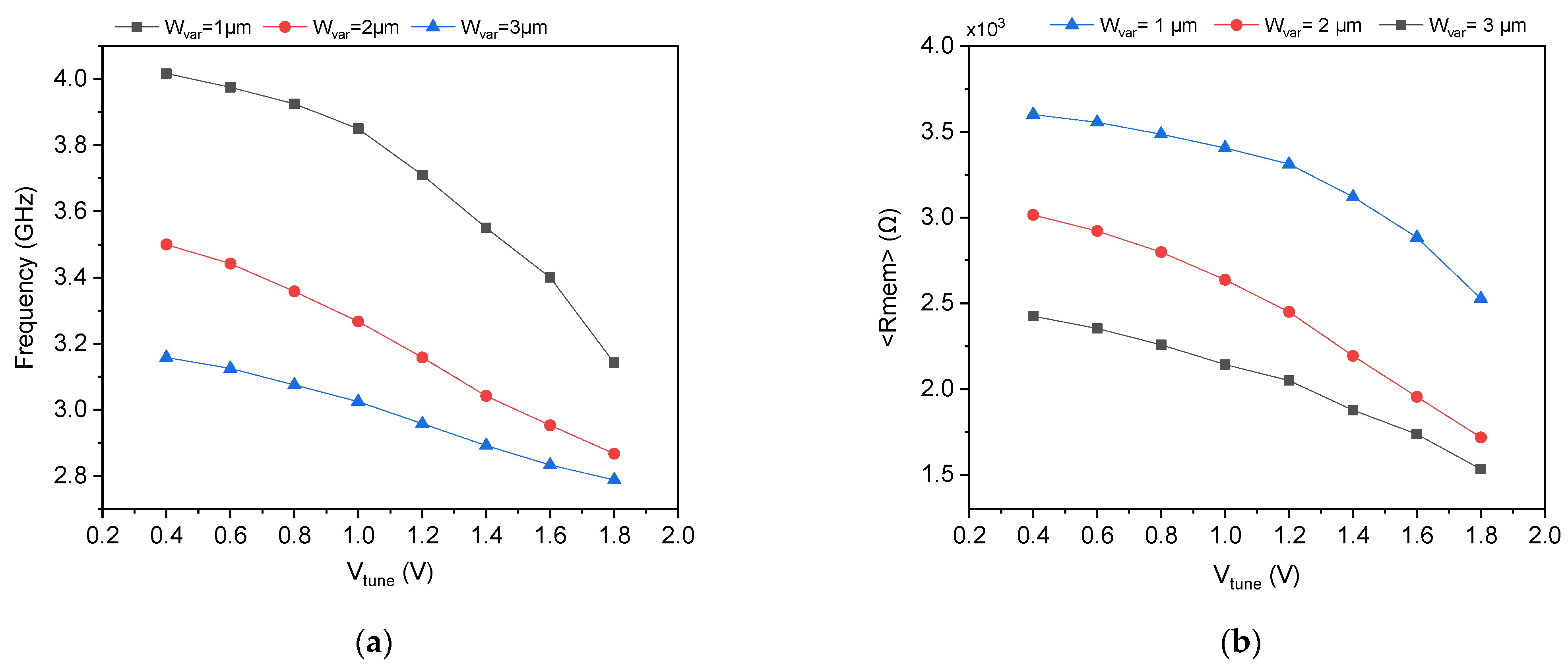
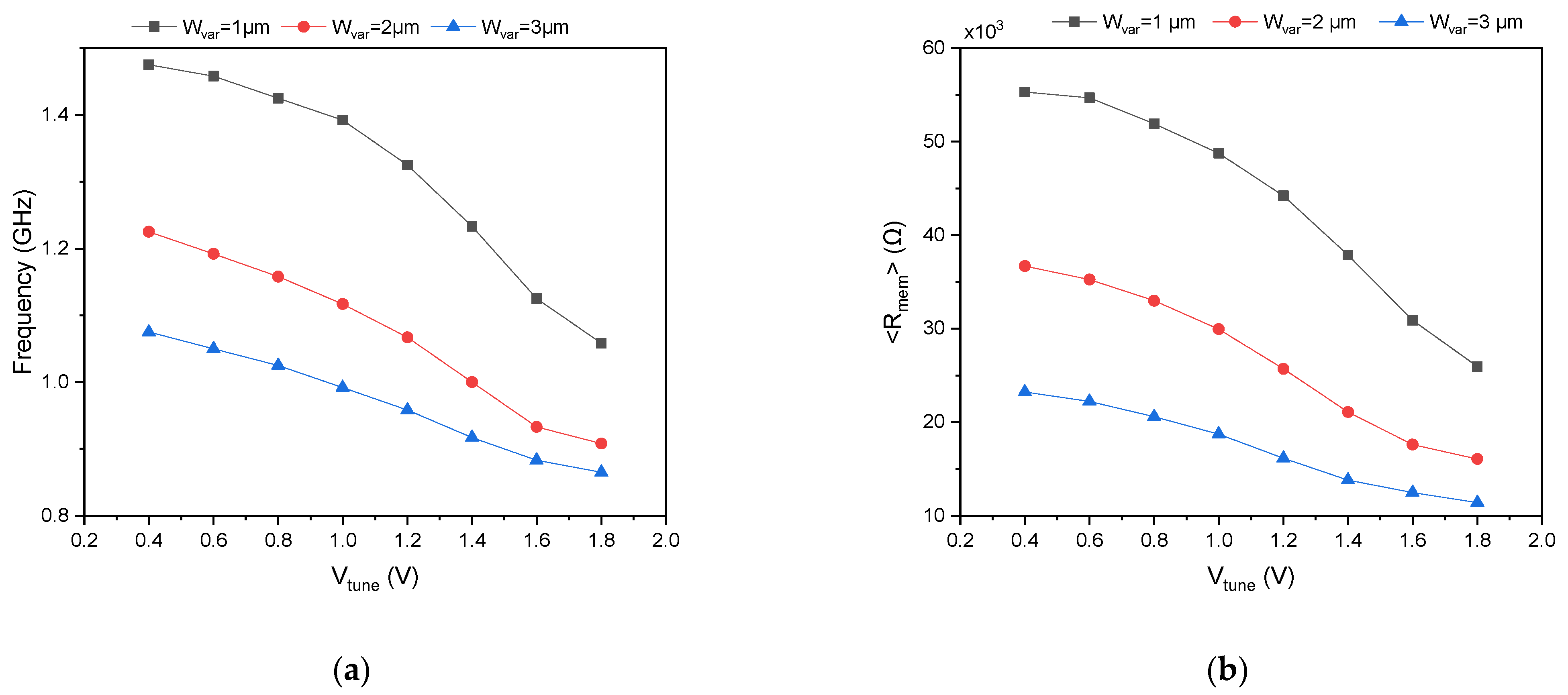
To further investigate the tunability of the proposed dual-mode oscillator, the oscillation frequency and average memristance
were characterized as functions of the varactor tuning voltage
for three different PMOS varactor widths:
, 2, and 3 μm, and two ring oscillator stage configurations: three-stage and five-stage. The supply voltage and substrate bias were fixed at
V and
V for all simulations. The complete dataset is summarized in
Table 3 for the three-stage topology and
Table 4 for the five stage topology, with graphical representations provided in
Figure 5 and
Figure 6, respectively. As shown in
Figure 5a and
Table 3, increasing the varactor width
reduces the oscillation frequency across the entire
range. For a fixed
V, the frequency decreases from 4.017 GHz at
μm to 3.158 GHz at
μm, a 21.4% reduction. This inverse relationship is explained by the proportional dependence of varactor capacitance on gate area:
. A wider varactor presents a larger effective capacitance at the memristor’s state node, which increases the time constant and slows the evolution of the state voltage
Consequently, the memristance
remains higher on average, as confirmed by
Figure 5b, where
at
V decreases from 3.6 kΩ at
μm to 2.242 kΩ at
μm. Since the oscillation frequency is inversely proportional to
, this increase in memristance directly suppresses
. Notably, the frequency tuning range (defined as
over
–1.8 V) expands with increasing varactor width. For
μm, the tuning ratio is 1.28× (4.017 GHz/3.142 GHz), while for
μm, it widens to 1.32× (3.158 GHz/2.808 GHz). This improvement is attributed to the enhanced capacitance modulation depth of larger varactors, which experience a greater absolute change in capacitance as
sweeps from accumulation to inversion. The wider capacitance swing produces a larger variation in
and thus a broader memristance range, translating into an extended frequency tuning span. However, this comes at the cost of reduced maximum frequency, as the larger minimum capacitance of wide varactors limits how low
can go even at minimal
.
Figure 6 and
Table 4 present the corresponding results for the five-stage ring oscillator configuration. As expected, increasing the number of stages from three to five reduces the oscillation frequency by approximately 2.7 to 3.8 times across all conditions, consistent with the fundamental relationship
. For example, at
μm and
V, the five-stage oscillator operates at 1.475 GHz compared to 4.017 GHz for the three-stage design. This frequency scaling enables the same core topology to cover different application bands without redesigning the delay cells: three stages for GHz-range wireless telemetry and five stages for sub-GHz baseband processing or intermediate-frequency signal conditioning. Furthermore, the strong correlation between
and oscillation frequency across all configurations confirms that the memristor is the dominant frequency-setting element in this design. The ability to predict and control
through
, whether by varying
,
, or
, validates the theoretical model developed in
Section 3 and establishes the DMEC as a reliable, repeatable, and integrable adaptive component for next-generation biomedical microsystems.
The spectral purity of the proposed dual-mode oscillator was evaluated through phase noise simulations for both three-stage and five-stage configurations at their respective center frequencies. For the three-stage oscillator operating at 4.017 GHz, the phase noise at a 1 MHz offset was measured as −87.82 dBc/Hz. For the five-stage oscillator configuration, the phase noise was measured at a center frequency of 1.475 GHz. At 1 MHz offset, the phase noise improved to −94.3 dBc/Hz, representing a 6.5 dB enhancement compared to the three-stage design. This improvement is attributed to two factors: first, the lower oscillation frequency inherently reduces phase noise for a given technology; second, the increased number of stages distributes the delay more evenly, reducing the effective jitter contribution per stage.
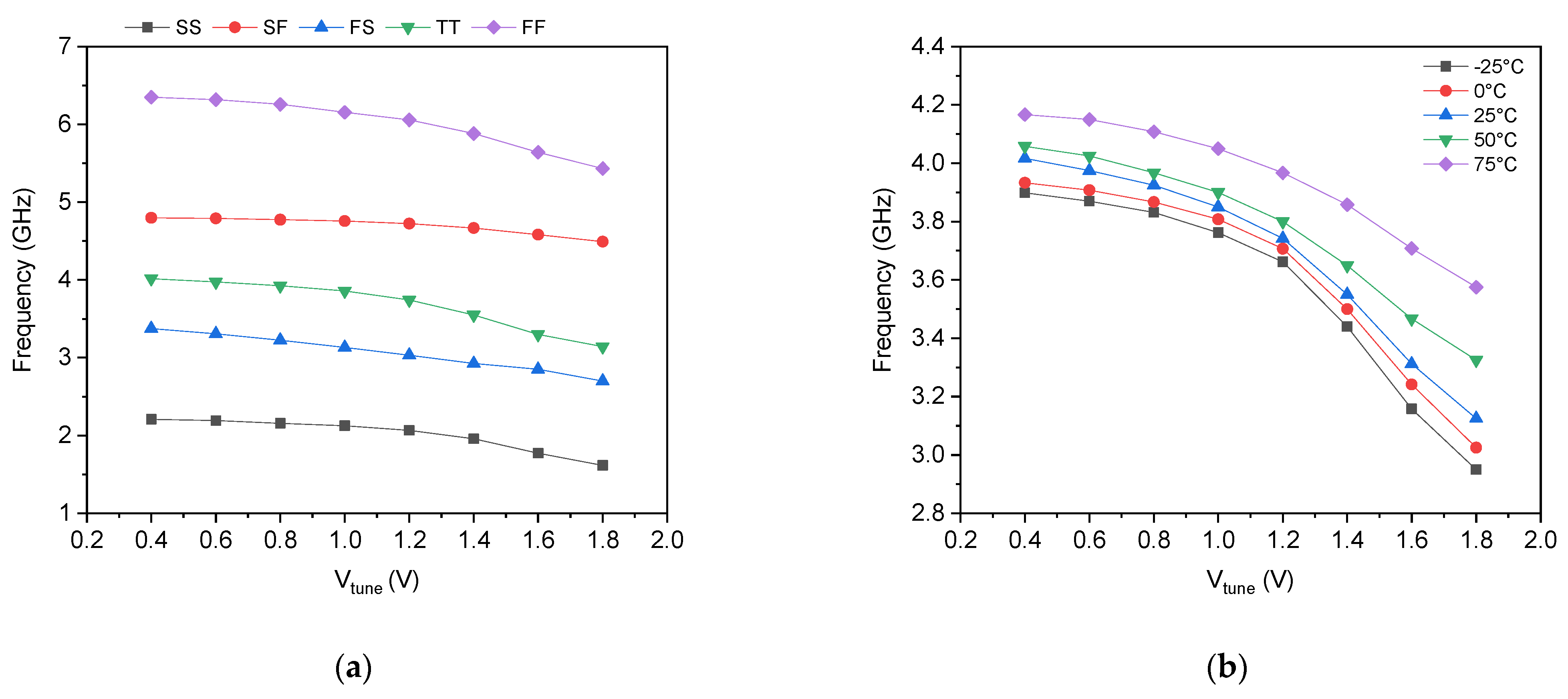
The robustness of the proposed dual-mode oscillator was evaluated through process corner simulations across the five standard CMOS corners: TT (typical–typical), FF (fast–fast), SS (slow–slow), FS (fast–slow), and SF (slow–fast). Simulations were performed at
V,
V, and
µm, with
swept from 0.4 V to 1.8 V. As depicted in
Figure 7a, the oscillation frequency exhibits the expected dependence on process conditions: the FF corner yields the highest frequencies, ranging from 6.35 GHz at
V to 5.433 GHz at
V, while the SS corner produces the lowest frequencies, from 2.208 GHz to 1.617 GHz over the same tuning range. This significant spread, approximately 2.9 times between FF and SS at
V, is attributed to the combined effects of faster carrier mobility, lower threshold voltages, and reduced memristance in fast corners, all of which decrease stage delay and elevate oscillation frequency. The SF and FS corners exhibit intermediate frequency responses, with SF consistently higher than FS due to the asymmetric impact of NMOS versus PMOS strength on the memristor-loaded PMOS inverter topology. Importantly, the oscillator maintained stable, continuous oscillation across all corners and tuning voltages, and the memristor’s characteristic pinched hysteresis loop remained clearly observable in each case. These results confirm that the proposed architecture is inherently robust to global process variations and can be reliably manufactured across different process splits. The thermal stability of the proposed dual-mode oscillator was characterized additionally across −25 °C to 75 °C at
V,
V, and
µm. As depicted in
Figure 7b, the oscillation frequency exhibits a positive temperature coefficient across all
values, increasing from 3.899 GHz at −25 °C to 4.167 GHz at 75 °C for
V. This variation arises because the threshold voltage reduction in the DTMOS devices outweighs mobility degradation with rising temperature, decreasing memristance and stage delay. For biomedical applications, this inherent stability ensures reliable operation across diverse environmental conditions, from cold storage to body temperature and febrile states, while eliminating the need for external temperature sensors or calibration loops. The monotonic frequency–temperature relationship also offers potential for dual-purpose use as an on-chip temperature sensor, further enhancing the oscillator’s utility in resource-constrained implantable and wearable systems. For biomedical applications requiring tight frequency tolerance, the observed corner-dependent frequency shifts can be readily compensated through the oscillator’s multiple tuning approaches, enabling post-fabrication calibration without additional circuitry or area overhead. Our proposed oscillator architecture offers four independent tuning mechanisms, each with distinct characteristics suitable for different calibration stages. The state capacitor
serves as the most powerful tuning knob, as it directly controls the memristor’s time constant and can shift the oscillation frequency over an order of magnitude. The supply voltage
provides a wide tuning range of ±43% around the center frequency, making it ideal for coarse corner correction, though with linear power scaling. The varactor control voltage
offers ±28% continuous fine-tuning with zero static power overhead, as it only sets the voltage on MOS varactor gates with negligible DC leakage. Additionally, the substrate bias
provides a ±17% tuning range that can be dedicated to temperature compensation without perturbing the primary controls.
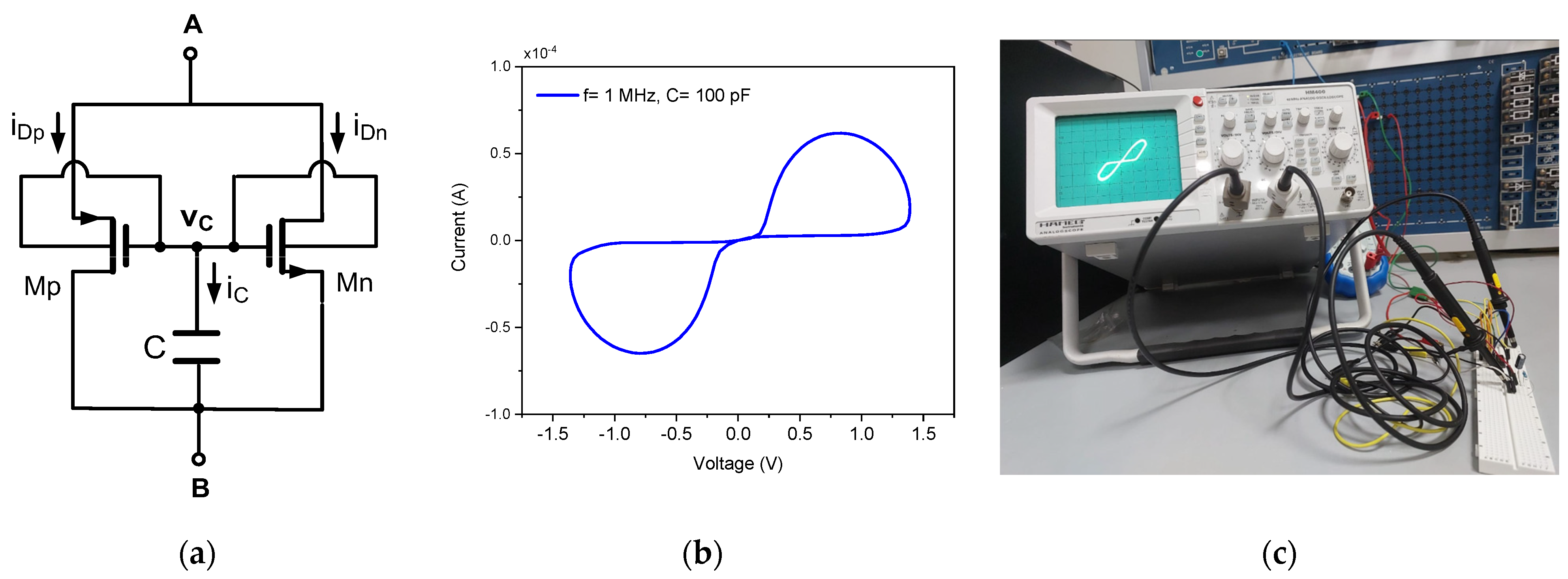
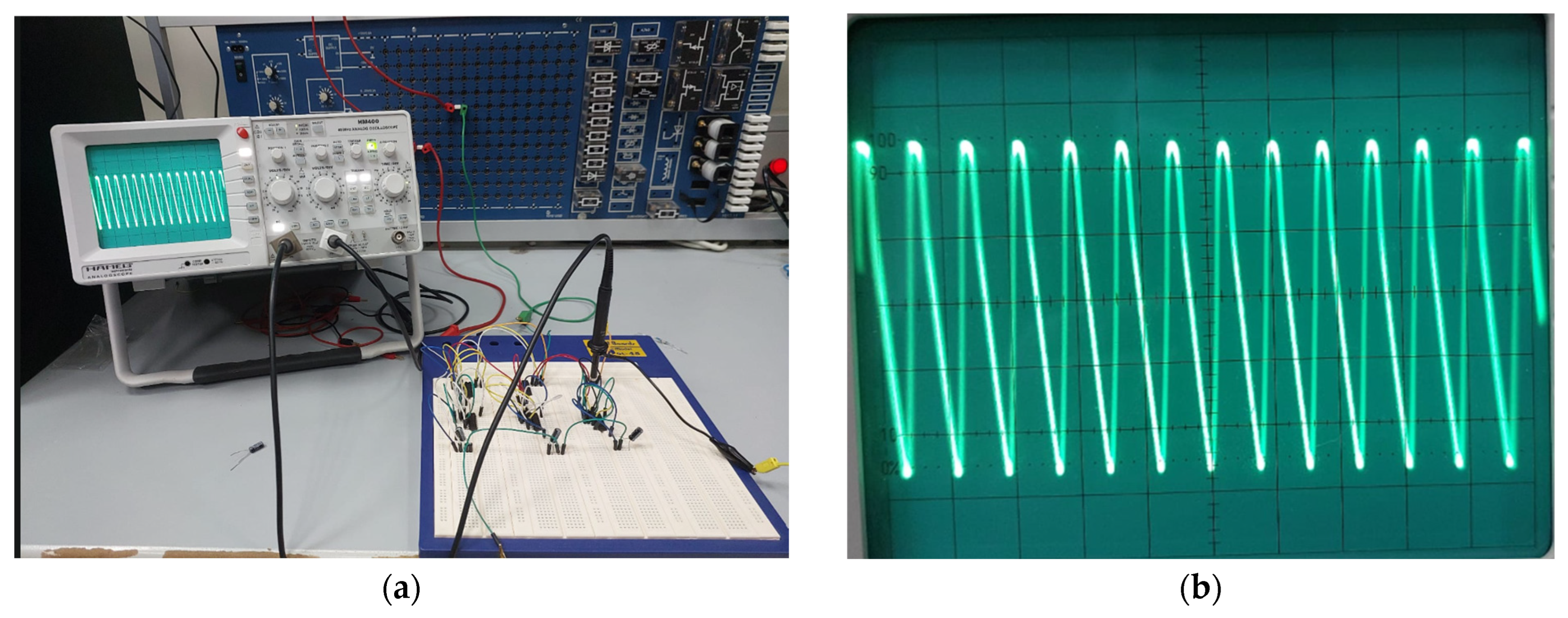
The oscillation principle of the proposed dual memristor-based ring oscillator was experimentally validated using a discrete prototype built around the CD4007UB CMOS integrated circuit, which contains complementary pairs of MOSFETs suitable for emulating the DTMOS configuration by externally connecting the gate and substrate terminals. The complete experimental setup is shown in
Figure 8a. Each memristor emulator was constructed using two CD4007 transistors configured as DTMOS devices, with an external state capacitor
C = 1 μF and discrete PMOS pull-up transistors forming the three-stage ring oscillator core. The output waveform was captured using a digital oscilloscope. It is important to emphasize that this discrete prototype serves a dual-purpose: first, to provide qualitative validation of the oscillation principle, and second, to investigate whether the proposed DTMOS memristor emulator could function correctly in a practical circuit implementation under real-world conditions. Despite its minimalist two-transistor topology, the emulator must demonstrate robust operability within a complete oscillator system, overcoming non-idealities such as component mismatches, parasitic elements, and measurement probe loading that are often absent in idealized simulations. The successful generation of stable oscillation under these practical challenges provides critical evidence that the memristive feedback mechanism is not merely a simulation concept but a practically realizable circuit element. The prototype successfully exhibited stable oscillation, with a measured fundamental frequency of 330 kHz for
C = 1 μF. The substantial frequency difference between this measurement and the multi-GHz simulated results arises from fundamental differences between the discrete and integrated implementations. The CD4007 transistors are fabricated in a legacy ~5 µm technology, featuring effective channel lengths much longer than the 0.18 µm devices used in our simulated design. Furthermore, the discrete prototype employs a 1 μF external state capacitor, larger than the integrated MOS varactors, which proportionally increases the memristor time constant. Combined with substantial parasitic elements from bond pads, PCB traces, package inductance, and oscilloscope probe loading, factors that are absent or minimized in the integrated implementation, these factors collectively account for the observed higher-frequency scaling between the prototype and the simulated CMOS design.
As depicted in
Figure 8b, the output waveform deviates significantly from an ideal sinusoidal shape, exhibiting a non-smooth, asymmetrical profile. This behavior is entirely consistent with expectations for a non-optimized discrete implementation and can be attributed to several factors. First, the CD4007 transistors are designed for general-purpose digital switching at 5–15 V supplies, not for analog subthreshold or high-speed operation, resulting in abrupt transitions and nonlinear current–voltage characteristics that introduce high-frequency harmonics. Second, the large discrete capacitor (1 μF) creates a millisecond-scale time constant that forces slow memristor state evolution, yet the CD4007 switching transitions remain sharp, producing a waveform that resembles a distorted, slew-rate-limited square wave rather than a pure sinusoid. Third, the prototype lacks the fine capacitive tuning, balanced complementary DTMOS matching, and parasitic optimization available in the integrated CMOS version, exacerbating non-idealities such as parasitic capacitances, bond-wire inductances, and mismatched threshold voltages between discrete devices. Additionally, the loading effect of the oscilloscope probe further degrades the waveform quality at the measurement node. Despite these imperfections, the prototype successfully achieves its intended validation objectives. Critically, it confirms that the memristive feedback mechanism operates correctly in practice, the oscillator starts reliably without external triggering, and that it maintains stable oscillation over extended measurement periods. We have separately validated the memristor emulator’s pinched hysteresis behavior using the same CD4007 prototype as depicted in
Figure 1c, confirming that the core memristive element functions as intended at the device level. The successful system-level oscillation demonstrated in
Figure 8b, despite the considerable limitations of the discrete implementation, provides strong evidence that the memristor-based oscillator topology is sound and translates correctly to integrated form.
Furthermore, this experimental validation demonstrates that the DTMOS memristor emulator is not merely a theoretical construct but a practically realizable circuit element capable of operating within complex systems using readily available, off-the-shelf components. The fact that oscillation was achieved with no specialized fabrication, no post-processing, and no trimming underscores the robustness and accessibility of the proposed design approach. This qualitative validation, combined with the comprehensive simulations in 0.18 µm CMOS presented throughout
Section 4, provides confidence that the proposed architecture achieves GHz-range operation with ultra-low power consumption when properly integrated. The quantitative performance metrics—multi-GHz frequencies, sub-100 µW power consumption, clean sinusoidal waveforms, and low phase noise—remain achievable only in full-custom CMOS integration, where careful layout, device matching, parasitic minimization, and optimized DTMOS implementation are possible. The discrete prototype thus serves as an essential bridge between simulation and practical realization, confirming both the theoretical soundness and the practical operability of the proposed memristor-based oscillator architecture.
4.2. Chirp Frequency Mode
Beyond fixed-frequency oscillation, the proposed dual-mode oscillator can be reconfigured to operate as a programmable chirp pulse generator, a critical function for frequency-modulated biomedical applications such as neural stimulation, bio-impedance spectroscopy, swept-frequency radar-based vital sign monitoring and wireless biomedical signal processing. In this mode, the memristor’s state capacitor is increased to a sufficiently large value such that the state voltage can no longer track the instantaneous oscillation; instead, it integrates the AC signal over many cycles, producing a slow, monotonic ramp in memristance. This gradual change in continuously modulates the stage delay, resulting in a linear frequency sweep (chirp) at the oscillator output. Unlike conventional voltage-controlled oscillators that require external ramp generators or digital frequency synthesizers, the proposed architecture generates the chirp autonomously using only the memristor’s inherent state dynamics. This section presents comprehensive simulation results characterizing the chirp generation capability of the oscillator, including the effects of state capacitor value and the width of the control signal SWchirp, on chirp rate, sweep range, and linearity.
The chirp mode operation of the proposed dual-mode oscillator was first characterized through transient simulation with a fixed state capacitor
pF, at
V and
μm.
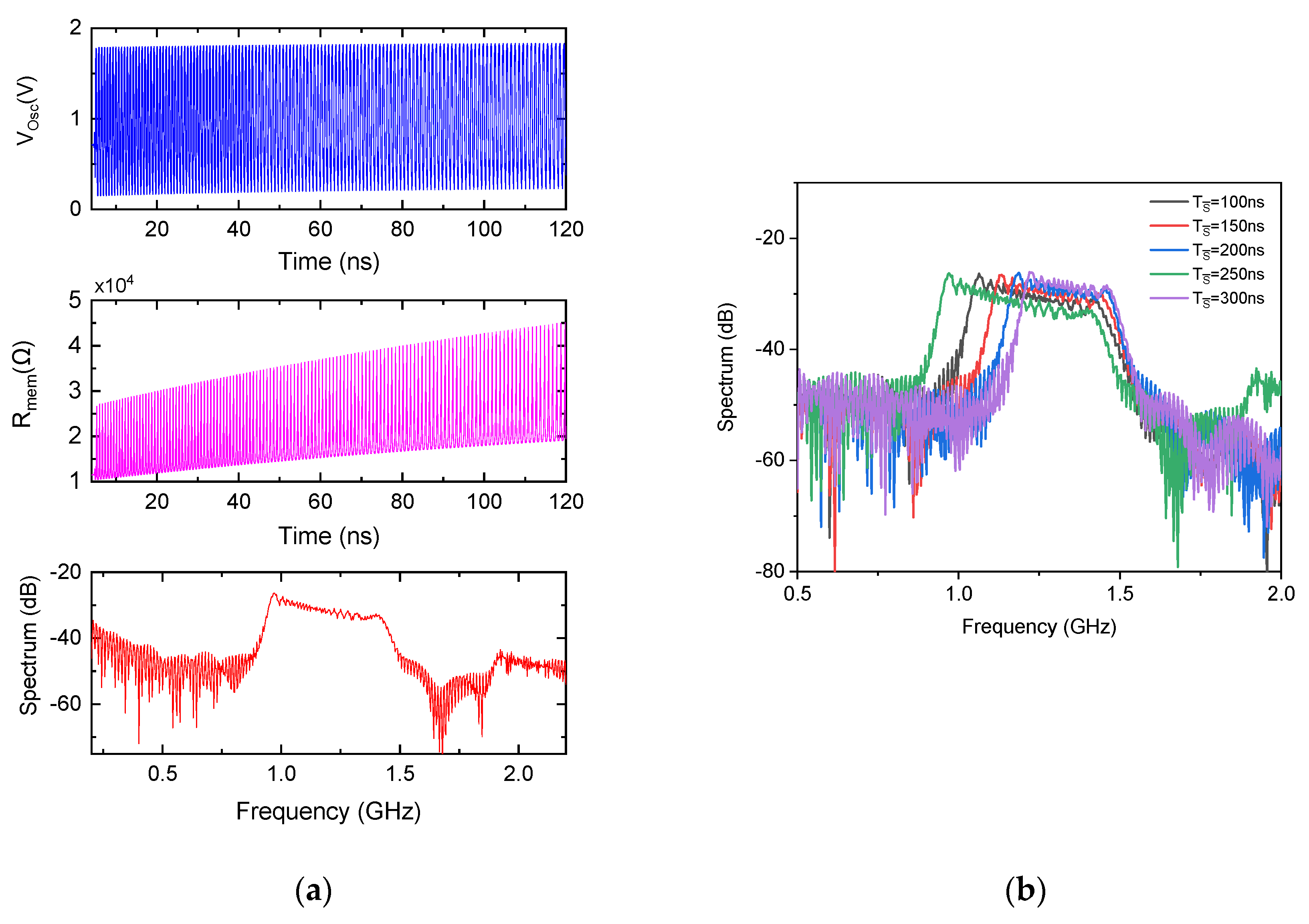
Figure 9a presents the transient output waveform, exhibiting a clear frequency sweep over time. The corresponding instantaneous memristance
, also plotted in
Figure 9a, reveals a distinctive dynamic behavior: the memristance oscillates periodically between a minimum and maximum value within each oscillation cycle, but crucially, both the lower and upper bounds of this oscillation increase monotonically with time. This gradual upward drift in memristance is the direct consequence of the state capacitor integrating the AC signal, causing
to rise slowly over thousands of cycles. As
increases, the stage delay grows, and the oscillation frequency progressively decreases, producing a positive-to-negative chirp (downsweep).
Figure 9a also depicts the corresponding output spectrum, showing a broad, continuous frequency spread from approximately 1.0 GHz to 1.5 GHz, confirming successful chirp generation.
The output spectrum exhibits a slight positive variation of approximately 4 dB across the chirp bandwidth, with lower-frequency components displaying significantly higher spectral magnitude than higher-frequency components. This phenomenon does not reflect amplitude variation in the time-domain waveform but rather the nonlinear frequency–time relationship inherent to the memristor-based chirp generation mechanism. As the state capacitor integrates charge, the rate of frequency change is not constant; the sweep progresses rapidly through the upper frequency band and gradually decelerates as memristance increases, causing the oscillator to dwell longer at lower frequencies. Consequently, more oscillation cycles contribute to the low-frequency portion of the spectrum, yielding greater integrated energy and higher FFT magnitude. This behavior is characteristic of passive, integration-based chirp synthesis and confirms that frequency modulation, not amplitude flatness, is the dominant information carrier. For biomedical applications such as swept-impedance spectroscopy or frequency-modulated neural stimulation, this energy concentration at the sweep endpoint is often desirable, as it maximizes signal energy in the band of interest without requiring additional power.
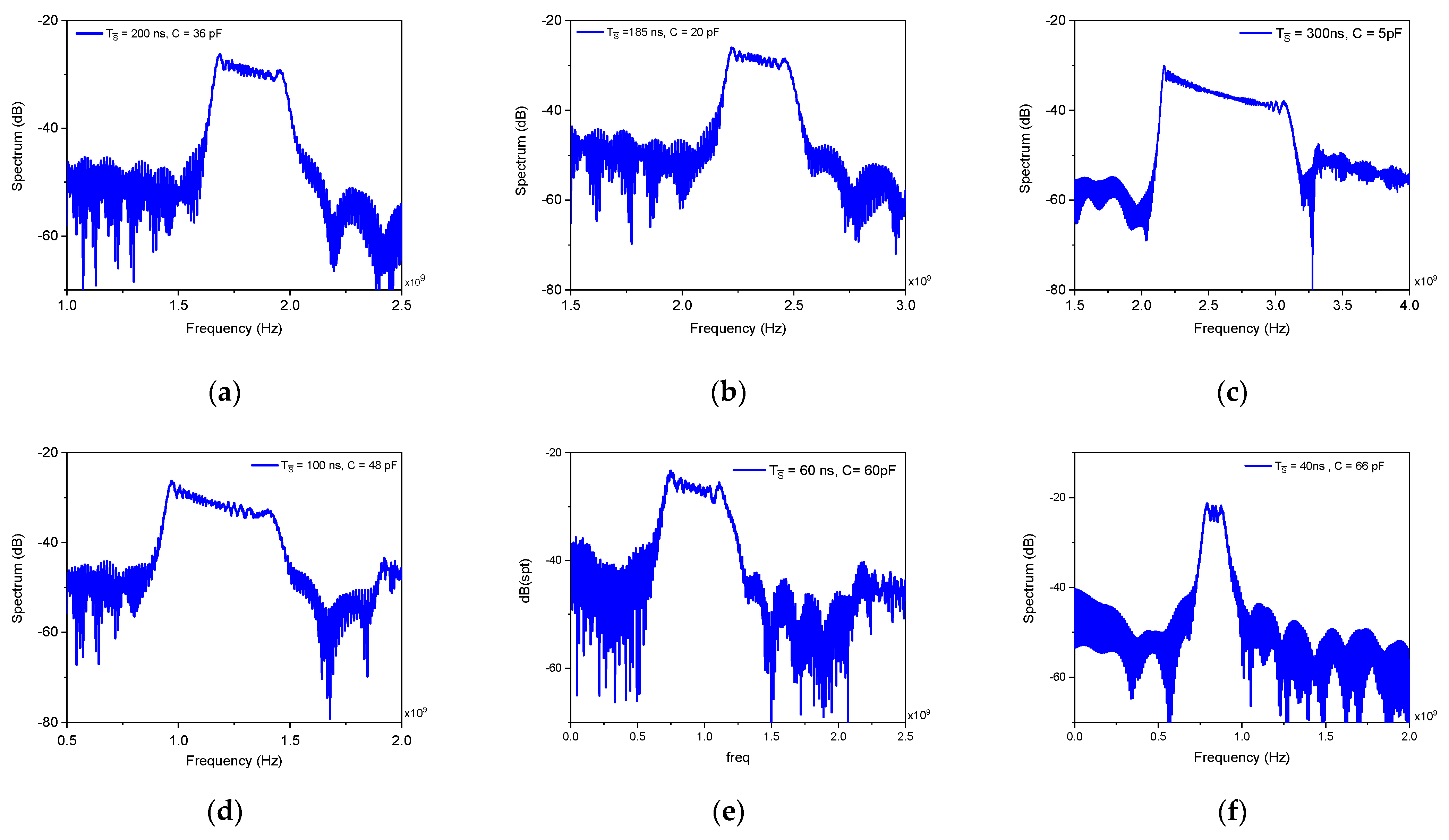
To investigate the programmability of the chirp waveform, the duration of the
control signal, which enables the current injection path to the state capacitor, was varied while maintaining a fixed
pF.
Figure 9b presents the output spectra for five different
pulse widths. Notably, the upper bound (highest frequency) of the chirp spectrum remains largely invariant with respect to the control signal width, as the initial memristance state is identical at the moment the chirp is triggered. However, the lower bound (lowest frequency) exhibits strong dependence on
width: longer enable pulses allow the state capacitor to integrate charge over an extended duration, driving
to higher values and memristance to larger magnitudes, thereby extending the frequency sweep further downward. This behavior provides a simple, digitally controllable approach for adjusting the chirp span without modifying analog components. For instance, increasing the
pulse width from 100 ns to 300 ns expands the sweep range from 1.23 to 1.45 GHz to 0.9–1.42 GHz, a 300 MHz extension of the low-frequency boundary.
As predicted theoretically, the absolute frequency band of the chirp is primarily governed by the value of the state capacitor
, while the sweep depth is independently controlled by the
pulse width.
Figure 10 presents the output spectra for different capacitance values, each measured with a correspondingly adjusted
width to maintain a consistent sweep range. Increasing
shifts the entire chirp spectrum upward: the 5 pF case achieves a maximum frequency of 3.3 GHz, while for 66 pF the spectrum centers around 1 GHz. This positive correlation between capacitance and frequency arises because larger
reduces the quiescent state voltage
, lowering the initial memristance and thereby raising the oscillation frequency when the chirp is triggered. Simultaneously, for a fixed
pulse width, the sweep depth contracts with increasing
, as the same injected charge produces a smaller voltage increment
. Thus,
serves as the master frequency-setting element in chirp mode, determining the spectral band, while
width independently controls the sweep depth. This orthogonal control, capacitance for coarse band selection, pulse width for fine sweep range adjustment, provides exceptional flexibility for biomedical applications, enabling dynamic reconfiguration of both carrier frequency and modulation bandwidth without additional circuitry or power overhead.