Article

Comparing Electrochemical Performance of Thin-Film Ti-Pt Microelectrodes on Planar and Non-Planar Glass Substrates for Lab-on-a-Chip Applications


by
Karolina Kołczyk-Siedlecka
1,2,*,
Zbigniew Szklarz
2,3,
Elizaveta Vereshchagina
4,
Aina Herbjørnrød
4,
Paul Wittendorp
4,
Shruti Jain
4,
Piotr Żabiński
1,
Aldona Garbacz-Klempka
3 and
Paweł Wójcik
5
1
Faculty of Non-Ferrous Metals, AGH University of Krakow, 30-059 Kraków, Poland
2
Department of Microfluidic Electrochemistry, Redoxme AB (redox.me), 30-054 Kraków, Poland
3
Faculty of Foundry Engineering, AGH University of Krakow, 30-059 Kraków, Poland
4
Department of Smart Sensors and Microsystems, SINTEF Digital, 0373 Oslo, Norway
5
Research & Development Department, Redoxme AB (redox.me), 602 33 Norrköping, Sweden
*
Author to whom correspondence should be addressed.
Micromachines 2026, 17(3), 318; https://doi.org/10.3390/mi17030318
Submission received: 26 January 2026 / Revised: 19 February 2026 / Accepted: 26 February 2026 / Published: 4 March 2026

Abstract

Miniaturization plays a critical role in modern microsystem engineering by enabling automation, reducing material consumption, and lowering operational costs. In electrochemical microsystems, thin-film electrodes are widely adopted due to their favorable surface-to-volume ratio and compatibility with scalable microfabrication processes. This study investigates the electrochemical performance, reliability, and reproducibility of titanium–platinum (Ti-Pt) thin-film microelectrodes patterned on both planar and non-planar glass substrates. The electrodes were fabricated using standard photolithography and physical vapor deposition (PVD) techniques, with curvature variation introduced to assess the effect of substrate topology on functional properties. Electrochemical characterization was conducted using classical cyclic voltammetry and impedance spectroscopy, with performance benchmarked against conventional platinum electrodes. The results show that Ti-Pt electrodes exhibit stable and repeatable behavior regardless of substrate curvature, with minor variations in impedance characteristics. These findings confirm the suitability of Ti-Pt microelectrodes for integration into complex lab-on-a-chip architectures, including those involving non-planar geometries.

1. Introduction

Electrochemistry is a subfield of physical chemistry dealing with the study of chemical processes [1]. Electrochemistry is a versatile discipline with a wide range of applications and analytical capabilities. Its continued development and integration into various fields promise innovative solutions to complex challenges and deeper insights into chemical processes, materials [2,3,4,5], and biological systems [6,7]. It has found applications across various fields due to its versatility and ability to provide valuable insights into chemical reactions and material properties. For example, electrochemistry plays a central role in batteries [8,9,10,11,12,13] and fuel cells [14], catalysts [15], enabling energy storage [16] and conversion for many applications, from portable electronics to electric vehicles [17] and more [18,19,20,21,22].
Electroanalytical techniques are fundamental tools in analytical chemistry [23]. They are used for quantitative analysis, identifying substances, and determining reaction kinetics. Electrochemical methods offer precise control over reaction conditions, making them suitable for studying reaction kinetics, thermodynamics, electroactive species’ behavior, and redox reactions in biological systems, aiding in the development, for example, of novel drugs and diagnostic tools [24,25]. Electrochemical sensors, individually or in combination with other sensing methods, are also widely used for environmental monitoring, food analysis, and more. They can be used in the detection of pesticides, heavy metals, and gases in air and water, contributing to environmental protection and public health.
Lab on Chip (LoC), also referred to as micro total analysis systems, represents a groundbreaking innovation in the field of analytical chemistry, biology and more [26,27]. Miniaturization has revolutionized the way experiments and analysis can be conducted, making it possible to perform complex laboratory procedures on a chip-sized platform. This miniaturization allows researchers to perform various experiments with small sample volumes, reduce reagents consumption, and obtain faster results. LoC technology can be cost-effective over time, making advanced analytical techniques more accessible [28,29].
LoC has found applications across numerous fields, including various types of sensors [30,31,32,33,34], the diagnosis of pathogens [35,36,37,38], clinical diagnostics [39,40,41], environmental monitoring [42], chemical and drug monitoring [43,44,45], and more [46,47,48,49,50]. The controlled flow of fluids within microchannels on LoC platforms enables precise manipulation of samples and reagents. Automation is simplified, reducing the risk of human error, and increasing experimental reproducibility. LoC devices often incorporate various sensors, such as electrochemical [51], optical [52], and biological sensors, enhancing their analytical capabilities. This integration often simplifies real-time monitoring and data acquisition.
In the realm of modern science and technology, the integration of miniaturized electrochemical sensors into microfluidic devices has emerged as a promising avenue for various applications, ranging from chemical analysis to biomedical diagnostics. Among the essential components of the microfluidic platforms are the thin-film electrode materials [52], which play a significant role in facilitating electrochemical processes [53,54]. The reliability of thin-film electrodes in miniaturized electrochemical flow cells remains a major limiting factor for applications requiring a long lifetime and reproducibility in analyses. Integrating electrodes into microchannels introduces additional challenges, e.g., electrodes breaking over the channel walls. This study advances the state of the art by benchmarking electrode reliability patterned on both planar and curved microfluidic geometries, enabling a general comparison of how surface topology influences stability and electrochemical performance. Although spray-coating methods are established [55,56], they are not yet routinely employed for miniaturized electrochemical systems integrated with microfluidics, as it is hard to meet the requirements necessary for reliable and prolonged electrochemical analysis. This paper provides foundational groundwork for challenges in the fabrication and performance of electrodes patterned over non-conformal substrates by presenting a proof-of-concept, while not pursuing extensive optimization of the spray-coating parameters or studies on the yield of uniform channel coverage.
In this context, platinum (Pt) microelectrodes have garnered considerable attention due to their exceptional electrochemical properties. In this paper, the influence of microelectrode geometry and morphology on electrochemical performance was determined. Pt, known for its catalytic activity and stability, has demonstrated remarkable potential as an electrode material, particularly when scaled down to microscale dimensions. Moreover, the successful deposition of Pt microelectrodes inside the micro channels etched inside the glass substrates represents a significant advancement in the field of microfluidics. The microchannel Pt electrodes may offer a unique opportunity to precisely control and manipulate chemical reactions within microfluidic channels, making them indispensable for applications requiring high sensitivity and precision. Comparative studies were performed on thin-film electrodes and classical microelectrodes in the form of a wire embedded in glass in order to determine the quality of the obtained coatings and their usefulness in the performance of precise electrochemical measurements.
Ferricyanide/ferrocyanide is a commonly used redox couple for measuring the mass transfer performance of electrochemical reactors; it is applied as an electrochemical standard to characterize the interfacial processes of new electrode materials [57,58,59].
This paper aims to delve into the electrochemical properties of Pt microelectrodes deposited on glass substrates and their implications for the future of microfluidic chip technology. Through comprehensive experimentation and analysis, the factors influencing the electrochemical behavior of these microelectrodes, such as electrode size, surface morphology, and shape of substrate, were tested. This research will allow us to take the next step in the production of electrochemical sensors with the highest possible precision of measurements.

2. Materials and Methods

Figure 1A shows a picture of a glass chip with five parallel measurement areas. In Figure 1B, the schematic drawing is posted to show the details of the chip. The black dashed line shows the area exposed to the electrolyte. The green dotted lines indicate the area of the channels inside which the electrodes are located. The active area of the microelectrodes which were used throughout the study is shown in red. They are characterized by a smaller surface area, and in the case of a chip with channels, the Pt electrode is entirely located inside the channel, which allows for a better comparison of the type of glass substrate. The surface area of this part equals 0.32 mm2 and it was fully immersed in electrolyte during measurements. All electrochemical measurements were performed on the same electrode design. The electrodes were patterned on planar and non-planar (with microchannels) substrates, which were cut from 150 mm diameter double-side polished glass wafers (PlanOptik, Elsoff, Germany).
Both planar (without microchannels) and non-planar (with microchannels) wafers went through the same process for the deposition of thin-film Ti-Pt electrodes. The wafers were rinsed in the solution of ammonium hydroxide for about 10 min, following a rinse in DI water. A total of 100 nm Pt with a 12 nm Ti adhesion layer was deposited using an AMAT Endura cluster tool. In the case of wafers with channels, the patterned side was coated with metal. The equipment used for spray-coating was an EVG®101 Advanced Resist Processing System (Sankt Florian am Inn, Austria). The wafers with microchannels relied on a lithography process with a spray-coat resist (AllResist, Strausberg, Germany), while the planar wafers used a spin-coating process with a 2.6 µm thick positive photoresist (HIPR 6512, Fujifilm, Tokyo, Japan); the wafers were processed using an EVG®101 Advanced Resist Processing System (Sankt Florian am Inn, Austria). Both types of wafers were exposed using the MA150 mask aligner, followed by development in a dedicated developer, inspection, and hard bake. The etching of Ti-Pt for both wafer types was carried out in a parallel-plate etcher PlasmaPro 80 RIE (Oxford Instruments, Abingdon, UK). After this, the resist was removed from the Tepla 300 plasma ashing system. Further, the wafers were inspected in an optical microscope and diced using dicing saw Disco DAD321. The resulting chips had dimensions of ca. 13.85 × 25.5 mm2.
Next, the electrochemical measurements were carried out in 0.1 M KCl water solution or 1 mM hexacyanoferrate (II)/(III), where 0.1 M KCl was used as a supporting electrolyte by using the dedicated electrochemical cell (Figure 1C), designed and manufactured by Redoxme AB (Department of Microfluidic Electrochemistry, Krakow, Poland). The cells were made of polyether ether ketone (PEEK), which is characterized by high chemical and mechanical resistances. This special vessel ensures the fixed positioning of electrodes in every measurement. For each electrochemical test, it was filled with the same volume of electrolyte—20 mL—and was tightly closed, limiting the access of the air. The experiments were run at room temperature. All reagents were characterized by analytical purity (WARCHEM sp. z o.o., Zakręt, Poland).
The measurements collected from thin-film electrodes were compared with wire-based Pt microelectrodes (Redoxme AB, Norrköping, Sweden) with 100 µm diameter placed in a glass tube. Wire-based microelectrodes are commonly used in electrochemistry, which is why such a comparison was made. For all tests, either Pt wire or a thin-film Ti-Pt microelectrode acted as a working electrode (WE), the platinum spiral wire was used as a counter electrode (CE) and the Ag/AgCl electrode was used as a reference electrode (RE).
A series of electrochemical measurements were performed using the cyclic voltammetry (CV) method with different scan rates in the range from 10 to 100 mV/s. For each scanning rate, 30 CV scans were performed. Then, 1000 CV scans with a scan rate of 100 mV/s were taken for long-term electrochemical stability measurements. All tests were performed in the potential range from −0.25 to 1.25 V vs. Ag/AgCl to include hydrogen and oxygen evolution processes. In the case of measurements carried out in hexacyanoferrate (II)/(III) solution, 10 CV scans were performed at different scan rates from 10 to 200 mV/s in the potential range of ±0.1 V vs. OCP (Open Circuit Potential). Then, 10 CV curves were determined with a scan rate of 100 mV/s with potential ranges from ±0.3 to ±1.2 V vs. OCP.
In the case of CV curves, the average current density and standard deviation values in characteristic peaks were determined. Such calculations make it possible to define the repeatability of the results obtained on individual electrodes and compare them to each other.
Electrochemical measurements were performed using the MULTI AUTOLAB M204 (Utrecht, The Netherlands) galvanostat–potentiostat equipped with an electrochemical impedance spectroscopy module and the NOVA 2.1.5 software. The microfabricated Ti-Pt electrodes were analyzed using an optical/confocal microscopy (Nikon Eclipse L100, Tokyo, Japan), a scanning electron microscopy (JEOL Microscope, Tokyo, Japan) and an atomic force spectroscopy (NtegraAura microscope, NT MDT, Moscow, Russia).

3. Results and Discussion

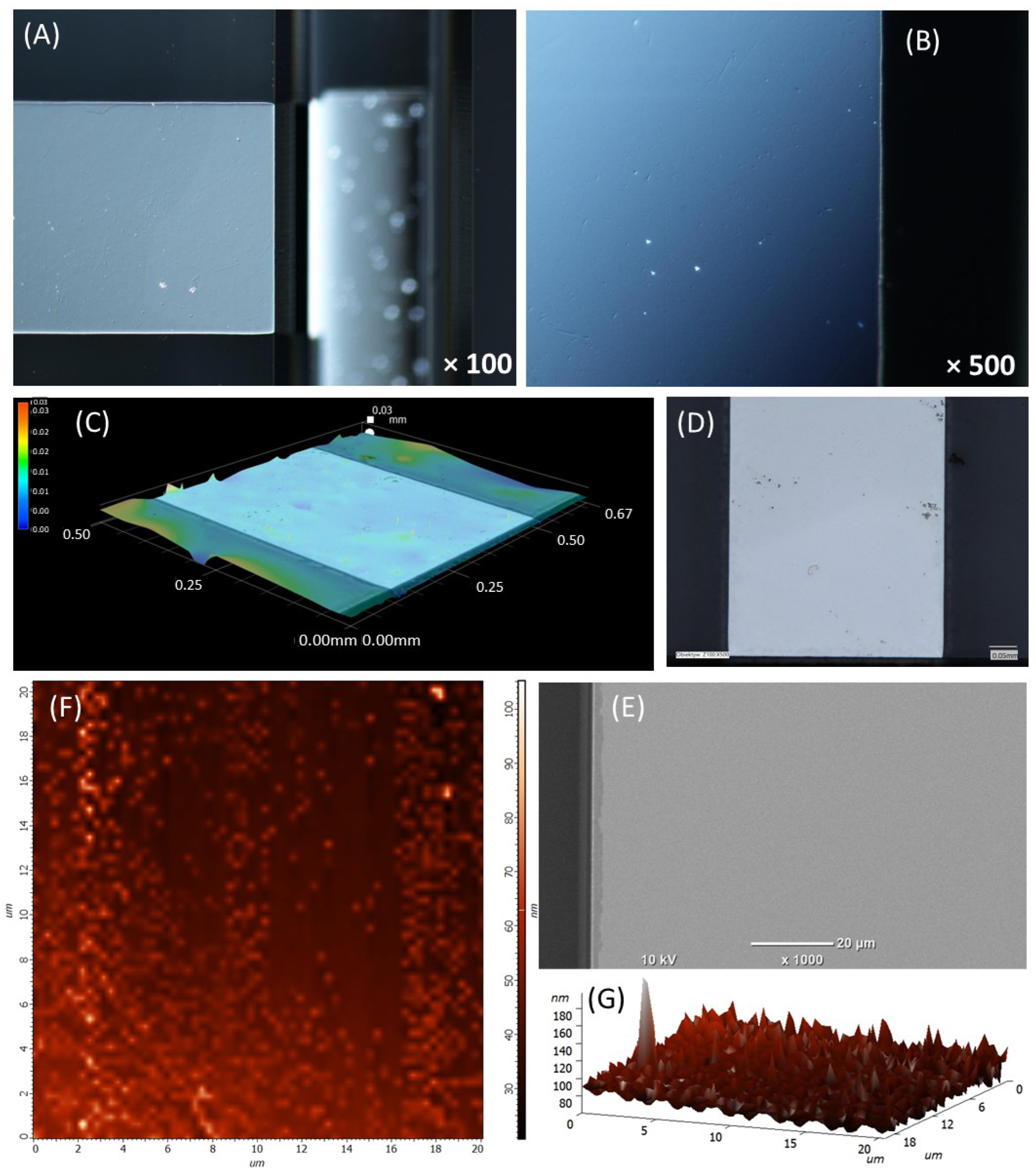
The analysis of the surface of thin-film Ti-Pt microelectrodes on a planar substrate is presented in Figure 2. Optical microscope images (Figure 2A,B) with different magnifications show that the metal film surface is smooth. This was also confirmed by confocal microscopy measurements (Figure 2C,D); there were no discontinuities observed in the coatings. Only slight irregularities in the form of dots were observed, which are probably related to contamination from the environment. A picture from a scanning microscope with a magnification of 1000× (Figure 2E) shows that the edges of the electrode are sharp and adhere well to the substrate. AFM images (Figure 2F,G) show that the coating is homogeneous. The average roughness Ra determined in the area of 20 µm × 20 µm is equal to 12.3661 nm.
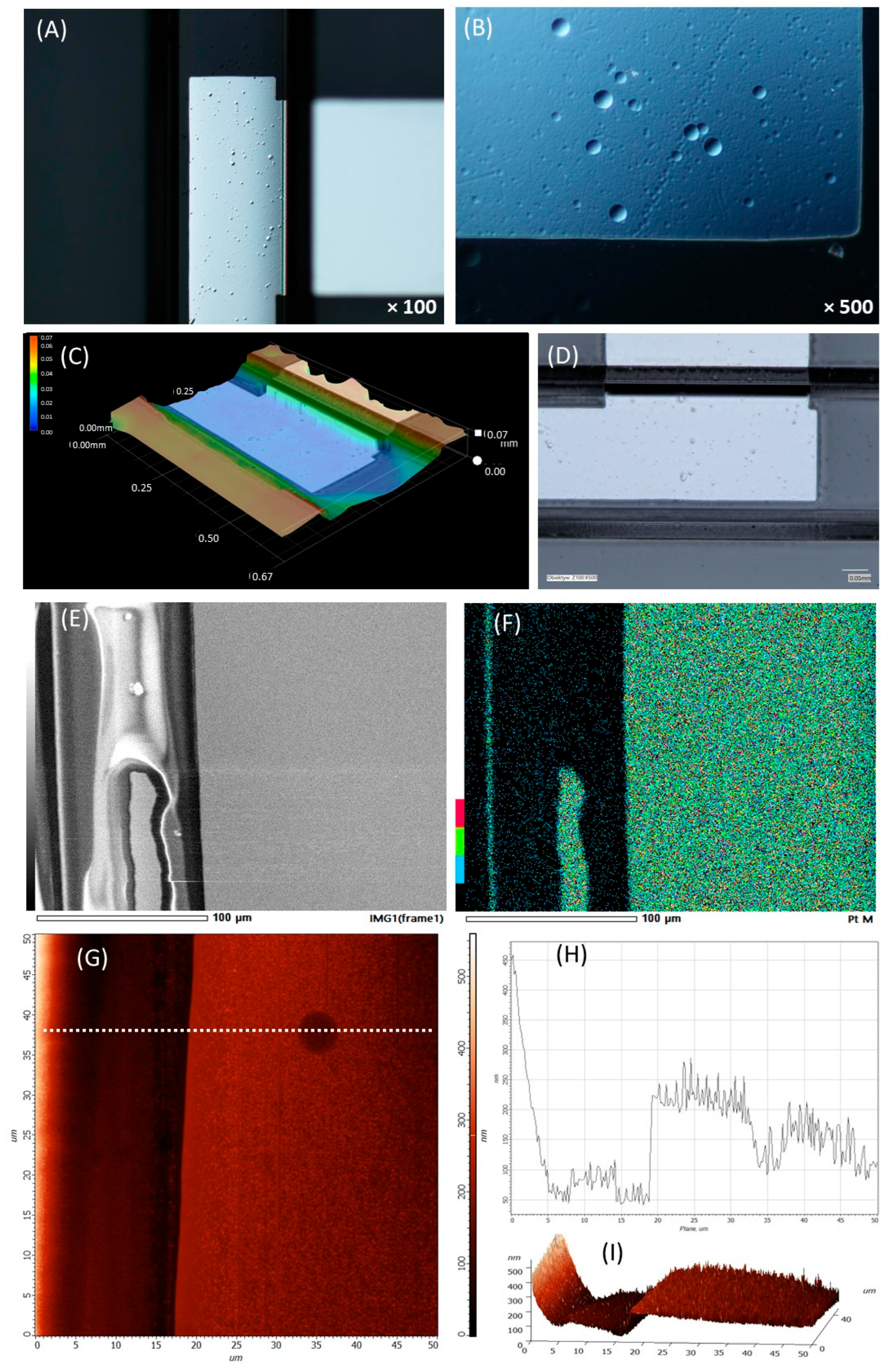
The case of the Pt electrodes on a non-planar substrate, i.e., located inside the microfluidic channels, is presented in Figure 3. The coating is characterized by some unevenness with dot-like heterogeneities, which is visible under the optical microscope (Figure 3A). By observing the shadow on the sample (Figure 3B), it can be seen that these are spherical holes. These defects were probably formed during the etching of the glass, which is a main step in the production of channels in this type of substrate. Despite the non-uniformity of the glass channel surface, the thin metal film is continuous. Analysis using a confocal microscope (Figure 3C,D) confirmed whether there were any discontinuities in metal coating observed, especially on the wall of the channel. During the inspection, particular attention was paid to the walls and bottom of the channel. The SEM picture (Figure 3E) and Pt mapping analysis (Figure 3F) of the area close to the edge of the electrode inside the channel show that, in addition to the Pt electrode, additional areas inside the channel were also deposited due to the specification of the metal deposition process. However, these are areas that are not connected with the electrode, so they should not disturb the operation of the chip. The edges of the electrode appear sharp and adhere well to the substrate. During the atomic force microscopy (Figure 3G) analysis, characteristic circular areas were observed on the surface of Ti-Pt deposited inside the channel. Analysis of the profile (Figure 3H) along the line marked in the figure (Figure 3G) allows us to conclude that these areas are spherical holes. They may have appeared during the etching of the glass substrate in 50% HF, which is a key step of the process of channel preparation. The diameter of such a hole is approx. 10 µm. The 3D image (Figure 3I) presents the area with the channel wall and the edge of the Pt electrode is visible; it is clearly defined. The average roughness determined in the area of 20 × 20 µm without any surface defects is equal to 30.0018 nm.
Figure 4 presents the results of cyclovoltammetric measurements in 0.1 M KCl electrolyte. The graph marked (Figure 4A) shows the results obtained for a Pt electrode on a planar substrate. Graph (Figure 4B) shows the results of analogous measurements, but they were made on a substrate with channels.
In analyzed variants, CV curves typical for platinum electrodes in the KCl environment were recorded, including a peak near the potential −0.18 V vs. Ag/AgCl. In the case of the substrate geometry, a certain influence is observed not on the shape of the curve itself, but on the current density in the characteristic peak. The linear fit is very good; in both cases, R2 is 0.997 or 0.996 (Figure 4C). Measurement error bars have been multiplied 10 times to obtain better visibility in the graph. In the case of long-term measurements consisting of 1000 CV measurements (Figure 4D,E), some differences in the course of the curves were observed, which may result from differences in surface morphology between the planar and inside the channel electrodes. For the planar electrode (Figure 4D), the average current density for the peak was equal to −1.880 mA/cm2, and the standard deviation was equal to 2.323%. In the case of the chip with channels (Figure 4E), the average current density for the peak was equal to −2.227 mA/cm2, and the standard deviation was equal to 0.80%. This behavior may be due to the fact that these measurements are long-term and, in the case of measurements at the planar electrode, some random perturbations may have occurred.
Table 1 presents the analysis of the anodic peak intensity and standard deviation values depending on the scan rate and electrode type. The values were obtained during measurements in 0.1 M KCl electrolyte; CV curves are shown in Figure 4. Standard deviations will allow for potential use as an electrochemical sensor. The type and size of the electrode are not affected; the higher the scan rate, the smaller the measurement error. When measurements at the lowest scan rate of 10 mV/s were performed, the average standard deviation was less than 2%. However, the standard deviation values recorded for the various scan rate values were averaged for each analyzed electrode. Thus, in the case of electrodes on a planar surface, the average standard deviation value is equal to 0.87%. A chip with channels is characterized by larger standard deviation value and it is equal to 1.11%. However, in this case, these values are still satisfactory, taking into account the fact that reactions were tested in a wide range of potentials. Such differences, depending on the surface geometry, may result from the fact that the metallic layer has different morphology, including roughness. In the case of a metallic layer deposited on a flat glass substrate, where the roughness coefficient was equal to 12.3661 nm, the standard deviations values are lower. The higher roughness of the metallic layer (30.0018 nm) deposited inside the channel results in larger standard deviations of the analyzed peaks.
Several measurement series were performed in a solution of 1 mM potassium ferricyanide/ferrocyanide K3[Fe(CN)6]/K4[Fe(CN)6]; the supporting electrolyte was 0.1 M KCl solution. The results are presented in Figure 5. The electrochemical reaction (1) is often taken as a simple and fast one-electron transfer at the outer spheres of each complex [60,61,62,63]:
[ F e C N 6 ] 3 ( a q ) +   e     [ F e C N 6 ] 4 ( a q )
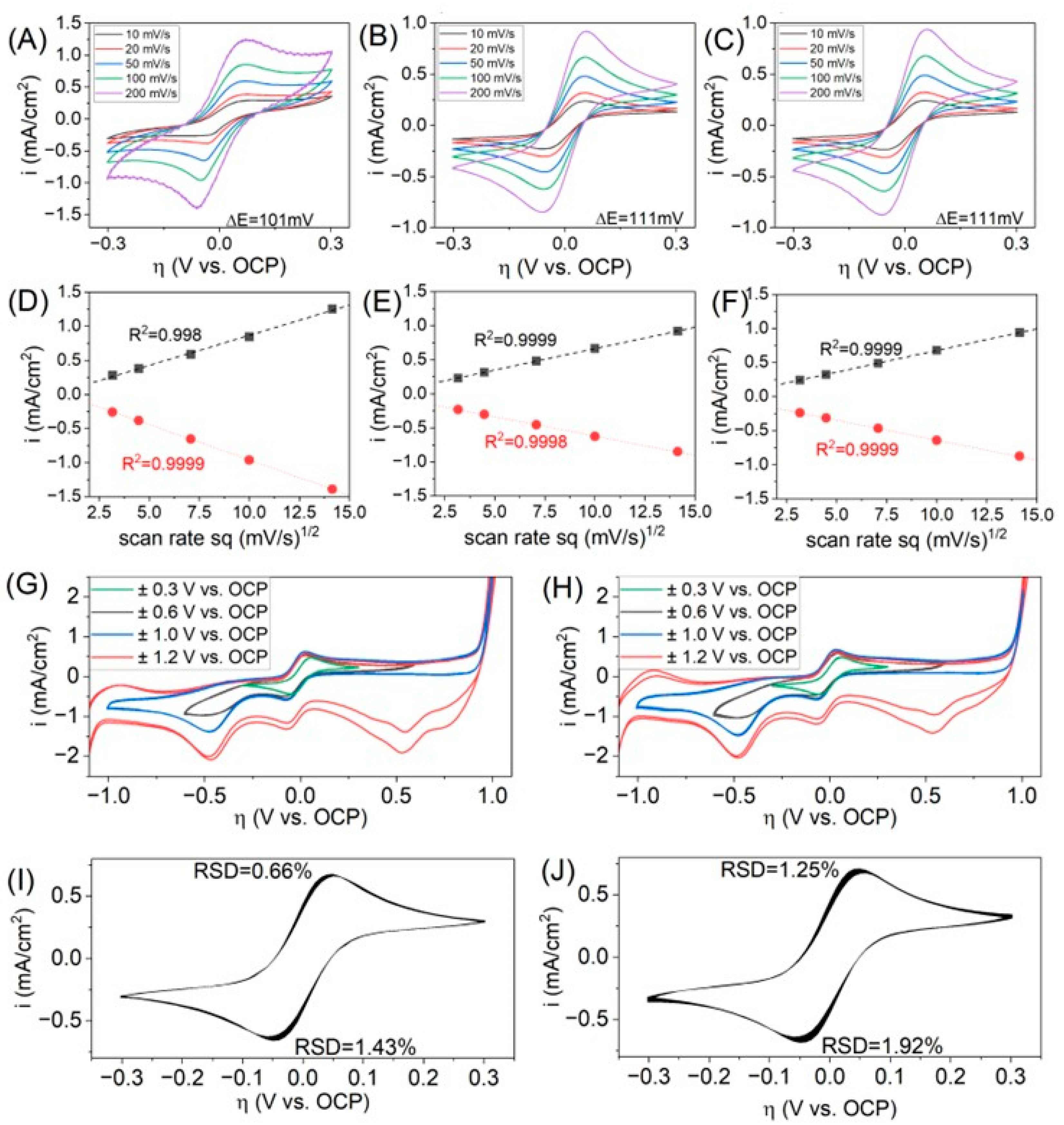
First, 10 CV scans are presented in Figure 5A–C. The maximum of the anodic and cathodic peaks, the values of the potential difference ΔE and the linear relationship depending on the square root of the scan rate were determined (Figure 5D–F). Subsequently, 10 CV curves were determined with a scanning speed of 100 mV/s with wider potential ranges. For the clarity of the graphs (Figure 5G,H), scans number 2 and 10 are presented. Then, after emptying the cells and refilling with fresh electrolyte, long-term tests of 1000 CV were performed in the potential range of ±0.1 V vs. OCP for a scan rate of 100 mV/s (Figure 5I,J).
Table 2 presents the OCP values for CV measurements performed in 1 mM hexacyanoferrate (II)/(III) solution with 0.1 M KCl as a supporting electrolyte with various scan rates, presented in Figure 5A–C. Before each CV scan, OCP was recorded. It is clearly visible that, in the case of a Pt wire-based microelectrode embedded in glass, the OCP values are different from printed electrodes. Moreover, depending on the scan rate, the OCP values change; in the case of the wire-based microelectrode, the standard deviation value of OCP is greater than 5%. In comparison, thin-film electrodes have standard deviation values below 2%. This suggests a greater electrochemical stability of the systems in which the electrodes are printed. This may be due to the presence of reaction products on the surface of the classic microelectrode with a diameter of 100 µm.
Figure 5A–C present CV curves for different scan rate values in a regular potential range, i.e., η ± 0.3 V vs. OCP, where the η value is overpotential, defined as the difference in the operating potential and the equilibrium potential. Regardless of the type of Pt electrode, typical and well-known reduction/oxidation peaks suitable for reaction (1) are observed. However, in the case of the Pt wire-based microelectrode (A), at higher scan rate values, deflections from the curves are observed at extreme potentials, which may indicate some additional interfering reactions, which may disturb the measurements of the redox reaction. Moreover, at a scan rate of 200 mV/s, deviations were observed in the CV curve. During the measurements on thin-film electrodes, the same curves (B, C) were obtained, which is logical, since the dimensions of the electrodes are equal. The only difference between the systems is the substrate shape (planar vs. non-planar). The differences in the shape of CV curves are certainly caused by different surface geometries. To some extent, it is observed in the graphs of the dependence of the current density in the anodic and cathodic peaks depending on the square root of the scan rate value (D–F). In most cases, the coefficient of determination R2 is equal to 0.9999, but in the case of the cathode peak recorded for wire-based microelectrodes, the R2 value is equal to 0.998, which differs significantly from the other recorded values.
In subsequent measurements (Figure 5G,H), CV curves were obtained in extended potential ranges to η ± 1.2 V vs. OCP that include irreversible reactions, such as the adsorption of iron ions or hydrogen/oxygen evolution. A detailed identification of peaks and a description of the processes occurring during analogous measurements were reported previously [64].
After the measurements, the electrolyte was replaced and long-term measurements (Figure 5I,J) were carried out consisting of 1000 CV scans at a rate of 100 mV/s for the potential range η ± 0.3 V vs. OCP. The curves, as in the previous cases, are characterized by typical anodic and cathodic peaks. Relative standard deviations were determined from the recorded peak maxima and, in this case, some differences were observed. Namely, in the case of the thin-film electrode on the planar substrate, the RSD values for the cathodic and anodic peaks are equal to 0.66 and 1.43%, respectively, while in the case of the Pt electrode embedded inside the channel, these values are equal to 1.25 and 1.92%. As in the case of measurements performed in 0.1 M KCl (Table 1), larger RSD values are observed in the case of the electrode embedded inside the channel.
As before, in the 0.1 M KCl electrolyte, a statistical measurement of the recorded peaks was performed in the ferrocyanide electrolyte (Table 3). The data in Table 3 refer to the CV graphs shown in Figure 5A–C. In this case, the current densities of the cathodic and anodic peaks assigned to reaction (1) were analyzed. Three types of electrodes were compared—a wire-based Pt electrode and thin-film electrodes on a planar glass substrate and inside the channel. There is an observed tendency that, in the case of large scan rate values, standard deviations are generally smaller than in the case of lower scan rate values. The exceptions are measurements for a scan rate of 200 mV/s carried out with wire-based electrodes—the standard deviations are clearly larger. This is probably due to the clearly different course of the curves (Figure 5A). The peaks recorded on the wire-based microelectrode are characterized by larger values of the average standard deviation compared with thin-film Pt electrodes. This indicates better electrochemical stability and better repeatability of CV measurements.

4. Conclusions

In this study, the performance of the thin-film Ti-Pt has been described. Electrochemical tests were carried out in a three-electrode system, where the working electrodes were microelectrodes patterned on planar and non-planar glass substrates. The electrodes were tested in typical electrolytes used in research work, i.e., 0.1 M KCl and solutions of 1 mM hexacyanoferrate with supporting electrolyte 0.1 M KCl. Differences in Pt thin-film microelectrodes were characterized mainly by surface quality and roughness, which resulted from the type of substrate—smooth or etched glass. Measurement errors were determined based on the standard deviation of the current density of peaks characteristic of the obtained CV curves.
CV measurements with different scan rate values showed that Pt electrodes patterned in the channels have a slightly larger measurement error, but it is still a satisfactory value. In the case of measurements in 0.1 M KCl electrolyte, the average standard deviation for planar Pt microelectrodes was below 1%, in channels—above 1%. However, during measurements in a 1 mM hexacyanoferrate solution, the RSD values below 0.3% were obtained. Measurements carried out with this electrolyte were compared with a wire-based Pt microelectrode. Larger measurement errors were obtained in the case of using a classical wire-based microelectrode, and it was possible to obtain satisfactory results in a smaller range of scan rate values. The obtained comparative results allow us to conclude that the obtained thin-film electrodes have a potentially wider application and it is possible to perform more precise electrochemical measurements.
The main conclusion of this work is the fact that thin-film Pt microelectrodes can be successfully used in electrochemical measurements where high accuracy is required. Moreover, studies have shown that the accuracy of measurements is better than when using classic wire-based microelectrodes. The fabrication method described for patterning thin-film electrodes on non-planar surfaces is suitable for implementation in LoC devices across a wide range of dimensions.
The research work carried out and presented in this paper is a preliminary stage of the development of the production of microsystems for electrochemical sensors. The conclusions from this experimental work will allow for the development of microelectrodes made of other metals and alloys, which will be characterized by high repeatability and accuracy.

Author Contributions

Conceptualization, K.K.-S. and Z.S.; production and preparation of chips, E.V., A.H., P.W. (Paul Wittendorp), and S.J.; electrochemical measurements and sample analysis, K.K.-S., Z.S., P.Ż. and A.G.-K.; supervision, P.W. (Paweł Wójcik). All authors have read and agreed to the published version of the manuscript.

Funding

This research was supported by the National Centre for Research and Development (NCBR), project number: NOR/POLNOR/UPTURN/0060/2019.

Institutional Review Board Statement

Not applicable.

Informed Consent Statement

Not applicable.

Data Availability Statement

Data will be made available on request.

Conflicts of Interest

The Redoxme AB company had no role in the design of the study; in the collection, analyses, or interpretation of data; in the writing of the manuscript; or in the decision to publish the results. The authors declare that the research was conducted in the absence of any commercial or financial relationships that could be construed as potential conflicts of interest. The authors declare no conflicts of interest.

Abbreviations

The following abbreviations are used in this manuscript:
PVDPhysical Vapor Deposition
LoCLab on Chip
PEEKPolyether Ether Ketone
WEWorking Electrode
CECounter Electrode
REReference Electrode
CVCyclic Voltammetry
OCPOpen Circuit Potential
AFMAtomic Force Spectroscopy
SEMScanning Electron Microscopy
RSDRelative Standard Deviation

References

  1. Kurzweil, P. HISTORY|Electrochemistry. In Encyclopedia of Electrochemical Power Sources; Elsevier: Amsterdam, The Netherlands, 2009; pp. 533–554. [Google Scholar]
  2. Serrà, A.; García-Torres, J. Electrochemistry: A Basic and Powerful Tool for Micro- and Nanomotor Fabrication and Characterization. Appl. Mater. Today 2021, 22, 100939. [Google Scholar] [CrossRef]
  3. Kutyła, D.; Kołczyk-Siedlecka, K.; Kwiecińska, A.; Skibińska, K.; Kowalik, R.; Żabiński, P. Preparation and Characterization of Electrodeposited Ni-Ru Alloys: Morphological and Catalytic Study. J. Solid State Electrochem. 2019, 23, 3089–3097. [Google Scholar] [CrossRef]
  4. Mao, Y.; Chen, C.; Fu, J.; Lai, T.; Lu, F.; Tsai, Y. Electrodeposition of Nickel-Copper on Titanium Nitride for Methanol Electrooxidation. Surf. Coat. Technol. 2018, 350, 949–953. [Google Scholar] [CrossRef]
  5. Vukmirovic, M.B.; Bliznakov, S.T.; Sasaki, K.; Wang, J.X.; Adzic, R.R. Electrodeposition of Metals in Catalyst Synthesis: The Case of Platinum Monolayer Electrocatalysts. Interface Mag. 2016, 20, 33–40. [Google Scholar] [CrossRef]
  6. Kempler, P.A.; Boettcher, S.W.; Ardo, S. Reinvigorating Electrochemistry Education. iScience 2021, 24, 102481. [Google Scholar] [CrossRef]
  7. Iost, R.M.; Crespilho, F.N. Layer-by-Layer Self-Assembly and Electrochemistry: Applications in Biosensing and Bioelectronics. Biosens. Bioelectron. 2012, 31, 1–10. [Google Scholar] [CrossRef]
  8. Zhu, S.; Wang, Q.; Ni, J. Aqueous Transition-Metal Ion Batteries: Materials and Electrochemistry. EnergyChem 2023, 5, 100097. [Google Scholar] [CrossRef]
  9. Leita, G.; Bozzini, B. Impact of Space Radiation on Lithium-Ion Batteries: A Review from a Radiation Electrochemistry Perspective. J. Energy Storage 2024, 100, 113406. [Google Scholar] [CrossRef]
  10. Liu, C.; Deng, Z.; Zhang, X.; Bao, H.; Cheng, D. Battery State of Health Estimation across Electrochemistry and Working Conditions Based on Domain Adaptation. Energy 2024, 297, 131294. [Google Scholar] [CrossRef]
  11. Zhang, Y.; Manaig, D.; Freschi, D.J.; Liu, J. Materials Design and Fundamental Understanding of Tellurium-Based Electrochemistry for Rechargeable Batteries. Energy Storage Mater. 2021, 40, 166–188. [Google Scholar] [CrossRef]
  12. Fetrow, C.J.; Carugati, C.; Zhou, X.D.; Wei, S. Electrochemistry of Metal-CO2 Batteries: Opportunities and Challenges. Energy Storage Mater. 2022, 45, 911–933. [Google Scholar] [CrossRef]
  13. Manzo, D.; Thai, R.; Le, H.T.; Venayagamoorthy, G.K. Fuel Cell Technology Review: Types, Economy, Applications, and Vehicle-to-Grid Scheme. Sustain. Energy Technol. Assess. 2025, 75, 104229. [Google Scholar] [CrossRef]
  14. Dolgikh, O.V.; Kravtsova, Y.G.; Sotskaya, N.V. The Effect of Composition of Electrodeposited Ni-P Alloys on the Hydrogen Evolution Rate. Russ. J. Electrochem. 2010, 46, 918–924. [Google Scholar] [CrossRef]
  15. Zhao, C.; Wang, C.; Gorkin, R.; Beirne, S.; Shu, K.; Wallace, G.G. Three Dimensional (3D) Printed Electrodes for Interdigitated Supercapacitors. Electrochem. Commun. 2014, 41, 20–23. [Google Scholar] [CrossRef]
  16. Waseem, M.; Amir, M.; Lakshmi, G.S.; Harivardhagini, S.; Ahmad, M. Fuel Cell-Based Hybrid Electric Vehicles: An Integrated Review of Current Status, Key Challenges, Recommended Policies, and Future Prospects. Green Energy Intell. Transp. 2023, 2, 100121. [Google Scholar] [CrossRef]
  17. Yang, M.; Compton, R.G. Electrochemical Sensors for Phytoplankton and Ocean Health. Curr. Opin. Electrochem. 2023, 42, 101413. [Google Scholar] [CrossRef]
  18. Shaukat, H.; Ali, A.; Bibi, S.; Mehmood, S.; Altabey, W.A.; Noori, M.; Kouritem, S.A. Piezoelectric Materials: Advanced Applications in Electro-Chemical Processes. Energy Rep. 2023, 9, 4306–4324. [Google Scholar] [CrossRef]
  19. Kilmartin, P.A. Electrochemistry Applied to the Analysis of Wine: A Mini-Review. Electrochem. Commun. 2016, 67, 39–42. [Google Scholar] [CrossRef]
  20. Gryszel, M.; Jakešová, M.; Lednický, T.; Głowacki, E.D. High-Capacitance Nanoporous Noble Metal Thin Films via Reduction of Sputtered Metal Oxides. Adv. Mater. Interfaces 2022, 9, 2101973. [Google Scholar] [CrossRef]
  21. Brinkert, K.; Mandin, P. Fundamentals and Future Applications of Electrochemical Energy Conversion in Space. NPJ Microgravity 2022, 8, 52. [Google Scholar] [CrossRef]
  22. Kätelhön, E.; Wolfrum, B. On-Chip Redox Cycling Techniques for Electrochemical Detection. Rev. Anal. Chem. 2012, 31, 7–14. [Google Scholar] [CrossRef]
  23. Li, X.R.; Zhou, Y.G. Electrochemical Detection of Circulating Tumor Cells: A Mini Review. Electrochem. Commun. 2021, 124, 106949. [Google Scholar] [CrossRef]
  24. Banks, C.E.; Killard, T.; Venton, B.J. Introduction to Electrochemistry for Health Applications. Anal. Methods 2019, 11, 2736–2737. [Google Scholar] [CrossRef]
  25. Jin, K.; Huang, Q.; Hu, C.; Hu, S.; Li, J. A Digital Microfluidic System with Integrated Electrochemical Impedance Detection Arrays. J. Phys. Conf. Ser. 2022, 2196, 012005. [Google Scholar] [CrossRef]
  26. Bogdanowicz, R.; Jönsson-Niedziolka, M.; Vereshchagina, E.; Dettlaff, A.; Boonkaew, S.; Pierpaoli, M.; Wittendorp, P.; Jain, S.; Tyholdt, F.; Thomas, J.; et al. Microfluidic Devices for Photo-and Pectroelectrochemical Applications. Curr. Opin. Electrochem. 2022, 36, 101138. [Google Scholar] [CrossRef]
  27. Zimmerman, W.B. Electrochemical Microfluidics. Chem. Eng. Sci. 2011, 66, 1412–1425. [Google Scholar] [CrossRef]
  28. Li, Y.; Van Roy, W.; Lagae, L.; Vereecken, P.M. Analysis of Fully On-Chip Microfluidic Electrochemical Systems under Laminar Flow. Electrochim. Acta 2017, 231, 200–208. [Google Scholar] [CrossRef]
  29. Wongkaew, N.; Simsek, M.; Griesche, C.; Baeumner, A.J. Functional Nanomaterials and Nanostructures Enhancing Electrochemical Biosensors and Lab-on-a-Chip Performances: Recent Progress, Applications, and Future Perspective. Chem. Rev. 2019, 119, 120–194. [Google Scholar] [CrossRef]
  30. Tsopela, A.; Laborde, A.; Salvagnac, L.; Ventalon, V.; Bedel-Pereira, E.; Séguy, I.; Temple-Boyer, P.; Juneau, P.; Izquierdo, R.; Launay, J.; et al. Development of a Lab-on-Chip Electrochemical Biosensor for Water Quality Analysis Based on Microalgal Photosynthesis. Biosens. Bioelectron. 2016, 79, 568–573. [Google Scholar] [CrossRef]
  31. Schmidt-Speicher, L.M.; Länge, K. Microfluidic Integration for Electrochemical Biosensor Applications. Curr. Opin. Electrochem. 2021, 29, 100755. [Google Scholar] [CrossRef]
  32. Kaur, G.; Tomar, M.; Gupta, V. Development of a Microfluidic Electrochemical Biosensor: Prospect for Point-of-Care Cholesterol Monitoring. Sens. Actuators B Chem. 2018, 261, 460–466. [Google Scholar] [CrossRef]
  33. Sassa, F.; Biswas, G.C.; Suzuki, H. Microfabricated Electrochemical Sensing Devices. Lab Chip 2020, 20, 1358–1389. [Google Scholar] [CrossRef] [PubMed]
  34. Simoska, O.; Stevenson, K.J. Electrochemical Sensors for Rapid Diagnosis of Pathogens in Real Time. Analyst 2019, 144, 6461–6478. [Google Scholar] [CrossRef]
  35. Dutta, G. Electrochemical Biosensors for Rapid Detection of Malaria. Mater. Sci. Energy Technol. 2020, 3, 150–158. [Google Scholar] [CrossRef]
  36. Srikanth, S.; Jayapiriya, U.S.; Dubey, S.K.; Javed, A.; Goel, S. A Lab-on-Chip Platform for Simultaneous Culture and Electrochemical Detection of Bacteria. iScience 2022, 25, 105388. [Google Scholar] [CrossRef]
  37. Zolti, O.; Suganthan, B.; Ramasamy, R.P. Lab-on-a-Chip Electrochemical Biosensors for Foodborne Pathogen Detection: A Review of Common Standards and Recent Progress. Biosensors 2023, 13, 215. [Google Scholar] [CrossRef]
  38. Nemčeková, K.; Labuda, J. Advanced Materials-Integrated Electrochemical Sensors as Promising Medical Diagnostics Tools: A Review. Mater. Sci. Eng. C 2021, 120, 111751. [Google Scholar] [CrossRef] [PubMed]
  39. Xie, Y.; Zhi, X.; Su, H.; Wang, K.; Yan, Z.; He, N.; Zhang, J.; Chen, D.; Cui, D. A Novel Electrochemical Microfluidic Chip Combined with Multiple Biomarkers for Early Diagnosis of Gastric Cancer. Nanoscale Res. Lett. 2015, 10, 477. [Google Scholar] [CrossRef] [PubMed]
  40. Gamagedara, S.; Maughan, N.; Nguyen, L.M. Microfluidic Separation and Electrochemical Detection of Serotonin Using a Portable Lab-on-a-Chip Device. Anal. Bioanal. Electrochem. 2015, 7, 1–11. [Google Scholar]
  41. Jang, A.; Zou, Z.; Lee, K.K.; Ahn, C.H.; Bishop, P.L. State-of-the-Art Lab Chip Sensors for Environmental Water Monitoring. Meas. Sci. Technol. 2011, 22, 032001. [Google Scholar] [CrossRef]
  42. Aleman, J.; Kilic, T.; Mille, L.S.; Shin, S.R.; Zhang, Y.S. Microfluidic Integration of Regeneratable Electrochemical Affinity-Based Biosensors for Continual Monitoring of Organ-on-a-Chip Devices. Nat. Protoc. 2021, 16, 2564–2593. [Google Scholar] [CrossRef]
  43. Abdelshafi, N.A.; Bell, J.; Rurack, K.; Schneider, R.J. Microfluidic Electrochemical Immunosensor for the Trace Analysis of Cocaine in Water and Body Fluids. Drug Test. Anal. 2019, 11, 492–500. [Google Scholar] [CrossRef]
  44. Odijk, M.; Baumann, A.; Olthuis, W.; van den Berg, A.; Karst, U. Electrochemistry-on-Chip for on-Line Conversions in Drug Metabolism Studies. Biosens. Bioelectron. 2010, 26, 1521–1527. [Google Scholar] [CrossRef] [PubMed]
  45. Gencoglu, A.; Minerick, A.R. Electrochemical Detection Techniques in Micro- and Nanofluidic Devices. Microfluid. Nanofluidics 2014, 17, 781–807. [Google Scholar] [CrossRef]
  46. Blair, E.O.; Corrigan, D.K. A Review of Microfabricated Electrochemical Biosensors for DNA Detection. Biosens. Bioelectron. 2019, 134, 57–67. [Google Scholar] [CrossRef] [PubMed]
  47. Rodrigues, P.d.F.S. Electrochemical Readout in Lab-On-Chip Platforms: Overview of State of the Art and Future Perspectives. Path Sci. 2023, 9, 7001–7014. [Google Scholar] [CrossRef]
  48. Ben-Yoav, H.; Dykstra, P.H.; Bentley, W.E.; Ghodssi, R. A Controlled Microfluidic Electrochemical Lab-on-a-Chip for Label-Free Diffusion-Restricted DNA Hybridization Analysis. Biosens. Bioelectron. 2015, 64, 579–585. [Google Scholar] [CrossRef]
  49. Schumacher, S.; Nestler, J.; Otto, T.; Wegener, M.; Ehrentreich-Förster, E.; Michel, D.; Wunderlich, K.; Palzer, S.; Sohn, K.; Weber, A.; et al. Highly-Integrated Lab-on-Chip System for Point-of-Care Multiparameter Analysis. Lab Chip 2012, 12, 464–473. [Google Scholar] [CrossRef] [PubMed]
  50. Vereshchagina, E.; Kolczyk-Siedlecka, K.; Szklarz, Z.; Wittendorp, P.; Herbjørnrød, A.; Sordo, G.; Moe, S.; Jain, S.; Summanwar, A.; Huong Hoang, D.C.; et al. Integration of Thin Film Electrodes for Microfluidic Electrochemical Cells. In Proceedings of the 2023 IEEE SENSORS, Vienna, Austria, 29 October–1 November 2023; IEEE: New York, NY, USA, 2023; pp. 1–4. [Google Scholar]
  51. Vereshchagina, E.; Milenko, K.; Dullo, F.T. Microfluidic Surface-Enhanced Raman Scattering Sensors Based on Nanoimprint Resist for Sensitive Detection of Pesticides in Water. In Proceedings of the 2023 IEEE SENSORS, Vienna, Austria, 29 October–1 November 2023; IEEE: New York, NY, USA, 2023; pp. 1–4. [Google Scholar]
  52. Vereshchagina, E.; Poppe, E.; Schjolberg-Henriksen, K.; Wohrmann, M.; Moe, S. Metal Films for MEMS Pressure Sensors: Comparison of Al, Ti, Al-Ti Alloy and Al/Ti Film Stacks. In Proceedings of the 2018 7th Electronic System-Integration Technology Conference (ESTC), Dresden, Germany, 18–21 September 2018; IEEE: New York, NY, USA, 2018; pp. 1–9. [Google Scholar]
  53. Kostiuchenko, Z.A.; Cui, J.Z.; Lemay, S.G. Electrochemistry in Micro- and Nanochannels Controlled by Streaming Potentials. J. Phys. Chem. C 2020, 124, 2656–2663. [Google Scholar] [CrossRef]
  54. Sassa, F.; Morimoto, K.; Satoh, W.; Suzuki, H. Electrochemical Techniques for Microfluidic Applications. Electrophoresis 2008, 29, 1787–1800. [Google Scholar] [CrossRef]
  55. Pham, N.P.; Scholtesa, T.L.M.; Kierka, R.; Sarroa, P.M.; Burghartza, J.N. Direct Spray Coating of Photoresist for MEMS Applications. In Proceedings of the SPIE Micromachining and Microfabrication Process Technology VII conference, San Francisco, CA, USA, 22–24 October 2001. [Google Scholar]
  56. Kilchenmann, S.C.; Rollo, E.; Bianchi, E.; Guiducci, C. Metal-Coated Silicon Micropillars for Freestanding 3D-Electrode Arrays in Microchannels. Sens. Actuators B Chem. 2013, 185, 713–719. [Google Scholar] [CrossRef]
  57. Sain, S.; Ficek, M.; Olejnik, A.; Sawczak, M.; Bogdanowicz, R.; Roy, S.S. Direct Determination of Paraquat Herbicide by Square-Wave Voltammetry by Two-Step Transfer Mechanism at Heterogeneous Boron-Doped Carbon Nanowall Electrodes. Diam. Relat. Mater. 2023, 140, 110504. [Google Scholar] [CrossRef]
  58. Cai, D.; Yang, X.; Qu, B.; Wang, T. Comparison of the Electrochemical Performance of Iron Hexacyanoferrate with High and Low Quality as Cathode Materials for Aqueous Sodium-Ion Batteries. Chem. Commun. 2017, 53, 6780–6783. [Google Scholar] [CrossRef]
  59. Risch, M.; Stoerzinger, K.A.; Han, B.; Regier, T.Z.; Peak, D.; Sayed, S.Y.; Wei, C.; Xu, Z.; Shao-Horn, Y. Redox Processes of Manganese Oxide in Catalyzing Oxygen Evolution and Reduction: An in Situ Soft X-Ray Absorption Spectroscopy Study. J. Phys. Chem. C 2017, 121, 17682–17692. [Google Scholar] [CrossRef]
  60. Heras, A.; Colina, A.; Ruiz, V.; Lopez-Palacios, J. UV-Visible Spectroelectrochemical Detection of Side-Reactions in the Hexacyanoferrate(III)/(II) Electrode Process. Electroanalysis 2015, 2003, 702–708. [Google Scholar] [CrossRef]
  61. Fernández Macía, L.; Petrova, M.; Hubin, A. ORP-EIS to Study the Time Evolution of the [Fe(CN)6]3−/[Fe(CN)6]4− Reaction Due to Adsorption at the Electrochemical Interface. J. Electroanal. Chem. 2015, 737, 46–53. [Google Scholar] [CrossRef]
  62. Rosseinsky, D.R.; Glasser, L.; Jenkins, H.D.B. Thermodynamic Clarification of the Curious Ferric/Potassium Ion Exchange Accompanying the Electrochromic Redox Reactions of Prussian Blue, Iron(III) Hexacyanoferrate(II). J. Am. Chem. Soc. 2004, 126, 10472–10477. [Google Scholar] [CrossRef]
  63. Hankins, M.J.; Yablonsky, G.S.; Kiss, I.Z. Dual Kinetic Curves in Reversible Electrochemical Systems. PLoS ONE 2017, 12, e0173786. [Google Scholar] [CrossRef]
  64. Sanchez-Amaya, M.; Bárcena-Soto, M.; Antaño-López, R.; Rodríguez-López, A.; Barragan, J.A.; Gutierrez-Becerra, A.; Larios-Durán, E.R. Effect of Wide Ranges of Polarization and Concentration on the Behavior of Ferricyanide/Ferrocyanide Systems Studied Through Electrochemical Measurements. Int. J. Electrochem. Sci. 2022, 17, 22016. [Google Scholar] [CrossRef]
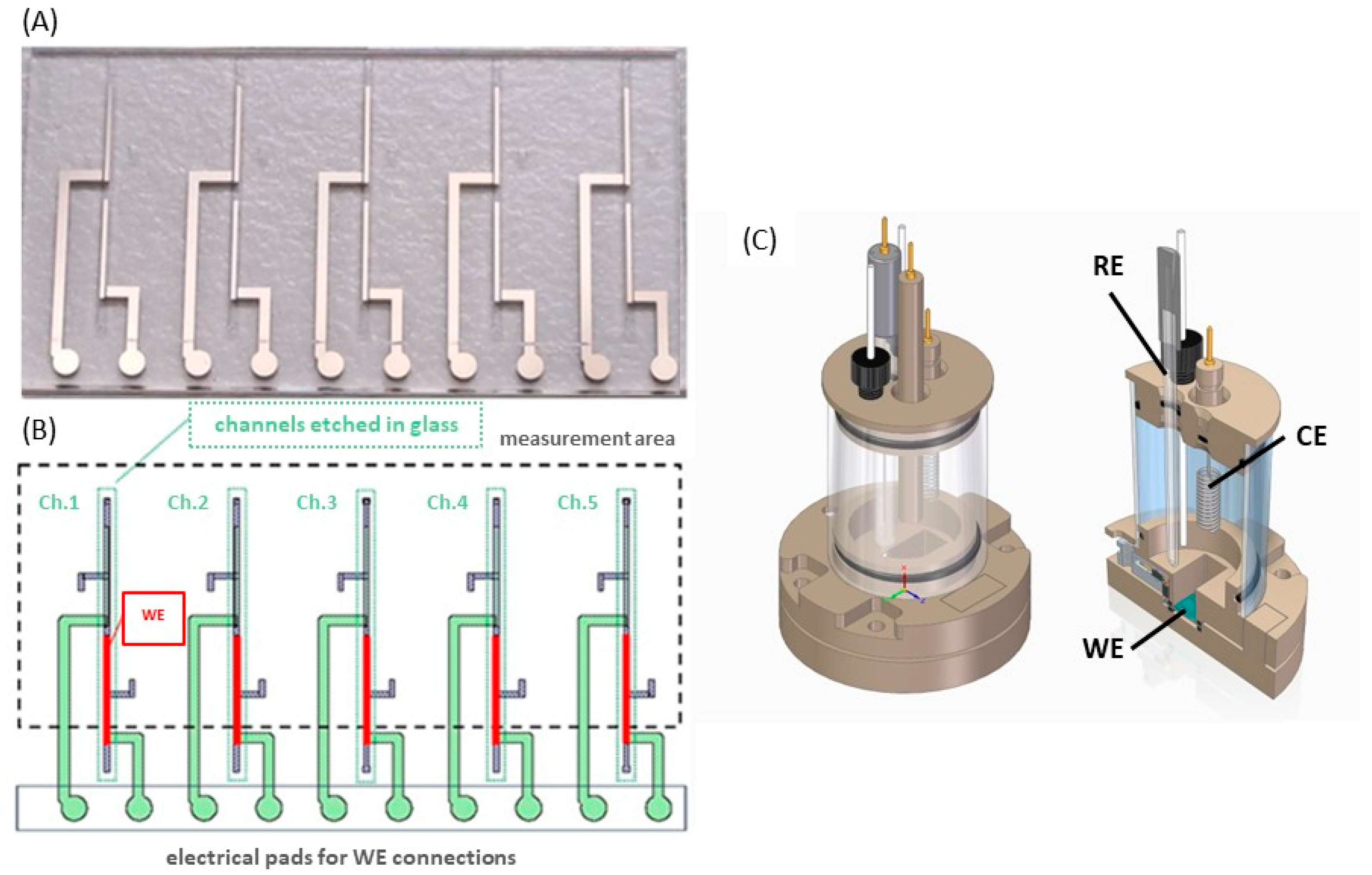
Figure 1. (A) Picture of used planar chip, (B) design of Ti-Pt microelectrodes, (C) the electrochemical cells used in measurements.
Micromachines 17 00318 g001
Figure 2. Surface analysis of Pt microelectrode on planar chip. (A,B) Optic microscopy pictures, (C,D) confocal microscopy pictures, (E) SEM picture (F,G) AFM analysis.
Micromachines 17 00318 g002
Figure 3. Surface analysis of Pt electrode in channel. (A,B) Optic microscopy pictures, (C,D) SEM picture and Pt mapping analysis, (E,F) confocal microscopy pictures, (GI) AFM analysis.
Micromachines 17 00318 g003
Figure 4. Effect of scan rates on the electrochemical response in 0.1 M KCl registered for the Pt microelectrodes on planar chip (A) and chip with channels (B). Linear fitting of peak current density −0.18 V vs. Ag/AgCl depending on scan rate (C). Long-term measurements on planar chip (D) and chip with channels (E).
Micromachines 17 00318 g004
Figure 5. The dependence of CV curves on scanning speed and peak fitting for the Pt wire-based microelectrode 100 µm Pt microelectrode (A,D), Pt thin-film planar microelectrode (B,E), and Pt thin-film microelectrode inside the channel (C,F). CV measurements for wider potential ranges on planar chip (G) and chip with channels (H). Long-term measurements on planar chip (I) and chip with channels (J). Used electrolyte: 1 mM potassium hexacyanoferrate (II)/(III) in 0.1 M KCl.
Micromachines 17 00318 g005
Table 1. Average density calculation of peak −0.18 V vs. Ag/AgCl analysis for different thin-film Pt microelectrodes, depending on the scan rate in the 0.1 M KCl electrolyte.
Thin-Film Pt
Electrode Type
-Scan Rate (mV/s)Average RSD (%)
100502010-
Planari (mA/cm2)−2.092−1.425−0.928−0.7100.87
Std. dev (%)0.650.630.611.58
Channeli (mA/cm2)−2.128−1.419−0.900−0.6491.11
Std. dev (%)0.730.830.981.90
Table 2. OCP analysis for various Pt electrode types in 1 mM potassium hexacyanoferrate (II)/(III) in 0.1 M KCl electrolyte.
Scan Rate (mV/s)Electrode Type
100 µm PtPt/PlanarPt/Channel
100.3020.2210.220
200.280.2310.228
500.2790.2290.228
1000.260.2260.225
RSD [%]5.311.661.45
Table 3. Average density calculation of anodic and cathodic peak analysis for different Pt microelectrodes, depending on scan rate in 1 mM ferrocyanide in 0.1 M KCl electrolyte, ic—current density of cathodic peak, ia—current density of anodic peak.
Electrode Type Scan Rate (mV/s)Average RSD (%)
200100502010
100 µm Ptic (mA/cm2)1.2460.8530.5940.4330.3590.40
Std. dev (%)0.420.140.310.710.39
100 µm Ptia (mA/cm2)−1.398−0.965−0.654−0.384−0.3100.28
Std. dev (%)0.760.050.050.060.50
Pt planaric (mA/cm2)0.9200.6670.4820.3170.2360.21
Std. dev (%)0.100.130.310.240.28
Pt planaria (mA/cm2)−0.851−0.625−0.456−0.305−0.2310.13
Std. dev (%)0.050.090.200.170.12
Pt channelic (mA/cm2)0.9380.6790.4910.3240.2420.27
Std. dev (%)0.190.120.360.310.35
Pt channelia (mA/cm2)−0.876−0.644−0.469−0.313−0.2390.18
Std. dev (%)0.160.110.250.190.18
Disclaimer/Publisher’s Note: The statements, opinions and data contained in all publications are solely those of the individual author(s) and contributor(s) and not of MDPI and/or the editor(s). MDPI and/or the editor(s) disclaim responsibility for any injury to people or property resulting from any ideas, methods, instructions or products referred to in the content.