Article

Sensitivity Analysis of Process Parameters on Deposition Quality and Multi-Objective Prediction in Ion-Assisted Electron Beam Evaporation of Ta2O5 Films

1
School of Mechanical and Power Engineering, Shanghai Jiao Tong University, Shanghai 200240, China
2
Laser Fusion Research Center, China Academy of Engineering Physics, Mianyang 621900, China
3
School of Mechatronics Engineering, Harbin Institute of Technology, Harbin 150001, China
*
Authors to whom correspondence should be addressed.
These authors contributed equally to this work.
Micromachines 2026, 17(2), 166; https://doi.org/10.3390/mi17020166
Submission received: 12 December 2025 / Revised: 6 January 2026 / Accepted: 26 January 2026 / Published: 27 January 2026
(This article belongs to the Special Issue Advances in Digital Manufacturing and Nano Fabrication)

Abstract

Tantalum pentoxide (Ta2O5) films deposited on fused silica substrates are critical components of high-power laser systems. Ion-assisted electron beam evaporation (IAD-EBE) is the mainstream technique for fabricating Ta2O5 films. However, it commonly requires extensive experimental efforts for deposition quality optimization, while each coating cycle is extremely time-consuming. To solve this issue, this work establishes a dataset targeting the surface roughness (Rq) and refractive index (n) of Ta2O5 films using atomic force microscopy, as well as ellipsometer and deposition experiments. Influence of assisting ion source beam voltage (V)/current (I) and Ar (Q1)/O2 (Q2) flow rate on the n and Rq of Ta2O5 films are analyzed. Combining energy-field mechanism analysis with a Bayesian optimization approach (PI-BO), both deposition quality prediction and feature analysis of process parameters are achieved. The determination coefficient/mean absolute error for the prediction models of n and Rq reach 0.927/0.013 nm and 0.821/0.049 nm, respectively. Based on sensitivity analysis, the weight factors of V, I, Q1, and Q2 affecting n/Rq of Ta2O5 films are determined to be 0.616/0.274, 0.199/0.144, 0.113/0.582, and 0.072/0.000. V and Q2 are identified as the core factors for regulating deposition quality. The optimal ranges for V and Q2 are 600~700 V and 70~80 sccm, respectively. This study proposes a PI-BO method for predicting Rq and n of Ta2O5 films under small-data conditions, while determining the preferred parameter ranges and their sensitivity weight factors. These findings provide effective theoretical support and technical guidance for IAD-EBE strategy design and optimization of optical films in high-power laser systems.

1. Introduction

Tantalum pentoxide (Ta2O5) has emerged as a core material in high-energy laser systems due to its high refractive index (n), low absorption loss, and excellent chemical stability [1,2,3,4,5,6]. Ion-assisted electron beam evaporation (IAD-EBE), a pivotal physical vapor deposition technique, allows precise control of density and stoichiometry of Ta2O5 films through ion bombardment [7,8,9,10]. During IAD, an ion source supplies energetic particles that enhance adatom mobility, reduce defect state density, and promote the formation of a dense microstructure. This process thereby facilitates the deposition of high-quality Ta2O5 films [11,12,13,14]. However, the superiority of this process heavily relies on the synergistic regulation of multiple parameters, which exhibit complex nonlinear coupling effects. This complexity poses significant challenges, such as high costs and poor interpretability, when attempting to identify the optimal deposition quality through traditional experimental approaches [15,16,17,18].
Current research on IAD processes predominantly focuses on the isolated impact of individual parameters on the deposition quality [19]. For instance, Mansour et al. [12] investigated the influence of ion energy and current density on the n, densification, and extinction coefficient of Ta2O5 films deposited via IAD. They reported maximum n of 2.27 at the ion energy of 300 eV and at the ion current density of 60 μA/cm2. Chun et al. [20] systematically established a quantitative relationship between assisting ion source beam voltage (V) and film performance in IAD deposition by controlling this single variable. They examined the effect of Ar/O2 plasma post-treatment duration on multilayer film properties. Demiryont et al. [21] studied oxygen content variation in ion beam sputtered Ta2O5 films. They revealed that an optimized Ar/O2 ratio yielded a bandgap of 4.3 eV and low extinction in the visible range. Sakiew et al. [22] found that xenon increased deposition rates but carried the risk of inducing localized defects at high currents. Traditional experimental methods, which rely solely on trial-and-error or univariate analysis, are inadequate for accurately analyzing such high-dimensional nonlinear relationships. Moreover, they are unable to deeply explore or reliably predict the complex relationship from small-sample, high-cost experimental datasets.
In recent years, machine learning (ML) has provided robust support for the inverse design of materials and processes. It demonstrates significant advantages in predicting optical responses of known materials and optimizing multilayer film architectures [23,24,25,26]. Tran et al. [27] developed a toolkit integrating electromagnetic simulation with ML to efficiently design multilayer optical films. This toolkit enabled rapid and accurate prediction of optical performance from film structures. Harsh et al. [28] proposed a ML-based approach to automatically extract n from charts and construct predictive models. By employing XGBoost algorithms and incorporating features (material composition, synthesis parameters, etc.), they achieved high-precision prediction of n. Fan et al. [29] introduced a novel method termed thin-film neural networks (TFNNs), which exploits the structural similarity between multilayer films and neural networks. When handling a 232-layer film, TFNNs reduced the iteration time from 67.5 s with conventional simulation to 0.9 s. They successfully designed filter films that mimic the spectral response of human cone cells. Jiang et al. [30] proposed a Deep Q-learning-based optimization method for multilayer optical film design. In this method, reinforcement learning autonomously adjusted layer thicknesses to minimize the discrepancy between simulated and target spectra, as validated through applications such as solar absorbers. However, directly transferring these methods to parameter-performance modeling for IAD-EBE-based Ta2O5 film faces two fundamental challenges. The first is the data challenge: acquiring sufficient, balanced, high-quality experimental data for complex processes such as IAD is prohibitively expensive, resulting in scarce and unevenly distributed samples. The second is the model challenge: under small-sample conditions, data-driven deep neural networks are prone to overfitting. Consequently, their predictions often lack both extrapolation robustness and physical interpretability, offering limited guidance for practical process optimization. Therefore, developing an intelligent modeling approach that can effectively integrate process physics and achieve high predictive accuracy is essential. Such an approach must also maintain strong generalization capability under small-sample constraints, which is key to overcoming the optimization bottleneck in IAD processes.
In this work, the effect of assisting ion source beam current (I), V, and gas flow rate on the n and surface roughness (Rq) of Ta2O5 films is investigated. To solve the difficulties of multivariate nonlinear coupling and small-sample modeling, a physics-informed Bayesian optimization (PI-BO) method is proposed, which incorporates deposition mechanism as constraints. Meanwhile, the critical role of ion source parameters is quantitatively clarified, and its optimal ranges are identified. This study provides a significant theory basis and optimization methodology for preparing high-performance Ta2O5 films via IAD-EBE.

2. Experimental Details and Theoretical Method

2.1. Ta2O5 Films on the FSS Prepared by IAD-EBE Experiments

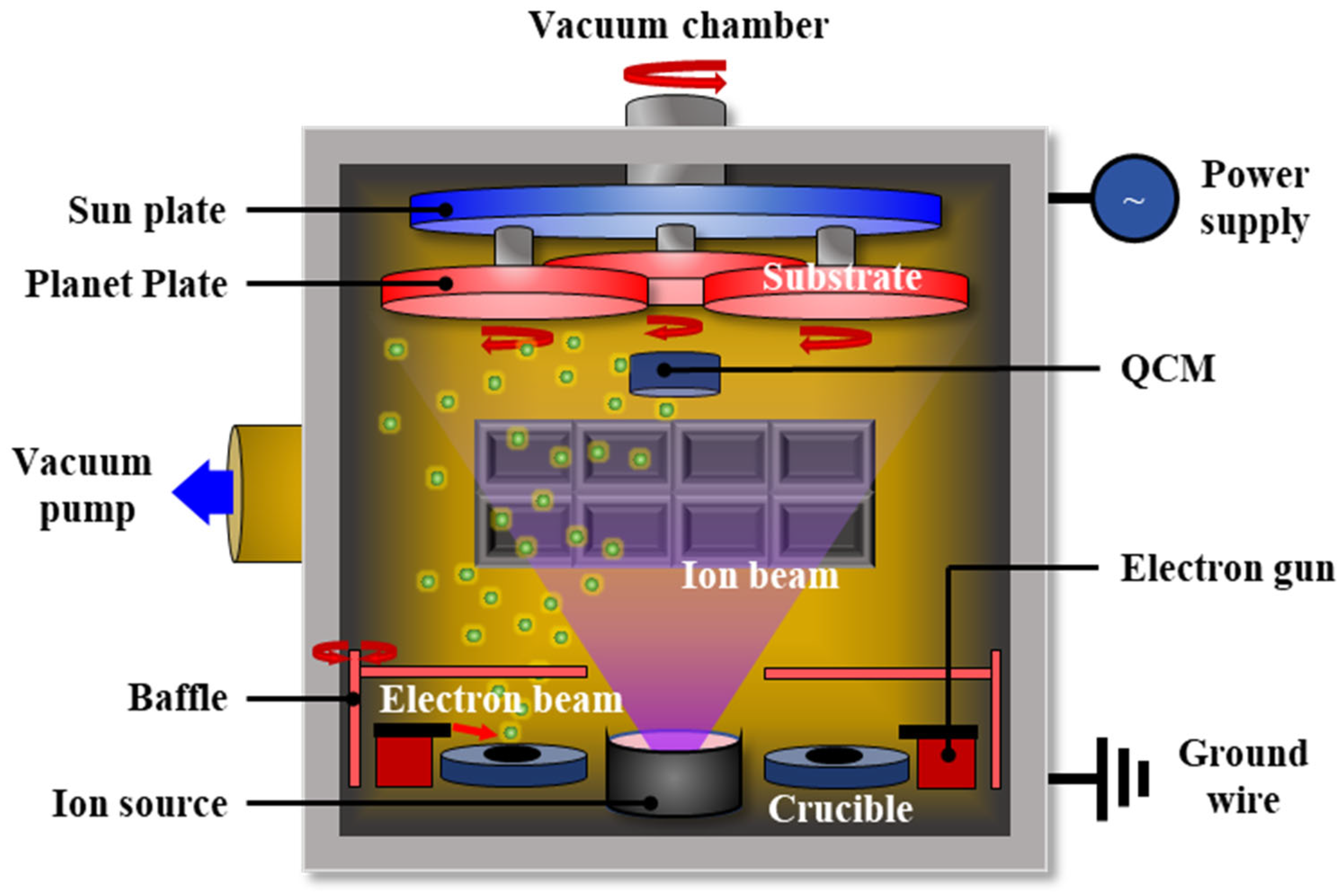
Ta2O5 films were deposited on fused silica substrates (FSS) using an IAD-EBE coating system (Chengdu, China). High-purity Ta2O5 particles (≥99.99%, 4 N) were used as the evaporation material after vacuum drying. The substrates were first wiped with dust free paper soaked in anhydrous ethanol to remove visible contaminants. They were then ultrasonically cleaned in acetone, ethanol, and deionized water for 15 min in sequence, and finally vacuum-dried before deposition. The coating system was equipped with a radio frequency (RF) discharge ion source. It provided an auxiliary ion beam with high energy density, excellent beam uniformity, and continuously adjustable parameters. Its primary role was to optimize film performance via high-energy ion beams. It densified the film microstructure, suppressed pore defects, and activated the FSS to enhance the film–substrate adhesion. A high-energy electron beam was used to bombard the Ta2O5 target, causing its evaporation and subsequent deposition onto substrates under planetary rotation. This process produced high-quality optical films, as illustrated in Figure 1.
Before deposition, the chamber was evacuated by a mechanical pump and a cryogenic pump to a base pressure of 3.0 × 10⁻⁴ Pa. During deposition, Ar and O2 were introduced through mass-flow controllers, and the chamber working pressure was continuously monitored by a vacuum gauge. A closed-loop pressure-control scheme was employed: the pumping conductance was dynamically adjusted based on the gauge feedback to maintain the chamber pressure at the target setpoint. The substrate temperature was actively controlled and maintained at 100 °C throughout the deposition process using the built-in substrate heating system (feedback control), and it was monitored in real time to minimize thermal fluctuations and eliminate temperature-induced variability. The film thickness was fixed at 400 nm and the deposition rate at 0.8 Å/s. A quartz crystal microbalance (QCM) was used for real-time monitoring, ensuring that variations in surface quality were primarily governed by the deposition conditions. V, I, and argon (Q1)/oxygen (Q2) flow rate were varied to study their effects on film surface quality. The detailed adjustment ranges of these deposition parameters are listed in Table 1. The parameter ranges were determined based on a combination of equipment operational limits, process stability considerations, and preliminary screening experiments. Specifically, the selected ranges ensured stable evaporation of Ta2O5, reliable ion source discharge without abnormal arcing, and repeatable film growth. In addition, the ranges were chosen to sufficiently cover regimes where ion-assisted densification, resputtering, and oxidation-state transitions are expected to occur.

2.2. Characterization of Rq and n in Ta2O5 Films

The diameter and thickness of the experimental FSS used for depositing Ta2O5 films were 10 mm and 1 mm, respectively. A comprehensive suite of techniques was employed to characterize the morphology, composition, and structure of the deposited films.
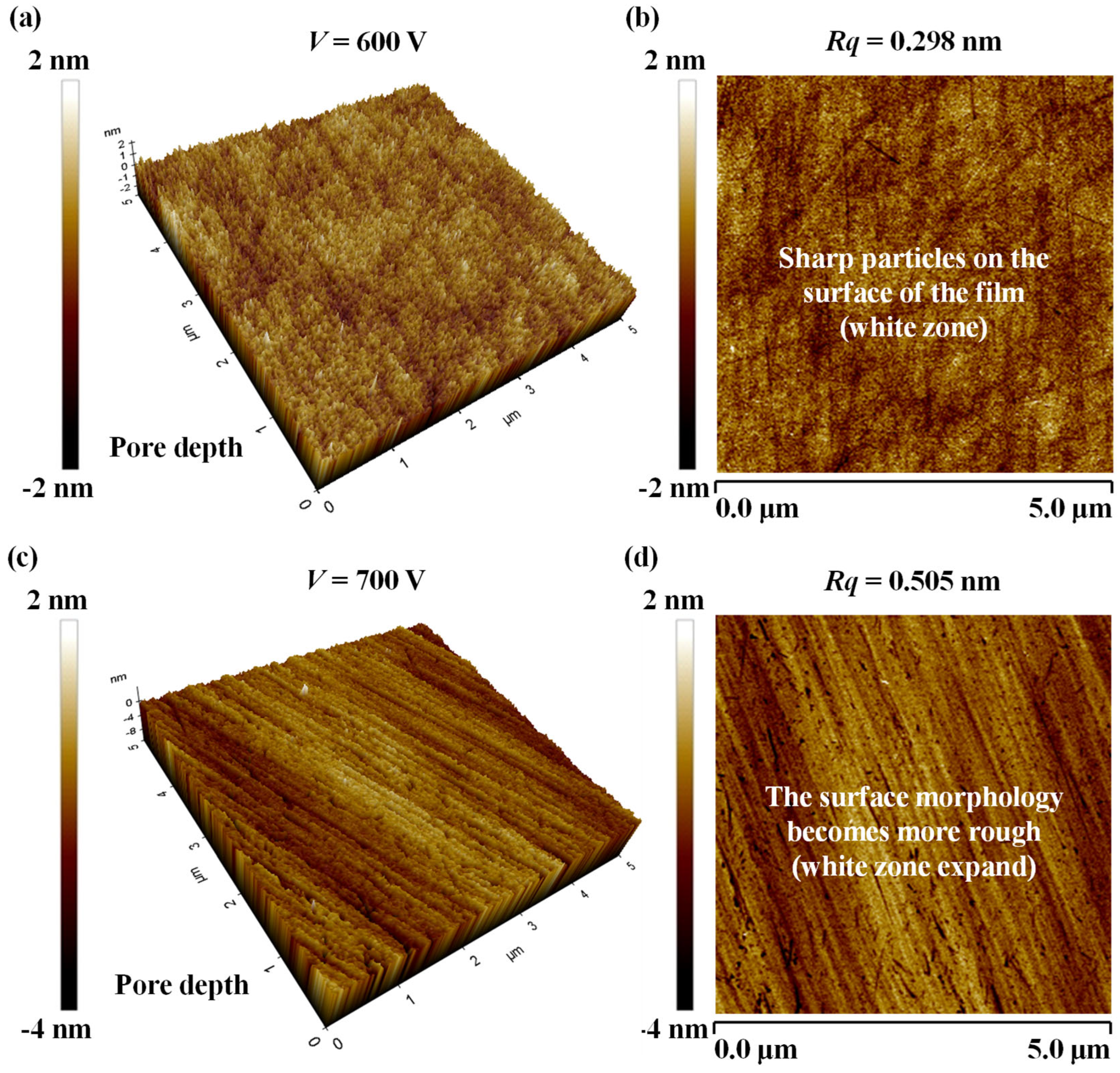
The Rq of the Ta2O5 films was characterized using atomic force microscopy (AFM) in tapping mode to minimize damage to the film surface (Chengdu, China). The instrument was regularly calibrated: the XY scan size with a standard grating and the Z-axis height with a step sample. The scanning range was set to 5 × 5 μm2 with a resolution of 512 × 512 pixels. After acquiring the raw topography images, plane-flattening was applied to remove background tilt. Rq was calculated as the root mean square deviation of the surface height, providing a sensitive measure of surface quality suitable for optical films. Figure 2 presents the three-dimensional (Figure 2a,c) and corresponding two-dimensional (Figure 2b,d) AFM topographies for films deposited at V of 600 V and 700 V, respectively, with other parameters held constant (I = 1200 mA, Q1 = 20 sccm, Q2 = 100 sccm). The film deposited at 600 V exhibits an exceptionally smooth and homogeneous surface with an Rq of 0.298 nm (Figure 2a,b). In stark contrast, increasing the ion beam voltage to 700 V significantly altered the surface topography, resulting in a more textured and granular morphology with a substantially higher Rq of 0.505 nm (Figure 2c,d). This indicates that the higher ion energy promoted greater surface mobility of adatoms or induced mild sputtering effects, leading to the development of a more textured morphology.
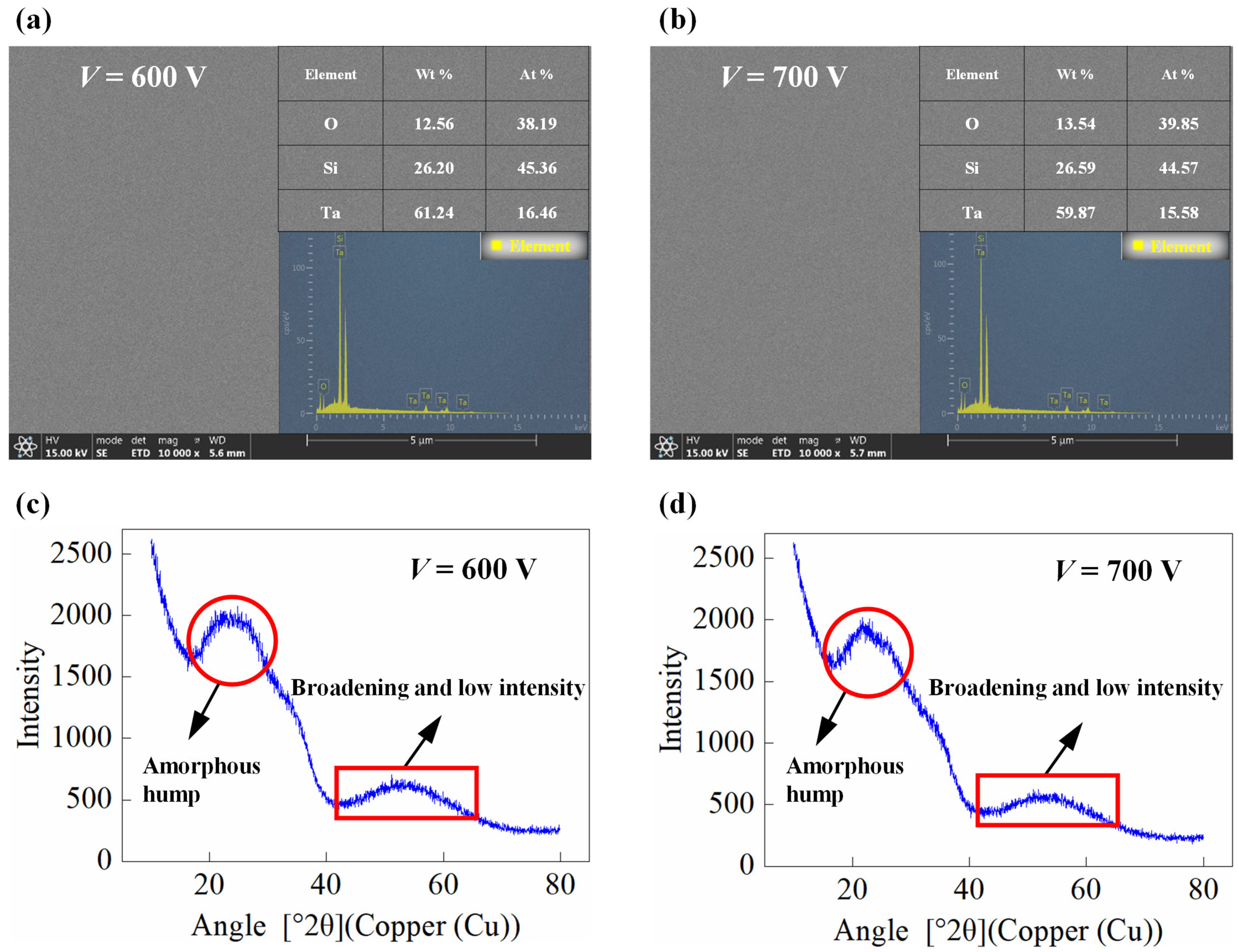
The elemental composition and surface morphology were analyzed using a scanning electron microscope (SEM) equipped with an energy-dispersive X-ray spectroscopy (EDS) detector (Chengdu, China). Prior to SEM/EDS analysis, the samples were coated with a thin conductive layer (Au) to prevent charging. The surface morphology was further corroborated by SEM, and the elemental composition was analyzed via EDS. Figure 3a,b show the SEM surface images for the 600 V and 700 V films, respectively. The SEM observations are fully consistent with the AFM results: the surface morphology of the film prepared under the 600 V process parameters is smoother. The corresponding quantitative EDS results are inset in each figure. Both films consist primarily of Ta and O, with a detectable Si signal originating from the underlying fused silica substrate, confirming the films are thinner than the SEM-EDS interaction volume. The atomic percentages of Ta are 16.46 at.% and 15.58 at.% for the 600 V and 700 V films, respectively (Figure 3a,b insets). The measured O/Ta atomic ratios for both films are notably lower than the stoichiometric value of 2.5 for Ta2O5. The substrate SiO2 provided the majority of the Si signal and a considerable portion of the O signal, while the film provided all the Ta signal and the remaining part of the O signal. Under the current deposition conditions, an oxygen-deficient tantalum oxide (TaOx) might have been formed.
The film structure was critically assessed by XRD (Chengdu, China) using Cu Kα radiation (λ = 1.5406 Å). The grazing Incidence XRD scan was performed continuously over 2θ = 10°~80° (step size: 0.035°, 2000 points) at a fixed grazing incidence angle (ω = 1°). The resulting patterns are shown in Figure 3c (600 V) and Figure 3d (700 V). The characteristic broad asymmetric diffraction hump spanning approximately 15° to 35° results from the superimposed scattering contributions of the amorphous FSS (dominant peak near 22°) and the amorphous Ta2O5 (α-Ta2O5) film, which typically exhibits a diffuse maximum at higher angles (approximately 28~35°) due to its distinct short-range atomic arrangement. Crucially, no sharp Bragg diffraction peaks corresponding to any known crystalline tantalum oxide polymorphs are observed. However, a very weak and broad intensity modulation is discernible around 50.5° in the patterns of both films, a position that coincides with the (221) reflection of crystalline β-Ta2O5. The extreme broadening and low intensity of these signals suggest that, if they originate from crystallized material, they correspond to extremely low-volume fraction within the dominant amorphous matrix. Nevertheless, the energy input under both conditions remained insufficient to drive a full-scale, long-range crystallization transition, which is consistent with the ion-assisted deposition process at relatively low substrate temperatures. This finding indicates that the deposition conditions, even at the higher ion energy of 700 V, did not provide sufficient energy or thermal activation for the formation of a long-range ordered crystalline lattice in these films.
Ellipsometry was used for high-precision and non-destructive determination of the n at 1053 nm (Chengdu, China). Before measurement, the samples were cleaned, dried, and inspected to select uniform surface regions. The instrument polarization state, wavelength, and angle of incidence were calibrated to minimize systematic errors. Measurements were then repeated at multiple sites under stable temperature and humidity.

2.3. Deposition Quality Prediction Achieved by Physics-Informed Bayesian Optimization

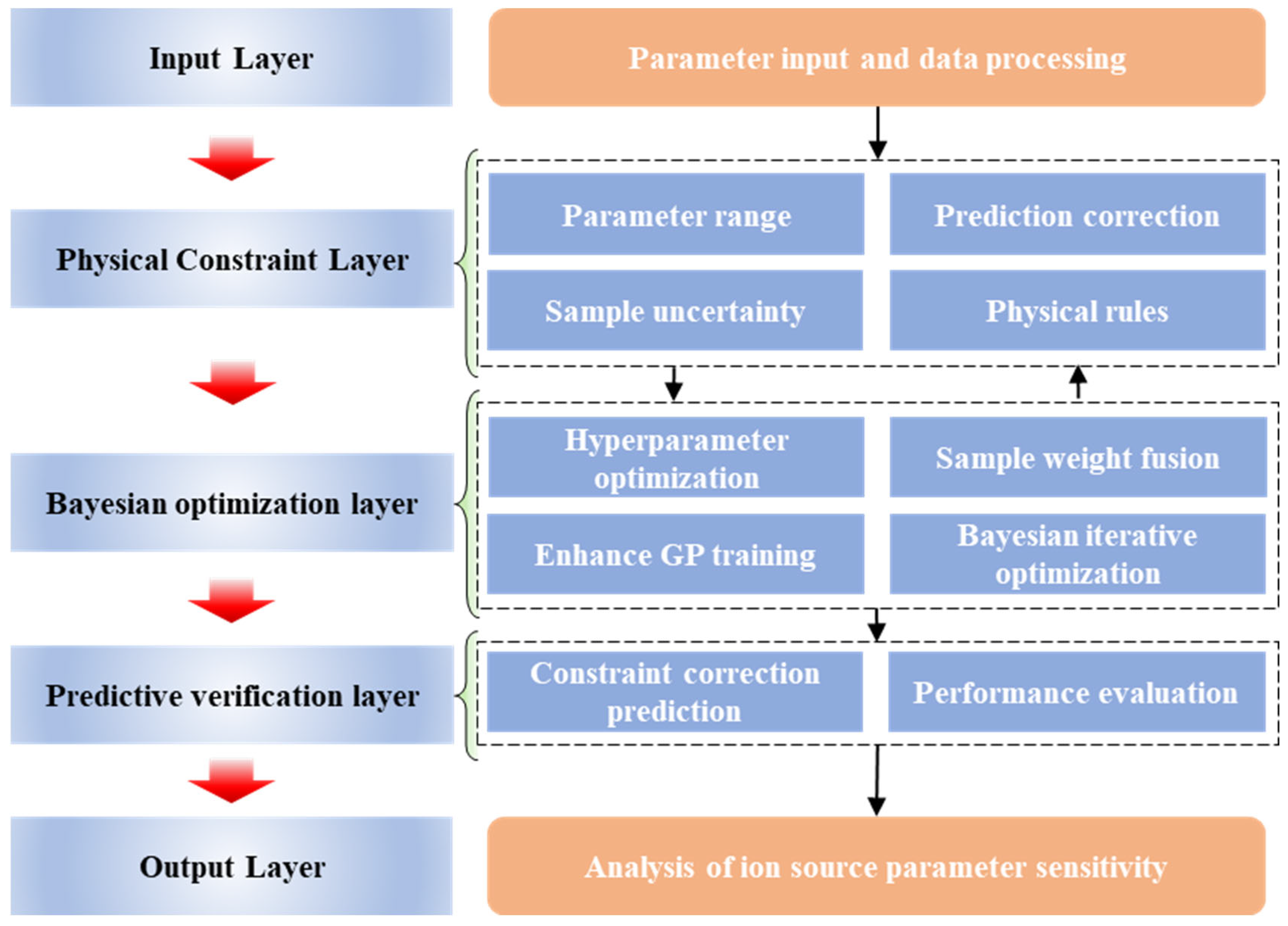
Figure 4 illustrated the complete hierarchical architecture of the proposed PI-BO model. Inputs to this architecture consisted of ion source parameters (V, I, Q1, and Q2), while outputs were Rq and n of Ta2O5 films. Overfitting and poor physical interpretability represented critical challenges in modeling small-sample process data. In this study, these were addressed through the deep coupling of the physical process prior of film deposition and data-driven BO. Preprocessing of raw data was performed in the input stage. Data standardization was implemented via the Z-score method within the parameter input and data processing module, followed by partitioning of training/test sets (8:2). Outlier filtering based on the interquartile range (IQR) criterion was also conducted, thereby providing structured and high-reliability foundational data for subsequent modeling steps.
The physical constraint layer was the main component responsible for ensuring model interpretability. It included parameter range constraints, prediction result correction constraints, sample uncertainty constraints, and physical prior rule constraints. The parameter range constraint limited the legal intervals between the input process parameters and the output Rq/n, as well as filtered out invalid samples. For the uncertainty constraints of data features, the threshold for repeated samples was set to 2, the basic uncertainty to 0.12, and the domain penalty coefficient to 0.5. These values were chosen to adapt to the stability characteristics of identical parameter combinations, the overall fluctuation range of the data, and the focus requirements of the low-Rq parameter domain, respectively, thereby enhancing model robustness. The prediction result correction constrained fine-tune the original predicted values of the GP model according to physical rules to ensure that the output conforms to the process laws. For the optimization goals of Rq and n, five parameter combination scoring rules were respectively constructed by physical prior constraints. The weight distribution was positively correlated with the influence intensity of each parameter on surface quality. The rule threshold was jointly determined by data characteristics and physical laws.
The BO layer employed the enhanced Gaussian Process (GP) as its core surrogate model to enable data-driven accurate modeling. First, sample weights output by the physical constraint layer were incorporated into the training process. Subsequently, iterative optimization of the GP model’s hyperparameters was accomplished via 5-fold cross-validation, where the optimal ARD squared exponential kernel function and noise parameter Σ were identified. Based on the Bayesian iterative optimization strategy, the model’s prediction error was minimized within the valid parameter space constrained by physical rules. This led to the construction of an enhanced GP model with both high fitting accuracy and strong generalization capability. In the prediction and validation phase, the raw GP outputs were further fused with physical prior rules through the constraint-corrected prediction module, and final Rq predictions that conform to process laws were generated. Meanwhile, model performance evaluation was conducted using quantitative metrics. In the output layer, the influence weights of each ion source process parameter on Rq were clarified via feature sensitivity analysis.

3. Results and Discussion

3.1. Mechanistic Analysis of the Influence of Plasma Energy Fields on Rq and n of Ta2O5 Films

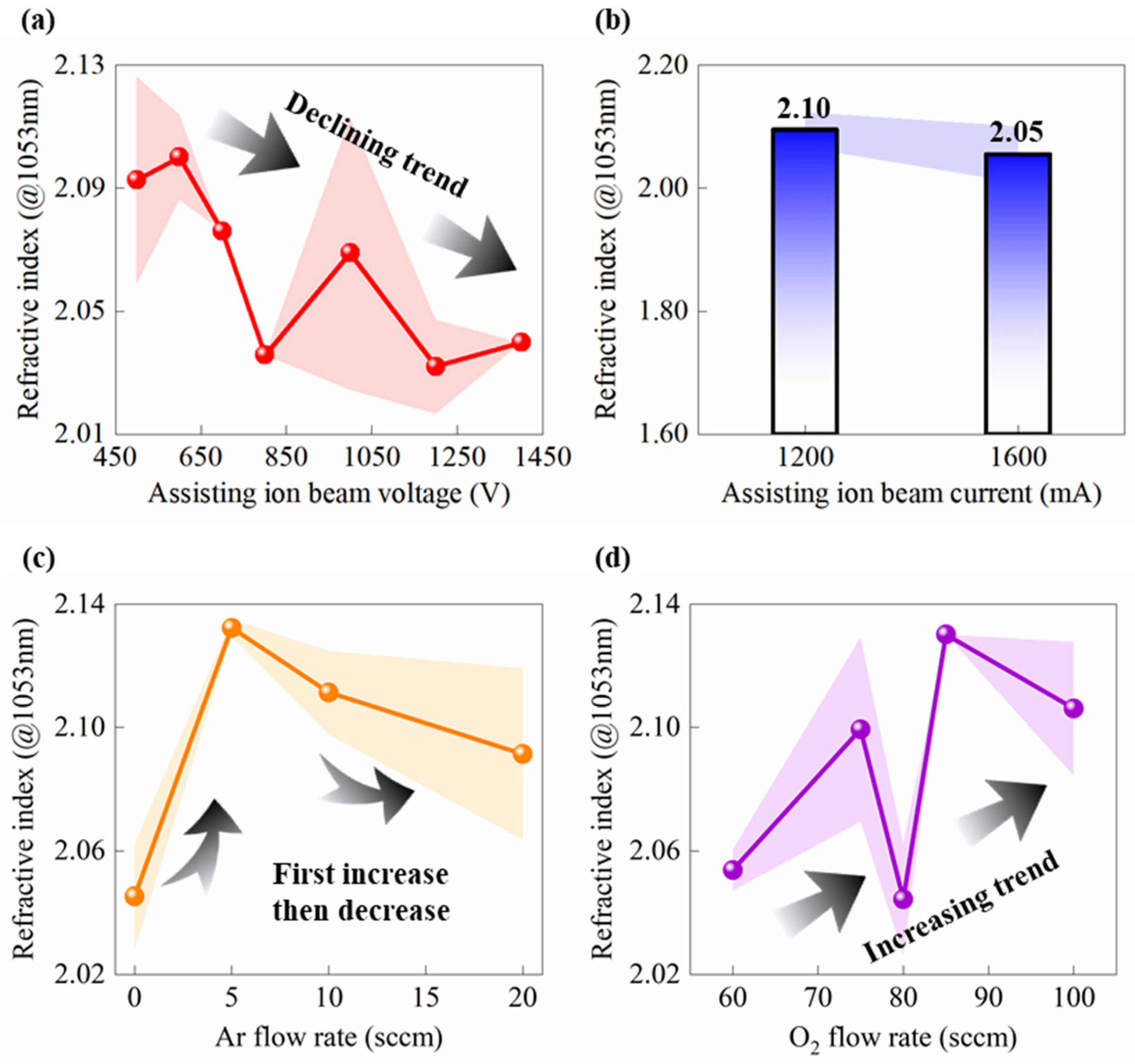
As crucial characteristics, n and Rq determine the service performance of Ta2O5 films in the high-energy laser systems. The role of ion source in affecting the deposition quality achieved by IAD-EBE is extremely important. This section investigates the effect of ion source parameters on n and Rq, as well as elucidating the underlying mechanisms governing these influences. Figure 5 illustrates the dependence of n (measured at 1053 nm) on four key ion source parameters: V, I, Q1, and Q2. Figure 5a reveals that n decreases overall with increasing V. n attains a local maximum at approximately 600 V. It drops sharply to around 2.03 at 800 V. A slight recovery in n is observed near 1000 V. It remains at a low level of 2.03~2.05 in this interval. Low V (500~650 V) favors the attainment of high n. However, a further rise in V induces an overall reduction in n. At low V (<650 V), ion bombardment during deposition regulates the columnar microstructure growth of films. This modification promotes film densification, thereby contributing to a higher value of n [12,31]. The decrease in n above 600 V may be attributed to the detrimental effect of excessive ion bombardment energy [12,32]. In Figure 5b, n exhibits an almost linear decrease as I increases from 1200 mA to 1600 mA. Its average value drops from 2.095 to 2.054, with error bar distribution further verifying the robustness of this trend. In principle, higher ion flux is typically anticipated to enhance the densification of deposited films [20]. Within the relatively high current range, the incident ion flux is significantly elevated. The resultant intense ion bombardment intensifies resputtering and facilitates the formation of local micropores or porous domains, which consequently lowers n [12,33]. Thus, an excessively high I is detrimental to the fabrication of Ta2O5 films with high n.
Figure 5c shows that n first increases and then decreases with increasing Q1. When Q1 increases from 0 sccm to 5 sccm, n rises sharply from about 2.05 to about 2.14, which is the highest value among all samples. As Q1 is further increased to 10 and 20 sccm, n gradually decreases and approaches about 2.09. At low Q1, the discharge is unstable and the ion beam flux is relatively low. The ion-assisted effect is therefore insufficient, and the film tends to grow with pronounced nanoscale voids, which results in a reduced refractive index. When a moderate amount of Ar is introduced, the discharge stability and ionization efficiency are significantly improved. More efficient momentum transfer to the film surface is achieved, the structure becomes more uniform and denser, and n reaches a maximum [31,34]. When Q1 is too high, Q2 becomes low and the supply of oxygen atoms is insufficient. During deposition, this favors the formation of sub-stoichiometric TaOx (x < 2.5), whose n is generally lower than that of stoichiometric Ta2O5. In addition, a high Q1 may strengthens resputtering, which weakens densification and reduces n [35]. Figure 5d shows that, as Q2 increases from 60 sccm to 100 sccm, n exhibits an overall slow increase, with pronounced local fluctuations. In reactive ion-assisted deposition, O2 plays a crucial role in controlling the oxidation state and stoichiometry of the film. In general, an increase in Q2 is beneficial for improving the oxidation degree of the film, the thermal decomposition and oxygen loss of Ta2O5 under high temperature and ion bombardment are suppressed, and the concentration of oxygen vacancies is reduced. As a result, a gradual increase in n is observed for the deposited Ta2O5 films. It should be noted that partial oxygen loss can still occur despite using Ta2O5 as the evaporation source, even in the vapor phase and growing film under electron beam bombardment and vacuum transport. Sub-stoichiometric TaOx (x < 2.5) can thus be formed, and the final stoichiometry becomes highly sensitive to the local Q2 and plasma chemistry near the substrate [36,37]. Near an Q2 of 75~80 sccm, n and its standard deviation show abnormally large fluctuations. Similar behavior is reported for Ta2O5 films prepared by reactive sputtering and ion beam/electron beam-assisted deposition, where the film stoichiometry and oxygen-vacancy concentration are highly sensitive to process variations when Q2 changes from an oxygen-deficient to a fully oxidizing regime. On this basis, the range of 75~80 sccm in the present work is considered a sensitive transition region from oxygen-deficient TaOx (x < 2.5) to near-stoichiometric Ta2O5, which leads to increased sample-to-sample scattering of n. When Q2 is further increased above 85 sccm, Q2 near the substrate is sufficient to stabilize the Ta2O5 phase. In summary, the variations in n of Ta2O5 films are jointly governed by the ion energy effect, the ion flux effect, and the oxidation stoichiometry. A moderate combination of V, I, Q2, and Q2 promotes surface densification and sufficient oxidation, and thus increases n. In contrast, excessive ion energy or over-bombardment induces resputtering, a loose microstructure, or oxygen deficiency, which degrades the optical performance of the films. These trends are consistent with the classical models for IAD growth of oxide thin films [32,38,39].
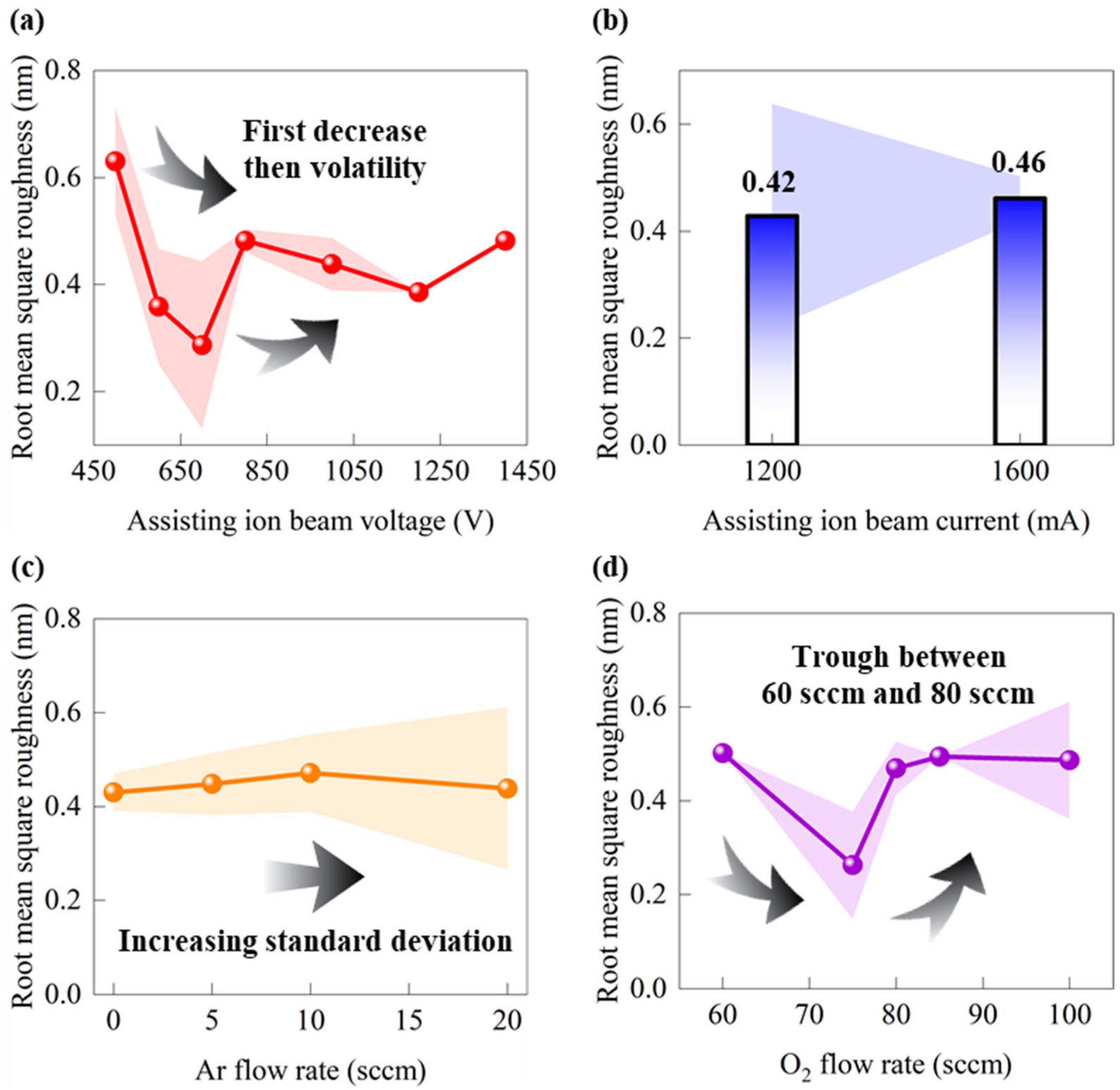
Figure 6 shows the dependence of Rq on four ion source parameters: V, I, Q1, and Q2. In Figure 6a, Rq decreases markedly as V increases from 450 V to 700 V, reaches a minimum around 700 V, and then increases again when the voltage is further raised to 1000 V. This trend indicates that, in the low and medium voltage range, appropriate incident ion energy promotes surface diffusion and rearrangement of adatoms or clusters. Porosity is closed, and the film becomes denser, which leads to a low Rq. When V exceeds a certain threshold, high-energy ions enhance resputtering and severe surface etching, so Rq increases again [40]. Therefore, there is an optimal voltage range (600~800 V) for minimizing Rq. To obtain a low Rq, prolonged operation at excessively high V should be avoided. Figure 6b shows that Rq increases slowly from about 0.38 nm to about 0.42 nm as I rises from 1200 mA to 1600 mA. The error band becomes narrower, and the overall variation remains very small. This result indicates that, in the present experimental range, the effect of increasing ion flux on Rq is relatively weak. The slight increase in roughness can be attributed to enhanced resputtering, local heating, or stress concentration at high ion flux, which introduces fine surface undulations [40]. Optimization of I should therefore be considered together with the beam voltage. At the optimal voltage, the current should be kept at a moderate level to avoid entering a high-flux regime where ion-induced damage dominates. In Figure 6c, when Q1 increases from 5 sccm to 20 sccm, Rq remains around 0.4 nm with a slight decreasing trend and relatively wide error bars. Q1 affects the discharge characteristics and stability of the ion source. However, in this range, the discharge remains stable, and the surface diffusion of Ta2O5 is mainly governed by ion energy. A larger gas flow may broaden the ion beam, but a flow of 5~20 sccm likely still lies within an effective bombardment regime. As a result, the overall impact of Q1 on Rq is limited. As shown in Figure 6d, when Q2 increases from 60 sccm to 100 sccm, Rq exhibits a minimum around 75 sccm, a pronounced peak at 80 sccm, and then decreases again in the range of 90~100 sccm. At low oxygen partial pressure, Ta2O5 films tend to contain a high concentration of oxygen vacancies and sub-stoichiometric TaOx (x < 2.5). The corresponding reduction in density and possible incorporation of inert gas favor the formation of columnar or porous structures, which increases Rq [37]. Rq minimum when Q2 increases from 80 sccm to 90 sccm suggests the existence of an optimal near-stoichiometric and highly dense oxygen flow window, in which absorption loss is minimized and the density of micro-defects is low [36]. When Q2 is further increased, while the V and I are kept constant, the energy gained per ion decreases. The effective bombardment of the substrate is weakened, and Rq increases again [36]. By combining the trends of the four ion source parameter, it is evident that V dominates film densification and resputtering behavior and is the most critical factor for Rq. I controls the ion flux, its influence is weaker but may still induce damage at high flux. The effect of Q1 is limited and mainly related to sustaining a stable discharge. In contrast, Q2 exhibits an optimal window and is the other key factor responsible for abrupt changes in roughness. Overall, these parameters jointly determine the ion energy flux density and the oxidation environment, thus controling the growth kinetics of Ta2O5 and the final surface morphology.
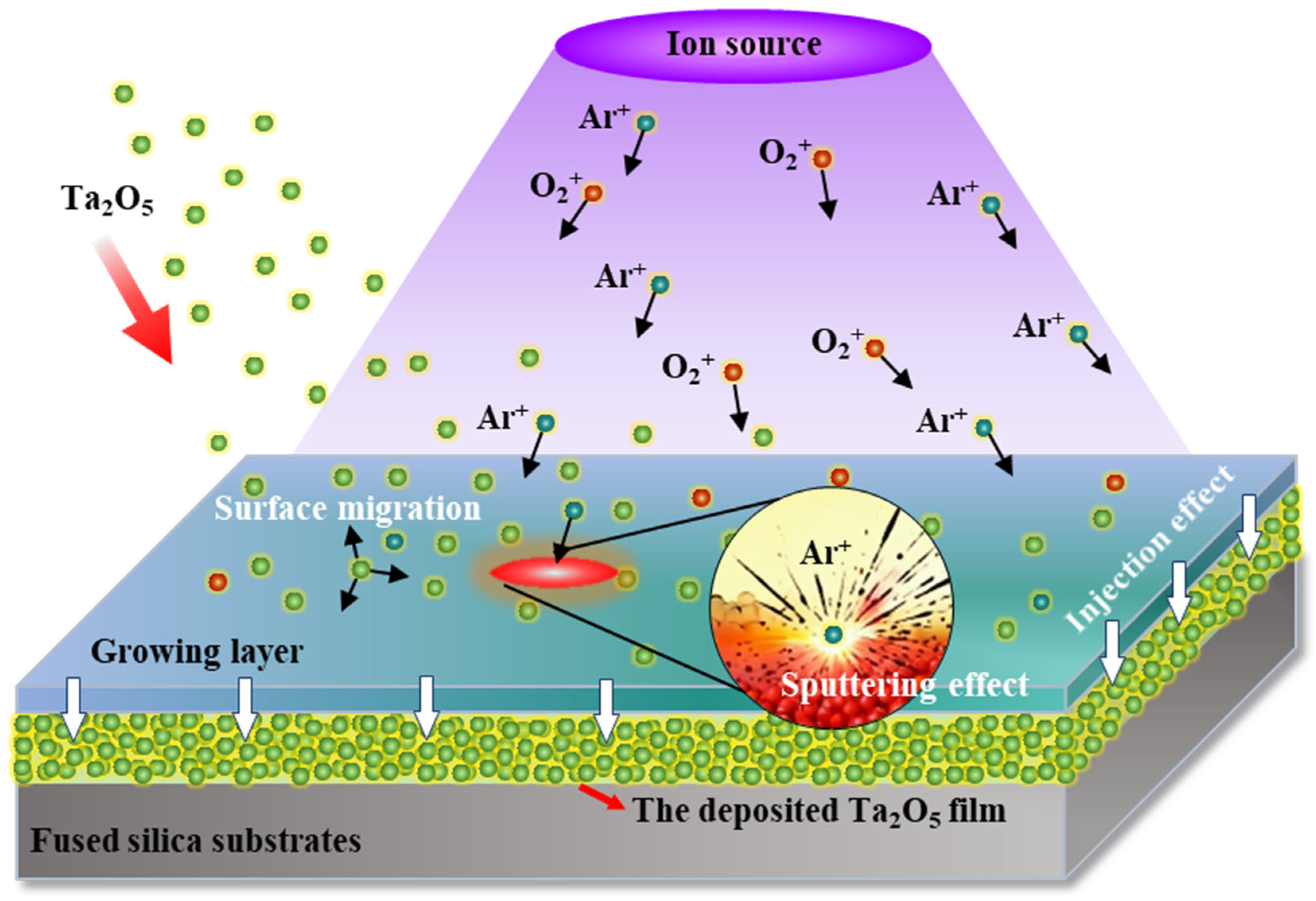
The schematic of the IAD-EBE reactive evaporation process for Ta2O5 films is shown in Figure 7. The Ta2O5 material is heated by the electron beam and evaporated, and the resulting vapor is transported to the substrate and condenses on the FSS. At the same time, the RF ion source installed in the chamber ionizes the working gas (Ar/O2 mixture) and generates Ar+ and O2+ ion beams, which is directed toward the deposition region. In the growing layer, low-energy ions collide with adatoms on the surface. The surface mobility and diffusion length of these adatoms are increased, which promotes cluster rearrangement, pore closure, and interface densification. As a result, Rq is reduced and n is increased [41]. When the ion energy becomes too high, reflection occurs. High-energy ions knock surface atoms out of the film and generate point defects or stress concentrations near the surface. The deposition rate is reduced, the surface becomes rougher, and the stoichiometry deviates from the nominal value [42]. At the same time, part of the incident ions is trapped within a few nanometers below the growing layer, giving rise to an ion implantation effect, which causes local structural damage and impurity incorporation in the Ta2O5 layer [40,43]. In the mixed plasma, Ar+ mainly acts as an inert momentum carrier. It enhances surface diffusion, increases film density and refractive index. In contrast, O2+ provides a strong chemical contribution: reactive oxygen ions can oxidize sub-stoichiometric TaOx, refill oxygen vacancies, and therefore control the stoichiometry and micro-defect structure of Ta2O5, which in turn has a pronounced impact on n [36,44]. Overall, enhancement of surface diffusion, resputtering, and the ion implantation effect act cooperatively under the mixed Ar+/O2+ ion beam. These coupled processes provide the basis for obtaining highly dense, low-defect Ta2O5 films by IAD-EBE.

3.2. PI-BO-Based Prediction and Experimental Validation of Rq and n for Ta2O5 Films

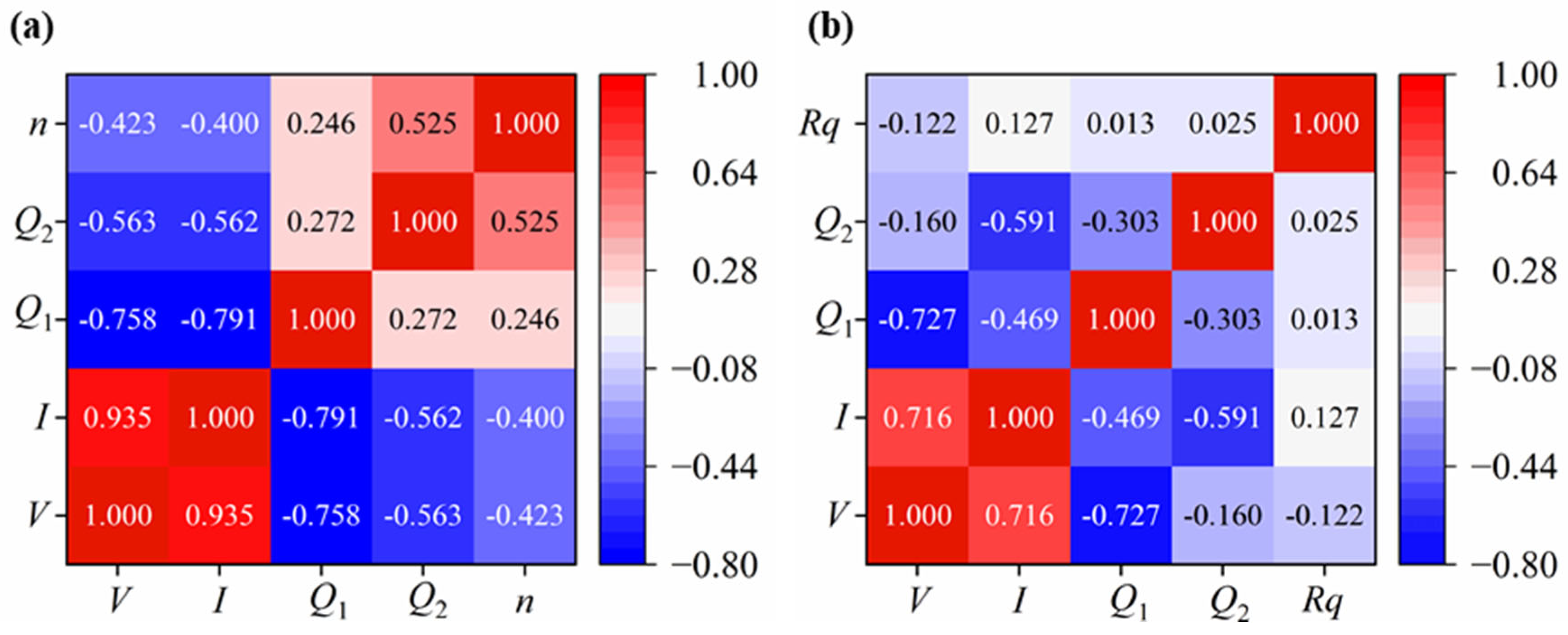
Figure 8 shows the Pearson correlation coefficient heatmap between V, I, Q1, and Q2 of the Ta2O5 films and n, Rq, respectively. The n is moderately and negatively correlated with V and I (rn,V = −0.423, rn,I = −0.4). In contrast, it is more strongly and positively correlated with Q2 (rn,Q2 = 0.525) and only weakly and positively correlated with the Q1 (rn,Q1 = 0.246). The root-mean-square roughness Rq shows only weak correlation with any single ion source parameter (|r| ≤ 0.13), which is consistent with the results discussed in Section 3.1.
In the PI-BO model proposed in this study, the setting of the physical constraint layer is based on the data statistical laws such as the Ta2O5 film deposition mechanism analysis and Pearson correlation coefficient analysis in Section 3.1. The specific physical laws are shown in Table 2.
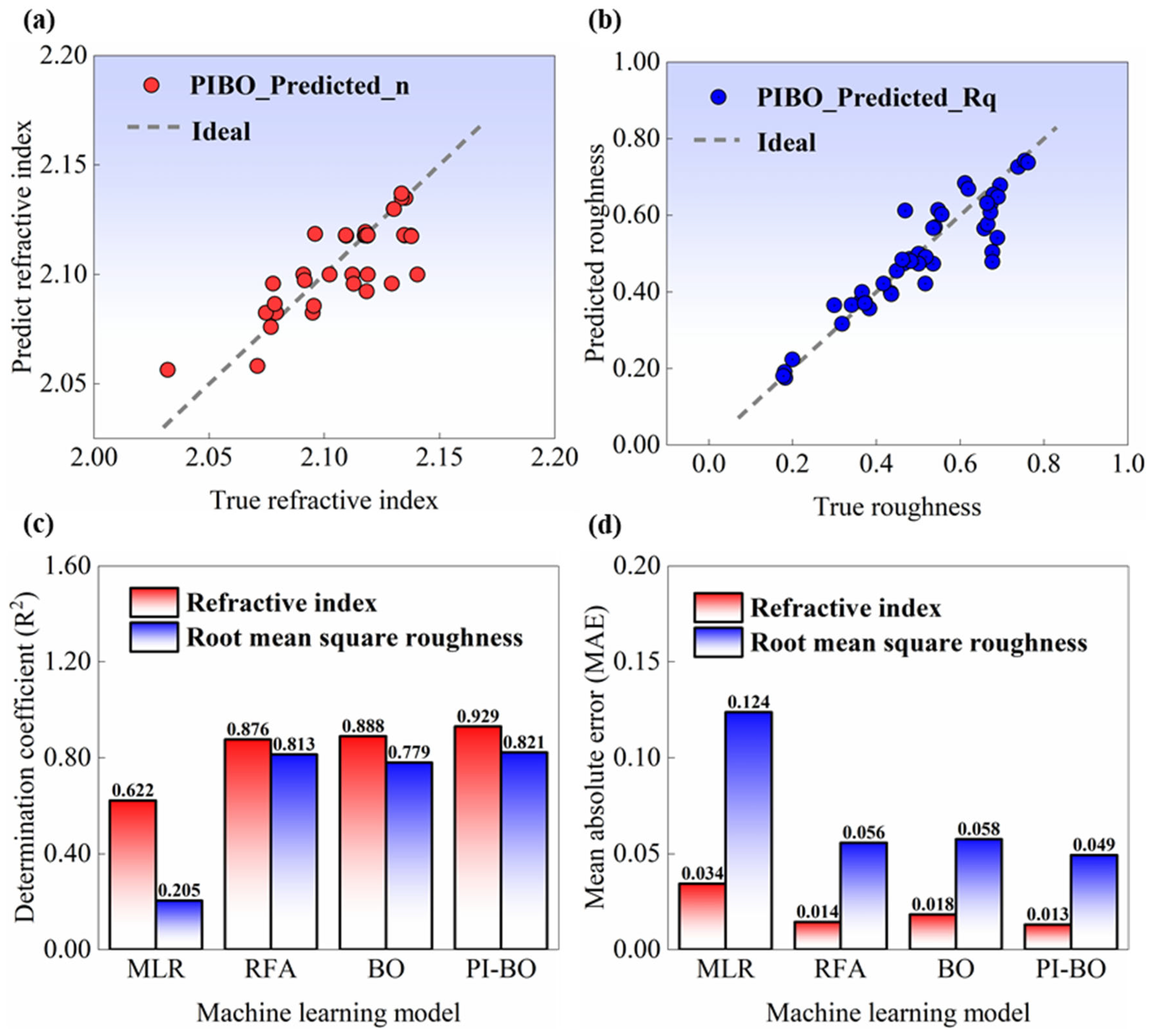
The training results of the PI-BO model and performance comparisons across different models are presented in Figure 9. In Figure 9a, the scatter plot of predicted versus actual n derived from the PI-BO model is illustrated. Data points are closely distributed around the ideal line, covering an actual n range of approximately 2.00 to 2.20. The vast majority of points fall within the band of ±0.05 relative to the ideal line, demonstrating high accuracy and low bias of the model. In Figure 9b, the prediction of Rq by the PI-BO model is shown. All data points lie close to the ideal line across the actual Rq range of 0.00 to 0.75 nm, with deviations mainly concentrated in the high Rq region.
ML models commonly applied to small-sample scenarios include multivariate linear regression (MLR), random forest algorithm (RFA), and standard BO. Figure 9c compares the R2 of four models for n and Rq prediction. For n, R2 value of the MLR model is 0.622, that of the RFA model is 0.876, that of the BO model is 0.888, and the PI-BO model achieves the highest value of 0.929. For Rq, the MLR model yields the lowest R2 of 0.205, followed by the RFA model (0.813), the BO model (0.779), and the PI-BO model (0.821). Superior performance of the PI-BO model over all other models is observed in both metrics, which indicates that it can better capture the nonlinear relationships between input parameters and output properties. Figure 9d displays the mean absolute error (MAE) values of the models. For refractive index, the MAE of the MLR model is 0.034, that of the RFA model is 0.018, that of the BO model is 0.014, and the PI-BO model attains the lowest MAE of 0.013. For roughness, the MLR model has the highest MAE of 0.124, while the RFA model and BO model have MAEs of 0.056 and 0.058, respectively, and the PI-BO model achieves an MAE of 0.049. The low MAE of the PI-BO model highlights its advantages in quantifying prediction errors, especially in the presence of noisy data or limited sample sizes.
Among the four models, the PI-BO model exhibits the highest R2 and the lowest MAE, which verifies its superior predictive accuracy and fitting performance. The BO and PI-BO models can form a set of ablation experiments. By comparing their prediction results, a robust mapping relationship of the PI-BO model is confirmed. The superiority of the PI-BO model stems from the integration of physical knowledge into the BO process: while the standard BO model only relies on the GP surrogate model to optimize the acquisition function, the PI-BO model constrains the surrogate function via physical prior rules, which enhances the exploration–exploitation balance. In deposition processes, this mechanism helps handle multimodal parameter spaces, thus achieving higher predictive accuracy and efficiency.

3.3. Sensitivity Analysis and Optimization of Process Parameters for Deposition Quality

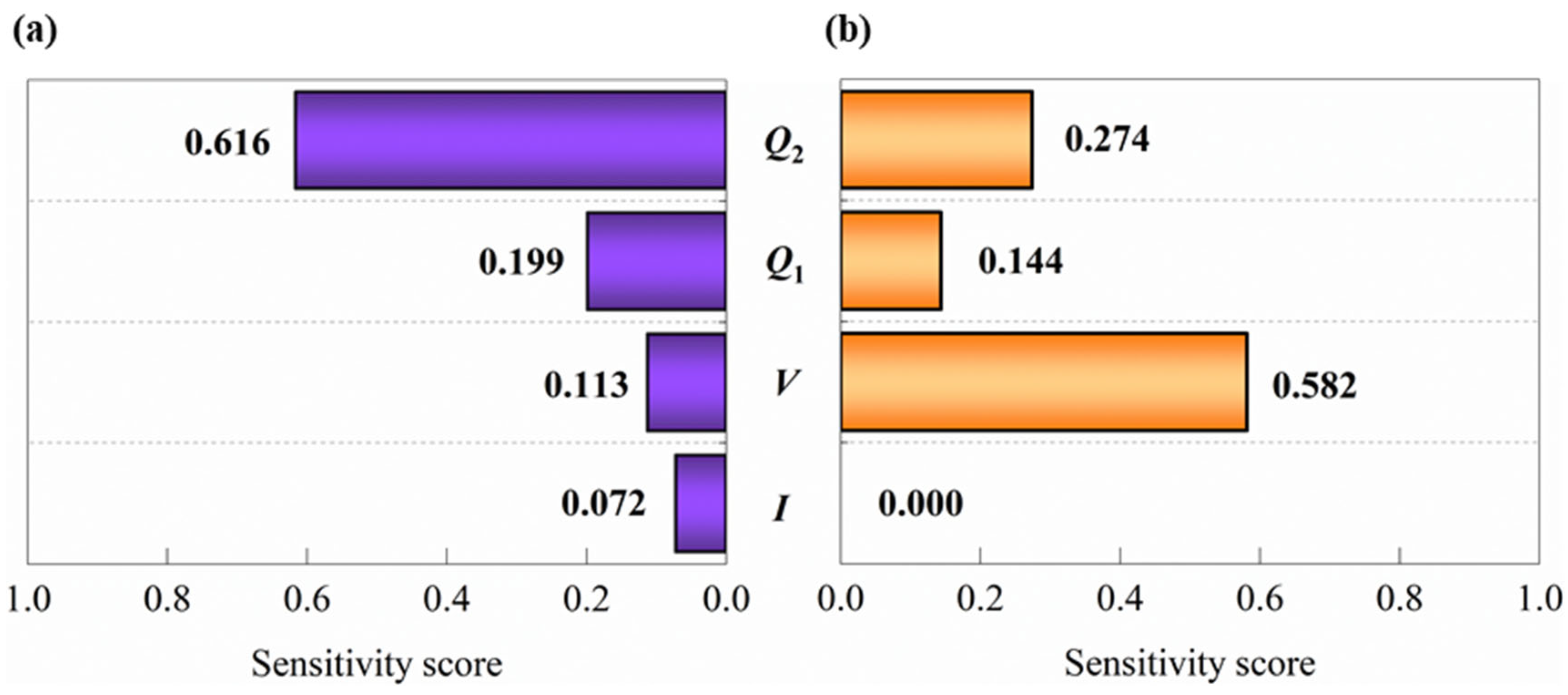
A sensitivity analysis of the assist ion source parameters is carried out based on the PI-BO model to evaluate their relative importance for n and Rq of Ta2O5 films deposited by IAD-EBE, as shown in Figure 10. The ion source parameters include V, I, Q1, and Q2. The sensitivity score ranges from 0 to 1 and represents the contribution of each parameter to the target property. The scores are obtained by permutation importance.
Figure 10a shows that the Q2 is the most important parameter for n, with a sensitivity score of 0.616. It is followed by Q2 (0.199), V (0.113), and I (0.072). This result indicates that the gas flow parameters dominate the variation in n and highlight the primary role of film stoichiometry and oxidation. The dominant role of the Q2 arises from its direct control of the oxidation state and the Ta:O stoichiometry. In IAD-EBE, O2 acts as a reactive gas and promotes ion-activated oxygen incorporation. The formation of sub-oxides (TaOx, x < 2.5) is suppressed, the film density is increased, and n is raised. Q1 is secondary and mainly influences the plasma density and ion flux. In this way, it affects surface diffusion and densification and assists the reactive role of O2. The lower importance of the V and I suggests that ion energy and ion flux act mainly as auxiliary factors for n control.
Figure 10b shows that V is the dominant parameter governing Rq, with a sensitivity score of 0.582. It is followed by Q2 (0.274), Q1 (0.144), and I (0.000). This trend is in sharp contrast to that of n and indicates that physical bombardment parameters are prioritized in the control of surface morphology. The high sensitivity of V is attributed to the fact that the ion kinetic energy directly drives the surface smoothing process. Q2 plays a secondary role by modifying the film stoichiometry. The low importance of Q1 is associated with its role in maintaining a stable ion flux and promoting uniform bombardment. The very low sensitivity of I suggests that its variation in the range of 1200~1600 mA has no significant effect on the change in Rq.
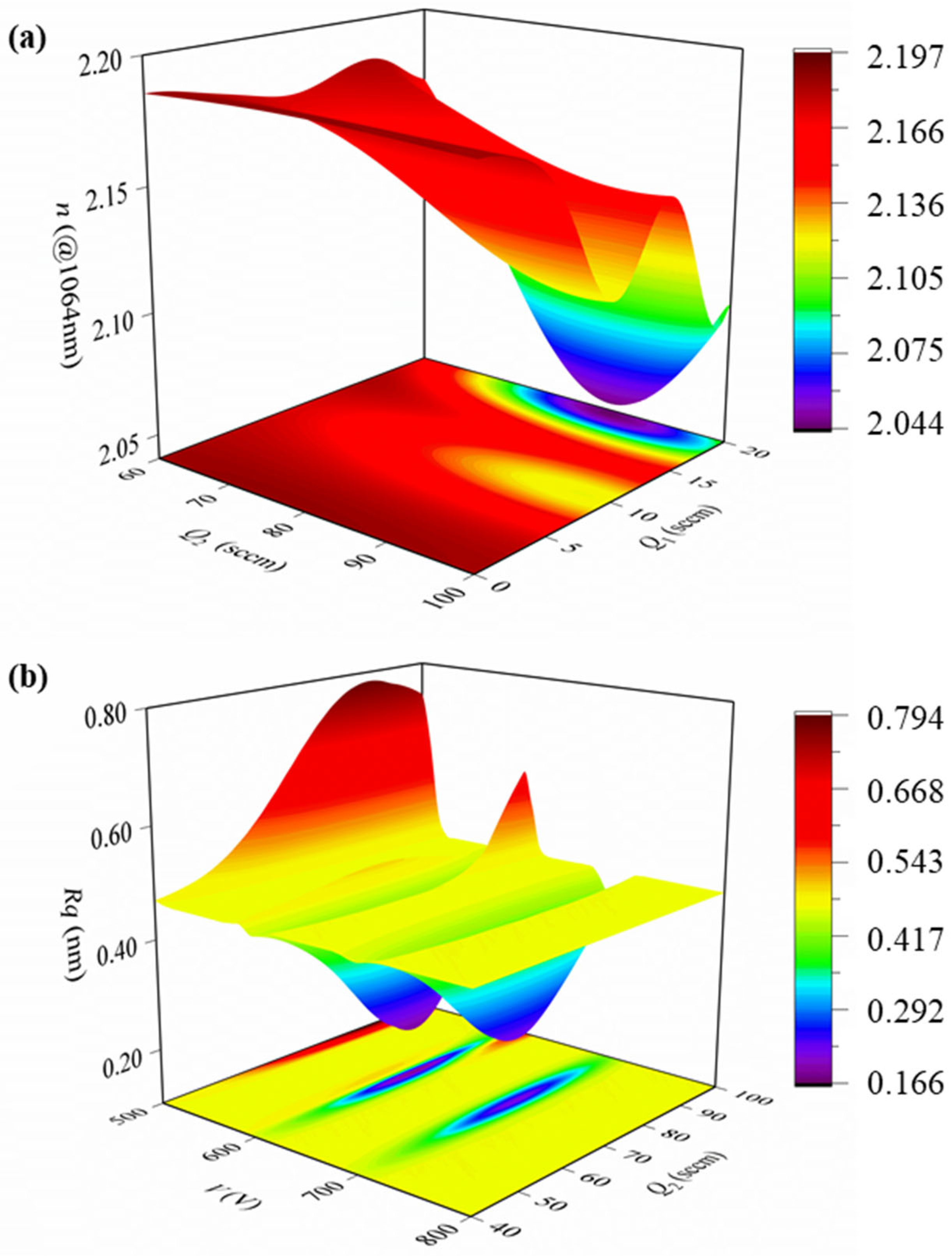
Figure 11 presents contour plots of the key process parameters versus n and Rq of the Ta2O5 films, as predicted by the PI-BO model. These plots allow the coupling between parameters and their optimization ranges to be visualized directly. In Figure 11a, the overall trend for n is as follows: At low Q1, n increases slightly with increasing Q2 and then tends to saturate, whereas a pronounced valley in n appears at high Q1. A region with moderate Q2 (70~80 sccm) and low Q1 (0 sccm~5 sccm) is favorable for increasing the film density and achieving a higher refractive index. Figure 11b shows a valley of minimum Rq at intermediate V (600~700 V) combined with intermediate Q2 (60~80 sccm). In contrast, low or excessively high voltages and too low or too high Q2 all lead to a marked increase in Rq. A combined analysis of the contour distributions for n and Rq indicates that the optimal process windows for these two properties do not fully overlap. Preferred V (600~700 V), and Q2 (70~80 sccm) together define a relatively narrow optimal range characterized by a high n (>2.15) and low Rq (0.2~0.3 nm), which provides clear process guidelines for the rapid optimization of Ta2O5 laser coating performance in engineering practice by adjusting V and Q2.

4. Conclusions

This study addresses the challenges associated with fabricating Ta2O5 films via IAD-EBE, including high experimental costs and unclear coupling effects of IAD parameters on deposition quality. In this work, a small-sample dataset is developed by IAD-EBE experiments and characterization of deposition quality. Utilizing a PI-BO method, accurate prediction of Rq and n for Ta2O5 films is achieved. Meanwhile, the sensitivity weight factors and preferred ranges of critical IAD parameters influencing deposition quality are obtained. The main conclusions are summarized as follows:
  • The regulating effects of ion source parameters (V, I, Q1 and Q2) on n and Rq of Ta2O5 films are clarified. As V increases, the overall trend of n and Rq shows a fluctuating decline. The increase in Q2 is conducive to enhancing the oxidation degree of the film, inhibiting the thermal decomposition of Ta2O5 and oxygen vacancies under high temperature and ion bombardment, while I and Q1 exert secondary influences via flux-induced damage and discharge stability.
  • The proposed method is grounded in the analysis of deposition mechanisms and Bayesian optimization theory. An approach for predicting the deposition quality of Ta2O5 films and characterizing the features of process parameters is developed, specifically designed for small-sample datasets. The validation results of the PI-BO method show that the R2/MAE of the prediction models for n and Rq reach 0.9273/0.0133 and 0.8214/0.0492, respectively. The PI-BO model has high robustness and strong generalization capability.
  • For n/Rq, the weight factors of V, I, Q1, and Q2 are 0.616/0.274, 0.199/0.144, 0.113/0.582, and 0.072/0.000, respectively. V and Q2 are identified as the dominant factors for regulating the deposition quality of Ta2O5 films. The preferred ranges for V and Q2 are determined to be 600~700 V and 70~80 sccm, respectively. Within the above ranges, Ta2O5 films exhibit high refractive index (n > 2.15) and low surface roughness (Rq: 0.2~3 nm).
In the present work, refractive index and surface roughness were selected as representative film-quality metrics due to their non-destructive measurability and strong correlation with densification behavior. While density was not explicitly included as a target parameter in the machine learning framework, it serves as an important underlying factor governing the observed trends. Incorporating direct density measurements in future studies would further strengthen the structure–property relationships and enhance the interpretability of data-driven optimization models.

Author Contributions

Conceptualization, Y.W., F.Z., Z.L. and H.L. (Henan Liu); Methodology, Y.W., J.L., W.M. and H.L. (Hongqin Lei); Software, J.L. and W.M.; Validation, J.L.; Formal analysis, W.M.; Investigation, J.L. and W.M.; Resources, Y.W., H.L. (Hongqin Lei), F.Z., H.L. (Henan Liu), X.H., L.Z. and M.C.; Data curation, J.L., W.M., H.L. (Hongqin Lei) and F.Z.; Writing—original draft, Y.W., J.L. and W.M.; Writing—review & editing, Y.W., H.L. (Hongqin Lei), F.Z., Z.L. and X.H.; Visualization, J.L. and X.H.; Supervision, Y.W., H.L. (Hongqin Lei), F.Z., Z.L., H.L. (Henan Liu), X.H., L.Z. and M.C.; Project administration, Y.W., H.L. (Hongqin Lei), F.Z., Z.L., H.L. (Henan Liu), X.H., L.Z. and M.C.; Funding acquisition, H.L. (Hongqin Lei), L.Z. and M.C. All authors have read and agreed to the published version of the manuscript.

Funding

This work received primary financial support from the National Natural Science Foundation of China (Nos. 524B2064, 52235010, 52293403, 52175389, 52405466), Presidential Foundation of CAEP (No. YZJJZQ2022014) and Heilongjiang Provincial Chunyan Talent Support Program for Science and Technology (No. CYQN24055). This work was also supported by the Fundamental Research Funds for the Central Universities (No. HIT.DZJJ.2024023), Young Elite Scientists Sponsorship Program by CAST (No. YESS20240573) and China Postdoctoral Science Foundation (No. 2024T171156).

Institutional Review Board Statement

Not applicable.

Informed Consent Statement

Not applicable.

Data Availability Statement

The data presented in this study are available on request from the corresponding author.

Conflicts of Interest

The authors declare no conflicts of interest.

Abbreviations

The following abbreviations are used in this manuscript:
Ta2O5Tantalum pentoxide
nRefractive index
IAD-EBEIon-assisted electron beam evaporation
VAssisting ion source beam voltage
MLMachine learning
TFNNsThin-film neural networks
IAssisting ion source beam current
RqRoot-mean-square surface roughness
PI-BOPhysics-informed Bayesian optimization
FSSFused silica substrate
RFRadio frequency
QCMQuartz crystal microbalance
Q1Argon flow rate
Q2Oxygen flow rate
AFMAtomic force microscopy
GPGaussian process
MLRMultivariate linear regression
RFARandom forest algorithm
MAEMean absolute error

References

  1. Jena, S.; Tokas, R.B.; Rao, K.D.; Thakur, S.; Sahoo, N.K. Annealing effects on microstructure and laser-induced damage threshold of HfO2/SiO2 multilayer mirrors. Appl. Opt. 2016, 55, 6108–6114. [Google Scholar] [CrossRef]
  2. Lei, H.; Yin, Z.; Zhao, L.; Cheng, J.; Chen, M.; Liu, Q.; Yang, D.; Chen, G.; Hu, J.; Chen, J. Repair-mechanism and strategy-customization during micro-milling of flawed potassium dihydrogen phosphate. Int. J. Mech. Sci. 2025, 290, 110110. [Google Scholar] [CrossRef]
  3. Cheikh, A.; Gonçalves, J.; Labbé, C.; Portier, X.; Marie, P.; Frilay, C.; Debieu, O.; Duprey, S.; Jadwisienczak, W.; Ingram, D.; et al. Tailoring structural and optical properties of Ta2O5 thin films via radio frequency magnetron sputtering for high-refractive index transparent materials. J. Alloys Compd. 2025, 1040, 183273. [Google Scholar] [CrossRef]
  4. Gangalakurti, L.; Venugopal Reddy, K.; Chhabra, I.M. Optimization of dielectric films with dual ion beam sputtering deposition for high reflectivity mirrors. Mater. Today Proc. 2021, 43, 400–406. [Google Scholar] [CrossRef]
  5. Cheng, J.; Chen, G.; Chen, M.; Cheng, J.; Chen, G.; Chen, M.; Zhao, L.; Xu, Q.; Yuan, X.; Liu, Z.; et al. Overview of advanced optical manufacturing techniques applied in regulating laser damage precursors in nonlinear functional KHxD2-xPO4 crystal. Light Adv. Manuf. 2025, 6, 546–574. [Google Scholar]
  6. Zhang, K.; Wang, X.; Shao, J.; Yi, K.; Hu, Y.; Hu, G.; Grilli, M.L.; Chai, Y. The formation of transient defects during high power laser-coating interaction revealed by the variation of electron beam evaporated coatings’ optical constants with temperature. Opt. Commun. 2022, 516, 127945. [Google Scholar] [CrossRef]
  7. Xu, L.; He, Y.; Li, K.; Zhou, H.; Xiong, Y. Study on thickness uniformity of Ta2O5 film evaporated on the inner-face of a hemispherical substrate. Optoelectron. Lett. 2021, 17, 673–677. [Google Scholar] [CrossRef]
  8. Lei, H.; Yin, Z.; He, Z.; Cheng, J.; Zhao, L.; Liu, Q.; Ding, W.; Yang, D.; Chen, G.; Chen, M. Characterization-method and repair-mechanism of atomic defects in potassium dihydrogen phosphate. Int. J. Mech. Sci. 2025, 308, 110950. [Google Scholar] [CrossRef]
  9. Guo, P.; Xue, Y.; Huang, C.; Xia, Z.; Zhang, G.; Fu, Z. Optical properties and elemental composition of Ta2O5 thin films. In Proceedings of the 2009 Symposium on Photonics and Optoelectronics, Wuhan, China, 14–16 August 2009. [Google Scholar]
  10. Song, R.; Hu, J.; Peng, Y.; Xiao, Y.A.; Wang, Y.; Zhu, K.; Jiang, Y.; Xia, X.; Xia, Z. Fabrication of ultra-low-absorption thin films via ion beam-assisted electron-beam evaporation. High Power Laser Sci. Eng. 2025, 13, E38. [Google Scholar] [CrossRef]
  11. Macleod, H.A. Chapter 1—Recent developments in deposition techniques for optical thin films and coatings. In Optical Thin Films and Coatings, 2nd ed.; Piegari, A., Flory, F., Eds.; Woodhead Publishing: Cambridge, UK, 2018; pp. 3–23. [Google Scholar]
  12. Farhan, M.S.; Zalnezhad, E.; Bushroa, A.R. Properties of Ta2O5 thin films prepared by ion-assisted deposition. Mater. Res. Bull. 2013, 48, 4206–4209. [Google Scholar] [CrossRef]
  13. Lei, H.; Zhao, Q.; Cheng, J.; Zhao, L.; Chen, M.; Liu, Q.; Yang, D.; Chen, G. Understanding the friction behavior and surface characteristic in multiple ball-end milling passes of soft-brittle KH2PO4 optics. Tribol. Int. 2025, 211, 110836. [Google Scholar] [CrossRef]
  14. Xu, C.; Li, D.; Fan, H.; Deng, J.; Qi, J.; Yi, P.; Qiang, Y. Effects of different post-treatment methods on optical properties, absorption and nanosecond laser-induced damage threshold of Ta2O5 films. Thin Solid Film. 2015, 580, 12–20. [Google Scholar] [CrossRef]
  15. Wen, J.; Zhu, M.; Chai, Y.; Liu, T.; Shi, J.; Du, W.; Shao, J. Optical and femtosecond laser-induced damage-related properties of Ta2O5-based oxide mixtures. J. Alloys Compd. 2023, 957, 170352. [Google Scholar]
  16. Zhang, G.; Xue, Y.; Guo, P.; Wang, H.; Ma, Z. Optical properties and microstructure of Ta2O5 thin films prepared by ion assisted electron beam evaporation. J. Wuhan Univ. Technol.-Mater. Sci. Ed. 2008, 23, 632–637. [Google Scholar] [CrossRef]
  17. Xie, W.; Zhang, M.; Xiao, J.; Wang, F. Research on the Performance of Nano-Scale AR Films for Airborne Optical Cable Components Based on Process Parameter Regulation; SPIE: Washington, DC, USA, 2025. [Google Scholar]
  18. Lei, H.; Zhao, L.; Cheng, J.; Chen, M.; Liu, Q. Material removal mechanisms affected by milling modes for defective KDP surfaces. CIRP J. Manuf. Sci. Technol. 2024, 48, 67–83. [Google Scholar] [CrossRef]
  19. Wang, L.; Zhang, W.; Hong, R.; Wang, K.; Wang, M.; Wang, Q.; Yi, K.; Shao, J. Reduction of absorption of Ta2O5 monolayers through the suppression of structural defects by employing an appropriate ionic oxygen concentration. Sci. Rep. 2025, 15, 4124. [Google Scholar] [CrossRef]
  20. Guo, C.; Kong, M.; Jing, J. High-performance Ta2O5 films prepared by plasma ion-assisted deposition for low-absorption optics. Opt. Contin. 2024, 3, 1679–1687. [Google Scholar] [CrossRef]
  21. Demiryont, H.; Sites, J.R. Effects of Deposition Parameters on Optical Properties of Ta2O5 Films Deposited Ion-Beam-Sputtering. In Proceedings of the Third Topical Meeting on Optical Interference Coatings, Monterey, CA, USA, 17–19 April 1984; Optica Publishing Group: Washington, DC, USA, 1984. [Google Scholar]
  22. Sakiew, W.; Schwerdtner, P.; Jupé, M.; Pflug, A.; Ristau, D. Impact of ion species on ion beam sputtered Ta2O5 layer quality parameters and on corresponding process productivity: A preinvestigation for large-area coatings. J. Vac. Sci. Technol. A 2021, 39, 063402. [Google Scholar] [CrossRef]
  23. Zheng, Y.; Blake, C.; Mravac, L.; Zhang, F.; Chen, Y.; Yang, S. A Machine Learning Approach Capturing Hidden Parameters in Autonomous Thin-Film Deposition. arXiv 2024, arXiv:2411.18721. [Google Scholar] [CrossRef]
  24. Reuna, J.; Vuorinen, M.; Isoaho, R.; Aho, A.; Mäkelä, S.; Hietalahti, A.; Anttola, E.; Tukiainen, A.; Guina, M. Optimization of reactive ion beam sputtered Ta2O5 for III–V compounds. Thin Solid Film. 2022, 763, 139601. [Google Scholar] [CrossRef]
  25. Ma, T.; Ma, M.; Guo, L.J. Optical multilayer thin film structure inverse design: From optimization to deep learning. iScience 2025, 28, 112222. [Google Scholar] [CrossRef] [PubMed]
  26. Nazrin, S.N.; Doroody, C.; Burhanuddin, L.A.; Jothi, N.; Ibrahim, N.; Zaman, H.B.; Tahir, M.H.M.; Soudagar, M.; Ramesh, S. Machine learning-driven prediction of optical and physical properties in lanthanum and gold-doped zinc borotellurite glasses for optoelectronic applications. Ceram. Int. 2025, 51, 30370–30383. [Google Scholar] [CrossRef]
  27. Tran, V.T.; Mai, H.V.; Nguyen, H.M.; Duong, D.C.; Vu, V.H.; Hoang, N.N.; Nguyen, M.V.; Mai, T.A.; Tong, H.D.; Nguyen, H.Q.; et al. Machine-learning reinforcement for optimizing multilayered thin films: Applications in designing broadband antireflection coatings. Appl. Opt. 2022, 61, 3328–3336. [Google Scholar] [CrossRef] [PubMed]
  28. Mishra, H.; Ladhe, P.D.; Misra, S. Machine Learning-Enabled Optical Property Prediction of Thin Films Using Spectral Data Extraction from Scientific Literature. ACS Appl. Opt. Mater. 2025, 3, 2544–2554. [Google Scholar] [CrossRef]
  29. Fan, L.; Chen, A.; Li, T.; Chu, J.; Tang, Y.; Wang, J.; Zhao, M.; Shen, T.; Zheng, M.; Guan, F.; et al. Thin-film neural networks for optical inverse problem. Light Adv. Manuf. 2021, 2, 395–402. [Google Scholar] [CrossRef]
  30. Jiang, A.; Osamu, Y.; Chen, L. Multilayer optical thin film design with deep Q learning. Sci. Rep. 2020, 10, 12780. [Google Scholar] [CrossRef]
  31. Hirvonen, J. Ion Beam Assisted Deposition for Optical Coatings: R&D to Production. In Proceedings of the 37th Annual Technical Conference of the Society of Vacuum Coaters, Albuquerque, NM, USA, 1994. [Google Scholar]
  32. Mcneil, J.R.; Barron, A.C.; Wilson, S.; Herrmann, W. Ion-assisted deposition of optical thin films: Low energy vs high energy bombardment. Appl. Opt. 1984, 23, 552–559. [Google Scholar] [CrossRef] [PubMed]
  33. Yang, L.; Randel, E.; Vajente, G.; Ananyeva, A.; Gustafson, E.; Markosyan, A.; Bassiri, R.; Fejer, M.; Menoni, C. Modifications of ion beam sputtered tantala thin films by secondary argon and oxygen bombardment. Appl. Opt. 2020, 59, A150–A154. [Google Scholar] [CrossRef]
  34. Woo, S.-H.; Hwangbo, C.K.; Son, Y.B.; Moon, I.C.; Kang, G.M.; Lee, K.S. Optical properties of Ta2O5 thin films deposited by plasma ion-assisted deposition. J. Korean Phys. Soc. 2005, 46, S187–S191. [Google Scholar]
  35. Lv, Q.; Huang, M.; Deng, S.; Zhang, S.; Li, G. Effects of oxygen flows on optical properties, micro-structure and residual stress of Ta2O5 films deposited by DIBS. Optik 2018, 166, 278–284. [Google Scholar] [CrossRef]
  36. Chen, C.; Wang, Y.; Feng, J.; Wang, Z.; Chen, Y.; Lu, Y.; Zhang, Y.; Li, D.; Cui, Y.; Shao, J. Effect of ionic oxygen concentration on properties of SiO2 and Ta2O5 monolayers deposited by ion beam sputtering. Opt. Mater. 2023, 136, 113349. [Google Scholar]
  37. Guo, Y.; Robertson, J. Comparison of oxygen vacancy defects in crystalline and amorphous Ta2O5. Microelectron. Eng. 2015, 147, 254–259. [Google Scholar] [CrossRef]
  38. Pai, Y.-H.; Chou, C.-C.; Shieu, F.-S. Preparation and optical properties of Ta2O5-x thin films. Mater. Chem. Phys. 2008, 107, 524–527. [Google Scholar] [CrossRef]
  39. Martin, P.J.; Macleod, H.A.; Netterfield, R.P.; Pacey, C.G.; Sainty, W.G. Ion-beam-assisted deposition of thin films. Appl. Opt. 1983, 22, 178–184. [Google Scholar] [CrossRef]
  40. Pan, Y.-G.; Liu, Z.; Liu, W.-C.; Li, M.; Zhang, S.B.; Luo, C.X.; Zhang, C.J. Research on the properties of Ta2O5 optical films prepared with APS plasma assisted deposition. In Proceedings of the Seventh Asia Pacific Conference on Optics Manufacture and 2021 International Forum of Young Scientists on Advanced Optical Manufacturing (APCOM and YSAOM 2021), Shanghai, China, 28–31 October 2021; SPIE: Washington, DC, USA, 2022. [Google Scholar]
  41. Manova, D.; Gerlach, J.W.; Mändl, S. Thin Film Deposition Using Energetic Ions. Materials 2010, 3, 4109–4141. [Google Scholar] [CrossRef] [PubMed]
  42. Gregoire, J.; Lobovsky, M.; Heinz, M.; DiSalvo, F.; Dover, R. Resputtering phenomena and determination of composition in codeposited. Phys. Rev. B—Condens. Matter Mater. Phys. 2007, 76, 195437. [Google Scholar]
  43. Jambur, V.; Wang, Z.; Sunderland, J.; Im, S.; Hu, X.; Akinyemi, S.; Perepezko, J.H.; Voyles, P.M.; Szlufarska, I. Ion beam assisted deposition of a thin film metallic glass. Thin Solid Film. 2025, 812, 140612. [Google Scholar] [CrossRef]
  44. Shu, X.-W.; Xu, C.; Tian, Z.-X.; Luo, D.; Shen, G.-D. Effects of Ar ion assisted deposition on the optical and electrical characteristics of electron-beam-evaporated amorphous Si films. Optoelectron. Lett. 2006, 2, 358–360. [Google Scholar] [CrossRef]
Figure 1. The schematic of ion-assisted electron beam evaporation fabrication process of Ta2O5 films on the fused silica substrates.
Micromachines 17 00166 g001
Figure 2. AFM surface morphology images of Ta2O5 film evaporated by ion-assisted electron beam evaporation under different process parameters. (a) Three-dimensional AFM topography (V = 600 V, I = 1200 mA, Q1 = 20 sccm, Q2 = 100 sccm). (b) Two-dimensional AFM surface morphology at 600 V (Rq = 0.298 nm). (c) three-dimensional AFM topography (V = 700 V, I = 1200 mA, Q1 = 20 sccm, Q2 = 100 sccm). (d) Two-dimensional AFM surface morphology at 700 V (Rq = 0.505 nm).
Micromachines 17 00166 g002
Figure 3. SEM, EDS, and XRD characterization results of Ta2O5 films under different assisting ion source beam voltage. (a) SEM surface image of the 600 V film (inset: corresponding EDS elemental composition results). (b) SEM surface image of the 700 V film (inset: corresponding EDS elemental composition results). (c) XRD pattern of the 600 V film (Cu Kα radiation, ω = 1°). (d) XRD pattern of the 700 V film (Cu Kα radiation, ω = 1°).
Micromachines 17 00166 g003
Figure 4. A complete hierarchical architecture of Bayesian optimization model integrating physical constraints for Ta2O5 film deposition process.
Micromachines 17 00166 g004
Figure 5. The influence of characteristic parameters on n (@1053 nm) of Ta2O5 optical films. (a) Assisting ion source beam voltage—V (500~1400 V). (b) Assisting ion source beam current—I (1200~1600 mA). (c) Ar flow rate—Q1 (0~20 sccm). (d) O2 flow rate—Q2 (60~100 sccm). Arrows indicate the general trend of the data; shaded bands represent uncertainty bands.
Micromachines 17 00166 g005
Figure 6. The influence of characteristic parameters on Rq of Ta2O5 optical films. (a) Assisting ion source beam voltage—V (500~1400 V). (b) Assisting ion source beam current—I (1200~1600 mA). (c) Ar flow rate—Q1 (0~20 sccm). (d) O2 flow rate—Q2 (60~100 sccm). Arrows indicate the general trend of the data; shaded bands represent uncertainty bands.
Micromachines 17 00166 g006
Figure 7. Schematic diagram of the growth mechanism of Ta2O5 films assisted by ion sources, where surface migration, sputtering effect, and injection effect exist in the growing layer. Arrows indicate the direction of ion and molecule movement; the gray, green, and blue layers represent the fused silica substrate, the deposited Ta2O5 film, and the growing layer, respectively; the purple region denotes irradiation from the ion source.
Micromachines 17 00166 g007
Figure 8. Pearson correlation heatmap of input–output parameters. (a) The correlation coefficients of V, I, Q1, and Q2 with n show that Q2 has the strongest positive correlation and V has the strongest negative correlation. (b) The correlation coefficients of V, I, Q1, and Q2 with Rq show that Q2 has the strongest positive correlation and I has the strongest negative correlation.
Micromachines 17 00166 g008
Figure 9. Predictive performance of the PI-BO model and comparative evaluation of machine learning models for Ta2O5 film properties. (a) Comparison between PI-BO model-predicted n and true n of Ta2O5 films; the dashed line represents the ideal prediction. (b) Comparison between PI-BO model-predicted Rq and true Rq of Ta2O5 films. (c) R2 of different machine learning models (ML, RF, BO, PI-BO) for predicting the refractive index and root-mean-square roughness of Ta2O5 films. (d) MAE of different machine learning models (ML, RF, BO, PI-BO) for predicting n and Rq of Ta2O5 films.
Micromachines 17 00166 g009
Figure 10. The characteristic importance of the process parameters of Ta2O5 films was analyzed by using the sensitivity scoring method. (a) The contribution of the characteristic parameters of the ion source to n is that Q1 makes the greatest contribution. (b) The contribution of the characteristic parameters of the ion source to Rq is that V contributes the most.
Micromachines 17 00166 g010
Figure 11. Process contour maps generated by sensitive parameters of the PI-BO model. (a) Process contour map of oxygen flow rate and argon flow rate on refractive index of optical film. (b) Process contour map of ion source beam pressure and oxygen flow rate on optical film roughness.
Micromachines 17 00166 g011
Table 1. Deposition process parameters of Ta2O5 film on the fused silica substrates.
Process ParametersSymbolUnitValue Range
Assisting ion source beam voltageVV500~1400
Assisting ion source beam currentImA1200~1600
Argon (Ar) flow rateQ1sccm0~20
Oxygen (O2) flow rate Q2sccm60~100
Table 2. Physical constraint rules for refractive index and roughness optimization of Ta2O5 films.
Constraint RuleOutputParameter ConditionWeight
Voltage–current synergy ruleRqV ∈ [900, 1000] V & I ∈ [1280, 1320] mA0.20
nV ∈ [800, 1200] V & I ∈ [1300, 1500] mA0.22
Power optimization ruleRqP = V × I/1000 ∈ [900, 1100] W0.26
nP = Voltage × Current/1000 ∈ [1000, 1500] W0.22
Ar flow rate control ruleRqQ1 ∈ [7, 9] sccm0.30
nQ1 = 0 sccm0.18
O2 flow rate priority ruleRqQ2 ∈ [77, 80] sccm0.18
nQ2 > 90 sccm0.25
Q2/Q1 ratio ruleRqQ2/Q1 ∈ [8, 12] (Q1 ≥ 5 sccm)0.15
nQ2/Q1 > 100.15
Disclaimer/Publisher’s Note: The statements, opinions and data contained in all publications are solely those of the individual author(s) and contributor(s) and not of MDPI and/or the editor(s). MDPI and/or the editor(s) disclaim responsibility for any injury to people or property resulting from any ideas, methods, instructions or products referred to in the content.