Experimental Study on Double-Sided Chemical Mechanical Polishing of Molybdenum Substrates for LED Devices

Abstract
1. Introduction
2. Double-Sided Chemical Mechanical Polishing Experiments
2.1. Surface Morphology and Formation Mechanism
2.2. Orthogonal Experiment
3. Results and Discussion
3.1. Analysis of Material Removal Process
3.2. Effect on Material Removal Rate
3.2.1. Range Analysis of the MRR
3.2.2. Analysis of Variance (ANOVA) for the MRR
3.3. Effect on Surface Roughness
3.3.1. Range Analysis of Sa
3.3.2. Analysis of Variance (ANOVA) for Sa
3.4. Process Parameter Optimization Based on Weight-Matrix Method
4. Conclusions
- (1)
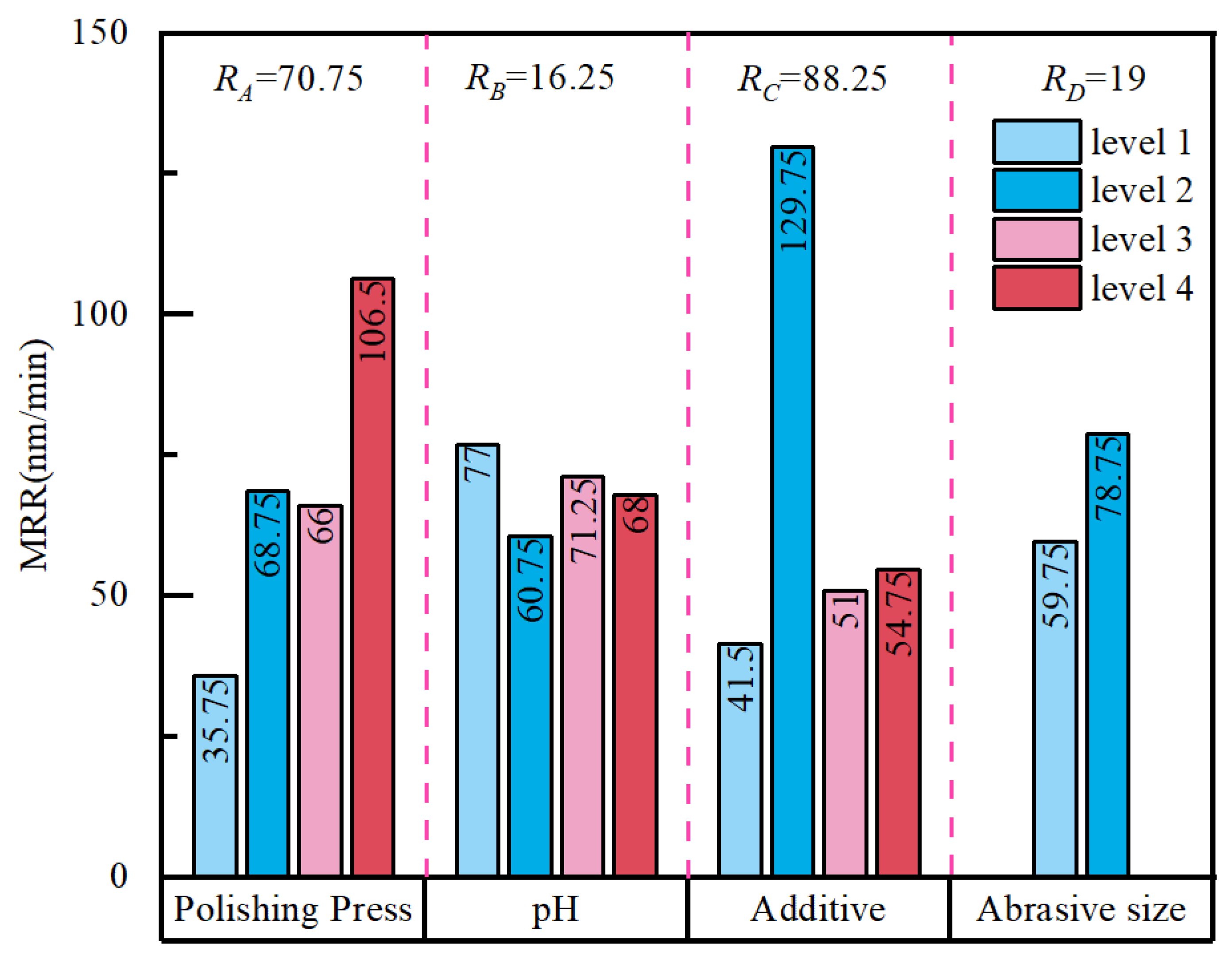
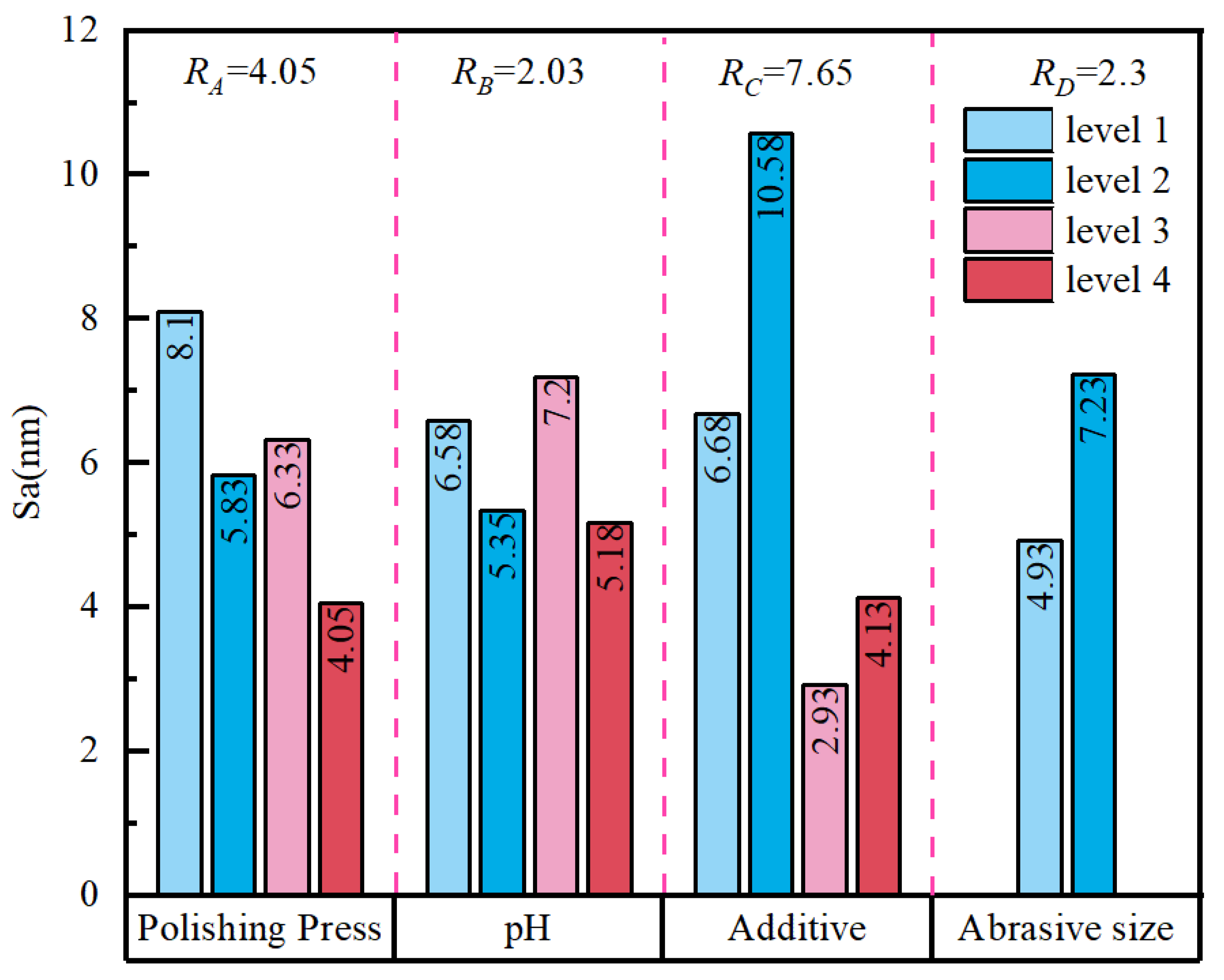
- The overall influence of the four factors shows that the additive system (C) is the dominant factor, followed by polishing pressure (A), with pH (B) and abrasive particle size (D) playing secondary roles. Specifically, for the MRR, the ranking is C > A ≫ D > B, while for Sa, it is C ≫ D > A > B. Thus, additives consistently exert the strongest effect; pressure is generally the second most influential factor; and pH shows the weakest main effect. In addition, Sa is more sensitive to abrasive particle size than to polishing pressure.
- (2)
- Using H2O2 alone markedly increases the MRR but tends to increase Sa and induce pit defects. Introducing glycine suppresses excessive reactions, significantly reduces Sa, and decreases the likelihood of pits. Increasing polishing pressure generally enhances the MRR; however, excessively high pressure and larger abrasive grains raise local contact stress and indentation effects, thereby increasing the risk of indentation-type “pits”. Therefore, the H2O2–glycine system combined with moderate-to-high pressure can maintain a high MRR while achieving low defects and low Sa.
- (3)
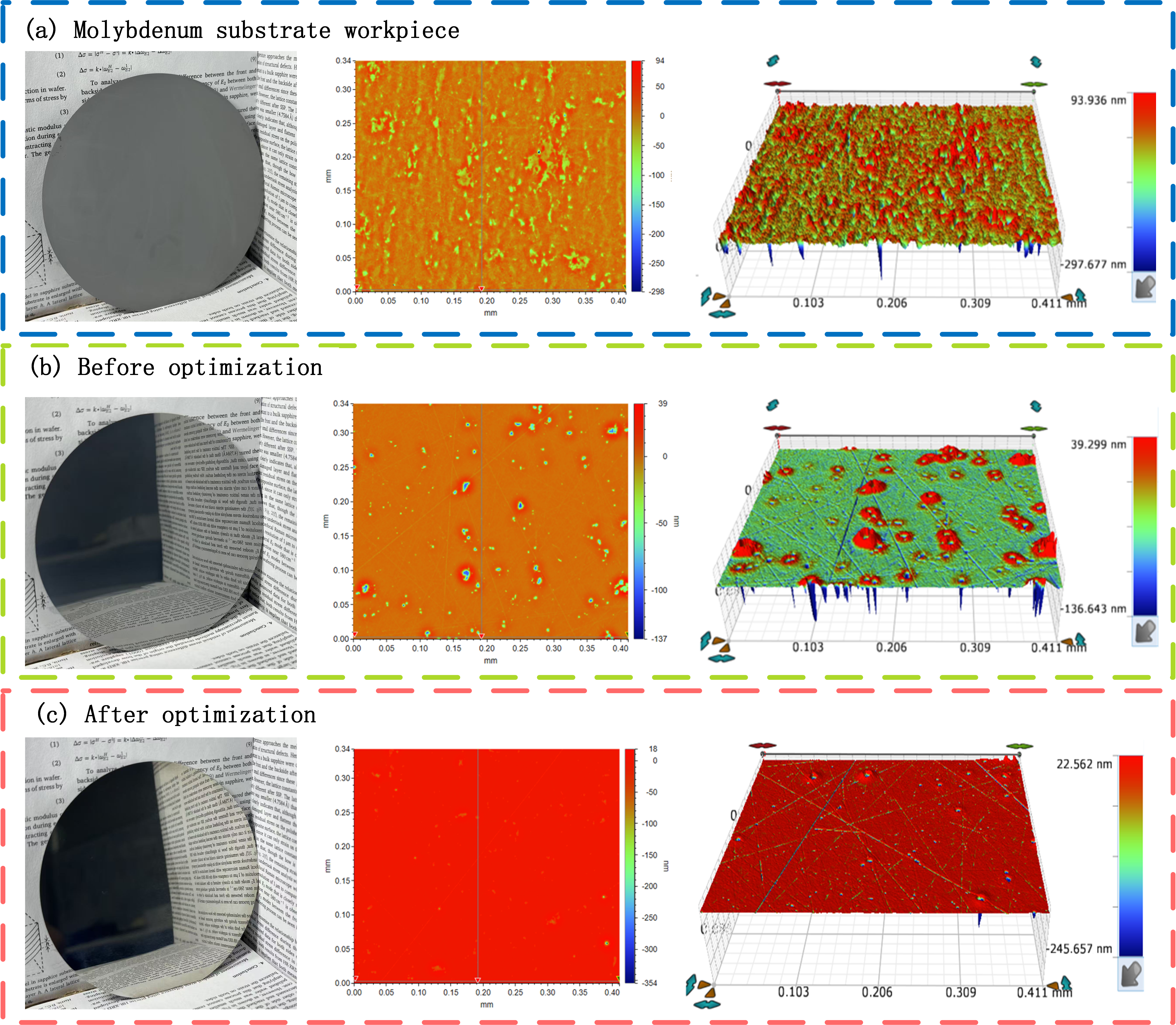
- The surface quality after double-sided CMP is governed by the coupled effects of process parameters. Based on multi-objective comprehensive optimization using the weight-matrix approach, the optimal parameter combination for the present system was determined as follows: a polishing pressure of 115 kPa, pH 11, H2O2 (0.5%) and glycine (5 mg/L) as additives, and an abrasive particle size of 0.6 μm. Under these conditions, a mirror-finish surface was obtained with an MRR of 80 nm·min−1 and Sa of 1.1 nm, meeting the processing requirements for high-quality, low-defect molybdenum substrate surfaces for LED applications.
Author Contributions
Funding
Institutional Review Board Statement
Informed Consent Statement
Data Availability Statement
Conflicts of Interest
References
- Chen, Y.R.; Chang, S.J.; Hsueh, T.J. A Co-planarized common cathode micro-LED display that is produced using planarization and a copper process. IEEE Electron. Device Lett. 2024, 45, 1875–1878. [Google Scholar] [CrossRef] [Scilit]
- Liu, P.; She, C.; Tan, L.; Xu, P.; Yan, L. Development of LED package heat dissipation research. Micromachines 2022, 13, 229. [Google Scholar] [CrossRef] [Scilit]
- Zhou, Y.; Yang, T.; Li, J.; Lu, Y.; Li, Y.; Li, Q.; Yan, C.; Wang, S.; Sun, J.; Yan, Q. Size and temperature effects on optoelectronic properties of Micro-LED arrays for display applications. Displays 2024, 85, 102841. [Google Scholar] [CrossRef] [Scilit]
- Salim, M.R.; Abas, A.; Lim, K.H.; Abdullah, M.N. Performance of power dissipation on semiconductor module for different configuration of heat SINK with thermal pad. Int. J. Therm. Sci. 2024, 201, 109045. [Google Scholar] [CrossRef] [Scilit]
- Li, G.; Xiao, C.; Zhang, S.; Sun, R.; Wu, Y. An experimental investigation of silicon wafer thinning by sequentially using constant-pressure diamond grinding and fixed-abrasive chemical mechanical polishing. J. Mater. Process. Technol. 2022, 301, 117453. [Google Scholar] [CrossRef] [Scilit]
- Buffolo, M.; Caria, A.; Piva, F.; Roccato, N.; Casu, C.; De Santi, C.; Trivellin, N.; Meneghesso, G.; Zanoni, E.; Meneghini, M. Defects and reliability of GaN-based LEDs: Review and perspectives. Phys. Status Solidi 2022, 219, 2100727. [Google Scholar] [CrossRef] [Scilit]
- Yao, X.; Zhang, B.; Hu, H.; Wang, Y.; Kong, Z.; Wu, Y.; Shao, Y.; Hao, X. State-of-the-art and prospective progress of growing AlN substrates by physical vapor transport. J. Cryst. Growth 2023, 617, 127276. [Google Scholar] [CrossRef] [Scilit]
- Kim, Y.C.; Yu, D.Y.; Kim, S.I.; Kim, Y.-M.; Byun, D.; Bang, J.; Kim, D. Heat-resistant durability of AMB substrates for SiC power devices: AlN and Si3N4, which one is thermally strong? Microelectron. Reliab. 2025, 167, 115676. [Google Scholar] [CrossRef] [Scilit]
- Amyx, I.; Anderson, C.; Cassada, N.; Lewinsohn, C.; Funaro, D.; Frye, C. Thermal management of discretized heaters using CuW microchannel heat sinks and FC3283. IEEE Trans. Compon. Packag. Manuf. Technol. 2025, 15, 470–478. [Google Scholar] [CrossRef] [Scilit]
- Xiong, M.; Su, H.; Zhao, B.; Chen, T.; Wang, G.; Sun, L.; Fu, Y.; Ding, W.; Zhu, Z.; Pu, F. Thermal behavior, interfacial reaction, and mechanical properties of SnPbAg–SnAgCu hybrid solder joints on Au/Ni/MoCu substrates in microwave modules. Vacuum 2025, 241, 114646. [Google Scholar] [CrossRef] [Scilit]
- Rohilla, P.; Rao, A.S. Synthesis optimisation and efficiency enhancement in Eu3+ doped barium molybdenum titanate phosphors for w-LED applications. Mater. Res. Bull. 2022, 150, 111753. [Google Scholar] [CrossRef] [Scilit]
- Hwangbo, S.; Hu, L.; Hoang, A.T.; Choi, J.Y.; Ahn, J.-H. Wafer-scale monolithic integration of full-colour micro-LED display using MoS2 transistor. Nat. Nanotechnol. 2022, 17, 500–506. [Google Scholar] [CrossRef] [Scilit]
- Zhang, X.; Chen, A.; Chen, L.; Zhou, Z. 2D materials bridging experiments and computations for electro/photocatalysis. Adv. Energy Mater. 2022, 12, 2003841. [Google Scholar] [CrossRef] [Scilit]
- Chen, J.; Lin, Y.; Wang, H.; Li, J.; Liu, S.; Lee, J.-M.; Zhao, Q. 2D molybdenum compounds for electrocatalytic energy conversion. Adv. Funct. Mater. 2023, 33, 2210236. [Google Scholar] [CrossRef] [Scilit]
- Zhang, C.; Zhao, Z.; Lin, X.; Wang, S.; Wang, J.; Li, Y.; Li, Y.; Zhang, Y.; Zhao, H. Molybdenum-14Rhenium alloy—The most promising candidate for high-temperature semiconductor substrate materials. J. Alloys Compd. 2024, 991, 174391. [Google Scholar] [CrossRef] [Scilit]
- Zhou, J.; Niu, X.; Liu, Z.; Ma, Q.; Li, J.; Hu, B.; Wu, Z. Revolutionizing chemical mechanical polishing with machine learning: A comprehensive review of challenges and opportunities. Arch. Comput. Methods Eng. 2025, 1–35. [Google Scholar] [CrossRef] [Scilit]
- Qu, S.; Sun, X.; Dong, Z.; Mu, S.; Zhao, H.; Yu, T.; Ma, Z.; Wang, Z.; Zhao, J. The effect of novel silica-based polishing solution on the UV-CMP performances of K9 optical glass. Ceram. Int. 2025, 52, 2043–2059. [Google Scholar] [CrossRef] [Scilit]
- Yan, H.; Niu, X.; Qu, M.; Luo, F.; Zhan, N.; Liu, J.; Zou, Y. A review: Research progress of chemical–mechanical polishing slurry for copper interconnection of integrated circuits. Int. J. Adv. Manuf. Technol. 2023, 125, 47–71. [Google Scholar] [CrossRef] [Scilit]
- Ryu, H.Y.; Teugels, L.; Devriendt, K.; Struyf, H.; Kim, T.-G.; Park, J.-G. Effects of H2O2 and pH on the chemical mechanical planarization of molybdenum. ECS J. Solid State Sci. Technol. 2021, 10, 94001. [Google Scholar] [CrossRef] [Scilit]
- He, P.; Shao, S.; Qu, X.P. Chemical mechanical polishing of molybdenum in potassium iodate-based acidic slurries. ECS J. Solid State Sci. Technol. 2018, 7, P299–P304. [Google Scholar] [CrossRef] [Scilit]
- Choi, S.H.; Lee, D.U.; Kreider, M.E.; Nielander, A.C.; Stevens, M.B.; Park, D.; Hong, I.; Park, K.-H.; Bae, K.; Kim, H.; et al. Stabilization of molybdenum in CMP: Operando insights into distinct inhibitor adsorption pathways. J. Electroanal. Chem. 2025, 996, 119377. [Google Scholar] [CrossRef] [Scilit]
- Wu, P.; Zhang, B.; Wang, Y.; Xie, M.; Liu, S.; Liu, M.; Xian, W.; Cui, D.; Zhang, K. Effect of synergetic inhibition of nonionic surfactant and benzotriazone for molybdenum in chemical mechanical polishing. Colloids Surf. A Physicochem. Eng. Asp. 2023, 664, 131164. [Google Scholar] [CrossRef] [Scilit]
- Kalantzis, P.; Teugels, L.; Gendt, S.D. Effect of Al2O3 and SiO2 abrasives on the CMP of molybdenum using different polishing parameters ICPT 2017. In Proceedings of the International Conference on Planarization/CMP Technology 2017, Leuven, Belgium, 11–13 October 2017; pp. 1–6. [Google Scholar]
- Yan, Q.S.; Chen, Y.L.; Xia, J.N.; Luo, Z.Y.; Wang, T. Study on planar grinding and surface creation mechanism of molybdenum circular substrate. Surf. Technol. 2024, 53, 181–192. [Google Scholar] [CrossRef]
- Li, Z.; Deng, Z.; Hu, Y. Effects of polishing parameters on surface quality in sapphire double-sided CMP. Ceram. Int. 2020, 46, 13356–13364. [Google Scholar] [CrossRef] [Scilit]
- Yang, G.; He, P.; Qu, X. Inhibition effect of glycine on molybdenum corrosion during CMP in alkaline H2O2 based abrasive free slurry. Appl. Surf. Sci. 2018, 427, 148–155. [Google Scholar] [CrossRef] [Scilit]
- Ryu, S.; Moinpour, M.; Rawat, A.; Kim, P.J.; Podlaha, E.J.; Seo, J. Molecular interactions of amino acids for corrosion control in molybdenum CMP through bridging experimental insights and DFT simulations. Appl. Surf. Sci. 2025, 698, 163046. [Google Scholar] [CrossRef] [Scilit]
- Zhou, Y. A matrix analysis of orthogonal design. Math. Pract. Theor. 2009, 39, 202–207. [Google Scholar]


| Lattice Constant/nm | Density ρ/(kg/m3) | Vickers Hardness (HV) | Thermal Conductivity/W·m−1 K−1 | Poisson’s Ratio | Elastic Modulus/Gpa |
|---|---|---|---|---|---|
| 0.315 | 10.2 × 10³ | 240–280 | 138 | 0.324 | 330 |
| Factors | Parameters | Levels | |||
|---|---|---|---|---|---|
| 1 | 2 | 3 | 4 | ||
| A | Pressure [kPa] | 64 | 77 | 90 | 115 |
| B | pH | 4 | 7 | 9 | 11 |
| C | Additive | none | H2O2 | H2O2 (0.5%) + Glycine (5 mg/L) | H2O2 (1%) + Glycine (5 mg/L) |
| D | Abrasive particle size [μm] | 0.6 | 1.7 | ||
| Factors | Parameters | Responses | |||||
|---|---|---|---|---|---|---|---|
| Polishing Pressure [kPa] | pH | Additive | Abrasive Particle Size [μm] | MRR [nm/min] | Sa [nm] | SD | |
| 1 | 1 | 1 | 1 | 1 | 11 | 9.3 | Pits |
| 2 | 1 | 2 | 2 | 1 | 94 | 8.7 | Pits |
| 3 | 1 | 3 | 3 | 2 | 18 | 6.6 | OK |
| 4 | 1 | 4 | 4 | 2 | 20 | 7.8 | OK |
| 5 | 2 | 1 | 2 | 2 | 125 | 13.2 | Pits |
| 6 | 2 | 2 | 1 | 2 | 43 | 6.4 | Pits |
| 7 | 2 | 3 | 4 | 1 | 50 | 2.1 | OK |
| 8 | 2 | 4 | 3 | 1 | 57 | 1.6 | OK |
| 9 | 3 | 1 | 3 | 1 | 41 | 1.5 | OK |
| 10 | 3 | 2 | 4 | 1 | 18 | 4.3 | Pits |
| 11 | 3 | 3 | 1 | 2 | 61 | 9.6 | Pits |
| 12 | 3 | 4 | 2 | 2 | 144 | 9.9 | Pits |
| 13 | 4 | 1 | 4 | 2 | 131 | 2.3 | Pits |
| 14 | 4 | 2 | 3 | 2 | 88 | 2 | Pits |
| 15 | 4 | 3 | 2 | 1 | 156 | 10.5 | Pits |
| 16 | 4 | 4 | 1 | 1 | 51 | 1.4 | Pits |
| Factor | Freedom | Deviation | Mean Square Deviation | Test Result (F-Value) | Contribution (%) |
|---|---|---|---|---|---|
| A | 3 | 10,082.5 | 3360.83 | 6.70 | 28.92% |
| B | 3 | 551.5 | 183.83 | 0.36 | 1.58% |
| C | 3 | 19,894.5 | 6631.5 | 13.22 | 57.07% |
| D | 1 | 1444 | 1444 | 2.88 | 12.43% |
| E (error) | 5 | 2506.5 | 501.3 |
| Factor | Freedom | Deviation | Mean Square Deviation | Test Result (F-Value) | Contribution (%) |
|---|---|---|---|---|---|
| A | 3 | 35.21 | 11.76 | 2.02 | 16.14% |
| B | 3 | 9.71 | 3.24 | 0.56 | 4.45% |
| C | 3 | 109.83 | 36.61 | 6.31 | 50.35% |
| D | 1 | 21.13 | 21.13 | 3.64 | 29.05% |
| E (error) | 5 | 28.99 | 5.8 |
Disclaimer/Publisher’s Note: The statements, opinions and data contained in all publications are solely those of the individual author(s) and contributor(s) and not of MDPI and/or the editor(s). MDPI and/or the editor(s) disclaim responsibility for any injury to people or property resulting from any ideas, methods, instructions or products referred to in the content. |
© 2026 by the authors. Licensee MDPI, Basel, Switzerland. This article is an open access article distributed under the terms and conditions of the Creative Commons Attribution (CC BY) license.
Share and Cite
Zhou, Z.; Wang, J.; Hu, Z.; Hsieh, P.; Xu, X. Experimental Study on Double-Sided Chemical Mechanical Polishing of Molybdenum Substrates for LED Devices. Micromachines 2026, 17, 150. https://doi.org/10.3390/mi17020150
Zhou Z, Wang J, Hu Z, Hsieh P, Xu X. Experimental Study on Double-Sided Chemical Mechanical Polishing of Molybdenum Substrates for LED Devices. Micromachines. 2026; 17(2):150. https://doi.org/10.3390/mi17020150
Chicago/Turabian StyleZhou, Zhihao, Jiabin Wang, Zhongwei Hu, Pinhui Hsieh, and Xipeng Xu. 2026. "Experimental Study on Double-Sided Chemical Mechanical Polishing of Molybdenum Substrates for LED Devices" Micromachines 17, no. 2: 150. https://doi.org/10.3390/mi17020150
APA StyleZhou, Z., Wang, J., Hu, Z., Hsieh, P., & Xu, X. (2026). Experimental Study on Double-Sided Chemical Mechanical Polishing of Molybdenum Substrates for LED Devices. Micromachines, 17(2), 150. https://doi.org/10.3390/mi17020150