Article

Surface Topography in Cutting-Speed-Direction Ultrasonic-Assisted Turning
by
Thanh-Trung Nguyen
,
Toan-Thang Vu
and
Thanh-Dong Nguyen
*
Precision Engineering and Smart Measurements Lab, School of Mechanical Engineering, Hanoi University of Science and Technology, Hanoi 100000, Vietnam
*
Author to whom correspondence should be addressed.
Micromachines 2024, 15(6), 668; https://doi.org/10.3390/mi15060668
Submission received: 29 April 2024 / Revised: 13 May 2024 / Accepted: 18 May 2024 / Published: 21 May 2024
(This article belongs to the Special Issue Advanced Manufacturing Technology and Systems, 3rd Edition)

Abstract

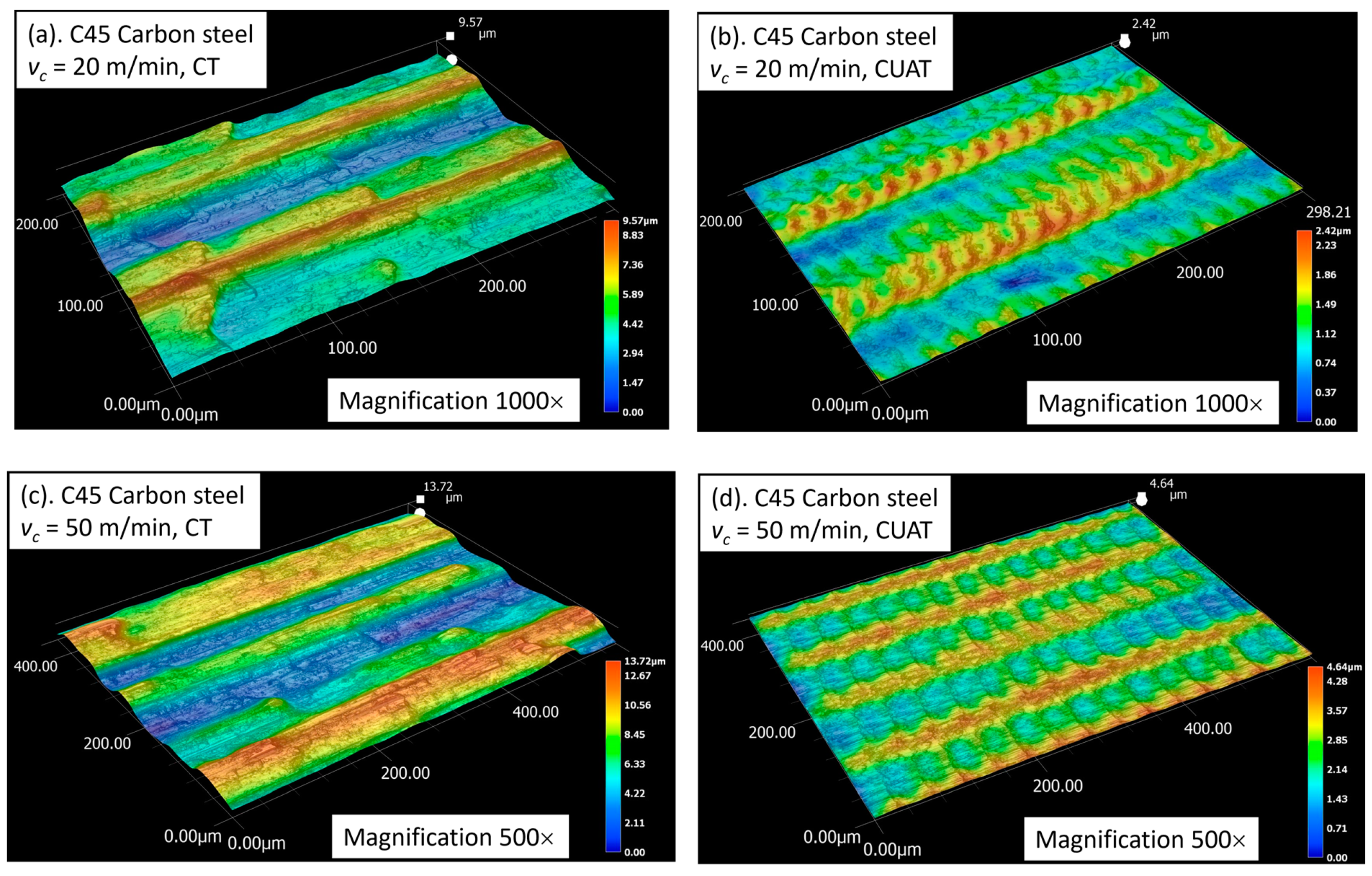
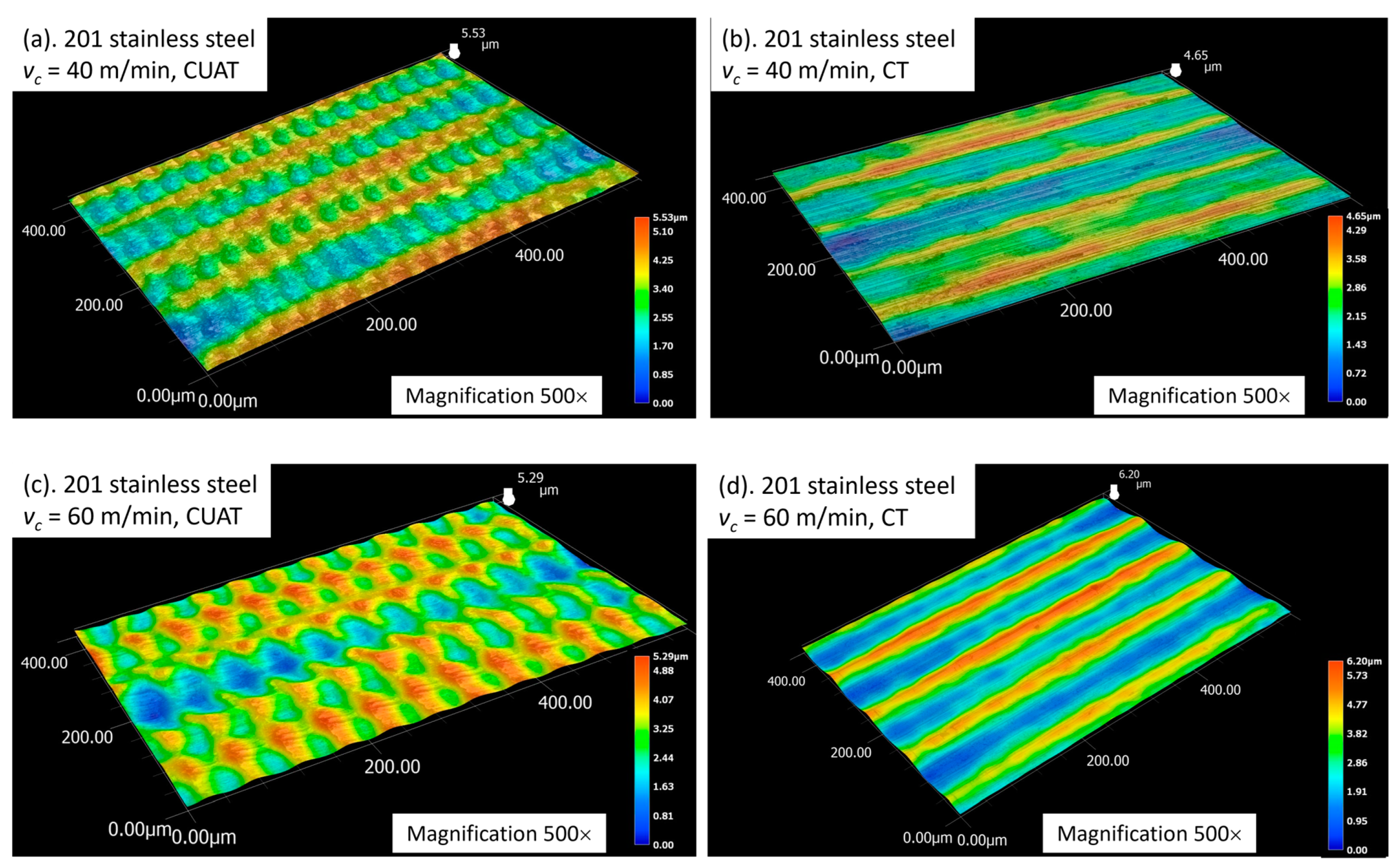
Ultrasonic vibration has been employed to assist in turning, introducing intermittent machining to reduce average cutting force, minimize tool wear, and enhance machining efficiency, thereby improving surface roughness. However, achieving intermittent cutting necessitates specific conditions, with a cutting speed or feed rate falling below the critical speed associated with the ultrasonic vibration parameters. This study presents a theoretical model for surface formation in cutting-speed-direction ultrasonic-assisted turning (CUAT), covering both continuous and intermittent machining regimes. Experimental validation was conducted on C45 carbon steel and 201 stainless steel to demonstrate the applicability of the theoretical model across different materials. Digital microscope analysis revealed 3D topography consistency with the theoretical formula. Surface roughness evaluations were performed for both CUAT and CT (conventional turning) methods. The results indicated a significant reduction in roughness Ra for C45 steel samples machined with CUAT, up to 80% compared to CT at a cutting speed of 20 m/min, while only exhibiting slight fluctuations when turning 201 stainless steel. Detailed analysis and explanation of these phenomena are presented herein.
Keywords: ultrasonic-assisted turning; cutting speed direction; intermittent cutting; continuous cutting; 3D surface topography; surface roughness ultrasonic-assisted turning; cutting speed direction; intermittent cutting; continuous cutting; 3D surface topography; surface roughness