Article

Characterization of Multilayer Coupling Based on Square Complementary Split Ring Resonator for Multiport Device Implementation

by
Eduardo Jarauta
1,
Juan Carlos Iriarte
1,2 and
Francisco Falcone
1,2,3,*
1
Electrical Engineering and Communications Department, Universidad Pública de Navarra, Campus Arrosadía, E-31006 Pamplona, Spain
2
Institute of Smart Cities, Universidad Pública de Navarra, Campus Arrosadía, E-31006 Pamplona, Spain
3
Tecnologico de Monterrey, School of Engineering and Sciences, Monterrey 64849, Mexico
*
Author to whom correspondence should be addressed.
Micromachines 2023, 14(1), 68; https://doi.org/10.3390/mi14010068
Submission received: 28 November 2022 / Revised: 17 December 2022 / Accepted: 22 December 2022 / Published: 27 December 2022
(This article belongs to the Special Issue Micro and Smart Devices and Systems, 2nd Edition)

Abstract

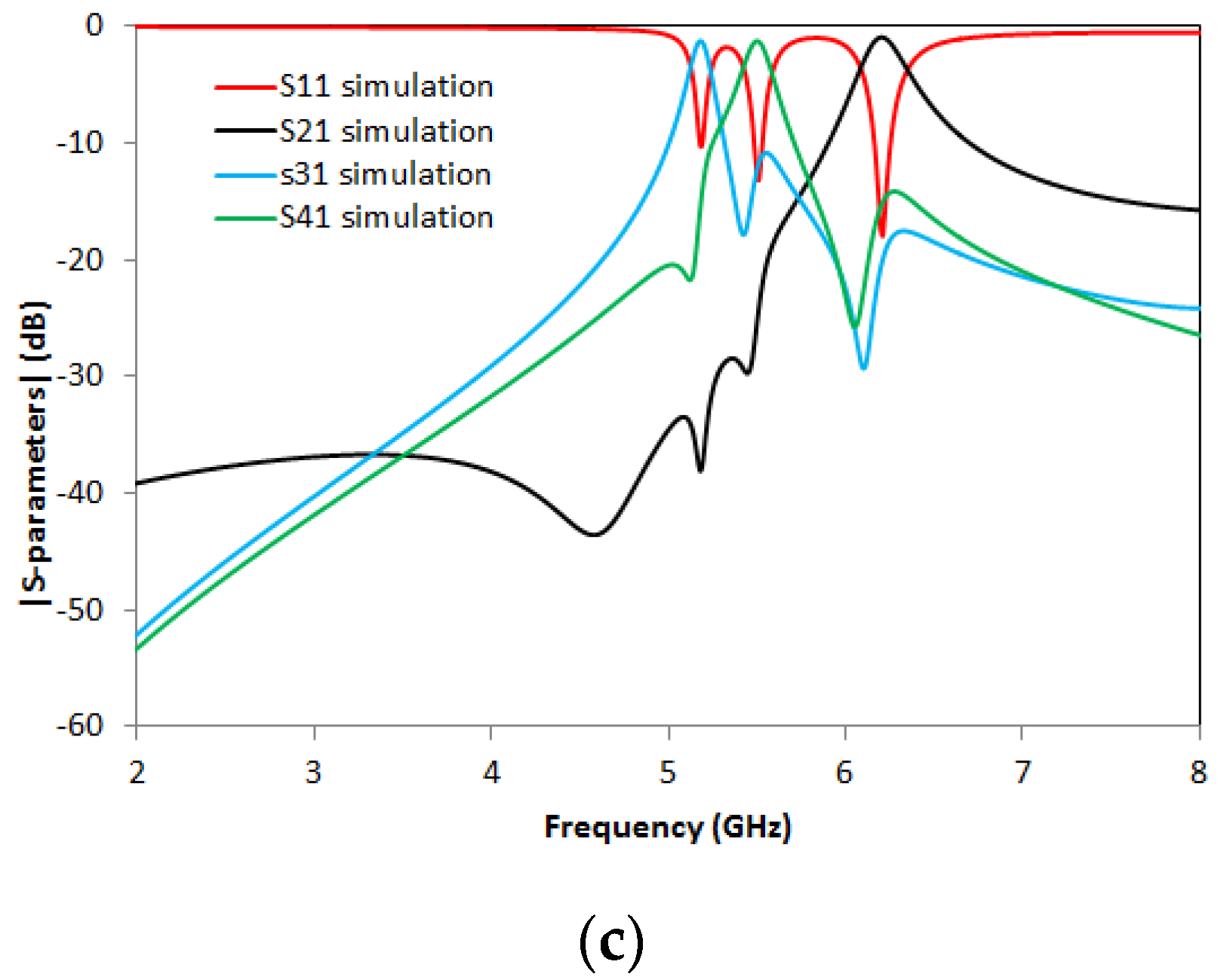
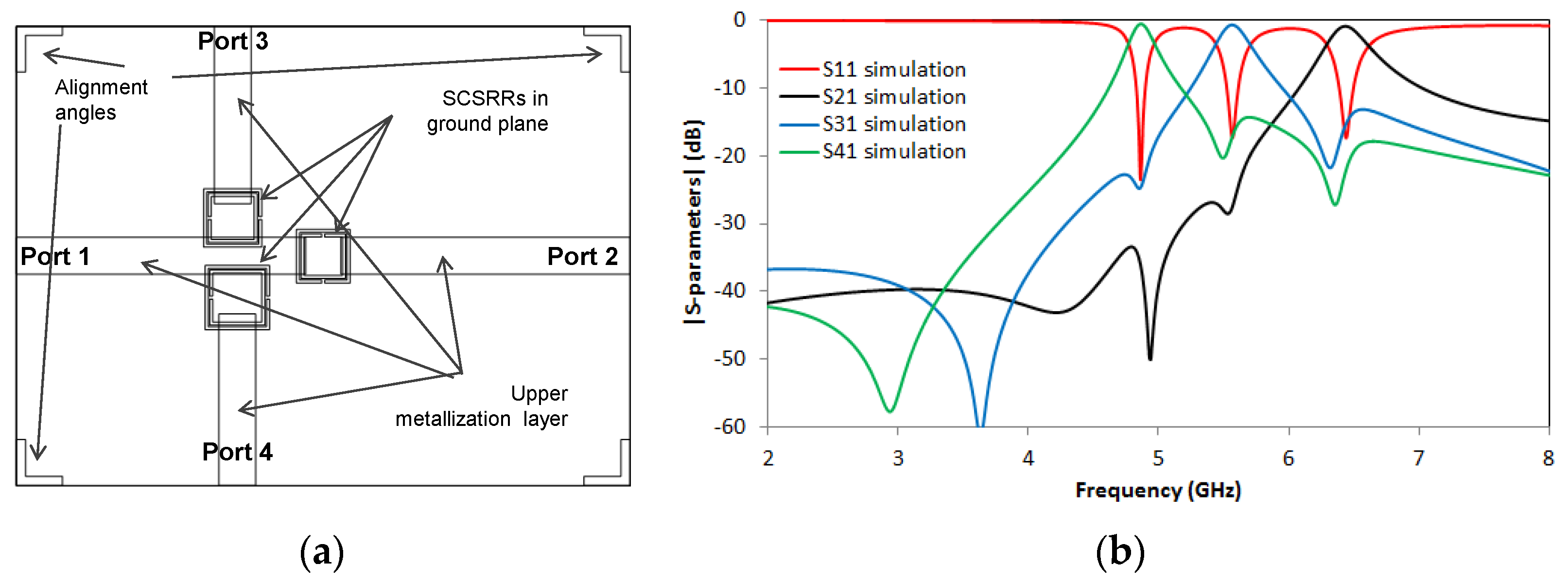
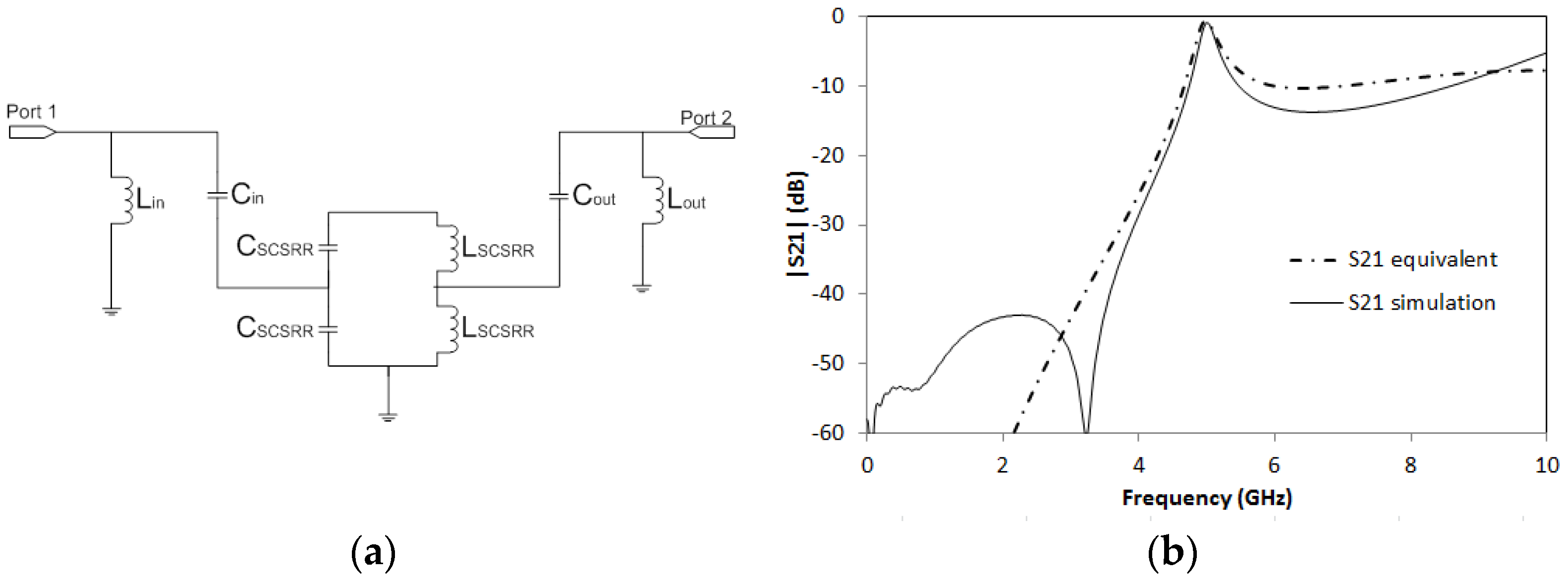
The advent of context-aware environments and related applications demands a high degree of connectivity, with new spectral bands and related radio resource management functionalities in the current 5G bands and foreseen in future 6G wireless communication systems. This, in turn, poses new challenges in the implementation of wireless transceivers and radiating systems, in terms of device integration, miniaturization and element isolation, among others. High-performance miniature devices are presented and studied in this work, aided by metamaterial-inspired complementary resonators. A single particle is used to build a single layer, double layer, double frequency resonators and power dividers. A complete characterization of each equivalent circuit is also analyzed, showing great agreement between analytical circuit models and full-wave electromagnetic simulations. By adding more particles, different diplexers and triplexers in the multi-layer configuration are proposed. The flexibility in the design is the key advantage, as all devices are easily tunable and the output lines can be built in different layers, enabling frequency scalability from RF to millimeter wave ranges. Nevertheless, they are only a sample of all possible combinations of devices that can be designed for integration in future wireless communication systems.
Keywords: microstrip multilayer; multilayer diplexer; multilayer resonator; complementary split ring resonator microstrip multilayer; multilayer diplexer; multilayer resonator; complementary split ring resonator