This is an early access version, the complete PDF, HTML, and XML versions will be available soon.
Article

Discovery of Protein-Derived Candidate Anticancer Peptides from Toad Poison (ChanSu) Using an Integrated Proteomics and Bioinformatics-Guided Strategy

1
Institute of Pharmacy, Shandong University of Tradional Chinese Medicine, Jinan 250355, China
2
State Key Laboratory of Drug Regulatory Science, National Institutes for Food and Drug Control, Beijing 100061, China
3
NMPA Key Shandong Engineering Laboratory for Standard Innovation and Quality Evaluation of TCM, Shandong Engineering Research Center for Generic Technologies of Traditional Chinese Medicine Formula Granules, Laboratory for Quality Evaluation of Gelatin Products, Shandong Institute for Food and Drug Control, Jinan 250101, China
*
Authors to whom correspondence should be addressed.
Toxins 2026, 18(8), 326; https://doi.org/10.3390/toxins18080326

Submission received: 11 June 2026 / Revised: 12 July 2026 / Accepted: 18 July 2026 / Published: 27 July 2026
(This article belongs to the Section Animal Venoms)

Abstract

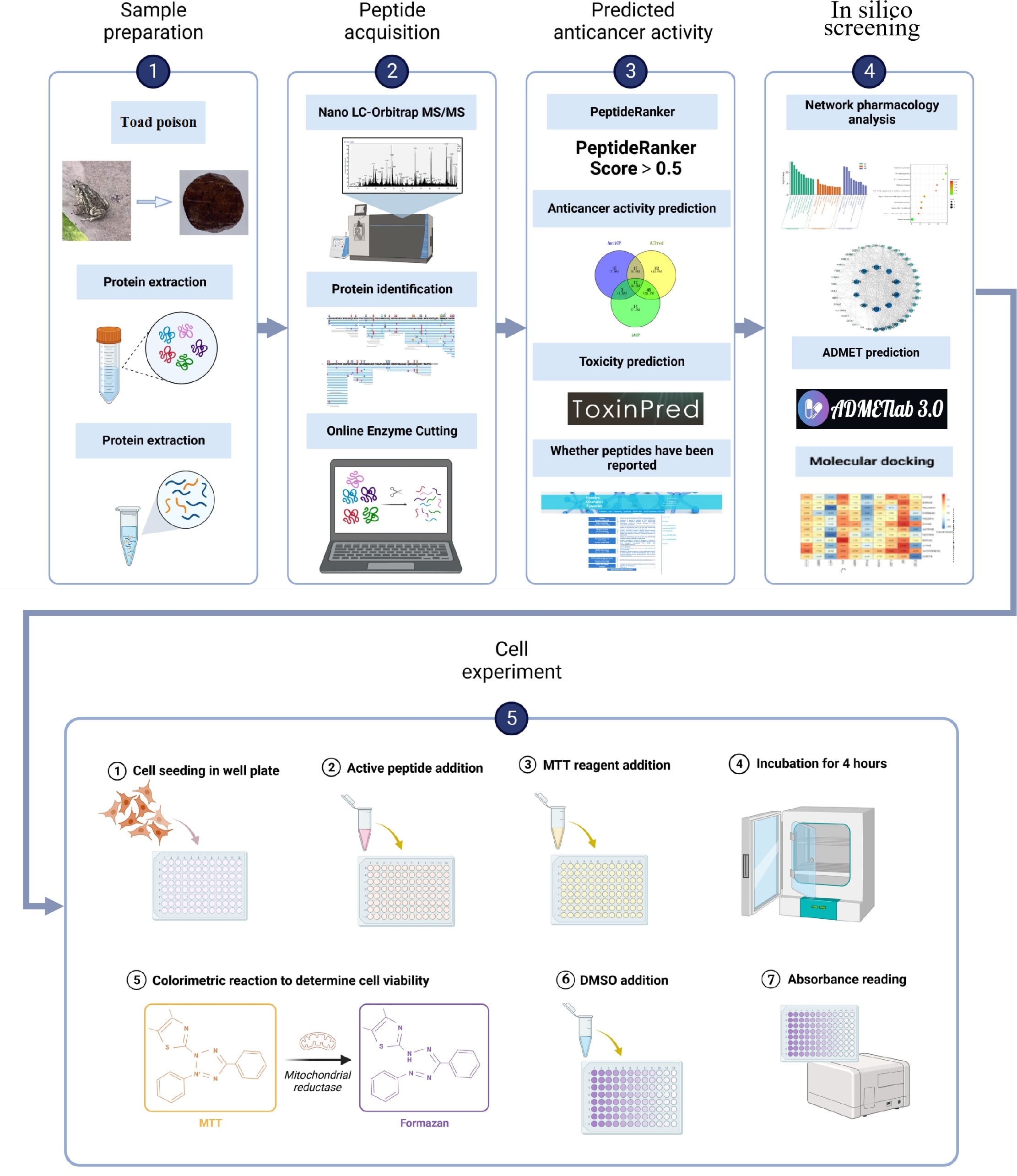
Toad poison (ChanSu), a traditional animal-derived medicine, has long been used in East Asian medical systems for the treatment of inflammatory conditions and tumor-related disorders. While bufadienolides have been extensively investigated as its major bioactive constituents, the contribution of peptide components to its antitumor effects remains largely unexplored. Here, we identified protein-derived candidate antiproliferative peptides from toad poison using an integrated proteomics and bioinformatics-guided strategy. Proteomic analysis identified 135 proteins, from which 2117 peptide sequences were generated via in silico digestion with trypsin and pepsin. Subsequent multi-step screening using PeptideRanker, AntiCP, iACP, and ACPred yielded twelve candidate peptides with predicted anticancer activity. Network pharmacology analysis suggested their potential involvement in cancer-related targets and pathways. ADMET (Absorption, Distribution, Metabolism, Excretion, and Toxicity) evaluation was subsequently used as a complementary assessment of drug-like and safety-related properties, further prioritizing four peptides for experimental validation, while molecular docking supported their interactions with key lung cancer-associated targets. In vitro assays demonstrated that three of the four prioritized peptides (WEAWN, NSQWG, and ACGVIGICQ) exhibited initial antiproliferative activity against human lung cancer A549 cells, though these findings should be interpreted with caution given the absence of a positive control in the MTT assay. This study provides preliminary evidence suggesting that protein-derived peptide candidates from toad poison may possess antiproliferative potential, representing an early systematic exploration of its previously unexplored peptidome as a source of candidate antiproliferative peptides warranting further pharmacological investigation. The integrated strategy presented here offers an efficient approach for the discovery of bioactive peptides from animal-derived traditional medicines.
Keywords: proteomics; anticancer peptides; toad poison; peptide; peptidomics proteomics; anticancer peptides; toad poison; peptide; peptidomics
Graphical Abstract