Beyond Wrinkle Efficacy: Toward a Broader Assessment of Longitudinal Compatibility in Routine Upper-Face Aesthetic BoNT-A


Abstract
1. Introduction
2. A Provisional Clinical Lens for Longitudinal Compatibility
3. Domains and Candidate Warning Signs Relevant to Longitudinal Compatibility
3.1. Morphologic Tolerance
3.2. Dynamic–Expressive Tolerance
3.3. Longitudinal Tolerance
4. A Pragmatic Tiered Approach to Assessment
4.1. Level 1: Routine Clinical Assessment
4.2. Level 2: Structured Clinical Assessment
4.3. Level 3: Research-Grade Assessment
5. Clinical Questions and Considered Responses
6. Clinical Implications, Current Limits, and Research Priorities
6.1. Clinical Implications
6.2. Current Limits of the Evidence Base
6.3. Research Priorities
7. Conclusions
Supplementary Materials
Funding
Institutional Review Board Statement
Informed Consent Statement
Data Availability Statement
Conflicts of Interest
References
- de Almeida, A.R.T.; Marques, E.R.M.d.C.; Contin, L.A.; de Almeida, C.T.; Miot, H.A. Long-term consecutive onabotulinumtoxinA injections for facial aesthetic treatment: A real-world study. Dermatol. Surg. 2025, 51, 1133–1138. [Google Scholar] [CrossRef] [PubMed]
- Rzany, B.; Dill-Müller, D.; Grablowitz, D.; Heckmann, M.; Caird, D. German-Austrian Retrospective Study Group. Repeated botulinum toxin A injections for the treatment of lines in the upper face: A retrospective study of 4103 treatments in 945 patients. Dermatol. Surg. 2007, 33, S18–S25. [Google Scholar] [CrossRef]
- Kerscher, M.; Rzany, B.; Prager, W.; Turnbull, C.; Trevidic, P.; Inglefield, C. Efficacy and Safety of IncobotulinumtoxinA in the Treatment of Upper Facial Lines: Results From a Randomized, Double-Blind, Placebo-Controlled, Phase III Study. Dermatol. Surg. 2015, 41, 1149–1157. [Google Scholar] [CrossRef] [PubMed]
- Fischer, T.; Sattler, G.; Prager, W.; Rzany, B.; Pavicic, T.; Gauglitz, G.; Weissenberger, P.; Riaz, S. Safety, Tolerability, and Efficacy of Repeat-Dose Injections of IncobotulinumtoxinA in the Treatment of Upper Facial Lines: Results from a Prospective, Open-Label, Phase III Study. J. Drugs Dermatol. 2020, 19, 461–469. [Google Scholar] [CrossRef]
- Nassif, A.D.; Boggio, R.F.; Espicalsky, S.; Faria, G.E.L. High precision use of botulinum toxin type A (BoNT-A) in aesthetics based on muscle atrophy, is muscular architecture reprogramming a possibility? A systematic review of literature on muscle atrophy after BoNT-A injections. Toxins 2022, 14, 81. [Google Scholar] [CrossRef] [PubMed]
- Punga, A.R.; Alimohammadi, M.; Liik, M. Keeping up appearances: Don’t frown upon the effects of botulinum toxin injections in facial muscles. Clin. Neurophysiol. Pract. 2023, 8, 169–173. [Google Scholar] [CrossRef]
- Salari, M.; Sharma, S.; Jog, M.S. Botulinum toxin induced atrophy: An uncharted territory. Toxins 2018, 10, 313. [Google Scholar] [CrossRef]
- Koerte, I.K.; Schroeder, A.S.; Fietzek, U.M.; Borggraefe, I.; Kerscher, M.; Berweck, S.; Reiser, M.; Ertl-Wagner, B.; Heinen, F. Muscle atrophy beyond the clinical effect after a single dose of onabotulinumtoxinA injected in the procerus muscle: A study with magnetic resonance imaging. Dermatol. Surg. 2013, 39, 761–765. [Google Scholar] [CrossRef] [PubMed]
- Schroeder, A.S.; Ertl-Wagner, B.; Britsch, S.; Schroder, J.M.; Nikolin, S.; Weis, J.; Muller-Felber, W.; Koerte, I.; Stehr, M.; Berweck, S.; et al. Muscle Biopsy Substantiates Long-Term MRI Alterations One Year After a Single Dose of Botulinum Toxin Injected into the Lateral Gastrocnemius Muscle of Healthy Volunteers. Mov. Disord. 2009, 24, 1494–1503. [Google Scholar] [CrossRef] [PubMed]
- Hopf, A.G.M.; Buchheim, A.; Hopf, M.; Cajkovský, M.; Eilert, D.W. A psychological guide to upper face botulinum toxin injections: Baseline emotional functions of facial expressions. J. Cosmet. Dermatol. 2025, 24, e70508. [Google Scholar] [CrossRef] [PubMed]
- Vanaria, R.J.; Chaudry, A.; Marrero-Perez, A.C.; Lorenc, Z.P.; Nestor, M.S. The face of emotion: Botulinum toxin, emotional anatomy, and mood modulation. J. Cosmet. Dermatol. 2025, 24, e70264. [Google Scholar] [CrossRef]
- Guntinas-Lichius, O.; Trentzsch, V.; Mueller, N.; Heinrich, M.; Kuttenreich, A.M.; Dobel, C.; Volk, G.F.; Graßme, R.; Anders, C. High-resolution surface electromyographic activities of facial muscles during the six basic emotional expressions in healthy adults: A prospective observational study. Sci. Rep. 2023, 13, 19214. [Google Scholar] [CrossRef] [PubMed]
- Yi, K.-H.; Wan, J.; Song, J.K.; Cartier, H. The facial muscle chain concept in forehead line treatment. Aesthetic Plast. Surg. 2025. online ahead of print. [Google Scholar] [CrossRef] [PubMed]
- Eilert, D.W.; Hopf, A.G.M.; Alfertshofer, M.; Prinz, V.; Friedrich, M.; Cajkovsky, M. Botulinum Toxin and Social Perception: Effects of Upper-Face Treatment on Facial Emotion Attribution. Aesthetic Surg. J. 2026. advance online publication. [Google Scholar] [CrossRef]
- Ugurlu, G.A.; Ugurlu, B.N.; Yalcinkaya, M. Evaluating the Impact of BoNT-A Injections on Facial Expressions: A Deep Learning Analysis. Aesthetic Surg. J. 2024, 45, NP1–NP7. [Google Scholar] [CrossRef]
- Multani, I.; Manji, J.; Hastings-Ison, T.; Khot, A.; Graham, H.K. Botulinum toxin in the management of children with cerebral palsy. Paediatr. Drugs 2019, 21, 261–281. [Google Scholar] [CrossRef] [PubMed]
- Alexander, C.; Elliott, C.; Valentine, J.; Stannage, K.; Bear, N.; Donnelly, C.J.; Shipman, P.; Reid, S. Muscle volume alterations after first botulinum neurotoxin A treatment in children with cerebral palsy: A 6-month prospective cohort study. Dev. Med. Child Neurol. 2018, 60, 1165–1171. [Google Scholar] [CrossRef] [PubMed]
- De Beukelaer, N.; Weide, G.; Huyghe, E.; Vandekerckhove, I.; Hanssen, B.; Peeters, N.; Uytterhoeven, J.; Deschrevel, J.; Maes, K.; Corvelyn, M.; et al. Reduced cross-sectional muscle growth six months after botulinum toxin type-A injection in children with spastic cerebral palsy. Toxins 2022, 14, 139. [Google Scholar] [CrossRef]
- Lambrechts, C.; De Beukelaer, N.; Weide, G.; Huyghe, E.; Vandekerckhove, I.; Hanssen, B.; Peeters, N.; Uytterhoeven, J.; Deschrevel, J.; Van Campenhout, A.; et al. Botulinum neurotoxin A-induced muscle morphology changes in children with cerebral palsy: A one-year follow-up study. Toxins 2025, 17, 327. [Google Scholar] [CrossRef]
- Schlager, S.; Kostunov, J.; Henn, D.; Stark, B.G.; Iblher, N. A 3D Morphometrical Evaluation of Brow Position After Standardized Botulinum Toxin A Treatment of the Forehead and Glabella. Aesthetic Surg. J. 2019, 39, 553–564. [Google Scholar] [CrossRef] [PubMed]
- Ascher, B.; Talarico, S.; Cassuto, D.; Escobar, S.; Hexsel, D.; Jaén, P.; Monheit, G.D.; Rzany, B.; Viel, M. International consensus recommendations on the aesthetic usage of botulinum toxin type A (Speywood Unit)–Part I: Upper facial wrinkles. J. Eur. Acad. Dermatol. Venereol. 2010, 24, 1278–1284. [Google Scholar] [CrossRef] [PubMed]
- Flynn, T.C.; Carruthers, A.; Carruthers, J.; Geister, T.L.; Görtelmeyer, R.; Hardas, B.; Himmrich, S.; Kerscher, M.; de Maio, M.; Mohrmann, C.; et al. Validated assessment scales for the upper face. Dermatol. Surg. 2012, 38, 309–319. [Google Scholar] [CrossRef]
- Klassen, A.F.; Cano, S.J.; Schwitzer, J.A.; Baker, S.B.; Carruthers, A.; Carruthers, J.; Chapas, A.; Pusic, A.L. Development and Psychometric Validation of the FACE-Q Skin, Lips, and Facial Rhytids Appearance Scales and Adverse Effects Checklists for Cosmetic Procedures. JAMA Dermatol. 2016, 152, 443–451. [Google Scholar] [CrossRef]
- Jaguś, D.; Pawłowska, A.; Mlosek, R.K. Ultrasound Evaluation of Upper Facial Muscles to Guide Botulinum Toxin Application. Toxins 2025, 17, 595. [Google Scholar] [CrossRef]
- Armenti, A.F. From Local Interventions to Systemic Modulation in Expressive and Neuromuscular Medicine: A Conceptual Reframing of Clinical Action. J. Eval. Clin. Pract. 2026, 32, e70415. [Google Scholar] [CrossRef] [PubMed]
- Crook, J.L.; Hamidian Jahromi, A.; Konofaos, P. Long-term Effects of Repeated Botulinum Toxin Injection in Cosmetic Therapeutics. Ann. Plast. Surg. 2022, 88, 345–352. [Google Scholar] [CrossRef]
- Rivkin, A.Z.; Ogilvie, P.; Dayan, S.; Yoelin, S.G.; Weichman, B.M.; Garcia, J.K. OnabotulinumtoxinA for Simultaneous Treatment of Upper Facial Lines: Subject-Reported Satisfaction and Impact From a Phase 3 Study. Dermatol. Surg. 2020, 46, 50–60. [Google Scholar] [CrossRef]
- Glogau, R.; Kontis, T.C.; Liu, Y.; Gallagher, C.J. Progressive Improvement in Static Glabellar Lines After Repeated Treatment with DaxibotulinumtoxinA for Injection. Dermatol. Surg. 2021, 47, 1579–1584. [Google Scholar] [CrossRef] [PubMed]
- Schlessinger, J.; Dover, J.S.; Joseph, J.; Monheit, G.; Nelson, D.B.; Albright, C.D.; Axford-Gatley, R.A.; Cohen, J.L. Long-term Safety of AbobotulinumtoxinA for the Treatment of Glabellar Lines: Results From a 36-Month, Multicenter, Open-Label Extension Study. Dermatol. Surg. 2014, 40, 176–183. [Google Scholar] [CrossRef]
- Carruthers, A.; Carruthers, J.; Fagien, S.; Lei, X.; Kolodziejczyk, J.; Brin, M.F. Repeated OnabotulinumtoxinA Treatment of Glabellar Lines at Rest Over Three Treatment Cycles. Dermatol. Surg. 2016, 42, 1094–1101. [Google Scholar] [CrossRef] [PubMed]
- Durand, P.D.; Couto, R.A.; Isakov, R.; Yoo, D.B.; Azizzadeh, B.; Guyuron, B.; Zins, J.E. Botulinum Toxin and Muscle Atrophy: A Wanted or Unwanted Effect. Aesthetic Surg. J. 2016, 36, 482–487. [Google Scholar] [CrossRef] [PubMed]
- Hexsel, D.; Soirefmann, M.; Porto, M.D.; Siega, C.; Schilling-Souza, J.; Rodrigues, T.C. Fields of Muscular and Anhidrotic Effects of 2 Botulinum Toxin-A Commercial Preparations: A Prospective, Double-Blind, Randomized, Multicenter Study. Dermatol. Surg. 2015, 41, S110–S118. [Google Scholar] [CrossRef] [PubMed]
- Gold, M.H.; Donofrio, L.; Shridharani, S.; Moradi, A.; Biesman, B.; Chiang, M.; George, R.; Polder, K.; Solish, N.; Schwarcz, R.; et al. Patient-Reported Outcomes for Glabellar Line Improvement and Satisfaction with the RelabotulinumtoxinA Ready-to-Use Liquid Formulation: Data From the Phase 3 READY-1 Trial. Aesthetic Surg. J. 2025, 45, 828–835. [Google Scholar] [CrossRef]
- Dayan, S.; Yoelin, S.G.; De Boulle, K.; Garcia, J.K. The Psychological Impacts of Upper Facial Lines: A Qualitative, Patient-Centered Study. Aesthetic Surg. J. Open Forum 2019, 1, ojz015. [Google Scholar] [CrossRef]

| Literature Domain | What It Supports | What It Does Not Establish | Why Current Assessment May Remain Incomplete |
|---|---|---|---|
| Wrinkle efficacy literature | BoNT-A is effective in reducing dynamic upper-face rhytides and remains a valid esthetic treatment for routine use. | It does not establish whether continued wrinkle improvement is accompanied by preserved regional form, expressive range, or broader longitudinal compatibility. | Wrinkle reduction alone cannot determine whether repeated treatment remains acceptable across morphologic and expressive dimensions. |
| Long-term adult esthetic studies | Repeated treatment may remain effective and satisfactory over time in many patients, without obvious treatment failure or gross loss of utility [1,2]. | They do not fully define the boundary at which repeated treatment may become less natural, less expressively compatible, or less structurally coherent over time. | Durable efficacy and patient acceptance are important, but incomplete, proxies for long-term compatibility. |
| Atrophy/remodeling literature | Repeated chemodenervation is not biologically neutral and may be associated with muscle adaptation, atrophy, altered architecture, or incomplete recovery in some contexts [5,6,7,8]. | It does not by itself establish when these changes become clinically relevant in routine upper-face esthetic practice, or how they should be assessed in everyday care. | Biological plausibility alone does not provide an operational framework for judging compatibility over repeated cycles. |
| Expressive/ psychological literature | The upper face contributes to emotional signaling, interpersonal readability, and socially meaningful facial modulation [10,11,14]. | It does not define how wrinkle benefit, expressive preservation, and regional structural coherence should be integrated in follow-up. | A broader construct remains useful because esthetic success may coexist with subtler losses in expressive function or naturalness. |
| Pediatric non-esthetic literature | In non-esthetic settings and growing muscles, repeated BoNT-A exposure may be associated with persistent or slowly recovering changes in muscle morphology and growth trajectories [16,18,19]. | These data cannot be directly extrapolated to routine adult upper-face esthetic treatment and do not prove equivalent facial outcomes. | They justify translational caution against assuming complete long-term biological neutrality and strengthen the rationale for a compatibility-oriented framework. |
| Hypothesized Link | Proposed Mechanism/Pathway | Role Within the Structural-Tolerance Window |
|---|---|---|
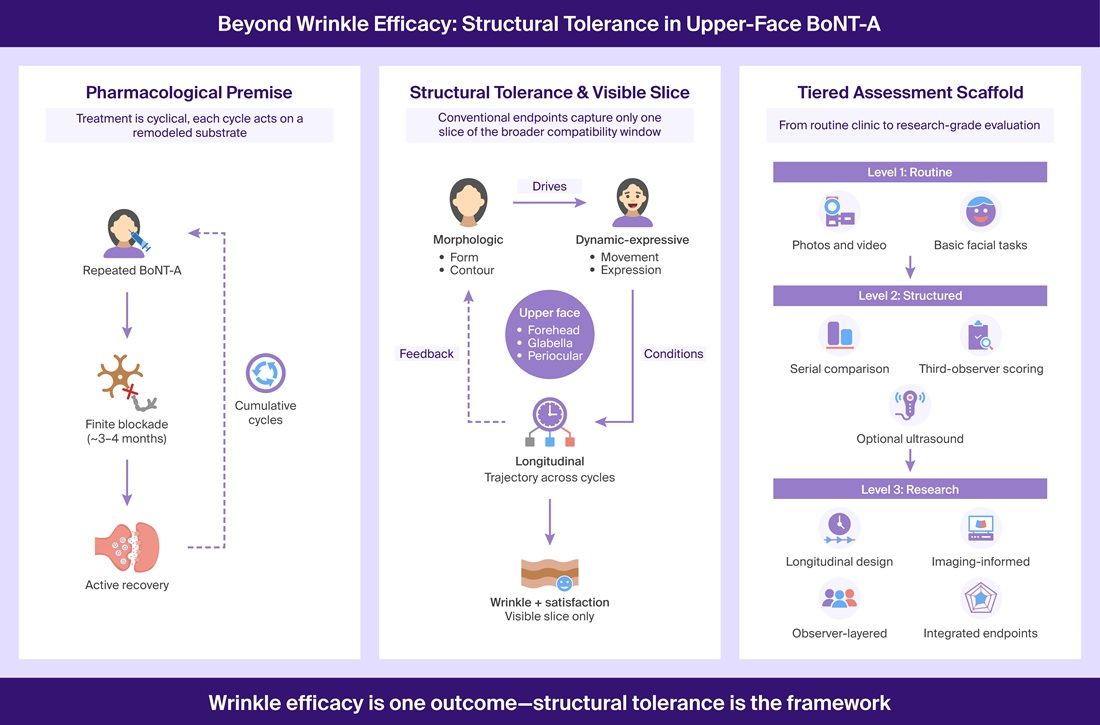
| Input → Morphologic tolerance Repeated BoNT-A exposure (dose, interval, cumulative) | Presynaptic chemodenervation followed by active synaptic and architectural recovery; over repeated cycles, fiber-type-selective atrophy and altered muscle architecture in the treated compartment. | Defines the regional substrate on which the next treatment cycle acts; not captured by wrinkle scales. |
| Morphologic→ Dynamic–expressive tolerance | Altered muscle architecture and reduced contractile reserve condition the available range of movement and the modulation of the upper face across tasks. | Explains how preserved wrinkle reduction can coexist with a narrowed expressive range and reduced task modulation. |
| Dynamic–expressive→ Longitudinal tolerance | Cumulative narrowing of expressive range and progressive loss of task-dependent variation across treatment cycles. | Generates a trajectory rather than a snapshot effect; visible only with serial comparison. |
| Longitudinal→Morphologic tolerance feedback | Cumulative exposure feeds back into regional form through reduced mechanical conditioning of the muscle–dermis interface and possible paracrine/secretome influence on adjacent soft tissue. | Closes the loop and provides a candidate biological route for progressive structural drift across cycles. |
| Dynamic–expressive tolerance→Visible outcome Wrinkle benefit + patient satisfaction | Standard wrinkle severity scales and patient-reported satisfaction measures preferentially capture the dynamic–expressive component of the treated cycle. | Captures only one slice of the cycle; may under-represent the longitudinal feedback loop and the cumulative regional cost. |
| Domain | Focus | Candidate Warning Signs | What Wrinkle-Only Follow-Up May Miss |
|---|---|---|---|
| Morphologic tolerance | Regional form, contour harmony, and brow–periocular coherence across cycles | Periocular hollowing tendency; excessive brow flattening (relative to baseline); upper-face over-deflation; skeletonization cues | Progressive change in volume impression or brow–periocular balance despite maintained wrinkle reduction |
| Dynamic–expressive tolerance | Usable movement, task modulation, and expressive compatibility | Reduced expressive range; excessive brow immobility (relative to baseline); loss of task modulation; reduced periocular smile participation; overtreated appearance | Loss of functional movement or social readability despite satisfactory static outcome |
| Longitudinal tolerance | Stability of the wrinkle–naturalness–expressivity balance across repeated cycles | Benefit–naturalness decoupling; preserved satisfaction but declining expressive quality; narrowing treatment window; increasing need for caution; increasing reliance on protocol adjustment | A compatibility drift visible only with serial comparison, even when wrinkle benefit remains satisfactory |
| Level/Setting | Core Elements | What It Supports | What It Cannot Support |
|---|---|---|---|
| Level 1/Routine injector | Standardized photographs and/or short videos in repose and during basic tasks; attention to brow balance, naturalness, dynamic range, and visible warning signs | Early detection of reduced tolerance and a basic judgment of whether wrinkle benefit remains compatible with an acceptable clinical result | Causality, tissue-level mechanisms, precise morphologic change, or formal boundary definition |
| Level 2/Structured clinician or training center | Serial cycle comparison; structured scoring; third-observer input when feasible; patient-reported naturalness or expressive comfort; optional pragmatic ultrasound | Stronger longitudinal judgment and better detection of emerging dynamic–expressive change | Definitive biologic mechanism, full generalizability, or research-grade quantification of structural change |
| Level 3/Research setting | Repeated-cycle longitudinal design; better-defined exposure patterns; integrated wrinkle, expressive, and morphologic endpoints; observer-layered outcomes; imaging-informed assessment | Empirical study of the compatibility boundary and of how benefit aligns or diverges from expressive and morphologic preservation across time | Universal thresholds or immediate transferability to every routine esthetic setting |
| Question | Considered Response |
|---|---|
| Does repeated BoNT-A injection cause muscle atrophy? | Evidence from imaging and histological studies suggests atrophy in multiple injection contexts, including a facial muscle (procerus) after a single dose [5,7,8,9]. Whether this occurs consistently in routine upper-face esthetic practice at standard doses and intervals, and whether it reaches clinical relevance, remains incompletely characterized. The evidence is sufficient to establish biological plausibility; it is not sufficient to establish clinical equivalence across all settings. |
| Can we assume that repeated upper-face chemodenervation is biologically neutral over time? | No. The available evidence does not support this assumption [5,6,7,8,9]. Imaging, neurophysiological, and histological studies document treatment-related muscle changes in multiple contexts. The magnitude and clinical relevance of these changes in routine adult esthetic practice are not fully established, but their existence is sufficient to argue against assuming complete biological neutrality across repeated cycles. |
| If wrinkle improvement is maintained across many treatment cycles, does that mean treatment is compatible? | Not necessarily. Wrinkle improvement and broader treatment compatibility are related but distinct [1,2,5,6]. Benefit can be maintained on a progressively adapted substrate without reflecting preserved regional form, expressive range, or longitudinal naturalness. Current wrinkle outcome measures are not designed to distinguish between these possibilities. |
| Can patient satisfaction be used as a proxy for long-term treatment compatibility? | Partly, but incompletely [10,11,14,23]. Satisfaction captures important dimensions of outcome but may not detect gradual narrowing of expressive range, subtle morphologic drift, or compatibility changes that are more visible to third-party observers or through serial comparison than to the patient. Observer-layered and dynamic–expressive assessments capture dimensions that satisfaction measures alone cannot. It should be noted that the link between patient satisfaction and failure to detect morphologic drift is inferential rather than directly demonstrated: no study has yet shown that satisfied patients systematically miss clinically relevant compatibility changes. The argument rests on the known limits of satisfaction as an outcome measure and on the construct-level gap between subjective acceptability and broader regional compatibility. |
| Can repeated upper-face BoNT-A reduce facial expressivity in ways not captured by standard assessment? | Yes, within the limits of available evidence [10,11,12,14,15]. Studies using observer-based rating, deep learning analysis, and structured emotional attribution tasks have documented that upper-face BoNT-A treatment affects how facial expressions are perceived and attributed by third parties, independently of patient satisfaction or wrinkle outcome. Standard wrinkle scales and satisfaction measures are not designed to detect these changes. |
| Should clinicians change their practice based on the concerns raised in this paper? | Not their injection practice, but yes their assessment practice. The framework proposed here does not call for dose reduction, interval extension, or treatment limitation. It does argue that serial documentation of regional form and facial dynamics—alongside wrinkle outcome—should become a routine part of long-term follow-up. This is a low-barrier step: standardized photography and short videos during basic facial tasks are already available in most clinical settings. The argument for doing so does not depend on formal construct validation; it depends only on the recognition that wrinkle response alone is an incomplete basis for judging repeated treatment over time. |
| Is “structural tolerance” a validated clinical construct? | No. The term is introduced here as a provisional clinical lens, not a validated endpoint [5,10,14]. It names a gap in current assessment frameworks and organizes candidate components for future empirical study. Validation would require longitudinal designs with integrated outcome measures, observer-layered assessment, and defined boundary conditions—none of which are yet available. The construct is offered as a problem formulation, not a clinical standard. |
Disclaimer/Publisher’s Note: The statements, opinions and data contained in all publications are solely those of the individual author(s) and contributor(s) and not of MDPI and/or the editor(s). MDPI and/or the editor(s) disclaim responsibility for any injury to people or property resulting from any ideas, methods, instructions or products referred to in the content. |
© 2026 by the author. Licensee MDPI, Basel, Switzerland. This article is an open access article distributed under the terms and conditions of the Creative Commons Attribution (CC BY) license.
Share and Cite
Armenti, A.F. Beyond Wrinkle Efficacy: Toward a Broader Assessment of Longitudinal Compatibility in Routine Upper-Face Aesthetic BoNT-A. Toxins 2026, 18, 232. https://doi.org/10.3390/toxins18050232
Armenti AF. Beyond Wrinkle Efficacy: Toward a Broader Assessment of Longitudinal Compatibility in Routine Upper-Face Aesthetic BoNT-A. Toxins. 2026; 18(5):232. https://doi.org/10.3390/toxins18050232
Chicago/Turabian StyleArmenti, Andrea Felice. 2026. "Beyond Wrinkle Efficacy: Toward a Broader Assessment of Longitudinal Compatibility in Routine Upper-Face Aesthetic BoNT-A" Toxins 18, no. 5: 232. https://doi.org/10.3390/toxins18050232
APA StyleArmenti, A. F. (2026). Beyond Wrinkle Efficacy: Toward a Broader Assessment of Longitudinal Compatibility in Routine Upper-Face Aesthetic BoNT-A. Toxins, 18(5), 232. https://doi.org/10.3390/toxins18050232