Review

An Update on Mycotoxins in Bee Pollen


1
Technological and Innovation Center Virovitica, Trg Ljudevita Patačića 1, 33000 Virovitica, Croatia
2
Faculty of Food Technology Osijek, Josip Juraj Strossmayer University of Osijek, Franje Kuhača 18, 31000 Osijek, Croatia
3
Department of Agrobiotechnology (IFA-Tulln), Institute of Bioanalytics and Agro-Metabolomics, University of Natural Resources and Life Sciences Vienna, Konrad Lorenzstr. 20, A-3430 Tulln, Austria
4
Institute for Global Food Security, School of Biological Sciences, Queen’s University Belfast, University Road, Belfast BT7 1NN, UK
*
Author to whom correspondence should be addressed.
Toxins 2026, 18(5), 207; https://doi.org/10.3390/toxins18050207

Submission received: 13 March 2026 / Revised: 23 April 2026 / Accepted: 27 April 2026 / Published: 29 April 2026
(This article belongs to the Special Issue Cereals Defense: A Global Perspective on Combating Mycotoxins)

Abstract

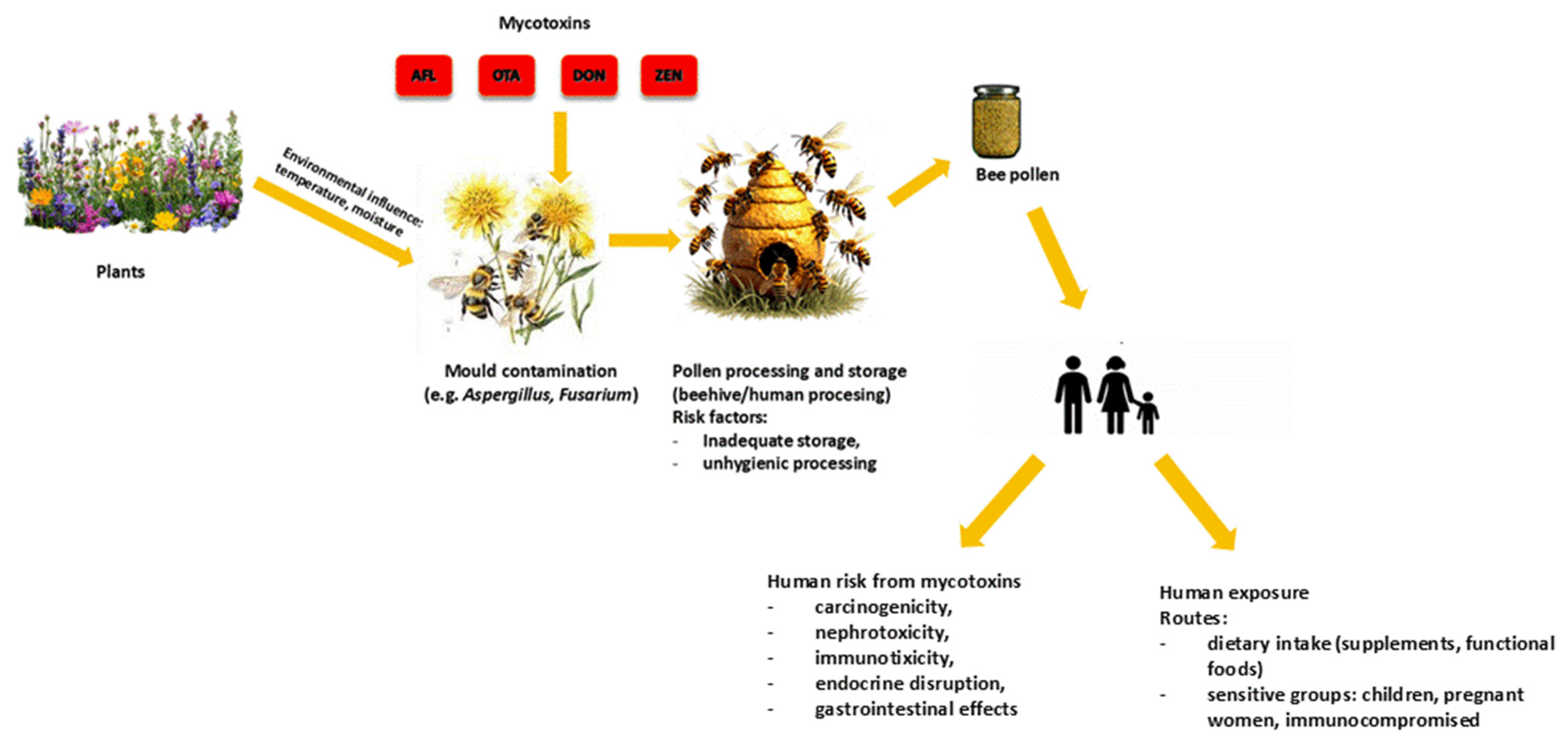
For centuries, bee pollen has been known for its medicinal value and regarded as a rich source of bioactive compounds, including essential nutrients and phytochemicals. Its putative therapeutic and health-promoting benefits include antioxidant, antibacterial, anticarcinogenic, anti-inflammatory, hypoglycaemic, and numerous additional properties. However, the beneficial qualities can only be guaranteed if potential contaminants do not detract from its superfood image. Recent research has indicated frequent occurrence of mycotoxins in bee pollen, occasionally at concentration levels exceeding safe intakes. There are very few published publications in the literature related to the research of mycotoxin concentrations in bee pollen. Based on that, the aim of this review is to provide an overview update of existing scientific research on the presence, prevalence and types of mycotoxins in bee pollen, with particular emphasis on toxins produced by fungi. Furthermore, the aim is to compile the available data on mycotoxin contamination of pollen in order to identify factors relevant to the safety and quality of bee pollen as a food product and dietary supplement.
Keywords: mycotoxins; bees; bee pollen; health risk; food safety mycotoxins; bees; bee pollen; health risk; food safety