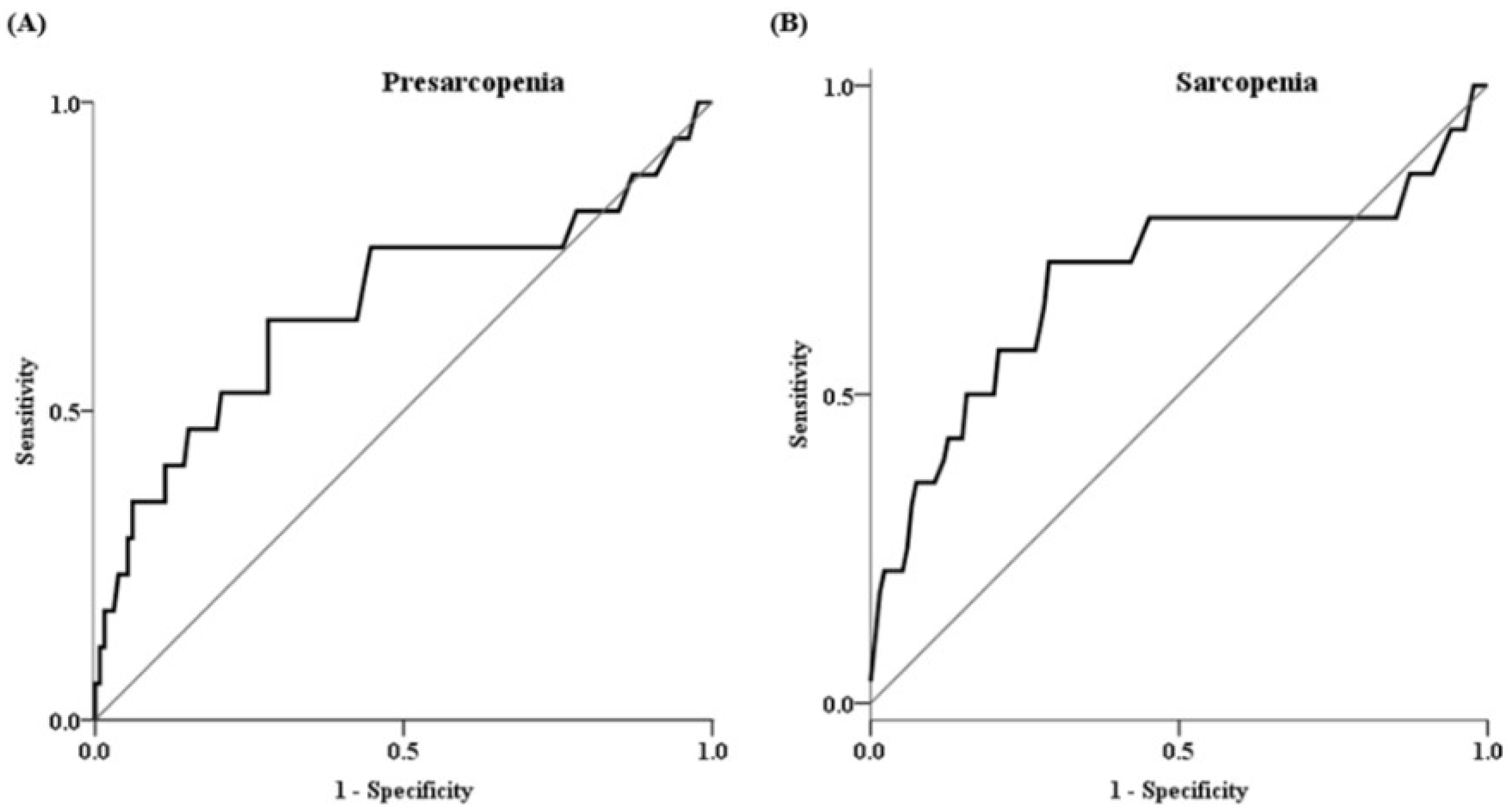
Indoxyl Sulfate Might Play a Role in Sarcopenia, While Myostatin Is an Indicator of Muscle Mass in Patients with Chronic Kidney Disease: Analysis from the RECOVERY Study

 , ,
, , 
Abstract
Share and Cite
Lee, S.M.; Han, M.Y.; Kim, S.H.; Cha, R.H.; Kang, S.H.; Kim, J.C.; An, W.S. Indoxyl Sulfate Might Play a Role in Sarcopenia, While Myostatin Is an Indicator of Muscle Mass in Patients with Chronic Kidney Disease: Analysis from the RECOVERY Study. Toxins 2022, 14, 660. https://doi.org/10.3390/toxins14100660
Lee SM, Han MY, Kim SH, Cha RH, Kang SH, Kim JC, An WS. Indoxyl Sulfate Might Play a Role in Sarcopenia, While Myostatin Is an Indicator of Muscle Mass in Patients with Chronic Kidney Disease: Analysis from the RECOVERY Study. Toxins. 2022; 14(10):660. https://doi.org/10.3390/toxins14100660
Chicago/Turabian StyleLee, Su Mi, Mi Yeun Han, Su Hyun Kim, Ran Hui Cha, Seock Hui Kang, Jun Chul Kim, and Won Suk An. 2022. "Indoxyl Sulfate Might Play a Role in Sarcopenia, While Myostatin Is an Indicator of Muscle Mass in Patients with Chronic Kidney Disease: Analysis from the RECOVERY Study" Toxins 14, no. 10: 660. https://doi.org/10.3390/toxins14100660
APA StyleLee, S. M., Han, M. Y., Kim, S. H., Cha, R. H., Kang, S. H., Kim, J. C., & An, W. S. (2022). Indoxyl Sulfate Might Play a Role in Sarcopenia, While Myostatin Is an Indicator of Muscle Mass in Patients with Chronic Kidney Disease: Analysis from the RECOVERY Study. Toxins, 14(10), 660. https://doi.org/10.3390/toxins14100660