Review

Impact of Bacterial Toxins in the Lungs


1
Pharmacology and Toxicology, Medical College of Georgia at Augusta University, Augusta, GA 30912, USA
2
Vascular Biology Center, Medical College of Georgia at Augusta University, Augusta, GA 30912, USA
3
Department of Medicine and Division of Pulmonary Critical Care Medicine, Medical College of Georgia at Augusta University, Augusta, GA 30912, USA
4
Lungen-und Atmungsstiftung, Bern, 3012 Bern, Switzerland
5
Pneumology, Clinic for General Internal Medicine, Lindenhofspital Bern, 3012 Bern, Switzerland
6
Labormedizinisches Zentrum Dr. Risch, Waldeggstr. 37 CH-3097 Liebefeld, Switzerland
7
Department of Medicine, Faculty of Medicine, Université de Montréal, Montréal, QC H3T 1J4, Canada
8
Pediatric Surgery, University Children’s Hospital, Zürich, Steinwiesstrasse 75, CH-8032 Zürch, Switzerland
9
Insitut für klinische Pharmakologie, Charité, Universitätsklinikum Berlin, Reichsstrasse 2, D-14052 Berlin, Germany
10
Department of Cardiothoracic Surgery, Voelklingen Heart Center, 66333 Voelklingen/Saar, Germany
11
Justus-Liebig-University, Biomedical Research Centre Seltersberg, Schubertstr. 81, 35392 Giessen, Germany
12
Medical Clinic V-Pneumology, Allergology, Intensive Care Medicine and Environmental Medicine, Faculty of Medicine, Saarland University, University Medical Centre of the Saarland, D-66421 Homburg, Germany
13
Institute for Clinical & Experimental Surgery, Faculty of Medicine, Saarland University, D-66421 Homburg, Germany
*
Authors to whom correspondence should be addressed.
These authors equally contributed to the manuscript.
Toxins 2020, 12(4), 223; https://doi.org/10.3390/toxins12040223

Submission received: 27 February 2020 / Revised: 30 March 2020 / Accepted: 31 March 2020 / Published: 2 April 2020
(This article belongs to the Special Issue Toxins and Lung Infection)

Abstract

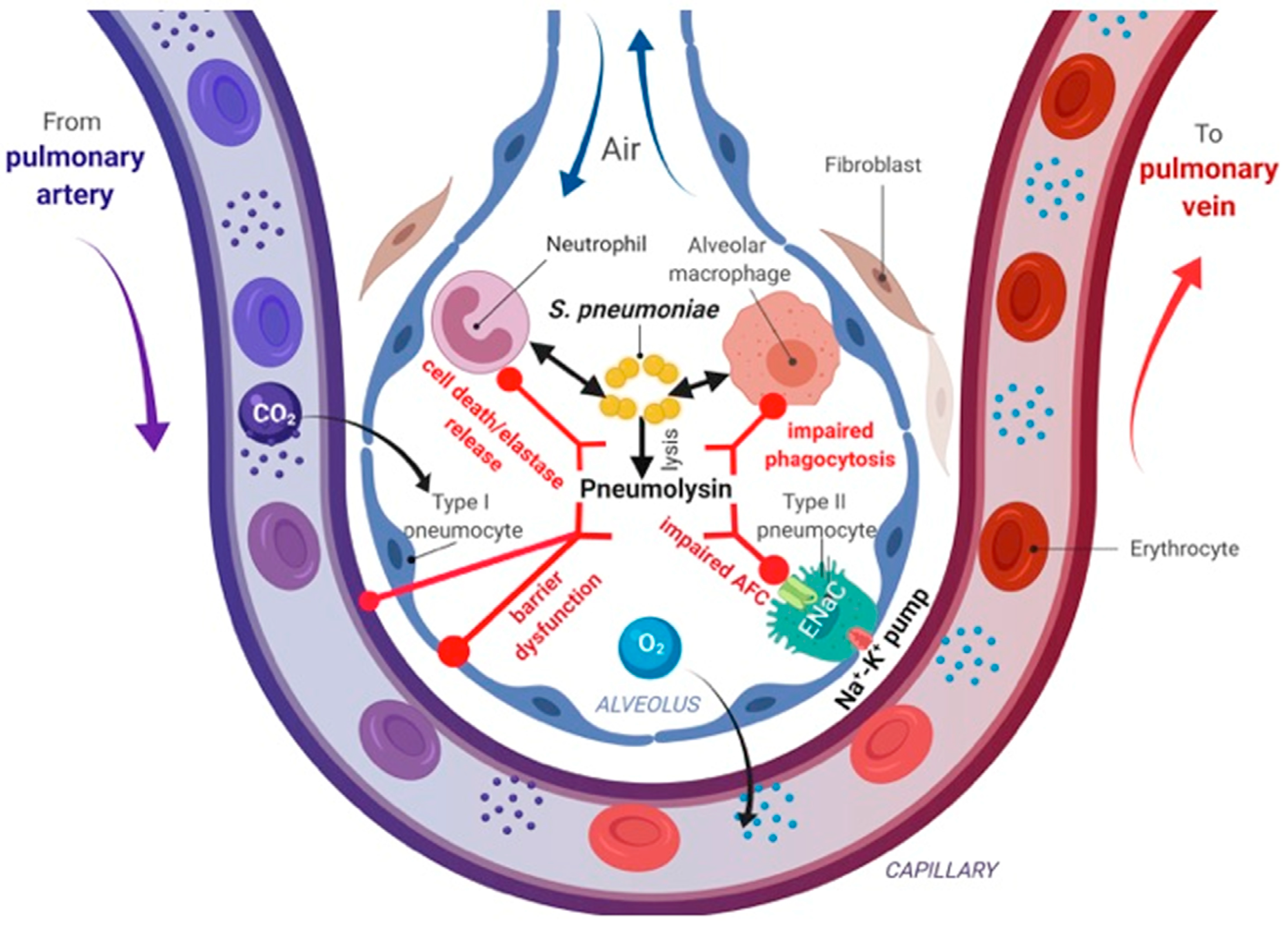
Bacterial toxins play a key role in the pathogenesis of lung disease. Based on their structural and functional properties, they employ various strategies to modulate lung barrier function and to impair host defense in order to promote infection. Although in general, these toxins target common cellular signaling pathways and host compartments, toxin- and cell-specific effects have also been reported. Toxins can affect resident pulmonary cells involved in alveolar fluid clearance (AFC) and barrier function through impairing vectorial Na+ transport and through cytoskeletal collapse, as such, destroying cell-cell adhesions. The resulting loss of alveolar-capillary barrier integrity and fluid clearance capacity will induce capillary leak and foster edema formation, which will in turn impair gas exchange and endanger the survival of the host. Toxins modulate or neutralize protective host cell mechanisms of both the innate and adaptive immunity response during chronic infection. In particular, toxins can either recruit or kill central players of the lung’s innate immune responses to pathogenic attacks, i.e., alveolar macrophages (AMs) and neutrophils. Pulmonary disorders resulting from these toxin actions include, e.g., acute lung injury (ALI), the acute respiratory syndrome (ARDS), and severe pneumonia. When acute infection converts to persistence, i.e., colonization and chronic infection, lung diseases, such as bronchitis, chronic obstructive pulmonary disease (COPD), and cystic fibrosis (CF) can arise. The aim of this review is to discuss the impact of bacterial toxins in the lungs and the resulting outcomes for pathogenesis, their roles in promoting bacterial dissemination, and bacterial survival in disease progression.
Keywords: bacterial toxins; alveolar-capillary barrier; host defense; alveolar liquid clearance; inflammation; pulmonary edema bacterial toxins; alveolar-capillary barrier; host defense; alveolar liquid clearance; inflammation; pulmonary edema