

Vitamin K2 Therapy for Postmenopausal Osteoporosis

Abstract
:1. Introduction
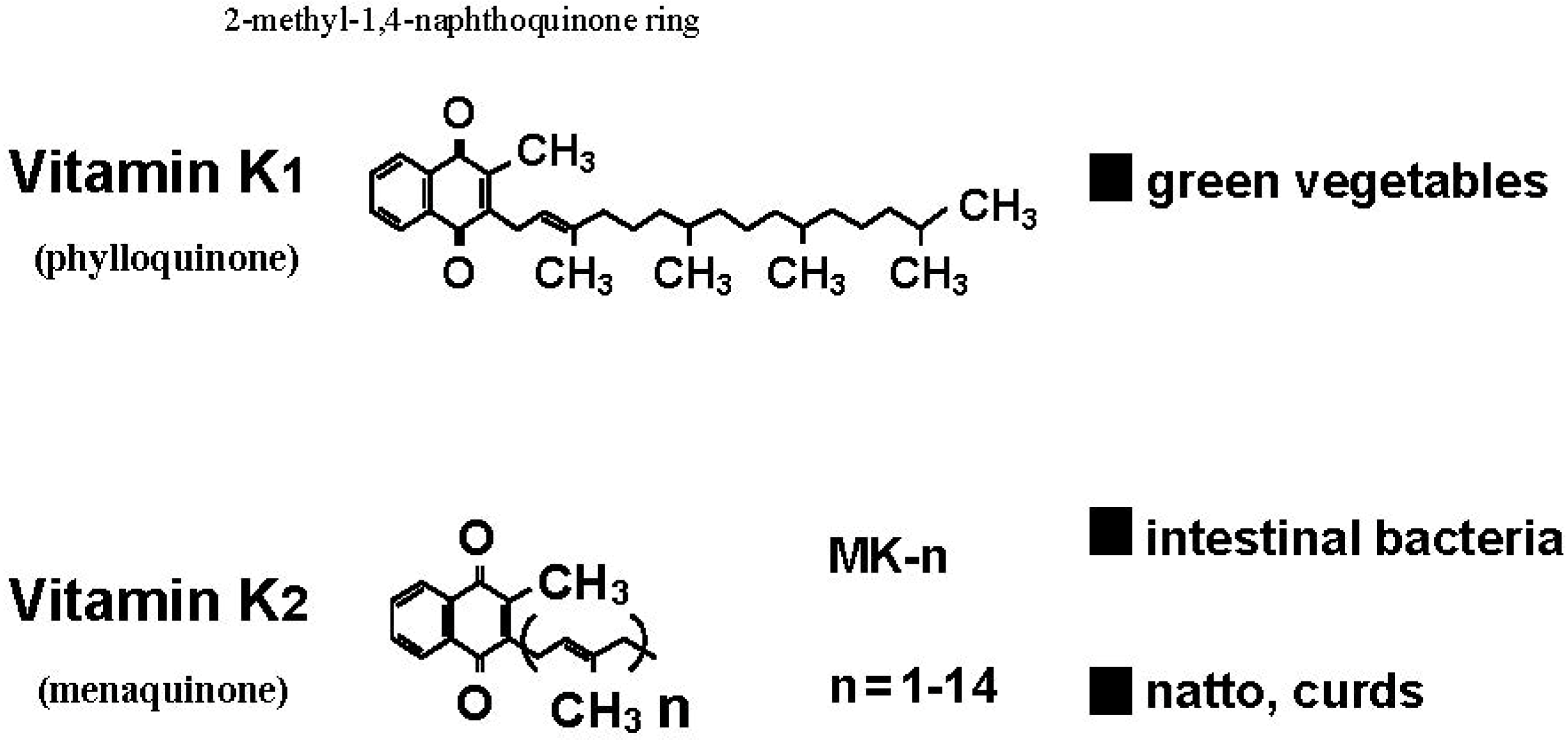
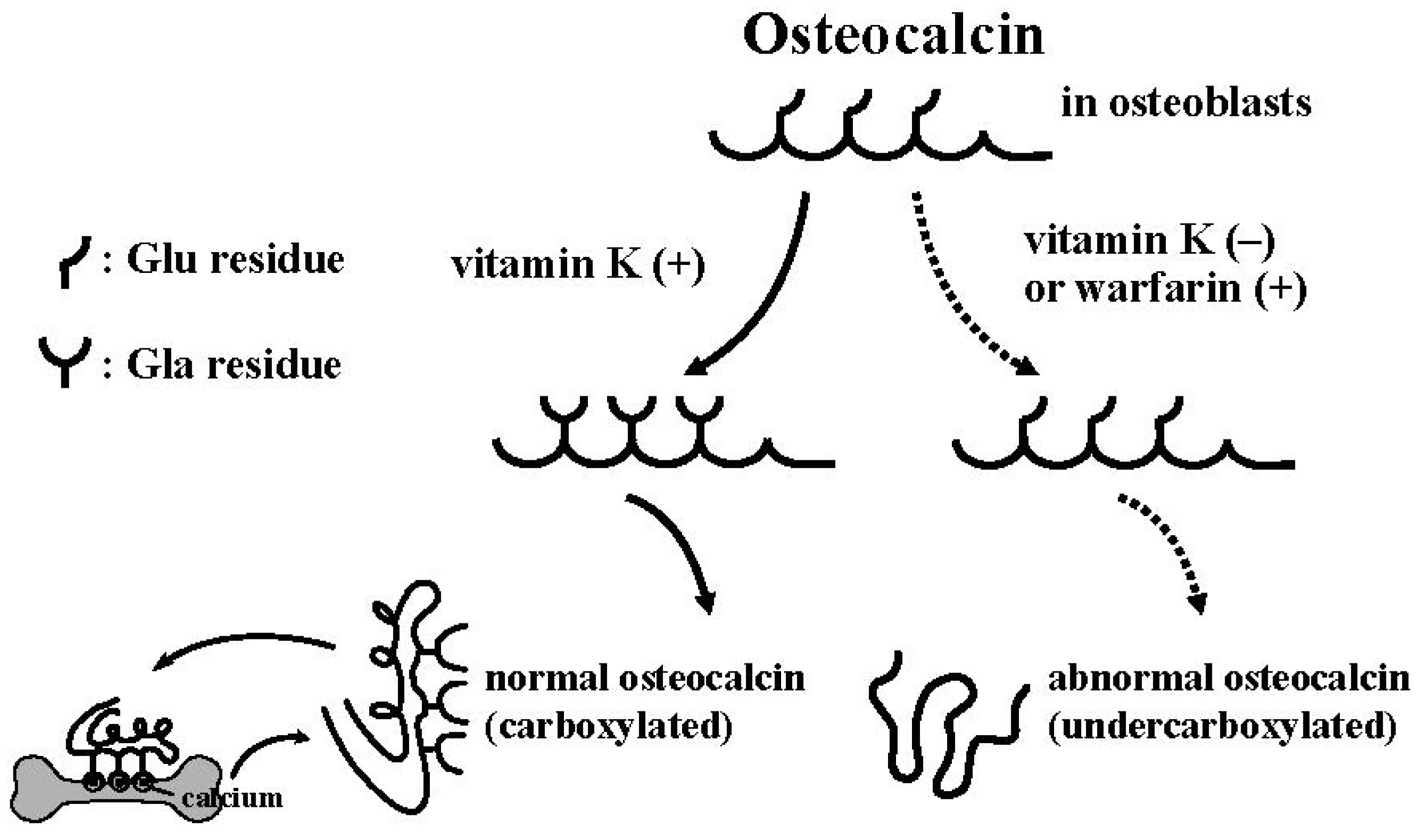
2. Approaches to Determining the Effect of Menatetrenone on Bone Health
3. Menatetrenone Monotherapy
4. Combined Menatetrenone and Alendronate Therapy
5. Discussion

| Authors | Reference (year) | Groups (number of subjects) | Study design | Outcome of menatetrenone | |
|---|---|---|---|---|---|
| BMD | Shiraki et al. | [10] (2000) | Menatetrenone (120), non-treatment (121) | Open-label RCT in Japan (45 mg, 2 years) | Lumbar spine BMD loss mitigated Menatetrenone: −0.5%, non-treatment: −3.3% |
| Iwamoto et al. | [14] (2000) | Menatetrenone (22), alfacalcidol (29), combination (21), calcium (22) | Open-label RCT in Japan (45 mg, 2 years) | Lumbar spine BMD maintained Menatetrenone: +0.9%, calcium: −0.79% | |
| Iwamoto et al. | [11] (2001) | Menatetrenone (23), etidronate (25), calcium (24) | Open-label RCT in Japan (45 mg, 2 years) | Ultra distal radius BMD maintained Menatetrenone: −0.1%, calcium: −1.7% | |
| Ushiroyama et al. * | [15] (2002) | Menatetrenone (43), alfacalcidol (43), combination (43), non-treatment (43) (Subjects: Postmenopausal women with osteopenia or osteoporosis) | Open-label RCT in Japan (45 mg, 2 years) | Lumbar spine BMD increased Menatetrenone: +1.37%, non-treatment: −4.05% | |
| Ishida & Kawai | [13] (2004) | Menatetrenone (66), estradiol (66), etidronate (66), eel calcitonin (66) alfacalcidol (66), non-treatment (66) | Open-label RCT in Japan (45 mg, 2 years) | Distal radius BMD loss mitigated Menatetrenone: −1.9%, non-treatment: −3.3% | |
| Purwosunu et al. | [16] (2006) | Menatetrenone (33), placebo (30) | Double-blind RCT in Indonesia (45 mg, 1 year) | Lumbar spine BMD increased Menatetrenone: +1.74%, placebo: −0.18% | |
| Jiang et al. | [17] (2014) | Menatetrenone (118), alfacalcidol (118) | Double-blind RCT in China (45 mg, 1 year) | Lumbar spine BMD increased Menatetrenone: 1.2%, alfacalcidol: 2.2% | |
| Fracture | Shiraki et al. | [10] (2000) | Menatetrenone (120), non-treatment (121) | Open-label RCT in Japan (45 mg, 2 years) | Clinical fracture (mainly vertebral fracture) incidence decreased Menatetrenone: 10.9%, non-treatment: 30.3% |
| Iwamoto et al. | [11] (2001) | Menatetrenone (23), etidronate (25), calcium (24) | Open-label RCT in Japan (45 mg, 2 years) | Vertebral fracture incidence decreased Menatetrenone: 8.7%, calcium: 25% | |
| Ishida & Kawai | [12] (2004) | Menatetrenone (66), estradiol (66), etidronate (66), eel calcitonin (66), alfacalcidol (66), non-treatment (66) | Open-label RCT in Japan (45 mg, 2 years) | Vertebral fracture incidence decreased Menatetrenone: 14%, non-treatment: 26% | |
| Inoue et al. | [13] (2009) | Menatetrenone (2193), non-treatment (2185) | Open-label RCT in Japan (45 mg, 3 years) (Osteoporotic Fracture study) | No significant effect on vertebral fracture incidence Menatetrenone: 5.87/100 patient-years Non-treatment: 5.74/100 patient-years |
6. Conclusions
Conflicts of Interest
References
- Hauschka, P.V.; Lian, J.B.; Cole, D.E.; Gundberg, C.M. Osteocalcin and matrix Gla protein: Vitamin K-dependent proteins in bone. Physiol. Rev. 1989, 69, 990–1047. [Google Scholar]
- Koshihara, Y.; Hoshi, K. Vitamin K2 enhances osteocalcin accumulation in the extracellular matrix of human osteoblasts in vitro. J. Bone Miner. Res. 1997, 12, 431–438. [Google Scholar] [CrossRef]
- Shearer, M.J. Vitamin K. Lancet 1995, 345, 229–234. [Google Scholar] [CrossRef]
- Vermeer, C.; Jie, K.S.; Knapen, M.H. Role of vitamin K in bone metabolism. Annu. Rev. Nutr. 1995, 15, 1–22. [Google Scholar] [CrossRef]
- Tsugawa, N.; Shiraki, M.; Kamao, M.; Kamao, M.; Ozaki, R.; Tanaka, K.; Okano, T. Usefulness of serum undercarboxylated osteocalcin measurement as a predictor for clinical fractures. Osteoporos. Jpn. 2010, 18, 254–256. (in Japanese). [Google Scholar]
- Shiraki, M.; Yamazaki, Y.; Shiraki, Y.; Hosoi, T.; Tsugawa, N.; Okano, T. High level of serum undercarboxylated osteocalcin in patients with incident fractures during bisphosphonate treatment. J. Bone Miner. Metab. 2010, 28, 578–584. [Google Scholar] [CrossRef]
- Orimo, H.; Fujita, T.; Onomura, T.; Inoue, T.; Kushida, K.; Shiraki, M. Clinical evaluation of soft capsule menatetrenone (Ea-0167) in the treatment of osteoporosis. Late Phase II Dose Study. J. New Rem. Clin. 1992, 41, 1249–1279. (in Japanese). [Google Scholar]
- Orimo, H.; Nakamura, T.; Hosoi, T.; Iki, M.; Uenishi, K.; Endo, N.; Ohta, H.; Shiraki, M.; Sugimoto, T.; Suzuki, T.; et al. Japanese 2011 guidelines for prevention and treatment of osteoporosis-executive summary. Arch. Osteoporos. 2012, 7, 3–20. [Google Scholar]
- Iwamoto, J.; Sato, Y.; Takeda, T.; Matsumoto, H. High-dose vitamin K supplementation reduces fracture incidence in postmenopausal women: A review of the literature. Nutr. Res. 2009, 29, 221–228. [Google Scholar] [CrossRef]
- Shiraki, M.; Shiraki, Y.; Aoki, C.; Miura, M. Vitamin K2 (menatetrenone) effectively prevents fractures and sustains lumbar bone mineral density in osteoporosis. J. Bone Miner. Res. 2000, 15, 515–521. [Google Scholar] [CrossRef]
- Iwamoto, J.; Takeda, T.; Ichimura, S. Effect of menatetrenone on bone mineral density and incidence of vertebral fractures in postmenopausal women with osteoporosis: A comparison with the effect of etidronate. J. Orthop. Sci. 2001, 6, 487–492. [Google Scholar] [CrossRef]
- Ishida, Y.; Kawai, S. Comparative efficacy of hormone replacement therapy, etidronate, calcitonin, alfacalcidol, and vitamin K in postmenopausal women with osteoporosis: The Yamaguchi Osteoporosis Prevention Study. Am. J. Med. 2004, 117, 549–555. [Google Scholar] [CrossRef]
- Inoue, T.; Fujita, T.; Kishimoto, H.; Makino, T.; Nakamura, T.; Nakamura, T.; Sato, T.; Yamazaki, K. Randomized controlled study on the prevention of osteoporotic fractures (OF Study): A phase IV clinical study of 15-mg menatetrenone capsules. J. Bone Miner. Metab. 2009, 27, 66–75. [Google Scholar] [CrossRef]
- Iwamoto, J.; Takeda, T.; Ichimura, S. Effect of combined administration of vitamin D3 and vitamin K2 on bone mineral density of the lumbar spine in postmenopausal women with osteoporosis. J. Orthop. Sci. 2000, 5, 546–551. [Google Scholar]
- Ushiroyama, T.; Ikeda, A.; Ueki, M. Effect of continuous combined therapy with vitamin K2 and vitamin D3 on bone mineral density and coagulofibrinolysis function in postmenopausal women. Maturitas 2002, 41, 211–221. [Google Scholar] [CrossRef]
- Purwosunu, Y.; Muharram; Rachman, I.A.; Reksoprodjo, S.; Sekizawa, A. Vitamin K2 treatment for postmenopausal osteoporosis in Indonesia. J. Obstet. Gynaecol. Res. 2006, 32, 230–234. [Google Scholar] [CrossRef]
- Jiang, Y.; Zhang, Z.L.; Zhang, Z.L.; Zhu, H.M.; Wu, Y.Y.; Cheng, Q.; Wu, F.L.; Xing, X.P.; Liu, J.L.; Yu, W.; et al. Menatetrenone versus alfacalcidol in the treatment of Chinese postmenopausal women with osteoporosis: A multicenter, randomized, double-blinded, double-dummy, positive drug-controlled clinical trial. Clin. Interv. Aging 2014, 9, 121–127. [Google Scholar]
- Shiraki, M.; Itabashi, A. Short-term menatetrenone therapy increases gamma-carboxylation of osteocalcin with a moderate increase of bone turnover in postmenopausal osteoporosis: A randomized prospective study. J. Bone Miner. Metab. 2009, 27, 333–340. [Google Scholar] [CrossRef]
- Hirao, M.; Hashimoto, J.; Ando, W.; Ono, T.; Yoshikawa, H. Response of serum carboxylated and undercarboxylated osteocalcin to alendronate monotherapy and combined therapy with vitamin K2 in postmenopausal women. J. Bone Miner. Metab. 2008, 26, 260–264. [Google Scholar] [CrossRef]
- Ducy, P.; Desbois, C.; Boyce, B.; Pinero, G.; Story, B.; Dunstan, C.; Smith, E.; Bonadio, J.; Goldstein, S.; Gundberg, C.; et al. Increased bone formation in osteocalcin-deficient mice. Nature 1996, 382, 448–452. [Google Scholar] [CrossRef]
- Knapen, M.H.; Schurgers, L.J.; Vermeer, C. Vitamin K2 supplementation improves hip bone geometry and bone strength indices in postmenopausal women. Osteoporos. Int. 2007, 18, 963–972. [Google Scholar] [CrossRef]
- Nakagawa, K.; Hirota, Y.; Sawada, N.; Yuge, N.; Watanabe, M.; Uchino, Y.; Okuda, N.; Shimomura, Y.; Suhara, Y.; Okano, T. Identification of UBIAD1 as a novel human menaquinone-4 biosynthetic enzyme. Nature 2010, 468, 117–121. [Google Scholar] [CrossRef]
- Cheung, A.M.; Tile, L.; Lee, Y.; Tomlinson, G.; Hawker, G.; Scher, J.; Hu, H.; Vieth, R.; Thompson, L.; Jamal, S.; et al. Vitamin K supplementation in postmenopausal women with osteopenia (ECKO trial): A randomized controlled trial. PLoS Med. 2008, 5, e196. [Google Scholar] [CrossRef]
- Assessment of fracture risk and its application to screening for postmenopausal osteoporosis. Report of a WHO Study Group. World Health Organ. Tech. Rep. Ser. 1994, 843, 1–129.
© 2014 by the authors; licensee MDPI, Basel, Switzerland. This article is an open access article distributed under the terms and conditions of the Creative Commons Attribution license (http://creativecommons.org/licenses/by/3.0/).
Share and Cite
Iwamoto, J. Vitamin K2 Therapy for Postmenopausal Osteoporosis. Nutrients 2014, 6, 1971-1980. https://doi.org/10.3390/nu6051971
Iwamoto J. Vitamin K2 Therapy for Postmenopausal Osteoporosis. Nutrients. 2014; 6(5):1971-1980. https://doi.org/10.3390/nu6051971
Chicago/Turabian StyleIwamoto, Jun. 2014. "Vitamin K2 Therapy for Postmenopausal Osteoporosis" Nutrients 6, no. 5: 1971-1980. https://doi.org/10.3390/nu6051971
APA StyleIwamoto, J. (2014). Vitamin K2 Therapy for Postmenopausal Osteoporosis. Nutrients, 6(5), 1971-1980. https://doi.org/10.3390/nu6051971

